

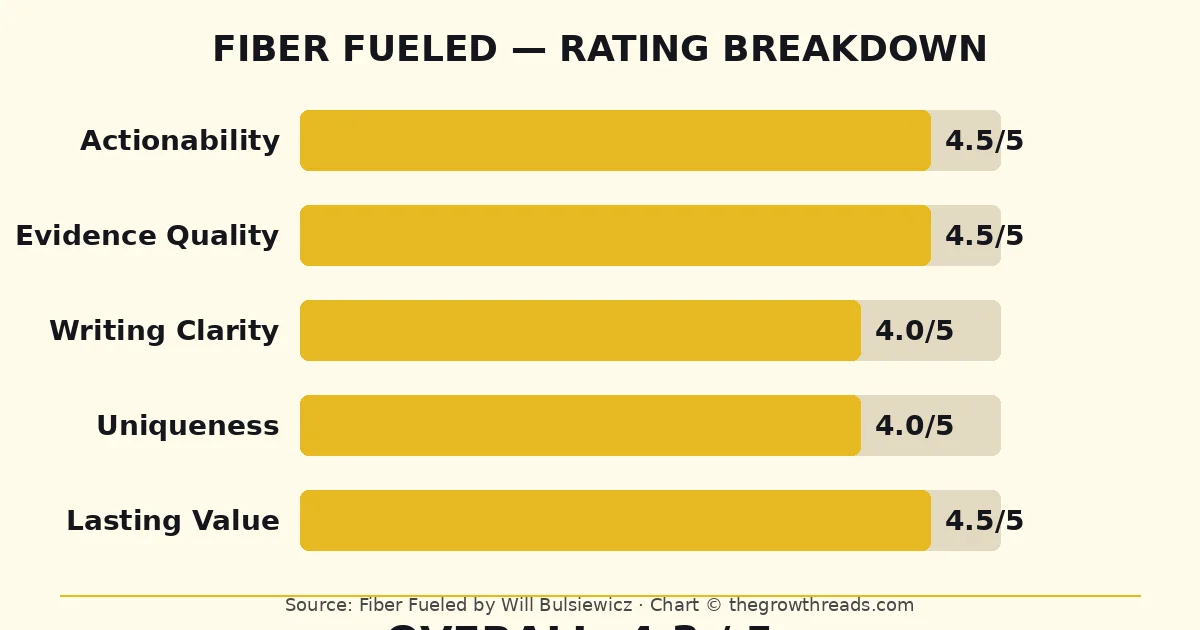
⭐⭐⭐⭐✬ 4.3 / 5
A science-backed deep dive into gut health that makes a compelling case for plant diversity as the foundation of overall wellness.
Best for: Anyone curious about gut health, digestion, or the science behind why plant-rich diets improve virtually every health marker.
Reading time: ~7 hours (416 pages)
Difficulty to apply: Low to moderate — the core advice is simple (eat more plants), but the 4-week swift protocol requires commitment.
Fiber Fueled in one minute
Your gut microbiome is the most powerful organ system you have never been taught about — and fiber is its fuel. Dr. Will Bulsiewicz, a board-certified gastroenterologist, argues that the trillions of bacteria living in your gut are not passive passengers but active participants in your immune function, metabolism, mental health, and disease resistance. The single most important thing you can do for your health is not a supplement, a cleanse, or a restrictive elimination diet — it is eating a wider variety of plants. The book draws on over 400 scientific references to explain why fiber diversity matters more than any single superfood, introduces the F-GOALS framework for building a plant-diverse diet, and provides a 4-week protocol for repairing damaged gut health. Bulsiewicz challenges the popular trend of restrictive diets — low-carb, keto, carnivore — by showing that cutting out plant groups starves the very bacteria that protect you from chronic disease.
Key takeaways
- Gut bacteria run the show: Your microbiome influences digestion, immunity, weight, mood, and disease risk. Feeding it well is the highest-leverage health investment you can make.
- Diversity over restriction: The single best predictor of a healthy microbiome is plant diversity — the number of different plants you eat per week, not the volume of any single one.
- 30 plants per week is the target: Research from the American Gut Project found that people eating 30+ unique plants weekly had significantly more diverse and resilient microbiomes.
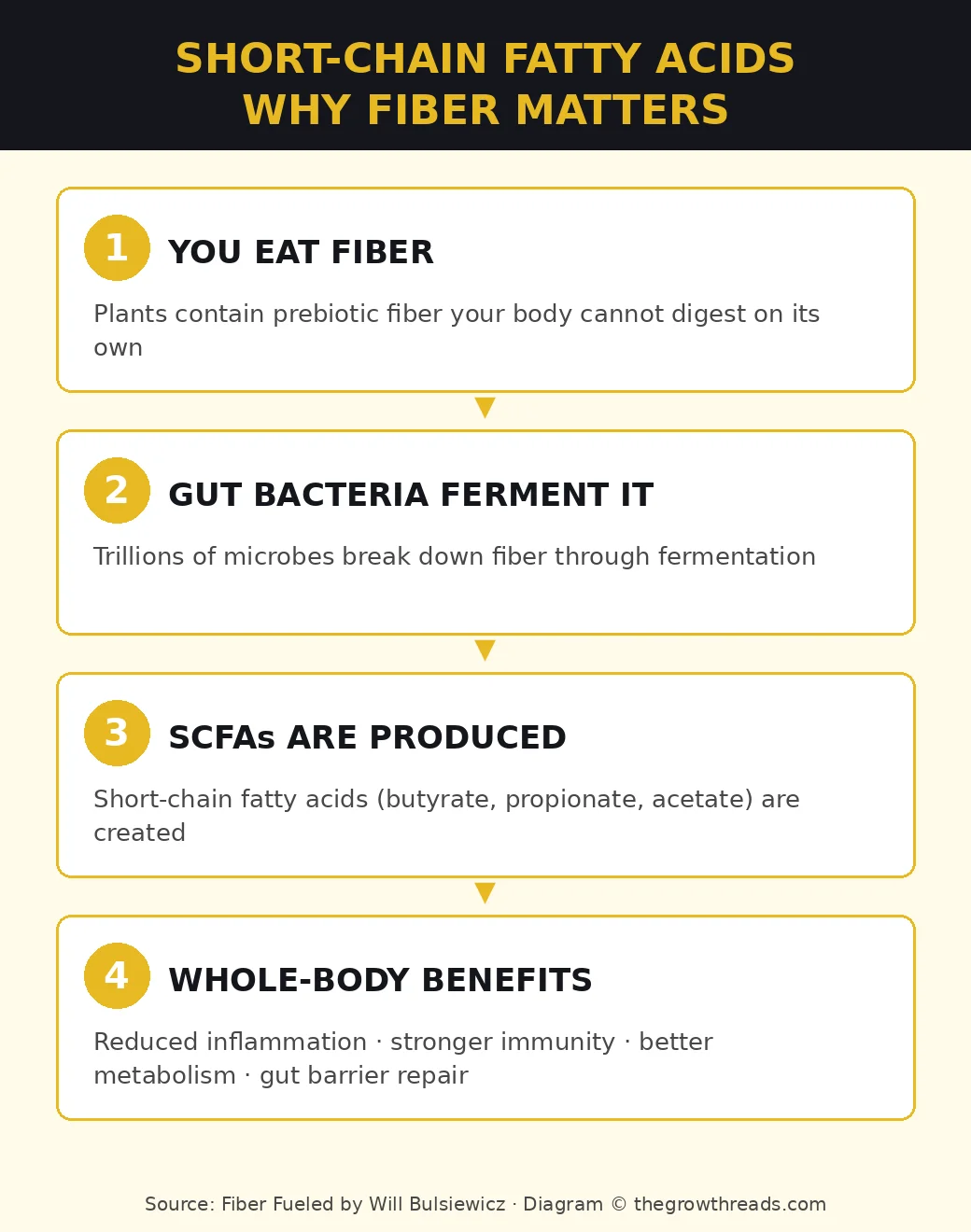
- Short-chain fatty acids are the payoff: When gut bacteria ferment fiber, they produce SCFAs (butyrate, propionate, acetate) that reduce inflammation, repair the gut lining, regulate metabolism, and strengthen immunity.
- Restrictive diets damage the microbiome: Keto, carnivore, and prolonged elimination diets reduce microbial diversity, which is associated with increased disease risk over time.
- Food intolerances are often fixable: Many people who believe they cannot tolerate certain plants have a damaged microbiome, not a permanent intolerance. Gradual reintroduction can rebuild tolerance.
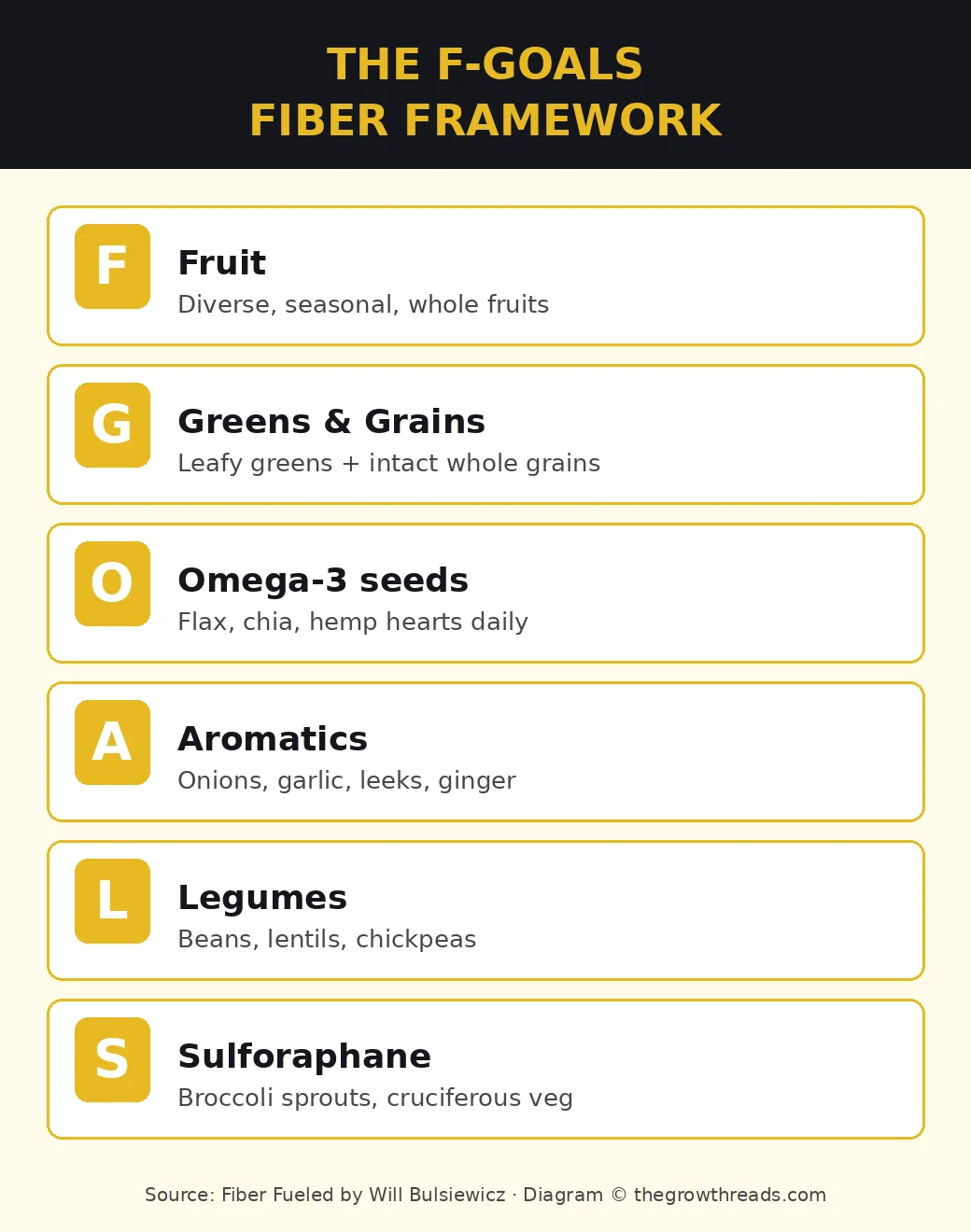
- The F-GOALS framework: Fruits, Greens and Grains, Omega-3 seeds, Aromatics, Legumes, and Sulforaphane — six categories to hit daily for optimal gut health.
- Prebiotics feed bacteria, probiotics are bacteria: Both matter, but most people underinvest in prebiotics (fiber-rich foods) while overspending on probiotic supplements that may not survive digestion.
- Gut health affects mental health: The gut-brain axis means your microbiome directly influences anxiety, depression, and cognitive function through neurotransmitter production and the vagus nerve.
- Start low and go slow: If you are not used to high-fiber eating, increase gradually. Sudden large increases cause bloating and gas — which discourages people from continuing.
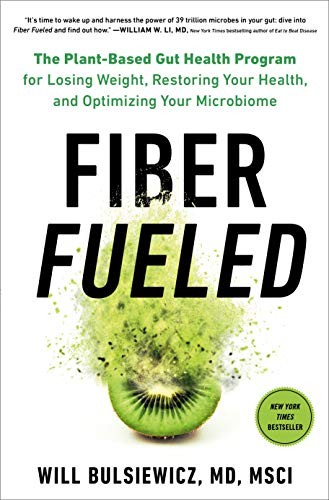
What is Fiber Fueled about?
Fiber Fueled is a science-based guide to gut health that explains how the microbiome works, why dietary fiber diversity is the key to optimizing it, and how to implement a plant-rich eating pattern using the F-GOALS framework and a structured 4-week protocol for healing digestive damage.
About the author
Dr. Will Bulsiewicz is a board-certified gastroenterologist and gut health researcher based in Charleston, South Carolina. He completed his fellowship in gastroenterology at Northwestern University and has treated thousands of patients with digestive disorders. His clinical experience led him to a conclusion that contradicted much of popular diet culture: the patients who improved most were not those on the most restrictive diets, but those who ate the widest variety of plants. Bulsiewicz became a vocal advocate for microbiome science on social media before writing Fiber Fueled, which became a New York Times bestseller. He followed it with The Fiber Fueled Cookbook and continues to publish research on the gut microbiome. Explore all Will Bulsiewicz book summaries →
Key concepts at a glance
| Concept | What it means | Use it when |
|---|---|---|
| Microbiome | The community of trillions of bacteria living in your gut | You want to understand why gut health affects everything |
| Short-chain fatty acids | Compounds produced when bacteria ferment fiber — the main health payoff | You need to explain why fiber matters beyond digestion |
| F-GOALS | Six daily food categories: Fruits, Greens/Grains, Omega-3 seeds, Aromatics, Legumes, Sulforaphane | You want a simple framework for plant-diverse eating |
| 30 plants per week | The research-backed target for microbiome diversity | You need a concrete, measurable goal |
| Dysbiosis | An imbalanced microbiome with reduced diversity | You have persistent digestive issues, food intolerances, or inflammation |
| Prebiotics vs. probiotics | Prebiotics feed existing bacteria (fiber); probiotics add new bacteria (supplements or fermented foods) | You are deciding whether to take supplements or change your diet |
| Start low, go slow | Increase fiber gradually to avoid bloating and let bacteria populations adapt | You are transitioning from a low-fiber diet |
| The 4-week swift protocol | A structured elimination and reintroduction plan to identify true intolerances | You have significant gut damage or multiple food sensitivities |
Part 1 — The microbiome: your invisible health engine
Bulsiewicz opens with a claim that reframes how most people think about health: you are more bacteria than human. The trillions of microorganisms living in your gut collectively weigh about three to five pounds and contain more genetic material than your own human cells. This is not trivia — it is the foundation of his argument. Your microbiome is not a passive ecosystem; it is an active metabolic organ that processes food your body cannot digest on its own, produces vitamins and neurotransmitters, trains your immune system, and communicates directly with your brain through the vagus nerve.
The science section draws on research from the Human Microbiome Project and the American Gut Project — two of the largest studies ever conducted on gut bacteria. The key finding: microbiome diversity is the strongest predictor of overall health. People with diverse gut bacteria have lower rates of obesity, diabetes, heart disease, autoimmune conditions, depression, and even certain cancers. People with low diversity have higher rates of all of these. And the single most important factor in microbiome diversity is not genetics, not geography, not medication history — it is diet. Specifically, the number of different plants you eat each week.
Bulsiewicz explains the mechanism through short-chain fatty acids, or SCFAs. When you eat fiber-rich plants, you cannot digest the fiber yourself — but your gut bacteria can. They ferment the fiber and produce three key SCFAs: butyrate, propionate, and acetate. Butyrate is particularly important — it is the primary fuel source for the cells lining your colon, it strengthens the gut barrier (preventing “leaky gut”), it reduces inflammation throughout the body, and it has anti-cancer properties. Without adequate fiber, SCFA production drops, the gut lining weakens, and systemic inflammation rises.
Part 2 — The case against restrictive diets
This is where Bulsiewicz takes aim at the most popular diet trends — and it is the most controversial section of the book. He argues that keto, carnivore, paleo, and prolonged elimination diets all share a fundamental problem: they reduce the diversity of your microbiome by cutting out entire categories of plant foods. When you stop feeding certain bacterial populations, those populations die off. And when those populations die off, you lose the ability to digest the foods they processed — which creates the illusion of a permanent food intolerance.
He walks through the mechanism step by step. A person starts a low-carb diet and cuts out beans, grains, and many fruits. Within weeks, the bacterial species that ferment those foods decline. Months later, the person tries eating beans again and experiences severe bloating and gas. They conclude they are intolerant to beans. But the real problem is not the beans — it is the depleted microbiome. The bacteria that would have processed those beans are gone. Bulsiewicz has seen this pattern hundreds of times in his clinic, and he argues that many self-diagnosed food intolerances are actually microbiome damage from restrictive eating patterns.
He is careful to note that some people have genuine medical conditions — celiac disease, inflammatory bowel disease, true allergies — that require avoiding specific foods. But he estimates that the majority of people who believe they cannot tolerate gluten, lectins, FODMAPs, or legumes are experiencing the consequences of a damaged microbiome rather than a permanent intolerance. The solution is not further restriction but gradual, careful reintroduction while rebuilding microbial diversity.
Part 3 — The F-GOALS framework and 30 plants per week
The practical heart of Fiber Fueled is the F-GOALS framework — six categories of plant foods to eat daily for optimal microbiome health. F is for Fruits — emphasizing variety and color over quantity. G is for Greens and Grains — leafy vegetables and intact whole grains like oats, quinoa, and barley. O is for Omega-3 super seeds — flax, chia, and hemp, which provide anti-inflammatory fats alongside fiber. A is for Aromatics — onions, garlic, leeks, and ginger, which contain unique prebiotic compounds. L is for Legumes — beans, lentils, and chickpeas, which Bulsiewicz calls the single most underrated food group in the Western diet. S is for Sulforaphane — the compound in broccoli sprouts and cruciferous vegetables with potent anti-cancer properties.
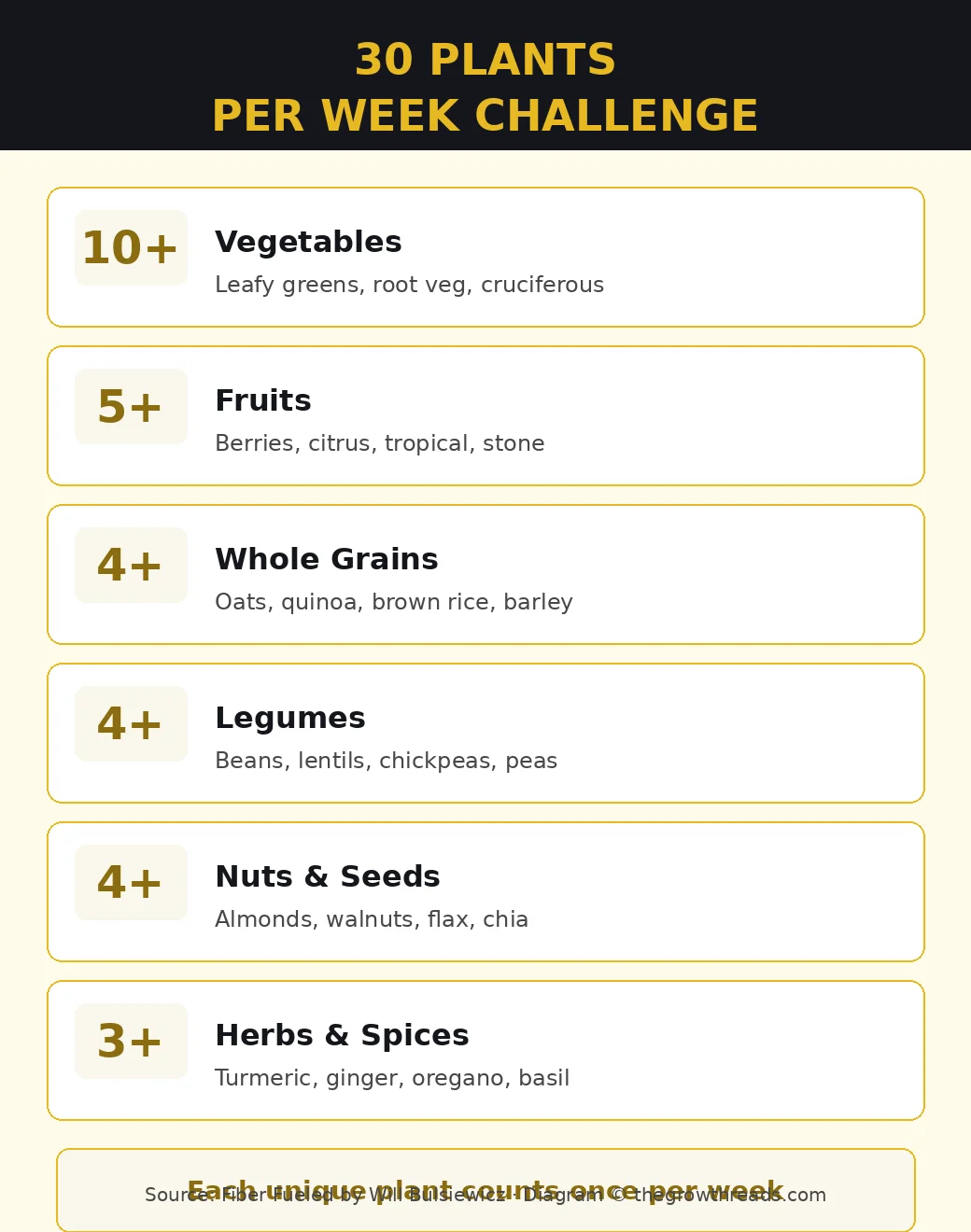
The 30-plants-per-week target comes from the American Gut Project, which analyzed microbiome samples from over 10,000 participants across 43 countries. The study found a clear threshold: people eating 30 or more unique plants per week had significantly more diverse microbiomes than those eating fewer than 10. This sounds daunting, but Bulsiewicz makes it achievable by counting every unique plant — herbs, spices, nuts, seeds, grains, and legumes all count, not just vegetables and fruits. A stir-fry with garlic, ginger, onion, broccoli, bell pepper, and cashews over brown rice is already seven plants in one meal.
He provides a tracking system and sample meal plans to help readers hit the target, emphasizing that the goal is not perfection but progress. Going from 8 unique plants a week to 20 is a massive improvement — you do not need to reach 30 immediately. The key insight is that diversity matters more than volume: eating three types of beans is better for your microbiome than eating a large quantity of one type. Each unique plant feeds different bacterial species, and the goal is to maintain a rich, diverse ecosystem.
Part 4 — The 4-week protocol and healing the gut
For readers with significant digestive damage — chronic bloating, IBS, food sensitivities, or history of restrictive dieting — Bulsiewicz provides a structured 4-week protocol. Week one eliminates the most common trigger foods to give the gut a rest. Weeks two through four systematically reintroduce food groups one at a time while monitoring symptoms. The protocol is not a permanent elimination diet — it is a diagnostic tool designed to identify true triggers while rebuilding tolerance to foods that were falsely blamed.
The “start low, go slow” principle is central to the protocol. If you have been eating a low-fiber diet for months or years, suddenly eating large amounts of beans, whole grains, and vegetables will cause significant discomfort. This is not because those foods are bad for you — it is because the bacterial populations needed to process them have diminished. Bulsiewicz recommends starting with small amounts (a tablespoon of lentils, a quarter cup of oats) and increasing gradually over weeks. As you feed those bacterial populations, they grow back, and your ability to tolerate higher-fiber foods increases.
He also addresses fermented foods — yogurt, kefir, sauerkraut, kimchi, miso — as a complement to fiber intake. Fermented foods provide live bacteria (probiotics) that can temporarily colonize the gut, while fiber provides the fuel (prebiotics) that lets beneficial bacteria thrive long-term. Bulsiewicz prioritizes prebiotics over probiotics but recommends both. His skepticism about probiotic supplements is notable — he argues that most commercial supplements do not survive stomach acid and that food-based probiotics are more effective and far cheaper.
Who is Fiber Fueled best for — and who should read something else first?
Fiber Fueled is ideal for anyone interested in gut health, digestive improvement, or the science behind plant-based nutrition. It is particularly valuable for people who have tried restrictive diets (keto, paleo, carnivore, low-FODMAP) and are ready to consider a different approach, and for anyone dealing with chronic bloating, food sensitivities, or IBS who wants a structured protocol beyond “just avoid it.” Health professionals will appreciate the depth of scientific references.
If you want a broader nutritional overview before diving into gut-specific science, start with In Defense of Food by Michael Pollan. If you are interested in longevity and disease prevention beyond gut health, Outlive by Peter Attia provides a comprehensive framework. If you are already plant-based and want recipe-forward guidance, Bulsiewicz’s follow-up, The Fiber Fueled Cookbook, is the natural next step.
Note: This book covers health and nutrition topics. The information here is educational — for specific medical conditions, consult a qualified healthcare provider.
Questions to reflect on
- How many unique plants did you eat in the last week — and how close are you to the 30-plant threshold?
- Have you ever eliminated a food group and then found you could no longer tolerate it? Could the microbiome explanation apply to your experience?
- If your gut bacteria are producing the compounds that regulate your mood, immunity, and weight, what does your current diet tell you about the signals you are sending?
- Are there foods you avoid based on self-diagnosis that you have never formally tested through a structured reintroduction protocol?
- What would change about your grocery shopping if you optimized for plant diversity rather than sticking to the same ten ingredients every week?
🔥 Ready to transform your gut health from the inside out?
Fiber Fueled gives you the science, framework, and protocol to build a thriving microbiome — one plant at a time.
How to apply Fiber Fueled (7-day plan)
- Day 1 — Count your current plants: Write down every unique plant you ate today — fruits, vegetables, grains, legumes, nuts, seeds, herbs, and spices. This is your baseline.
- Day 2 — Add one new plant: Buy one plant you do not normally eat — a new herb, a different grain, an unfamiliar vegetable — and add it to a meal.
- Day 3 — Build an F-GOALS checklist: Create a simple daily tracker for the six F-GOALS categories. Check off each category you hit today.
- Day 4 — Start a fermented food: Add one serving of a fermented food — yogurt, kefir, sauerkraut, or kimchi — to your daily routine.
- Day 5 — Prep a high-diversity meal: Cook one meal with at least eight different plants. A grain bowl, stir-fry, or large salad makes this easy.
- Day 6 — Identify your fiber gaps: Review which F-GOALS categories you consistently miss. Plan how to fill those gaps next week.
- Day 7 — Set your weekly plant target: Based on your baseline count, set a target for next week that is five plants higher. Track it.
Frequently asked questions
Do I need to go fully plant-based to benefit from Fiber Fueled?
No. Bulsiewicz does not require readers to be vegan or vegetarian. His argument is about increasing plant diversity, not eliminating animal products. Someone who eats meat but hits 30 plants per week will have a healthier microbiome than a vegan who eats the same five foods repeatedly. The emphasis is on adding variety, not on restriction. That said, the book does make a strong case that animal products provide no fiber, so increasing plant intake naturally means reducing animal product consumption proportionally.
What if I get bloated when I eat more fiber?
This is expected and temporary. Bloating when increasing fiber means your gut bacteria are adjusting to new food sources — it is actually a sign the fermentation process is working. The solution is not to stop eating fiber but to increase more slowly. Bulsiewicz recommends the “start low, go slow” approach: begin with small portions of high-fiber foods and increase gradually over weeks. Most people find the bloating resolves within two to four weeks as their bacterial populations adapt to the new food supply.
How does Fiber Fueled compare to The Plant Paradox?
These books reach opposite conclusions. Steven Gundry argues in The Plant Paradox that lectins in many plants cause gut damage and inflammation, and recommends avoiding beans, grains, and certain vegetables. Bulsiewicz argues the opposite — that these same foods feed beneficial gut bacteria and that properly preparing them (soaking, cooking, fermenting) eliminates lectin concerns. Both authors are MDs citing research. The mainstream gastroenterology consensus leans toward Bulsiewicz’s position, but readers should evaluate both perspectives.
Are probiotic supplements worth taking?
Bulsiewicz is skeptical of most commercial probiotic supplements. His concerns: many strains do not survive stomach acid, the quantities are often too small to create lasting change, and the strains used may not match what your specific microbiome needs. He favors food-based probiotics — yogurt, kefir, sauerkraut, kimchi, miso — which deliver live bacteria in a food matrix that protects them during digestion. He views prebiotics (fiber) as more important than probiotics because they feed the bacteria already adapted to your gut.
Can Fiber Fueled help with IBS?
Bulsiewicz treats IBS patients in his gastroenterology practice and argues that many cases are caused by microbiome damage from restrictive diets, stress, or antibiotic use. The 4-week swift protocol in the book is designed partly for IBS sufferers — it identifies true triggers while gradually rebuilding fiber tolerance. However, he is clear that IBS is complex and that some patients need individualized medical treatment beyond what a book can provide. The book is a starting framework, not a replacement for clinical care.
What is the 30-plants-per-week rule based on?
The target comes from the American Gut Project, the largest citizen-science microbiome study, which collected and analyzed samples from over 10,000 people across 43 countries. Researchers found a clear inflection point: participants eating 30 or more unique plants per week had significantly more diverse microbiomes — with more beneficial bacterial species and stronger gut barriers — than those eating fewer than 10. Each unique plant counts once per week, and herbs, spices, nuts, seeds, and grains all qualify.
Is Fiber Fueled still relevant in 2026?
The microbiome science Bulsiewicz draws on has only grown stronger since the book’s 2020 publication. More recent studies have reinforced the link between gut diversity and chronic disease prevention, and the gut-brain axis research has expanded significantly. The F-GOALS framework and 30-plants target remain practical and evidence-based. If anything, the book’s warnings about restrictive diets have become more urgent as extreme elimination protocols continue to gain popularity on social media.
Related summaries
- How Not to Die Summary — Michael Greger on using whole foods to prevent and reverse chronic disease.
- Glucose Revolution Summary — Jessie Inchauspe on small dietary changes that stabilize blood sugar and reduce inflammation.
- Gut Summary — Giulia Enders on the fascinating science of the digestive system.
- In Defense of Food Summary — Michael Pollan on the seven words that summarize the best nutritional advice.
📚 Explore the full Health collection
This summary is part of our best health books series — 39 in-depth reviews to help you optimize your body, mind, and longevity.
Related Health Summaries
Never Finished Summary & Review: Unshackle Your Mind and Win the War Within
Super Human Summary & Review: The Biohacker`s Guide to Aging Backwards
The Blood Sugar Solution Summary and Review
The Complete Guide to Fasting Summary & Review: Heal Your Body Through Fasting
The Wim Hof Method Summary & Review: Breathe, Embrace the Cold, Transform Your Health