

⭐⭐⭐⭐✬ 4.5 / 5
A sharp, irreverent guide to building a lean business by doing less — better.
Best for: Entrepreneurs, freelancers, and anyone tired of bloated business advice.
Reading time: ~3.5 hours (288 pages)
Difficulty to apply: Low — the advice is intentionally simple and immediately actionable.
Rework in one minute
Most business advice is wrong because it was designed for someone else’s business. Jason Fried and David Heinemeier Hansson — the founders of 37signals (now Basecamp) — argue that the traditional playbook of writing business plans, raising capital, hiring fast, and scaling aggressively is not just unnecessary but actively harmful for most companies. Rework strips away conventional wisdom and replaces it with a leaner, more practical approach: start small, ship fast, say no by default, and let constraints fuel creativity. The book is organized into short, punchy chapters — many just two or three pages — that each deliver one clear, contrarian idea. It is not a step-by-step manual; it is a philosophy of productive minimalism applied to business.
Key takeaways
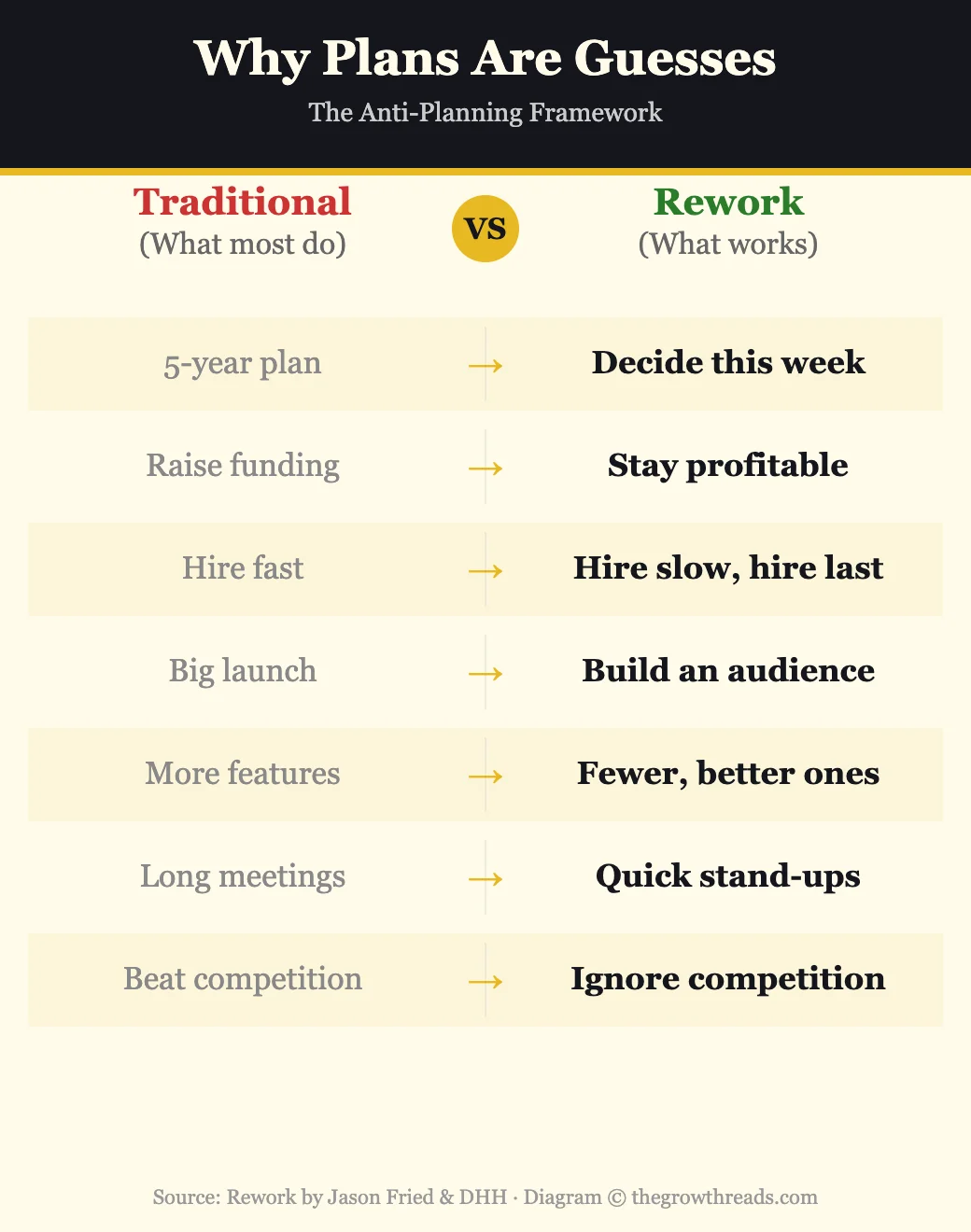
- Plans are guesses: Long-term business plans create a false sense of certainty. Decide what to do this week instead.
- Less is a legitimate business strategy: You do not need more features, more people, or more funding. You need fewer distractions and sharper focus.
- Workaholism is not a virtue: Working more hours does not mean producing more value. It often means poor prioritization.
- Start a business, not a startup: The startup mythology of burn rates and exit strategies is irrelevant to most founders. Focus on profit from day one.
- Launch now: If you wait for perfect, you will never ship. Get something real into the world and improve it based on feedback.
- Meetings are toxic: Most meetings waste time. They pull people out of productive flow for information that could have been an email.
- Say no by default: Every yes is a commitment that restricts future flexibility. Make no your default and only say yes when it truly matters.
- Build an audience, not a customer list: Teach and share what you know. An audience that trusts you will buy from you when they are ready.
- Embrace constraints: Limited time, money, and resources force creative solutions. They are advantages, not obstacles.
- Scratch your own itch: Build something you personally need. You already understand the problem better than any market research could tell you.
What is Rework about?
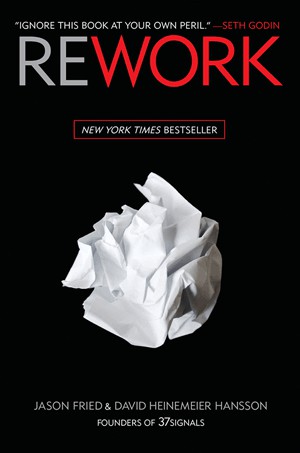
Rework is a business book that challenges every piece of conventional startup advice. Written by the founders of Basecamp, it argues that you can build a profitable, sustainable business without venture capital, business plans, or big teams — by embracing simplicity, shipping fast, and saying no to almost everything.
About the author
Jason Fried is the co-founder and CEO of 37signals, the company behind Basecamp and HEY. He has been building web-based software since the mid-1990s and is known for advocating calm, sustainable business practices over the hustle-culture approach. David Heinemeier Hansson (DHH) is the co-founder and CTO of 37signals and the creator of Ruby on Rails, one of the most influential web development frameworks in history. Together they have also written It Doesn’t Have to Be Crazy at Work and Remote: Office Not Required. Their company has been profitable since its founding and has never taken outside investment — a fact that informs every page of Rework. Explore all David Heinemeier Hansson book summaries →
Key concepts at a glance
| Concept | What it means | Use it when |
|---|---|---|
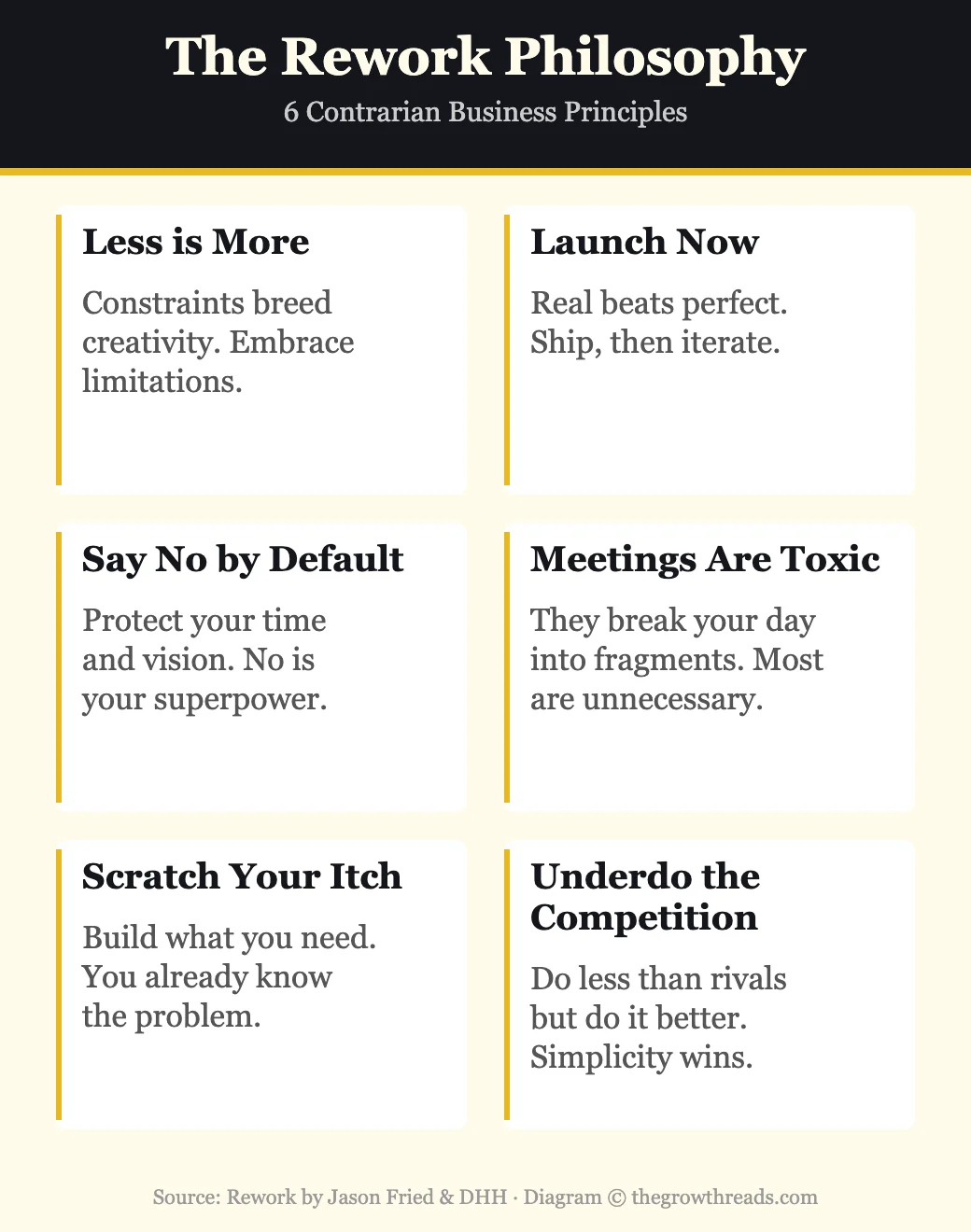
| Plans are guesses | Long-range planning creates false confidence; decide in the moment | You feel pressured to write a 5-year business plan |
| Scratch your own itch | Build products you personally need so you understand the problem intimately | You are looking for a business idea |
| Embrace constraints | Limited resources are creative advantages, not handicaps | You think you need more money, time, or people to start |
| Launch now | Ship a minimal version and iterate; perfectionism kills momentum | You keep delaying launch to add one more feature |
| Meetings are toxic | Most meetings destroy productive time and could be replaced by written updates | Your calendar is full but your output is low |
| Say no by default | Every commitment reduces future flexibility; no protects your priorities | Someone requests a feature, partnership, or meeting |
| Build an audience | Teach what you know publicly; trust converts to customers over time | You want sustainable growth without paid advertising |
| Underdo the competition | Offer less than competitors but make it simpler and more focused | You feel pressure to match every competitor feature |
Part 1 — First: tear up the old rules
Fried and Hansson open by dismantling the assumptions most people carry into business. The real world, they argue, is not what MBA programs describe. You do not need a business plan — those documents become fiction the moment they meet reality. You do not need outside investors — their money comes with strings that pull your company away from what made it special. And you certainly do not need to be a workaholic — the person putting in 14-hour days is often just bad at prioritizing, not more dedicated.
The authors point to their own experience at 37signals. They stayed small by choice, remained profitable from the start, and never raised a round of funding. The conventional response to this is that they got lucky, but Fried and Hansson argue it is the opposite: they succeeded because they ignored conventional advice. When you remove the pressure to grow at all costs, you can focus on building something you actually care about.
One of the most powerful reframes in this section is the distinction between a “startup” and a “business.” Startups chase growth metrics and dream of exits. Businesses chase profit and dream of sustainability. Rework is a book for people who want to build the second kind.
Part 2 — Go: start building something real
The second section is about action. Fried and Hansson believe that the biggest barrier to starting a business is not a lack of ideas or money — it is a surplus of excuses. You do not need to quit your day job immediately. You do not need co-founders. You do not need an office. You need a laptop, a few hours a week, and a problem you care about solving.
The concept of “scratching your own itch” is central here. When you build something you personally need, you skip the market research phase because you already understand the pain point. Basecamp itself was born this way — 37signals needed a project management tool for their client work, so they built one. It turned into a product that millions of people use.
They also introduce the idea of “drawing a line in the sand.” Great businesses stand for something. They have a point of view and are willing to alienate some customers to serve others better. This is the opposite of the corporate instinct to please everyone, and it is one of the reasons Basecamp developed such a loyal following — the company was unapologetically opinionated about how work should be done.
The section closes with a critical distinction: making a dent in the universe does not require venture-scale ambition. A profitable business that serves a thousand happy customers and funds the life you want is a legitimate success. Not every business needs to be the next unicorn.
Part 3 — Progress: ship, iterate, and cut the excess
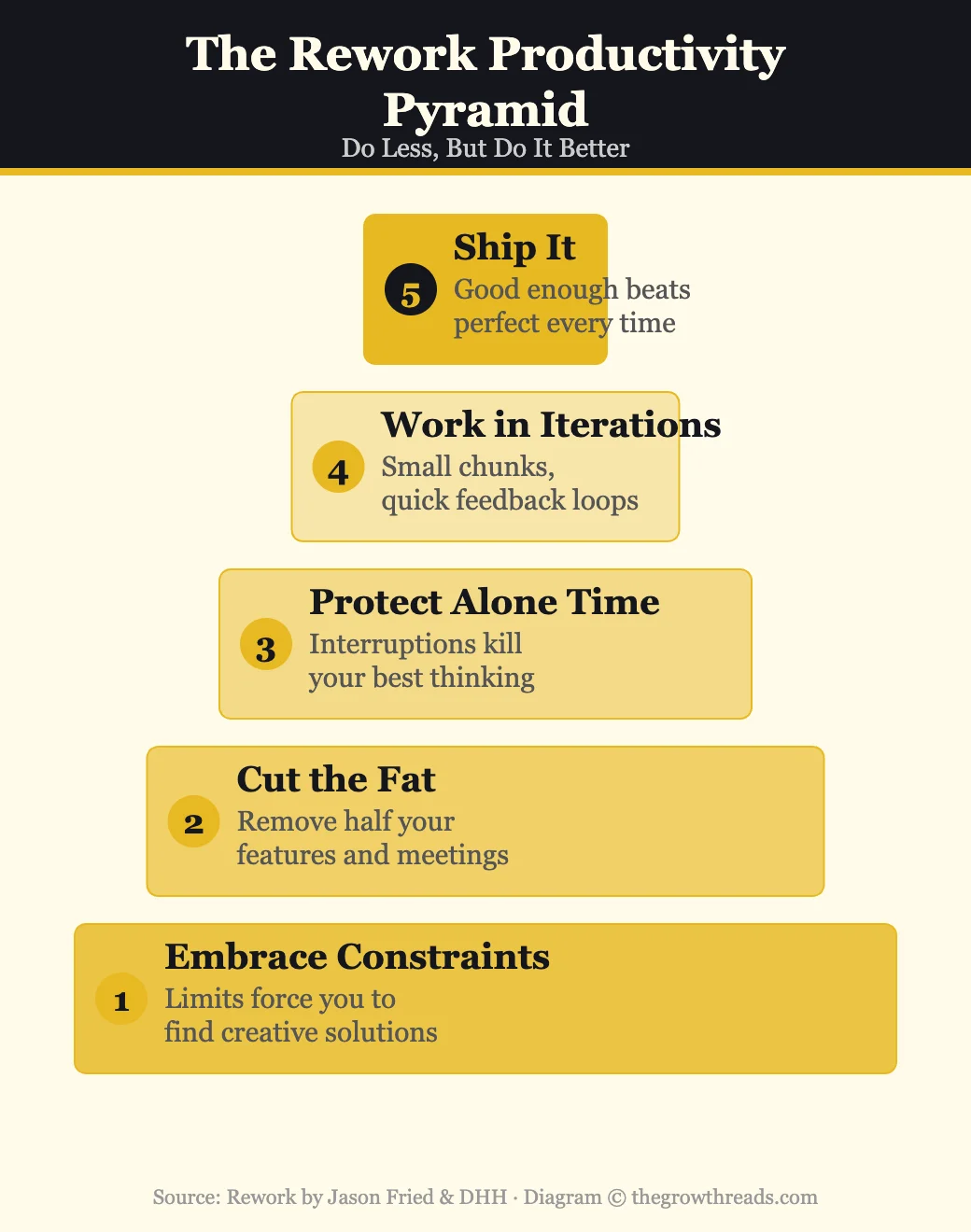
This is the operational heart of the book. Fried and Hansson lay out their philosophy of productive minimalism: build less, ship sooner, and cut anything that does not directly serve the customer.
The “launch now” principle is the centerpiece. Most entrepreneurs delay launching because their product is not ready. But “ready” is a moving target — there will always be one more feature to add, one more bug to fix, one more edge case to handle. The Rework solution is to ship the stripped-down version and let real users tell you what actually needs improving. This is faster, cheaper, and produces better products than months of isolated development.
They extend this to meetings, which they call “toxic.” A one-hour meeting with ten people is not one hour of lost productivity — it is ten hours. And most meetings have no clear agenda, no time limit, and no actionable outcome. The alternative: written communication, short stand-ups, and a cultural norm that protects uninterrupted work time.
Constraints get a full chapter of their own. When Southwest Airlines could not afford a fleet of different planes, they standardized on the Boeing 737 — which slashed training costs, simplified maintenance, and became a competitive advantage. The lesson: do not wish for more resources. Work brilliantly within the ones you have.
Part 4 — Promotion, hiring, and culture: do it differently
The final major section covers how to grow without losing what made you good. Marketing, in the Rework worldview, is not about ad spend — it is about teaching. When you share what you know through blog posts, talks, and behind-the-scenes content, you build an audience that trusts you. That audience becomes your customer base without a single cold call.
Hiring gets the contrarian treatment too. Do not hire until it hurts — meaning until the pain of not having someone is clearly greater than the cost and complexity of bringing them on. And when you do hire, hire for writing ability first. Clear writing signals clear thinking, and in a remote or asynchronous company, written communication is the primary way work gets done.
On competition, the advice is counterintuitive: ignore your competitors. Obsessing over what rivals are doing leads to reactive, copycat products. Instead, focus on what makes you different and double down on that. “Underdoing” the competition — offering fewer features but executing them better — is a viable and often superior strategy.
Culture, they argue, is not something you create with mission statements and ping-pong tables. Culture is a byproduct of consistent behavior. If you ship on time, communicate honestly, and respect people’s time, you will build a culture worth working in — no manifesto required.
Who is Rework best for — and who should read something else first?
Rework is ideal for first-time entrepreneurs, side-project builders, freelancers, and anyone who feels overwhelmed by traditional business advice. If you have been told you need a business plan, funding, and a ten-person team before you can start — this book will free you from that thinking. It is also valuable for managers at larger companies who want to cut bureaucracy and protect their team’s productive time.
If you are looking for detailed frameworks on scaling a company past 100 employees, Rework is not the right fit. Try Good to Great or High Output Management instead. And if you want the productivity principles without the business context, Essentialism covers similar ground from a personal-effectiveness angle.
Questions to reflect on
- What are you waiting for before you start — and is that wait truly necessary, or is it a form of procrastination?
- Which meetings on your calendar this week could be replaced by a short written update?
- If you had to cut half your product’s features, which half would survive — and would the product actually be better?
- When was the last time you said no to a request that felt urgent but was not actually important?
- What do you know — from your daily work or personal experience — that you could teach others, building trust and audience in the process?
🔥 Ready to rethink how you build and work?
Rework will change how you think about planning, productivity, and what it takes to build something that lasts.
How to apply Rework (7-day plan)
- Day 1 — Audit your commitments: List every project, meeting, and obligation you are currently carrying. Circle the three that produce the most value.
- Day 2 — Cancel one meeting: Pick the least productive recurring meeting on your calendar and replace it with a written status update.
- Day 3 — Ship something small: If you have a project in progress, identify the smallest useful version and release it today — even if it is rough.
- Day 4 — Practice saying no: Decline at least one request (a feature, a meeting, a favor) that does not align with your top priorities.
- Day 5 — Embrace a constraint: Pick one limitation you have been complaining about (budget, time, team size) and brainstorm three creative solutions that work within it.
- Day 6 — Teach something: Write a short post, send a team email, or record a quick video sharing one useful thing you have learned from your work.
- Day 7 — Reflect and cut: Review your to-do list and remove the bottom 20 percent. Ask: if I never did these, would anyone notice?
Frequently asked questions
Is Rework only for tech entrepreneurs?
Not at all. While Fried and Hansson draw examples from their software company, the principles — embrace constraints, ship fast, say no by default — apply to any business or creative endeavor. Freelancers, restaurant owners, consultants, and nonprofit leaders have all found the advice relevant. The book deliberately avoids jargon and speaks in universal business language.
How is Rework different from The Lean Startup?
Both books advocate for shipping quickly and learning from real users, but they differ in ambition. The Lean Startup assumes you are building a high-growth venture and need a systematic process to find product-market fit. Rework questions whether high growth is even desirable and advocates for staying small, profitable, and independent. They are complementary — Lean Startup for methodology, Rework for philosophy.
Can I apply Rework if I work at a large company?
Yes, selectively. The advice on reducing meetings, protecting focus time, and saying no applies directly to anyone in a corporate environment. The advice on ignoring investors and staying small is obviously aimed at founders, but the underlying principle — do not let external pressure distract you from doing great work — translates to any role.
Is the advice in Rework backed by research?
Rework is not an academic book. It draws primarily from the authors’ two decades of experience running Basecamp. Some claims (like the toxicity of meetings) are supported by organizational psychology research, but the book does not cite studies. It is a practitioner’s guide, not a scholarly text — and that is part of its appeal. The advice has been tested in a real, profitable company for over 20 years.
What should I read after Rework?
If you liked the productivity angle, try Deep Work by Cal Newport or Essentialism by Greg McKeown. If you want more from the same authors, It Doesn’t Have to Be Crazy at Work extends Rework’s philosophy into workplace culture. For the startup perspective, The Lean Startup is the natural complement.
How long does it take to read Rework?
Most readers finish Rework in about 3 to 4 hours. At 288 pages with very short chapters — many just two or three pages — it reads fast. The writing is punchy and direct, with no filler. You could realistically read it in a single afternoon and start applying the ideas the next morning.
Is Rework still relevant in 2026?
More than ever. The rise of remote work, solo entrepreneurship, and AI-assisted productivity has made the Rework philosophy — stay lean, automate ruthlessly, ship fast — even more practical. The core arguments against unnecessary meetings, bloated teams, and performative busyness have only become more urgent as companies grapple with return-to-office debates and rising operational costs.
Related summaries
- The Lean Startup Summary — The complementary guide to validated learning and iterative development.
- Deep Work Summary — Cal Newport’s case for protecting uninterrupted focus time.
- Essentialism Summary — Greg McKeown on the disciplined pursuit of less.
- The 4-Hour Workweek Summary — Tim Ferriss on designing a business around the life you want.
📚 Explore the full Productivity collection
This summary is part of our best productivity books series — 39 in-depth reviews to help you work smarter and build better habits.
Related Productivity Summaries
Smarter Faster Better Summary & Review: The 8 Drivers of Real Productivity
The 4-Hour Workweek Summary & Review: Escape the 9-to-5 Without Waiting for Retirement
The Art of Learning Summary & Review: Master Any Skill Under Pressure
The One Thing Summary & Review: The Surprisingly Simple Truth Behind Extraordinary Results
When Summary & Review: Master the Science of Perfect Timing