

★★★★★ 4.5 / 5
One-liner: The most research-backed relationship book ever written — 40 years of lab data distilled into seven actionable principles that predict whether marriages thrive or fail.
Best for: Couples at any stage — newlyweds building a foundation, long-term partners seeking renewal, or anyone who wants to understand what actually makes relationships work.
Reading time: ~7 hrs (320 pages)
Difficulty to apply: Medium — the principles are clear but require consistent practice and vulnerability from both partners.
The Seven Principles for Making Marriage Work in one minute
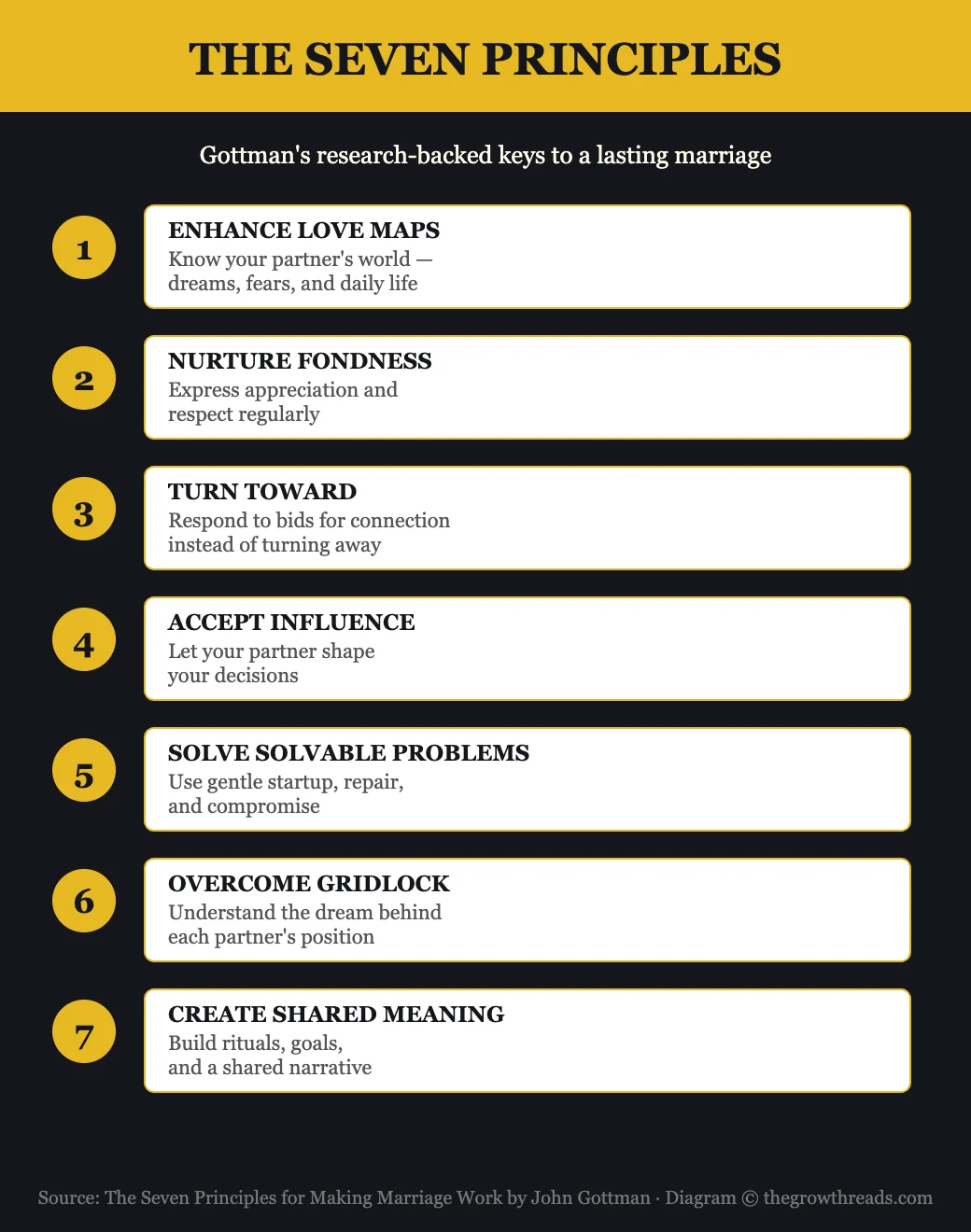
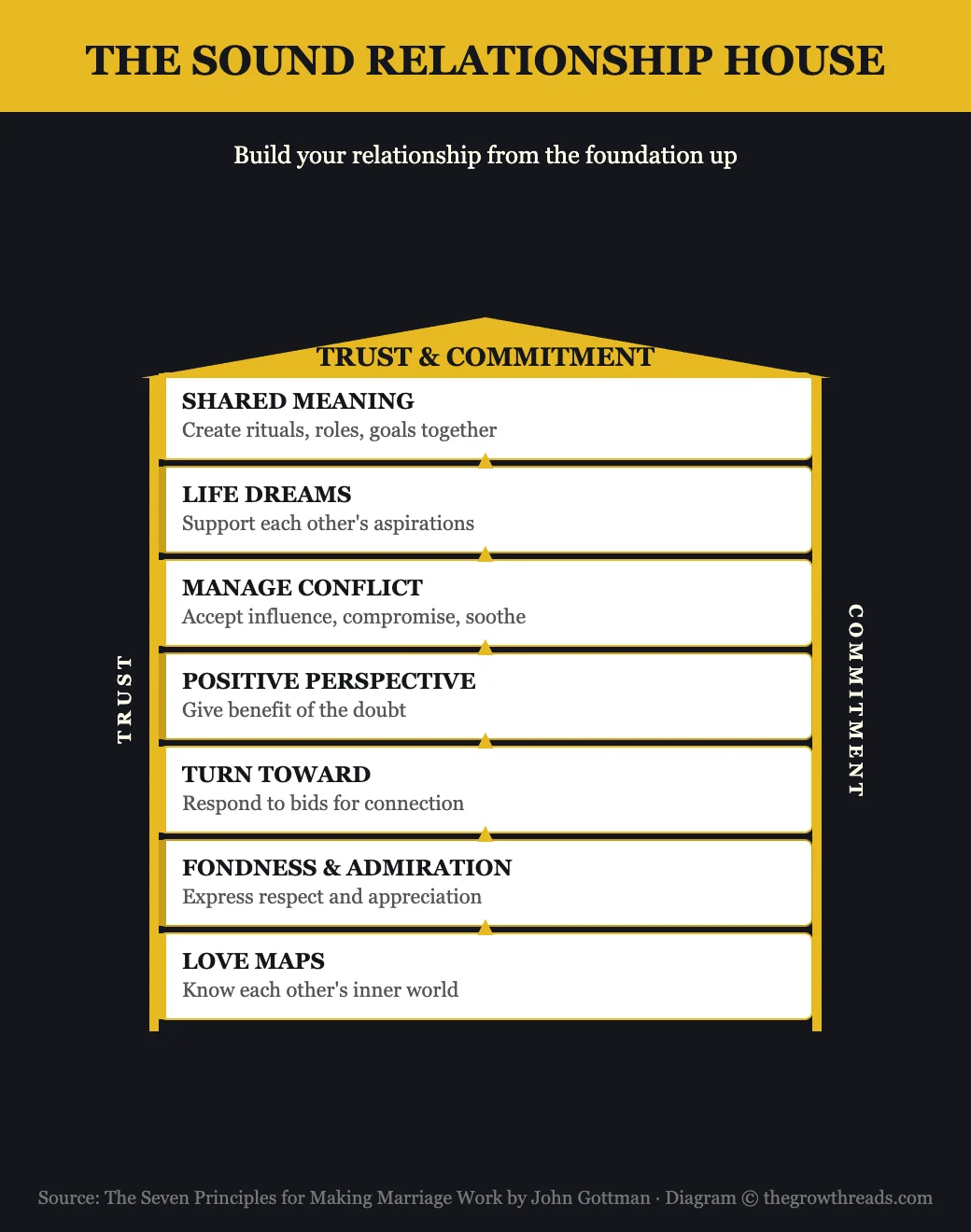
After studying over 3,000 couples in his “Love Lab,” John Gottman can predict with 94% accuracy whether a marriage will survive or fail. The patterns that separate happy couples from miserable ones are not what most people expect — they have less to do with romance and more to do with friendship, respect, and how partners handle everyday moments. The Seven Principles for Making Marriage Work translates four decades of observational research into a practical system: build deep knowledge of each other (love maps), nurture fondness, turn toward bids for connection, accept influence, solve solvable problems with gentleness, overcome gridlocked conflicts by understanding the dreams beneath them, and create shared meaning through rituals and goals. The book also identifies the “Four Horsemen” — criticism, contempt, defensiveness, and stonewalling — as the toxic behaviours that destroy relationships when left unchecked.
Key takeaways
- Friendship is the foundation: Happy marriages are built on deep friendship — knowing your partner’s world, expressing fondness, and responding to their bids for connection.
- The magic ratio is 5:1: Stable relationships maintain at least five positive interactions for every negative one during conflict. Below that ratio, the relationship deteriorates.
- The Four Horsemen predict divorce: Criticism, contempt, defensiveness, and stonewalling — in that order of severity — are the four behaviours most reliably associated with relationship failure.
- Contempt is the worst: Of the Four Horsemen, contempt (eye-rolling, sarcasm, mockery) is the single strongest predictor of divorce. It communicates disgust and superiority.
- Bids for connection are micro-moments: When your partner says “look at that bird,” they are not asking about ornithology — they are bidding for your attention. Turning toward these bids builds trust.
- 69% of conflicts are perpetual: Most relationship disagreements are never fully resolved. The goal is not to solve them but to dialogue about them with humour, affection, and acceptance.
- Gentle startup changes everything: How a conversation begins determines how it ends 96% of the time. Start with “I feel…” instead of “You always…”
- Accept influence from your partner: Research shows that relationships where partners (especially men) accept influence from each other are significantly more likely to succeed.
- Dreams fuel gridlock: Behind every gridlocked argument is a deeper dream or value. Understanding your partner’s dream — even if you disagree — unlocks compromise.
- Shared meaning creates legacy: Couples who build rituals, shared goals, and a common narrative about their relationship report higher satisfaction and resilience.
What is The Seven Principles for Making Marriage Work about?
The Seven Principles for Making Marriage Work is a research-based guide to building and maintaining a happy marriage. Drawing on John Gottman’s four decades of studying couples in his lab, the book identifies seven evidence-backed principles that predict relationship success, the toxic behaviours that destroy marriages, and practical exercises couples can use to strengthen their bond.
About the author
John Gottman, PhD, is a professor emeritus of psychology at the University of Washington and co-founder of The Gottman Institute. Over 40 years, he and his team observed thousands of couples in his research facility (nicknamed the “Love Lab”), measuring everything from heart rate and facial expressions to conversation patterns during conflict. His research has been published in over 200 academic papers and has fundamentally shaped how therapists, counsellors, and researchers understand romantic relationships. Co-author Nan Silver is an award-winning journalist who collaborated with Gottman to translate his research for a general audience. The book, first published in 1999 and revised in 2015, has sold over two million copies worldwide. Explore all John Gottman book summaries →
Key concepts at a glance
| Concept | What it means | Use it when |
|---|---|---|
| Love Maps | Detailed knowledge of your partner’s inner world | You feel disconnected or out of touch |
| Fondness & Admiration | Regularly expressing respect, affection, and appreciation | Criticism is creeping into daily interactions |
| Turning Toward | Responding positively to bids for emotional connection | Your partner reaches out and you tend to ignore it |
| The Four Horsemen | Criticism, contempt, defensiveness, stonewalling | Arguments escalate destructively |
| 5:1 Ratio | Five positive interactions for every negative one | The relationship feels more negative than positive |
| Gentle Startup | Beginning difficult conversations softly rather than harshly | Discussions always turn into fights |
| Repair Attempts | Efforts to de-escalate tension during conflict | Arguments spiral out of control |
| Dreams Within Conflict | The deeper values and aspirations behind gridlocked positions | The same argument keeps recurring without resolution |
| Shared Meaning | Rituals, roles, goals, and symbols that define your partnership | The relationship feels routine or purposeless |
Part 1 — The research foundation: what predicts success and failure
Gottman opens by explaining his research methodology. In the Love Lab at the University of Washington, couples were observed during both mundane conversations and conflict discussions. Sensors tracked heart rate, skin conductance, and blood pressure while cameras captured facial expressions and body language. Over time, clear patterns emerged: the couples who stayed together and reported high satisfaction behaved fundamentally differently from those who divorced.
The most important finding was the 5:1 ratio. During conflict, stable couples maintained at least five positive interactions (humour, affection, curiosity, agreement, empathy) for every negative one. Unstable couples dropped below this threshold, often reaching 1:1 or worse. This ratio alone predicted outcomes with remarkable accuracy.
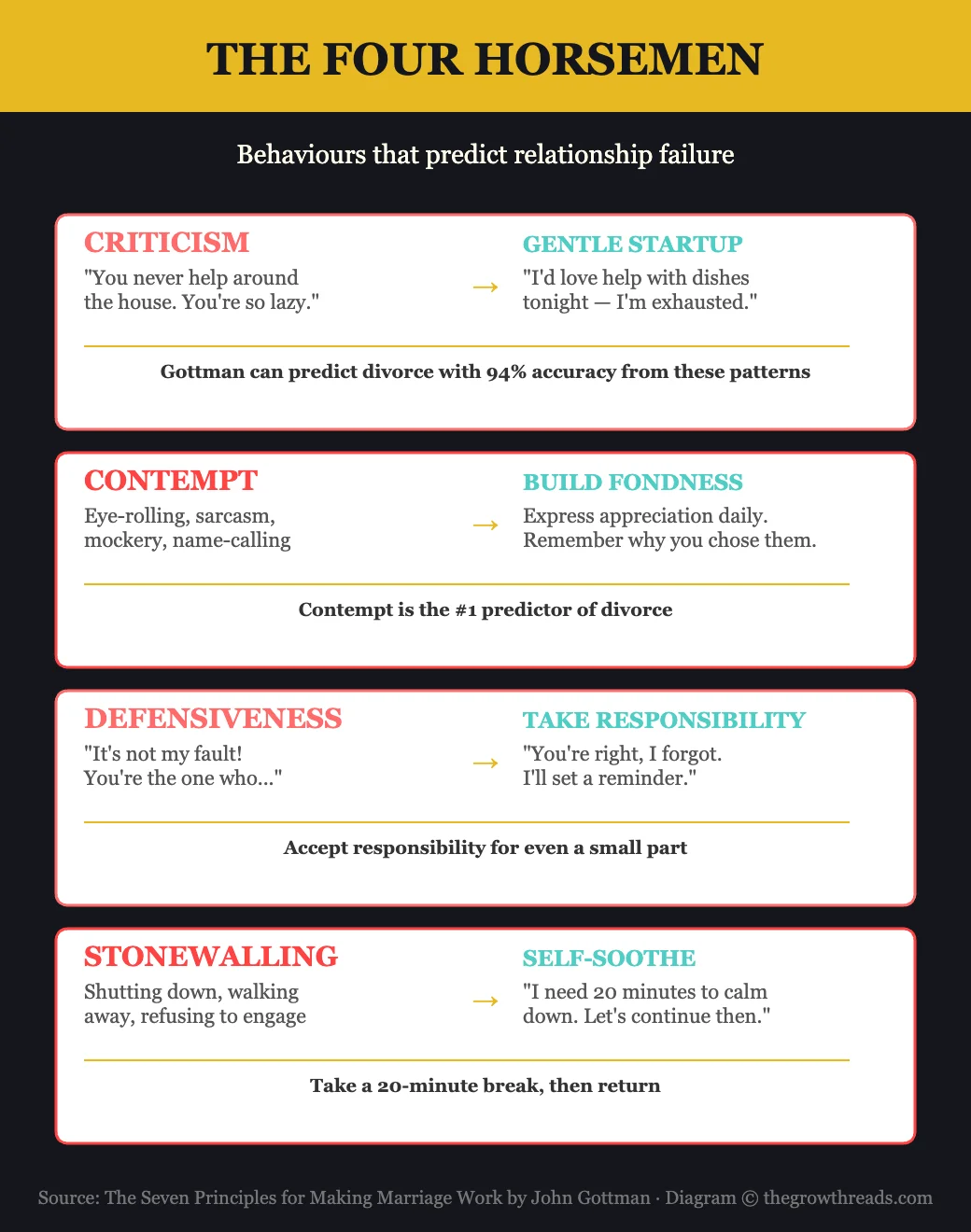
Gottman then introduces the Four Horsemen — the four toxic communication patterns that most reliably predict relationship failure. Criticism attacks the partner’s character rather than addressing a specific behaviour. Contempt communicates disgust and superiority through eye-rolling, sarcasm, or mockery — and is the single strongest predictor of divorce. Defensiveness deflects responsibility by counter-attacking or playing the victim. Stonewalling is emotional withdrawal — shutting down, disengaging, and refusing to respond. The antidotes are equally specific: use gentle startup instead of criticism, build a culture of fondness instead of contempt, take responsibility instead of getting defensive, and self-soothe instead of stonewalling.
Part 2 — The seven principles in practice
The bulk of the book walks through each principle with exercises, questionnaires, and real couple examples. Principle 1 — Enhance Your Love Maps — is about building and maintaining detailed knowledge of your partner’s inner world: their worries, dreams, daily stresses, favourite memories, and current preoccupations. Gottman’s research shows that couples with detailed love maps navigate transitions (new baby, job change, retirement) far better because they understand how events affect their partner specifically.
Principle 2 — Nurture Fondness and Admiration — addresses the antidote to contempt. Gottman found that couples who spontaneously expressed fondness and admiration (even in brief comments like “I appreciate you doing that”) maintained the positive sentiment override that keeps relationships stable. The exercise here is simple: list three things you genuinely admire about your partner and tell them directly.
Principle 3 — Turn Toward Each Other — is perhaps the most underrated. Bids for connection happen dozens of times daily — a comment about the weather, a sigh, a question about dinner. Partners who consistently turn toward these bids (responding with attention and engagement) build what Gottman calls an “emotional bank account” that sustains the relationship through hard times. Couples who turn away — ignoring bids or dismissing them — gradually erode the connection until there is nothing left.
Part 3 — Conflict, gridlock, and shared meaning
Principles 4 through 7 address the harder territory: conflict, influence, perpetual problems, and legacy. Principle 4 — Let Your Partner Influence You — is particularly striking. Gottman’s data shows that marriages where one partner (research identified this pattern predominantly in men) refuses to accept influence from the other have an 81% chance of failing. Accepting influence does not mean capitulating — it means genuinely considering your partner’s perspective and incorporating it into decisions.
Principle 5 — Solve Your Solvable Problems — distinguishes between solvable and perpetual conflicts. Solvable problems have practical solutions; perpetual ones are rooted in fundamental personality differences or values. For solvable problems, Gottman prescribes gentle startup (soften how you raise the issue), repair attempts (humour, apology, or affection to de-escalate), compromise, and tolerance of imperfection. The key finding: how a conversation begins predicts how it will end 96% of the time.
Principle 6 — Overcome Gridlock — tackles the 69% of conflicts that are perpetual. The secret is not resolution but understanding the dream behind each partner’s position. When a couple fights endlessly about how much time to spend with in-laws, the deeper issue might be one partner’s dream of family closeness versus the other’s dream of independence. Making the dream visible transforms the argument from a power struggle into a conversation about values.
Principle 7 — Create Shared Meaning — closes the system. Couples who build rituals of connection (weekly date nights, morning coffee together, annual traditions), shared goals, agreed-upon roles, and a common narrative about their relationship report significantly higher satisfaction and resilience during adversity.
Who is The Seven Principles best for — and who should read something else first?
This book is ideal for any couple that wants to strengthen their relationship using evidence-based tools — whether you are newly together, navigating a rough patch, or simply want to deepen an already good partnership. It is also essential reading for therapists and counsellors working with couples.
If your relationship involves deeper attachment wounds or emotional disconnection, Hold Me Tight by Sue Johnson may be a better starting point, as it addresses the emotional bond underneath the communication patterns. For dating and early-stage relationships, Attached by Amir Levine is more directly applicable.
Questions to reflect on
- How well do you know your partner’s current worries, dreams, and daily stresses — could you pass a “love map” quiz?
- Which of the Four Horsemen shows up most often in your disagreements?
- How do you typically respond when your partner makes a bid for connection — do you turn toward, turn away, or turn against?
- Is there a perpetual conflict in your relationship that might have a dream hidden beneath it?
- What rituals of connection do you share with your partner — and could you create one new one this week?
🔥 Ready to build a relationship that lasts?
40 years of research. Seven principles. One stronger marriage.
How to apply The Seven Principles (7-day plan)
- Day 1 — Love map conversation: Ask your partner three questions you don’t know the answer to: What’s stressing you most right now? What’s one dream you haven’t told me about? What can I do to support you this week?
- Day 2 — Fondness exercise: Write down three specific things you genuinely admire about your partner. Tell them directly — out loud, not by text.
- Day 3 — Track bids for connection: Notice every time your partner makes a bid today (a comment, a question, a touch). Count how many you turn toward versus turn away from. Aim for 80%+.
- Day 4 — Identify your horseman: Reflect on your last disagreement. Which of the Four Horsemen showed up? Practice the specific antidote in your next conversation.
- Day 5 — Gentle startup practice: Bring up one small issue using the format: “I feel [emotion] about [specific situation]. I need [specific request].” No “you always” or “you never.”
- Day 6 — Explore a perpetual conflict: Pick a recurring disagreement. Ask your partner: “What does this issue mean to you at a deeper level? What dream or value is at stake?” Listen without defending.
- Day 7 — Create a ritual: Establish one small ritual of connection — a 10-minute morning coffee, a weekly date night, a daily check-in question. Put it on the calendar and protect it.
Frequently asked questions
Can this book help a relationship that’s already in trouble?
Yes — Gottman specifically designed the exercises for couples at all stages, including those in significant distress. The Four Horsemen framework helps couples identify destructive patterns, and the repair attempt strategies provide immediate tools for de-escalation. However, if both partners are not willing to engage with the material, or if there are issues like abuse or addiction, professional couples therapy is a better first step.
What is the 5:1 ratio in Gottman’s research?
The 5:1 ratio means that stable, happy couples maintain at least five positive interactions for every negative one during conflict. This includes moments of humour, affection, curiosity, empathy, and agreement that balance out the inevitable tensions. Couples who drop below this ratio — especially to 1:1 or lower — are at high risk of relationship breakdown. The ratio applies during conflict specifically; outside of conflict, happy couples show even higher positive-to-negative ratios.
What are bids for connection?
Bids for connection are any attempt by one partner to get attention, affirmation, affection, or engagement from the other. They can be verbal (“how was your day?”), physical (a touch on the shoulder), or nonverbal (a sigh or a glance). Gottman’s research found that couples who consistently turn toward bids stayed together at much higher rates than those who turned away. Recognising and responding to these micro-moments is one of the most impactful habits a couple can build.
What are the Four Horsemen of the Apocalypse in relationships?
The Four Horsemen are criticism (attacking your partner’s character), contempt (expressing disgust or superiority), defensiveness (counter-attacking or playing the victim), and stonewalling (shutting down emotionally). Gottman found these patterns predict relationship failure with high accuracy. Contempt is the most destructive. The antidotes are gentle startup, building fondness, taking responsibility, and self-soothing.
Does the book apply to non-married couples?
Yes. While the research was conducted primarily on married couples, the principles apply to any committed romantic relationship. The communication patterns, conflict resolution strategies, and connection-building exercises are relevant regardless of legal status. Many unmarried couples, cohabiting partners, and LGBTQ+ couples have found the framework equally valuable.
What makes this book different from other relationship books?
The primary differentiator is the volume and rigour of the research behind it. Most relationship books are based on clinical observation or personal philosophy. Gottman’s work is based on longitudinal studies of over 3,000 couples with physiological measurements, coded behaviour analysis, and multi-year follow-ups. The 94% prediction accuracy for divorce gives the principles a level of empirical support that few other relationship books can match.
How long does it take to read The Seven Principles?
The book is 320 pages and takes most readers 6–8 hours to read. However, many couples read it together over several weeks, doing one principle and its exercises per week. The revised 2015 edition includes updated research and additional exercises. The audiobook runs approximately 8 hours and is narrated clearly, though the interactive exercises work better in print.
Related summaries
If this summary resonated, explore these related reads:
- Hold Me Tight by Sue Johnson — Emotionally Focused Therapy for couples seeking deeper emotional connection.
- Attached by Amir Levine — how attachment styles shape romantic relationships and what to do about it.
- Nonviolent Communication by Marshall Rosenberg — a framework for expressing needs without triggering defensiveness.
- The 5 Love Languages by Gary Chapman — understanding how you and your partner give and receive love differently.
📚 Explore more: Best Relationship Books — Our Complete Ranked List
Related Relationships Summaries
How to Win Friends and Influence People Summary & Review: Carnegie’s Timeless Playbook
The Dance of Anger Summary & Review: Turn Anger Into Real Change
The State of Affairs Summary & Review: Rethinking Infidelity and Modern Love
Toxic Parents Summary & Review: Susan Forward’s Guide to Breaking Free from Hurtful Family Patterns
Untamed Summary & Review: Stop Pleasing and Start Living as Your Truest Self