

★★★★☆ 4.4 / 5
One-liner: A raw, unfiltered sequel that proves David Goggins’s toughest battles came after he became famous — and the war within never ends.
Best for: Anyone who resonated with Can’t Hurt Me and wants the next chapter, plus readers facing plateaus, setbacks, or the complacency that follows success.
Reading time: ~7 hrs (312 pages)
Difficulty to apply: High — Goggins demands physical and mental discomfort as non-negotiable daily practice.
Never Finished in one minute
Becoming hard was the easy part — staying hard is the real war. In Never Finished, David Goggins reveals that the relentless mental toughness he built in Can’t Hurt Me nearly unravelled after his rise to fame. Injuries, surgeries, a failing marriage, and the seduction of comfort tested him in ways that ultramarathons and Navy SEAL training never did. This book is his account of fighting back from the edge — and his argument that mental evolution is not a destination but a lifelong, daily practice. Where Can’t Hurt Me showed how to callous the mind, Never Finished shows how to keep the callouses from softening.
Key takeaways
- You are never finished: The moment you believe you have “made it” is the moment you start dying. Growth demands permanent discomfort.
- Success is the most dangerous drug: Fame, money, and recognition create complacency. Your hardest mental battles come after achievement, not before.
- The 40% rule still applies: When your mind says you are done, you have used roughly 40% of your capacity. Push past the governor.
- Own your starting point: No matter how far behind you are — overweight, uneducated, broke — accept reality without self-pity and begin from there.
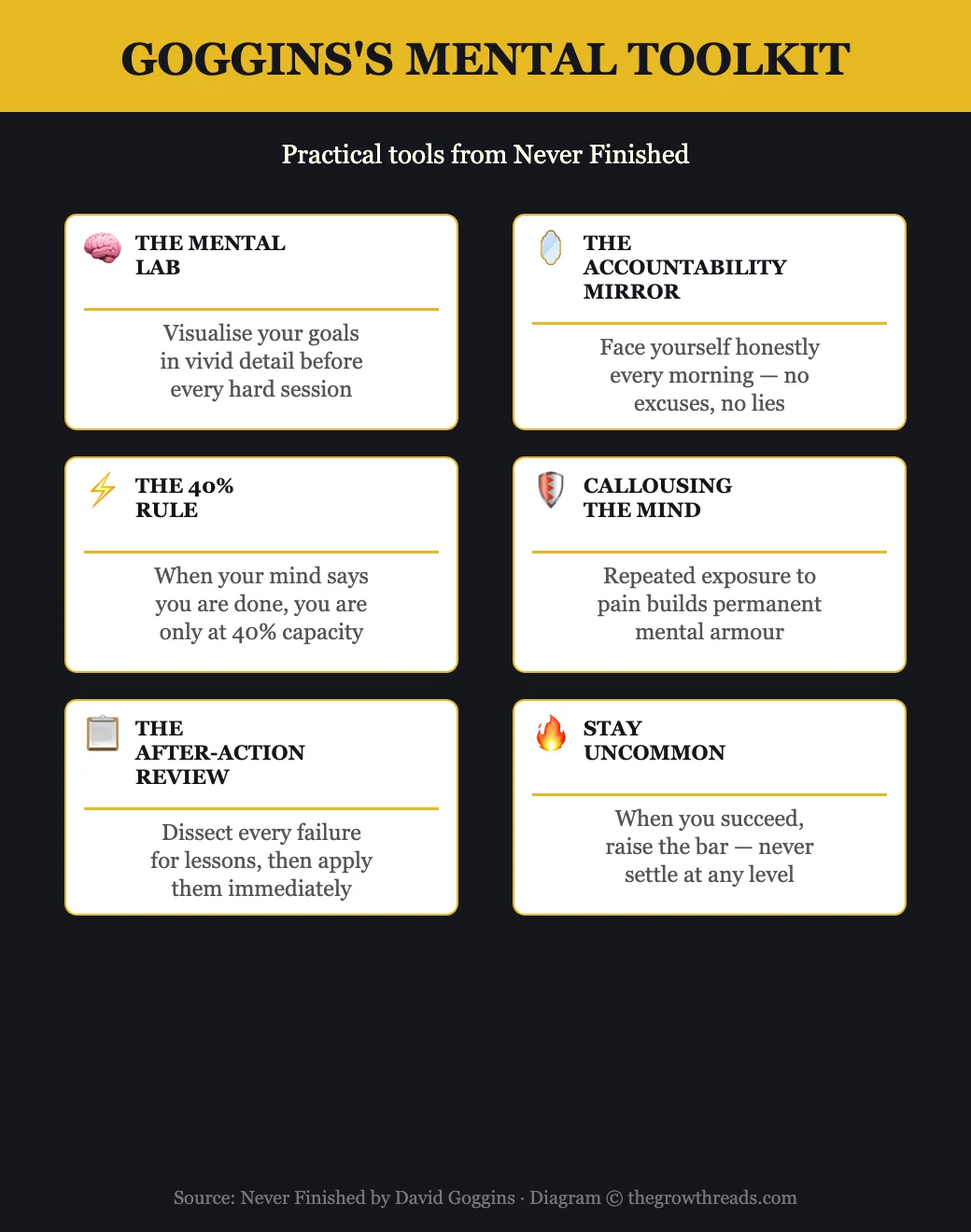
- The mental lab: Before every hard task, visualise the effort in vivid detail. See yourself suffering, pushing through, and completing it.
- Take souls, not credit: Outwork everyone around you so thoroughly that their internal standards shift. Lead by extreme example.
- Callousing the mind never stops: Mental toughness is perishable. If you stop training it, it atrophies — just like a muscle.
- Pain is the admission price: Every meaningful transformation requires suffering. Avoiding pain is choosing mediocrity.
- The accountability mirror: Face yourself honestly every morning. No excuses, no rationalisation, no comfortable lies.
- Write your own story: Nobody is coming to save you. Your circumstances are your starting line, not your ceiling.
What is Never Finished about?
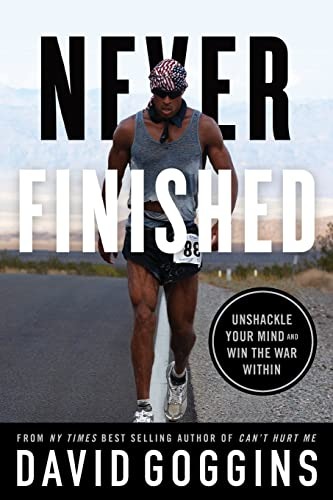
Never Finished is David Goggins’s memoir-sequel to Can’t Hurt Me, revealing how he nearly lost everything after becoming famous — and rebuilt himself through the same principles of extreme mental toughness, voluntary suffering, and relentless self-accountability that made him extraordinary in the first place.
About the author
David Goggins is a retired Navy SEAL, ultramarathon runner, ultra-distance cyclist, and motivational speaker. He overcame childhood abuse, obesity, and a learning disability to complete three Hell Weeks, set the Guinness World Record for pull-ups, and finish some of the world’s hardest endurance events. His first book, Can’t Hurt Me, sold over five million copies. Goggins is known for his unfiltered honesty, his refusal to sugarcoat suffering, and his belief that most people operate at a fraction of their potential. He continues to train, compete, and push the limits of human endurance from his home base in the United States. Explore all David Goggins book summaries →
Key concepts at a glance
| Concept | What it means | Use it when |
|---|---|---|
| The Inner War | The battle between your savage self and your comfort-seeking mind | You feel tempted to quit or coast |
| The 40% Rule | When you think you are done, you have only used 40% of capacity | You hit a wall during training, work, or any hard task |
| Mental Lab | Vivid visualisation of effort before each challenge | You need to prepare mentally for something hard |
| Callousing the Mind | Building mental armour through repeated voluntary discomfort | You want long-term resilience, not temporary motivation |
| Accountability Mirror | Facing yourself honestly every day — no excuses | You are rationalising mediocre effort |
| Stay Uncommon | Refusing to rest on past achievements | Success has made you comfortable |
| Taking Souls | Outworking others so thoroughly that standards shift | You want to lead by example rather than words |
| After-Action Review | Dissecting every failure for lessons and applying them immediately | You failed and want to extract maximum value from it |
Part 1 — The seduction of success
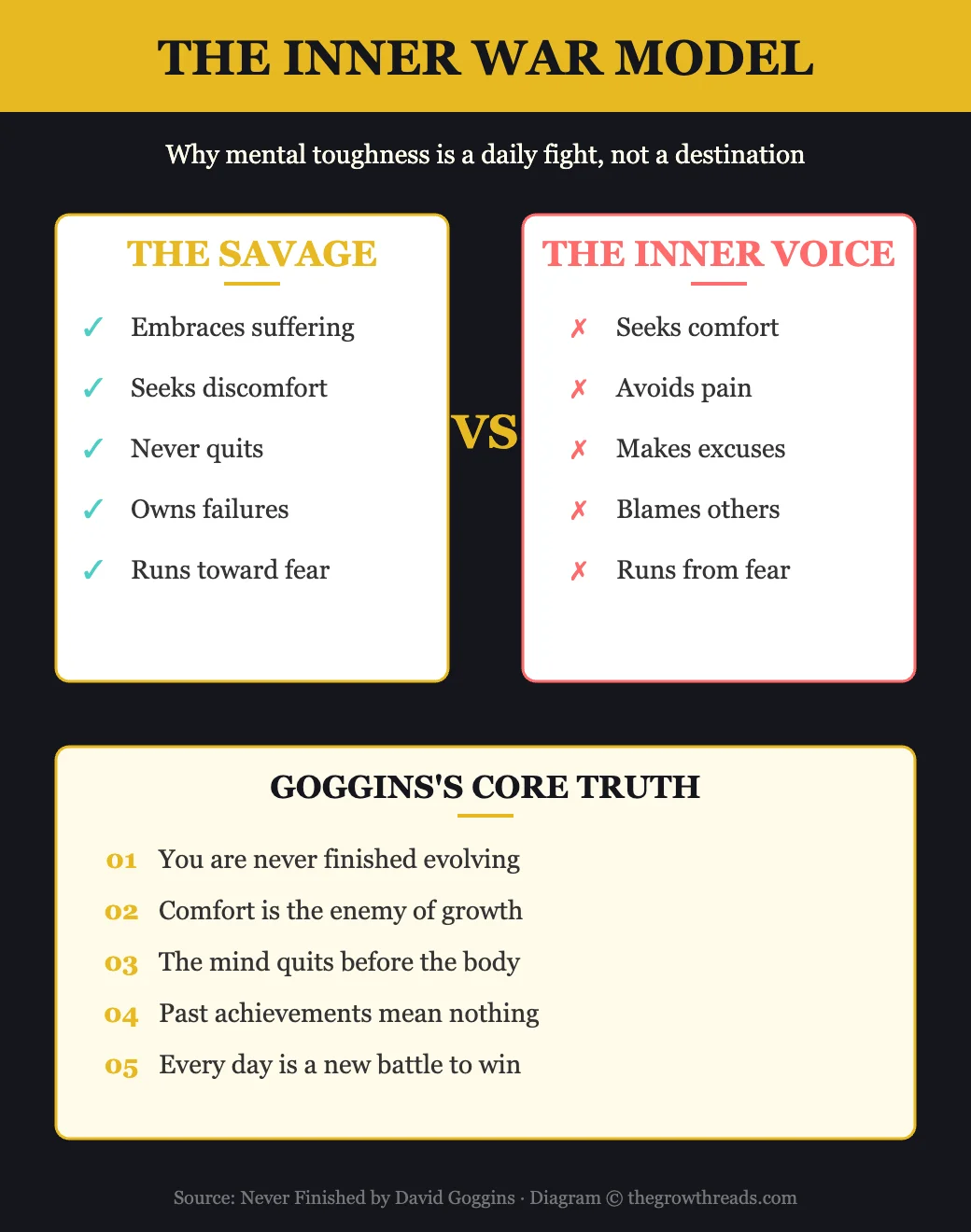
Goggins opens with a confession that will surprise fans of Can’t Hurt Me: after becoming famous, he nearly fell apart. The speaking engagements, podcast appearances, and constant attention created a version of David Goggins that was more brand than warrior. He stopped doing the hard things that made him extraordinary. Injuries piled up — he had multiple knee surgeries and was told by doctors to stop running. His marriage ended. He gained weight. The callouses on his mind softened.
This section is the most psychologically revealing part of the book. Goggins describes how success creates a gravitational pull toward comfort — the same comfort he spent his entire life fighting. When everyone tells you how amazing you are, the internal accountability system weakens. You start believing you have arrived. And arriving, in Goggins’s framework, is the beginning of death.
The antidote, he argues, is treating every day as if you have never accomplished anything. The accountability mirror — a practice from Can’t Hurt Me where you confront yourself honestly each morning — becomes even more important after success because the lies you tell yourself become more sophisticated.
Part 2 — Rebuilding from wreckage
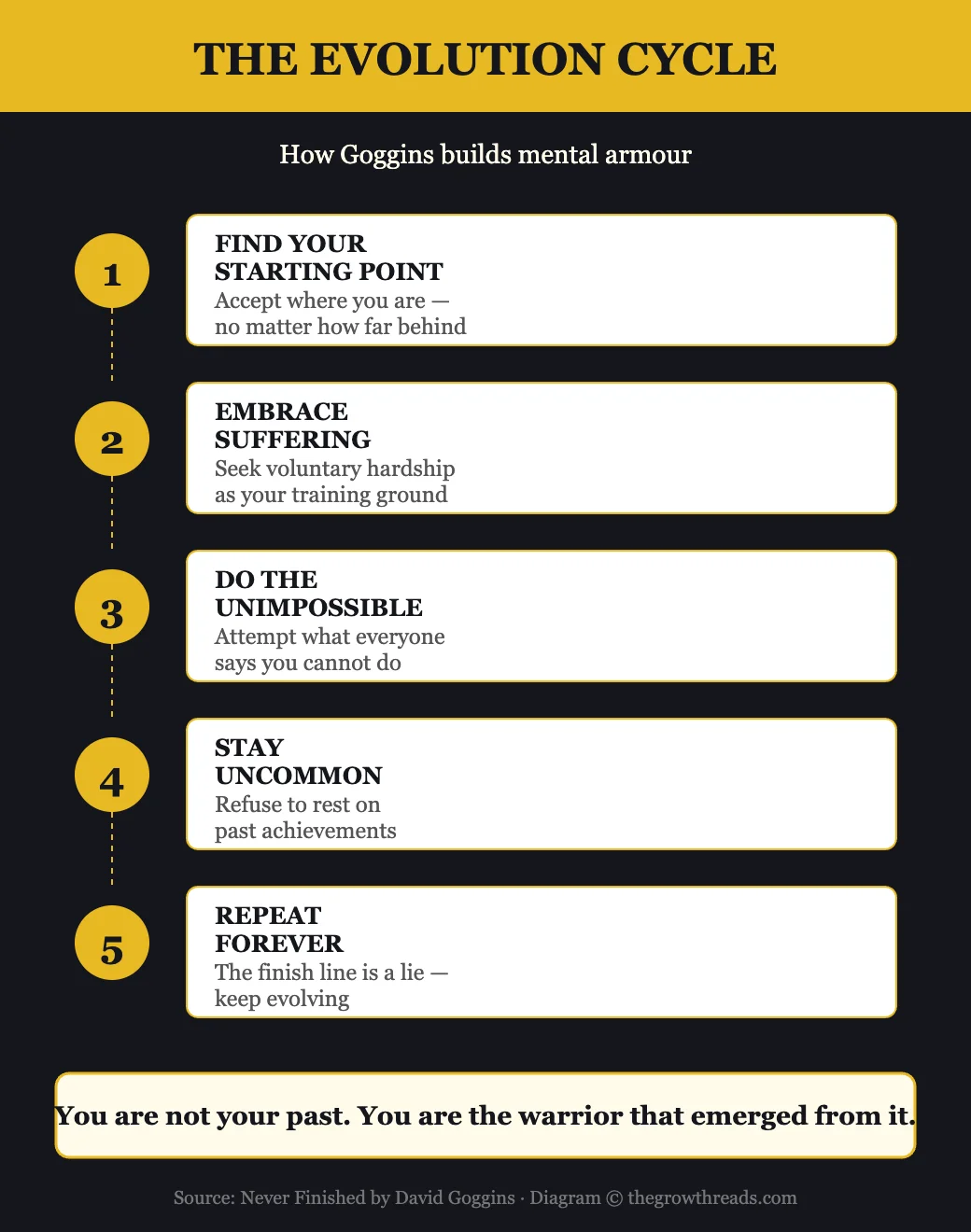
The middle section chronicles Goggins’s physical and mental rebuild. After being told he might never run again, he designed a rehabilitation program that defied medical advice — not recklessly, but through meticulous study of his own body, consultation with specialists, and incremental progress. He returned to ultrarunning and completed events that would challenge healthy athletes half his age.
Goggins introduces the concept of the “mental lab” here — an evolution of the visualisation techniques from his first book. Before every hard session, he sits quietly and runs the entire effort in his mind: the pain, the doubt, the moment he wants to quit, and the decision to keep going anyway. By the time he starts the physical work, he has already rehearsed the suffering and knows he can survive it.
He also deepens the “callousing the mind” framework. In Can’t Hurt Me, this meant building mental toughness through exposure to hard things. In Never Finished, the emphasis shifts to maintenance — recognising that mental callouses soften if you stop training them. Toughness is not a trait you acquire once; it is a practice you maintain daily, like brushing your teeth.
Part 3 — Stay uncommon amongst uncommon
The final section is Goggins’s philosophy distilled to its purest form. “Uncommon amongst the uncommon” means that even within elite groups — SEALs, ultrarunners, Special Operations — most people eventually plateau. They reach a level of achievement that satisfies them and stop pushing. Goggins refuses this. His goal is not to be the best in the room but to be the person who never stops getting better, regardless of what room he is in.
He tells the story of returning to pull-up training after his record was broken, despite having no professional obligation to reclaim it. He ran a 240-mile race through the desert with stress fractures in both feet. He embraced suffering not as punishment but as the price of evolution — and argued that this price is what separates people who achieve temporary success from those who sustain it permanently.
The book closes with a challenge: stop reading about mental toughness and start practising it. Today. Not tomorrow, not when conditions are right, not when you feel motivated. The war within never ends, and the only way to win is to fight it every single day.
Who is Never Finished best for — and who should read something else first?
This book is ideal for readers who loved Can’t Hurt Me and want the next chapter, athletes dealing with injury and comeback, entrepreneurs who have tasted success and feel themselves getting soft, and anyone who needs a raw, unfiltered push to stop coasting.
If you prefer evidence-based, clinical approaches to resilience and mental health, the relentless intensity here may feel overwhelming. In that case, try The Body Keeps the Score by Bessel van der Kolk for trauma-informed resilience, or Spark by John Ratey for the science of exercise and mental performance.
Questions to reflect on
- Where in your life have you stopped pushing because you reached a “good enough” level?
- What is the hardest thing you have done in the last 30 days — and was it hard enough?
- If you faced yourself in the accountability mirror right now, what would you have to admit?
- What would you attempt if you applied the 40% rule — believing you have far more capacity than you think?
- Are you maintaining your mental callouses, or have they started to soften?
🔥 Ready to unshackle your mind?
The war within never ends. Win today’s battle.
How to apply Never Finished (7-day plan)
- Day 1 — Accountability mirror: Stand in front of a mirror for two minutes. Say out loud where you are falling short. No excuses, no softening. Write down the three biggest truths.
- Day 2 — Find your 40%: During your next workout or hard task, note the exact moment you want to quit. Push 20% further. Record how it felt and what you learned.
- Day 3 — Mental lab session: Before your hardest task tomorrow, spend five minutes visualising the entire effort — the pain, the doubt, and the decision to push through.
- Day 4 — Voluntary suffering: Do something physically hard that you would normally avoid: a cold shower, a hill sprint, an extra set. The point is the discomfort, not the activity.
- Day 5 — After-action review: Pick a recent failure or setback. Write down exactly what went wrong, what you could have done differently, and what you will change going forward.
- Day 6 — Stay uncommon: Identify one area where you have been coasting on past achievement. Set a new, harder target in that area.
- Day 7 — Design your war plan: Commit to one daily practice from this list as a permanent addition to your routine. Mental toughness is perishable — train it daily or lose it.
Frequently asked questions
Do I need to read Can’t Hurt Me before Never Finished?
Not strictly, but it helps. Can’t Hurt Me provides Goggins’s origin story — childhood abuse, obesity, Navy SEAL training — that gives Never Finished its emotional weight. Never Finished assumes you know the backstory and focuses on what happened after the first book’s success. Reading both in order delivers the most complete picture of his philosophy and evolution.
What is the main message of Never Finished?
The core message is that mental toughness is not a destination but a daily practice that never ends. Goggins argues that success, comfort, and past achievements are the most dangerous threats to growth — more dangerous than poverty or failure — because they make you believe you have arrived. The book is a case for permanent evolution through voluntary suffering and relentless self-accountability.
What is the 40% rule?
The 40% rule is Goggins’s principle that when your mind tells you that you are finished, you have actually used only about 40% of your total capacity. The brain creates the sensation of exhaustion as a protective mechanism long before the body truly fails. By recognising this mental governor and pushing past it, you access reserves of physical and mental energy you did not know you had.
Is Never Finished only for athletes and military people?
No. While Goggins draws heavily on athletic and military examples, the principles apply to any domain that requires sustained effort: entrepreneurship, creative work, academic study, recovery from illness, or personal transformation. The mental toolkit — accountability mirror, mental lab, after-action review — can be adapted to any challenging pursuit regardless of physical fitness level.
How is Never Finished different from Can’t Hurt Me?
Can’t Hurt Me is an origin story — how Goggins went from an abused, overweight child to a Navy SEAL and ultramarathon runner. Never Finished picks up after the fame and focuses on the harder, less glamorous battle: staying hungry after success, rebuilding after injury, and maintaining mental toughness when the external pressure to grow disappears. The sequel is rawer, more introspective, and more focused on the long game.
Is Goggins’s approach healthy or extreme?
Both, depending on application. Goggins is the first to acknowledge that his level of physical intensity has caused serious injuries. The value for most readers is not replicating his exact regimen but adopting his mental framework: embracing discomfort deliberately, refusing to coast, and holding yourself accountable without excuses. Applied with common sense, these principles build resilience without requiring ultramarathon-level suffering.
How long does it take to read Never Finished?
The book is 312 pages and reads quickly due to Goggins’s direct, conversational style. Most readers finish it in 6–8 hours. The audiobook, narrated by Goggins himself, runs approximately 7 hours and 30 minutes and includes his characteristic intensity and unfiltered commentary that many listeners prefer over the print version.
Related summaries
If this summary fired you up, explore these related reads:
- Can’t Hurt Me by David Goggins — the origin story and the foundational mental toughness framework.
- The Comfort Crisis by Michael Easter — the science behind why discomfort improves health, focus, and life satisfaction.
- Extreme Ownership by Jocko Willink — Navy SEAL leadership principles built on total accountability.
- The Obstacle Is the Way by Ryan Holiday — the Stoic framework for turning adversity into advantage.
📚 Explore more: Best Health Books — Our Complete Ranked List
Related Health Summaries
In Defense of Food Summary & Review: Eat Food, Not Too Much, Mostly Plants
The Blood Sugar Solution Summary and Review
The China Study Summary & Review: The Case for Plant-Based Eating
The Longevity Diet Summary & Review: Valter Longo’s Science-Backed Plan for Living Longer
The Sleep Revolution Summary and Review