

★★★★☆ 4.3 / 5
One-liner: A neuroscience-based guide to creating secure, lasting relationships by understanding how your and your partner’s nervous systems drive your behavior in love.
Best for: Couples who fight in destructive patterns and want to understand the neuroscience behind their conflicts, and anyone interested in attachment theory applied to daily relationship life.
Reading time: ~5 hours (240 pages)
Difficulty to apply: Moderate — the concepts require genuine self-awareness and partner cooperation, but the “couple bubble” framework provides immediate structure.
Wired for Love in one minute
Your romantic conflicts are not about who left the dishes in the sink — they are about two nervous systems trying to feel safe with each other. Stan Tatkin, a clinician and researcher in the field of couple therapy, draws on neuroscience and attachment theory to explain why couples get stuck in destructive patterns and how to break free. He introduces three attachment styles — anchors (secure), islands (avoidant), and waves (anxious) — and shows how each style’s wiring creates predictable conflict triggers. His central prescription is the “couple bubble”: a mutual agreement between partners to prioritize each other’s safety and well-being above all else. When both partners commit to protecting each other’s nervous systems, conflicts become manageable because the underlying security is never in question.
Key takeaways
- Attachment is neurobiological: Your attachment style is not a personality quirk — it is a wiring pattern laid down in early childhood that affects how your nervous system responds to closeness, conflict, and separation.
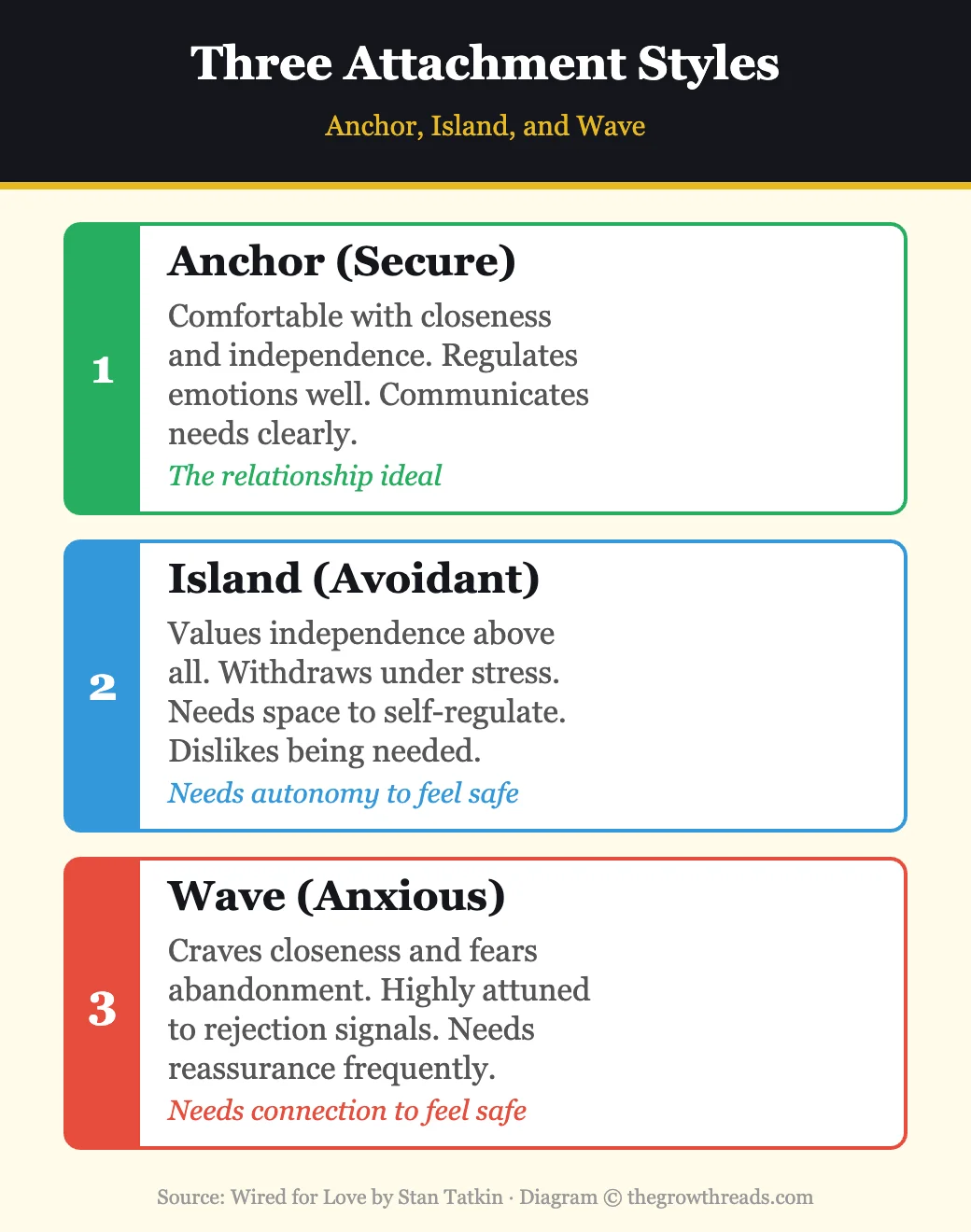
- Three styles shape every couple: Anchors (secure) handle intimacy and independence well. Islands (avoidant) need space and self-sufficiency. Waves (anxious) need closeness and reassurance. Most conflicts arise from style clashes.
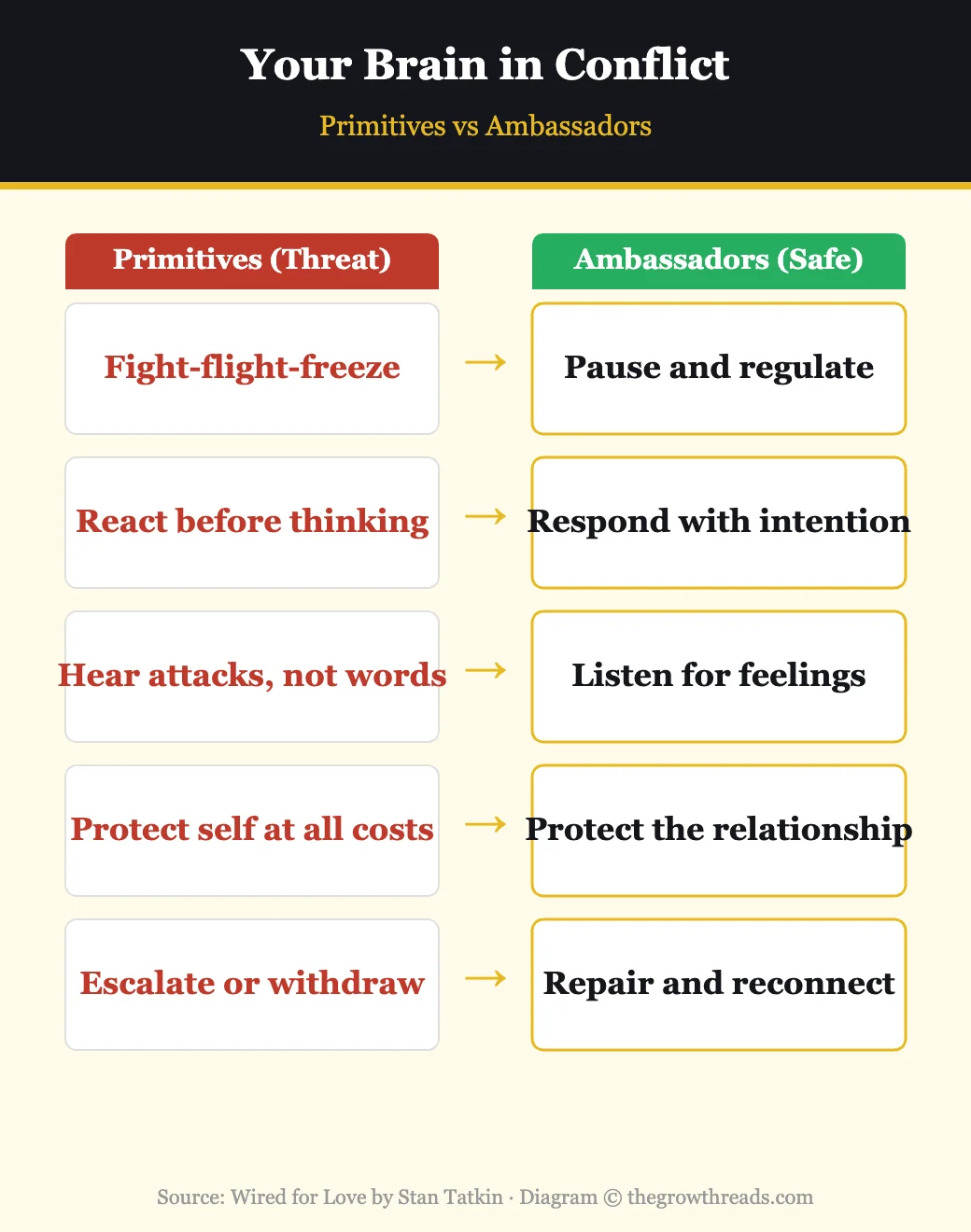
- Your brain has primitives and ambassadors: Under threat, your brain’s primitive survival systems (amygdala-driven fight/flight/freeze) hijack rational thinking. Learning to activate your “ambassadors” (prefrontal cortex) during conflict changes everything.
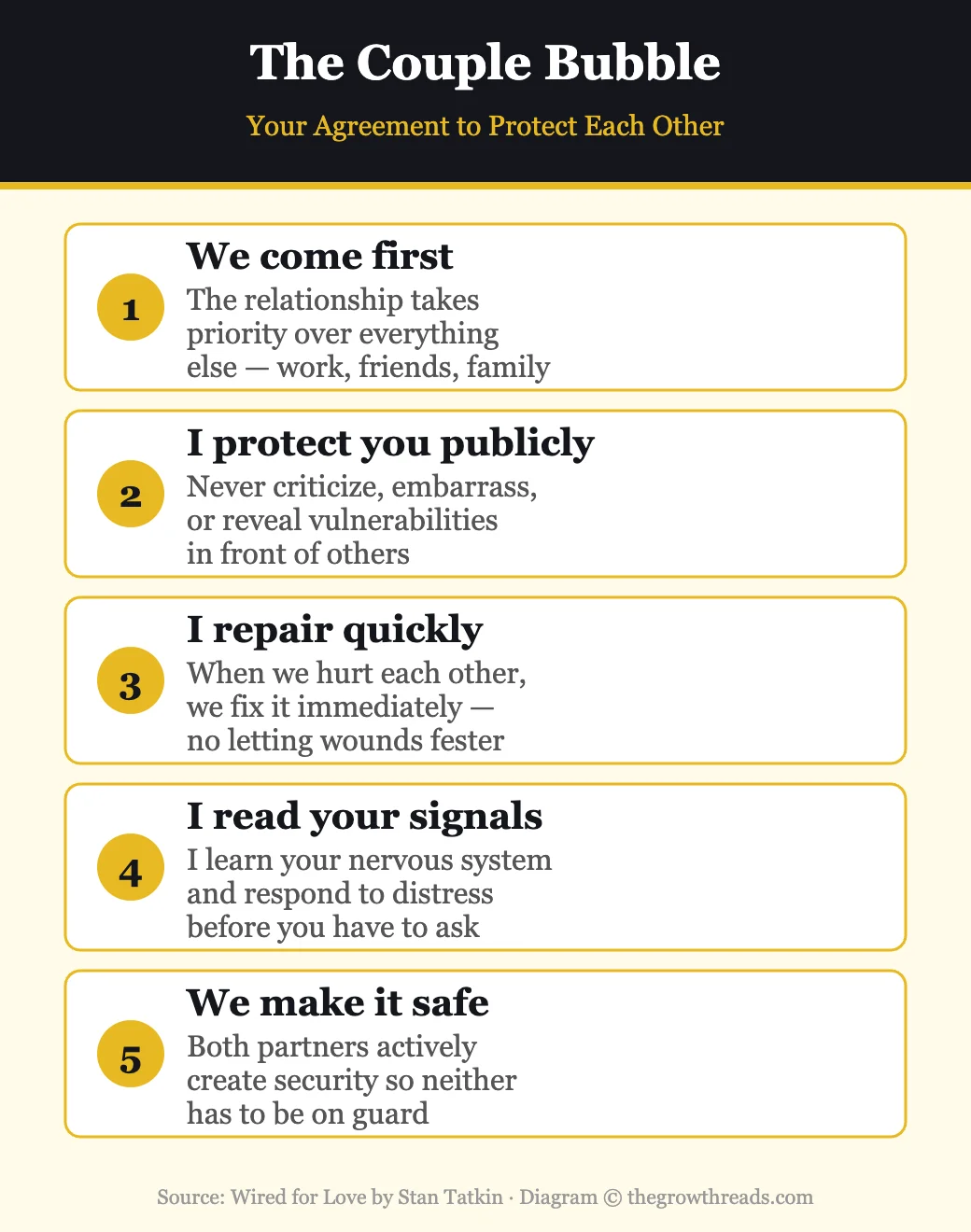
- The couple bubble is the foundation: An explicit agreement that “we come first” — that both partners will protect each other publicly, repair ruptures quickly, and create mutual safety — transforms the entire relationship dynamic.
- Morning and nighttime rituals matter: How you greet each other in the morning and how you reconnect at night are the two most important moments of the day for maintaining your couple bubble.
- Learn to read your partner’s nervous system: Recognizing the signs that your partner is dysregulated (elevated voice, withdrawal, fidgeting) and responding with calming instead of escalation is the core skill of a secure relationship.
- Repair is more important than prevention: Every couple will hurt each other. What distinguishes secure couples is not the absence of ruptures but the speed and quality of repair.
- Fighting fairly means managing arousal: Conflicts become destructive when one or both partners’ nervous systems go into threat mode. Managing physiological arousal (eye contact, physical touch, voice tone) keeps the ambassadors in charge.
What is Wired for Love about?
Wired for Love is a relationship book by psychotherapist Stan Tatkin that uses neuroscience and attachment theory to explain why couples get stuck in destructive conflict patterns. Tatkin introduces three attachment styles — anchors, islands, and waves — and provides a framework called the “couple bubble” for creating a secure relationship where both partners’ nervous systems feel safe, enabling genuine intimacy, effective conflict resolution, and lasting connection.
About the author
Stan Tatkin is a clinician, researcher, teacher, and developer of the Psychobiological Approach to Couple Therapy (PACT), which integrates attachment theory, developmental neuroscience, and arousal regulation into a comprehensive model for working with couples. He holds a PsyD in clinical psychology and is an assistant clinical professor at the UCLA David Geffen School of Medicine. His clinical approach emerged from decades of working with couples in distress and studying how the brain’s threat-detection systems interact with romantic attachment. Wired for Love, published in 2012, became a bestseller that brought complex neuroscience concepts into accessible, practical relationship advice. He has since written Wired for Dating and We Do, and his PACT training program has certified therapists in over 20 countries. Explore all Stan Tatkin book summaries →
Key concepts at a glance
| Concept | What it means | Use it when |
|---|---|---|
| Anchor (secure) | Comfortable with both intimacy and independence; regulates emotions effectively | You want to understand what secure attachment looks and feels like in practice |
| Island (avoidant) | Prioritizes autonomy and self-regulation; withdraws under stress; needs space | Your partner shuts down during arguments and you don’t understand why |
| Wave (anxious) | Craves closeness and reassurance; highly sensitive to rejection; pursues during conflict | You notice yourself chasing your partner when they pull away |
| Couple bubble | A mutual agreement to prioritize each other’s safety and well-being above all else | You want to create the foundational security that makes everything else work |
| Primitives | Brain’s threat-response systems (amygdala) that hijack rational thinking during conflict | You or your partner say things in fights that you don’t mean and can’t take back |
| Ambassadors | Brain’s rational, empathic systems (prefrontal cortex) that enable thoughtful response | You want to stay calm and constructive during difficult conversations |
| Arousal regulation | Managing your and your partner’s physiological activation levels during conflict | Arguments escalate physically (racing heart, raised voice) before you can think clearly |
Part 1: Understanding your wiring — attachment styles
Tatkin opens by introducing the neurobiological basis of attachment. Drawing on the work of John Bowlby and Mary Ainsworth, he explains that your attachment style is not something you chose — it was shaped by how your primary caregivers responded to your needs in the first years of life. Children whose caregivers were consistently responsive develop secure attachment (anchors). Those whose caregivers were emotionally unavailable learn to self-soothe and suppress their need for connection (islands). Those whose caregivers were inconsistently responsive become hypervigilant about closeness and rejection (waves).
The practical implication is that every couple is a combination of these styles, and each combination creates predictable patterns. Island-wave pairings (the most common problematic dynamic) produce a pursue-withdraw cycle: the wave seeks more closeness when stressed, which feels suffocating to the island, who withdraws, which triggers more pursuit from the wave. Neither partner is “wrong” — their nervous systems are operating exactly as they were wired to operate. Understanding this removes blame and opens the door to intentional change.
Tatkin emphasizes that attachment style is not destiny. Insecure styles (island and wave) can move toward earned security through conscious effort, therapeutic work, and the experience of a secure relationship. The goal is not to change your partner’s wiring but to understand it well enough to work with it rather than against it.
Part 2: The couple bubble — creating mutual security
The couple bubble is Tatkin’s central concept and his most practical contribution. It is an explicit, verbalized agreement between partners that their relationship comes first — before work, extended family, friends, children, and individual interests. This sounds extreme, and Tatkin acknowledges that. But he argues that without this foundational priority, neither partner’s nervous system can relax enough to allow genuine vulnerability, honest communication, or sustainable intimacy.
The couple bubble operates through specific commitments. Partners agree to never threaten the relationship during conflict (no “maybe we should break up” as a weapon), to protect each other in public (never criticize or embarrass your partner in front of others), to repair ruptures quickly (ideally within minutes, not hours or days), and to make decisions jointly about anything that affects both partners. These commitments create a container of safety that allows both people to bring their full, imperfect selves to the relationship.
Tatkin prescribes specific rituals to maintain the couple bubble: a meaningful morning greeting (eye contact, physical touch, expressed warmth), a reunification ritual at the end of the workday (transition from individual mode to couple mode), and a bedtime ritual (physical closeness, gratitude, or conversation). These rituals are not romantic extras — they are neurobiological maintenance, keeping both partners’ nervous systems calibrated for security.
Part 3: Fighting well — managing your primitives
The final major section addresses conflict, which Tatkin reframes not as a communication problem but as a nervous system problem. When a couple fights, both partners’ brains shift from “ambassador” mode (prefrontal cortex — rational, empathic, perspective-taking) to “primitive” mode (amygdala-driven — threat detection, fight/flight/freeze). In primitive mode, your partner becomes the enemy. You hear attacks where none were intended, you say things designed to wound, and you cannot access the part of your brain that remembers you love this person.
Tatkin’s approach to fighting well centers on arousal regulation — managing the physiological activation that pushes both partners into primitive mode. Specific techniques include maintaining eye contact during difficult conversations (which activates social engagement circuits and inhibits threat responses), using physical touch to co-regulate (holding hands, sitting close), keeping voices at conversational volume, and taking structured breaks when arousal gets too high (with an explicit agreement to return to the conversation within a defined time).
He introduces the concept of “quick repair” — the idea that what matters most in conflict is not preventing ruptures (which is impossible) but repairing them rapidly. Secure couples repair within minutes; insecure couples let ruptures fester for hours, days, or weeks, during which the wound compounds and resentment calcifies. Tatkin teaches couples to use physical approach (not withdrawal), genuine apology (not defensive explanation), and expressed care (not logical argument) as repair tools.
Who is Wired for Love best for — and who should read something else first?
Wired for Love is best for couples who recognize destructive conflict patterns but don’t understand why they keep repeating them. It is especially powerful for island-wave pairings where one partner pursues and the other withdraws, creating a cycle that neither can break alone. The neuroscience framing helps remove blame and replace it with understanding, which makes it easier for both partners to engage with the material together.
If you want a broader relationship framework before diving into neuroscience, start with our Seven Principles summary by John Gottman. If your primary focus is healing from attachment wounds rather than managing current conflicts, our Hold Me Tight summary by Sue Johnson provides the therapeutic approach. And if you want to understand the five specific ways people express love (a more behavioral framework), our 5 Love Languages summary by Gary Chapman offers the complementary perspective.
Questions to reflect on
- Based on the descriptions, are you more of an anchor, island, or wave — and what about your partner? How does your combination create specific conflict patterns?
- When you and your partner fight, can you identify the moment your “primitives” take over? What are the physical signals — racing heart, tight jaw, urge to flee?
- Do you and your partner have a couple bubble — an explicit agreement that your relationship comes first — or is that priority implicit and sometimes violated?
- How do you greet each other in the morning and reconnect at the end of the day? Are these moments intentional or automatic?
- When there is a rupture between you, how quickly does repair happen — minutes, hours, or days? What would it take to shorten that timeline?
🔥 Ready to understand your relationship’s wiring?
Start with the couple bubble — it changes everything.
How to apply Wired for Love (7-day plan)
- Day 1 — Identify your attachment styles: Read Tatkin’s descriptions of anchors, islands, and waves. Identify your own style and your partner’s. Discuss together without judgment — this is wiring, not character.
- Day 2 — Create your couple bubble: Sit down together and explicitly agree: “Our relationship comes first.” Discuss what this means practically — how you’ll handle conflicts with extended family, work demands, and outside friendships.
- Day 3 — Establish a morning ritual: Before leaving each other in the morning, make eye contact, say something warm, and touch (hug, kiss, hand on shoulder). Time: 30 seconds. Impact: disproportionate.
- Day 4 — Establish an evening reunion ritual: When you reunite at the end of the day, take two minutes to greet each other fully before attending to children, phones, or tasks. Make the transition from “individual mode” to “couple mode” intentional.
- Day 5 — Practice reading signals: Throughout the day, notice your partner’s nonverbal cues — tone of voice, facial expression, body language. When you detect stress, respond with calming (“You seem tense — what do you need?”) rather than ignoring or matching.
- Day 6 — Practice quick repair: If a conflict arises today, try to repair within 15 minutes. Use physical approach (not withdrawal), genuine apology, and expressed care. If no conflict occurs, discuss how you’ve handled past ruptures and what you’d do differently.
- Day 7 — Review and commit: Together, review the week. Which rituals felt natural? Which felt awkward? What changed in the relationship’s emotional tone? Commit to continuing the practices that worked for the next 30 days.
Frequently asked questions
What is the couple bubble?
The couple bubble is Tatkin’s central concept — an explicit mutual agreement between partners that their relationship comes first, before work, family, friends, or individual interests. It includes specific commitments: never threatening the relationship during conflict, protecting each other publicly, repairing ruptures quickly, and making joint decisions. The couple bubble creates neurobiological safety, allowing both partners’ nervous systems to relax and enabling genuine intimacy and constructive conflict.
What are the three attachment styles in Wired for Love?
Tatkin uses the terms anchor (secure — comfortable with closeness and independence), island (avoidant — prioritizes autonomy, withdraws under stress, needs space to self-regulate), and wave (anxious — craves closeness, fears abandonment, pursues during conflict). These map onto the standard attachment theory categories but use more accessible, less clinical language. Most relationship conflicts stem from style mismatches, particularly the island-wave pursue-withdraw dynamic.
Can attachment styles change?
Yes. Tatkin emphasizes that insecure attachment styles (island and wave) can move toward earned security through conscious effort, therapeutic work, and — most powerfully — the experience of a genuinely secure relationship. When an insecure person is consistently met with safety, responsiveness, and repair by their partner, their nervous system gradually recalibrates. This doesn’t erase the original wiring but creates new, more secure patterns alongside it.
What are primitives and ambassadors?
Primitives are Tatkin’s term for the brain’s threat-response systems — primarily the amygdala and brainstem — that activate during conflict and produce fight, flight, or freeze responses. Ambassadors are the prefrontal cortex systems responsible for rational thinking, empathy, perspective-taking, and impulse control. During relationship conflict, primitives often hijack ambassadors, causing partners to say and do things they regret. Learning to recognize and manage this shift is the core skill Tatkin teaches.
How is Wired for Love different from other relationship books?
Most relationship books focus on communication skills (what to say and how to say it). Wired for Love focuses on the nervous system — the biological machinery that determines whether you can even access those communication skills during conflict. Tatkin’s unique contribution is showing that relationship problems are often regulation problems: when both partners’ nervous systems feel safe, communication happens naturally; when they don’t, no script or technique can overcome the biological threat response.
Do I need my partner to read the book too?
Ideally yes — Tatkin’s approach works best when both partners understand their wiring and agree to the couple bubble. However, one partner can create significant change unilaterally by learning to regulate their own nervous system during conflict, responding to their partner’s distress with calming rather than escalation, and modeling the repair behaviors Tatkin describes. Often, when one partner changes their response pattern, the other partner’s pattern shifts in response.
Is Wired for Love still relevant in 2026?
Absolutely. The neuroscience of attachment and arousal regulation has only been further validated since publication. Tatkin’s PACT approach is now taught in over 20 countries, and his training program continues to grow. In an era of constant digital distraction that threatens couple connection, the couple bubble concept is more practically useful than ever — it provides a clear, enforceable framework for prioritizing your relationship in a world that competes for every moment of your attention.
Related summaries
- Hold Me Tight by Sue Johnson — the Emotionally Focused Therapy approach to healing attachment wounds and creating secure bonds.
- The Relationship Cure by John Gottman — the science of emotional bids and why small moments of connection build lasting relationships.
- The Seven Principles for Making Marriage Work by John Gottman — the most comprehensive research-backed guide to what makes marriages succeed.
- Emotional Intelligence by Daniel Goleman — the foundational science of emotional regulation that underpins Tatkin’s approach.
Related Relationships Summaries
Daring Greatly Summary & Review: Why Vulnerability Is the Ultimate Courage
Never Split the Difference Summary & Review: FBI Negotiation Tactics for Everyday Life
Rising Strong Summary & Review: How to Get Back Up When Vulnerability Knocks You Down
Supercommunicators Summary & Review: The Secret Language of Connection
Toxic Parents Summary & Review: Susan Forward’s Guide to Breaking Free from Hurtful Family Patterns