

⭐⭐⭐⭐⭐ 4.4/5
Actionability: 3.8/5 · Evidence Quality: 4.7/5 · Writing Clarity: 4.8/5 · Uniqueness: 4.6/5 · Lasting Relevance: 4.3/5
One-liner: The most entertaining and accessible guide to the immune system ever written — by the creator of Kurzgesagt.
Best for: Anyone who wants to understand how their body defends itself — no biology degree required.
Reading time: ~7 hours (368 pages)
Difficulty to apply: Low for the lifestyle chapters; the deeper science is for understanding, not direct action.
Immune in One Minute
Your immune system is the most complex biological system in your body after your brain — and you probably know almost nothing about it. Philipp Dettmer, the creator of the wildly popular Kurzgesagt science channel, takes readers on a visual, deeply engaging tour of this hidden army. From the physical barriers of skin and mucus to the precision-guided missiles of adaptive immunity, the book reveals how trillions of cells coordinate to keep you alive every second of every day. Dettmer explains why fever helps, how vaccines work, what autoimmune diseases actually are, and why your gut microbiome is your immune system’s most important ally. The result is a book that makes immunology not just comprehensible but genuinely fascinating.
Key Takeaways
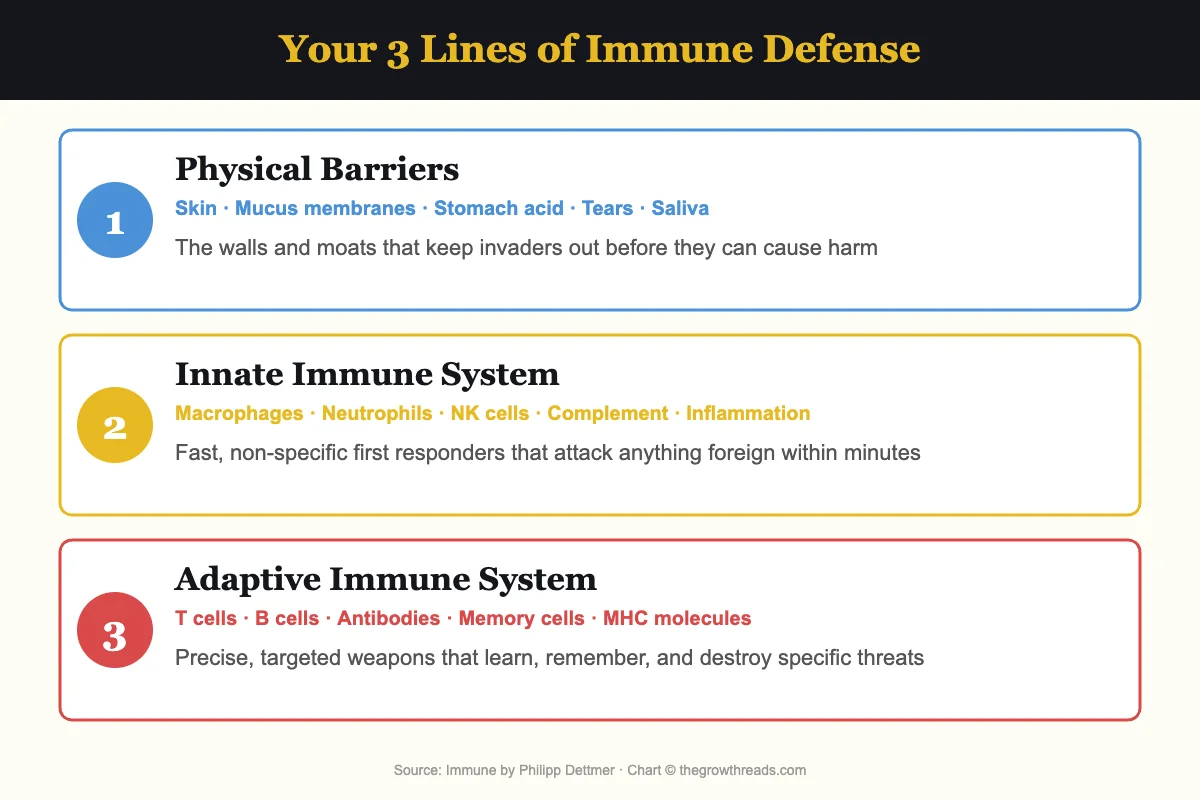
- Your immune system has three lines of defense: Physical barriers (skin, mucus), the fast-responding innate immune system, and the precise adaptive immune system that remembers every pathogen it has ever fought.
- Inflammation is a feature, not a bug: Redness, swelling, and pain are your immune system creating a hostile battlefield for invaders — but chronic inflammation becomes destructive when it never turns off.
- Your complement system is your unsung hero: These 30+ proteins coat bacteria, punch holes in their membranes, and summon immune cells — all without any instructions from the brain.
- T cells are the generals of adaptive immunity: Helper T cells coordinate the attack, killer T cells destroy infected cells, and regulatory T cells prevent friendly fire against your own tissues.
- Antibodies are precision weapons: Each B cell produces antibodies that fit one specific pathogen like a lock and key — and your body can generate antibodies for billions of different shapes.
- Vaccines train your army safely: They introduce harmless fragments of a pathogen so your adaptive immune system builds memory cells without the danger of real infection.
- Your gut microbiome trains your immune system: Trillions of bacteria in your intestines constantly educate immune cells about what is dangerous and what is safe.
- Sleep is non-negotiable for immunity: Even one night of poor sleep measurably reduces T cell function and increases susceptibility to infection.
- Autoimmune diseases are friendly fire: When the immune system mistakes the body’s own tissues for threats, it creates chronic inflammation that damages organs and joints.
- Stress is an immunosuppressant: Chronic cortisol exposure suppresses immune surveillance and weakens both innate and adaptive responses.
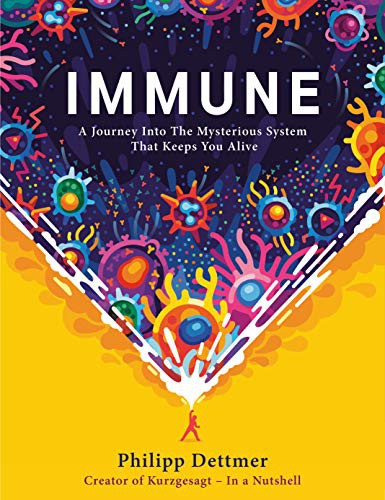
What Is Immune About?
Immune is a comprehensive visual guide to the human immune system written for a general audience. Philipp Dettmer explains how your body’s defense network works at every level — from the physical barriers of skin and stomach acid through the rapid-response innate system to the precision-targeted adaptive immune system. The book covers viruses, bacteria, parasites, allergies, autoimmune diseases, cancer, vaccines, and the gut microbiome.
About the Author
Philipp Dettmer is a German information designer, science communicator, and the founder of Kurzgesagt — In a Nutshell, one of the largest educational YouTube channels in the world with over 23 million subscribers and billions of views. Dettmer developed his talent for explaining complex science visually through years of creating animated videos on topics from black holes to the immune system. His personal experience battling a severe illness inspired him to dive deep into immunology, ultimately producing this book. He lives in Munich, Germany. Explore all Philipp Dettmer book summaries → Explore all Philipp Dettmer book summaries →
Key Concepts at a Glance
| Concept | What It Means | Use It When |
|---|---|---|
| Innate Immunity | Fast, non-specific first responders (macrophages, neutrophils, NK cells) | Understanding why you feel sick within hours of infection |
| Adaptive Immunity | Slow but precise response using T cells and antibodies | Understanding how vaccines and immunity work |
| Complement System | 30+ proteins that coat, puncture, and mark pathogens | Appreciating the complexity of even basic immune responses |
| MHC Molecules | Surface markers that present pathogen fragments to T cells | Understanding transplant rejection and autoimmunity |
| Immunological Memory | Memory B and T cells that respond faster to repeat infections | Understanding why you rarely get the same illness twice |
| Microbiome | Trillions of gut bacteria that train and regulate immunity | Making dietary choices that support immune health |
| Cytokine Storm | Immune overreaction that damages the body more than the pathogen | Understanding severe illness and sepsis |
Part 1: The Barriers and the Innate Immune System
Dettmer begins with the defenses most people never think about: the physical barriers that stop the vast majority of pathogens before they ever reach a single immune cell. Your skin is a fortress of dead cells layered twenty to thirty deep, coated in antimicrobial peptides and acids that make it hostile to most bacteria and viruses. Your mucus membranes — lining your nose, throat, lungs, and gut — trap pathogens in sticky mucus and sweep them out with tiny hair-like cilia.
When a pathogen breaches these barriers — through a cut, an inhalation, or contaminated food — the innate immune system activates within minutes. Macrophages, the body’s patrol officers, are already stationed in every tissue. They engulf and digest invaders through a process called phagocytosis, then release chemical signals called cytokines that summon reinforcements. Neutrophils — the most abundant and most aggressive immune cells — flood the site, killing pathogens and dying in such numbers that their corpses form pus.
The complement system deserves special attention because it operates entirely automatically. These thirty-plus proteins circulate in your blood in an inactive state, waiting to encounter a bacterial surface. When they do, they activate in a cascade: coating the bacterium to mark it for destruction (opsonization), punching holes in its membrane to kill it directly, and releasing fragments that act as chemical beacons for immune cells. All of this happens without any conscious control or even instructions from the brain.
Inflammation — the redness, heat, swelling, and pain that everyone recognizes — is the innate system’s deliberate strategy. By widening blood vessels and making them leaky, inflammation floods the infected area with immune cells and proteins. It also raises the local temperature, which slows bacterial reproduction and speeds up immune cell activity. The discomfort you feel during inflammation is a sign that your immune system is working exactly as designed.
Part 2: The Adaptive Immune System — Learning and Memory
The adaptive immune system is where Dettmer’s storytelling truly shines. While the innate system fights with brute force, the adaptive system fights with precision. Its foundation is an almost inconceivably diverse army: your body generates T cells and B cells with billions of different receptor shapes, each capable of recognizing one specific molecular pattern. This diversity is generated through a process of random genetic recombination in the thymus (T cells) and bone marrow (B cells).
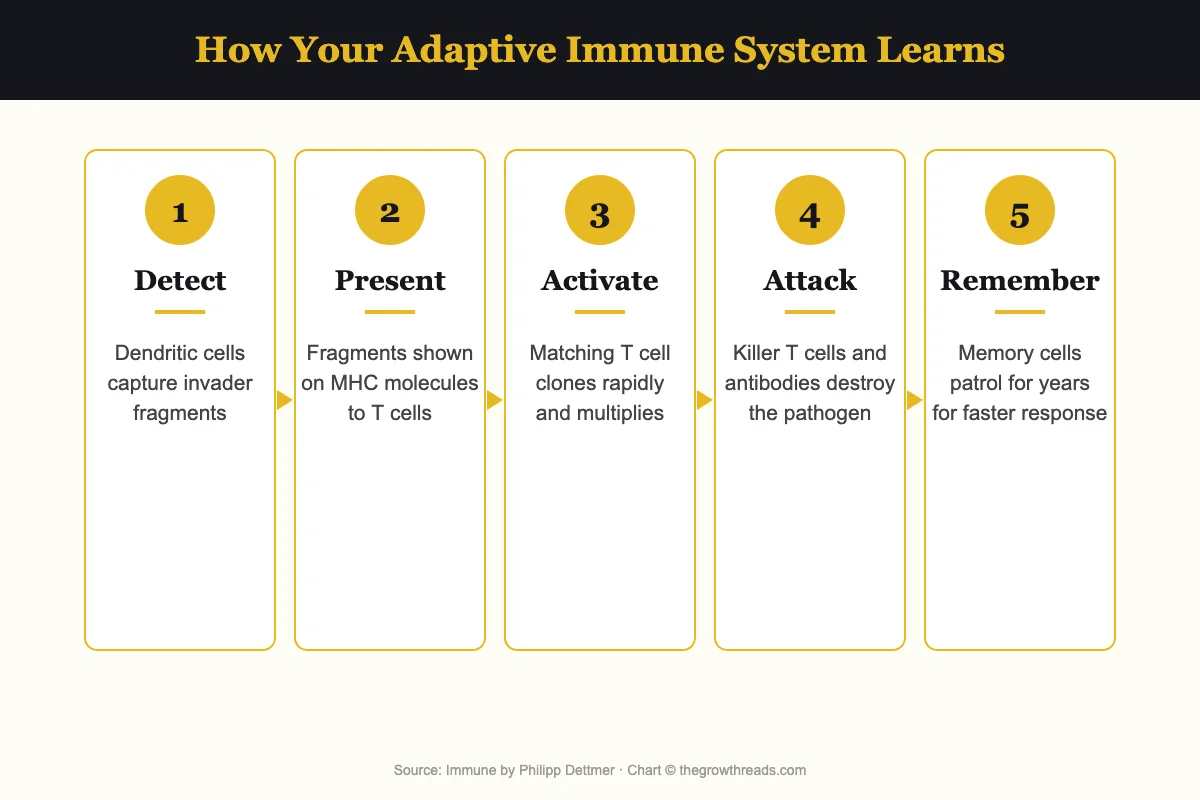
The bridge between innate and adaptive immunity is the dendritic cell — Dettmer calls it the immune system’s intelligence officer. Dendritic cells patrol tissues, collecting fragments of pathogens. When they find something dangerous, they travel to the nearest lymph node and present these fragments on their surface using MHC molecules. Inside the lymph node, millions of T cells examine these fragments. When a T cell finds a match — its receptor fits the presented fragment like a key in a lock — it activates, clones itself rapidly, and launches a targeted assault.
Helper T cells coordinate the broader response, activating B cells to produce antibodies and recruiting killer T cells to destroy infected cells. Killer T cells are the immune system’s assassins: they recognize cells displaying viral fragments on their surface and force those cells to self-destruct, eliminating virus factories before they can spread. B cells, once activated by helper T cells, transform into plasma cells that pump out up to 2,000 antibodies per second — each one a Y-shaped protein designed to latch onto one specific pathogen and neutralize it.
The most remarkable feature of adaptive immunity is memory. After the infection is cleared, most T and B cells die off, but a small population of memory cells survives for years or decades. These memory cells patrol the body, ready to mount a faster and more powerful response if they encounter the same pathogen again. This is why you rarely get measles or chickenpox twice, and it is the principle that makes vaccination possible.
Part 3: When the System Fails — Allergies, Autoimmunity, and Cancer
Dettmer devotes a substantial section to what happens when the immune system malfunctions. Allergies are a case of mistaken identity: the immune system classifies a harmless substance — pollen, peanut protein, dust mites — as a dangerous pathogen and mounts a full inflammatory response against it. The culprit is immunoglobulin E (IgE), an antibody type that evolved to fight parasites but now, in the relatively parasite-free modern world, sometimes targets innocent proteins instead.
Autoimmune diseases represent a more serious failure. The immune system’s quality control — the process of eliminating T and B cells that react to the body’s own tissues — is extraordinarily thorough but not perfect. When self-reactive cells escape and activate, they can attack joints (rheumatoid arthritis), the nervous system (multiple sclerosis), the thyroid (Hashimoto’s), or virtually any tissue. Dettmer explains that autoimmunity often involves a combination of genetic predisposition and environmental triggers, and that the gut microbiome plays a central role in training the immune system to distinguish self from non-self.
Cancer presents a different challenge: the immune system is designed to detect and destroy cancer cells, and it does so successfully thousands of times throughout your life. The cancers that become clinical disease are the ones that evolve mechanisms to hide from immune surveillance — suppressing MHC expression so killer T cells cannot see them, recruiting regulatory T cells to shut down the immune response locally, or creating a chemical microenvironment that exhausts the immune cells sent to attack them. Modern immunotherapy drugs work by removing these brakes, unleashing the immune system against tumors it was previously unable to fight.
Part 4: Supporting Your Immune System — What Actually Works
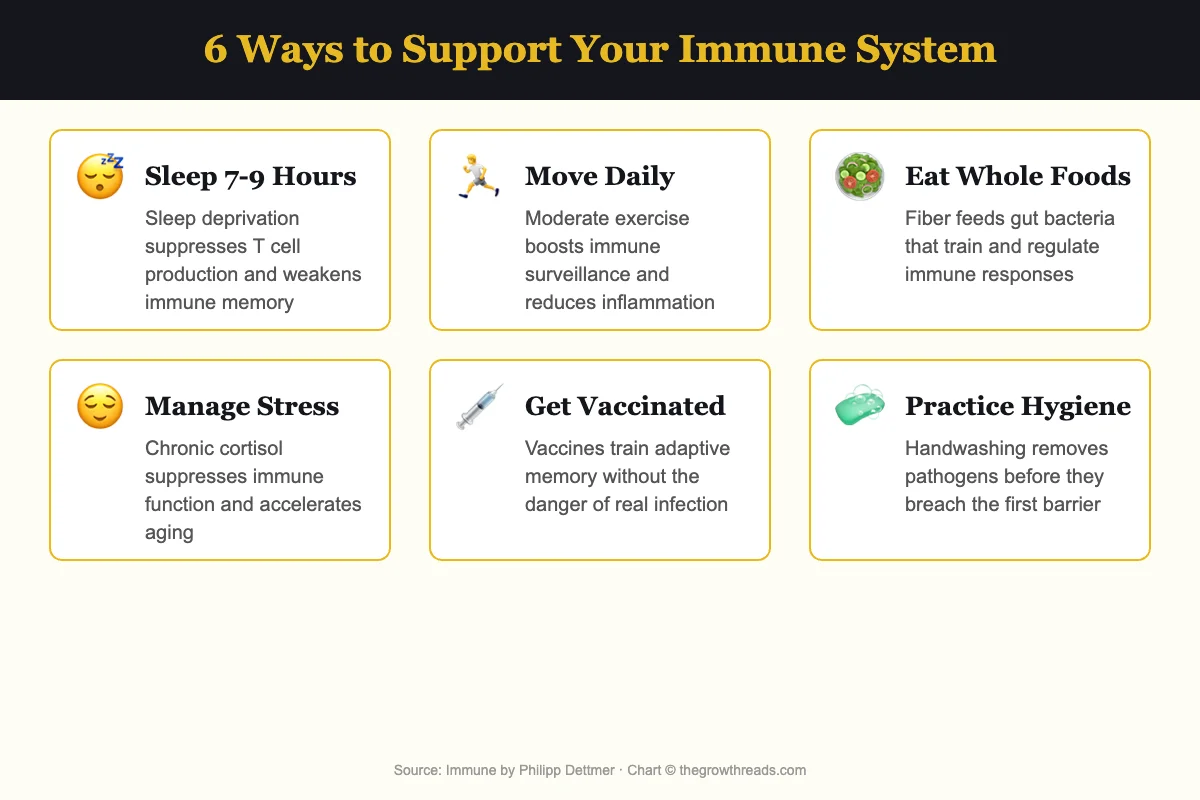
The final section tackles the question everyone wants answered: what can you actually do to strengthen your immune system? Dettmer is refreshingly honest about what the science supports and what it does not. Most “immune boosting” supplements have little to no evidence behind them. The interventions that genuinely matter are the fundamentals that health experts have recommended for decades — and they work precisely because they support the biological mechanisms Dettmer has spent the rest of the book explaining.
Sleep is the single most impactful intervention. During deep sleep, the immune system produces cytokines needed for inflammation and infection response, and T cell adhesion molecules that allow immune cells to stick to and destroy infected cells become more effective. Studies show that people who sleep less than six hours per night are four times more likely to catch a cold after viral exposure than those sleeping seven or more hours.
Exercise has a powerful effect when practiced in moderation. Regular physical activity increases immune cell circulation, improves surveillance against pathogens and cancer cells, and reduces chronic inflammation. However, extreme exercise — ultramarathons, overtraining — temporarily suppresses immune function, creating a window of vulnerability.
Diet matters primarily through the gut microbiome. A diverse, fiber-rich diet feeds the beneficial bacteria that train and regulate immune responses. Processed foods and excessive sugar, by contrast, promote inflammatory bacterial species and weaken the gut barrier, allowing bacterial fragments to enter the bloodstream and trigger chronic low-grade inflammation.
Stress management is the most underappreciated immune intervention. Chronic psychological stress raises cortisol levels, which directly suppresses both innate and adaptive immune function. The evolutionary logic was sound — cortisol prevents the immune system from wasting resources during physical danger — but in the modern world of chronic psychological stress, it becomes a sustained immunosuppressant.
Who Is Immune Best For — and Who Should Read Something Else First?
This book is perfect for anyone who wants to understand how their body defends itself — curious readers, health-conscious individuals, students, parents who want to explain illness and vaccines to their children, and anyone who found themselves wondering how the immune system works during the pandemic. Dettmer’s visual, analogy-rich style makes complex immunology accessible without dumbing it down.
If you are looking for specific dietary advice to support immunity, start with How Not to Die by Michael Greger or Eat to Beat Disease by William Li. If you want a broader framework for longevity that includes immune health, try Outlive by Peter Attia. If sleep is your weakest link, Why We Sleep by Matthew Walker is the essential starting point.
Questions to Reflect On
- How well do you actually understand the difference between a virus and a bacterium — and how does that affect your health decisions?
- What is one habit you currently have that supports your immune system, and one that undermines it?
- When you feel the first signs of illness, do you typically help or hinder your immune system’s response?
- How has your understanding of vaccines changed after learning how adaptive immunity and immunological memory actually work?
- What role does chronic stress play in your life, and what is one concrete step you could take this week to reduce it?
🔥 Ready to Understand Your Body’s Hidden Army?
Discover the fascinating system that keeps you alive every second of every day.
How to Apply Immune (7-Day Plan)
- Day 1 — Audit your sleep for immunity. Track your sleep tonight. If you are consistently below seven hours, commit to adding 30 minutes by setting a firm bedtime. Your T cells and memory responses depend on it.
- Day 2 — Feed your gut microbiome. Add one new source of fiber to your diet today — beans, lentils, whole grains, or fermented foods like yogurt or kimchi. A diverse microbiome trains stronger immune responses.
- Day 3 — Move for immune surveillance. Take a 30-minute brisk walk or moderate exercise session. Regular movement increases the circulation of immune cells and natural killer cells throughout your body.
- Day 4 — Review your vaccination status. Check whether your routine vaccinations are up to date — tetanus, flu, and any boosters recommended for your age group. Vaccines are the most powerful tool for training adaptive immunity safely.
- Day 5 — Address one chronic stressor. Identify your biggest ongoing source of stress and take one concrete step to reduce it — whether that is delegating a task, setting a boundary, or scheduling a difficult conversation.
- Day 6 — Upgrade your hand hygiene. Focus on proper handwashing today — 20 seconds with soap, especially before eating and after public spaces. This supports your first line of defense against respiratory and gastrointestinal pathogens.
- Day 7 — Teach someone what you learned. Explain one concept from the book — the complement system, how T cells work, or why fever helps — to a friend or family member. Teaching deepens your own understanding and spreads health literacy.
Frequently Asked Questions
Do I need a science background to understand this book?
Not at all — that is the book’s greatest strength. Dettmer built his career explaining complex science to millions of YouTube viewers with no scientific background. He uses vivid analogies (immune cells as soldiers, antibodies as handcuffs, the complement system as landmines), clear visual descriptions, and a conversational tone that makes immunology genuinely entertaining. If you can follow a well-told story, you can follow this book.
Does the book tell you how to boost your immune system?
Yes, but honestly. Dettmer is clear that most “immune boosting” supplements lack evidence. The interventions that genuinely work are the fundamentals: sleeping seven to nine hours, exercising moderately, eating a fiber-rich diet to support gut bacteria, managing chronic stress, staying vaccinated, and maintaining good hygiene. The book explains WHY these work at the cellular level, which makes you more likely to actually follow through.
How does the book explain vaccines?
Dettmer explains vaccines through the lens of adaptive immunity. Vaccines introduce harmless fragments of a pathogen — or weakened versions of it — so that your dendritic cells can present these fragments to T cells, triggering the full adaptive response without the danger of real infection. Your body builds memory T and B cells that persist for years, ready to mount a rapid response if you encounter the real pathogen. The explanation is thorough, balanced, and grounded entirely in established immunology.
What is the complement system and why does it matter?
The complement system is a network of over 30 proteins that circulate in your blood in an inactive state. When they encounter a bacterial surface, they activate in a cascade: some coat the bacterium to mark it for destruction by macrophages (opsonization), others punch physical holes in the bacterial membrane to kill it directly, and still others release chemical signals that attract immune cells to the site. It is one of the oldest and most powerful parts of immunity, operating entirely automatically without any input from the brain.
What causes autoimmune diseases according to the book?
Dettmer explains autoimmune diseases as failures in the immune system’s quality control. During development, T and B cells that react to the body’s own proteins are normally eliminated. But this process is not perfect, and sometimes self-reactive cells escape. When these cells activate — often triggered by infections, gut microbiome disruptions, or environmental factors in genetically predisposed individuals — they attack healthy tissues. The result can be conditions like rheumatoid arthritis, multiple sclerosis, type 1 diabetes, or lupus.
How does the gut microbiome affect immunity?
The gut contains roughly 70 percent of your immune cells. Trillions of bacteria in your intestines constantly interact with immune cells, training them to distinguish between dangerous pathogens and harmless substances. A diverse microbiome — supported by a fiber-rich diet — produces short-chain fatty acids that strengthen the gut barrier, reduce inflammation, and support regulatory T cells. A depleted or imbalanced microbiome has been linked to allergies, autoimmune diseases, and increased infection susceptibility.
What should I read after Immune?
For sleep’s role in immunity, read Why We Sleep by Matthew Walker. For the dietary approach to disease prevention, try How Not to Die by Michael Greger or Eat to Beat Disease by William Li. For the gut microbiome in depth, read Gut by Giulia Enders. For a comprehensive longevity framework that includes immune health, try Outlive by Peter Attia. And for understanding chronic inflammation and metabolic health, see Good Energy by Casey Means. This is not medical advice — consult a qualified healthcare professional for personalized health guidance.
Related Summaries
- Why We Sleep by Matthew Walker — The science of sleep’s critical role in immune function, memory, and health.
- How Not to Die by Michael Greger — Evidence-based nutrition for preventing and reversing disease through dietary choices.
- Gut by Giulia Enders — The fascinating world of the digestive system and its connection to immunity.
- Outlive by Peter Attia — A comprehensive framework for longevity covering exercise, nutrition, sleep, and emotional health.
📚 Explore more Health & Wellness book summaries: Best Health Books →
Related Health Summaries
Good Energy Summary & Review: Fix Your Metabolism to Unlock Limitless Health
Outlive Summary & Review: The Science and Art of Longevity
Spark Summary & Review: The Science of Exercise and the Brain
The Blue Zones Summary & Review: 9 Lessons From the World’s Longest-Lived People
The Plant Paradox Summary & Review: Are “Healthy” Foods Making You Sick?