

⭐⭐⭐⭐⭐ 4.6/5
One-liner: The grittiest, most honest entrepreneurship memoir ever written — Phil Knight’s raw account of building Nike from a $50 loan to a global empire.
Best for: Entrepreneurs, founders, business students, and anyone who wants to see what building a company from nothing actually looks and feels like.
Reading time: ~7 hours (400 pages)
Difficulty to apply: Low — this is a memoir, not a how-to. The lessons are absorbed through story, not instruction.
Shoe Dog in one minute
Nike did not start with a bold vision — it started with a guy who liked running and a crazy idea he could not shake. Phil Knight graduated from Stanford Business School in 1962 with a term paper about importing Japanese running shoes to the United States. Instead of getting a normal job, he flew to Japan, bluffed his way into a meeting with Onitsuka Tiger, and started selling shoes out of the trunk of his green Plymouth Valiant. For the next 18 years, Knight and his co-founder Bill Bowerman — his college track coach — scraped, borrowed, nearly went bankrupt multiple times, fought lawsuits, navigated betrayals, and somehow built one of the most iconic brands in history. Shoe Dog is Knight’s memoir of those early years, written with remarkable candour about the fear, doubt, and chaos behind what the world now sees as an inevitable success story.
Key takeaways
- Start before you are ready: Knight had no money, no experience, and no business plan beyond a term paper. He started anyway, and figured it out as he went.
- The path is never straight: Nike nearly died from cash flow crises, legal battles, and broken supplier relationships — repeatedly. Success was never guaranteed.
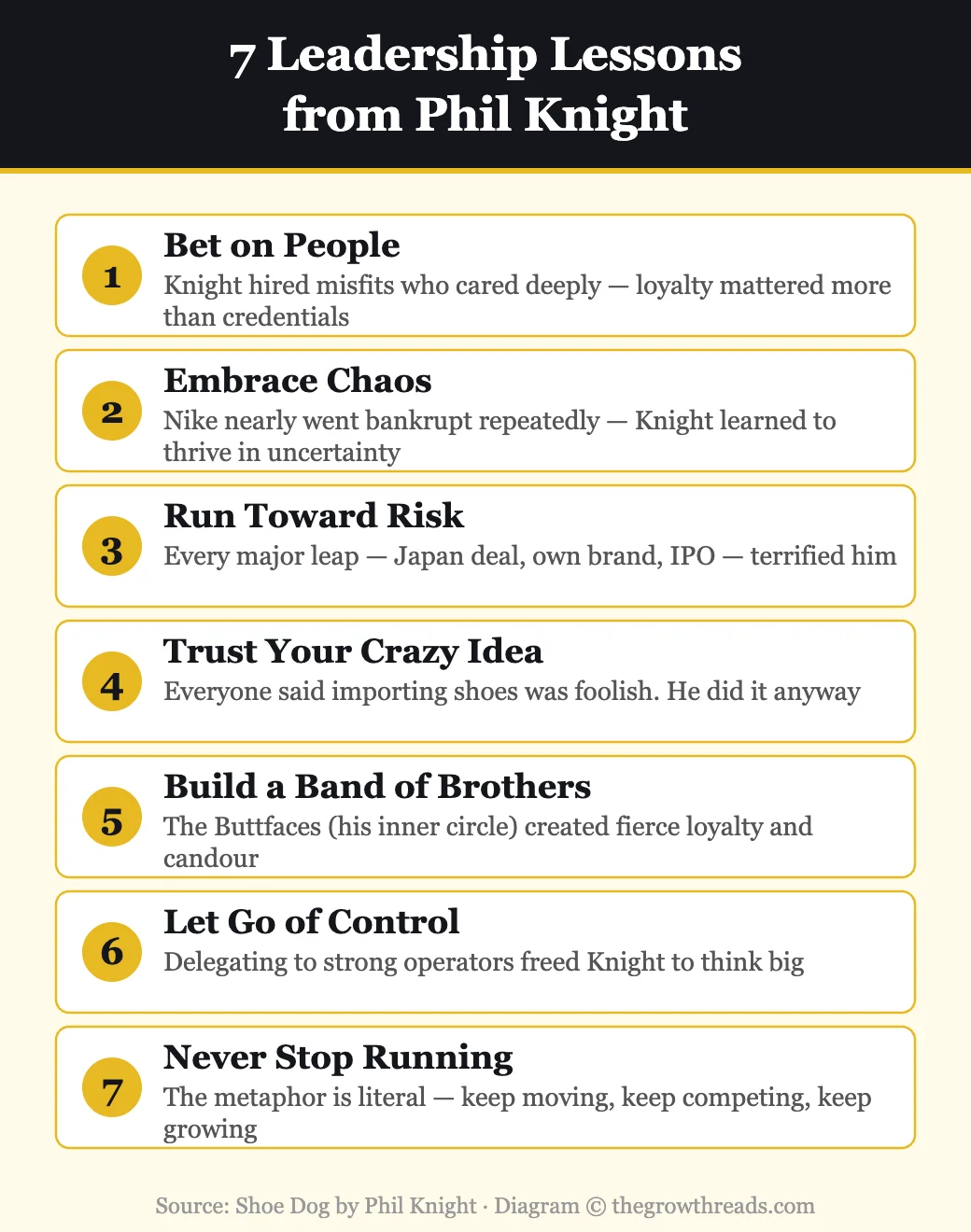
- Hire believers, not credentials: Knight’s early team — Jeff Johnson, Bob Woodell, Rob Strasser — were passionate misfits who cared about the mission more than the paycheque.
- Your supplier can become your enemy: Onitsuka Tiger tried to replace Knight and steal his distribution. The betrayal forced Nike to create its own brand — the best thing that ever happened.
- Cash flow kills more companies than bad products: Nike was profitable on paper but perpetually broke because growth consumed every dollar of available credit.
- Innovation comes from obsession: Bill Bowerman poured rubber into his wife’s waffle iron to create a better shoe sole. The Waffle Trainer became Nike’s first blockbuster.
- Branding is identity: The Swoosh cost $35 from a design student. Knight initially did not love it, but it became one of the most recognised symbols on Earth.
- Going public solves problems and creates new ones: The IPO rescued Nike from its cash flow crisis but brought scrutiny, politics, and the loss of scrappy startup culture.
- Vulnerability makes better leaders: Knight writes openly about his fears, mistakes, and regrets — a rare quality in CEO memoirs.
- The journey matters more than the destination: Knight ends the book wishing he could do it all again, not because of the billions but because of the adventure.
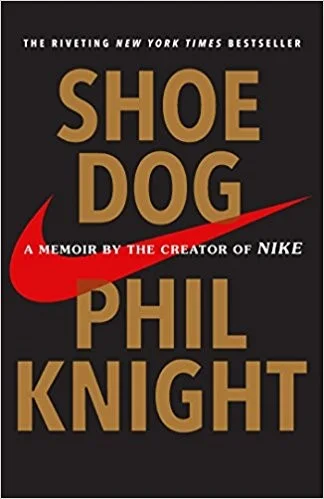
What is Shoe Dog about?
Shoe Dog is Phil Knight’s memoir of founding Nike, covering the years from 1962 to 1980. It traces his journey from importing Japanese running shoes with a $50 loan from his father to building a billion-dollar global brand, revealing the near-constant crises, improbable luck, and fierce determination behind one of business history’s greatest entrepreneurial stories.
About the author
Phil Knight is the co-founder and chairman emeritus of Nike, Inc. Born in Portland, Oregon in 1938, he ran track at the University of Oregon under legendary coach Bill Bowerman, then earned an MBA from Stanford Graduate School of Business. Knight built Nike from a one-man import operation into the world’s largest athletic footwear and apparel company, with annual revenues exceeding $50 billion. Known for his intensely private nature, Knight rarely gave interviews or public speeches during his decades running Nike. Shoe Dog, published when he was 78 years old, was his first and only extended public account of the company’s founding. Warren Buffett called it one of the best business books he had ever read. Explore all Phil Knight book summaries →
Key concepts at a glance
| Concept | What it means | Use it when |
|---|---|---|
| Crazy Idea | A vision that feels irrational but compels you forward regardless | You are weighing a leap that logic says is too risky but your gut will not release |
| The Buttface | Knight’s irreverent name for his inner circle of trusted operators | You need a small, candid advisory group that tells you the truth |
| Cash Flow vs Profit | A company can be profitable and still die if it cannot fund growth | Your business is growing fast but you struggle to pay bills |
| Supplier Dependency | Relying on one supplier creates existential vulnerability | A single partner controls your product, distribution, or revenue |
| Waffle Iron Innovation | Breakthrough products from obsessive tinkering, not R&D budgets | You need innovation but lack corporate resources |
| Brand as Identity | A brand is what people feel, not what you tell them | You are building a company identity that needs to resonate emotionally |
| Hire for Passion | Believers outperform credentialed professionals in startup environments | You are building a founding team and choosing between polish and conviction |
| The Athlete Ambassador | Product credibility through genuine use by respected performers | You need market validation and cannot afford traditional advertising |
Part 1: The crazy idea (1962–1964)
The book opens with 24-year-old Phil Knight, freshly graduated from Stanford, standing at the edge of adulthood with no clear plan except a nagging idea he cannot shake. During his MBA, he had written a seminar paper arguing that Japanese manufacturers could do to German athletic shoes (Adidas, Puma) what Japanese cameras had done to German cameras — produce comparable quality at lower prices. Most students write term papers and forget them. Knight could not forget his.
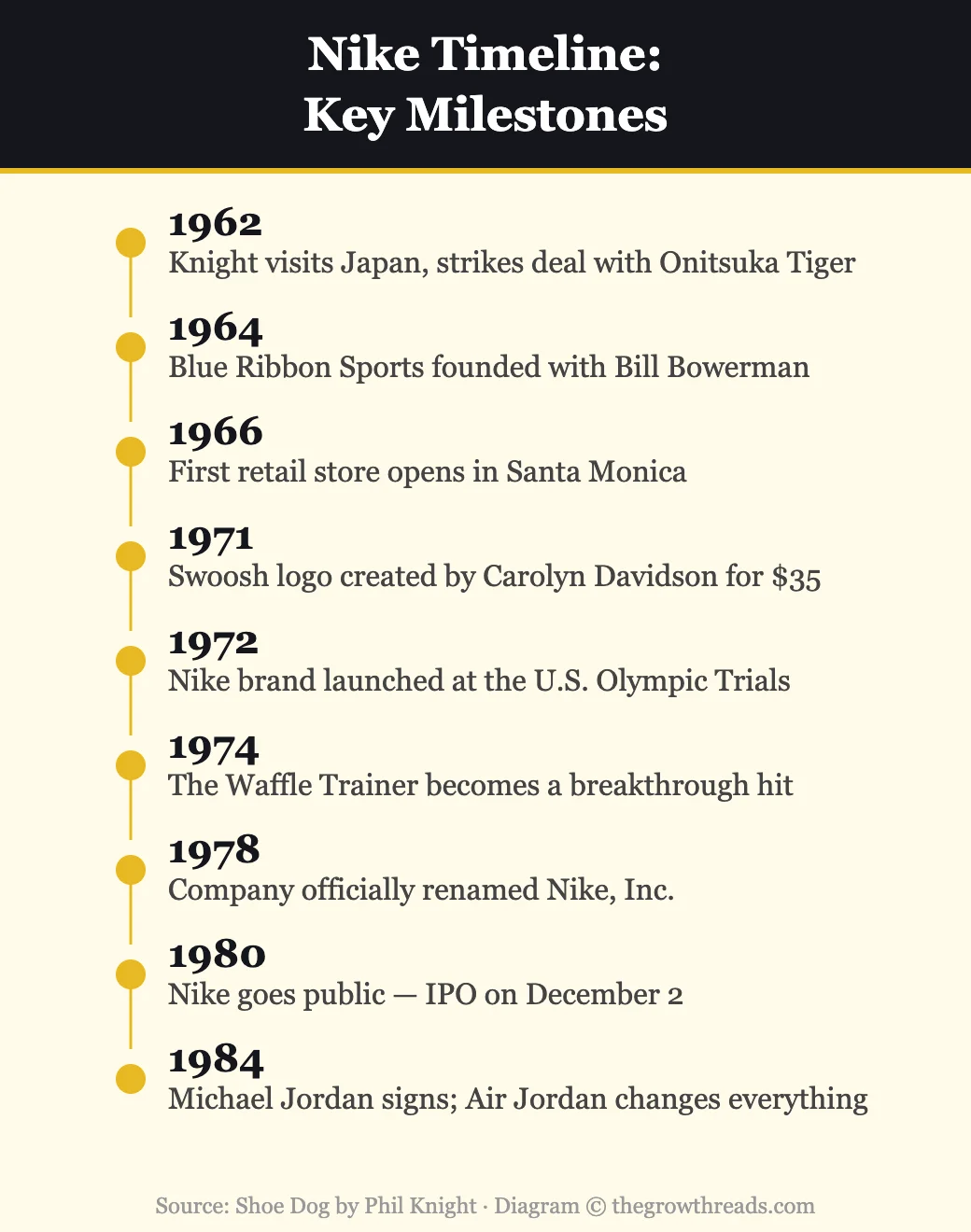
Instead of taking a corporate job, Knight embarked on a trip around the world. In Kobe, Japan, he visited the Onitsuka Company (makers of Tiger shoes) and, in a meeting he had not properly prepared for, bluffed that he represented “Blue Ribbon Sports” — a company that did not yet exist. When Onitsuka agreed to send samples, Knight had to quickly make the fiction real. He teamed up with his former track coach at the University of Oregon, Bill Bowerman, who was already obsessively modifying shoes for his athletes. Each put in $500, and Blue Ribbon Sports was born in January 1964.
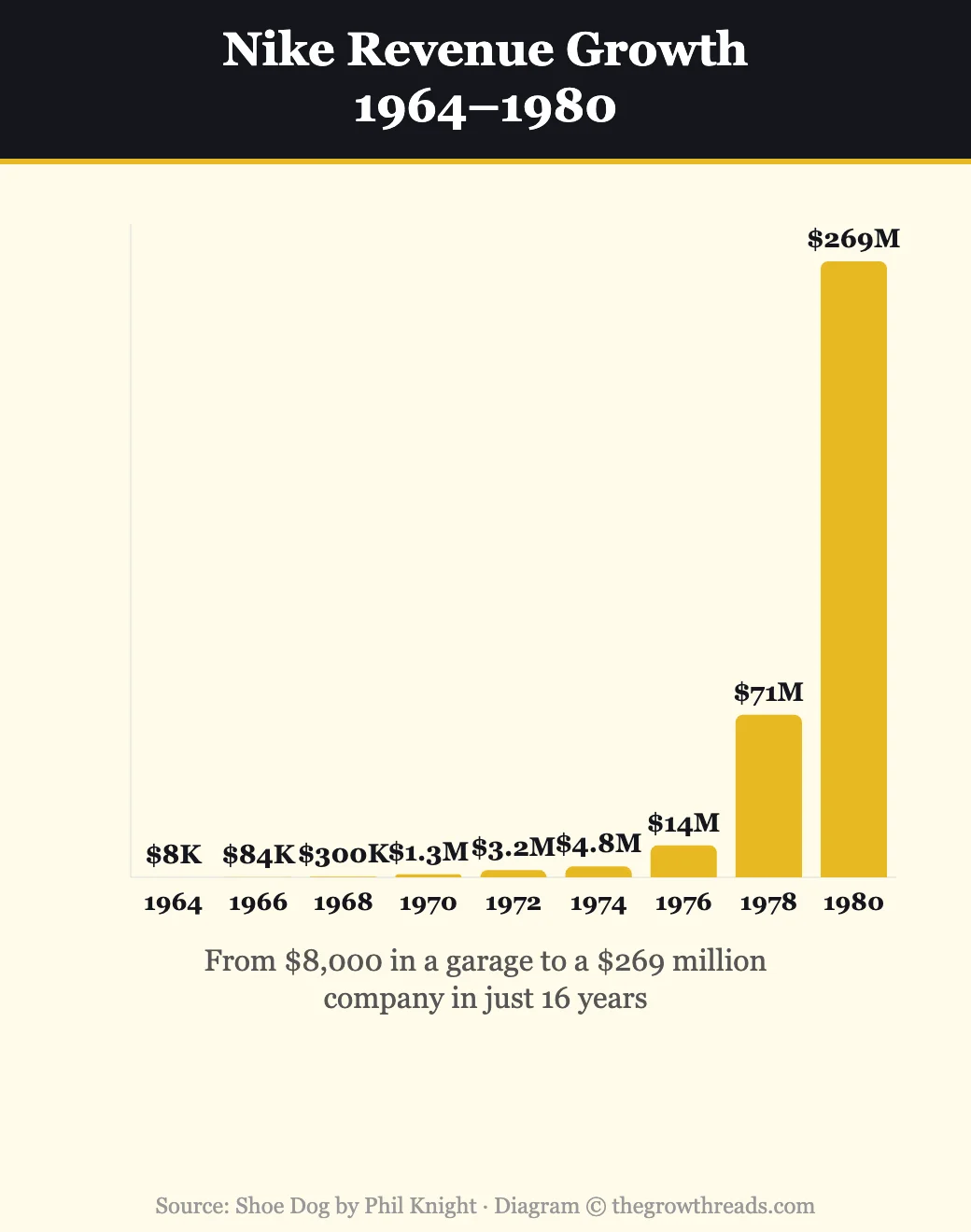
The early days were comically modest. Knight sold Tigers at track meets from the trunk of his car. He kept his day job as an accountant at Price Waterhouse. Orders were small — the first year’s total revenue was $8,000. But Knight noticed something that market research could not have told him: runners who tried Tigers loved them. The product was genuinely better. This gave him a conviction that data alone never could.
Part 2: Growth and crisis (1965–1971)
As demand grew, Knight faced the problem that would haunt Nike for its entire early history: cash flow. The business model was simple but brutal. Knight ordered shoes from Japan, sold them in the U.S. at a markup, and used the profit to order more shoes. But every time he grew, he needed more inventory, which meant more cash upfront, which meant bigger loans. The Bank of Oregon kept extending credit, but Knight lived in perpetual terror of having his line pulled.
His first employee, Jeff Johnson, became a one-man army — salesman, marketer, customer service department, warehouse manager, and store operator. Johnson was fanatically devoted, sleeping in the back of his store and writing Knight long, obsessive letters about every pair he sold. Knight rarely replied, which frustrated Johnson enormously, but their partnership endured because they shared the same irrational commitment to the product.
Bowerman, meanwhile, was conducting shoe experiments that bordered on mad science. He dismantled every pair he received, modified them, and tested the results on his Oregon runners. His most famous innovation came from pouring liquid urethane into his wife’s waffle iron, creating the waffle-patterned sole that would become Nike’s first signature technology. Bowerman destroyed the waffle iron in the process. His wife was not pleased.
The relationship with Onitsuka grew increasingly tense. Knight was their most successful American distributor, but Onitsuka kept threatening to find other partners, arriving unannounced, and demanding changes to the agreement. Knight began to suspect they were actively looking to replace him — a suspicion that would prove devastatingly accurate.
Part 3: Birth of Nike (1971–1976)
In 1971, the crisis Knight had feared arrived: Onitsuka was secretly negotiating with other American distributors to replace Blue Ribbon Sports. When Knight discovered this — through a document left face-up on an Onitsuka executive’s desk during a visit to Japan — he realised he had to create his own brand or lose everything.
The name “Nike” came from Jeff Johnson, who reported dreaming it — the Greek goddess of victory. The Swoosh logo was designed by Carolyn Davidson, a Portland State University graphic design student whom Knight was paying $2 per hour for freelance work. She charged $35 for the logo. Knight’s reaction: “I don’t love it, but I think it will grow on me.” It did.
Nike debuted at the 1972 U.S. Olympic Track and Field Trials in Eugene, Oregon. Knight and his team handed out shoes to runners, and several wore them in competition. The brand was instantly associated with elite performance — a positioning advantage that would prove priceless. But the legal battle with Onitsuka was just beginning. They sued Knight; Knight countersued. The litigation lasted years, consumed enormous resources, and added another layer of existential stress to an already precarious business.
Through the mid-1970s, Nike grew explosively. The Waffle Trainer became a genuine cultural phenomenon, beloved not just by runners but by ordinary Americans who discovered that athletic shoes could be comfortable everyday footwear. Revenue climbed from $3.2 million in 1972 to $14 million by 1976. But every dollar of growth required more inventory, more credit, and more risk. Knight was building a rocket ship while it was in flight.
Part 4: Going public and beyond (1977–1980)
By the late 1970s, Nike was a $70 million company still operating with the financial infrastructure of a startup. The cash flow crisis came to a head when their bank, First National, threatened to call in all of Nike’s loans. Knight was simultaneously fighting Onitsuka in court, managing explosive international growth, and trying to keep the company solvent week to week. He describes lying awake at night, unable to sleep, calculating how many days of cash remained.
The solution was an IPO. On December 2, 1980, Nike went public at $22 per share, raising enough capital to permanently resolve the cash flow crisis that had defined its first 16 years. Knight became a very wealthy man — but the moment is described with surprisingly little triumph. Going public meant accountability to shareholders, quarterly earnings pressure, and the gradual loss of the scrappy, us-against-the-world culture that had defined the company.
Knight closes the memoir by reflecting on what he would do differently. He wishes he had spent more time with his family. He regrets the relationships that were strained or lost to the relentless demands of building Nike. He mourns his son Matthew, who died in a scuba diving accident at 34. And he returns, again and again, to the idea that the journey was the point — not the money, not the fame, not the Swoosh on every shoe in the world, but the daily struggle of building something from nothing with people he loved.
The final line of the book is a meditation on impermanence: Knight sitting in his office, looking at the pile of shoes he has kept from every era of Nike’s history, and wishing he could do it all one more time.
Who is Shoe Dog best for — and who should read something else first?
Shoe Dog is essential reading for anyone who wants to understand what entrepreneurship actually feels like — not the sanitised version from business school case studies but the raw, terrifying, exhilarating reality. It is particularly valuable for founders in the early stages of building a company, because Knight is remarkably honest about the fear, doubt, and near-constant financial peril that defined Nike’s first two decades. It is also an exceptional book for anyone interested in branding, since Nike’s identity was forged through instinct and accident as much as strategy.
If you want prescriptive business strategy rather than memoir, try Good to Great by Jim Collins or Zero to One by Peter Thiel. If you want another great founder memoir with more systematic management lessons, The Hard Thing About Hard Things by Ben Horowitz is the closest comparable. And if you love the athletic world context, Legacy by James Kerr applies leadership lessons from the New Zealand All Blacks.
Questions to reflect on
- Is there a “crazy idea” you have been carrying around but have not acted on — and what would it take to start, even in the smallest way?
- When you think about your biggest professional risk, does it feel more like Knight’s deliberate leap to Japan or his reactive pivot when Onitsuka betrayed him?
- Who are the believers in your work life — the people who would follow your mission even when it looked like it was failing?
- Has cash flow ever threatened something you were building, and what did you learn about the difference between profit and survival?
- If you could only keep one lesson from Nike’s origin story, which would serve you most right now?
🔥 Ready to see what building a company from nothing really looks like?
Shoe Dog is the most honest entrepreneurship memoir ever written — raw, gripping, unforgettable.
How to apply Shoe Dog (7-day plan)
- Day 1 — Name your crazy idea. Write down the one business idea, project, or career move you keep thinking about but have not started. Describe it in one paragraph, the way Knight described his in his Stanford paper.
- Day 2 — Take the smallest step. Knight’s first step was buying a plane ticket to Japan. Identify the smallest, cheapest action that moves your idea from fantasy to reality — a phone call, an email, a prototype sketch — and do it today.
- Day 3 — Find your Bowerman. Identify one person who shares your passion and brings complementary skills. Reach out and have a conversation about your idea. Partnerships like Knight-Bowerman are the foundation of great companies.
- Day 4 — Stress-test your cash flow. If you run a business, map out exactly how much cash you have, when it comes in, and when it goes out. Knight’s biggest threat was always cash, not competition.
- Day 5 — Audit your supplier risk. Identify your biggest single dependency — a client, supplier, platform, or partner. What would you do if they disappeared tomorrow? Start building a backup plan.
- Day 6 — Build your Buttface group. Assemble 3–5 people you trust to give you brutally honest feedback. Schedule a recurring meeting — even monthly — where the only rule is candour.
- Day 7 — Write your origin story. Knight’s memoir succeeds because he tells the truth about failure and fear. Write one page about why you started (or want to start) what you are doing. Be honest about the doubts. This becomes your anchor when things get hard.
Frequently asked questions
Is Shoe Dog a business book or a memoir?
It is a memoir first, business book second. Knight tells the story of Nike’s founding chronologically, focusing on the human drama — relationships, fears, setbacks, and moments of joy — rather than on business frameworks or management theory. The business lessons are embedded in the narrative and absorbed through the story rather than extracted as principles. This makes it more emotionally engaging than a typical business book but less directly prescriptive.
What years does Shoe Dog cover?
The book covers 1962 to 1980, from Knight’s post-MBA trip around the world to Nike’s IPO. This means it does not cover the Michael Jordan era, the “Just Do It” campaign, or Nike’s later controversies around overseas manufacturing. Knight chose to focus on the origin story — the scrappy, uncertain early years when nothing was guaranteed and every week brought a new existential crisis.
Why did Warren Buffett call it one of the best books he has ever read?
Buffett praised Shoe Dog for its rare honesty about the entrepreneurial journey. Most CEO memoirs are self-congratulatory victory laps. Knight writes candidly about his mistakes, fears, and the role of luck in Nike’s success. Buffett, who values integrity and long-term thinking, likely appreciated Knight’s willingness to show vulnerability and his focus on the decades-long grind rather than any single breakthrough moment.
What is the main lesson of Shoe Dog for entrepreneurs?
The central lesson is that the path to building something great is far messier, more frightening, and more uncertain than it looks from the outside. Knight almost went bankrupt multiple times, was betrayed by his main supplier, fought years of litigation, and made countless mistakes. Success came not from a brilliant master plan but from persistence, adaptability, passionate people, and a willingness to keep going when quitting would have been the rational choice.
Who were the key people in Nike’s founding besides Phil Knight?
Bill Bowerman, Knight’s college track coach, was co-founder and the product innovator behind the Waffle Trainer and many other shoe designs. Jeff Johnson was employee number one — a fanatically dedicated salesman who named the company “Nike” after the Greek goddess of victory. Bob Woodell, a former runner paralysed in an accident, became a key operations leader. Rob Strasser handled legal and marketing. Knight affectionately called his inner circle “the Buttfaces” — a name that stuck.
Does the book discuss Nike’s controversies?
Not extensively. Because the memoir ends in 1980, it predates the major controversies around overseas labour practices that emerged in the 1990s. Knight briefly addresses some early challenges but does not engage deeply with the ethical criticisms that later defined public debate about Nike. Readers looking for that perspective should seek additional sources. The book focuses on the founding story and the human experience of building the company.
Is Shoe Dog worth reading in 2026?
Absolutely. While the specific business context — 1960s shoe importing — is dated, the emotional and psychological truths about entrepreneurship are timeless. The fear of running out of cash, the agony of depending on an unreliable partner, the thrill of seeing customers love your product, the tension between personal life and professional obsession — these experiences are identical for a 2026 startup founder building an AI company. It remains the gold standard for honest founder memoirs.
Related summaries
- The Hard Thing About Hard Things by Ben Horowitz — another unflinchingly honest account of what it takes to build and run a company.
- Start With Why by Simon Sinek — the framework for building brands around purpose, which Nike exemplifies.
- Zero to One by Peter Thiel — contrasting philosophy on building monopolistic companies from scratch.
- Extreme Ownership by Jocko Willink — leadership under pressure, with parallels to Knight’s wartime mentality.
We read every book cover to cover, cross-reference key claims with primary research, and test practical advice against real-world application. Our ratings weigh five criteria equally: actionability, evidence quality, writing clarity, originality, and lasting value. Read our full methodology.
Related Leadership Summaries
Team of Rivals Summary and Review
The Hard Thing About Hard Things Summary & Review: A CEO Survival Manual for the Hardest Decisions
The Infinite Game Summary & Review: Lead Beyond the Finish Line
The No Asshole Rule Summary and Review
The Ride of a Lifetime Summary & Review: Leadership Lessons from Disney’s Greatest CEO