

★★★★ 4/5 — a genuinely powerful central idea (the Golden Circle) that has reshaped how leaders and brands think about purpose. It’s repetitive and leans hard on a few examples, but the core lesson sticks.
Best for: leaders, founders, marketers, and anyone who wants their work to inspire rather than just sell · Reading time: ~5 hours (this guide: 15 min) · Difficulty to apply: Simple to understand — hard to live with real discipline
Start With Why in one minute
The world’s most influential leaders and organizations all think, act, and communicate in the same way — and it’s the complete opposite of everyone else: they start with why. Simon Sinek’s core idea is a simple model he calls the Golden Circle, made of three concentric rings: why (your purpose, cause, or belief), how (the actions that bring it to life), and what (the products or services you sell). Most people and companies communicate from the outside in — they lead with what they do and maybe how, but rarely articulate why. Inspiring leaders reverse this, starting from the inside out with a clear sense of purpose. This matters because, as Sinek puts it, people don’t buy what you do — they buy why you do it. A clear why creates trust, loyalty, and genuine inspiration, while a business built only on what is forced to compete on price, features, and manipulation. Knowing and staying true to your why, Sinek argues, is the foundation of lasting success and the reason some organizations command devotion while others merely make transactions.
Key takeaways
- Start with why: great leaders and brands begin with purpose, not product.
- The Golden Circle: why (purpose) → how (process) → what (product) — communicate from the inside out.
- People buy the why: “people don’t buy what you do; they buy why you do it.”
- Why is biological: the why speaks to the emotional, decision-making part of the brain; the what speaks only to the rational part.
- Manipulation vs inspiration: price, promotions, and fear drive short-term sales; a clear why inspires lasting loyalty.
- Trust and loyalty follow purpose: people are loyal to companies whose beliefs they share.
- The Law of Diffusion: a clear why wins over early adopters, who then pull the majority along.
- Clarity, discipline, consistency: know your why, stay disciplined about how, and be consistent in what you do.
- Why comes from the founder: the why is rooted in origin and belief, and must be protected as a company grows.
- When why goes fuzzy, companies drift: losing sight of purpose is what turns inspiring companies into ordinary ones.
What is Start With Why about?
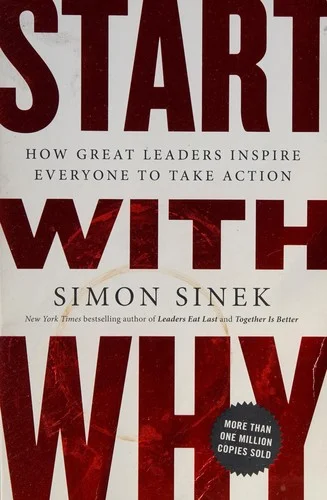
Start With Why is a leadership and marketing book by Simon Sinek about the power of purpose. It argues that the most inspiring leaders and organizations all begin with why — their cause or belief — rather than what they sell, using a model called the Golden Circle. Because people are drawn to why you do something, not just what you do, a clear purpose builds trust, loyalty, and lasting success.
About the author
Simon Sinek is a British-American author, speaker, and organizational consultant who became one of the most recognized voices in modern leadership. He introduced the ideas in this book through a 2009 TED talk, “How Great Leaders Inspire Action,” which went on to become one of the most-watched TED talks of all time and turned the phrase “start with why” into a business catchphrase. Start With Why, also published in 2009, expanded that talk into a full framework, and Sinek followed it with influential books including Leaders Eat Last and The Infinite Game. His gift is for taking an intuitive truth about human motivation and giving it a memorable name and shape; his critics note that he leans heavily on a handful of examples (Apple, the Wright brothers, Martin Luther King Jr.) and can be repetitive, but few writers have done more to put purpose at the center of the leadership conversation. Explore all Simon Sinek book summaries →
Key concepts at a glance
| Concept | What it means | Use it when |
|---|---|---|
| Why | Your purpose, cause, or belief | Defining your mission |
| How | The actions that realize your why | Setting values & process |
| What | The products or services you sell | The proof of your why |
| Golden Circle | Communicate from why outward | Messaging & pitching |
| Manipulation | Price, promos, fear, novelty | Short-term sales tactics to avoid relying on |
| Law of Diffusion | Win early adopters first | Launching something new |
Part 1: The Golden Circle
The heart of the book is a deceptively simple diagram Sinek calls the Golden Circle — three nested rings that describe how any person or organization operates.
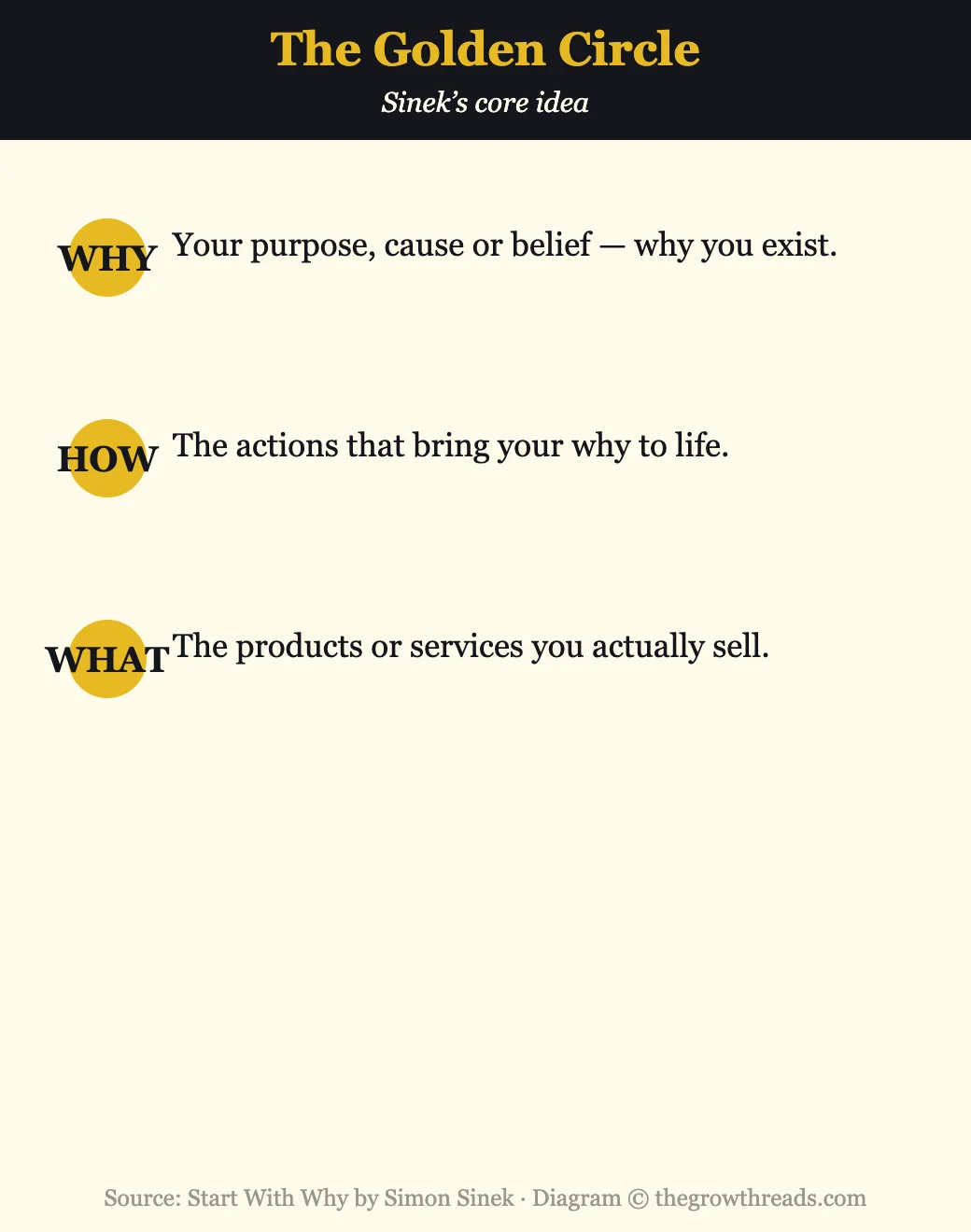
The outer ring is what: the products you make or the services you provide — every company knows what it does. The middle ring is how: the specific actions, methods, or differentiators you use to do it — some companies can articulate this. The innermost ring is why: your purpose, cause, or belief — the reason your organization exists beyond making money, and the reason anyone should care. Sinek’s crucial observation is about direction. The vast majority of people and companies communicate from the outside in: they tell you what they do, sometimes how they do it, and almost never why. Inspiring leaders and organizations do the reverse — they communicate from the inside out, starting with why. When you lead with purpose, the what and how become the tangible proof of a belief people can rally around, rather than a list of features they must be talked into buying. The Golden Circle isn’t just a communication trick; Sinek argues it reflects how humans actually make decisions, which is why starting with why is so much more powerful than starting with what.
Part 2: People don’t buy what you do — they buy why you do it
The book’s most quoted line captures its central claim: people don’t buy what you do, they buy why you do it.
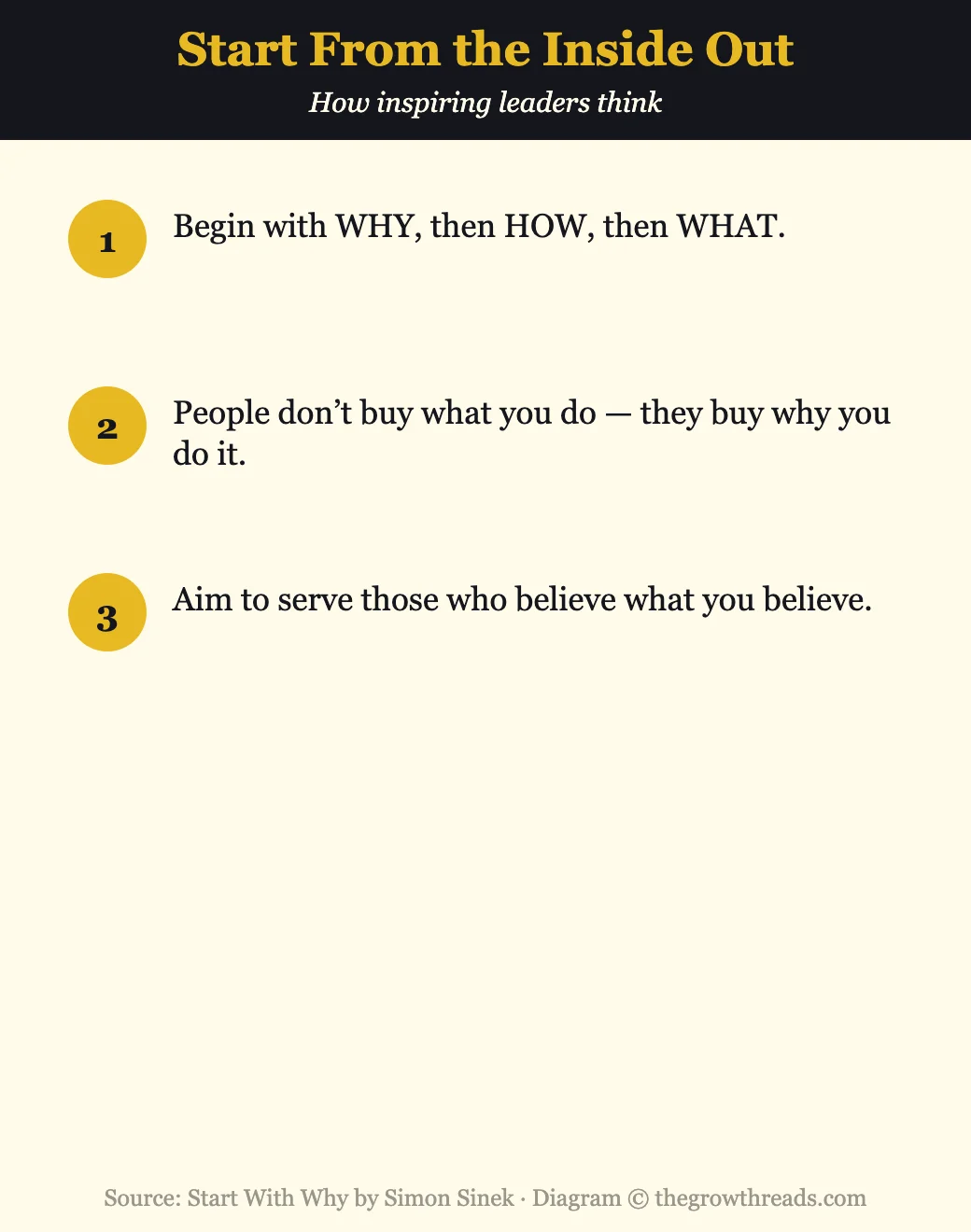
Sinek grounds this in biology. The Golden Circle, he suggests, maps onto the structure of the brain: the what corresponds to the neocortex, responsible for rational, analytical thought and language, while the why and how correspond to the limbic brain, which governs feelings, trust, loyalty, and decision-making but has no capacity for language. This is why leading with facts and features (the what) often fails to move people, while leading with purpose (the why) speaks directly to the part of the brain that actually drives behavior — and why we often make decisions that “feel right” even when we can’t fully explain them. His signature example is Apple. Apple sells the same products as many competitors, but communicates from the why first: they believe in challenging the status quo and thinking differently, and their products are simply the proof of that belief. That clarity of purpose is why customers feel loyalty to Apple that no spec sheet could explain. When you start with why, Sinek argues, you attract people who believe what you believe, and those people become loyal customers, employees, and evangelists — not because of what you sell, but because of what you stand for.
TGR Note: Sinek’s “why” is the organizational cousin of the personal “identity” that drives lasting change in Atomic Habits — James Clear argues you change behavior by changing who you believe you are, and Sinek argues companies inspire by clarifying what they believe. Purpose, at both scales, beats tactics.
Part 3: Manipulation versus inspiration
Sinek draws a sharp line between two ways to influence behavior: manipulation and inspiration.
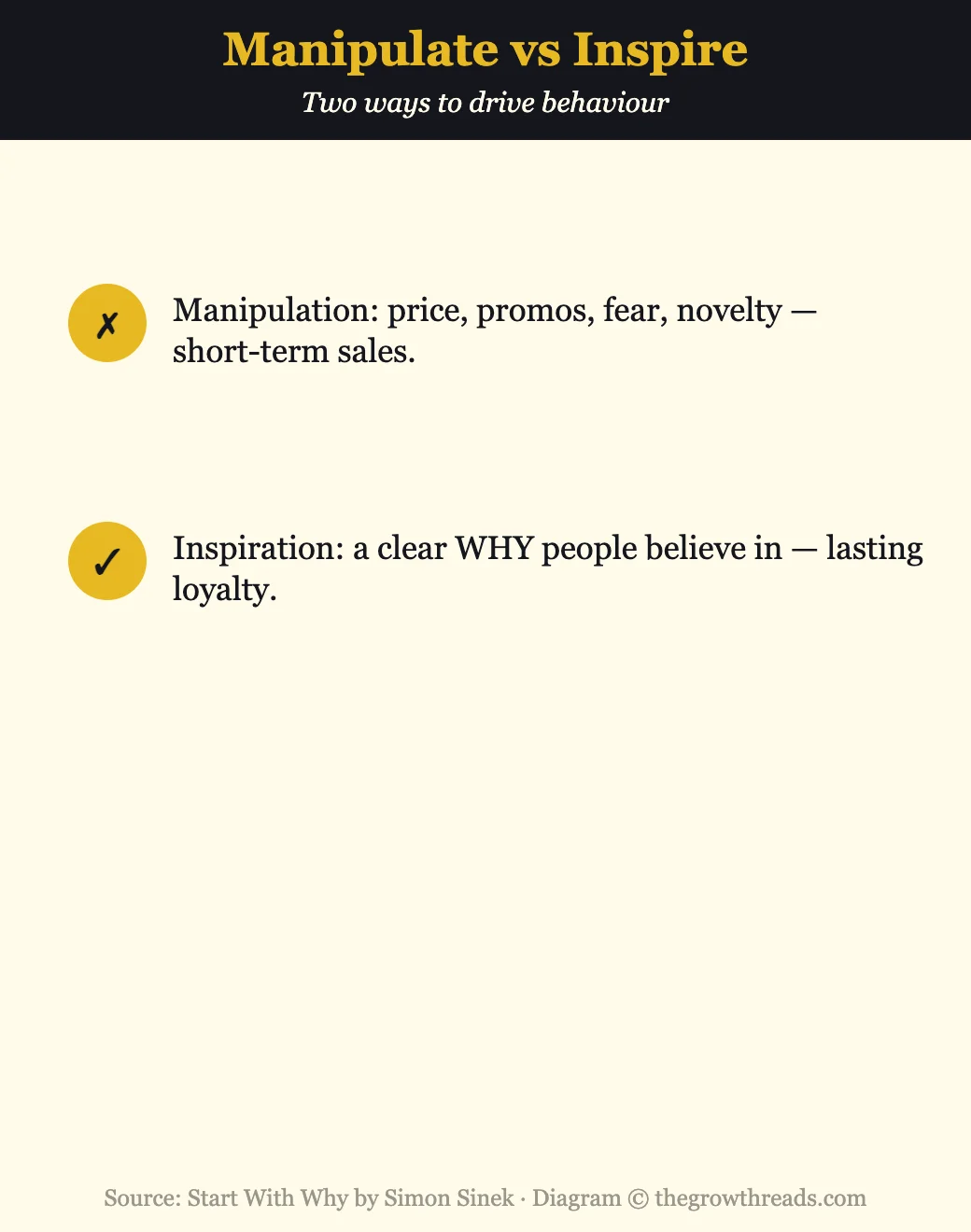
Manipulations are the familiar tactics most businesses reach for: dropping prices, running promotions, using fear or aspirational messaging, leaning on peer pressure (“nine out of ten people prefer…”), and promising novelty. These tactics work — they can drive a sale — but Sinek argues they come at a cost. They only produce transactions, not loyalty; they have to be repeated endlessly and often escalated; and a business that competes on price or promotions is trapped in a race to the bottom, because customers won it on a deal will leave for a better one. Inspiration works differently. When people are drawn to your why — when they genuinely believe what you believe — they stay loyal through good times and bad, pay premiums, forgive missteps, and recommend you to others, not because of any single incentive but because your purpose resonates with their own sense of identity. The distinction is the difference between a customer who buys from you once because of a coupon and a customer who is devoted to you for years because of what you stand for. Manipulation buys behavior; inspiration earns loyalty — and only one of them is a foundation for lasting success.
Part 4: The Law of Diffusion, and keeping your why clear
To explain how purpose-driven ideas spread, Sinek borrows the Law of Diffusion of Innovation: any population breaks down into innovators and early adopters (who embrace new ideas readily), an early and late majority (who wait until something is proven), and laggards (who resist). The mistake most companies make is chasing the big majority directly. Sinek’s argument is that you must first win the innovators and early adopters — the people who feel your why most strongly and are willing to take a chance on you — because it is they who ultimately pull the majority along. A clear why is what attracts that crucial early group, letting an idea cross from a niche of believers into the mainstream.
The rest of the book is about protecting the why as an organization grows. Sinek frames a healthy company as needing clarity of why (you must be able to articulate your purpose), discipline of how (you must hold to the values and principles that realize it), and consistency of what (everything you do and say must prove the why). He describes the why as originating with a founder’s belief and offers the “celery test” — a way to check whether your actions are consistent with your purpose — as a filter for decisions. His cautionary tales are companies that lost sight of their why as they scaled, often after a founder’s departure, and drifted into competing purely on what and price, forfeiting the very inspiration that made them great. The book’s weaknesses are real — it is repetitive, relies on a small set of flattering examples, and can veer toward oversimplification — but its central insight is genuinely valuable: clarify why you do what you do, communicate it first, and stay true to it, and you build something people don’t just buy from but believe in.
TGR Note: Where Sinek gives you the inspiring “why” of leadership, Extreme Ownership supplies the accountable “how” — Jocko Willink and Leif Babin on taking total responsibility for execution. And Ego Is the Enemy is the guardrail that keeps a leader’s why about the mission rather than themselves.
Who is Start With Why best for — and who should read something else first?
This book is ideal for leaders, founders, marketers, and anyone building or communicating a brand, mission, or team — its Golden Circle is a genuinely useful lens for clarifying purpose and messaging. It’s also great for individuals wanting to find more meaning and direction in their work. It is not the book for you if you want detailed, step-by-step implementation (it’s more inspirational than tactical), or if you’re impatient with repetition and a small, recycled set of examples — the core idea can be grasped from Sinek’s TED talk in 18 minutes. For the execution discipline the why needs, pair it with Extreme Ownership; for the character underneath, Ego Is the Enemy.
Questions to reflect on
- Can you state your (or your company’s) why in a single, clear sentence?
- When you communicate, do you lead with what you do or why you do it?
- Are you winning customers or a team through inspiration — or through manipulation?
- Do your what and how actually prove your why, or contradict it?
- Where has your sense of purpose gone fuzzy, and how would you make it clear again?
🔥 Ready to find your why?
This guide is the map — Sinek’s stories and examples are what make the idea land.
How to apply Start With Why (7-day plan)
- Day 1 — Draft your why. Write one sentence stating your purpose or belief, beyond what you do or sell.
- Day 2 — Map your Golden Circle. List your why, how, and what, and check they align.
- Day 3 — Flip your pitch. Rewrite how you describe your work to lead with why, not what.
- Day 4 — Audit for manipulation. Spot where you rely on price, promos, or fear, and imagine an inspiration-led alternative.
- Day 5 — Run the celery test. Take a current decision and check whether it’s consistent with your why.
- Day 6 — Find your early adopters. Identify the people who already believe what you believe and focus there.
- Day 7 — Commit to consistency. Choose one visible way to make your what better prove your why.
Frequently asked questions
Is Start With Why worth reading?
Yes, for its core idea, with a caveat. The Golden Circle — the notion that inspiring leaders and brands start with purpose (why) rather than product (what) — is a genuinely powerful, memorable framework that has reshaped how many leaders and marketers think, and it’s well worth internalizing. The caveat is that the book is repetitive and builds its case on a small, recycled set of examples (Apple, the Wright brothers, Martin Luther King Jr.), so some readers feel the whole message could be delivered in far fewer pages. If you value the big idea and the stories that illustrate it, it’s worth the read; if you just want the concept, Sinek’s TED talk covers it in 18 minutes.
What is the main message of Start With Why?
That the most inspiring leaders and organizations start with why — their purpose, cause, or belief — rather than with what they do or sell. Sinek’s key claim is that “people don’t buy what you do; they buy why you do it,” so a clear why builds trust, loyalty, and lasting success, while a business built only on products and price is forced to compete through manipulation. The practical model is the Golden Circle: communicate and operate from the inside out, leading with why, supported by how, and proven by what.
What is the Golden Circle?
It’s Sinek’s central model: three concentric rings representing why, how, and what. Why is your purpose, cause, or belief — the reason you exist beyond making money. How is the actions and values that bring that purpose to life. What is the products or services you actually offer. Most people communicate from the outside in (what first), but inspiring leaders reverse it and communicate from the inside out, starting with why. Sinek argues this ordering matters because it mirrors how the brain makes decisions — the why speaks to the emotional, trust-driven part, while the what speaks only to the rational part.
What does “people don’t buy what you do, they buy why you do it” mean?
It means customers are ultimately drawn to the purpose and beliefs behind a product, not just its features or price. Sinek grounds this in brain biology: the emotional, decision-making part of the brain (the limbic system) responds to why and how, while the rational part (the neocortex) handles the what. So leading with facts and features often fails to move people, whereas leading with a clear purpose speaks to what actually drives behavior. His example is Apple, whose customers are loyal not because of specs but because they believe in the company’s why — challenging the status quo.
What is the difference between manipulation and inspiration?
Manipulations are tactics like price cuts, promotions, fear, aspirational messaging, peer pressure, and novelty. They can drive a sale but only produce one-off transactions, must be repeated endlessly, and trap a business in competing on price. Inspiration comes from a clear why that people genuinely believe in; it earns lasting loyalty, premium pricing, forgiveness of mistakes, and word-of-mouth advocacy. Sinek’s point is that manipulation buys short-term behavior while inspiration builds long-term loyalty — and only inspiration is a foundation for enduring success.
How long does it take to read Start With Why?
The book is around 250 pages and most readers finish it in about five hours. Because it’s built around one central idea that’s repeated and illustrated, many people read it quickly or even skim later chapters once they grasp the Golden Circle. Our summary above captures the full framework — the Golden Circle, the biology, manipulation versus inspiration, and keeping your why clear — in roughly 15 minutes, and Sinek’s original TED talk delivers the core concept in about 18 minutes.
Is Start With Why oversimplified?
It’s a fair criticism. Sinek presents a clean, inspiring model, but skeptics note that he leans on a handful of flattering examples, glosses over companies that succeeded without a lofty why, and can veer toward survivorship bias (celebrating winners whose “why” is identified after the fact). The brain-biology framing is also more metaphor than rigorous neuroscience. None of this negates the book’s practical value: as a lens for clarifying purpose and communicating it, the Golden Circle is genuinely useful. Read it for the actionable idea, not as an airtight scientific theory, and it holds up well.
Related summaries
- Extreme Ownership Summary — the execution discipline behind the why.
- Ego Is the Enemy Summary — keeping the why about the mission, not you.
- The 7 Habits Summary — begin with the end in mind.
- Atomic Habits Summary — identity and purpose driving change.
- Browse all our best leadership books.
How we analyze books: We work from the full book — reconstructing its core arguments in our own words, adding commentary that connects it to related research and other books in our library, and pressure-testing the advice against how it plays out in real life. We never reproduce the text; we synthesize it. Read our full methodology.
Disclosure: The Growth Reads is reader-supported. When you buy through links on our site we may earn an affiliate commission at no extra cost to you. We only recommend books we believe are worth your time, and our summaries and opinions are written independently.
Related Leadership Summaries
The Culture Code Summary & Review: Build Teams That Thrive
The Five Dysfunctions of a Team Summary & Review: Build a Team That Actually Trusts Each Other
The Ideal Team Player Summary & Review: Hire for Humility, Hunger, and People Smarts
The Infinite Game Summary & Review: Lead Beyond the Finish Line
Turn the Ship Around Summary & Review: How to Build Teams That Think for Themselves