

★★★★ 4.2/5 — a compelling, research-backed case that sustained passion and perseverance, not raw talent, drive great achievement. Inspiring, if a touch overstated.
Best for: anyone chasing a long-term goal, and parents and educators shaping young people’s character · Reading time: ~6 hours (this guide: 15 min) · Difficulty to apply: Easy to grasp — sustaining grit over years is the real test
Grit in one minute
The secret to outstanding achievement is not talent but grit — the combination of passion and perseverance for very long-term goals. Psychologist Angela Duckworth spent years studying who succeeds in demanding settings, from cadets surviving West Point’s grueling initiation to finalists in the National Spelling Bee, and found that raw talent was a poor predictor. What consistently distinguished high achievers was grit: a sustained passion for a single overarching goal, paired with the perseverance to keep working toward it through boredom, setbacks, and failure. Duckworth argues that we overrate natural talent and underrate effort, and she shows mathematically why effort “counts twice.” She then lays out how grit can be grown, both from the inside — through interest, deliberate practice, purpose, and hope — and from the outside, through supportive-yet-demanding parenting, extracurricular challenges, and gritty cultures. The message is empowering: you are not simply born gritty or not; grit can be cultivated.
Key takeaways
- Grit = passion + perseverance: sustained commitment to one long-term goal predicts success better than talent.
- We overrate talent: we’re biased to attribute success to natural gifts and to underrate the effort behind it.
- Effort counts twice: talent × effort builds skill, and skill × effort produces achievement — effort appears in both.
- Deliberate practice builds skill: focused, effortful practice on weaknesses, with feedback, drives improvement.
- Passion is consistency, not intensity: gritty people stick with one top-level goal for years rather than chasing new ones.
- Interest fuels grit: you must genuinely enjoy what you do to sustain effort over the long haul.
- Purpose sustains it: connecting your work to something beyond yourself keeps you going when motivation dips.
- Hope keeps you moving: the belief that effort can improve your situation lets you persevere through adversity.
- Grit can be grown from outside: wise parenting, extracurriculars, and gritty cultures cultivate perseverance.
- The Hard Thing Rule: commit to hard pursuits, don’t quit on a bad day, and finish what you start.

What is Grit about?
Grit is a psychology book by Angela Duckworth about why passion and perseverance — not talent — drive great achievement. Drawing on her research across demanding fields, it defines grit, shows why effort matters more than natural ability, and explains how to grow grit from the inside through interest, practice, purpose, and hope, and from the outside through parenting and culture.
About the author
Angela Duckworth is a professor of psychology at the University of Pennsylvania and the founder of Character Lab, a nonprofit that applies psychological science to help children thrive. Before academia she worked as a management consultant and, formatively, as a middle-school math teacher, where she noticed that her most successful students were not always her most talented — an observation that launched her research career. Her work on grit earned her a MacArthur “genius” grant, and her 2013 TED talk on the subject became one of the most watched of all time. Published in 2016, Grit: The Power of Passion and Perseverance brought her research to a mass audience and became a major bestseller. Duckworth writes as a rigorous scientist who is also a warm storyteller, weaving her studies together with profiles of exceptional achievers and reflections on raising her own children, and she is candid about the limits and nuances of her findings. Explore all Angela Duckworth book summaries →
Key concepts at a glance
| Concept | What it means | Use it when |
|---|---|---|
| Grit | Passion + perseverance for long-term goals | Pursuing a big, distant goal |
| Effort counts twice | Effort builds skill and achievement | Tempted to blame lack of talent |
| Deliberate practice | Focused practice on weaknesses | Trying to improve a skill |
| Purpose | Work connected to others | Motivation is fading |
| Hope | Belief effort can improve things | Facing adversity |
| The Hard Thing Rule | Commit, don’t quit on a bad day | Raising gritty kids |
Part 1: What grit is — and why it beats talent
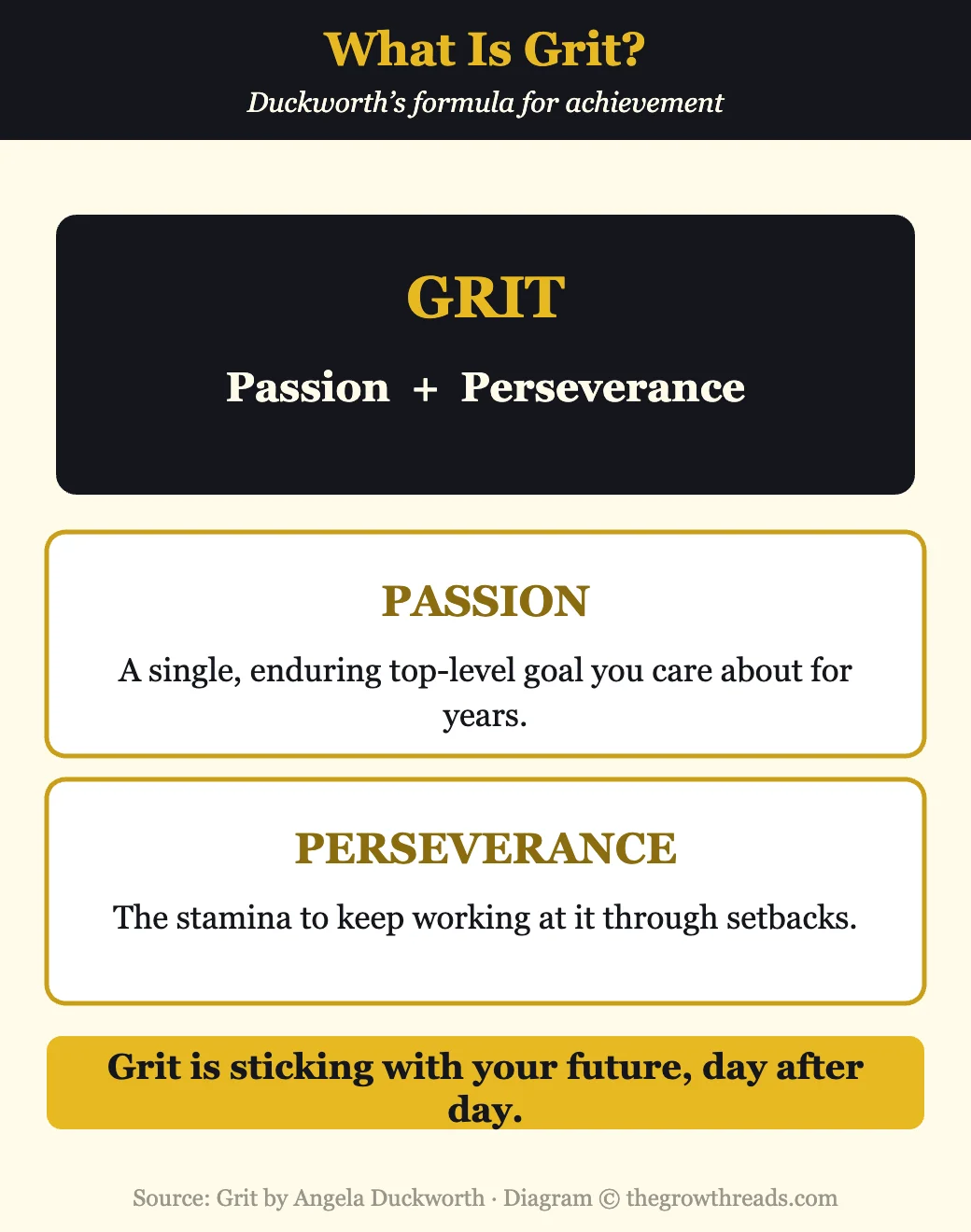
Duckworth defines grit as the combination of passion and perseverance directed at a single, long-term goal. Passion here does not mean intense enthusiasm that flares and fades; it means consistency over time — staying loyal to one top-level goal for years rather than constantly switching. Perseverance is the stamina to keep working toward that goal despite failure, boredom, and plateaus.
Her research made the case dramatically. Studying incoming cadets at West Point, she found that a short questionnaire measuring grit — her “Grit Scale” — predicted who would survive the punishing summer initiation known as Beast Barracks far better than the academy’s own composite measure of talent and fitness. Across other domains — sales, teaching, spelling bees, elite competitions — the same pattern held: grit, not talent, best predicted who persisted and excelled. This runs against a deep cultural bias. Duckworth argues that we are naturally drawn to the idea of the effortless “natural,” because talent feels magical while effort feels mundane, and admitting the role of effort implicates our own choices. But this bias leads us to overrate talent and systematically underestimate the sheer sustained work behind almost every great accomplishment. Talent, she concludes, may determine how quickly you can improve, but grit determines whether you keep improving at all.
Part 2: Effort counts twice
To show precisely why effort matters more than talent, Duckworth offers a simple two-part model.
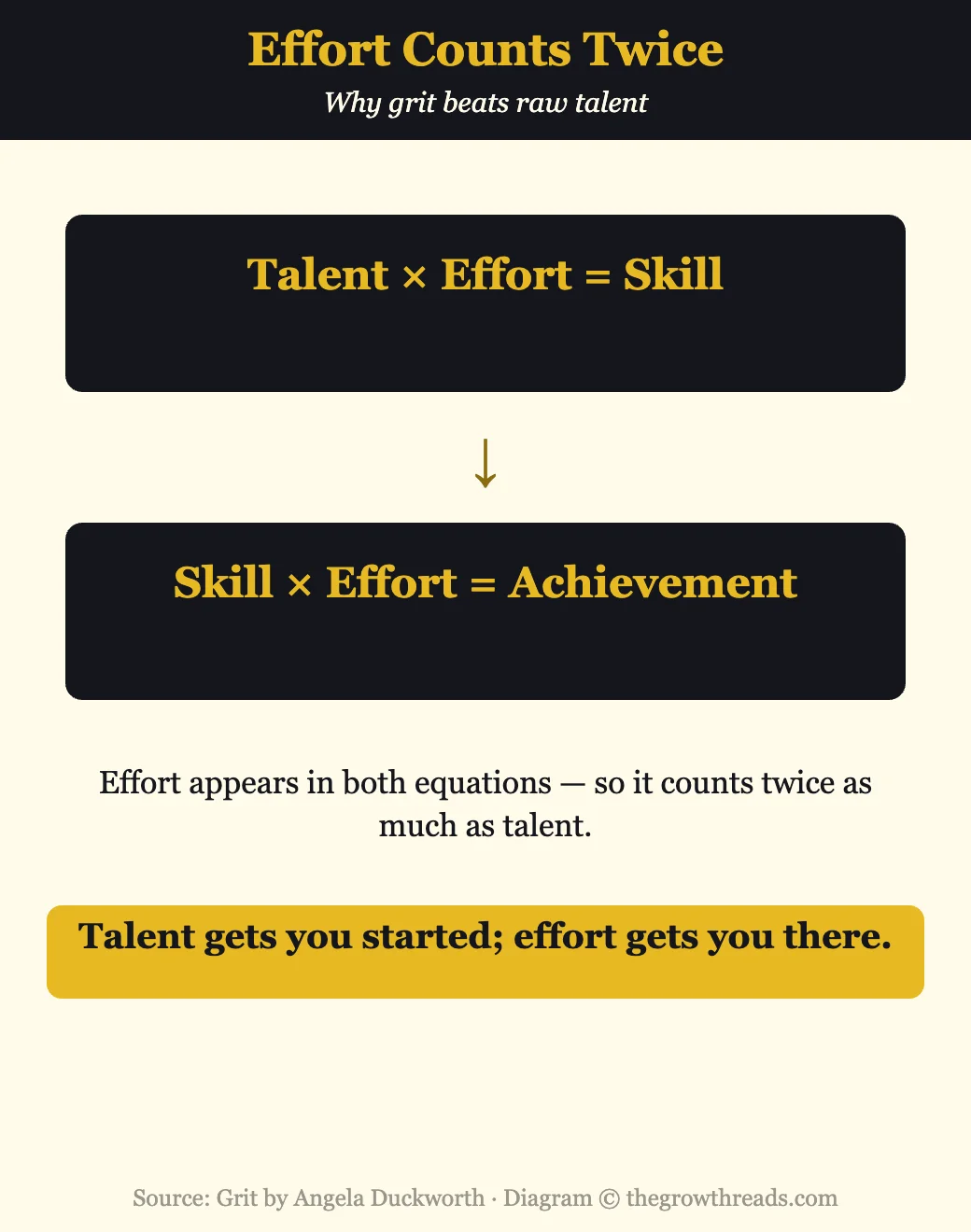
First, talent multiplied by effort produces skill: your natural aptitude determines how fast you acquire skill when you apply effort. Second, skill multiplied by effort produces achievement: having a skill isn’t enough — you must apply effort again to actually produce results with it. Because effort appears in both equations, it contributes to success twice over, while talent contributes only once. The practical implication is striking: a moderately talented person who works relentlessly will, over time, out-achieve a highly talented person who coasts. Effort is what converts talent into skill, and then converts skill into accomplishment. Central to sustaining that effort productively is the concept of deliberate practice — not mindless repetition, but focused, effortful practice that targets your specific weaknesses, includes clear goals and immediate feedback, and pushes just beyond your current ability. Gritty high performers, Duckworth shows, do vast amounts of this uncomfortable, concentrated practice, which is exactly the kind of work that talent alone will never do for you.
TGR Note: Grit and Carol Dweck’s Mindset are intellectual partners — Duckworth explicitly builds her “hope” on Dweck’s growth mindset, since you only persevere if you believe effort works. And the deliberate practice at grit’s core is the same disciplined focus Deep Work is built to protect. Believe you can grow, then put in the deep, effortful reps.
Part 3: Growing grit from the inside
The good news, Duckworth argues, is that grit is not fixed — it can be developed. She identifies four psychological assets that gritty people tend to develop over time, roughly in sequence.
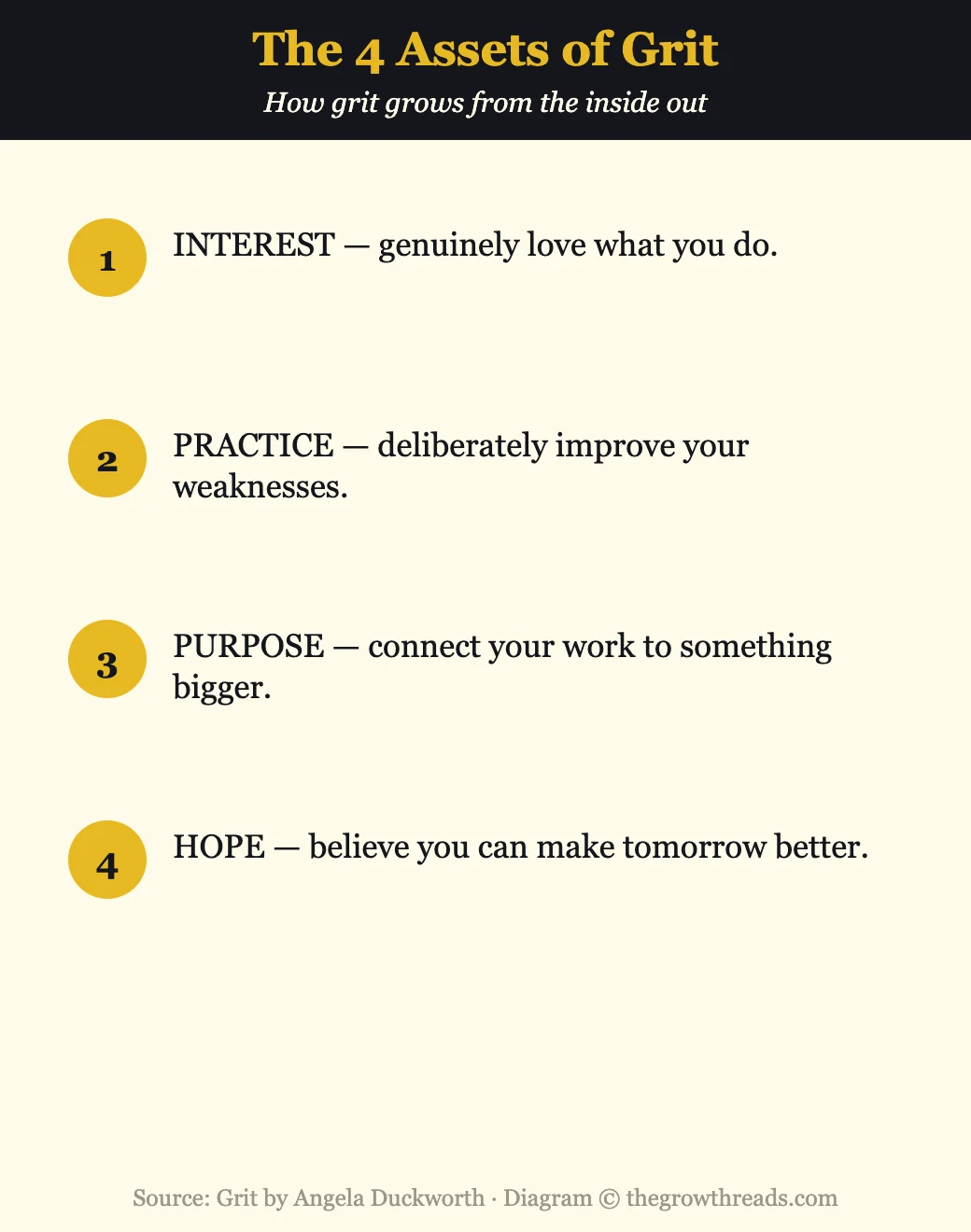
The first is interest: you must genuinely enjoy what you do, because passion begins with intrinsic interest, and no one perseveres for years at something they find meaningless. Interest is usually discovered and then deepened through exploration, not found fully formed. The second is practice: the daily discipline of trying to do better than yesterday through deliberate practice, embracing the discomfort of working on your weak points. The third is purpose: the conviction that your work matters to people beyond yourself. Interest may get you started, but purpose — the sense of contributing to others’ wellbeing — is what makes a passion sustainable over a lifetime, transforming a personal pursuit into a calling. The fourth is hope: not a passive wish that things will improve, but the active belief that your own effort can change your future. This kind of hope, rooted in a growth mindset, is what allows gritty people to get back up after every setback. Together, these four assets — interest, practice, purpose, and hope — are the internal engine of grit, and each can be deliberately nurtured.
Part 4: Growing grit from the outside
Grit is also cultivated by the environment and people around us. Duckworth examines how to raise gritty children and finds that the most effective parenting is both supportive and demanding — warm and loving, but with high expectations and clear standards. This “wise” parenting communicates that you believe in the child’s ability to meet a high bar, which builds their own grit. She offers a concrete tool she uses in her own family, the “Hard Thing Rule”: everyone in the household must commit to a hard thing that requires deliberate practice (an instrument, a sport, a skill); you are not allowed to quit on a bad day, only at a natural stopping point; and you get to choose your own hard thing. This teaches children to stick with challenges without trapping them forever in the wrong pursuit.
Beyond the family, she highlights the role of extracurricular activities — sustained, challenging pursuits pursued for a year or more, which research links to better outcomes precisely because they teach follow-through — and the powerful influence of gritty cultures, from elite sports teams to institutions like West Point, where being surrounded by gritty people and a culture of perseverance pulls up your own grit. The lesson is that grit is contagious: if you want to be grittier, join a group that prizes it. Duckworth closes on a balanced and honest note. She acknowledges that grit is not the only thing that matters — talent, luck, opportunity, and other virtues all count — and that grit taken to an extreme, or aimed at the wrong goal, has downsides. She is also candid that the science continues to be refined, and indeed later research has debated exactly how strongly grit predicts success and how much it overlaps with the established trait of conscientiousness. But the book’s core message endures and is genuinely valuable: sustained effort toward a meaningful long-term goal is one of the most reliable ingredients of a life of accomplishment, and it is something you can build.
Who is Grit best for — and who should read something else first?
This book is ideal for anyone working toward an ambitious long-term goal who needs encouragement to keep going, and especially for parents, teachers, and coaches shaping young people. Its blend of research and story is inspiring and practical. It is not for you if you want a strictly rigorous, skeptical treatment — some readers feel it overstates grit’s power and underplays luck and circumstance — or if you dislike anecdote-driven psychology. If you want the belief system that underpins grit, read Mindset first; for grit taken to a raw, personal extreme, read Can’t Hurt Me.
Questions to reflect on
- Do you have a single, long-term “top-level” goal — or are you switching passions too often?
- Where are you blaming a lack of talent when the real gap is sustained effort?
- Which of the four assets — interest, practice, purpose, hope — is weakest for you right now?
- Is your work connected to a purpose beyond yourself, and how could you strengthen that link?
- What “hard thing” could you commit to and refuse to quit on a bad day?
🔥 Ready to build your grit?
This guide is the map — Duckworth’s research and profiles are what make the case stick.
How to apply Grit (7-day plan)
- Day 1 — Name your top-level goal. Write the single long-term goal your daily efforts should serve.
- Day 2 — Reframe a “talent” gap. Take something you think you’re “not good at” and treat it as an effort gap instead.
- Day 3 — Do deliberate practice. Spend focused time on a specific weakness, with a clear goal and feedback.
- Day 4 — Reconnect to purpose. Write how your goal helps someone beyond yourself.
- Day 5 — Practice hope. After a setback, name one thing your effort can change, and act on it.
- Day 6 — Set a Hard Thing Rule. Commit to one hard pursuit and decide you won’t quit on a bad day.
- Day 7 — Find a gritty culture. Join or connect with a group that models the perseverance you want.
Frequently asked questions
Is Grit worth reading?
Yes, for most readers seeking motivation and insight into long-term achievement. It makes a compelling, research-backed case that sustained passion and perseverance matter more than raw talent, and it offers practical ways to build grit from the inside and out. The blend of studies and inspiring stories is engaging. The main criticisms are that it can feel anecdote-heavy and that it may overstate grit’s power relative to luck, opportunity, and circumstance. Read with that balance in mind, it is both encouraging and genuinely useful, especially for anyone pursuing a distant, demanding goal.
What is grit according to Angela Duckworth?
Grit is the combination of passion and perseverance directed at a single, long-term goal. Passion, in her definition, means consistency of interest over years — staying committed to one overarching goal rather than constantly changing direction — while perseverance means the stamina to keep working through failure, boredom, and plateaus. Duckworth’s research found that this quality, measured by her Grit Scale, predicted success in demanding settings like West Point’s initiation and the National Spelling Bee better than measures of talent or intelligence.
What does “effort counts twice” mean?
It is Duckworth’s explanation of why effort matters more than talent, based on a two-step model. First, talent multiplied by effort produces skill — your aptitude sets how fast you improve when you work. Second, skill multiplied by effort produces achievement — you must apply effort again to turn skill into real results. Because effort appears in both equations, it contributes to success twice while talent contributes only once. The takeaway is that persistent effort will, over time, beat superior talent that isn’t paired with hard work.
What are the four assets of grit?
Duckworth identifies four psychological assets that gritty people develop, roughly in order: interest (genuinely enjoying what you do, so passion has something to grow from), practice (the daily discipline of deliberate practice to keep improving), purpose (the conviction that your work matters to people beyond yourself, which sustains long-term commitment), and hope (the active belief that your own effort can improve your future, which lets you rise after setbacks). Together these form the internal engine of grit, and each can be deliberately cultivated.
Can grit be developed, or are you born with it?
Duckworth argues grit can be grown, not just inherited. From the inside, you develop it by cultivating the four assets — deepening your interests, practicing deliberately, connecting your work to a larger purpose, and building hope. From the outside, grit is fostered by supportive-yet-demanding parenting, sustained extracurricular challenges (captured in her “Hard Thing Rule”), and immersion in gritty cultures where perseverance is the norm. While people may differ in their starting levels, her central, hopeful message is that grit is a quality you can build through effort and environment over time.
How long does it take to read Grit?
The book is around 350 pages and most readers finish it in about six hours, aided by its accessible, story-driven style. Its chapters are self-contained enough to read in sections. Our summary above captures the core framework — the definition of grit, why effort counts twice, and the four assets — in roughly 15 minutes, which is enough to grasp and start applying the main ideas.
Is the concept of grit scientifically solid?
Grit is grounded in real research by Duckworth and others, and the broad idea that sustained effort predicts achievement is well supported. That said, the science has been actively debated: some meta-analyses have found that grit’s ability to predict success is more modest than the book’s enthusiasm implies, and that grit overlaps substantially with the long-established personality trait of conscientiousness. The reasonable conclusion is that grit is a useful and motivating lens on achievement, while it is not the single decisive factor — talent, luck, opportunity, and circumstances also matter significantly.
Related summaries
- Mindset Summary — the growth mindset that underpins grit’s “hope.”
- Can’t Hurt Me Summary — perseverance taken to a raw extreme.
- Atomic Habits Summary — the daily systems behind deliberate practice.
- Deep Work Summary — protecting time for effortful practice.
- Browse all our best psychology books.
How we analyze books: We work from the full book — reconstructing its core arguments in our own words, adding commentary that connects it to related research and other books in our library, and pressure-testing the advice against how it plays out in real life. We never reproduce the text; we synthesize it. Read our full methodology.
Disclosure: The Growth Reads is reader-supported. When you buy through links on our site we may earn an affiliate commission at no extra cost to you. We only recommend books we believe are worth your time, and our summaries and opinions are written independently.
Related Psychology Summaries
Lost Connections Summary & Review: Depression Isn’t All in Your Head
The Confidence Gap Summary and Review
The Gift of Fear Summary & Review: Why Your Instincts Are Your Best Protection
Thinking in Bets Summary & Review: Make Smarter Decisions Under Uncertainty
When the Body Says No Summary & Review: How Suppressed Emotion Makes You Sick