

⭐⭐⭐⭐ 4.3/5 — A timeless philosophical treatise that reframes love as a skill you practice, not a feeling you stumble into.
Best for: Anyone who suspects modern culture has distorted their understanding of love and wants a deeper, more intentional approach to relationships.
Reading time: ~3.5 hours (160 pages)
Difficulty to apply: Moderate — the ideas are profound but the practices require sustained inner work.
The Art of Loving in one minute
Most people think love is about finding the right person — Erich Fromm argues it is about becoming the right person. In this compact, deeply influential book first published in 1956, Fromm dismantles the modern myth that love is primarily an emotion you “fall into.” Instead, he presents love as an art — something that demands knowledge, effort, discipline, and practice, just like music or medicine. He maps out five types of love, identifies four core elements that every form of love requires (care, responsibility, respect, and knowledge), and prescribes four disciplines for mastering the practice of love in daily life. The book is as much a critique of consumer society — which Fromm believes erodes our capacity for genuine connection — as it is a guide to relationships. Nearly seven decades later, his arguments feel sharper than ever.
Key takeaways
- Love is an art, not an accident: Like any art, it requires theory, practice, and treating mastery as a matter of ultimate concern — not something you hope will just happen to you.
- The problem is not finding love, but developing the capacity for it: People focus on being lovable (attractive, successful) rather than on learning how to love actively.
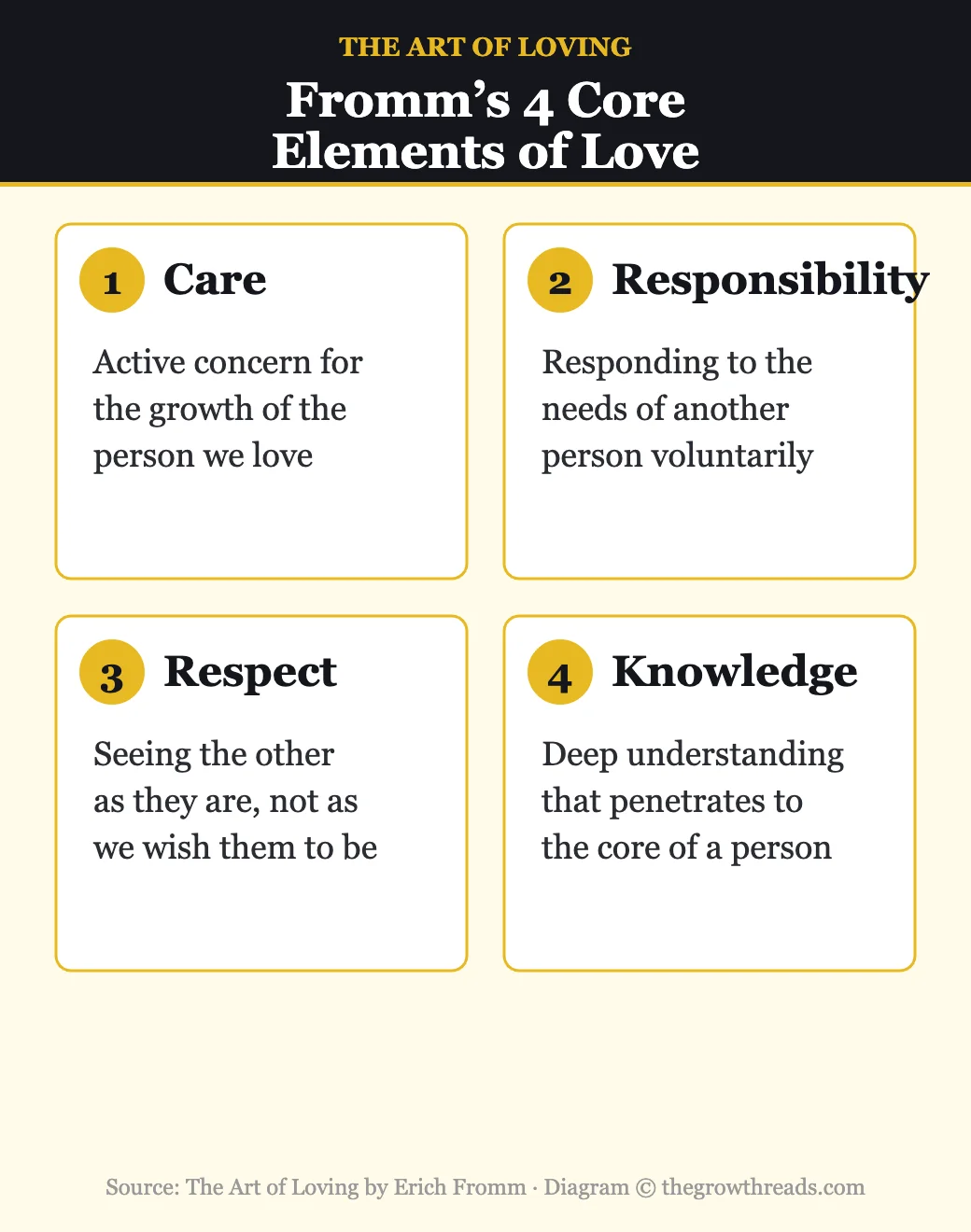
- All love shares four elements: Care (active concern for growth), responsibility (voluntary response to needs), respect (seeing the other as they truly are), and knowledge (deep understanding beyond surface).
- There are five distinct types of love: Brotherly love (universal), motherly love (unconditional), erotic love (exclusive union), self-love (prerequisite, not selfishness), and love of God (overcoming separateness).
- Self-love is the foundation, not the enemy: You cannot genuinely love another person if you cannot first affirm your own life and growth — selfishness and self-love are actually opposites.
- Erotic love is the trickiest form: It begins with the desire for total fusion with one person but can easily be confused with the intensity of infatuation or possessiveness.
- Modern capitalism erodes love: Consumer culture trains people to treat relationships as transactions — seeking the best “deal” on the personality market rather than developing genuine connection.
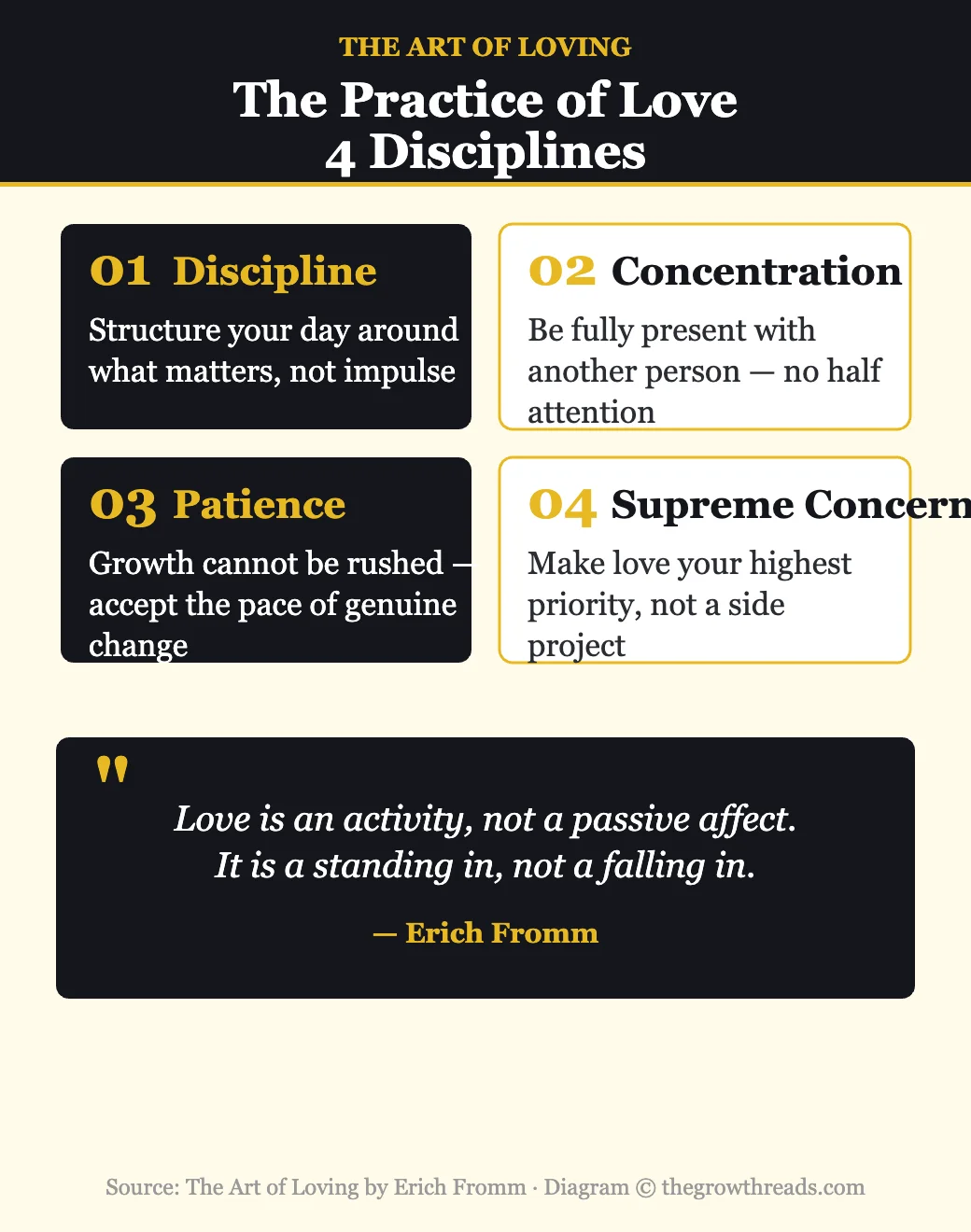
- Practicing love requires four disciplines: Discipline (structured living), concentration (full presence), patience (accepting the pace of growth), and supreme concern (making love your highest priority).
- Love requires courage: Loving means committing without guarantees, being vulnerable, and accepting that loss is possible — faith in the other person is essential.
- Love is a decision and a commitment: Mature love says “I choose to love you” and sustains that through difficulty, not just when the feeling is convenient.
What is The Art of Loving about?
The Art of Loving is Erich Fromm’s argument that love is not a spontaneous emotion but a deliberate practice requiring knowledge, effort, and discipline. He examines five types of love, identifies their shared core elements, critiques how modern consumer culture undermines genuine connection, and prescribes four disciplines for developing the capacity to love well in everyday life.
About the author
Erich Fromm (1900–1980) was a German-born social psychologist, psychoanalyst, and humanistic philosopher who fled Nazi Germany and became one of the most influential public intellectuals of the twentieth century. Trained at the Berlin Psychoanalytic Institute and deeply influenced by both Freud and Marx, he spent decades exploring how social structures shape human psychology. His books — including Escape from Freedom, The Sane Society, and To Have or to Be? — sold millions worldwide. The Art of Loving, published in 1956, became his best-known work and has been translated into more than 30 languages. Fromm taught at institutions including Columbia, Yale, Michigan State, and the National Autonomous University of Mexico. Explore all Erich Fromm book summaries →
Key concepts at a glance
| Concept | What it means | Use it when |
|---|---|---|
| Love as an art | Love requires theory + practice, not just good fortune | You notice you are waiting for love to “happen” instead of building it |
| The four elements | Care, responsibility, respect, knowledge form every kind of love | A relationship feels hollow — diagnose which element is missing |
| Five types of love | Brotherly, motherly, erotic, self-love, love of God | You conflate different forms and expect one type to fulfill all needs |
| Self-love vs. selfishness | Genuine self-care enables love for others; selfishness blocks it | You feel guilty for setting boundaries or prioritizing your own growth |
| The personality market | People package themselves to attract the best “deal” in a partner | You catch yourself treating dating as shopping |
| Symbiotic union | Unhealthy fusion where one dominates and one submits | A relationship feels suffocating or controlling |
| Mature love | Union that preserves individuality: “I am you” without losing “I am me” | You want deep connection without codependency |
| The four disciplines | Discipline, concentration, patience, supreme concern | You want a concrete daily practice for building your capacity to love |
Part 1: Is love an art?
Fromm opens with a deceptively simple question: if love is an art, then it requires knowledge and effort — just like painting, carpentry, or medicine. Most people assume love is primarily a pleasant sensation that either happens or does not. They invest enormous energy in being attractive (so they will be loved) rather than in learning how to love. This assumption, Fromm argues, is the central error.
He identifies three widespread misconceptions. First, people think the problem of love is the problem of being loved, rather than the problem of loving. Second, they believe love is about the object — finding the “right” person — rather than about the faculty of loving itself. Third, they confuse the initial experience of “falling in love” with the permanent state of “being in love,” not realizing that the electric intensity of new attraction is biologically temporary.
Fromm draws on his background in psychoanalysis and social theory to explain why these errors persist. In a consumer society, people learn to approach relationships the way they approach shopping: they want the best product available within their budget. Two people “fall in love” when they feel they have found the best available object on the market, given their own exchange value. This market orientation is so deeply embedded in modern culture that people barely notice it.
The book’s thesis emerges here in its clearest form: mastering the art of love requires three things. First, mastering the theory — understanding what love is and how it works. Second, mastering the practice — developing the daily disciplines that build the capacity to love. Third, treating this mastery as a matter of ultimate concern — making it the single most important thing in your life, not a hobby you get to when everything else is done.
Part 2: The theory of love — why we need it
Fromm traces the need for love to the deepest problem of human existence: the awareness of separateness. Unlike animals, humans are conscious of their own isolation — of being born alone, dying alone, and standing fundamentally apart from others. This awareness produces anxiety, and the desire to overcome separateness is the most powerful striving in all of human life.
People attempt to escape separateness in several ways. Orgiastic states (alcohol, drugs, ritualized ecstasy) offer temporary fusion but leave emptiness afterward. Conformity — becoming identical to the group — offers a quieter solution but at the cost of individuality. Creative activity provides partial relief by uniting the creator with the material. But none of these is sufficient. The only answer that truly resolves the problem of separateness, Fromm argues, is interpersonal fusion — achieved through love.
Here Fromm introduces the crucial distinction between immature (symbiotic) love and mature love. In symbiotic union, one person dominates and the other submits. The dominant partner escapes separateness by absorbing the other; the submissive partner escapes by being absorbed. Neither preserves their individual integrity. Mature love, by contrast, is “union under the condition of preserving one’s integrity.” Two people become one and yet remain two.
This mature love has four components that appear in every genuine form of love. Care is active concern for the life and growth of the person loved — love and labor are inseparable. Responsibility means responding to the expressed and unexpressed needs of the other person, freely and voluntarily. Respect (from the Latin respicere, to look at) is the ability to see the other person as they really are, in their unique individuality, without trying to reshape them for your convenience. And knowledge goes beyond surface understanding — it is the desire to penetrate to the core of the other person, which is only possible through the act of love itself.
Part 3: The objects of love — five types
Fromm dedicates the heart of his theory to distinguishing five types of love. Each has a unique character, but all share the four core elements.
Brotherly love is the most fundamental: love among equals, the sense of responsibility, care, respect, and knowledge for any other human being. It is the kind of love the Bible means by “love thy neighbor as thyself.” Fromm argues this is the bedrock on which all other forms of love rest. If you cannot love a stranger, your love for specific people is incomplete.
Motherly love is unconditional. It says: “You are alive, you are my child, therefore I love you — nothing you do can change that.” This differs from fatherly love, which is conditional: “I love you because you fulfill my expectations.” The mature person integrates both — they can give unconditional acceptance and still hold high standards. Fromm points out that motherly love requires the mother to eventually encourage separation, which is the hardest part: loving the child’s independence as much as the child’s dependence.
Erotic love is exclusive and craves complete fusion with one other person. It is the most deceptive form of love because the intensity of infatuation — the experience of suddenly dropping all barriers — can be confused with love itself. The initial electricity fades, and unless the couple has built genuine care, respect, responsibility, and knowledge beneath it, they are left wondering where the love went. Fromm is blunt: erotic love without brotherly love is only a passing physical attraction.
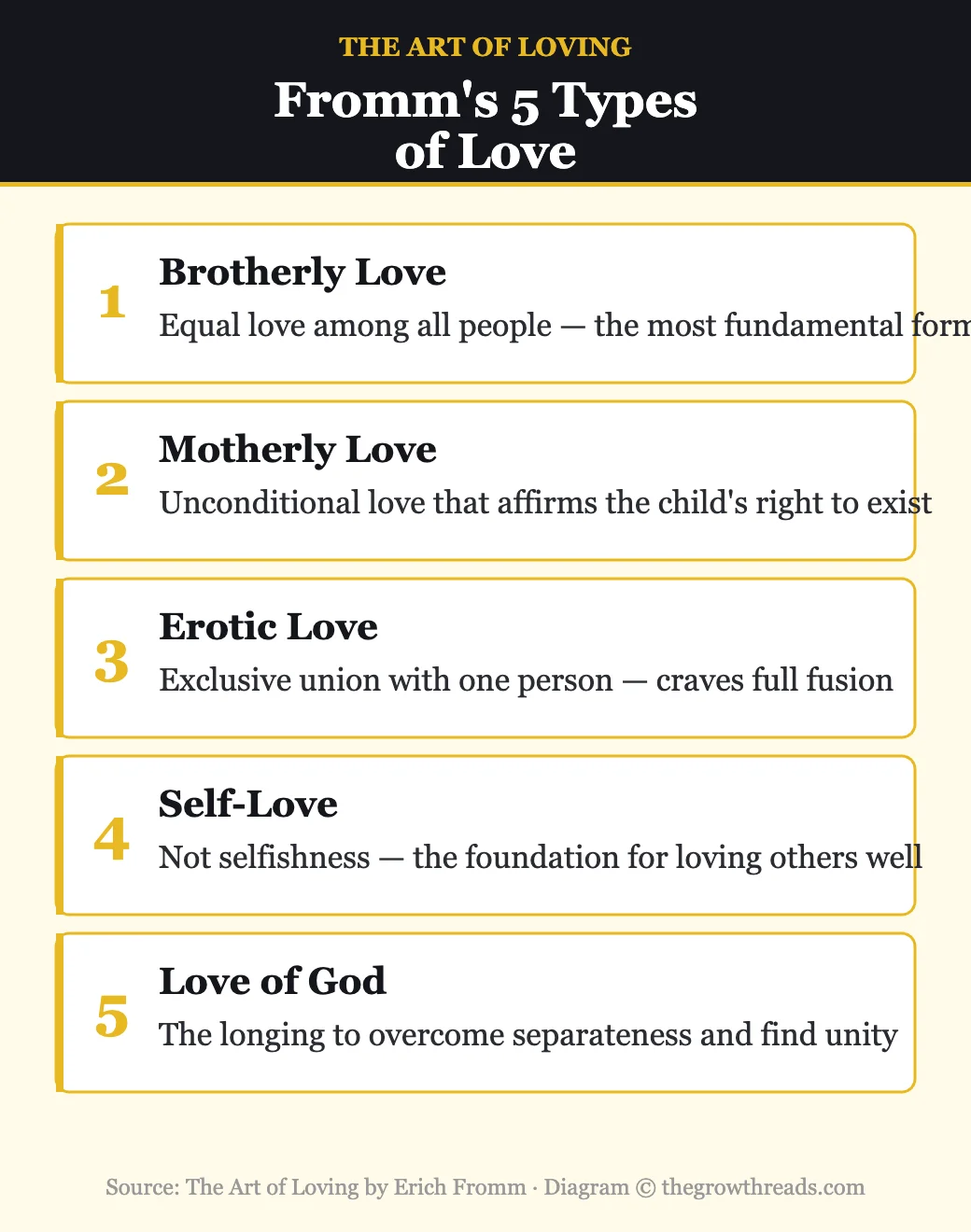
Self-love is perhaps Fromm’s most counterintuitive argument. Western culture often treats self-love and selfishness as synonyms — Fromm insists they are opposites. The selfish person does not love themselves too much; they love themselves too little. Their grasping, acquisitive behavior is an attempt to compensate for a fundamental failure of self-care. A person who genuinely affirms their own life, happiness, and growth is far more capable of loving others. Self-love is the prerequisite, not the obstacle.
Love of God represents the human desire to overcome separateness at the most universal level. Fromm approaches this philosophically rather than doctrinally, examining how Eastern and Western religious traditions conceptualize the relationship between the individual and the divine. He sees the mature religious attitude as one that does not seek a powerful father figure for protection but instead strives to embody the principles of love, truth, and justice in one’s own life.
Part 4: The practice of love
Fromm acknowledges that most readers will be disappointed by his practical advice — because they expect a set of techniques (“do X and Y to make your partner happy”), and what he offers instead are disciplines of character. This is consistent with his thesis: if love is an art, you cannot separate the practice of love from the practice of becoming a certain kind of person.
He prescribes four disciplines. Discipline means living by a structured set of values and practices, not at the whim of impulse. The person who only does what they feel like doing, when they feel like doing it, will never master any art. Concentration means being fully present — truly listening to another person, sitting with your own thoughts without distraction, being alone with yourself without anxiety. Fromm notes that modern Western culture makes concentration extraordinarily difficult, since it encourages doing many things at once and rarely being still.
Patience means accepting that anything worth achieving takes time. A society obsessed with speed and efficiency trains people to want quick results, but love — like any art — cannot be rushed. And supreme concern means making love the most important thing in your life. The person who wants to learn medicine but treats it as a side hobby will never become a good doctor. Likewise, the person who treats love as something that should happen automatically, without dedicated effort, will never develop the capacity for it.
Fromm adds several specific qualities that the practice of love requires. Overcoming narcissism — the inability to see reality from any perspective other than your own — is essential, because love requires seeing the other person as they truly are. Objectivity and reason help you distinguish the actual person from your projections and fantasies. Faith — not blind belief, but rational faith in the core of another person and in your own capacity to love — provides the confidence needed to commit without guarantees. And courage enables you to risk pain, rejection, and disappointment in the service of genuine connection.
The book closes with a sobering cultural critique. Fromm argues that the social structure of modern capitalism systematically undermines the conditions necessary for love. A society that values production, consumption, and exchange above all else will inevitably produce people who approach relationships as transactions. The practice of love therefore requires a degree of non-conformity — a willingness to prioritize human connection over material success, even when the entire culture is pushing you the other way.
Who is The Art of Loving best for — and who should read something else first?
This book is ideal for readers who want to think deeply about what love actually is — not just how to manage conflict or communicate better in a relationship. If you are drawn to philosophical frameworks and want to examine the assumptions behind your approach to love, Fromm’s 160 pages will give you more to chew on than most 400-page relationship guides. It is also excellent for anyone who has noticed that their relationships follow a pattern — intense beginning, gradual disillusionment — and wants to understand why.
If you are looking for immediately actionable relationship techniques, start with The Seven Principles for Making Marriage Work or Hold Me Tight instead. If you want to understand your attachment style first, Attached is a better starting point. Fromm’s book provides the philosophical foundation; these others provide the behavioral toolkit.
Questions to reflect on
- Do you spend more energy trying to be lovable (attractive, successful, interesting) than trying to develop your capacity to love?
- Which of Fromm’s four elements — care, responsibility, respect, knowledge — is weakest in your most important relationship right now?
- Can you distinguish between genuine self-love and selfishness in your own behavior? Where is the line for you?
- How much of your approach to dating or relationships has been shaped by a “marketplace” mentality — evaluating people based on their exchange value?
- Of the four disciplines (discipline, concentration, patience, supreme concern), which one would make the biggest difference if you practiced it for the next month?
🔥 Ready to practice love as an art?
Fromm’s compact masterpiece will change how you think about every relationship in your life.
How to apply The Art of Loving (7-day plan)
- Day 1 — Audit your love orientation: Write down whether you spend more time trying to be loved (impressing, performing, seeking approval) or trying to love well (caring, understanding, respecting). Be honest about the ratio.
- Day 2 — Practice concentration: Have one conversation today where you give the other person your complete, undivided attention — no phone, no mental to-do list, no planning your response while they speak. Notice how different it feels.
- Day 3 — Diagnose the four elements: Pick your most important relationship and rate each element — care, responsibility, respect, knowledge — on a scale of 1–10. Identify the weakest one and commit to one specific action to strengthen it this week.
- Day 4 — Challenge the marketplace mentality: Notice any moment today where you evaluate another person (or yourself) in terms of “exchange value” — attractiveness, status, usefulness. Simply notice it without judgment.
- Day 5 — Practice self-love (not selfishness): Do one thing today that genuinely affirms your own growth and wellbeing — not as a guilty indulgence, but as a foundation for being more present with others.
- Day 6 — Exercise patience: Choose one area where you have been trying to force faster progress in a relationship. Consciously let go of the timeline and accept the pace of genuine growth.
- Day 7 — Make love your supreme concern: Look at your calendar and your habits. Does the way you spend your time reflect that love is your highest priority? Rearrange one thing so it does.
Frequently asked questions
Is The Art of Loving still relevant today?
Absolutely. Fromm wrote the book in 1956, but his core arguments about consumer culture eroding the capacity for genuine connection have only become more acute in the age of dating apps, social media, and algorithmically optimized distraction. His critique of the “personality market” — where people package and sell themselves to attract the best “deal” — reads like a description of modern swipe culture. The philosophical framework is timeless, and the practical disciplines he prescribes (concentration, patience, presence) are more needed now than ever.
What are the main types of love Fromm describes?
Fromm identifies five types: brotherly love (universal love for all people), motherly love (unconditional affirmation), erotic love (exclusive desire for fusion with one person), self-love (genuine self-affirmation that enables loving others), and love of God (the drive to overcome separateness at the most universal level). He argues that all five share the same four elements — care, responsibility, respect, and knowledge — but express them differently. Brotherly love is the foundation; erotic love without brotherly love is mere physical attraction.
What does Fromm mean by “love is an art”?
Fromm means that love, like music or medicine, requires deliberate study and disciplined practice — it is not something that happens to you automatically when you meet the right person. Just as a pianist must learn theory, practice daily, and treat mastery as a serious commitment, a person who wants to love well must understand how love works, develop specific character traits (discipline, concentration, patience), and make love their highest priority rather than a pleasant side effect of an otherwise busy life.
How is self-love different from selfishness?
Fromm argues they are actually opposites. The selfish person does not love themselves too much — they love themselves too little. Their constant grasping, hoarding, and self-centeredness is compensation for an inner emptiness and lack of genuine self-affirmation. True self-love means affirming your own life, growth, happiness, and freedom — which makes you more capable of genuinely loving others, not less. A person who cannot say “my life matters and I deserve care” will struggle to offer authentic care to anyone else.
Is The Art of Loving a religious book?
Not in a doctrinal sense, though Fromm discusses “love of God” as one of his five types. His approach is philosophical and humanistic — he examines how different religious traditions (Judeo-Christian, Buddhist, Taoist) conceptualize the human relationship with the divine, but he does not advocate for any particular faith. His interest is in the psychological drive behind religious experience: the desire to overcome separateness and achieve unity. Secular readers will find the framework fully applicable without needing to engage the theological dimensions.
How long does it take to read The Art of Loving?
The book is approximately 160 pages and can be read in about three to four hours, though it rewards slower, reflective reading. Fromm writes with the density of a philosopher rather than the expansiveness of a pop psychology author — every paragraph carries weight. Many readers report rereading specific chapters multiple times. The brevity is part of the appeal: Fromm delivers more insight per page than most 400-page relationship books, making it an efficient but intellectually demanding read.
What should I read after The Art of Loving?
If you want actionable relationship techniques that build on Fromm’s philosophical foundation, read The Seven Principles for Making Marriage Work by John Gottman or Hold Me Tight by Sue Johnson. For understanding attachment patterns, try Attached by Amir Levine. For boundary-setting as an expression of self-love, Set Boundaries, Find Peace is excellent. For more Fromm, Escape from Freedom extends his social critique.
Related summaries
- The 5 Love Languages Summary — Chapman’s practical framework for expressing love in ways your partner actually receives.
- Attached Summary — How attachment theory explains why you love the way you do.
- The Seven Principles for Making Marriage Work Summary — Gottman’s research-backed techniques for lasting relationships.
- Nonviolent Communication Summary — Rosenberg’s method for connecting through empathy and honest expression.
📚 Explore more: This book is part of our Best Relationship Books collection — see the full ranked list for our top picks across love, communication, and connection.
Related Relationships Summaries
Getting the Love You Want Summary & Review: Why You Chose Your Partner
His Needs, Her Needs Summary & Review: Affair-Proof Your Marriage
Love Sense Summary & Review: The Revolutionary Science of Romantic Love
Maybe You Should Talk to Someone Summary & Review: A Therapist’s Guide to Being Human
The Four Agreements Summary & Review: A Simple Code for Personal Freedom