

★★★★½ 4.5/5 — a clarifying manifesto for doing less, but better. Slightly repetitive, but its central discipline can genuinely reshape how you spend your life.
Best for: overcommitted, stretched-thin people who feel busy but not productive · Reading time: ~5 hours (this guide: 15 min) · Difficulty to apply: Moderate — the idea is simple; saying no is the hard part
Essentialism in one minute
You cannot do everything, so stop trying — instead, do less, but better. Greg McKeown argues that most of us live as “non-essentialists,” saying yes to too much, spreading ourselves thin across a hundred good things, and making “a millimeter of progress in a million directions.” The essentialist, by contrast, relentlessly distinguishes the vital few from the trivial many and pours energy only into what truly matters. This is not about doing more in less time; it is a disciplined, systematic approach to figuring out what is absolutely essential, eliminating everything else, and then removing obstacles so the essential can flow effortlessly. The payoff is not just greater productivity but a greater sense of control and meaning — the feeling that you, not the demands of others, are choosing how you spend your one life. The book organizes this into three moves: explore what matters, eliminate what doesn’t, and execute with ease.
Key takeaways
- Less but better: the essentialist does fewer things, but does the right things exceptionally well.
- Almost everything is noise: only a tiny fraction of your options and activities are truly essential.
- You always have a choice: reclaiming your power to choose is the foundation of essentialism.
- Trade-offs are real: you can’t have it all or do it all, so choose deliberately instead of by default.
- Explore before you commit: create space to think, and evaluate many options against strict criteria.
- The 90% rule: if something isn’t a clear, enthusiastic yes (a 90+ out of 100), treat it as a clear no.
- Learn to say no gracefully: a slow yes to everything is a no to what matters; protect your time with tactful refusals.
- Uncommit from the non-essential: cut sunk-cost projects and edit your life like an editor cutting a manuscript.
- Build in buffers: leave slack for the unexpected so you aren’t perpetually behind.
- Make execution effortless: remove obstacles, celebrate small wins, and build routines around the essential.
What is Essentialism about?
Essentialism is a productivity and life-design book by Greg McKeown about “the disciplined pursuit of less.” It argues that success comes not from doing more but from focusing only on what is truly essential — exploring options carefully, eliminating the non-essential, and executing the vital few things effortlessly — so you can make your highest contribution rather than spreading yourself thin.
About the author
Greg McKeown is a writer, speaker, and leadership consultant who has advised companies across Silicon Valley and beyond on strategy and focus. Born in the UK and based in the US, he became widely known for popularizing the idea of “essentialism” as an antidote to the overcommitment and burnout endemic to modern professional life. Published in 2014, Essentialism: The Disciplined Pursuit of Less became a bestseller and a staple on productivity and leadership reading lists, and McKeown followed it with Effortless, which extends the philosophy to making the essential easier to do. He writes with the clarity of a consultant and the conviction of someone who watched capable people undermine themselves by trying to do everything. His central aim is to reframe focus not as a one-time event but as an ongoing discipline — a way of continually asking, “Am I investing in the right activities?” Explore all Greg McKeown book summaries →
Key concepts at a glance
| Concept | What it means | Use it when |
|---|---|---|
| Less but better | Fewer things, done excellently | You feel spread thin |
| The vital few | The small set that truly matters | Prioritizing anything |
| The 90% rule | Below a clear yes is a no | Evaluating an opportunity |
| The graceful no | Declining without damage | Someone asks for your time |
| Buffer | Slack for the unexpected | Planning your time |
| Effortless execution | Remove obstacles to the essential | A key goal keeps stalling |
Part 1: The essentialist mindset — less but better
McKeown opens by contrasting two ways of living. The non-essentialist thinks “I have to do it all,” treats almost everything as important, reacts to whatever is most pressing, and ends up overextended and unfulfilled. The essentialist thinks “I choose to do only what is essential,” recognizes that almost everything is nonessential, and channels energy toward the few things that make the highest contribution.
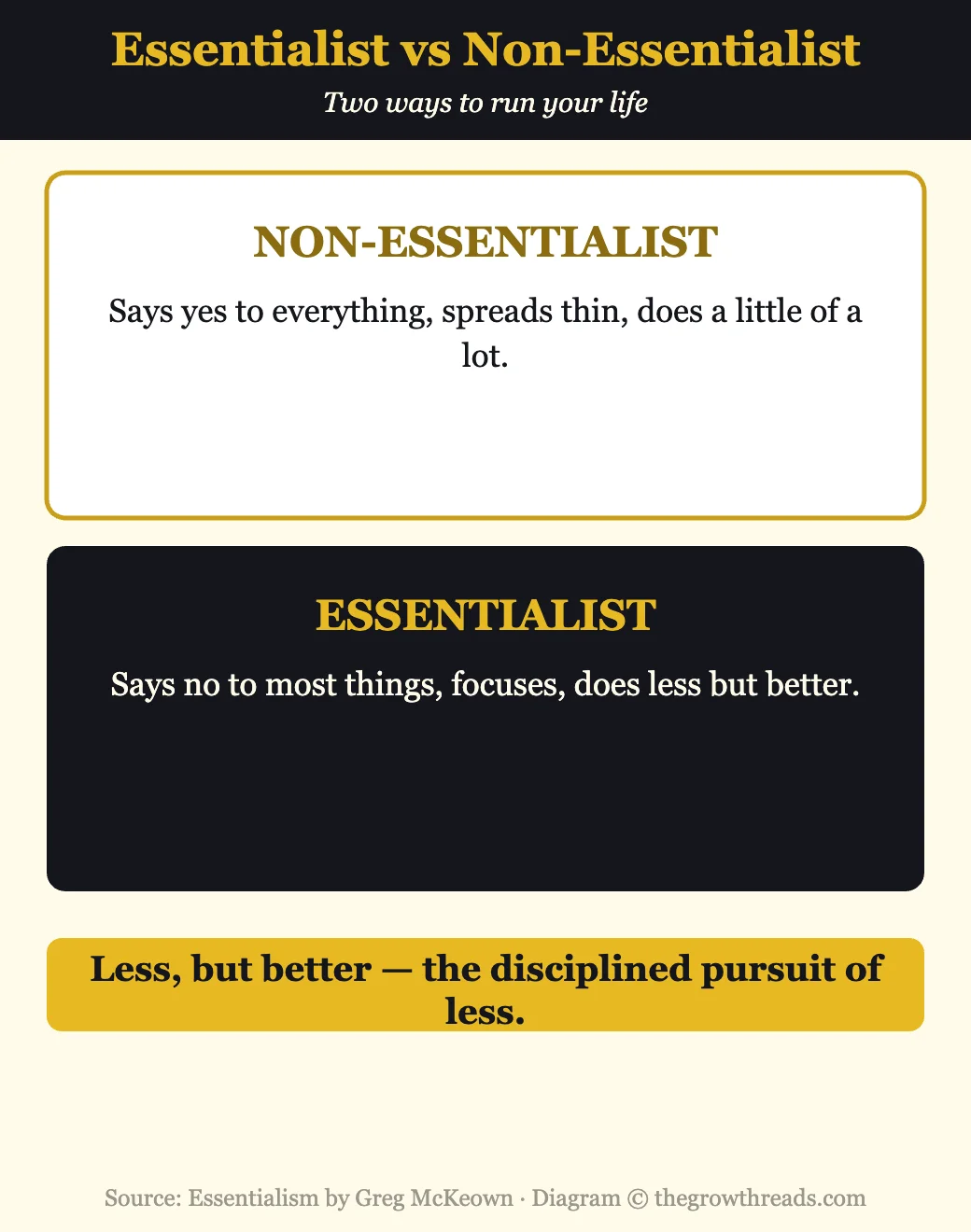
Three core realities underpin this mindset. First, the power of choice: we often forget that we can choose how to spend our time and energy, and reclaiming that sense of agency is the starting point of essentialism. Second, the reality of trade-offs: we cannot have it all or do it all, and pretending otherwise leads to being pulled in every direction; the essentialist asks not “How can I do both?” but “Which problem do I want to solve?” Third, the recognition that the vast majority of our options and activities are essentially noise — the “trivial many” — while only a small number are the “vital few” that produce most of the value. McKeown invokes the idea that a tiny fraction of efforts drive the majority of results. Once you internalize that most things don’t matter much, the logic of doing less becomes not a sacrifice but a strategy. The book is then organized around a three-part process for putting this into practice.
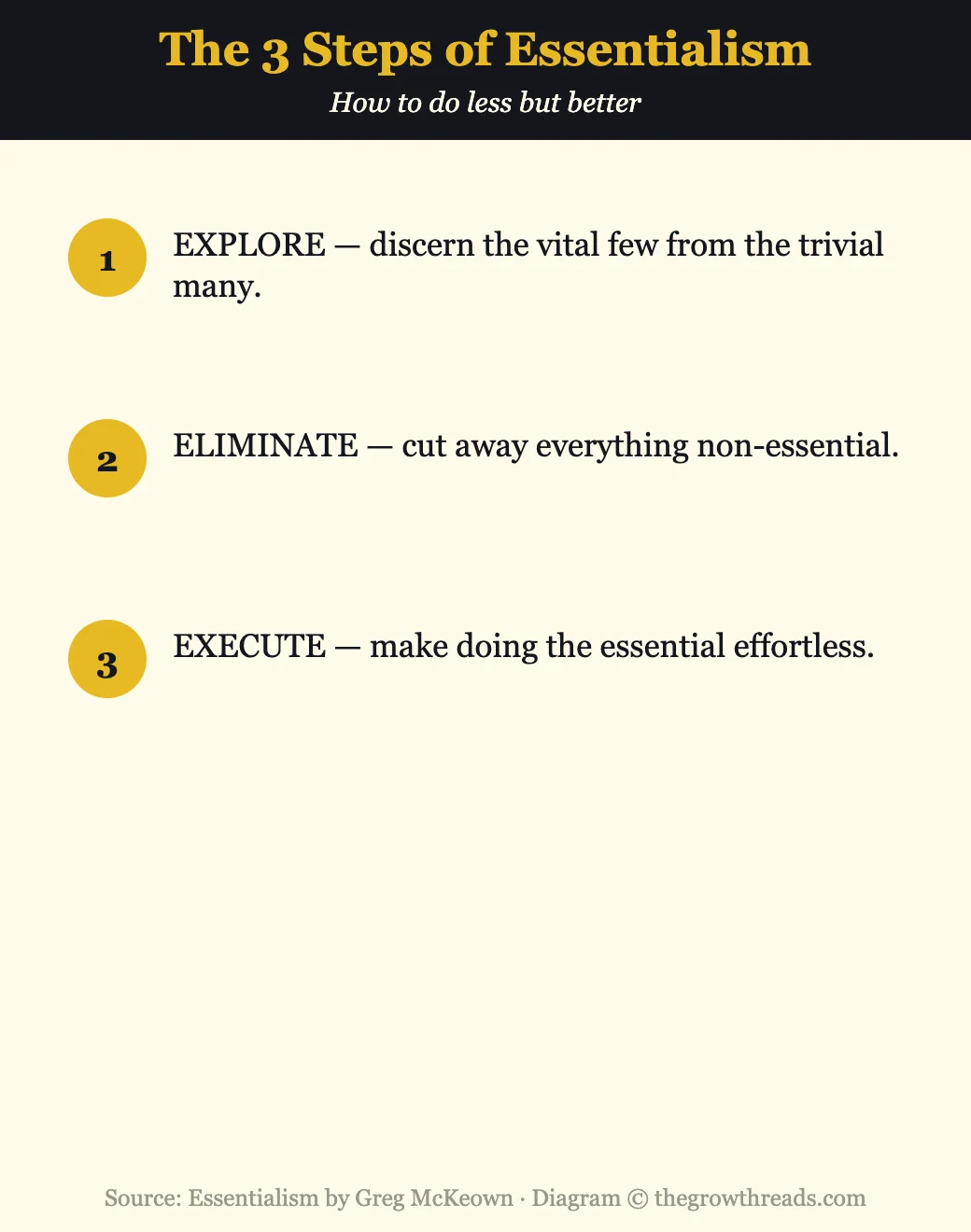
Part 2: Explore — discern the vital few
The first step, counterintuitively, is to explore more options before committing to fewer. Essentialists, McKeown argues, actually explore a wider range of possibilities than non-essentialists, but they do so in order to select more ruthlessly. This requires deliberately creating space to think and escape the busyness — time to reflect, to look at the big picture, even to play, which he argues fuels creativity and broadens perspective. He also insists on protecting “the asset,” meaning yourself: guarding your sleep and wellbeing, because a depleted person cannot discern or contribute well.
The crucial discipline of exploring is applying extremely selective criteria, captured in his famous 90% rule.
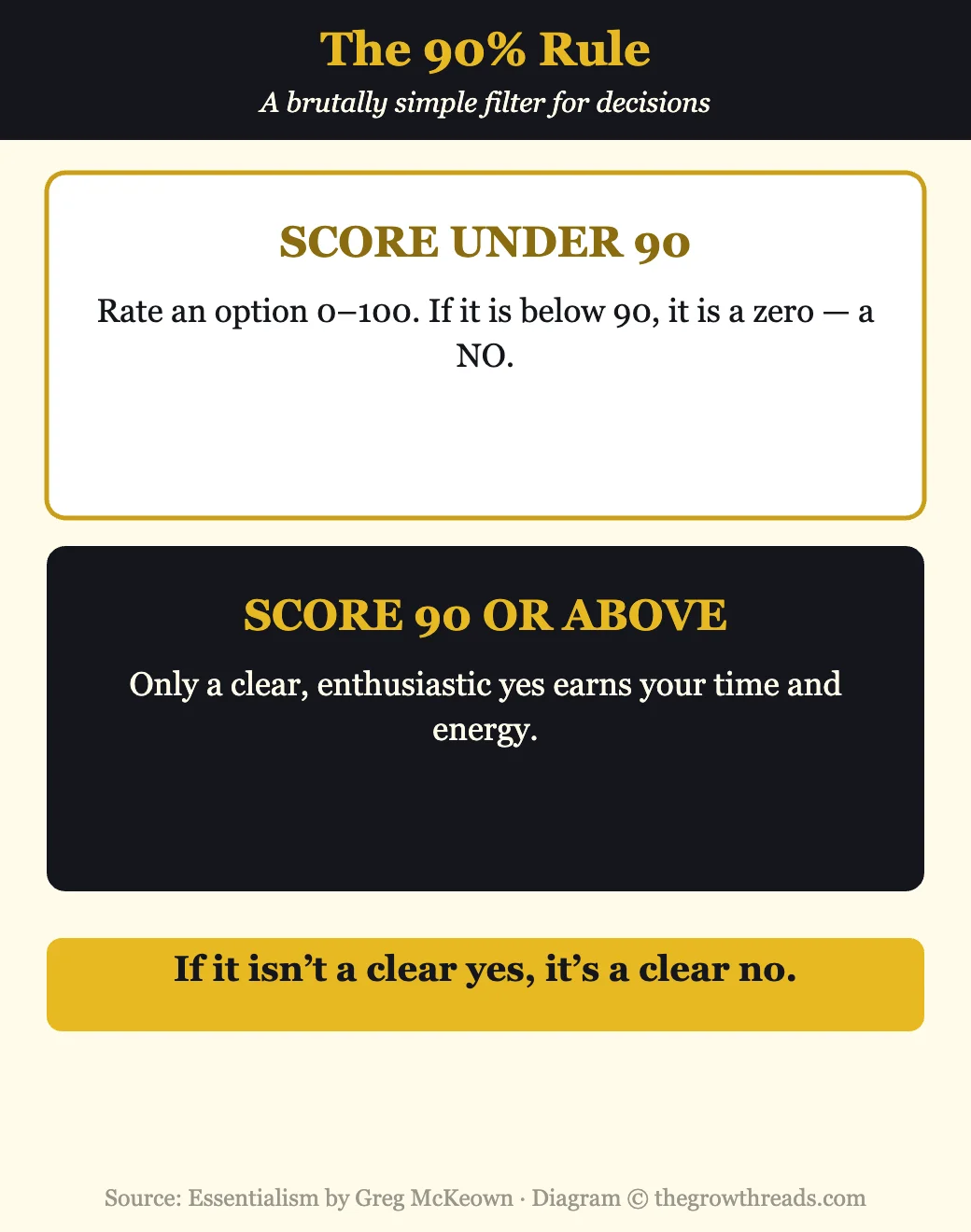
When evaluating an option or opportunity, McKeown suggests you rate how well it fits what you want on a scale of 0 to 100 — and if it scores anything below 90, treat it as a zero and reject it. The point is to refuse to settle for options that are merely good, because a life full of “pretty good” commitments crowds out the great ones. The simplest version is his mantra: “If it isn’t a clear yes, then it’s a clear no.” Most of us do the opposite, saying yes to anything that isn’t a definite no, and end up buried. By raising the bar this high, you ensure that the few things you do commit to are genuinely worth your finite time and energy. Exploring widely but selecting by strict criteria is how the essentialist finds the vital few worth their all.
TGR Note: Essentialism and The One Thing are two sides of the same coin — both argue that extraordinary results come from radical focus and saying no to the merely good. And the focus Essentialism protects is exactly what Deep Work teaches you to spend well. Together they form a tight trio: choose less, protect it, and go deep on it.
Part 3: Eliminate — cut the non-essential
Discerning what matters is only half the battle; the harder half is eliminating what doesn’t, especially the things you have already said yes to. McKeown starts with clarity: essentialists commit to one “essential intent” — a concrete, inspiring, and meaningful goal that guides decisions — because vague priorities let non-essential activities creep back in. From there, the central skill is the graceful “no.” Because saying yes to one thing always means saying no to something else, the essentialist becomes comfortable declining requests, invitations, and opportunities that don’t align with their essential intent, doing so tactfully but firmly. McKeown offers practical ways to say no without damaging relationships — separating the decision from the relationship, using a gentle but clear refusal, and remembering that a slow, reluctant yes is worse than a fast, respectful no.
He also confronts our reluctance to cut things we’ve already invested in — the sunk-cost trap, where we keep pouring resources into a failing project simply because we’ve already spent so much. The essentialist asks not “How much have I already invested?” but “If I weren’t already involved, how much would I invest to get into this now?” He recommends “uncommitting” from such commitments, and thinking like an editor who improves a piece of writing by cutting — removing the good to make room for the great. Setting clear boundaries is part of this: protecting your limits so that other people’s agendas don’t consume your essential few. Elimination, McKeown stresses, is not a one-time purge but an ongoing practice of continually pruning the nonessential from your life.
Part 4: Execute — make the essential effortless
The final step is to design your life so that doing the essential becomes almost automatic, rather than requiring constant willpower. McKeown’s counterintuitive advice is to remove obstacles rather than add motivation. He suggests building in a “buffer” — deliberate slack in your schedule and resources — so that the inevitable unexpected events don’t derail you and leave you perpetually behind; essentialists plan for things to take longer than expected. He advises identifying and removing the single biggest obstacle slowing your progress toward the essential, the “slowest hiker” holding up the whole group, rather than trying to optimize everything at once.
He is a strong believer in the power of small wins and steady progress: rather than aiming for a huge, intimidating breakthrough, focus on minimal viable progress and celebrate incremental gains, which build momentum and motivation. And he champions routine — designing repeatable habits and defaults around your essential activities so they happen without daily deliberation, turning focus into something structural rather than effortful. Finally, execution comes down to presence: focusing on what is important now rather than being scattered across past regrets and future worries. Taken together, the book’s argument is a coherent and liberating one: by exploring carefully, eliminating ruthlessly, and executing effortlessly, you can escape the exhausting cycle of overcommitment and instead make your highest contribution to the things that truly matter. Some readers find the message repetitive and the examples familiar, but the discipline it teaches — the constant, courageous question of “Is this essential?” — is genuinely capable of changing how you live.
Who is Essentialism best for — and who should read something else first?
This book is ideal for anyone who feels busy but not productive, stretched across too many commitments, and unable to focus on what matters — professionals, leaders, and overextended high-achievers especially. Its central discipline of “less but better” is genuinely clarifying. It is not for you if you want detailed tactical systems rather than a mindset and principles, or if you find repetition tiresome, since the core idea is stated many ways. If you want a concrete system for managing the commitments you keep, pair it with Getting Things Done; if you want to narrow all the way to a single priority, read The One Thing.
Questions to reflect on
- Where are you making “a millimeter of progress in a million directions”?
- What in your life would you not commit to today if you weren’t already involved?
- Which recent “yes” was really a reluctant one that crowded out something essential?
- If you applied the 90% rule to your current commitments, which would score below 90?
- What is the single biggest obstacle slowing you down — your “slowest hiker”?
🔥 Ready to do less, but better?
This guide is the map — McKeown’s stories and criteria are what make “less but better” practical.
How to apply Essentialism (7-day plan)
- Day 1 — List your commitments. Write down everything you’re currently saying yes to, big and small.
- Day 2 — Apply the 90% rule. Score each commitment 0–100 against what matters most; flag everything under 90.
- Day 3 — Define your essential intent. Write one clear, meaningful goal to guide your decisions.
- Day 4 — Say one graceful no. Decline a request that doesn’t fit your essential intent, tactfully but firmly.
- Day 5 — Uncommit from a sunk cost. Cut one project you’re continuing only because you’ve already invested.
- Day 6 — Build a buffer. Add slack to your schedule so the unexpected doesn’t derail you.
- Day 7 — Remove your slowest hiker. Identify and clear the single biggest obstacle to your essential goal.
Frequently asked questions
Is Essentialism worth reading?
Yes, especially if you feel overcommitted and busy without being truly productive. Its central idea — the disciplined pursuit of less, or “less but better” — is clarifying and can genuinely change how you prioritize your time and energy. The framework of explore, eliminate, and execute is practical, and the 90% rule and the “graceful no” are immediately usable. The main criticism is that the book is somewhat repetitive, stating its core message many ways, and it offers a mindset and principles more than a detailed tactical system. But for chronic over-committers, it is a valuable read.
What is the main message of Essentialism?
That you should do less, but better — focusing your time and energy only on what is truly essential and eliminating everything else. McKeown argues most people spread themselves thin across too many good things, making little progress on any, while essentialists ruthlessly identify the vital few, cut the trivial many, and remove obstacles so the essential flows effortlessly. The deeper message is about reclaiming your power to choose and making your highest contribution rather than being run by others’ agendas.
What is the 90% rule in Essentialism?
The 90% rule is McKeown’s method for making selective decisions. When evaluating an opportunity, you rate how well it fits what you truly want on a scale of 0 to 100, and if it scores anything below 90, you treat it as a zero and decline it. The idea is to refuse merely “good” options that would crowd out great ones. Its simplest form is the mantra “If it isn’t a clear yes, then it’s a clear no,” which reverses the common habit of saying yes to anything that isn’t a definite no.
How is Essentialism different from The One Thing?
They share a philosophy of radical focus but differ in emphasis. Essentialism is a broad life-design framework — explore, eliminate, execute — for continually discerning and pursuing what matters across all of life, and it dwells heavily on saying no and eliminating the nonessential. The One Thing narrows further, urging you to identify the single most important task that makes everything else easier or unnecessary and to protect time for it. Essentialism is the wider discipline of doing less; The One Thing zooms in on the single highest-leverage priority.
How long does it take to read Essentialism?
The book is around 260 pages and most readers finish it in about five hours, and its short, punchy chapters make it easy to read in sittings. Because the core idea is simple and repeated, some readers move through it quickly or skim. Our summary above captures the full framework and its key tools in roughly 15 minutes, which is often enough to start applying the “less but better” discipline right away.
Is Essentialism just about productivity?
Not only. While it is often shelved as a productivity book, its deeper concern is how you spend your life. The discipline of focusing on the essential applies to relationships, health, purpose, and wellbeing as much as to work — McKeown stresses protecting sleep, making space to think, and choosing a meaningful essential intent. It is better understood as a philosophy of intentional living than as a set of efficiency hacks: the aim is not merely to get more done, but to ensure the things you do are the right things.
Is Essentialism good for beginners?
Yes. It requires no background and its clear, principle-driven style makes it very accessible. Beginners often find its central idea — do less but better — eye-opening, and simple tools like the 90% rule and the graceful no are easy to start using. Because it offers a mindset and criteria more than a step-by-step system, pairing it with a practical productivity method helps turn the philosophy into daily habits.
Related summaries
- The One Thing Summary — narrowing all the way to a single priority.
- Deep Work Summary — going deep on the essential few.
- Getting Things Done Summary — a system for the commitments you keep.
- Atomic Habits Summary — building routines around the essential.
- Browse all our best productivity books.
How we analyze books: We work from the full book — reconstructing its core arguments in our own words, adding commentary that connects it to related research and other books in our library, and pressure-testing the advice against how it plays out in real life. We never reproduce the text; we synthesize it. Read our full methodology.
Disclosure: The Growth Reads is reader-supported. When you buy through links on our site we may earn an affiliate commission at no extra cost to you. We only recommend books we believe are worth your time, and our summaries and opinions are written independently.
Related Productivity Summaries
Getting Things Done Summary & Review: The Art of Stress-Free Productivity
The Effective Executive Summary & Review: Get the Right Things Done
The Power of Full Engagement Summary & Review: Manage Energy, Not Time
The Power of Habit Summary & Review: Why We Do What We Do
Willpower Summary & Review: The Science of Self-Control and How to Strengthen It