

★★★★½ 4.5/5 — the definitive productivity system for capturing everything and freeing your mind. Detailed and demanding to set up, but genuinely stress-reducing once it clicks.
Best for: anyone overwhelmed by commitments who wants a complete, trusted system to organize their work and life · Reading time: ~7 hours (this guide: 16 min) · Difficulty to apply: Moderate — the ideas are simple; building and maintaining the system takes discipline
Getting Things Done in one minute
Your mind is for having ideas, not for holding them — so get everything out of your head and into a trusted external system. David Allen’s classic productivity method, universally known as GTD, is built on a simple insight: the stress and mental fog of modern work come from carrying dozens of unfinished commitments, or “open loops,” in your head, where they nag at you and drain your focus. The solution is a five-step workflow — capture everything, clarify what it means, organize it where it belongs, reflect on it regularly, and engage with the right task — that moves all those loops out of your mind and into a reliable system you review consistently. When you trust that system completely, your mind can relax into a state Allen calls “mind like water”: calm, clear, and fully present for whatever you’re doing. It is less a motivational book than a detailed operating manual for stress-free productivity, and for many people it is life-changing once they commit to it.
Key takeaways
- Your mind is for having ideas, not holding them: unprocessed commitments in your head create stress and sap focus.
- Capture everything: collect every task, idea, and commitment into trusted inboxes, getting it all out of your head.
- Clarify what each item means: decide if it’s actionable, and if so, what the very next physical action is.
- The 2-minute rule: if an action takes less than two minutes, do it immediately rather than tracking it.
- Define next actions: vague “to-dos” cause paralysis; a clear, concrete next action makes work start.
- A project is anything needing more than one action: track projects separately from their next actions.
- Organize by lists and contexts: next actions, projects, waiting-for, someday/maybe, calendar, and reference.
- The weekly review is the keystone: a regular review keeps the system current and trustworthy.
- Engage with confidence: with everything captured and clarified, you can choose what to do now without anxiety.
- Mind like water: a trusted system produces a calm, focused, stress-free state of mind.
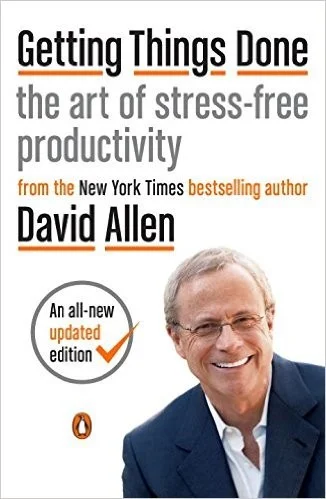
What is Getting Things Done about?
Getting Things Done is a productivity book by David Allen presenting the GTD method for stress-free productivity. Its central idea is to capture all your commitments in a trusted external system rather than your head, then process them through a five-step workflow — capture, clarify, organize, reflect, and engage — so you can focus calmly on the right task at the right time.
About the author
David Allen is an American productivity consultant, executive coach, and the creator of the Getting Things Done methodology. He spent decades advising individuals and organizations on personal productivity before distilling his approach into this book, first published in 2001 and substantially revised in 2015 to reflect the digital age. GTD went on to become one of the most influential productivity systems in the world, spawning a devoted community, countless apps built around its principles, and a vocabulary — “next actions,” “inbox zero,” the “weekly review” — that has entered mainstream work culture. Allen writes as a practical systems-builder rather than a motivator; his focus is not on inspiring you to work harder but on engineering a reliable process that removes the friction and anxiety from managing your commitments. The book’s enduring appeal is that its core logic is timeless, even as the specific tools people use to implement it continue to change. Explore all David Allen book summaries →
Key concepts at a glance
| Concept | What it means | Use it when |
|---|---|---|
| Capture | Collect everything out of your head | Something has your attention |
| Next action | The concrete next physical step | You feel stuck on a task |
| 2-minute rule | Do quick tasks immediately | Processing your inbox |
| Project | Anything needing 2+ actions | An outcome has many steps |
| Context | Grouping actions by tool or place | Deciding what to do now |
| Weekly review | Keeping the system current | Every week, without fail |
Part 1: Mind like water — the core promise
Allen begins with a diagnosis of why we feel overwhelmed. It is not, he argues, the sheer amount of work, but the way we manage it — specifically, the habit of trying to keep track of everything in our heads. Every unfinished commitment, from a major project to a reminder to buy batteries, is an “open loop” that your mind cannot fully let go of. These loops nag at you, pull your attention, and create a constant low-grade stress, precisely because the mind is a terrible place to store things: it reminds you of them at random, unhelpful moments and cannot prioritize.
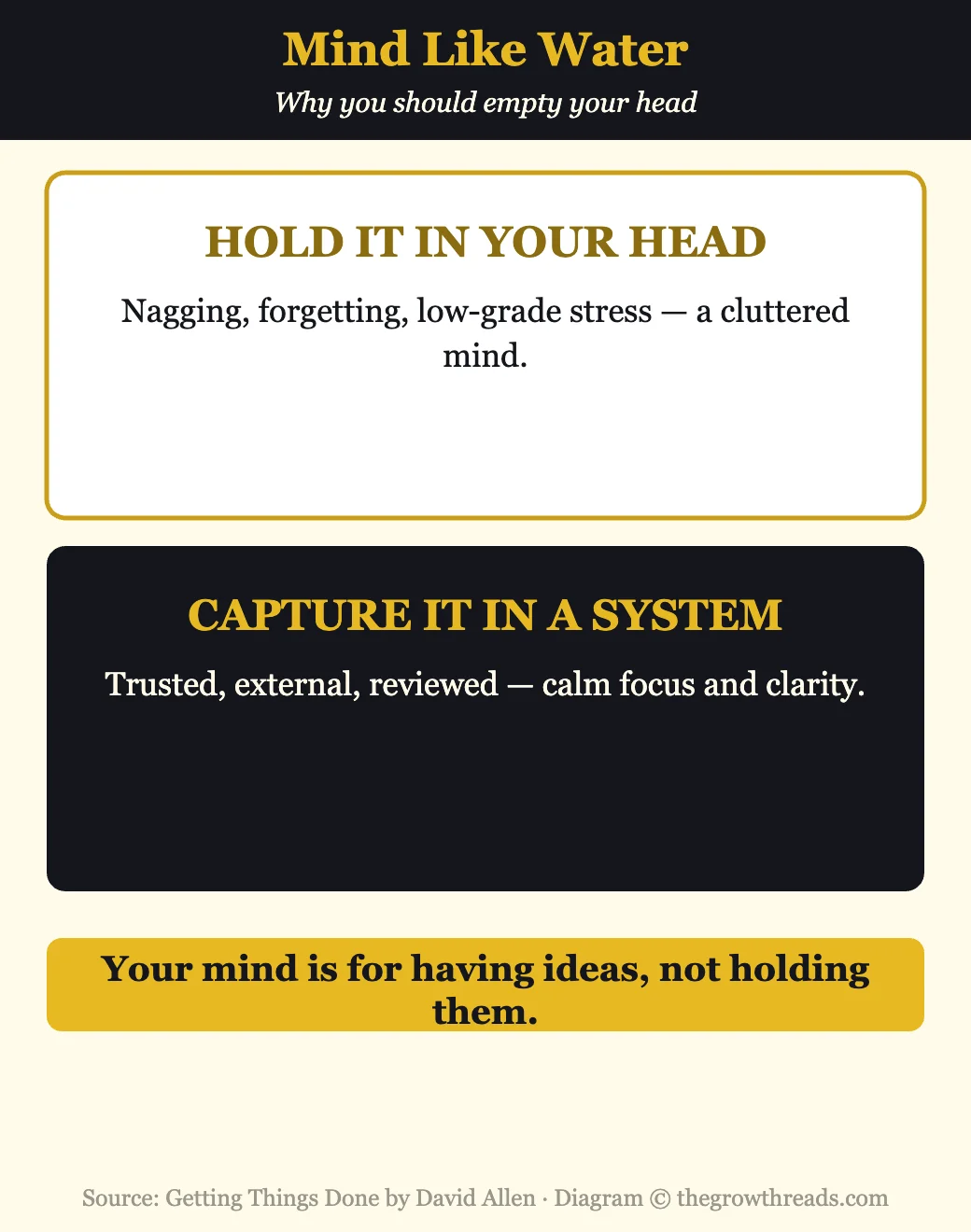
His central metaphor is “mind like water” — the calm, responsive state of a mind that is not cluttered with things it is trying not to forget. When water is disturbed it reacts appropriately and then returns to stillness; a clear mind does the same. The way to achieve this, Allen says, is counterintuitive: paradoxically, you gain mental clarity not by trying harder to remember but by getting everything out of your head and into a trusted external system. Once your mind genuinely trusts that nothing will be forgotten because it is all captured and regularly reviewed, it can relax and give its full attention to the task in front of you. This is the promise of GTD: not just more done, but done with far less stress. The rest of the book is the detailed method for getting there.
Part 2: The five steps of GTD
The heart of the system is a five-step workflow for managing everything that has your attention. Allen is emphatic that these are distinct stages and that trouble arises when we try to do them all at once.
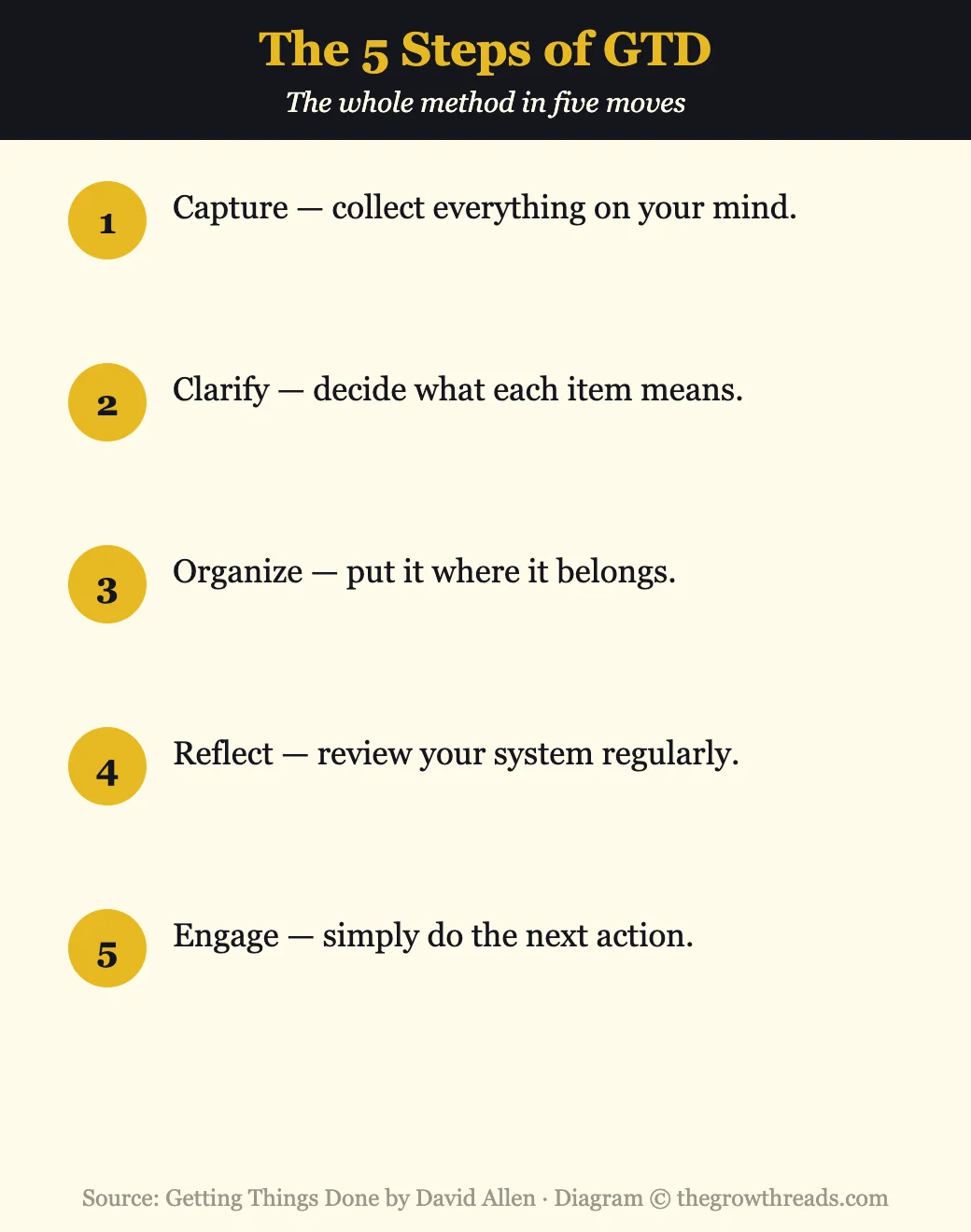
The first step is Capture: collect absolutely everything that has your attention — tasks, ideas, commitments, worries — into a small number of trusted “inboxes” (a physical tray, a notes app, an email inbox), getting it all out of your head. The second is Clarify: process what you’ve captured by asking, for each item, what it is and whether it’s actionable. The third is Organize: put the results where they belong — on the appropriate list, calendar, or reference file. The fourth is Reflect: review your system regularly, above all through a weekly review, so it stays current and you can trust it. The fifth is Engage: simply do — make confident choices about what to work on now, knowing your whole landscape is captured and clarified. Together these steps form a pipeline that reliably converts the chaos of incoming “stuff” into organized, actionable, trusted commitments. Master the pipeline, and nothing falls through the cracks.
Part 3: Clarifying — next actions, the 2-minute rule, and the 4 D’s
The clarify step is where GTD does its most important work, and it hinges on a decision tree. For each captured item, you first ask: is it actionable? If it is not actionable, it becomes one of three things — trash (delete it), a “someday/maybe” item (things you might do later), or reference material (information to keep). If it is actionable, you must define the very next physical action required to move it forward, and then decide what to do with it.
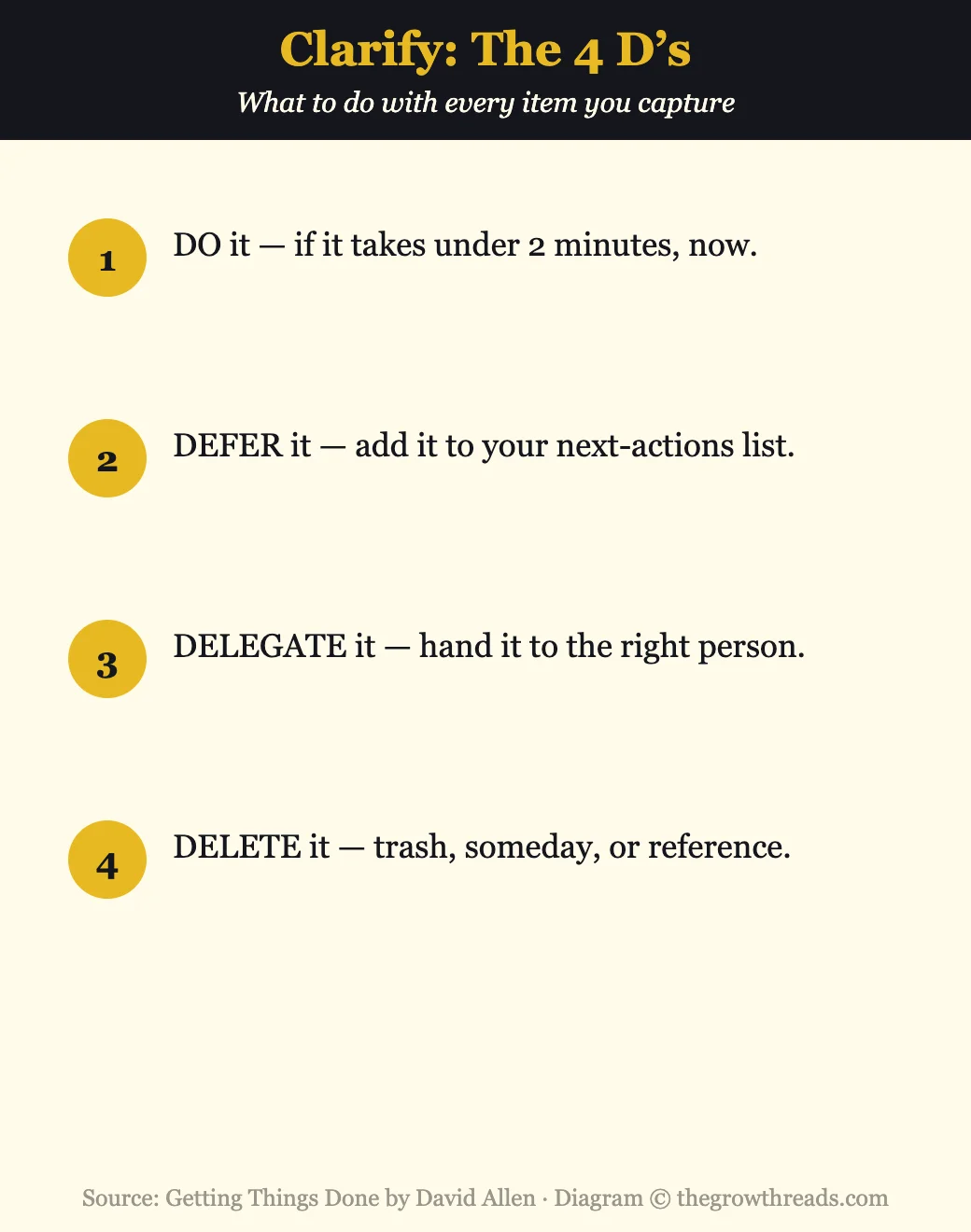
Here Allen offers his most famous rule, the 2-minute rule: if the next action will take less than two minutes, do it immediately, because it would take longer to track it than to just get it done. If it takes longer, you either delegate it (if someone else should do it, tracking it on a “waiting for” list) or defer it (put the next action on your action lists to do later). Two ideas make this powerful. The first is the insistence on defining a concrete next action — not a vague label like “Mom’s birthday” but a specific physical step like “call the bakery to order a cake.” Vague items paralyze us; concrete next actions make it obvious how to start. The second is the distinction between a project and an action: in GTD, a project is anything that requires more than one action to complete, so “plan the trip” is a project, and it needs both a spot on your projects list and a defined next action. Processing every inbox item through this logic ensures that nothing is left as ambiguous, anxiety-inducing “stuff.”
TGR Note: GTD and Deep Work are natural partners. Cal Newport’s method for protecting focused, high-value work only functions if the shallow tasks aren’t nagging at you — which is exactly what GTD’s capture-and-clarify system quiets. Use GTD to “drain the shallows” into a trusted system, and Deep Work to spend the freed-up attention on what matters.
Part 4: Organize, reflect, and engage
Once items are clarified, the Organize step sorts them into a specific set of lists that together map your entire world of commitments: a “next actions” list (often broken down by context, such as @calls, @computer, or @errands, so you can act on what’s possible in your current situation), a “projects” list of all your multi-step outcomes, a “waiting for” list of things others owe you, a “someday/maybe” list, a calendar for time-and-date-specific commitments only, and a reference filing system. The discipline of putting each thing in exactly one right place is what makes the system trustworthy. Contexts are a particularly clever touch: when you have a spare ten minutes and only your phone, you look at your @calls list rather than scanning everything, which removes decision friction.
The step that holds the whole system together is Reflect — and its engine is the weekly review, which Allen calls the critical success factor for GTD. Once a week you get clear (empty your inboxes), get current (review your lists, calendar, and projects, updating next actions), and get creative (consider your someday/maybe list and bigger goals). Without this regular review, the system silently goes stale, you stop trusting it, and you drift back to keeping things in your head. Finally, the Engage step is about choosing what to do in the moment, which Allen says you can do confidently by weighing four factors — your context, your available time, your available energy, and priority. The book also offers a “natural planning model” for projects (define purpose, envision the outcome, brainstorm, organize, and identify next actions) and touches on higher “horizons of focus,” from daily actions up to life purpose. The system is undeniably detailed and takes real effort to set up and maintain, and some readers find it heavy or the tooling advice dated. But its underlying logic — capture everything, clarify it into next actions, trust the system, review weekly — is remarkably durable, and for people drowning in commitments, it delivers exactly what the subtitle promises: the art of stress-free productivity.
TGR Note: The weekly review is GTD’s keystone habit, and installing it is a habit-design problem — which is where Atomic Habits earns its place beside this book. And GTD’s insistence on defining the concrete next action is the same “make it easy, start small” wisdom that powers The One Thing. Allen gives you the system; habit science makes it stick.
Who is Getting Things Done best for — and who should read something else first?
This book is ideal for busy professionals, managers, and anyone juggling many commitments who wants a complete, reliable system to get organized and reduce stress. Its methodology is comprehensive and, once set up, genuinely powerful. It is not for you if you want a quick, breezy read or a light set of tips — it is detailed, systematic, and requires real effort to implement, and readers who prefer minimal systems can find it heavy. If you want the mindset of focusing on less before you organize more, pair it with Essentialism or The One Thing; for protecting the focused time GTD frees up, read Deep Work.
Questions to reflect on
- How many “open loops” are you currently trying to hold in your head?
- Do you have a single trusted place where everything gets captured — or many scattered ones?
- Which of your to-dos are vague labels rather than concrete next actions?
- What two-minute tasks are you tracking that you could just do right now?
- Do you have a weekly review habit — and if not, what would it take to build one?
🔥 Ready for a mind like water?
This guide is the map — Allen’s full method is what turns the ideas into a working system.
How to apply Getting Things Done (7-day plan)
- Day 1 — Do a mind sweep. Write down absolutely everything that has your attention, big and small, in one place.
- Day 2 — Set up your inboxes. Choose a small number of trusted capture points and start using them for everything.
- Day 3 — Clarify a batch. Process items by asking “is it actionable?” and defining the next action for each.
- Day 4 — Use the 2-minute rule. As you process, immediately do anything that takes under two minutes.
- Day 5 — Build your lists. Organize next actions, projects, waiting-for, and someday/maybe into separate lists.
- Day 6 — Add contexts. Tag your next actions by context (@calls, @computer, @errands) so you can act by situation.
- Day 7 — Do a weekly review. Get clear, get current, and get creative, then schedule this review every week.
Frequently asked questions
Is Getting Things Done worth reading?
Yes, particularly if you feel overwhelmed by commitments and want a complete system rather than scattered tips. GTD is one of the most influential productivity methods ever created, and its core logic — get everything out of your head into a trusted system, clarify it into next actions, and review weekly — is genuinely effective and stress-reducing. The main caveat is that it is detailed and demanding to set up and maintain, and some readers find the book long or its tool suggestions dated. But the underlying method has stood the test of time and remains a benchmark.
What is the GTD method?
GTD, or Getting Things Done, is a five-step workflow for managing your commitments with less stress. You Capture everything that has your attention into trusted inboxes, Clarify what each item means and its next action, Organize the results into appropriate lists and a calendar, Reflect on your system regularly through a weekly review, and Engage by confidently choosing what to do now. The goal is to move all your open loops out of your head into a reliable external system, freeing your mind for focused, calm work.
What is the 2-minute rule in Getting Things Done?
The 2-minute rule states that if an action you’re processing will take less than two minutes to complete, you should do it immediately rather than filing it away for later. Allen’s reasoning is efficiency: for such quick tasks, it would take more time and mental energy to track, organize, and revisit them than to simply get them done on the spot. The rule is applied during the clarify step as you process your inbox, and it prevents small tasks from piling up into an overwhelming backlog.
What is a next action in GTD?
A next action is the very next concrete, physical step required to move something forward. GTD insists on this level of specificity because vague to-dos like “car” or “Mom’s birthday” cause paralysis — the mind doesn’t know how to begin. Rephrasing them as clear next actions like “call the garage to book a service” or “order a cake online” makes it immediately obvious how to act. Defining next actions for everything is one of the most powerful and practical habits the book teaches.
What is the weekly review in Getting Things Done?
The weekly review is the regular maintenance ritual that keeps the whole GTD system trustworthy, and Allen calls it the critical factor for success. Once a week you get clear by emptying your inboxes, get current by reviewing your lists, calendar, and projects and updating next actions, and get creative by revisiting your someday/maybe list and bigger goals. Without this review, the system quickly goes stale and you lose trust in it, sliding back to keeping things in your head. It is the habit that makes GTD work long-term.
How long does it take to read Getting Things Done?
The book is around 350 pages and most readers take about seven hours to read it, though implementing the system is a separate, larger commitment that unfolds over weeks. Because it is a detailed manual, many people read it in sections and return to reference specific parts as they build their system. Our summary above captures the complete method in roughly 16 minutes, which is enough to understand and start applying the core workflow.
Is GTD still relevant in the digital age?
Yes. The 2015 revision specifically updated the book for digital tools, and while the particular apps people use keep changing, the underlying principles are tool-agnostic and remain highly relevant. Capturing everything, clarifying next actions, organizing into trusted lists, and reviewing weekly apply just as well to a notes app and a digital calendar as to paper. If anything, the constant stream of digital inputs makes a reliable capture-and-clarify system more valuable than ever, which is why GTD continues to underpin many modern productivity apps and workflows.
Related summaries
- Deep Work Summary — protecting the focused time GTD frees up.
- Atomic Habits Summary — installing the weekly review habit.
- Essentialism Summary — doing less before organizing more.
- The One Thing Summary — the single next action that matters most.
- Browse all our best productivity books.
How we analyze books: We work from the full book — reconstructing its core arguments in our own words, adding commentary that connects it to related research and other books in our library, and pressure-testing the advice against how it plays out in real life. We never reproduce the text; we synthesize it. Read our full methodology.
Disclosure: The Growth Reads is reader-supported. When you buy through links on our site we may earn an affiliate commission at no extra cost to you. We only recommend books we believe are worth your time, and our summaries and opinions are written independently.
Related Productivity Summaries
First Things First Summary & Review: Live by the Compass, Not the Clock
Free to Focus Summary & Review: Achieve More by Doing Less
The E-Myth Revisited Summary & Review: Why Most Small Businesses Don’t Work
The Power of Habit Summary & Review: Why We Do What We Do
The Talent Code Summary & Review: Greatness Is Grown, Not Born