

★★★★★ 4.5 / 5
One-liner: A revelatory map of human morality that explains why good people disagree so bitterly about politics, religion, and values — and what we can do about it.
Best for: Anyone frustrated by political polarization, curious about moral psychology, or wanting to understand why the other side is not simply wrong or evil.
Reading time: ~10 hours (528 pages)
Difficulty to apply: Moderate — the frameworks are immediately useful for understanding disagreements, but genuinely adopting intellectual humility about your own moral intuitions takes ongoing practice.
The Righteous Mind in one minute
We do not reason our way to moral conclusions — we feel them first and rationalize afterward. Jonathan Haidt, a social psychologist who spent twenty-five years studying moral judgment across cultures, argues that the human mind is designed for righteousness, not truth-seeking. He introduces the metaphor of the elephant (automatic moral intuition) and the rider (conscious reasoning) to show that our moral judgments are driven by gut feelings, not logic. He then maps six moral foundations — Care, Fairness, Loyalty, Authority, Sanctity, and Liberty — and demonstrates that liberals and conservatives weight these foundations differently, which is why each side genuinely cannot understand the other. The book’s final insight is evolutionary: morality evolved not to make us good individuals but to bind us into cohesive groups — groups that then compete with other groups. Morality, Haidt concludes, simultaneously binds us together and blinds us to the legitimacy of other moral worldviews.
Key takeaways
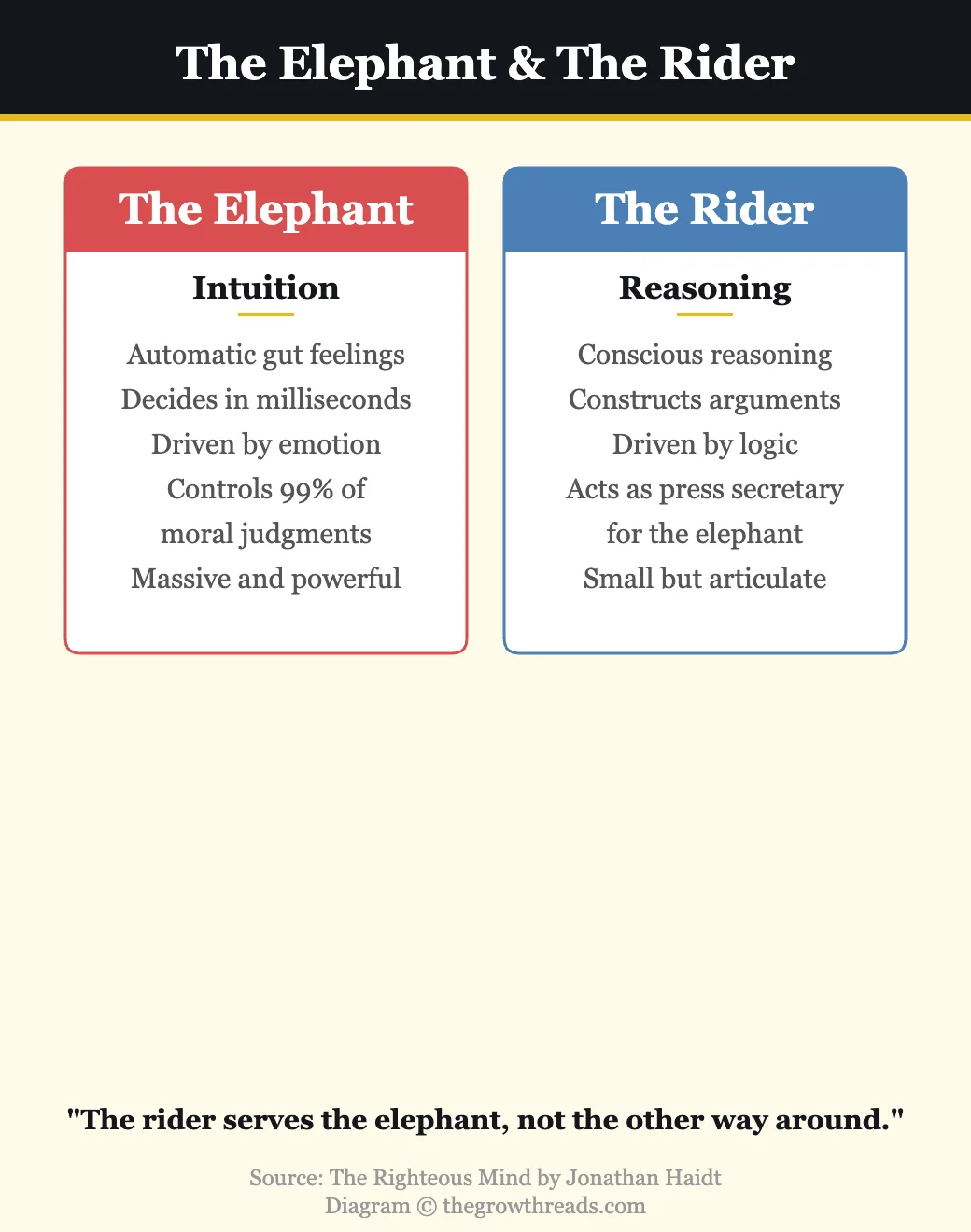
- Intuitions come first, reasoning follows: Moral judgments happen in milliseconds, driven by gut feelings. Reasoning is the press secretary that invents justifications after the elephant has already decided.
- The elephant and the rider: The elephant is your automatic, intuitive moral response. The rider is your conscious reasoning mind. The rider serves the elephant, not the other way around.
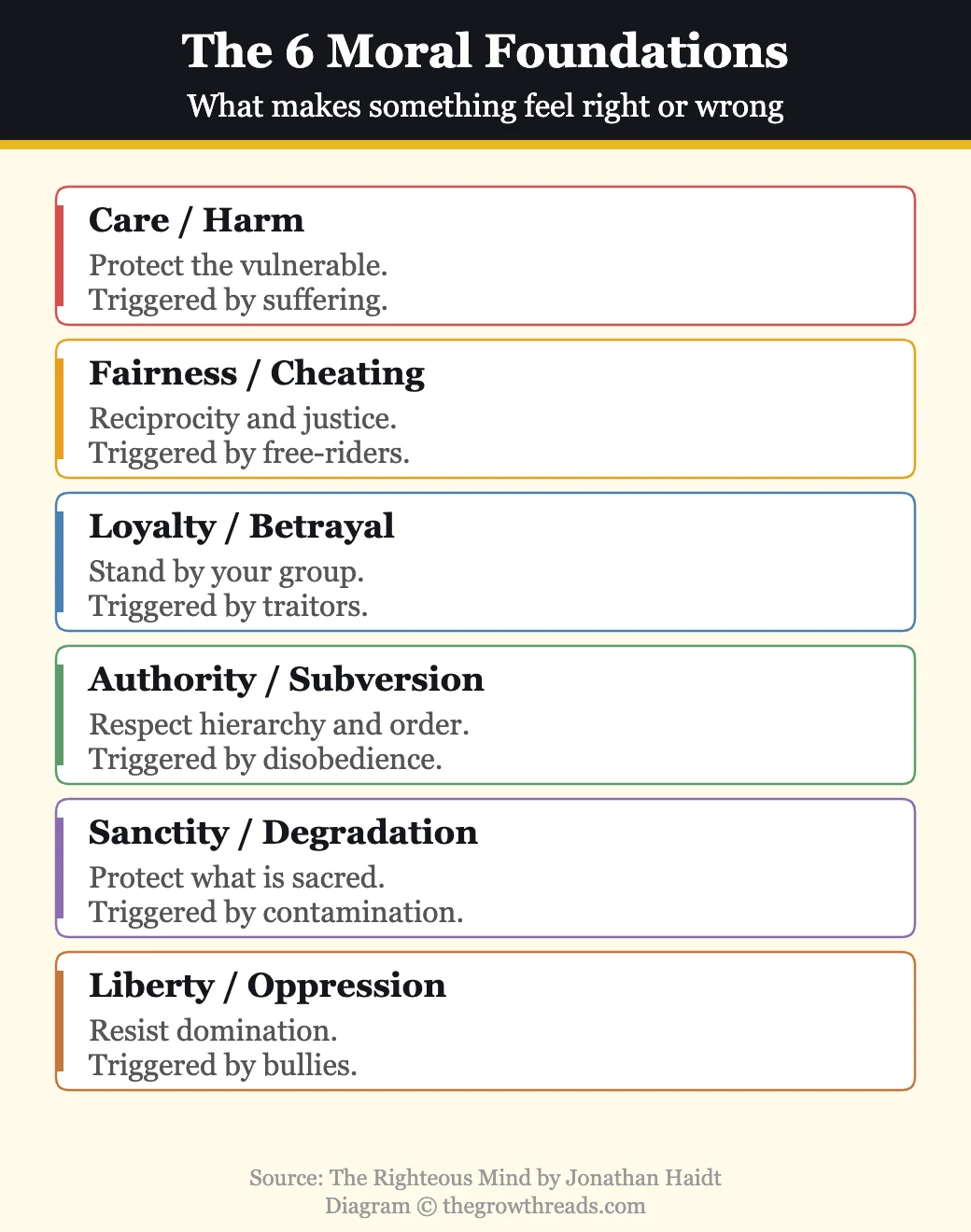
- There are (at least) six moral foundations: Care/Harm, Fairness/Cheating, Loyalty/Betrayal, Authority/Subversion, Sanctity/Degradation, and Liberty/Oppression. Each is a “moral taste bud” shaped by evolution.
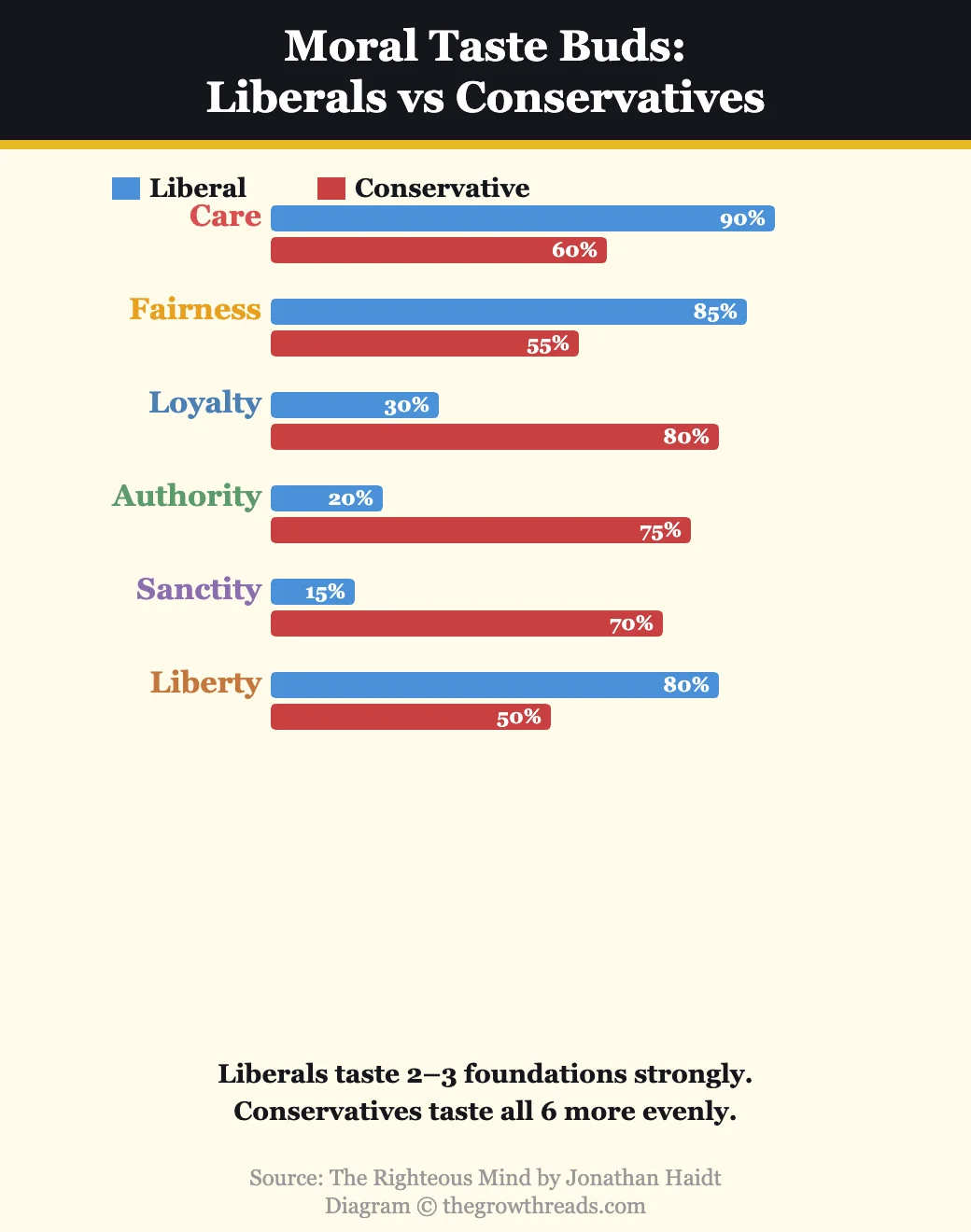
- Liberals and conservatives taste morality differently: Liberals rely heavily on Care and Fairness (and sometimes Liberty). Conservatives draw on all six foundations more evenly, which gives them a broader moral palette.
- WEIRD morality is not universal: Western, Educated, Industrialized, Rich, Democratic societies emphasize individual autonomy and harm-based ethics. Most of the world also values community, divinity, and hierarchy.
- Morality binds and blinds: Moral systems evolved to enable cooperation within groups (binding), but they also make us tribal and unable to see the merits of other groups’ moral reasoning (blinding).
- Humans are 90% chimp and 10% bee: We are mostly selfish competitors, but we have a “hive switch” that can flip us into selfless group mode — through rituals, shared purpose, and collective action.
- Religion is a team sport: Religious practices evolved not primarily to enforce beliefs but to bind communities together through shared rituals, norms, and identity markers.
- You cannot change minds with arguments alone: To persuade across moral divides, you must first speak to the elephant — connecting with the other person’s intuitions and values before presenting reasons.
- Each side sees part of the truth: Liberals are right that we should protect the vulnerable. Conservatives are right that social order and community cohesion matter. Understanding this can reduce demonization.
What is The Righteous Mind about?
The Righteous Mind is a work of moral psychology that explains why good, intelligent people disagree so passionately about politics, religion, and values. Drawing on evolutionary psychology, cultural anthropology, and two decades of original research, Jonathan Haidt reveals that moral judgments are driven by intuition rather than reason, and that different moral communities weight six foundational values in fundamentally different ways.
About the author
Jonathan Haidt is a social psychologist and the Thomas Cooley Professor of Ethical Leadership at New York University’s Stern School of Business. He earned his Ph.D. from the University of Pennsylvania in 1992 and spent sixteen years at the University of Virginia before moving to NYU. His earlier book, The Happiness Hypothesis, explored ancient wisdom through the lens of modern psychology and established him as one of the field’s most accessible writers. Haidt’s research on moral foundations theory has been cited thousands of times and has become a standard framework in political psychology. He is also the author of The Anxious Generation and co-founder of Heterodox Academy, an organization promoting viewpoint diversity in universities. Explore all Jonathan Haidt book summaries →
Key concepts at a glance
| Concept | What it means | Use it when |
|---|---|---|
| Elephant & Rider | Moral intuitions (elephant) drive judgments; reasoning (rider) rationalizes | You want to persuade someone who disagrees with you |
| Moral Foundations | Six evolved psychological systems that generate moral intuitions | You cannot understand why someone holds a position you find absurd |
| WEIRD Societies | Western cultures over-index on individual autonomy and under-value community | You assume your moral framework is universal |
| Hive Switch | The capacity to transcend self-interest and merge with a group | You want to build team cohesion or understand collective experiences |
| Moral Capital | The shared norms and institutions that make cooperation possible | You are evaluating social policies and their impact on community bonds |
| Binding Foundations | Loyalty, Authority, Sanctity — the foundations that hold groups together | You wonder why some communities resist change more than others |
| Individualizing Foundations | Care and Fairness — the foundations that protect individuals from harm | You are advocating for rights, equality, or compassion-based policies |
| Moral Matrix | The consensual reality constructed by a moral community | You feel certain the other side is simply wrong about everything |
Part 1: Intuitions come first, strategic reasoning second
Haidt opens by demolishing the rationalist delusion — the idea, inherited from Plato and enshrined in Western philosophy, that moral reasoning is the cause of moral judgment. He presents a series of studies that prove otherwise.
The most famous is his “moral dumbfounding” experiment. He told subjects a story about two adult siblings, Julie and Mark, who decide to have a sexual encounter while on vacation. They use two forms of contraception, keep the experience private, and both feel closer afterward. Subjects immediately judged the act as wrong — but when pressed to explain why, they could not produce a coherent reason. They stuttered, circled, and eventually said things like “I just know it is wrong.” Their elephant had decided instantly; their rider was scrambling for a justification that did not exist.
This pattern, Haidt argues, is not an anomaly — it is the default mode of moral cognition. He introduces the Social Intuitionist Model: moral judgments are rapid, automatic intuitions (the elephant), and moral reasoning is a post-hoc construction designed to justify those intuitions to others (the rider). We are not judges weighing evidence; we are lawyers building a case for a verdict that was delivered before the trial began.
The rider is not useless, though. Haidt identifies two channels through which reasoning can influence the elephant: other people’s arguments (social persuasion) and new experiences that trigger different intuitions. You cannot reason your own elephant into changing its mind, but you can sometimes be moved by someone else — especially if they speak to your values first, before presenting their case.
Part 2: There is more to morality than harm and fairness
The central intellectual contribution of the book is Moral Foundations Theory. Haidt and his colleagues identified six psychological systems that evolved to solve specific adaptive challenges in human social life. Each foundation generates automatic moral intuitions — like taste buds on a moral tongue.
Care/Harm evolved to protect and care for children. It makes us sensitive to signs of suffering and generates compassion. Fairness/Cheating evolved for reciprocal altruism — detecting cheaters and rewarding cooperators. Loyalty/Betrayal evolved for forming cohesive coalitions, making us sensitive to team players and traitors. Authority/Subversion evolved for navigating social hierarchies, generating respect for legitimate leadership and contempt for those who undermine social order. Sanctity/Degradation evolved from the psychology of disgust, originally for avoiding pathogens but extended to protect whatever a culture considers sacred. Liberty/Oppression evolved as a reaction against domination — the instinct to resist bullies and tyrants.
Haidt’s critical finding is that liberals and conservatives do not simply disagree about facts — they are operating with different moral taste palettes. Liberals rely heavily on Care and Fairness, and to some extent Liberty. Conservatives draw on all six foundations more evenly. This means conservatives can build broader moral coalitions (speaking to loyalty, authority, and sanctity as well as care and fairness), while liberals often struggle to understand why anyone would care about tradition, hierarchy, or purity — they literally cannot taste those flavours.
Part 3: Morality binds and blinds
The final section answers a deeper question: why did morality evolve in the first place? Haidt’s answer draws on multilevel selection theory — the idea that natural selection operates not just on individuals but also on groups. Groups whose members could cooperate effectively outcompeted groups of selfish individuals. Morality is the glue that made large-scale cooperation possible.
Haidt introduces the metaphor of humans as “90 percent chimp, 10 percent bee.” Most of the time we are self-interested primates, competing for status and resources. But we also have a “hive switch” — a capacity to transcend self-interest and lose ourselves in something larger. This switch flips during collective rituals, military drills, synchronized movement, and ecstatic religious experiences. When it flips, the boundaries between self and group dissolve, and people become capable of extraordinary sacrifice.
Religion, Haidt argues, is best understood not as a set of supernatural beliefs but as a social technology for activating the hive switch. Religious communities outcompeted secular ones because their rituals, norms, and shared narratives bound members into cooperative units that could suppress free-riders and coordinate action. The content of the beliefs matters less than the binding function they serve.
The dark side of moral binding is moral blindness. Once you are inside a moral matrix — a coherent set of values, narratives, and intuitions shared by your tribe — it becomes nearly impossible to see the merits of a competing matrix. Each side views the other not as people with different moral taste buds but as morally defective. This is why political debates generate heat but almost never change minds: both sides are speaking different moral languages and neither can hear the other.
Who is The Righteous Mind best for — and who should read something else first?
This book is ideal for anyone exhausted by political polarization who genuinely wants to understand why the other side thinks the way it does — rather than simply dismissing them. It is equally valuable for educators, managers, mediators, and anyone who needs to work across ideological or cultural divides. Haidt’s framework is powerful for therapists and coaches who encounter clients with conflicting moral intuitions.
If you want a broader introduction to cognitive biases and irrationality before diving into moral psychology specifically, start with Thinking, Fast and Slow by Daniel Kahneman. If your primary interest is persuasion and influence rather than moral psychology, Influence by Robert Cialdini is a more practical starting point. And if you want to explore happiness rather than morality, Haidt’s own earlier book, The Happiness Hypothesis, is a gentler entry to his thinking.
Questions to reflect on
- When you last felt morally outraged, did you reason your way to that feeling — or did it arrive instantly? What does that tell you about your elephant?
- Which of the six moral foundations do you weight most heavily? Which ones barely register for you?
- Can you name a political position you disagree with and articulate why a reasonable person might hold it — using their moral foundations, not yours?
- When has your “hive switch” flipped? What were you doing, and how did it feel to transcend your individual self?
- If morality binds and blinds, what practical step could you take this week to peek outside your own moral matrix?
🔥 Ready to understand why good people disagree?
Get The Righteous Mind and discover the hidden moral foundations behind every political and religious debate.
How to apply The Righteous Mind (7-day plan)
- Day 1 — Take the Moral Foundations Questionnaire: Visit yourmorals.org and take the MFQ. Review your scores across the six foundations. Where are you strong? Where are your blind spots?
- Day 2 — Catch your elephant: Three times today, notice a moral judgment that arrives before any reasoning. Write down what triggered it and what foundation was activated (Care? Fairness? Loyalty?).
- Day 3 — Read the other side charitably: Find an op-ed from someone whose political views differ sharply from yours. Instead of arguing, identify which moral foundations they are drawing on. Try to understand their elephant.
- Day 4 — Practice moral humility: Choose one issue where you feel strong moral certainty. Write down what a thoughtful person from the other side would say, using their strongest arguments — not a straw man.
- Day 5 — Speak to the elephant first: In a conversation where you want to persuade someone, lead with a value you share before making your argument. Notice how this changes the dynamic.
- Day 6 — Activate the hive switch: Participate in a group activity that involves synchrony — singing, team sports, group cooking, or a community service project. Notice whether you feel the boundaries between self and group soften.
- Day 7 — Map a disagreement: Take a disagreement you are currently involved in and map both sides using the six foundations. Which foundations is each side invoking? Write down what each side gets right.
Frequently asked questions
Is The Righteous Mind worth reading?
Yes, especially if you find yourself baffled or frustrated by people who hold political or moral views opposite to yours. Haidt does not tell you which side is right — he gives you the tools to understand why each side feels so certain it is right. The book is intellectually rigorous, well-written, and genuinely perspective-shifting. It is one of the few books in political psychology that both liberals and conservatives have praised, which itself is evidence of its balance.
What is the elephant and the rider in The Righteous Mind?
The elephant represents your automatic moral intuitions — the gut feelings that arrive in milliseconds and determine your moral judgments before you are even aware of them. The rider represents your conscious reasoning mind, which Haidt argues acts as a “press secretary” for the elephant: it does not make the decisions but constructs plausible justifications for decisions the elephant has already made. The key insight is that reasoning rarely changes your own mind; it is designed to influence others.
What are the six moral foundations?
The six foundations are Care/Harm (sensitivity to suffering), Fairness/Cheating (reciprocity and justice), Loyalty/Betrayal (allegiance to your group), Authority/Subversion (respect for hierarchy and tradition), Sanctity/Degradation (protection of what is sacred), and Liberty/Oppression (resistance to domination). Each foundation is a psychological system shaped by evolution that generates automatic moral intuitions — like taste buds that detect different moral “flavours” in a situation.
Does The Righteous Mind favour conservatives or liberals?
Neither — and both. Haidt’s central argument is that each side sees important moral truths that the other misses. Liberals are right to prioritize care and fairness; conservatives are right that loyalty, authority, and sanctity play essential roles in maintaining functional communities. The book has been praised by readers on both sides of the political spectrum precisely because it takes both moral worldviews seriously rather than dismissing either one.
What does “morality binds and blinds” mean?
Haidt uses this phrase to describe the dual function of moral systems. On one hand, shared moral values bind communities together, enabling cooperation, trust, and collective action — this is the “glue” that holds societies together. On the other hand, the same moral certainty that binds a group together blinds its members to the legitimacy of other groups’ moral reasoning. Each team becomes unable to see beyond its own moral matrix, leading to demonization, tribalism, and the breakdown of productive disagreement.
What is the hive switch?
The hive switch is Haidt’s term for the human capacity to transcend self-interest and merge psychologically with a group. When the hive switch flips — through rituals, synchronized movement, shared ecstatic experience, or collective purpose — people stop thinking of themselves as individuals and start feeling like cells in a larger organism. This capacity, Haidt argues, evolved through group-level selection and explains why humans can achieve both extraordinary cooperation and dangerous tribalism.
How does The Righteous Mind compare to Thinking, Fast and Slow?
Both books argue that human cognition is dominated by fast, automatic processes rather than slow, deliberate reasoning. Kahneman’s Thinking, Fast and Slow applies this insight across all domains — economics, medicine, prediction, everyday decisions. Haidt’s The Righteous Mind applies a similar dual-process model specifically to moral and political psychology. If Kahneman shows that System 1 runs the show in general, Haidt shows that in moral judgment, System 1’s dominance is especially complete and especially consequential. The two books complement each other well.
Related summaries
- Thinking, Fast and Slow by Daniel Kahneman — the dual-process framework that Haidt applies to moral psychology.
- Influence by Robert Cialdini — the science of persuasion through the moral foundations lens.
- The Happiness Hypothesis by Jonathan Haidt — Haidt’s earlier book on ancient wisdom and modern psychology.
- The Laws of Human Nature by Robert Greene — individual motives in the context of group competition.
📚 Explore more: Best Psychology Books · Best Self-Help Books
Related Psychology Summaries
Incognito Summary & Review: The Secret Lives of Your Brain
On the Move Summary & Review: A Neurologist’s Extraordinary Life of Curiosity and Courage
Stumbling on Happiness Summary & Review: Why Your Brain Lies About the Future
The 48 Laws of Power Summary & Review: Reading the Hidden Game of Influence
The Anxious Generation Summary & Review: How Phones Rewired Childhood