

⭐⭐⭐⭐ 4.0 / 5 — A research-backed field guide to the eight principles that separate genuinely productive people and teams from everyone else.
Best for: Professionals, managers, and anyone who feels busy but not effective — especially those who want to understand why some people and teams accomplish so much more.
Reading time: ~8 hours (400 pages)
Difficulty to apply: Moderate — the eight concepts are intuitive, but rewiring motivation habits and decision-making patterns takes deliberate practice over weeks.
Smarter Faster Better in one minute
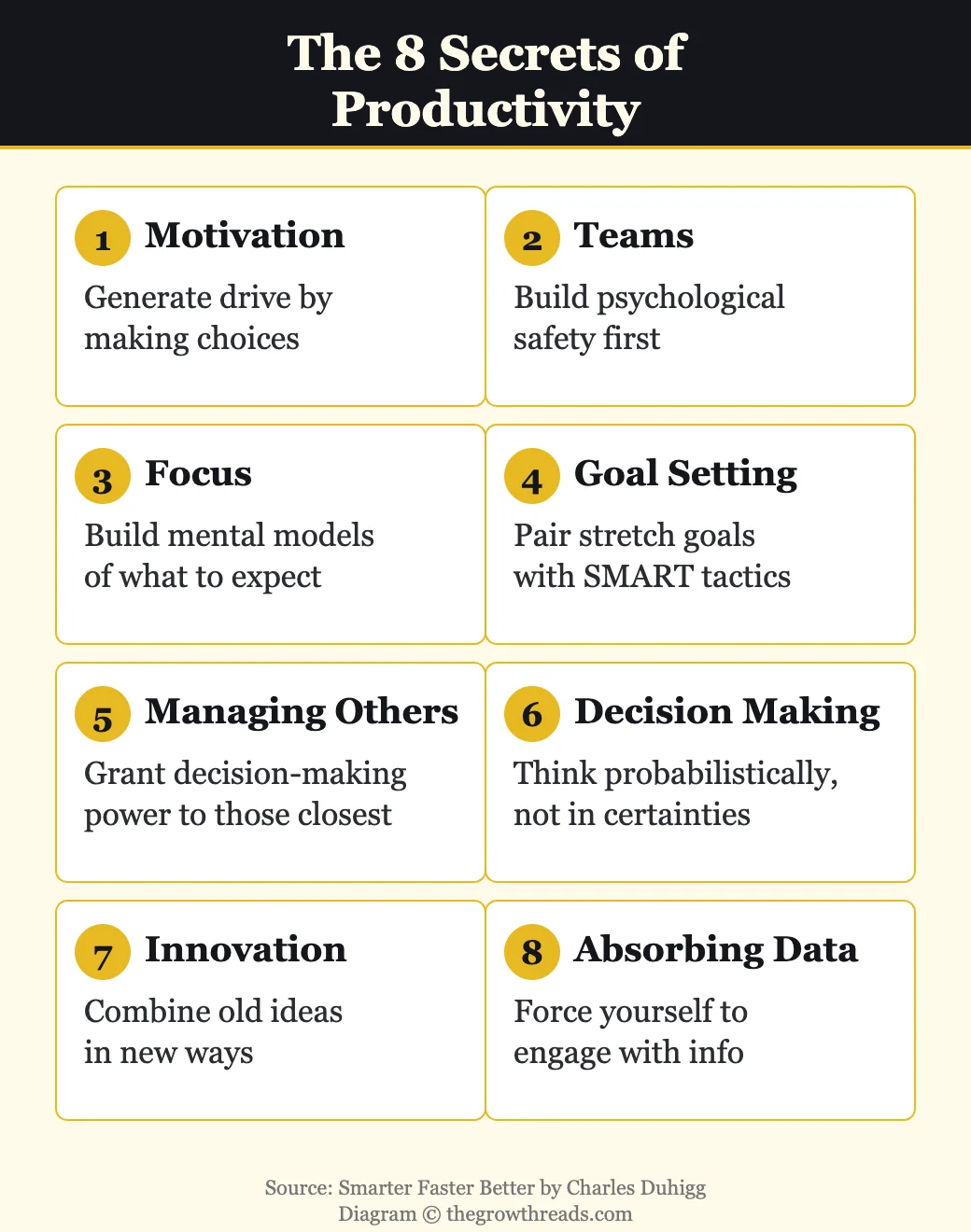
Productivity is not about working harder or longer — it is about making certain choices in certain ways. Charles Duhigg identifies eight ideas that the most productive people, companies, and organisations have in common: motivation through internal locus of control, psychological safety in teams, sharp mental models for focus, pairing stretch goals with SMART sub-goals, empowering decision-makers closest to the problem, thinking probabilistically, combining old ideas for innovation, and forcing yourself to genuinely engage with incoming data. Each chapter pairs neuroscience and management research with vivid stories — from a kidnapping survivor to the creators of Frozen — to show how these principles play out in practice.
Key takeaways
- Motivation is a skill, not a trait: You can manufacture drive by making choices that give you a sense of control, even small ones like picking the order of your to-do list.
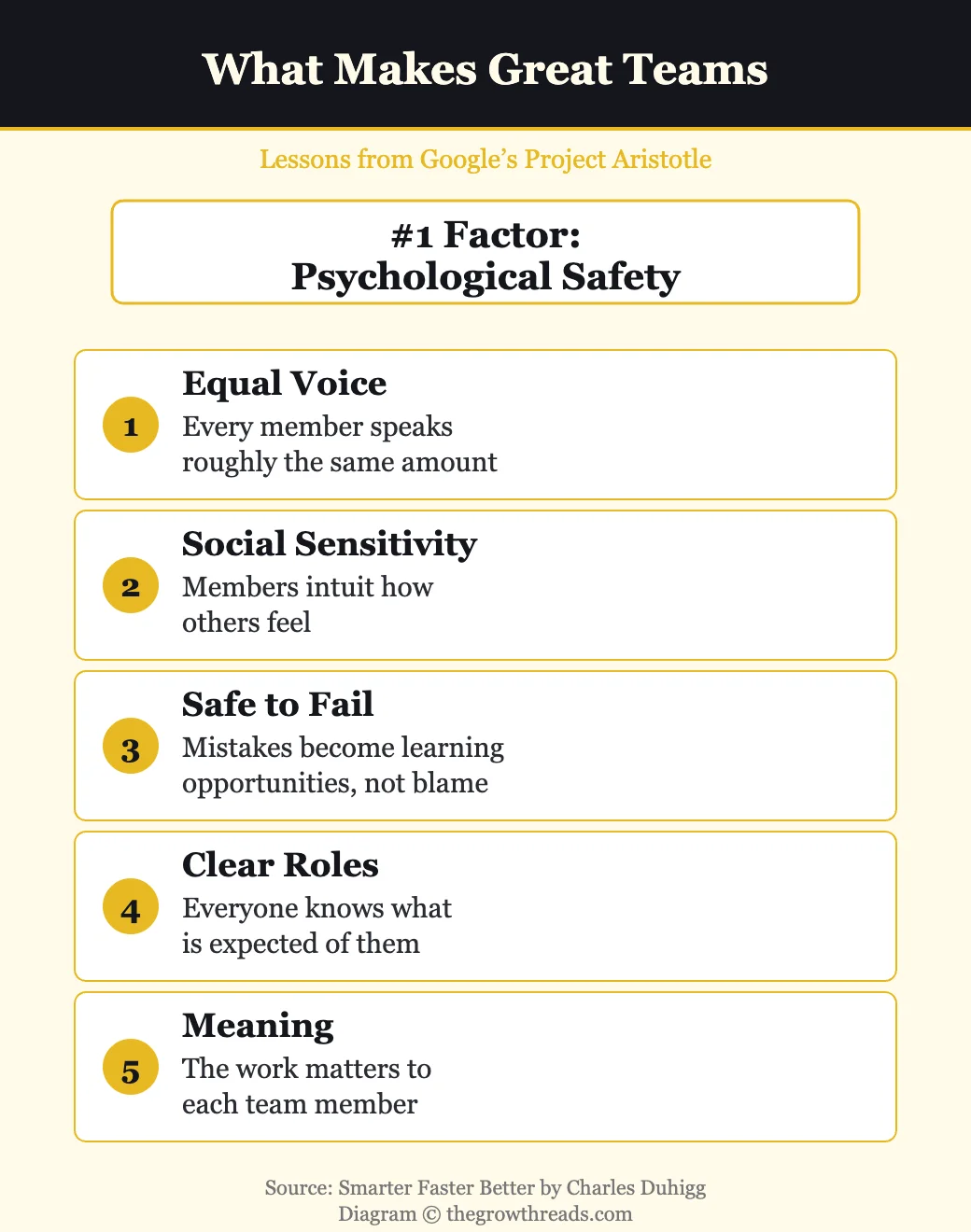
- Psychological safety beats talent: Google’s Project Aristotle found that the single biggest predictor of team performance is whether members feel safe to take risks and speak up.
- Mental models sharpen focus: The most focused people constantly narrate what they expect to happen next, so they notice when reality diverges and can react faster.
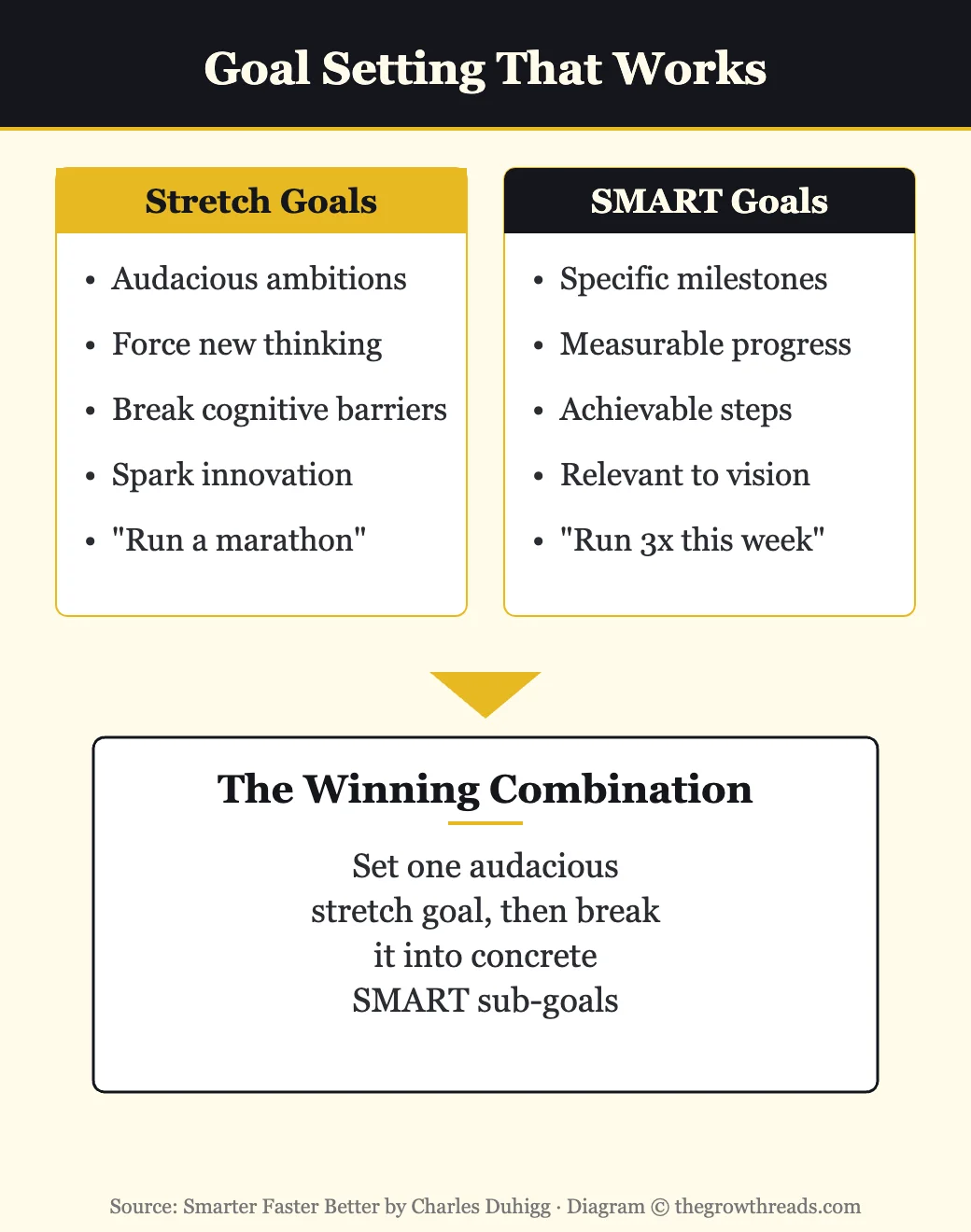
- Stretch goals need SMART companions: Audacious ambitions spark innovation, but without concrete sub-goals they create panic — pair every stretch target with specific, measurable milestones.
- Push decisions down: Organisations that empower front-line workers to make judgment calls outperform those with rigid top-down command structures.
- Think in probabilities: Better decision-makers hold multiple possible futures in their head at once rather than betting everything on a single prediction.
- Innovation is recombination: Breakthrough ideas almost always come from combining existing concepts in new ways — creative brokers who move between communities have an edge.
- Absorbing data requires effort: Information only becomes useful when you force yourself to do something with it — write it down, explain it, or transform it into a different format.
- Commitment culture wins long-term: Companies built on trust, loyalty, and emotional investment consistently outperform those built on star talent or rigid process.
- Productivity is learnable: None of the eight principles require innate genius — they are habits and mental frameworks anyone can develop with practice.
What is Smarter Faster Better about?
Smarter Faster Better explores the science of productivity through eight core principles — motivation, teams, focus, goal setting, managing others, decision making, innovation, and absorbing data. Duhigg argues that productivity is not about working more hours but about making smarter choices about how you allocate attention, set priorities, and collaborate with others.
About the author
Charles Duhigg is a Pulitzer Prize-winning investigative journalist and the author of The Power of Habit, one of the best-selling nonfiction books of the last decade. He spent years at The New York Times covering business and psychology before writing his productivity trilogy. Duhigg studied history at Yale and received an MBA from Harvard Business School. His reporting has won the National Academies of Sciences, Engineering, and Medicine’s communication award, among others. His work sits at the intersection of behavioural science and practical application — a hallmark of Smarter Faster Better as well. Explore all Charles Duhigg book summaries →
Key concepts at a glance
| Concept | What it means | Use it when |
|---|---|---|
| Internal locus of control | Believing your choices shape outcomes generates motivation | You feel stuck or unmotivated on a project |
| Psychological safety | Teams perform best when members can speak up without fear | Building or leading any collaborative team |
| Mental models | Narrating expected outcomes sharpens focus and reaction time | High-stakes or information-dense situations |
| Stretch + SMART goals | Pair audacious ambitions with concrete, measurable sub-goals | Setting quarterly or annual plans |
| Decentralised decision-making | Empower people closest to the problem to make judgment calls | Scaling an organisation or speeding up execution |
| Probabilistic thinking | Hold multiple scenarios and assign rough odds instead of picking one | Making decisions under uncertainty |
| Creative brokering | Combine familiar ideas from different domains to innovate | Brainstorming, R&D, or creative projects |
| Disfluency | Forcing yourself to re-engage with data makes it stick | Learning new material or reviewing dashboards |
Part 1 — Motivation and teams: the internal engine
Duhigg opens with the story of Robert Philippe, a man who lost all motivation after a neurological event damaged his striatum. Neuroscientists discovered that motivation is not simply about reward — it hinges on a sense of agency. When people feel they are making choices, even trivial ones, the striatum activates and drive returns. Duhigg translates this into a practical rule: whenever you feel unmotivated, make a choice — any choice — that asserts control. Picking which email to answer first, deciding the order of tasks on a list, or choosing your own stretch assignment at work can be enough to re-engage the motivational circuitry.
The chapter on teams centres on Google’s Project Aristotle, an internal study that analysed 180 teams to find the recipe for high performance. The researchers expected intelligence or seniority to matter most. Instead, the single strongest predictor was psychological safety — the shared belief that the team would not punish anyone for speaking up, admitting mistakes, or proposing unconventional ideas. Two observable norms underpinned it: roughly equal conversational turn-taking (no one person dominated) and high social sensitivity (members could read each other’s nonverbal cues). Duhigg argues that leaders can manufacture psychological safety by modelling vulnerability, explicitly inviting dissent, and responding to mistakes with curiosity rather than blame.
Part 2 — Focus and goal setting: directing your attention
The focus chapter tells the story of Qantas Flight 32, where pilots managed an engine explosion over Singapore by relying on mental models. Rather than freezing under information overload, Captain Richard de Crespigny continuously narrated what he expected to happen next — a technique cognitive scientists call building a mental model. When instruments showed data that diverged from his narration, he immediately spotted the anomaly and adapted. Duhigg shows that this habit transfers to everyday work: before a meeting, mentally rehearse what will likely be discussed; before reading a report, predict its conclusions. This pre-loading primes your brain to notice what actually matters.
Goal setting receives one of the book’s most actionable chapters. Duhigg examines General Electric’s transformation under Jack Welch, who mandated stretch goals — targets so ambitious they forced people to rethink processes entirely. But stretch goals alone caused anxiety at some GE divisions where managers lacked a follow-through framework. The fix was pairing every stretch ambition with SMART sub-goals: specific, measurable, achievable, relevant, and time-bound steps. The stretch goal provides direction and sparks creativity; the SMART sub-goals provide traction and prevent paralysis.
Part 3 — Managing others and deciding well
Duhigg profiles a Toyota-GM joint venture called NUMMI to illustrate how lean manufacturing empowers front-line workers. At NUMMI, any assembly-line worker could pull a cord to stop the entire production line if they spotted a defect. This radical decentralisation of authority — giving decision-making power to the people closest to the problem — cut defect rates dramatically and turned the worst GM plant into one of its best. The underlying principle is that centralised control creates bottlenecks and kills initiative, while distributed authority accelerates both speed and quality.
The decision-making chapter introduces Annie Duke’s poker-thinking approach before she popularised it in her own book. Duhigg argues that most people make decisions by picking the outcome they consider most likely and ignoring alternatives. Better decision-makers think in probabilities: they assign rough percentage likelihoods to multiple scenarios and update those estimates as new information arrives. This Bayesian approach does not require mathematical precision — simply forcing yourself to consider “what else could be true” and “how confident am I, really?” dramatically improves judgment under uncertainty.
Part 4 — Innovation and absorbing data: turning information into action
The innovation chapter traces how Disney’s Frozen went from a failing project to the highest-grossing animated film of its era. The breakthrough came when the creative team combined a traditional fairy-tale structure with a modern sister-relationship story — an act of what sociologists call creative brokering. Duhigg identifies a pattern: the most innovative people are not necessarily the most original thinkers. They are brokers who move between different communities, absorb ideas from each, and recombine them. The practical takeaway is to deliberately expose yourself to fields outside your own — read widely, attend events in adjacent industries, and look for structural similarities between problems in different domains.
The final chapter tackles how we absorb data, using the story of a Cincinnati public school system that gave teachers access to enormous data dashboards. Performance did not improve until teachers were required to manually re-enter and annotate the data — a technique psychologists call disfluency. When information flows in too smoothly, the brain treats it as unimportant. Forcing yourself to interact with data — rewriting key numbers by hand, explaining a chart to a colleague, or transforming a spreadsheet into a narrative — creates friction that makes the information stick and become actionable.
Who is Smarter Faster Better best for — and who should read something else first?
This book is ideal for mid-career professionals who manage both their own output and a team, and who want a research-backed framework rather than a list of hacks. It is especially valuable for managers who sense their team is underperforming despite having talented individuals — the chapters on psychological safety and decentralised decision-making provide immediate, testable fixes. If you are earlier in your career and want a tighter focus on personal productivity habits, start with Deep Work by Cal Newport or Atomic Habits by James Clear. If you specifically want a goal-setting system, Measure What Matters goes deeper on OKRs than this book does.
Questions to reflect on
- When did you last feel genuinely motivated at work — and what choice or sense of control triggered it?
- Does your team have genuine psychological safety, or do people self-censor to avoid looking foolish?
- Before your next important meeting, can you spend two minutes narrating what you expect to happen — and notice what actually differs?
- Do your current goals include both a stretch ambition and concrete SMART sub-goals, or are you missing one half of the pair?
- When you last reviewed data or a report, did you do something active with it — rewrite, explain, or restructure — or did you just skim?
🔥 Ready to unlock the eight drivers of real productivity?
Smarter Faster Better will change how you motivate yourself, lead teams, and make decisions.
How to apply Smarter Faster Better (7-day plan)
- Day 1 — Reclaim your sense of control: Before starting work, choose the order of your first three tasks yourself (do not default to your inbox). Notice how this small act of agency shifts your motivation.
- Day 2 — Build a mental model: Before your biggest meeting today, spend two minutes mentally rehearsing what will happen. During the meeting, note where reality diverges from your prediction.
- Day 3 — Set a stretch + SMART pair: Write down one audacious goal for this quarter. Below it, list three SMART sub-goals that would move you toward it this month.
- Day 4 — Audit psychological safety: In your next team meeting, ask each person to share one thing that is not going well. Model vulnerability by sharing your own first.
- Day 5 — Practice probabilistic thinking: For one decision today, write down three possible outcomes and assign rough percentage odds to each before choosing.
- Day 6 — Cross-pollinate ideas: Read one article or attend one event outside your field. Write down one structural similarity between that domain and a problem you are working on.
- Day 7 — Apply disfluency: Take one report or dashboard you reviewed this week and rewrite the three most important numbers by hand, adding a one-sentence interpretation for each.
Frequently asked questions
Is Smarter Faster Better worth reading if I already read The Power of Habit?
Yes. While both books are by Duhigg, they cover different territory. The Power of Habit focuses on how individual habits form and change. Smarter Faster Better zooms out to eight broader principles — motivation, teams, focus, goal setting, managing others, decision-making, innovation, and absorbing data — that govern productivity at both the personal and organisational level. There is almost no content overlap between the two books, and the research base is entirely different.
What is the main idea of Smarter Faster Better?
The central argument is that productivity is not about working more hours or pushing harder — it is about making better choices about how you motivate yourself, direct your attention, set goals, and process information. Duhigg distills this into eight learnable principles backed by neuroscience, psychology, and management research, and shows through case studies how each principle operates in real organisations from Google to Disney to the U.S. Marine Corps.
How long does it take to read Smarter Faster Better?
The book is approximately 400 pages. At an average reading speed of 50 pages per hour, most readers will finish it in about 8 hours. The appendix includes a reader’s guide with discussion questions that can add another 30 minutes. For a quicker pass, the introduction and conclusion chapters summarise all eight principles in about 40 pages total, giving you the core framework in under an hour.
What is psychological safety and why does it matter for teams?
Psychological safety is the shared belief among team members that they will not be punished for speaking up, admitting errors, or proposing unconventional ideas. Google’s Project Aristotle, which Duhigg details extensively, found it to be the single strongest predictor of team effectiveness — more important than individual talent, tenure, or team size. Teams with high psychological safety innovate faster, catch mistakes earlier, and report higher satisfaction.
What are stretch goals and SMART goals, and how do they work together?
Stretch goals are audacious targets that force you to rethink your approach entirely — for example, doubling revenue in a year. SMART goals are specific, measurable, achievable, relevant, and time-bound milestones — like increasing monthly sales calls by 20 percent this quarter. Duhigg argues that using stretch goals alone can cause panic, while using SMART goals alone can limit ambition. The most productive approach is to set one big stretch goal and immediately break it into a series of concrete SMART sub-goals.
How can I improve my focus using mental models?
Mental models, as Duhigg describes them, are internal narratives about what you expect to happen in a given situation. Before starting a task or entering a meeting, spend one to two minutes mentally rehearsing the likely sequence of events. This primes your brain to notice when reality diverges from expectation — which is exactly when your attention needs to engage most sharply. The technique is used by pilots, surgeons, and elite athletes to maintain focus under pressure.
Does Smarter Faster Better apply to personal life or just work?
Both. While many of the case studies come from corporate or military settings, the eight principles transfer directly to personal life. The motivation chapter applies to exercise and creative hobbies. The focus chapter helps with parenting and difficult conversations. The goal-setting framework works for fitness targets and financial goals. Duhigg deliberately chose examples that span professional and personal domains to show that productivity is a universal skill, not just a workplace metric.
Related summaries
- The Power of Habit by Charles Duhigg — the companion volume on how habits form and change
- Deep Work by Cal Newport — a deeper dive into sustained concentration
- Measure What Matters by John Doerr — the full OKR system that mirrors stretch + SMART
- The Culture Code by Daniel Coyle — more on psychological safety and team culture
Related Productivity Summaries
Getting Things Done Summary & Review: The Art of Stress-Free Productivity
Indistractable Summary & Review: How to Control Your Attention
Slow Productivity Summary & Review: The Case for Doing Fewer Things Better
The Life-Changing Magic of Tidying Up Summary & Review: Spark Joy and Transform Your Space
The Productivity Project Summary & Review: Manage Your Time, Attention, and Energy