

★★★★☆ 4.0 / 5 — A foundational guide to harnessing the power of your subconscious mind through visualization, affirmation, and belief.
Best for: Anyone interested in the psychology of belief, mental programming, and how thoughts shape outcomes
Reading time: ~5 hours (300 pages)
Difficulty to apply: Low to moderate — techniques are simple but require consistent daily practice
The Power of Your Subconscious Mind in One Minute
Your subconscious mind accepts whatever you habitually think and believe — then works to make it real. Joseph Murphy argues that most people unknowingly program their subconscious with fear, doubt, and negative self-talk, then wonder why life feels stuck. The book teaches a set of practical techniques — visualization, affirmation, sleep programming, and prayer — to deliberately reprogram your subconscious with the outcomes you want. Murphy draws on case studies, spiritual traditions, and early psychology research to show that the subconscious does not distinguish between vivid imagination and reality. Feed it the right mental images, and it will mobilize resources you did not know you had.
Key Takeaways
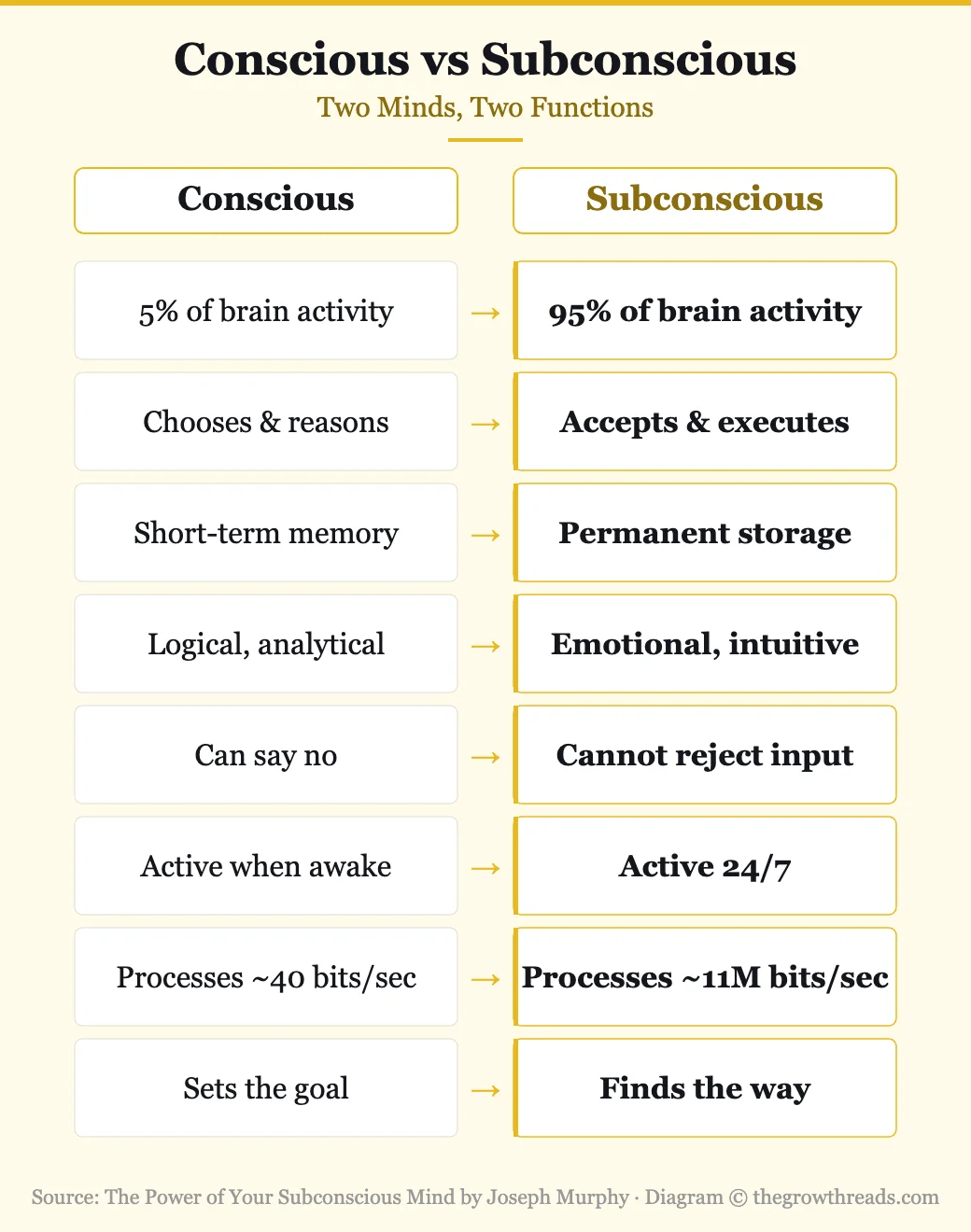
- Your subconscious mind is always working: It controls your habits, emotions, bodily functions, and beliefs — running roughly 95% of your daily behavior without conscious input.
- It cannot reject what you feed it: Unlike your conscious mind, which can reason and refuse, the subconscious accepts every repeated thought, image, and feeling as an instruction.
- Habitual thinking becomes belief: What you tell yourself daily — whether positive or negative — hardens into subconscious programming that shapes your actions and outcomes.
- Visualization is the primary programming tool: Vividly imagining your desired outcome as already achieved sends a clear instruction to the subconscious.
- The drowsy state before sleep is the golden window: Your subconscious is most receptive when the conscious mind relaxes, making bedtime the ideal time for mental programming.
- Fear and worry are negative prayers: When you dwell on what you fear, you are effectively programming your subconscious to produce that result.
- Your subconscious can improve health: Murphy presents cases of physical healing through mental imagery, arguing the mind-body connection operates through subconscious channels.
- Forgiveness is a subconscious reset: Holding resentment keeps negative programming active; releasing it clears the channel for positive input.
- Repetition is the mechanism: A single affirmation does little — consistent, emotionally charged repetition is what rewires subconscious patterns.
- The subconscious connects to a universal intelligence: Murphy believed the subconscious can tap into an infinite source of wisdom and creative solutions beyond the individual mind.
What Is The Power of Your Subconscious Mind About?
The Power of Your Subconscious Mind teaches that your habitual thoughts and mental images program your subconscious, which then works to manifest those patterns in your life. Joseph Murphy provides practical techniques — visualization, affirmation, sleep programming, and prayer — to deliberately replace negative mental habits with positive ones, applying the principle to health, wealth, relationships, and personal growth.
About the Author
Joseph Murphy (1898–1981) was an Irish-born author, minister, and lecturer who spent most of his career in Los Angeles as the leader of the Church of Divine Science. He held a PhD in psychology and spent decades studying the intersection of religion, philosophy, and the subconscious mind. His work bridged the New Thought spiritual movement with practical psychology, and The Power of Your Subconscious Mind — first published in 1963 — has sold over 10 million copies worldwide, making it one of the most enduring self-help books ever written. Murphy published over 30 books during his lifetime, but this remains his defining contribution. Explore all Joseph Murphy book summaries →
Key Concepts at a Glance
| Concept | What It Means | Use It When |
|---|---|---|
| Conscious vs Subconscious | The thinking mind directs; the subconscious executes | Understanding why willpower alone often fails |
| The Law of Belief | What you believe in your subconscious becomes your reality | Examining limiting beliefs that hold you back |
| Mental Movie Method | Visualize the end result as a vivid scene, felt as real | Setting goals or working toward any outcome |
| Sleep Programming | Feed your subconscious a clear request in the drowsy pre-sleep state | Solving problems, building new habits |
| Affirmation with Feeling | Repeat positive statements with emotional conviction | Replacing negative self-talk patterns |
| The Healing Principle | The subconscious controls bodily functions and can aid healing | Supporting recovery alongside medical treatment |
| Forgiveness Technique | Release resentment to clear negative subconscious programming | Breaking free from grudges or emotional blocks |
| Fear as Negative Prayer | Dwelling on fears programs the subconscious toward those outcomes | Catching and redirecting anxious thought patterns |
Part 1: How Your Mind Works
Murphy opens with the fundamental architecture of the mind. Your conscious mind is the thinking, choosing, reasoning part — the captain of the ship. Your subconscious mind is the engine room — it takes orders, stores memories, runs bodily systems, and executes habitual patterns without question. The crucial insight is that the subconscious does not evaluate or argue. It accepts whatever the conscious mind repeatedly tells it as truth and then works to make that truth manifest.
This means that both positive and negative programming work equally well. A person who habitually thinks “I am unlucky” is programming their subconscious just as effectively as someone who thinks “opportunities come to me easily.” The subconscious does not judge the content — it simply follows instructions. Murphy uses the metaphor of a garden: the conscious mind is the gardener who chooses what to plant, and the subconscious is the soil that grows whatever seeds are placed in it, whether flowers or weeds.
Murphy also introduces the concept of a universal mind or infinite intelligence that the subconscious can access. This is the most spiritually-oriented part of the book, rooted in the New Thought tradition. Whether you interpret this literally or metaphorically, the practical implication is the same: the subconscious has access to creative solutions and insights beyond what the conscious mind can calculate.
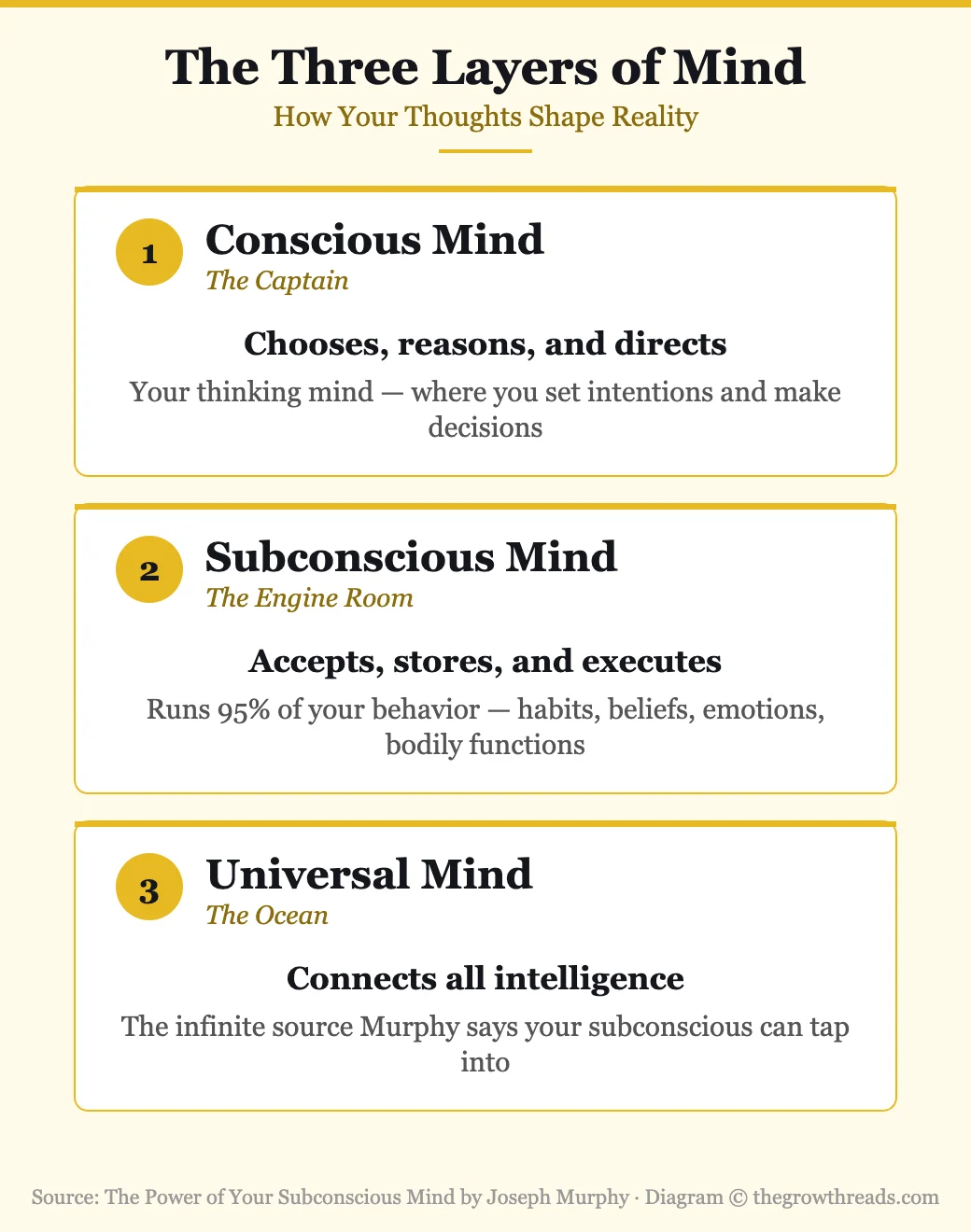
TGR Note: Modern neuroscience has confirmed much of Murphy’s basic framework. Research shows the subconscious processes roughly 11 million bits of information per second, while the conscious mind handles about 40. If you want the scientific version of these ideas, see our summary of Thinking, Fast and Slow by Daniel Kahneman, which maps “System 1” (automatic, subconscious) and “System 2” (deliberate, conscious) thinking in rigorous detail.
Part 2: The Techniques of Mental Programming
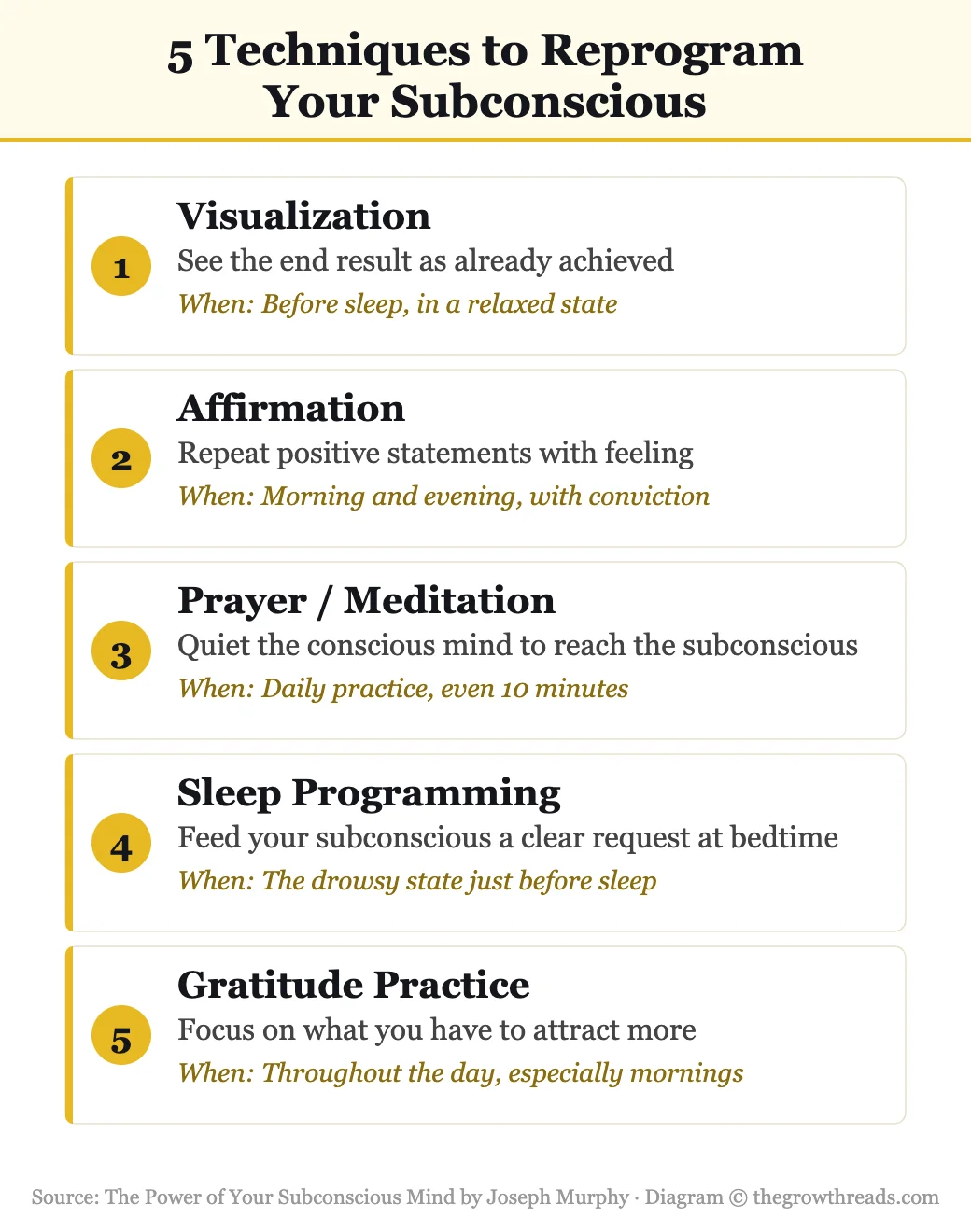
The practical core of the book lays out several techniques for reprogramming the subconscious. The most powerful, Murphy argues, is visualization — creating a vivid mental movie of your desired outcome as if it has already happened. The key is sensory detail and emotional engagement. Do not just think about what you want; see it, feel it, hear it, and experience the emotions of already having it. The subconscious responds to vivid imagery more than to abstract thoughts or words.
Sleep programming is Murphy’s second major technique. In the drowsy state just before sleep (the hypnagogic state), the conscious mind relaxes its guard, and the subconscious becomes highly receptive. Murphy recommends using this window to repeat a single clear statement or visualize a single desired scene. The subconscious then works on this input throughout the night, often producing solutions, insights, or shifts in behavior by morning.
Affirmations — positive statements repeated with conviction and feeling — form the third technique. Murphy stresses that mechanical repetition without emotion is ineffective. The affirmation must be stated positively (what you want, not what you want to avoid), in the present tense (as if it is already true), and charged with genuine feeling. “I am healthy, strong, and full of energy” works; “I hope I will stop being sick” does not.
Murphy also discusses gratitude as a programming tool. Focusing on what you appreciate trains the subconscious to notice and attract more of it. And forgiveness serves as a reset — holding onto anger or resentment keeps negative programs running in the background, consuming mental energy that could be redirected toward positive outcomes.
TGR Note: The sleep programming technique echoes what modern sleep science calls “targeted memory reactivation.” Matthew Walker’s Why We Sleep shows that the brain consolidates and processes information during sleep. Murphy’s pre-sleep technique — however spiritually framed — aligns with the finding that the sleeping brain continues working on problems introduced before bed. For more on how habits form at the subconscious level, see The Willpower Instinct by Kelly McGonigal.
Part 3: Applications — Health, Wealth, and Relationships
Murphy dedicates the middle section to applying these techniques across different life domains. On health, he presents case studies of individuals who used visualization and affirmation to support recovery from illness. He argues that the subconscious controls autonomic functions — heart rate, digestion, immune response — and that mental imagery can influence these systems. While Murphy’s claims sometimes outpace the evidence, the placebo effect and psychoneuroimmunology research have since shown that belief and expectation genuinely influence physical health outcomes.
On wealth, Murphy challenges the idea that wanting money is greedy or unspiritual. He argues that poverty consciousness — the habitual belief that money is scarce, hard to get, or morally suspect — programs the subconscious to repel financial opportunity. Replacing these beliefs with abundance thinking (not magical thinking, but genuine belief in one’s capacity to create value) opens the subconscious to notice and act on opportunities that were always there.
On relationships, Murphy teaches that you attract people and situations that match your dominant mental patterns. Someone who subconsciously expects rejection will unconsciously behave in ways that invite it. By reprogramming the inner narrative — replacing “nobody likes me” with “I am warm, open, and attract good people” — you change the signals you send and the responses you receive.
TGR Note: The wealth-consciousness section pairs well with Secrets of the Millionaire Mind by T. Harv Eker, which explores how subconscious “money blueprints” — formed in childhood — control financial behavior. Where Murphy provides the spiritual framework, Eker provides the specific exercises for identifying and changing your money programming.
Part 4: Overcoming Fear, Worry, and Mental Blocks
The final section addresses the biggest obstacles to subconscious reprogramming: fear, worry, resentment, and self-sabotage. Murphy frames fear and worry as “negative prayers” — when you vividly imagine a negative outcome with emotional intensity, you are using the exact same mechanism as positive visualization, just aimed in the wrong direction. The subconscious does not know the difference between what you want and what you fear; it simply responds to the dominant mental image.
His solution is not suppression but substitution. You cannot eliminate a negative thought by fighting it — that gives it more attention and energy. Instead, you replace it with a positive, specific alternative. When a fear arises, you immediately pivot to visualizing the desired outcome. Over time, the new pattern becomes the dominant signal, and the old fear loses its grip.
Murphy also addresses self-sabotage — the phenomenon where people unconsciously undermine their own success. This happens, he argues, because the subconscious is running a program that conflicts with the conscious desire. You may consciously want a promotion, but if your subconscious is programmed with “I do not deserve success,” it will find ways to prevent it. The solution is to identify and replace the conflicting belief through the techniques in Part 2.
TGR Note: The substitution technique — replacing a negative thought with a positive one rather than fighting it — is well-supported by cognitive behavioral therapy (CBT). If you want a more clinical framework for this same principle, see our summary of Emotional Intelligence by Daniel Goleman, which explains how the brain’s emotional circuits can be retrained through deliberate practice.
Who Is The Power of Your Subconscious Mind Best For — and Who Should Read Something Else First?
This book is ideal for people who are open to the intersection of psychology and spirituality and want a simple, repeatable system for changing their mental habits. It is especially powerful for anyone struggling with negative self-talk, limiting beliefs, or chronic worry. The techniques are straightforward and require no special equipment or training — just consistency.
If you prefer a purely scientific approach without the spiritual framework, start with Thinking, Fast and Slow by Daniel Kahneman for the cognitive science of unconscious processing. If you want a more modern take on reprogramming habits specifically, The Willpower Instinct by Kelly McGonigal offers evidence-based techniques. And if your primary goal is overcoming negative thought patterns, The Mountain Is You by Brianna Wiest provides a contemporary framework for self-sabotage.
Questions to Reflect On
- What recurring thoughts run through your mind daily — and are they programming your subconscious for the outcomes you actually want?
- When you imagine your future, do you default to visualizing what you fear or what you desire?
- Is there a belief about yourself — about your worthiness, capability, or luck — that you absorbed in childhood and never questioned?
- What would change in your life if you spent five minutes before sleep vividly imagining your ideal outcome instead of reviewing the day’s problems?
- Who do you need to forgive — not for their sake, but to release the negative programming it keeps running in your subconscious?
🔥 Ready to Reprogram Your Subconscious Mind?
Learn the techniques that have helped millions change their thinking and transform their lives.
How to Apply The Power of Your Subconscious Mind (7-Day Plan)
- Day 1: Write down three beliefs you hold about yourself that might be limiting you. For each one, write a positive replacement statement in the present tense.
- Day 2: Before bed tonight, spend five minutes in the drowsy state vividly visualizing one specific outcome you want — see it, feel it, experience the emotions of having it. Fall asleep holding that image.
- Day 3: Create a single affirmation for your most important goal. Repeat it with genuine feeling 10 times in the morning and 10 times before sleep.
- Day 4: Catch yourself in three negative thought loops today. Each time, practice the substitution technique: immediately replace the negative thought with your positive affirmation or a vivid mental image of what you want instead.
- Day 5: Write a gratitude list of 10 things you genuinely appreciate in your life. Read it slowly, feeling each item. This trains your subconscious to focus on abundance rather than scarcity.
- Day 6: Identify one person you are holding a grudge against. Write a forgiveness statement — not to send to them, but to release the negative programming inside yourself. Read it aloud once.
- Day 7: Combine all techniques into a 15-minute evening routine: gratitude (2 min), affirmation (3 min), visualization of your primary goal (5 min), then fall asleep in the drowsy state holding the image. Commit to this routine for 30 days.
Frequently Asked Questions
Is The Power of Your Subconscious Mind scientifically accurate?
The book was written in 1963 and uses spiritual language that predates modern neuroscience. However, many of its core claims have been supported by subsequent research. The existence of unconscious processing, the power of visualization in performance, the placebo effect, and the influence of belief on behavior are all well-documented in contemporary psychology. The specific mechanism Murphy describes — a subconscious that “manifests” outcomes — is better understood today as the reticular activating system filtering attention toward what you focus on, combined with the behavioral changes that follow from altered beliefs.
What is the main message of The Power of Your Subconscious Mind?
The main message is that your habitual thoughts and beliefs program your subconscious mind, which then works to make those thoughts manifest in your life. By deliberately changing what you feed your subconscious — through visualization, affirmation, and other techniques — you can change your habits, health, relationships, and outcomes. The subconscious does not distinguish between a vividly imagined experience and a real one, so feeding it positive, specific mental images creates real behavioral and perceptual changes.
How do you reprogram your subconscious mind according to Joseph Murphy?
Murphy outlines several techniques: visualization (creating vivid mental movies of desired outcomes as if already achieved), affirmation (repeating positive present-tense statements with emotional conviction), sleep programming (feeding the subconscious a clear request in the drowsy pre-sleep state), prayer and meditation (quieting the conscious mind to access the subconscious), gratitude (focusing on what you have to train the subconscious toward abundance), and forgiveness (releasing resentment to clear negative programming). The common thread is repetition with feeling — consistent, emotionally charged input that gradually overwrites old patterns.
How long does it take for subconscious reprogramming to work?
Murphy does not give a specific timeline, but he emphasizes that consistency matters more than intensity. Most practitioners report noticing shifts in their thinking patterns within two to four weeks of daily practice. Deeper behavioral and life changes typically take longer — 60 to 90 days of consistent effort. The key variable is emotional engagement: mechanical repetition without feeling produces slower results than affirmations and visualizations charged with genuine emotion and belief.
Is this book religious or spiritual?
Murphy was a minister in the Church of Divine Science, and the book draws on spiritual concepts including prayer, infinite intelligence, and a universal mind. However, the techniques themselves are practical and do not require any religious belief to apply. Many readers treat the spiritual language as metaphorical and focus on the psychological principles — visualization, affirmation, and habit change — which work regardless of one’s spiritual orientation. The book is more accurately described as “spiritual but practical” rather than religious.
What is the difference between this book and The Secret?
Both books discuss the power of thought, but they differ significantly in approach. The Secret (2006) focuses on the “Law of Attraction” — the idea that thoughts emit frequencies that attract matching experiences. Murphy’s book, published 40 years earlier, provides a more nuanced psychological framework rooted in how the subconscious mind processes and acts on habitual thought patterns. Murphy emphasizes technique and practice (visualization, sleep programming, affirmation) rather than simply “thinking positive thoughts.” His approach is closer to cognitive psychology than to metaphysical attraction.
Can The Power of Your Subconscious Mind help with anxiety?
Many readers find the book helpful for managing anxiety because it provides a framework for understanding why anxious thoughts feel so powerful (the subconscious treats them as instructions) and techniques for replacing them. The substitution method — redirecting a fearful thought toward a positive visualization — aligns with principles used in cognitive behavioral therapy. However, for clinical anxiety disorders, this book should complement professional treatment rather than replace it. The techniques work well as a daily mental hygiene practice alongside therapy and, if needed, medication.
Related Summaries
- Thinking, Fast and Slow Summary & Review — The scientific framework for conscious vs unconscious processing
- The Willpower Instinct Summary & Review — Evidence-based techniques for reprogramming habits
- The Mountain Is You Summary & Review — A modern guide to overcoming self-sabotage
- Best Psychology Books — 2026 Rankings
Browse more in this category:
Related Psychology Summaries
Grit Summary & Review: The Power of Passion and Perseverance
Superforecasting Summary and Review
The 48 Laws of Power Summary & Review: Reading the Hidden Game of Influence
The Untethered Soul Summary & Review: The Voice in Your Head Is Not You
Thinking, Fast and Slow Summary & Review: Master Your Mind’s Hidden Shortcuts