

⭐⭐⭐⭐ 4.0/5
One-liner: A deceptively simple parable about four characters in a maze that reveals why we resist change and how to move forward when the world shifts beneath us.
Best for: Leaders navigating organisational change, professionals facing career transitions, and anyone who tends to cling to the familiar instead of adapting.
Reading time: ~1 hour (96 pages)
Difficulty to apply: Low — the concepts are instantly graspable; the challenge is emotional, not intellectual.
Who Moved My Cheese? in one minute
The cheese you are clinging to is already gone — and the longer you wait, the worse things get. Spencer Johnson tells the story of four characters living in a maze: two mice named Sniff and Scurry, and two tiny humans named Hem and Haw. When their reliable supply of cheese disappears, the mice immediately set off to find new cheese. The humans, however, react with denial, anger, and fear. Hem refuses to leave, convinced the cheese will return. Haw eventually overcomes his fear, ventures into the maze, and discovers an even bigger supply of cheese. The parable carries a single, powerful message: change is inevitable, and your success depends entirely on how quickly you detect it, accept it, and adapt to it.
Key takeaways
- Change is inevitable: No matter how stable your current situation seems — your job, your relationship, your industry — the cheese will eventually move. Planning for change is not pessimism; it is realism.
- The biggest obstacle to change is your own mind: Hem does not fail because the maze is too complex. He fails because his fear, pride, and sense of entitlement keep him frozen in place.
- Monitor your cheese constantly: Sniff succeeds because he notices small changes early. If you pay attention to subtle shifts in your environment, you can adapt before a crisis forces you to.
- Action cures fear: Haw discovers that the fear of change is worse than the change itself. The moment he starts moving, his anxiety decreases — even before he finds new cheese.
- Old beliefs create old results: Hem keeps expecting the old cheese to reappear because his identity is built around it. Letting go of outdated beliefs is a prerequisite for finding new opportunities.
- Laugh at yourself: Haw’s turning point comes when he stops taking himself so seriously and finds humour in his own stubbornness. Self-awareness and lightness accelerate adaptation.
- Imagining new cheese helps you find it: Haw visualises himself enjoying new cheese, which gives him the motivation to keep exploring when the maze feels endless.
- The quicker you let go, the sooner you find something better: Speed of adaptation is the single most important variable. Every day spent in denial is a day your competitors are moving forward.
- Small moves compound: Haw does not leap to the new cheese station in one bold move. He progresses through many small steps, finding small bits of cheese along the way that sustain him.
- Be ready to change again and again: Finding new cheese is not the end of the story. Haw learns to inspect his new station daily, ready to move again when the supply inevitably shifts.
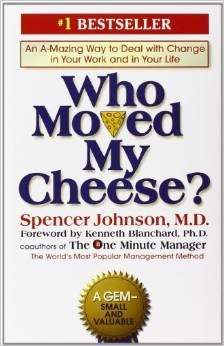
What is Who Moved My Cheese? about?
Who Moved My Cheese? is a motivational business parable about dealing with change. Through the story of two mice and two tiny humans searching for cheese in a maze, Spencer Johnson illustrates different responses to change — from denial and fear to rapid adaptation — and shows that the ability to let go of the old and embrace the new is the most important skill in work and life.
About the author
Spencer Johnson was an American physician and author who specialised in writing short, accessible parables about human behaviour and management. He earned his medical degree from the Royal College of Surgeons in Ireland and worked in medical research before turning to writing. His breakthrough came with The One Minute Manager, co-authored with Ken Blanchard in 1982, which became one of the bestselling business books of all time. Who Moved My Cheese?, published in 1998, has sold over 30 million copies worldwide and been translated into 42 languages. Johnson passed away in 2017, leaving behind a body of work characterised by its brevity, clarity, and universal applicability to personal and professional life. Explore all Spencer Johnson book summaries →
Key concepts at a glance
| Concept | What it means | Use it when |
|---|---|---|
| The Maze | The environment where you search for what you want — your career, organisation, or life | You feel lost or stuck and need to remember the whole system is navigable |
| The Cheese | Whatever you pursue — success, money, health, love, recognition, peace of mind | Defining what matters most to you right now |
| Sniffing | Detecting change early by paying attention to subtle signals | Your industry, company, or role is showing early signs of shifting |
| Scurrying | Taking immediate action without overthinking | Analysis paralysis is keeping you frozen |
| Hemming | Resisting change through denial, blame, and entitlement | You catch yourself saying “it’s not fair” or “this shouldn’t be happening” |
| The Handwriting on the Wall | Lessons Haw writes as he journeys through the maze | You need a simple reminder to keep moving forward |
Part 1: The gathering and the story begins
The book opens with a framing device: a group of former classmates gather at a reunion and begin discussing how they have dealt with the changes in their lives since school. One of them, Michael, shares the story of Who Moved My Cheese? — a parable that he says transformed how he thinks about change in both his personal and professional life.
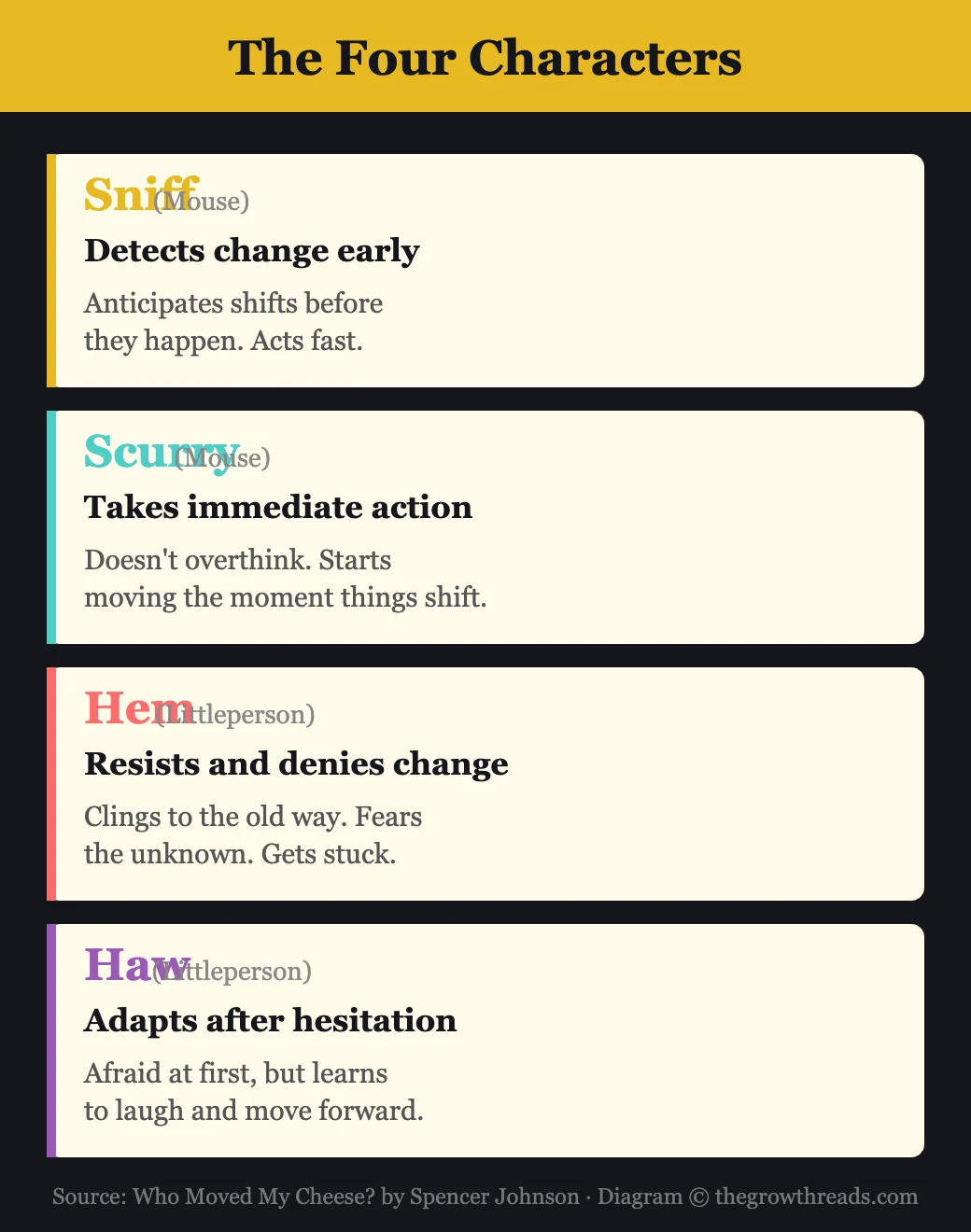
The story introduces four characters living inside a maze. Sniff and Scurry are mice who operate on simple instincts — they put on their running shoes every morning and search for cheese through trial and error. Hem and Haw are “littlepeople” — tiny humans with complex brains full of beliefs, emotions, and expectations. All four characters eventually find Cheese Station C, a massive supply of their favourite cheese that seems inexhaustible.
The mice and the littlepeople develop different routines. Sniff and Scurry arrive early each day, inspect the station, and notice that the cheese supply is gradually shrinking. Hem and Haw, however, become complacent. They sleep late, stroll to the station at their leisure, and begin to feel entitled to the cheese. They build their social identity around it. Haw even writes on the wall: “Having Cheese Makes You Happy.” Their entire sense of security becomes dependent on Cheese Station C remaining exactly as it is.
Part 2: The cheese disappears
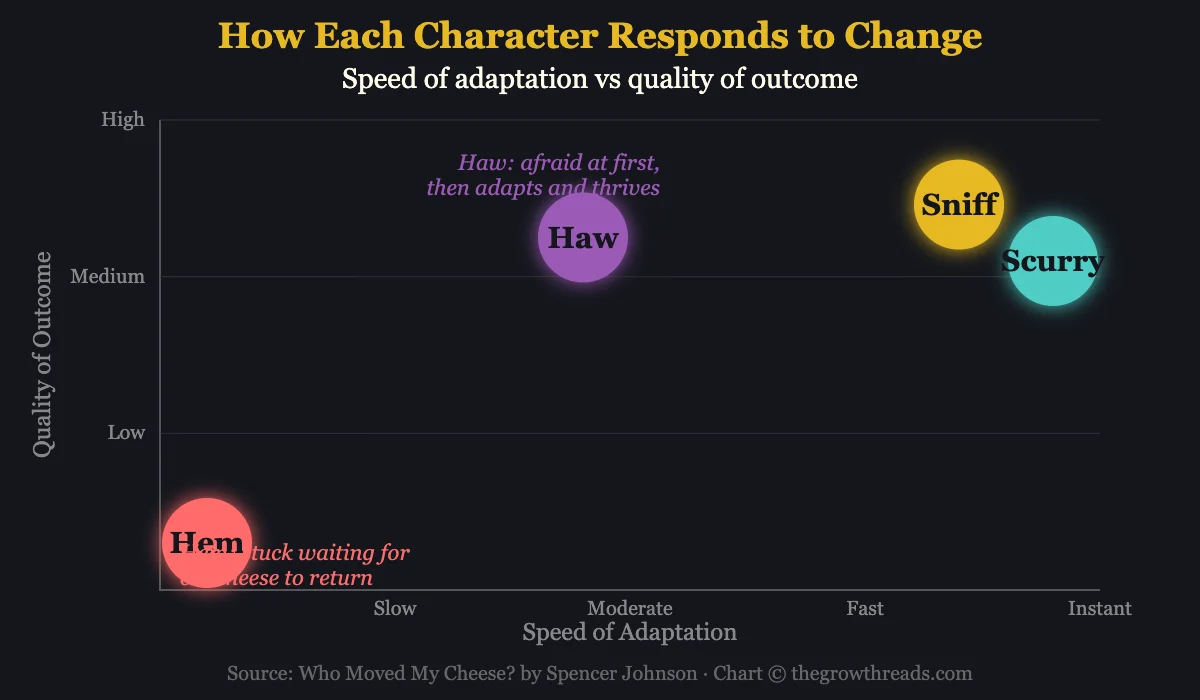
One morning, all four characters arrive at Cheese Station C to find it empty. For Sniff and Scurry, this is not a shock — they had noticed the cheese dwindling for weeks. Without hesitation, they lace up their running shoes and head deeper into the maze to search for new cheese. They do not waste time analysing the situation, assigning blame, or grieving their loss. They simply act.
Hem and Haw react very differently. They stand in disbelief. Hem shouts, “Who moved my cheese?” as if the universe owes him an explanation. Haw feels paralysed. They return to the empty station day after day, expecting the cheese to reappear. They grow frustrated, hungry, and resentful. Hem becomes increasingly angry, blaming unnamed forces for his predicament. Haw begins to wonder whether they should explore the maze but is held back by fear and by Hem’s constant insistence that staying put is the rational choice.
Johnson uses this section to illustrate the psychological stages most people go through when confronted with unwanted change: denial (the cheese will come back), anger (this is unfair), bargaining (maybe if we wait just a little longer), and finally the choice between depression (giving up) and adaptation (moving forward). The mice skip all of these stages because they do not complicate reality with stories about what should be happening. They simply respond to what is happening.
Part 3: Haw moves
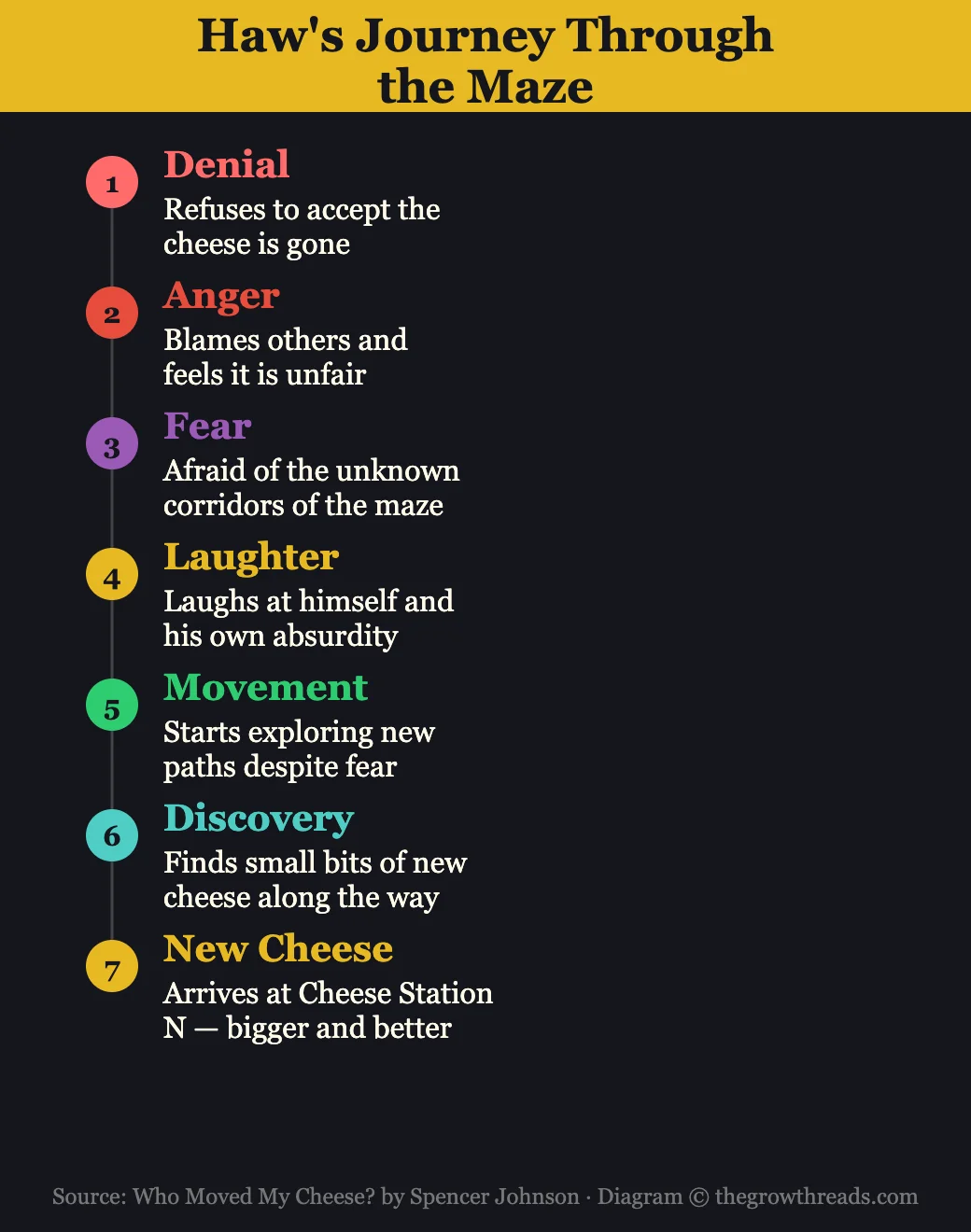
The turning point of the story comes when Haw realises that waiting is not a strategy — it is a slow death. He begins to laugh at himself. He sees how absurd it is to sit in an empty room expecting cheese to materialise. This moment of self-awareness breaks the spell of his fear.
Haw decides to venture into the maze alone, leaving Hem behind. The journey is frightening. The maze is dark, unfamiliar, and full of dead ends. But Haw notices something unexpected: the moment he starts moving, his fear diminishes. He writes on the wall: “What would you do if you were not afraid?” This becomes his guiding question whenever anxiety threatens to stop his progress.
Along the way, Haw finds small bits of cheese — not the abundance of Cheese Station C, but enough to sustain him and confirm that he is heading in the right direction. He begins to enjoy the adventure of exploration itself, rather than fixating solely on the destination. He imagines himself sitting in front of a massive pile of new cheese, and this mental image gives him energy to keep searching.
Eventually, Haw arrives at Cheese Station N, where the mice have already been feasting for some time. The new station has even more cheese than the old one, and different varieties he has never tasted before. Haw realises that the change he feared so desperately was actually the gateway to something better. He writes his lessons on the wall for anyone who might follow and makes a commitment to himself: he will never allow himself to become so comfortable that he stops paying attention to change.
Part 4: The lessons and the discussion
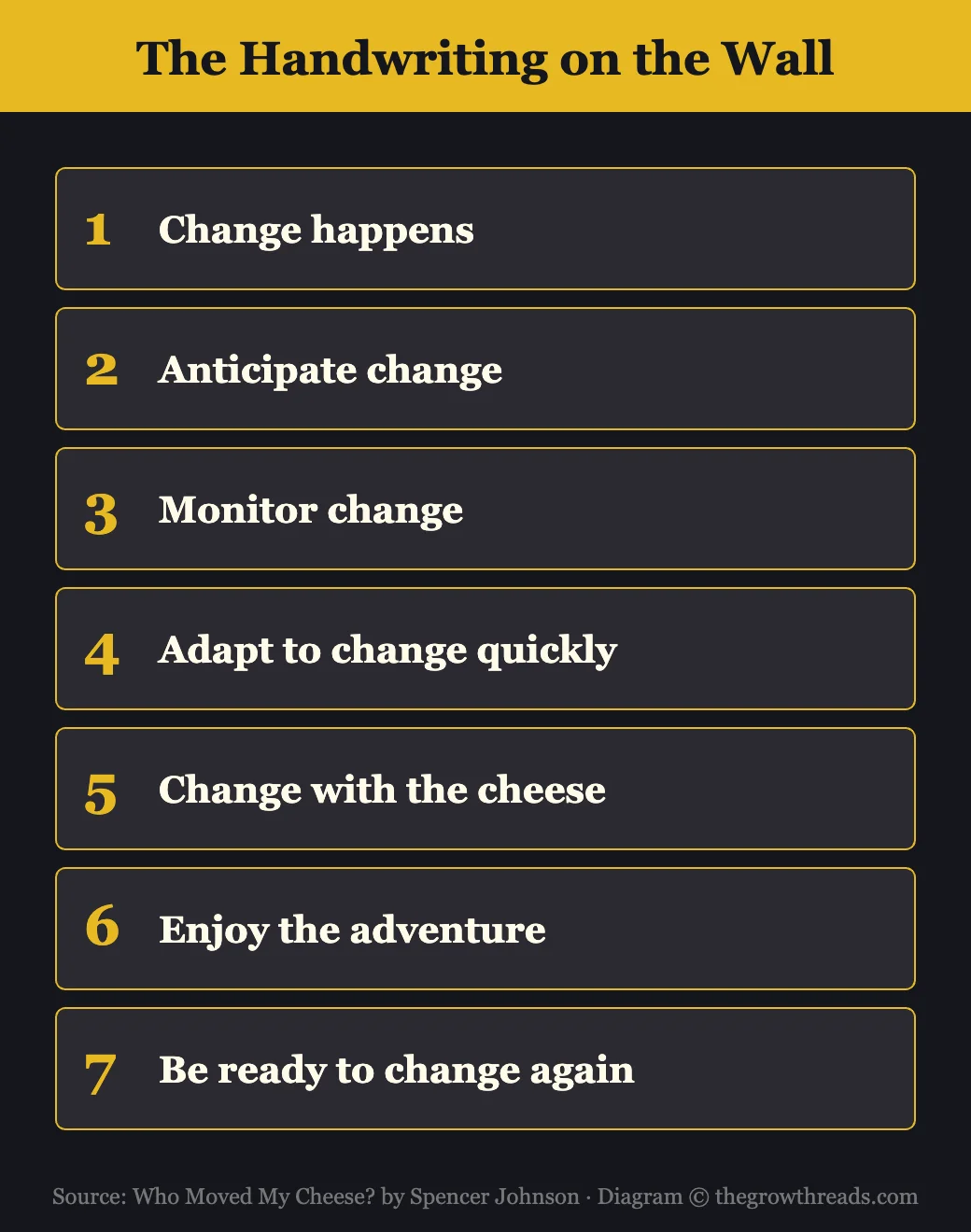
Johnson closes the parable with Haw writing his accumulated wisdom on the maze walls — what the book calls “The Handwriting on the Wall.” These seven statements distill the entire philosophy of the book: change happens, anticipate change, monitor change, adapt to change quickly, change with the cheese, enjoy the adventure, and be ready to change again.
The story returns to the reunion gathering, where the former classmates discuss what the parable means for their own lives. Different characters in the discussion identify with different characters in the story. One executive admits he has been a Hem at work, resisting a reorganisation that threatened his status. A woman recognises that she was a Haw in her marriage — initially paralysed by fear of the unknown but eventually finding the courage to make a change that led to a better life. A teacher says the story helped her understand why some students thrive during transitions while others shut down.
The discussion reinforces Johnson’s central insight: the parable is not about mice and cheese. It is about the universal human tendency to resist change because our identity, our comfort, and our sense of control are all tied to the way things are. The characters in the maze represent the different parts of ourselves — the part that senses danger early (Sniff), the part that acts without overthinking (Scurry), the part that clings (Hem), and the part that eventually finds the courage to adapt (Haw).
Who is Who Moved My Cheese? best for — and who should read something else first?
This book is ideal for leaders who need to help teams navigate organisational change, professionals facing involuntary career transitions, and anyone who recognises the Hem in themselves — the tendency to resist, deny, and cling. Its brevity (you can read it in a single sitting) makes it perfect for team book clubs and shared reading exercises.
However, if you want deeper psychological tools for managing change, you may benefit from Mindset by Carol Dweck, which provides the research framework behind why some people adapt and others freeze. If you need a leadership playbook for driving change across an organisation, The Lean Startup by Eric Ries offers a more systematic methodology. And if your challenge is personal rather than professional, The Mountain Is You goes deeper into the self-sabotage patterns that keep people stuck.
Questions to reflect on
- Which character are you most often — Sniff, Scurry, Hem, or Haw — and has that changed over the course of your career?
- What is one area of your life where you are sitting at an empty cheese station, hoping the cheese will return instead of going to find new cheese?
- What would you do right now if you were not afraid?
- What small signs of change in your industry, role, or relationships have you been ignoring?
- If you imagined the best possible outcome of embracing the change you are resisting, what would it look like?
🔥 Ready to stop waiting and start moving?
Get Spencer Johnson’s classic parable on navigating change — read it in one hour, apply it for a lifetime.
How to apply Who Moved My Cheese? (7-day plan)
- Day 1 — Identify your cheese. Write down the three most important things in your life right now — the “cheese” you depend on for security, happiness, or identity. Be specific: a particular role, a relationship, an income source, a routine.
- Day 2 — Sniff for change. For each cheese, list three early warning signs that the supply might be shrinking. Are there subtle shifts you have been ignoring? Industry trends? Relationship tensions? Declining engagement?
- Day 3 — Name your Hem moments. Identify one area where you are actively resisting change. Write down the specific fears and beliefs keeping you stuck. What story are you telling yourself about why things should stay the same?
- Day 4 — Ask Haw’s question. For the situation you identified yesterday, answer honestly: “What would I do if I were not afraid?” Write the answer without editing or filtering.
- Day 5 — Take one small step into the maze. Do one concrete thing today that moves you toward your answer from Day 4. It does not need to be dramatic — send an email, have a conversation, research an option, update your skills.
- Day 6 — Visualise new cheese. Spend ten minutes imagining the best possible outcome if you fully embrace the change you identified. Make it vivid: where are you, what does it feel like, who is around you? Write it down.
- Day 7 — Build your early warning system. Create a monthly calendar reminder to “check your cheese.” For each of your three cheeses from Day 1, define one metric or signal you will monitor monthly so that you are never caught off guard again.
Frequently asked questions
What is Who Moved My Cheese? about?
It is a parable about four characters — two mice (Sniff and Scurry) and two tiny humans (Hem and Haw) — who live in a maze and depend on cheese for nourishment and happiness. When their cheese supply suddenly disappears, each character responds differently. The mice adapt immediately, while the humans struggle with denial and fear. The story illustrates different approaches to change and argues that the ability to detect, accept, and adapt to change quickly is the most important skill in life and work.
What does the cheese represent?
The cheese is a metaphor for whatever you value most — your career, your income, your relationship, your health, your status, or your sense of security. Different readers will identify different “cheeses” in their own lives. The maze represents the environment where you search for what you want, whether that is a company, an industry, a community, or the broader world. The point is that both the cheese and the maze are always changing.
Why has this book sold over 30 million copies?
Three reasons. First, the parable format makes the message instantly accessible — you can read it in one hour and understand it without any prior knowledge. Second, the metaphor is universally applicable to any kind of change, from corporate restructuring to personal relationships. Third, companies buy it in bulk for employees during organisational change initiatives because it provides a non-threatening, shared language for discussing resistance to change. Its simplicity is its superpower.
Is the book too simplistic?
This is the most common criticism, and it is fair — the book deliberately sacrifices nuance for clarity. It does not address systemic injustice, power imbalances, or situations where change is genuinely harmful and should be resisted. However, the simplicity is intentional. Johnson wrote it as a starting point for thinking about change, not a comprehensive guide. Most readers find that the parable plants a seed of awareness that grows into more nuanced thinking over time.
What happens to Hem at the end of the story?
The original book leaves Hem’s fate ambiguous — he is still sitting at the empty Cheese Station C when the story ends, refusing to move. Johnson later published a sequel, Out of the Maze (2018), which follows Hem’s eventual journey. However, in the original parable, Hem’s unresolved situation is the point: some people never adapt, and the story invites readers to ask whether they are being a Hem in their own lives.
How can I use Who Moved My Cheese? with my team?
Many managers use the book as a team reading exercise during periods of organisational change. The most effective approach is to have everyone read it (it takes about an hour), then facilitate a discussion using the four characters as a framework: “Where are we being Sniff? Where are we being Hem?” This gives team members a safe, non-personal language for acknowledging resistance and discussing adaptation strategies. Some teams post the “Handwriting on the Wall” lessons in their shared workspace as a visual reminder.
What should I read after Who Moved My Cheese?
For a deeper dive into change leadership, read The First 90 Days by Michael Watkins for a tactical transition playbook, or The Infinite Game by Simon Sinek for a strategic perspective on playing long-term games in a changing world. For the psychology of resistance, Mindset by Carol Dweck explains the fixed vs. growth mindset framework that underlies why some people adapt and others freeze. For a more personal take on life transitions, The Mountain Is You by Brianna Wiest explores the self-sabotage patterns that keep people stuck.
Related summaries
- The First 90 Days by Michael Watkins — Summary & Review
- The Infinite Game by Simon Sinek — Summary & Review
- Good to Great by Jim Collins — Summary & Review
- The Lean Startup by Eric Ries — Summary & Review
- Best Leadership Books — The Complete TGR List
Related Leadership Summaries
Multipliers Summary & Review: How the Best Leaders Make Everyone Smarter
On Becoming a Leader Summary and Review
Servant Leadership Summary and Review
The New One Minute Manager Summary & Review: Three Simple Secrets to Effective Leadership
Trillion Dollar Coach Summary & Review: The Coaching Playbook Behind Silicon Valley’s Greatest Companies