

⭐⭐⭐⭐ 4.3/5
One-liner: A research-backed guide to becoming the person everyone wants to talk to — by learning to recognize which conversation is actually happening and matching it.
Best for: Anyone who struggles with miscommunication, difficult conversations, or wants to deepen personal and professional relationships.
Reading time: ~5 hours (304 pages)
Difficulty to apply: Medium — the framework is simple but requires practice to use in real time.
Supercommunicators in one minute
Most miscommunication happens not because people disagree, but because they are having different conversations at the same time. Charles Duhigg’s research reveals that every discussion is actually one of three types: practical (problem-solving), emotional (processing feelings), or social (navigating identity and belonging). When someone vents about a stressful day and their partner immediately offers solutions, the conversation fails — not because the advice was bad, but because an emotional conversation was met with a practical response. Supercommunicators — the people who consistently connect with others — succeed because they identify which conversation is happening and match it before trying to lead. The book’s core technique, “looping for understanding,” is devastatingly simple: ask, listen, repeat back what you heard, and confirm you got it right. People do not need you to agree with them. They need you to prove you understood.
Key takeaways
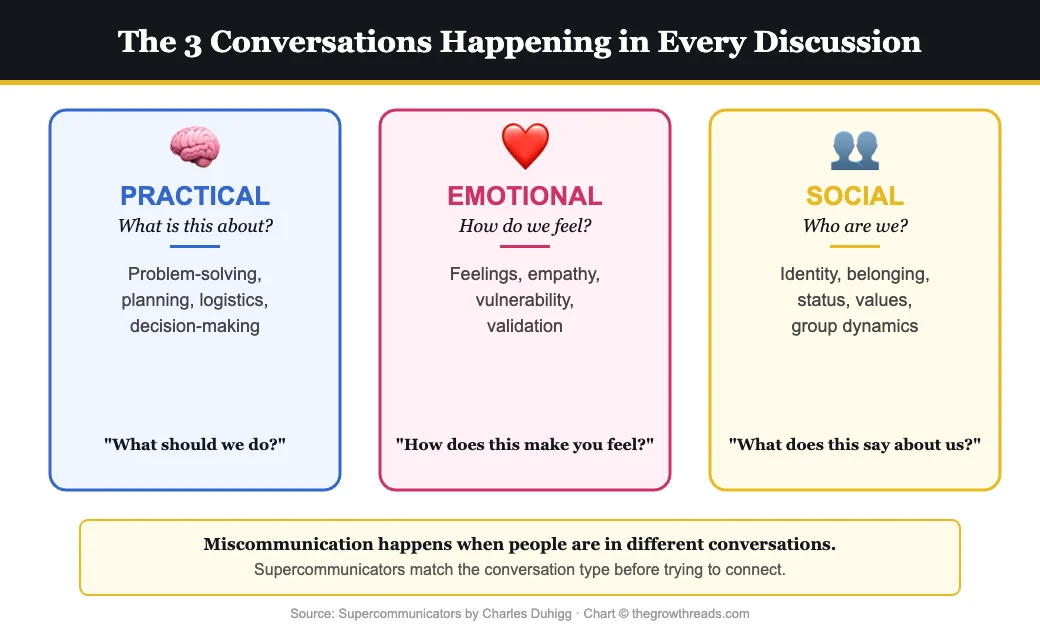
- Every conversation is one of three types: Practical (“What should we do?”), emotional (“How do we feel?”), or social (“Who are we?”). Identifying the type is the first step to connecting.
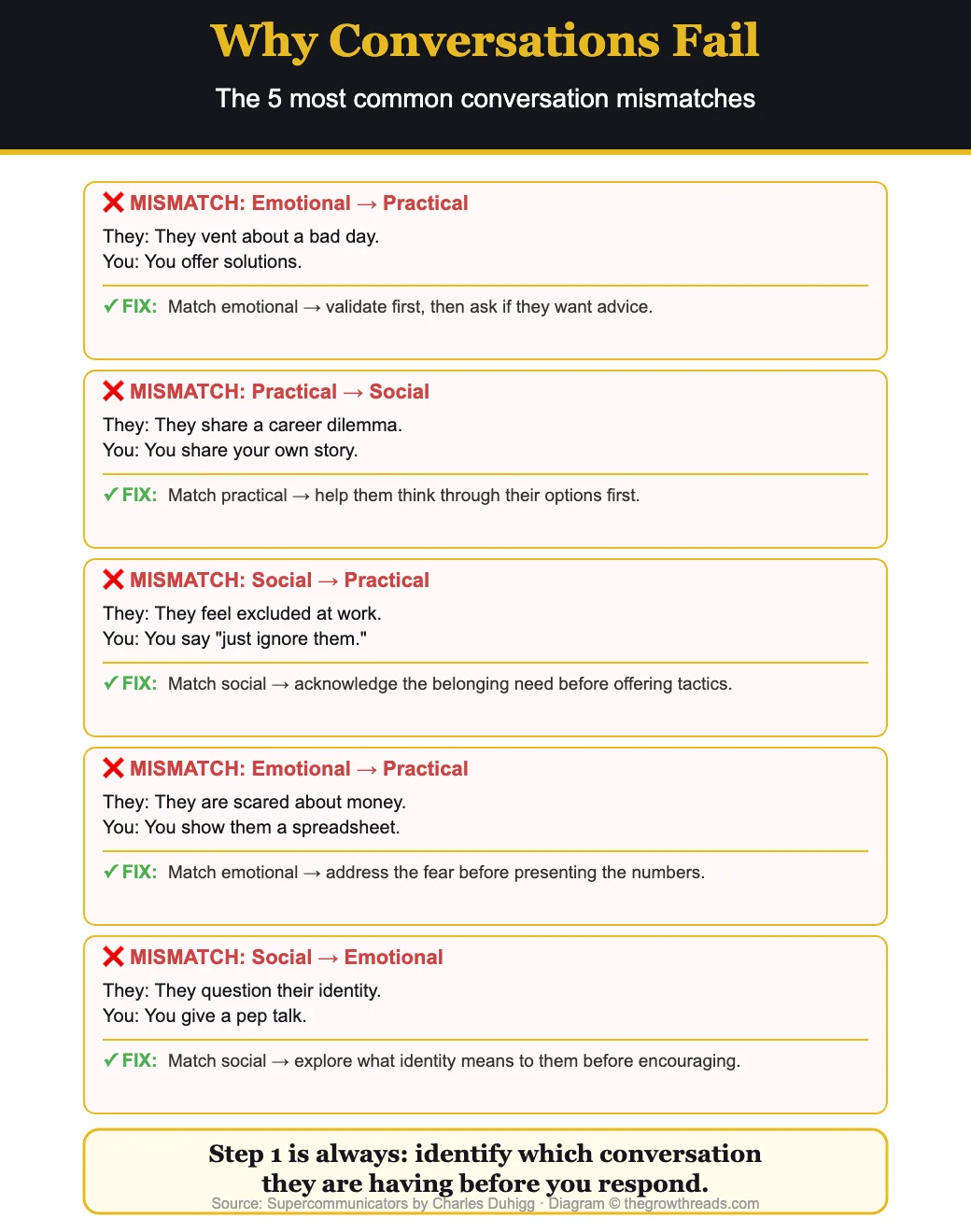
- Mismatches cause most communication failures: When one person is having an emotional conversation and the other responds practically, both feel unheard — even if the content is correct.
- Matching precedes leading: You must join someone in their conversation type before you can guide them to a different one. Validate before you advise.
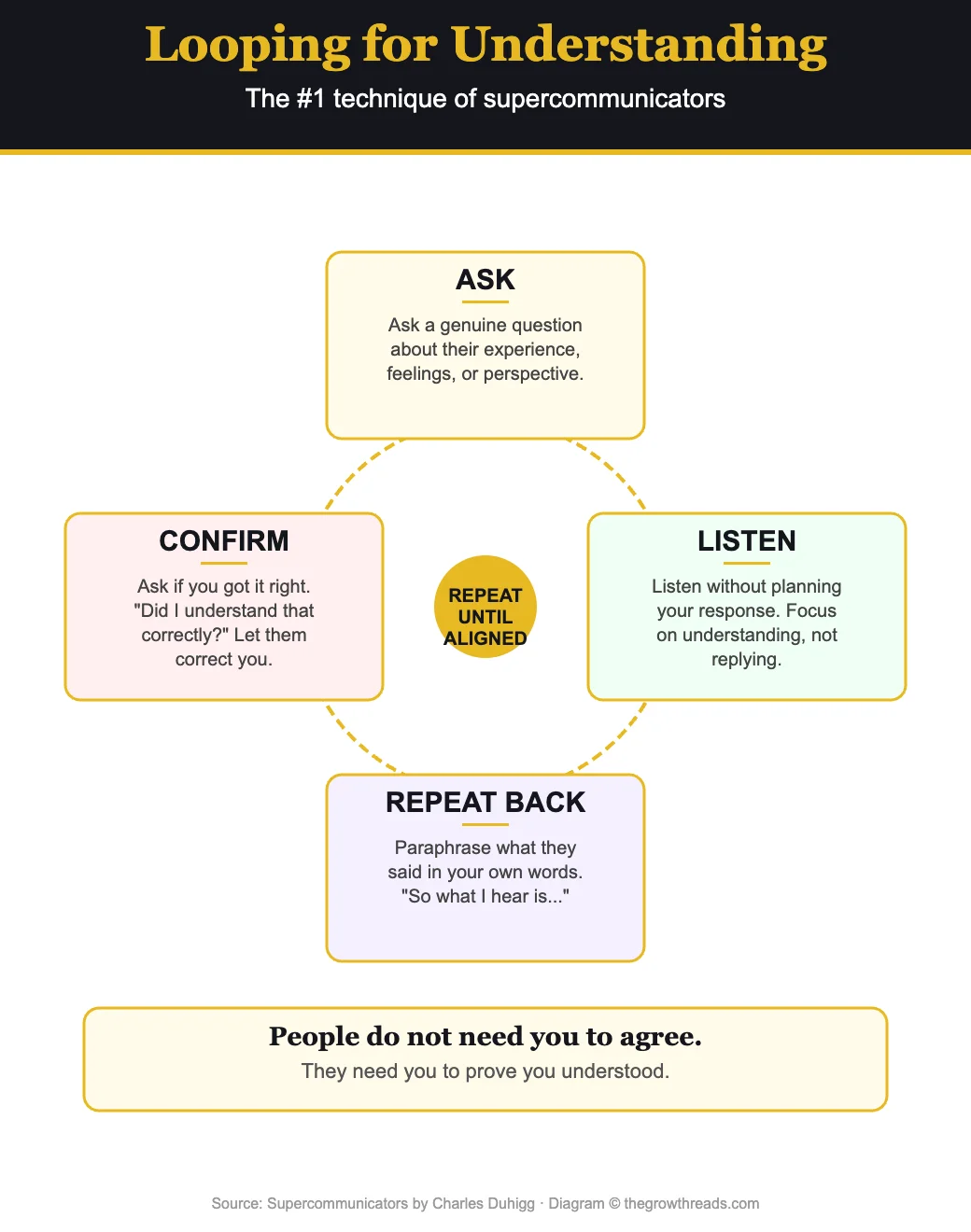
- Looping for understanding is the master skill: Ask a question, listen deeply, repeat back what you heard in your own words, then ask if you got it right. This single technique transforms relationships.
- Questions are more powerful than statements: Deep questions (“How did that make you feel?” rather than “What happened?”) invite the kind of sharing that creates genuine connection.
- Emotional contagion is real: Your mood, energy, and emotional register literally spread to the person you are talking to. Supercommunicators manage this consciously.
- Vulnerability invites vulnerability: When you share something personal, others reciprocate. The willingness to go first is what separates supercommunicators from average communicators.
- Social conversations are about identity: When people argue about politics, religion, or values, they are often defending their sense of who they are — not debating facts.
- Reading the room is a learnable skill: Supercommunicators pay attention to body language, vocal tone, facial expressions, and energy shifts. These signals tell you which conversation is happening.
- Connection is a decision, not a talent: The research shows that supercommunicators are not born — they have simply learned to pay more attention and ask better questions.
What is Supercommunicators about?
Supercommunicators is a research-based exploration of why some people consistently connect with others while most struggle. Charles Duhigg identifies three conversation types (practical, emotional, social), explains why mismatching them causes most communication breakdowns, and provides a learnable framework for becoming the person everyone wants to talk to.
About the author
Charles Duhigg is a Pulitzer Prize-winning journalist and bestselling author known for translating behavioral science into practical frameworks. His first book, The Power of Habit (2012), sold over five million copies and introduced the world to the habit loop (cue-routine-reward). His second, Smarter Faster Better (2016), explored the science of productivity. Before writing books, Duhigg spent a decade at The New York Times, where his reporting on Apple’s supply chain won the Pulitzer Prize for Explanatory Reporting. Supercommunicators, published in 2024, emerged from Duhigg’s fascination with a question he encountered repeatedly: why do some people seem effortlessly good at connecting, even across differences? Explore all Charles Duhigg book summaries →
Key concepts at a glance
| Concept | What it means | Use it when |
|---|---|---|
| Three Conversations | Every discussion is practical, emotional, or social — and only one at a time | You sense a conversation is going off track and cannot figure out why |
| Matching | Identifying which conversation type the other person is in and joining them | Someone seems frustrated by your response despite you being helpful |
| Looping for Understanding | Ask → listen → repeat back → confirm — a cycle that proves you understood | You want to deepen any conversation or resolve a disagreement |
| Deep Questions | Questions about feelings, values, and experiences rather than facts | A conversation feels shallow and you want genuine connection |
| Emotional Contagion | Your mood and energy literally transfer to others in a conversation | You need to set the tone in a meeting, negotiation, or difficult talk |
| Neural Entrainment | Brain waves of connected conversationalists literally synchronize | You want to understand the neuroscience behind “clicking” with someone |
| The Who Are We? Conversation | Discussions about identity, values, and belonging | A disagreement seems irrational but is actually about identity threat |
Part 1: The three conversations — why we talk past each other
Duhigg opens with a deceptively simple observation: most communication problems are not about content — they are about category. When your partner comes home and says “I had the worst day,” they are almost certainly having an emotional conversation. They want empathy, validation, and the feeling of being heard. But if you respond with “Have you tried talking to your boss about it?” you have answered a practical conversation that nobody was having. The advice might be good. It does not matter. The mismatch means the connection fails.
Duhigg’s framework categorizes every conversation into one of three types. Practical conversations are about making decisions, solving problems, and planning — “What should we do?” Emotional conversations are about processing feelings, seeking support, and being understood — “How does this make us feel?” Social conversations are about identity, status, belonging, and values — “Who are we, and how do we relate to each other?”
The crucial insight is that people shift between types without signaling the change, and the shifts can happen multiple times in a single conversation. A discussion about where to eat dinner (practical) can become a conversation about feeling unappreciated (emotional) and then about power dynamics in the relationship (social) — all in the span of five minutes. Supercommunicators navigate these shifts in real time because they are paying attention to the signals: tone of voice, word choice, body language, and emotional energy.
Part 2: The matching principle — how to connect instantly
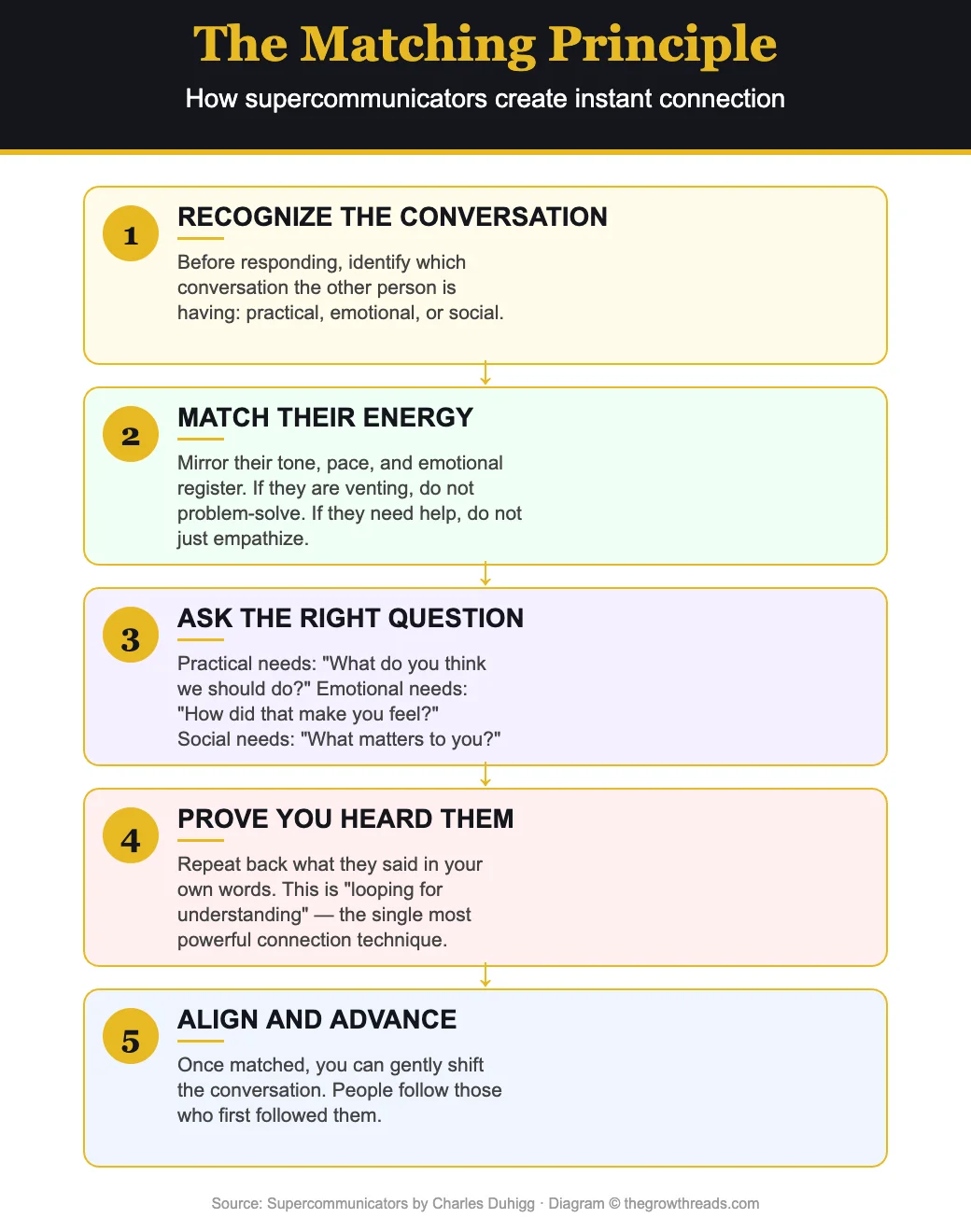
The central skill of supercommunication is matching: identifying which conversation the other person is having and joining them in it before trying to guide them anywhere else. This sounds obvious in theory but is extraordinarily difficult in practice, because our instinct is to respond from our own conversation type. Analytical people default to practical responses. Empathetic people default to emotional ones. Neither is wrong — but both can be mismatched.
Duhigg illustrates this with research from multiple domains. Hostage negotiators, for example, are trained to match the emotional state of the person they are talking to before introducing practical solutions. A negotiator who immediately says “Come out with your hands up” fails because they are having a practical conversation while the person inside is in an emotional or social crisis. The best negotiators spend most of their time listening, validating, and building rapport — matching — before they ever propose a plan of action.
The technique that makes matching work in everyday life is looping for understanding. The process is simple: (1) ask a genuine question, (2) listen to the answer without planning your response, (3) repeat back what you heard in your own words, (4) ask if you got it right. This cycle — which Duhigg calls “the most powerful communication technique in existence” — works because it forces you to actually understand the other person before responding. Most people skip step 3 and 4 entirely, which means they are responding to what they think was said rather than what was actually said.
Part 3: Emotional and social conversations — the deeper layers
The middle section explores the two conversation types that trip most people up: emotional and social. Emotional conversations are difficult because most people — especially in professional settings — are trained to solve problems rather than sit with feelings. Duhigg presents research showing that the single most powerful thing you can do in an emotional conversation is not to offer advice, comfort, or perspective. It is to ask a deep question: “How did that make you feel?” or “What was the hardest part?” Deep questions invite the speaker to process their own emotions, which is what they actually need.
Social conversations are the hardest of the three because they involve identity. When people argue about politics, religion, parenting styles, or values, they are rarely debating facts. They are defending their sense of who they are. Telling someone their political view is wrong feels like telling them their identity is wrong — which is why political arguments almost never change minds. Duhigg argues that the only way to navigate social conversations productively is to acknowledge the identity layer explicitly: “I can see this is really important to who you are. Help me understand why.”
He also introduces the concept of emotional contagion — the finding that emotions literally transfer between people in conversation. Your anxiety makes the other person anxious. Your calm makes them calm. Supercommunicators understand this and consciously manage their own emotional state as a tool, not just a byproduct. Walking into a difficult conversation with genuine curiosity rather than defensiveness does not just feel better — it measurably changes the other person’s neurological state.
Part 4: Becoming a supercommunicator — putting it all together
The final section moves from theory to practice. Duhigg profiles supercommunicators across domains — a surgeon who reduces malpractice claims by 40% simply by listening differently, a manager who turns around failing teams by asking better questions, a couple who saved their marriage by learning to identify when they were in different conversations. The common thread is not charisma or extroversion. It is attention and intention.
Duhigg’s most actionable advice for immediate improvement: before you respond to anyone, pause and ask yourself, “What kind of conversation is this person having?” If you can answer that question correctly, you are already ahead of 90% of communicators. If you then match their conversation type before introducing your own perspective, you will be ahead of 99%. The technique is not difficult. It just requires practice — the same way any skill improves with repetition.
He also emphasizes that vulnerability is reciprocal. When you share something personal — a fear, a struggle, an uncertainty — the other person almost always reciprocates. This is not manipulation; it is how human trust works neurologically. The willingness to go first, to show that you are a real person with real feelings, is what distinguishes supercommunicators from people who are merely articulate. You can be eloquent and still fail to connect. Connection requires risk.
Who is Supercommunicators best for — and who should read something else first?
This book is ideal for anyone who wants to improve their communication in relationships, at work, or in difficult conversations. It is particularly useful for people who have been told they are “bad listeners,” who struggle with emotional conversations, or who find that their advice — however good — consistently lands wrong. The framework is simple enough to remember in real time and deep enough to transform how you relate to others.
If you want a more structured communication protocol, start with Crucial Conversations by Patterson, Grenny, McMillan, and Switzler. If you want the therapeutic depth of emotional communication, Nonviolent Communication by Marshall Rosenberg goes deeper. Duhigg’s strength is making the science accessible and the framework memorable — this is the communication book you will actually use because it is simple enough to remember.
Questions to reflect on
- Think about your last argument with someone close to you. Were you both having the same type of conversation? What would have changed if you had matched their type first?
- Which conversation type do you default to? Practical, emotional, or social? How might this default create mismatches?
- When was the last time someone made you feel truly heard? What did they do differently from others?
- In your most important relationships, how often do you ask deep questions about feelings and values rather than just exchanging information?
- What would happen if you tried looping for understanding in your next difficult conversation?
🔥 Ready to become the person everyone wants to talk to?
Supercommunicators will transform every conversation you have.
How to apply Supercommunicators (7-day plan)
- Day 1 — Identify the conversation: In every conversation today, silently label whether the other person is having a practical, emotional, or social conversation. Do not change your behavior yet — just observe.
- Day 2 — Practice matching: In at least one conversation, consciously match the other person’s conversation type before responding with your own perspective. Notice how the dynamic changes.
- Day 3 — Loop for understanding: In a conversation with someone close to you, try the full loop: ask, listen, repeat back, confirm. Notice their reaction when they feel genuinely understood.
- Day 4 — Ask one deep question: Replace a surface-level question (“How was your day?”) with a deep one (“What was the best part of your day — and why?”). Observe the difference in the response.
- Day 5 — Manage your contagion: Before entering your most important conversation of the day, consciously set your emotional state to curiosity rather than judgment. Notice how this affects the other person.
- Day 6 — Go first with vulnerability: Share something personal — a struggle, a fear, a genuine uncertainty — with someone you want to be closer to. Observe whether they reciprocate.
- Day 7 — Navigate a social conversation: When a discussion touches identity, values, or belonging, try acknowledging the identity layer: “I can see this is really important to you. Tell me more about why.” Observe how it defuses defensiveness.
Frequently asked questions
What are the three types of conversations in Supercommunicators?
Every conversation is one of three types: practical (problem-solving, decision-making, logistics — “What should we do?”), emotional (processing feelings, seeking empathy, needing validation — “How does this make us feel?”), or social (navigating identity, belonging, status, and values — “Who are we?”). The key insight is that most miscommunication happens when two people are in different conversation types without realizing it.
What is looping for understanding?
Looping for understanding is the core technique of supercommunication. It has four steps: (1) ask a genuine question, (2) listen to the answer without planning your response, (3) repeat back what you heard in your own words, and (4) ask if you understood correctly. You repeat this cycle until the other person confirms you got it right. Research shows this technique dramatically increases trust, connection, and the quality of outcomes in every type of conversation.
What makes someone a supercommunicator?
Supercommunicators are not born with special talent. Research shows they share three habits: they pay close attention to which type of conversation is happening, they match the other person’s conversation type before introducing their own perspective, and they ask more deep questions (about feelings, values, and experiences) than average communicators. These are all learnable skills that improve with deliberate practice.
How is Supercommunicators different from other communication books?
Most communication books teach you what to say. Supercommunicators teaches you how to listen and how to identify what kind of conversation the other person needs. The three-conversation framework gives you a simple diagnostic tool that works in real time — something most communication models lack. It is also heavily grounded in neuroscience research (neural entrainment, emotional contagion) rather than just anecdotal advice, which makes the recommendations more credible and specific.
Can Supercommunicators help with relationship problems?
Yes — in fact, relationship communication is one of the book’s strongest applications. Many relationship conflicts are conversation-type mismatches: one partner is seeking emotional support while the other offers practical solutions. Learning to identify and match the conversation type can immediately reduce conflict and increase the feeling of being understood. The looping technique is particularly powerful in intimate relationships where both people feel unheard.
How long does it take to read Supercommunicators?
The book is 304 pages and reads in about five hours. Duhigg writes in his trademark style — research findings woven into compelling stories about real people — which makes the pages move quickly. The audiobook runs about seven hours. Many readers find they can apply the three-conversation framework immediately after the first few chapters, which makes the reading experience feel immediately useful rather than theoretical.
What is neural entrainment in communication?
Neural entrainment is the finding from fMRI research that when two people have a genuine, connected conversation, their brain waves literally begin to synchronize. Their neural patterns start to mirror each other in real time. This is the biological basis of “clicking” with someone — it is not just a feeling but a measurable neurological event. Duhigg uses this research to explain why looping for understanding works: it creates the conditions for neural entrainment, which produces the feeling of being deeply understood.
Related summaries
- Crucial Conversations Summary — A structured protocol for high-stakes conversations where emotions run hot.
- Nonviolent Communication Summary — Marshall Rosenberg’s framework for compassionate communication.
- Difficult Conversations Summary — The Harvard Negotiation Project’s guide to navigating challenging talks.
- Best Relationship Books — Our curated guide to the most impactful books on love, connection, and communication.
Related Relationships Summaries
Attached Summary & Review: Decode Your Love Patterns With Science
Crucial Conversations Summary & Review: Master High-Stakes Dialogue
Loving Bravely Summary and Review
The New Rules of Marriage Summary and Review
Toxic Parents Summary & Review: Susan Forward’s Guide to Breaking Free from Hurtful Family Patterns