

⭐⭐⭐⭐ 4.2/5
One-liner: The essential companion to Essentialism — once you know what matters, this book shows you how to make it easier to actually do.
Best for: High achievers stuck in an exhausting cycle of pushing harder for diminishing returns.
Reading time: ~4 hours (256 pages)
Difficulty to apply: Low to medium — the techniques are deliberately simple by design.
Effortless in one minute
You have already identified what matters most — now stop making it so hard to do. Greg McKeown wrote Essentialism to help you focus on the right things. He wrote Effortless because he watched high achievers burn out trying to do those right things through sheer willpower and grinding effort. The book’s central argument is counterintuitive: when essential work feels like a slog, the answer is not to push harder but to find an easier path to the same result. McKeown structures the book around three shifts — entering an effortless state (mental readiness), taking effortless action (simplifying execution), and achieving effortless results (building systems that produce residual output). The result is a productivity philosophy that rejects hustle culture without rejecting ambition.
Key takeaways
- Invert the question: Instead of asking “How can I push harder?” ask “What if this could be easy?” This single reframe often reveals simpler paths you never considered.
- Pair work with play: Making essential activities enjoyable is not cheating — it is a strategy. Rituals, music, and social pairing reduce friction and increase consistency.
- Define “done”: Most tasks expand endlessly because you never defined what “finished” looks like. Set a clear completion point before you start.
- Start with a zero draft: Perfectionism kills momentum. Write the worst possible version first — a “zero draft” — to break the blank-page barrier.
- Set an upper bound on effort: Do not do more today than you can recover from by tomorrow. Sustainable pace beats heroic sprints every time.
- Simplify the steps: For any process, ask: “What are the minimum steps needed?” Remove every step that does not directly produce the result.
- Automate with checklists: Checklists free your brain from remembering sequences so you can focus mental energy on creative decisions.
- Build residual results: Instead of solving the same problem repeatedly (linear results), create systems, templates, and relationships that keep producing output without constant input.
- Trust as leverage: High-trust teams move faster with less overhead. Investing in trust upfront is the highest-leverage productivity move.
- Prevent, don’t fix: One upstream solution prevents a hundred downstream crises. Always look for the root cause before patching symptoms.
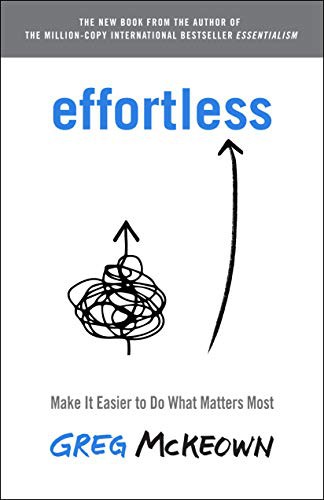
What is Effortless about?
Effortless is a practical guide to making essential work easier rather than harder. Greg McKeown argues that high achievers burn out not because they lack focus, but because they default to the most difficult path. The book provides frameworks for entering a productive mental state, simplifying execution, and building systems that deliver compounding results.
About the author
Greg McKeown is a British-American author, speaker, and leadership strategist. His first book, Essentialism: The Disciplined Pursuit of Less (2014), sold over two million copies and became a defining text in the modern productivity canon. McKeown studied at Stanford University, where he became fascinated by the question of why smart, capable people often fail to achieve their goals. He has advised clients at Apple, Google, Facebook, Salesforce, and the United Nations. Effortless, published in 2021, emerged from a personal crisis — his daughter’s prolonged illness — that forced him to confront the limits of his own “try harder” philosophy. Explore all Greg McKeown book summaries →
Key concepts at a glance
| Concept | What it means | Use it when |
|---|---|---|
| The Effortless Inversion | Asking “What if this could be easy?” instead of defaulting to hard work | You feel stuck or exhausted on an important task |
| Effortless State | A mental state of focus, presence, and lightness that makes work flow | You are mentally cluttered and cannot begin |
| Zero Draft | The worst possible first version — designed to break perfectionism paralysis | You are procrastinating on a writing or creative task |
| Effortless Action | Simplifying the process to the minimum viable steps | A project feels overcomplicated or has too many moving parts |
| Linear vs. Residual Results | Linear results require repeated effort; residual results keep flowing from initial work | You want to stop solving the same problem every week |
| Effortless Results | Building systems, trust, and knowledge that compound over time | You want long-term leverage, not just short-term output |
| Upper Bound | A ceiling on effort to prevent burnout and maintain sustainability | You habitually overwork and crash on weekends |
| The Courage to Be Rubbish | Giving yourself permission to produce a terrible first attempt | Perfectionism is blocking your progress |
Part 1: Effortless State — the mental shift
The book opens with McKeown’s confession: the Essentialism framework he championed was not enough. He had identified what mattered most, but he was still exhausted. His daughter was seriously ill, his schedule was crushing, and he was doing everything “right” — yet the results felt harder and harder to sustain. The insight that followed became the book’s thesis: what if the bottleneck is not knowing what to focus on, but how you approach the work itself?
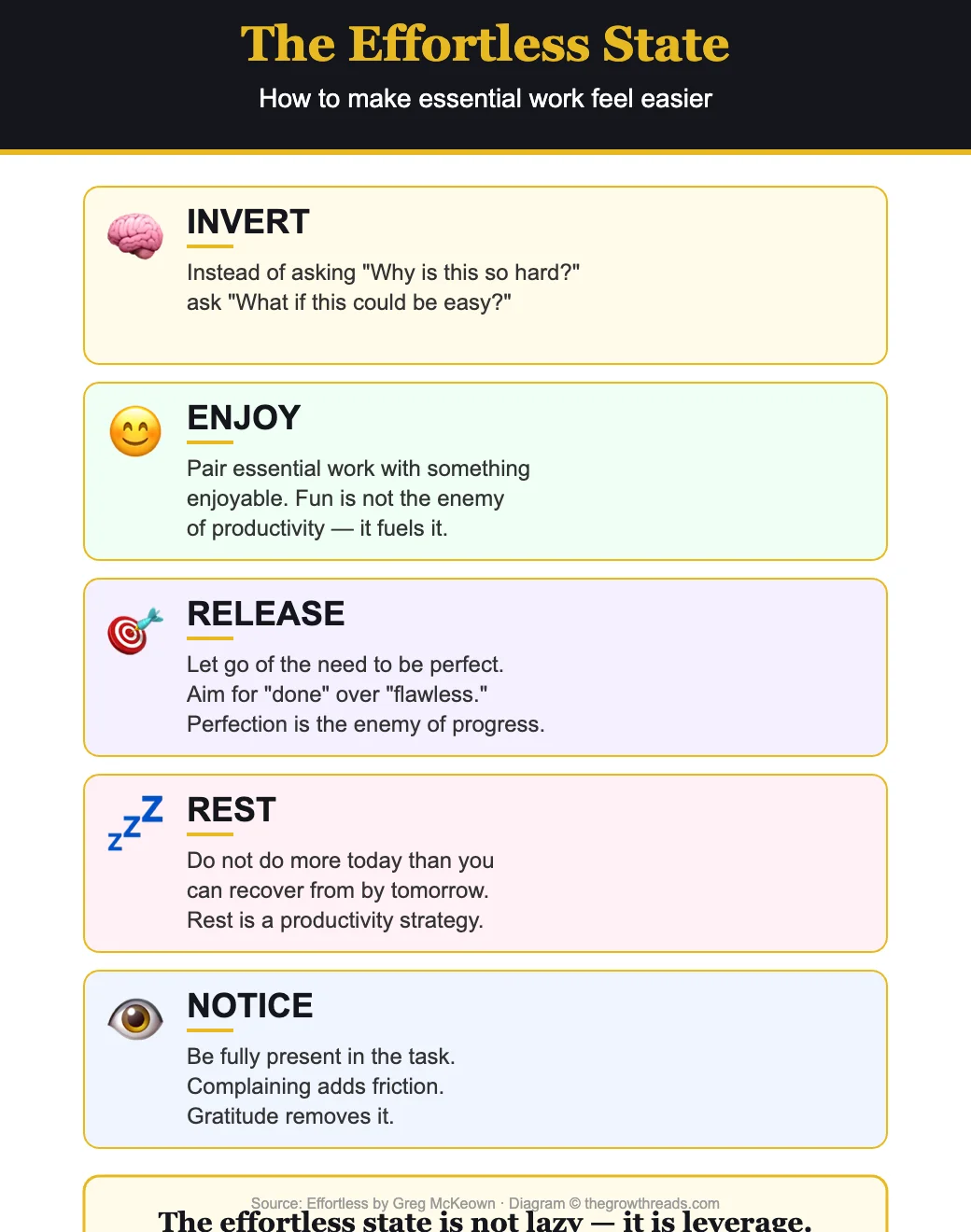
The first section addresses the internal state you bring to work. McKeown identifies several mental habits that make essential tasks harder than they need to be: overthinking, complaining, trying to control every variable, carrying emotional baggage from past failures, and the pervasive belief that valuable work should feel difficult. His counter-move is the Effortless Inversion — a mental habit of asking, for every important task, “What if this could be easy?”
This is not laziness dressed up as wisdom. McKeown carefully distinguishes between making things easy (finding simpler paths to the same outcome) and making things easy by lowering the bar (accepting worse outcomes). The goal is the same high-quality result, achieved through a lighter process. He cites research on psychological fluency — the finding that people perform better and learn faster when the process feels natural rather than forced.
Practically, entering the effortless state involves clearing mental clutter (resentments, worries, open loops), pairing work with small pleasures (a particular playlist, a favorite workspace, a walking meeting), and building rituals that signal to your brain that it is time to focus. The state is not mystical; it is the simple result of removing friction between you and the work.
Part 2: Effortless Action — simplifying execution
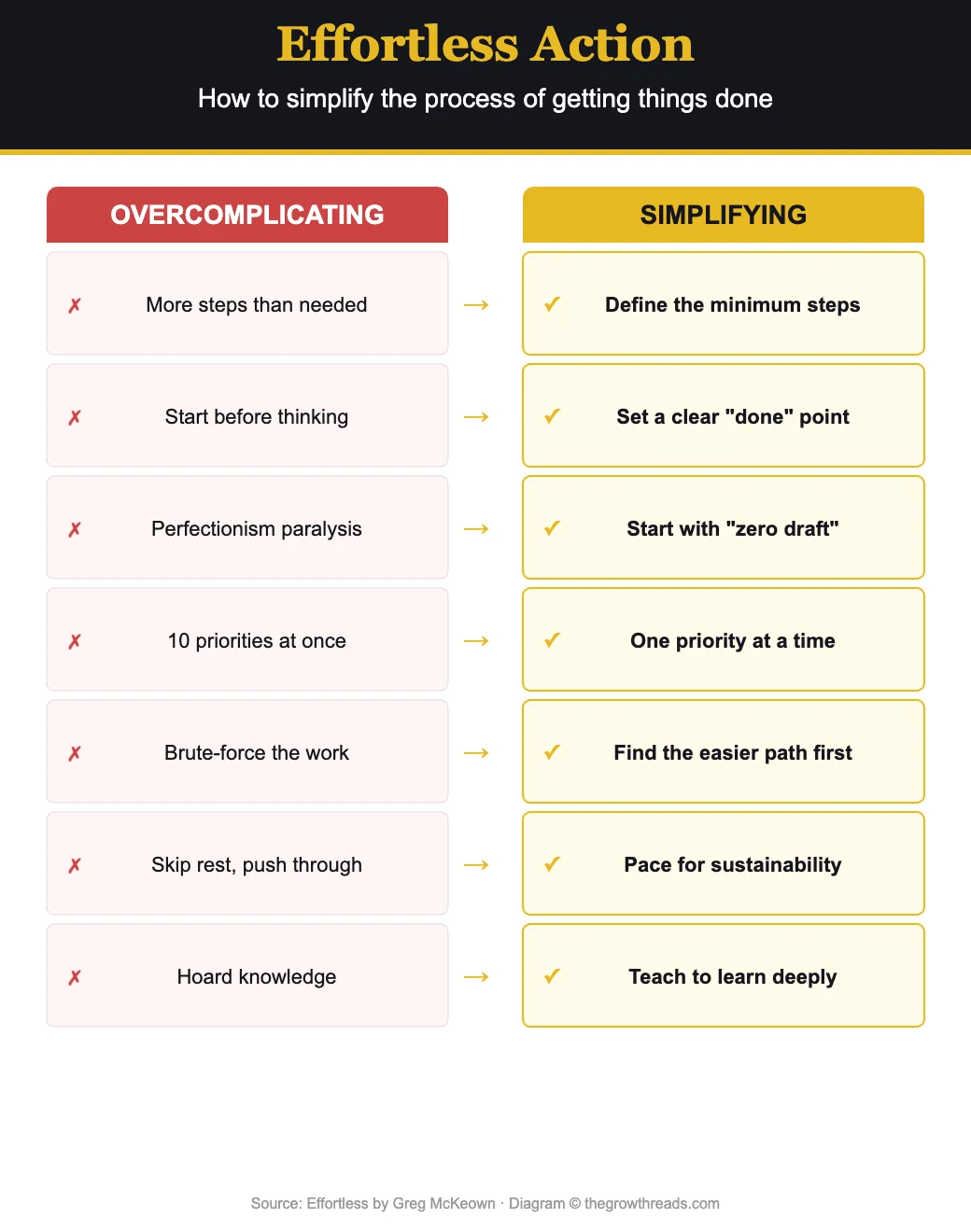
Once you are in the right state, the next challenge is the work itself. McKeown argues that most people overcomplicate essential tasks — they add unnecessary steps, delay starting because they cannot envision the perfect outcome, and treat every project as if it requires maximum effort. Effortless action means stripping the process down to the fewest steps that produce the desired result.
The most memorable technique is the “zero draft.” Instead of staring at a blank page waiting for inspiration, you write the worst possible version as fast as you can. McKeown borrowed this from a screenwriter friend who said, “I give myself permission to write the worst first draft in the history of writing.” The zero draft breaks the psychological barrier of starting. Once something — anything — exists on the page, editing and improving feel natural. The blank page is the enemy; the terrible first draft is the antidote.
Another key principle: define “done” before you begin. Without a clear endpoint, tasks expand to fill all available time and energy (Parkinson’s Law taken to its logical extreme). McKeown suggests that before starting any project, you write down exactly what “finished” looks like. Not “work on the report” but “submit a 3-page summary with 5 recommendations by Friday noon.” This specificity is not just about time management — it protects you from the perfectionist’s trap of endlessly refining work that is already good enough.
McKeown also introduces the concept of an upper bound on effort. Most productivity advice focuses on minimum output — what is the least you can do? McKeown flips it: what is the most you should do in a single session? Do not do more today than you can recover from by tomorrow. This principle — borrowed from endurance athletes — prevents the boom-and-bust cycle where you work heroically for three days, then crash for two.
Part 3: Effortless Results — building systems that compound
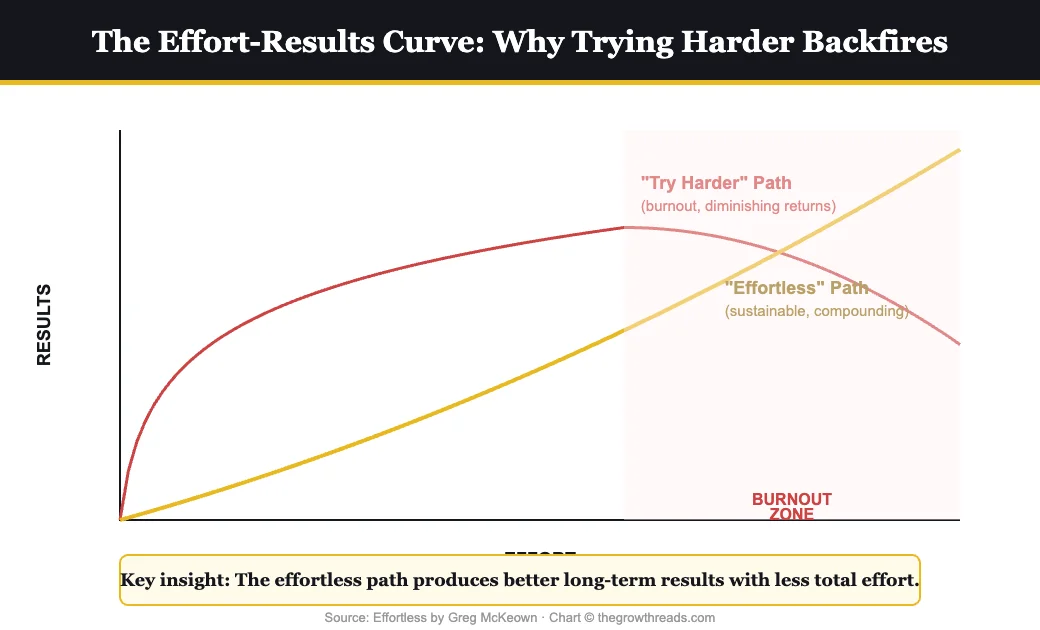
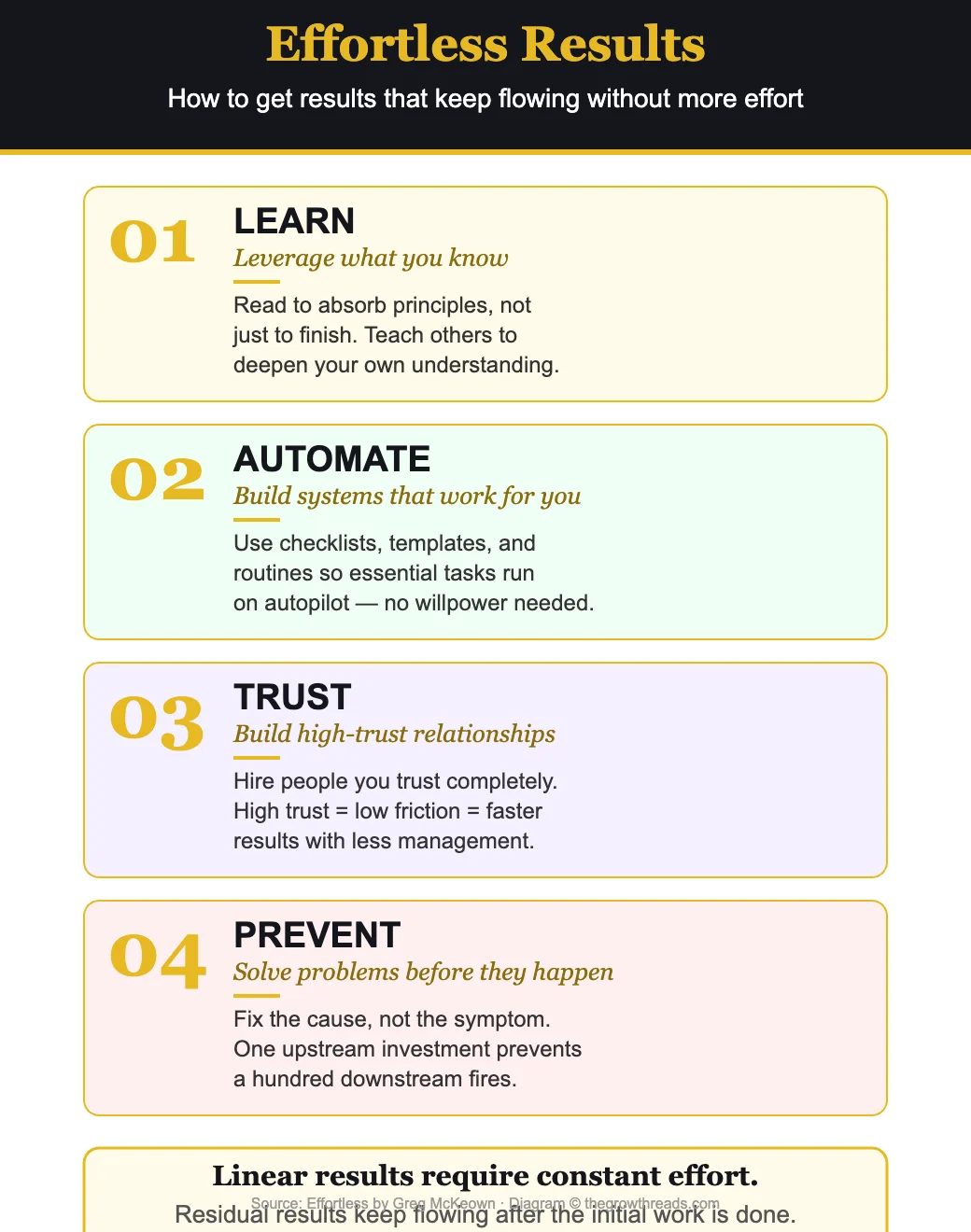
The final section addresses McKeown’s most important distinction: linear results vs. residual results. Linear results require you to keep putting in effort to keep getting output — like a hamster wheel. You stop working, the results stop. Residual results, by contrast, keep flowing long after the initial effort is complete. A book generates royalties for decades. A well-designed checklist saves thousands of hours across an organization. A trusted relationship produces opportunities you never had to chase.
McKeown organizes residual-result strategies into four categories. Learning means reading to absorb principles (not just facts) and teaching others as the ultimate retention tool — research consistently shows that teaching material forces deeper processing and longer retention than passive review. Automating means creating checklists, templates, and standard operating procedures that capture your best thinking so you do not have to reinvent the process every time.
Trust is McKeown’s most underrated lever. He argues that high-trust relationships dramatically reduce the friction of collaboration. When you trust someone completely, you skip the micromanagement, the double-checking, the political maneuvering — and both parties move faster. The upfront investment in building trust pays residual dividends across every interaction. Prevention is the final category: investing in solving root causes so that problems do not recur. Fixing a leaky pipe once is effortless compared to mopping the floor every day for a year.
The section’s practical power lies in its relentless focus on leverage. McKeown does not ask “How can I work more?” He asks “What is the one thing I can do today that will make everything else easier or unnecessary tomorrow?” This is Essentialism taken to its logical conclusion — not just doing less, but designing systems so the essential things practically do themselves.
Who is Effortless best for — and who should read something else first?
This book is ideal for anyone who has already embraced essentialism (knowing what to focus on) but still feels overwhelmed by the execution. It is particularly valuable for recovering perfectionists, workaholics, and people who equate effort with virtue. If you believe that hard work is inherently noble and ease is inherently suspicious, this book will challenge that assumption productively.
If you have not yet read Essentialism, start there — Effortless assumes you already know what matters and focuses on how to execute it. If you want a deeper system for task management, Getting Things Done is more comprehensive. If you want the science of habit formation rather than work simplification, Atomic Habits is the better starting point.
Questions to reflect on
- What essential task in your life have you been making harder than it needs to be? What would the easier version look like?
- Where are you producing linear results (constant effort for constant output) that could be converted to residual results?
- What would happen if you set an upper bound on your work today — committing to stop before exhaustion?
- Which relationship in your professional life would benefit most from a deliberate investment in trust?
- What is one recurring problem you keep fixing downstream that could be solved once at the root?
🔥 Ready to make what matters easier?
Effortless will change how you think about productivity, effort, and results.
How to apply Effortless (7-day plan)
- Day 1 — Invert one task: Pick your most dreaded task this week. Ask “What if this could be easy?” and brainstorm three simpler approaches before starting.
- Day 2 — Define “done” for three projects: For your three most important current projects, write a single sentence describing what “finished” looks like. Pin it where you will see it.
- Day 3 — Write a zero draft: Pick a task you have been procrastinating on (email, report, proposal) and write the worst possible version in 15 minutes. Then improve it.
- Day 4 — Set an upper bound: Before starting work, decide when you will stop — not a minimum output target, but a maximum effort ceiling. Respect it.
- Day 5 — Build one checklist: Identify a recurring task (weekly meeting prep, client onboarding, content review) and create a simple checklist that captures your best process.
- Day 6 — Invest in trust: Have one conversation with a colleague or partner focused purely on building trust — acknowledge their contribution, ask what they need, follow through immediately.
- Day 7 — Fix one root cause: Identify a problem you have been patching repeatedly. Spend today’s energy solving it at the source so it never recurs.
Frequently asked questions
Is Effortless a sequel to Essentialism?
It is a companion, not a sequel. Essentialism answers “What should I focus on?” while Effortless answers “How do I make that focus easier to execute?” You do not need to read Essentialism first, but the books work best together. McKeown wrote Effortless because he realized that knowing what matters is only half the battle — the other half is making the essential work sustainable.
What is the main idea of Effortless?
The main idea is that when essential work feels hard, the solution is not to try harder but to find an easier path to the same result. McKeown argues that overachievers default to brute force when smarter, simpler approaches would produce better outcomes with less burnout. The book provides frameworks for entering a productive mental state, simplifying execution, and building systems that deliver compounding results over time.
What is a zero draft?
A zero draft is a deliberately terrible first version of any creative work — worse than a rough draft. The concept comes from screenwriting and is designed to defeat perfectionism. By giving yourself explicit permission to produce something bad, you eliminate the psychological barrier of starting. Once the zero draft exists, you can edit and improve it, which is far easier than creating from nothing. McKeown argues this single technique can break the most stubborn procrastination.
What is the difference between linear and residual results?
Linear results require constant effort — you stop working, the results stop. Think of manually answering the same customer question every day. Residual results keep flowing after the initial investment. Think of writing an FAQ page that answers the question automatically. McKeown argues that most professionals spend too much time on linear activities and too little time building systems, templates, checklists, and relationships that produce residual output.
Is Effortless about being lazy or doing less work?
No. McKeown explicitly distinguishes between making things easy (finding simpler paths to high-quality outcomes) and being lazy (accepting lower standards). The goal is the same ambitious result, achieved through a lighter, smarter process. The book challenges the cultural belief that effort and suffering are inherently noble — arguing that the best performers often make difficult things look easy because they have found the path of least resistance to excellence.
How long does it take to read Effortless?
Effortless is 256 pages and most readers finish it in about four hours. McKeown writes in a clear, anecdote-driven style with short chapters. The audiobook, narrated by the author, runs about five hours. The book is structured so each chapter stands alone with a single principle and practical exercise, making it easy to read in short sessions and apply ideas immediately.
Should I read Effortless if I already follow GTD or Atomic Habits?
Yes — they complement each other well. Getting Things Done provides a comprehensive task management system, Atomic Habits focuses on building automatic behaviors, and Effortless addresses the meta-question of making essential work feel lighter. Where GTD asks “How do I organize everything?” and Atomic Habits asks “How do I build better routines?” Effortless asks “Why am I making this harder than it needs to be?” The three books together cover different dimensions of personal effectiveness.
Related summaries
- Essentialism Summary — McKeown’s first book on the disciplined pursuit of less.
- Atomic Habits Summary — James Clear’s framework for building compounding habits.
- Deep Work Summary — Cal Newport on focused, distraction-free work in a noisy world.
- Best Productivity Books — Our curated guide to the most impactful books on getting things done.
Related Productivity Summaries
Deep Work Summary & Review: Rules for Focused Success in a Distracted World
Joy at Work Summary & Review: The KonMari Method for Your Professional Life
Smarter Faster Better Summary & Review: The 8 Drivers of Real Productivity
The Checklist Manifesto Summary & Review: How Simple Lists Prevent Catastrophic Failures
The One Thing Summary & Review: The Surprisingly Simple Truth Behind Extraordinary Results