

⭐⭐⭐⭐ 4.3/5
One-liner: A Toltec guide to building relationships rooted in freedom, acceptance, and self-love rather than fear, control, and neediness.
Best for: Anyone stuck in patterns of jealousy, people-pleasing, or conditional love — and ready to break free.
Reading time: ~3 hours (152 pages)
Difficulty to apply: Medium — the concepts are simple but require deep self-honesty and patience.
The Mastery of Love in one minute
Most relationship problems start inside you, not between you and another person. Don Miguel Ruiz argues that we carry emotional wounds from childhood — what he calls “emotional poison” — and then project that poison onto our partners, expecting them to heal us. The result is fear-based relationships built on control, neediness, and conditions. The alternative is radical self-love: when you fill your own emotional needs first, you stop demanding that others complete you. You become free to love without fear, accept people as they are, and build partnerships based on respect rather than obligation. Ruiz draws on ancient Toltec wisdom to show that love is your natural state — fear is the learned behavior that blocks it.
Key takeaways
- You were domesticated to seek approval: From childhood, you learned to modify your behavior to earn love — and this pattern follows you into adult relationships.
- Emotional wounds create emotional poison: Unhealed rejection and pain generate fear, jealousy, and anger that infect every relationship you enter.
- The “magical kitchen” test: If you already have love within yourself (a full kitchen), you never accept love with abusive conditions attached.
- Fear-based love is not love: Relationships driven by neediness, control, or the fear of being alone are transactions, not genuine connections.
- Stop taking things personally: Other people act from their own dream, their own wounds — their behavior is about them, not about you.
- Acceptance is the highest form of love: Trying to change your partner means you do not love who they actually are.
- Self-love is the foundation: You cannot give what you do not have — loving yourself unconditionally is the prerequisite for loving anyone else well.
- Forgiveness heals the wounds: Forgiving others (and yourself) is how you drain the emotional poison and stop the cycle of suffering.
- Love is action, not words: Real love shows up in how you treat people daily — with respect, kindness, and freedom.
- Your happiness is your responsibility: No one else can make you happy; expecting them to is the fastest path to disappointment.
What is The Mastery of Love about?
The Mastery of Love is a guide to building relationships based on unconditional love rather than fear. Drawing on Toltec wisdom, Don Miguel Ruiz explains how childhood conditioning creates emotional wounds that poison our adult relationships, and offers a path to healing through self-awareness, forgiveness, and radical self-acceptance.
About the author
Don Miguel Ruiz grew up in rural Mexico in a family of healers and practitioners of the ancient Toltec tradition. He trained as a surgeon before a near-fatal car accident in 1970s Tijuana led him to abandon Western medicine and return to his family’s spiritual teachings. His 1997 book The Four Agreements spent over a decade on the New York Times bestseller list and has sold more than 15 million copies worldwide. Ruiz has dedicated his life to sharing Toltec wisdom in practical, modern language, earning recognition from Oprah Winfrey and spiritual leaders across traditions. The Mastery of Love, published in 1999, is the companion volume that applies the Four Agreements specifically to relationships and love. Explore all Don Miguel Ruiz book summaries →
Key concepts at a glance
| Concept | What it means | Use it when |
|---|---|---|
| The Dream of the Planet | The collective beliefs and rules society programs into you from birth | You catch yourself following a relationship “script” that does not serve you |
| Domestication | The process of learning to seek external approval to earn love | You notice people-pleasing patterns in your relationships |
| Emotional Poison | The fear, anger, and jealousy produced by unhealed wounds | You react disproportionately to small triggers from your partner |
| The Magical Kitchen | A metaphor: when you are full of self-love, you never accept conditional love | You feel tempted to stay in a relationship out of need rather than choice |
| The Track of Love vs. Fear | Two parallel tracks — love creates freedom; fear creates control | You want to diagnose whether a relationship dynamic is healthy |
| The Perfect Relationship | One where both partners respect each other’s freedom completely | You are building or resetting expectations with a partner |
| Forgiveness Surgery | A visualization practice for opening and draining emotional wounds | You carry resentment that keeps resurfacing in conflicts |
| The Master’s Path | Awareness → Transformation → Love: the three-stage progression to freedom | You want a roadmap for personal growth within relationships |
Part 1: The wounded mind — why we suffer in love
Ruiz opens with a provocative claim: humans are the only animals that suffer in love, because we are the only ones who build an entire belief system — “the Dream” — around what love should look like. From birth, you were domesticated. Your parents, teachers, and culture taught you which behaviors earned approval and which earned punishment. You learned to wear a social mask — what Ruiz calls the “image of perfection” — to gain acceptance. The problem is that this mask is not you. And when you build relationships while wearing it, you attract people who love the mask, not the real person underneath.
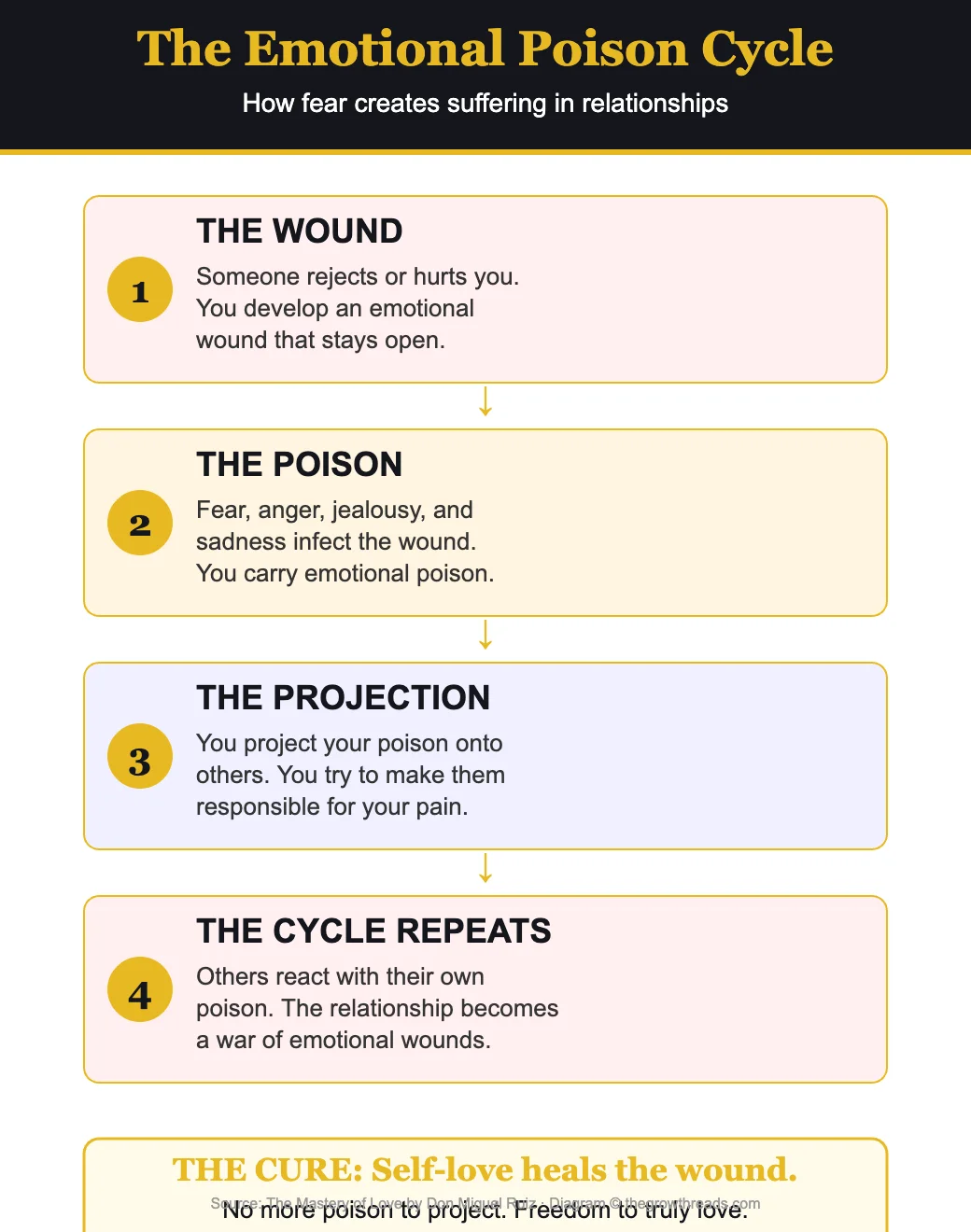
This domestication creates what Ruiz calls the emotional body: a collection of wounds that never fully healed. Every rejection, every moment of shame, every time love was withheld as punishment — these leave open wounds. And those wounds produce emotional poison: fear, jealousy, possessiveness, and anger. You do not choose these reactions. They flow automatically from the wounds, like infection from a cut.
The key insight is that most relationship conflicts are not actually about the relationship. They are about two wounded people bumping into each other’s pain. When your partner says something that triggers you, the intensity of your reaction comes from the old wound — not from what they said. This is why small disagreements escalate into disproportionate fights. You are not arguing about the dishes; you are reliving the pain of not feeling good enough.
Part 2: The track of fear vs. the track of love
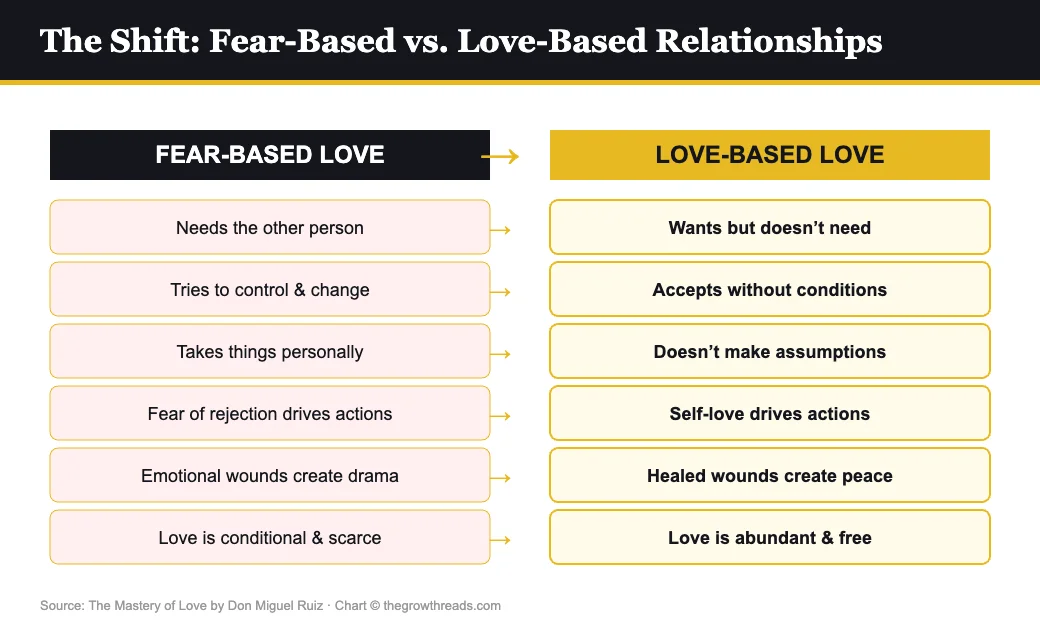
Ruiz presents one of the book’s most useful frameworks: every relationship operates on one of two tracks — fear or love. On the track of fear, you control your partner because you are afraid of losing them. You set conditions: “I will love you if you behave the way I want.” You become possessive, jealous, and manipulative — not because you are a bad person, but because fear makes you desperate. Fear-based love says: “I need you to complete me.”
On the track of love, you give your partner complete freedom. You do not try to change them. You do not punish them for being different from your expectations. You accept them exactly as they are — and you accept yourself exactly as you are. Love-based love says: “I am already complete. I choose to share my completeness with you.”
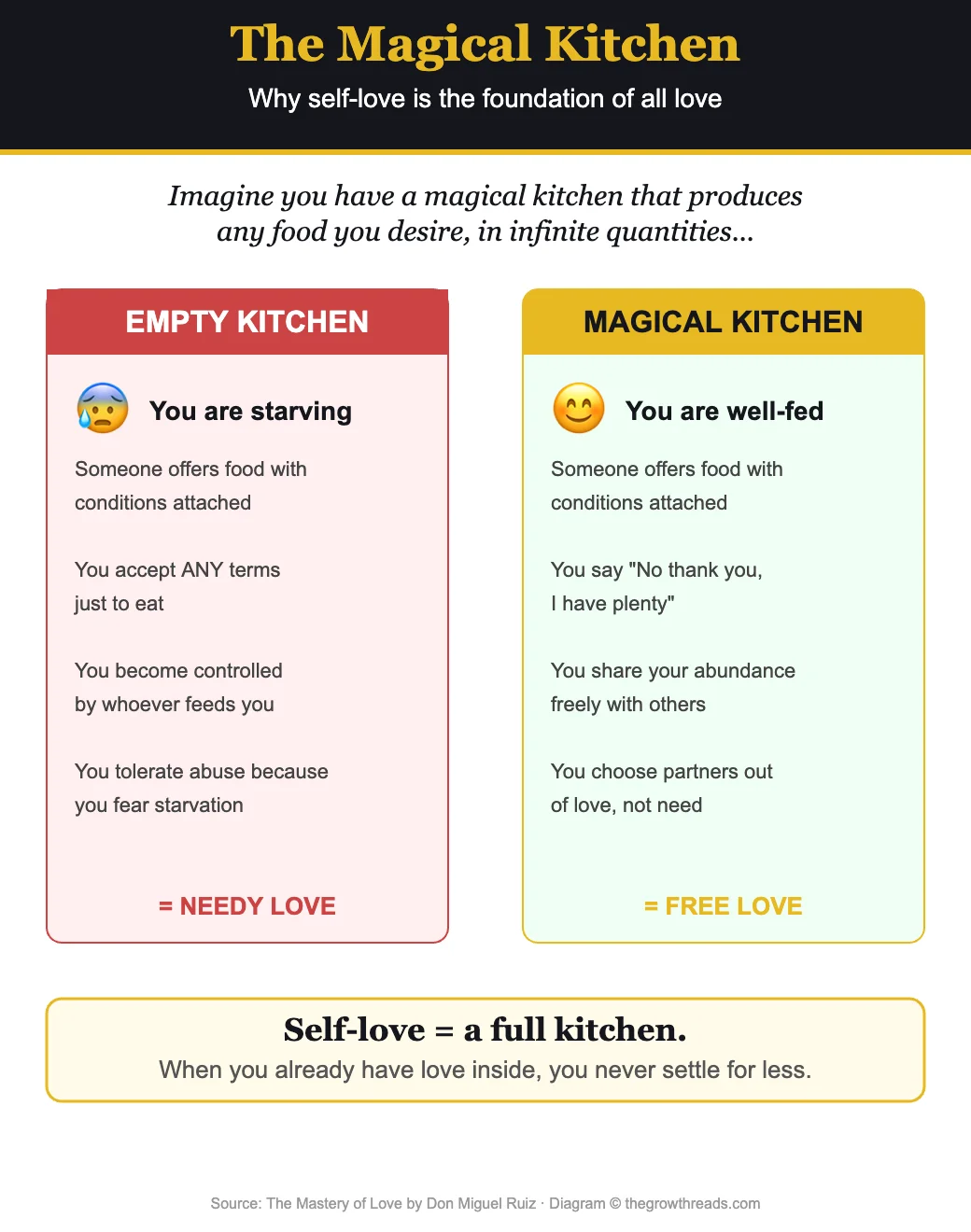
The difference is not subtle. Ruiz illustrates it with the magical kitchen analogy. Imagine you have a kitchen that magically produces unlimited food. You are always full, always satisfied. Now someone knocks on your door and says, “I will give you food — but only if you let me control your life.” You would laugh and say no, because you already have everything you need. But if you were starving? You would accept any terms, no matter how degrading.
Self-love is the magical kitchen. When you already love yourself — when your emotional needs are met from within — you never accept conditional love from others. You never stay in a relationship that diminishes you. And paradoxically, this is when you become capable of truly generous love, because you give from abundance rather than from desperation.
Part 3: The perfect relationship
Ruiz challenges the idea that relationships require sacrifice. The widespread belief — “love means giving up what I want for the other person” — is, in his view, a recipe for resentment. When you sacrifice your authenticity to keep someone happy, you accumulate poison. Eventually that poison erupts as passive aggression, emotional withdrawal, or outright conflict. What looked like selflessness was actually a transaction: “I gave up X, so you owe me Y.”
The alternative is what Ruiz calls the perfect relationship, built on three commitments. First, you keep your half of the relationship clean — you do not dump your emotional poison on your partner. Second, you do not take their emotional reactions personally, because their reactions come from their wounds, not from your worth. Third, you make no assumptions about what they want or feel — you communicate directly and honestly.
These three commitments mirror three of the Four Agreements from Ruiz’s earlier book. But here he applies them specifically to intimate relationships, where the stakes — and the temptation to violate these agreements — are highest. It is easy to be impeccable with your word at work. It is much harder with someone who has access to your deepest insecurities.
Ruiz also addresses sex with refreshing directness. In fear-based relationships, sex becomes a tool of control — a reward, a weapon, or a way to fill an emotional void. In love-based relationships, sex is an expression of genuine energy and pleasure between two people who are already whole. The difference is not in technique; it is in the emotional foundation underneath.
Part 4: The mastery path — healing and freedom
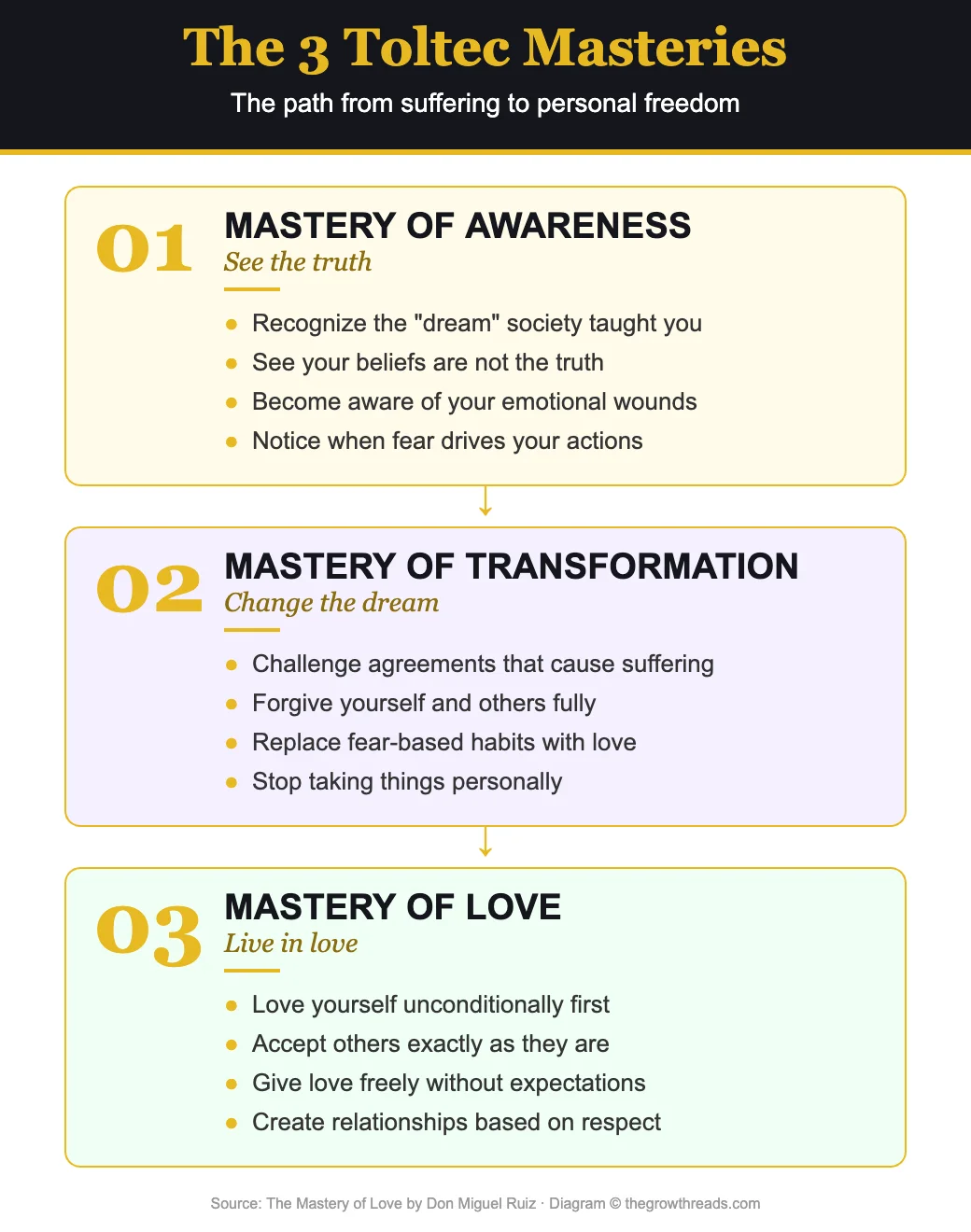
The final section lays out Ruiz’s healing process: the three masteries. The Mastery of Awareness comes first — you learn to see the beliefs, agreements, and wounds that drive your behavior. This is not intellectual understanding; it is visceral recognition in real time. You catch yourself mid-reaction and realize: “This is my wound talking, not reality.”
The Mastery of Transformation follows. Once you can see the pattern, you can change it. Ruiz’s primary tool is forgiveness — what he describes as an emotional surgery. You visualize opening each wound, draining the poison (resentment, blame, self-pity), and allowing the wound to heal cleanly. This is not about condoning what happened; it is about refusing to let the past keep infecting the present.
Finally, The Mastery of Love itself. This is the state where love is no longer an effort. You have healed enough wounds and dissolved enough fear that love becomes your default. You do not have to try to be kind, accepting, or generous — it flows naturally because the emotional poison that blocked it is gone.
Ruiz is honest that this path takes time. It is not a weekend seminar or a single conversation with your partner. It is a practice — daily awareness, daily forgiveness, daily choice to respond from love rather than fear. But he argues that the rewards compound. Each wound you heal removes a source of conflict from all your relationships, not just one. And the freedom you gain is permanent: once you stop needing others to validate your worth, you can never be emotionally controlled again.
Who is The Mastery of Love best for — and who should read something else first?
This book is ideal for people who recognize unhealthy patterns in their relationships — jealousy, control, people-pleasing, or emotional reactivity — and want a philosophical framework for understanding why those patterns exist. It works well as a companion to The Four Agreements or as a standalone introduction to Toltec wisdom applied to love.
If you prefer research-based, step-by-step relationship advice, start with The Seven Principles for Making Marriage Work by John Gottman or Hold Me Tight by Sue Johnson. If you want a deeper dive into attachment patterns specifically, Attached by Amir Levine offers a more clinical framework. Ruiz’s strength is the big-picture shift in perspective — from fear to love — rather than tactical communication scripts.
Questions to reflect on
- Where in your current relationships are you operating from fear rather than love? What would change if you chose love instead?
- What conditions do you attach to the love you give — and what conditions have you accepted from others?
- If your “emotional kitchen” were full, which relationships would you approach differently?
- What emotional wounds from your past are you still projecting onto your partner?
- What would it look like to fully accept someone you love — exactly as they are, without trying to change anything?
🔥 Ready to transform how you love?
The Mastery of Love will change how you see every relationship in your life.
How to apply The Mastery of Love (7-day plan)
- Day 1 — Awareness audit: Spend the day noticing when you act from fear (needing approval, avoiding conflict, suppressing your truth) vs. love (speaking freely, accepting outcomes). Write down three moments in a notebook.
- Day 2 — The kitchen check: Ask yourself: “Am I staying in any relationship or tolerating any behavior because I am afraid of being alone?” Write your honest answer.
- Day 3 — Drop one condition: Identify one condition you place on someone you love (“I will be happy when they…”) and practice accepting them without that condition for the full day.
- Day 4 — Don’t take it personally: When someone says something that triggers you, pause and ask: “Is this about me, or about their own wound?” Respond from curiosity, not reaction.
- Day 5 — Forgiveness surgery: Choose one resentment you carry. Visualize the wound, acknowledge the pain, and consciously decide to release the poison — not for them, but for your own freedom.
- Day 6 — Express love without agenda: Do something kind for someone you love with absolutely no expectation of reciprocity. Notice how it feels to give from fullness.
- Day 7 — Self-love practice: Spend 20 minutes doing something that fills your own “kitchen” — exercise, journaling, time in nature. Commit to making this a daily non-negotiable.
Frequently asked questions
Is The Mastery of Love a sequel to The Four Agreements?
It is a companion book, not a direct sequel. While The Four Agreements provides four general principles for personal freedom, The Mastery of Love applies Toltec wisdom specifically to romantic relationships, family dynamics, and self-love. You do not need to read The Four Agreements first, but readers familiar with it will recognize shared concepts like “don’t take anything personally” and “don’t make assumptions” explored in greater depth here.
What is the magical kitchen story in The Mastery of Love?
The magical kitchen is Ruiz’s central metaphor for self-love. Imagine having a kitchen that produces infinite food — you would never accept food from someone who attached degrading conditions to it. Self-love works the same way: when you are emotionally full, you never accept love that comes with control, manipulation, or abuse. People with “empty kitchens” (low self-love) tolerate toxic relationships because they fear emotional starvation.
How long does it take to read The Mastery of Love?
The book is 152 pages and reads in roughly three hours. Ruiz writes in short, parable-style chapters using simple language and vivid metaphors. Most readers find they can finish it in a single sitting. However, the real time investment is in applying the concepts — the awareness practices and forgiveness exercises may take weeks or months to integrate into daily life and relationships.
What does Don Miguel Ruiz mean by emotional poison?
Emotional poison refers to the negative emotions — fear, anger, jealousy, resentment, and sadness — that accumulate from unhealed emotional wounds. These wounds typically originate in childhood through rejection, punishment, or conditional love. The poison then leaks into adult relationships, causing disproportionate reactions to minor triggers. Ruiz argues that most relationship conflicts are actually two people’s emotional poison colliding, rather than genuine disagreements about the present situation.
Can The Mastery of Love help fix a struggling relationship?
It can provide a powerful perspective shift, but it is not a tactical relationship repair manual. Ruiz’s approach focuses on inner transformation — healing your own wounds and changing your own patterns — rather than on communication techniques or conflict resolution scripts. If your relationship needs immediate practical tools, pair this with a more action-oriented book like The Seven Principles for Making Marriage Work by John Gottman.
What are the three masteries in Toltec wisdom?
The three masteries form a sequential path to personal freedom. The Mastery of Awareness teaches you to see the unconscious beliefs and wounds that drive your behavior. The Mastery of Transformation gives you tools (primarily forgiveness) to change those patterns. The Mastery of Love is the final stage where unconditional love becomes your natural state because the fear and poison that blocked it have been dissolved. Each mastery builds on the previous one.
Is The Mastery of Love religious or spiritual?
It is spiritual but not religious. Ruiz draws from the Toltec tradition — an ancient Mesoamerican philosophical system — but presents the ideas in secular, practical language. There are no prayers, rituals, or deity-specific teachings. The core message (heal your wounds, love yourself, accept others) is compatible with any belief system. Readers from Buddhist, Christian, secular, and therapeutic backgrounds have all found value in the framework without needing to adopt Toltec spirituality.
Related summaries
- The Four Agreements Summary — Ruiz’s foundational work on personal freedom through four life-changing principles.
- Attached Summary — A research-based look at how your attachment style shapes your love life.
- Nonviolent Communication Summary — Practical language tools for compassionate communication in relationships.
- Best Relationship Books — Our curated guide to the most impactful books on love, connection, and communication.
Related Relationships Summaries
Attached Summary & Review: Decode Your Love Patterns With Science
His Needs, Her Needs Summary & Review: Affair-Proof Your Marriage
How to Know a Person Summary & Review: The Art of Truly Seeing Others
Mating in Captivity Summary & Review: How to Keep Desire Alive in Love
Untamed Summary & Review: Stop Pleasing and Start Living as Your Truest Self