

⭐⭐⭐⭐✬ 4.3/5
| Actionability: | ⭐⭐⭐⭐⭐ 5/5 |
| Writing Quality: | ⭐⭐⭐⭐ 4/5 |
| Research Depth: | ⭐⭐⭐✬ 3.5/5 |
| Accessibility: | ⭐⭐⭐⭐⭐ 5/5 |
| Lasting Impact: | ⭐⭐⭐⭐ 4/5 |
A practical, science-backed guide to cold exposure, breathwork, and mindset — the method that turned a Dutch daredevil into a global health phenomenon and challenged medical orthodoxy along the way.
Best for: Biohackers, athletes, stress-management seekers, and anyone curious about using cold and breath to improve energy, immune function, and mental resilience.
Reading time: ~5 hours (232 pages) | Difficulty to apply: Low — the breathing technique takes 15 minutes; cold showers start at 30 seconds. Consistency is the challenge, not complexity. Not medical advice — consult a doctor before starting, especially with cardiovascular conditions.
The Wim Hof Method in one minute
You have far more control over your body than modern medicine believed possible. Wim Hof — nicknamed “The Iceman” for feats like climbing Mount Kilimanjaro in shorts and running a half-marathon barefoot above the Arctic Circle — distills his approach into three pillars: breathing, cold exposure, and commitment. The breathing technique (controlled hyperventilation followed by breath retention) alkalizes your blood, triggers adrenaline release, and appears to give practitioners voluntary influence over their innate immune system — something scientists previously thought impossible. Cold exposure activates brown fat, strengthens the cardiovascular system, and builds the kind of stress resilience that carries over into every area of life. The commitment pillar is the glue: the willingness to override your body’s comfort signals, day after day, until the practice becomes identity. Backed by a landmark 2014 Radboud University study, the method has gone from fringe curiosity to mainstream health practice adopted by athletes, military operators, and millions of everyday people.
Key takeaways
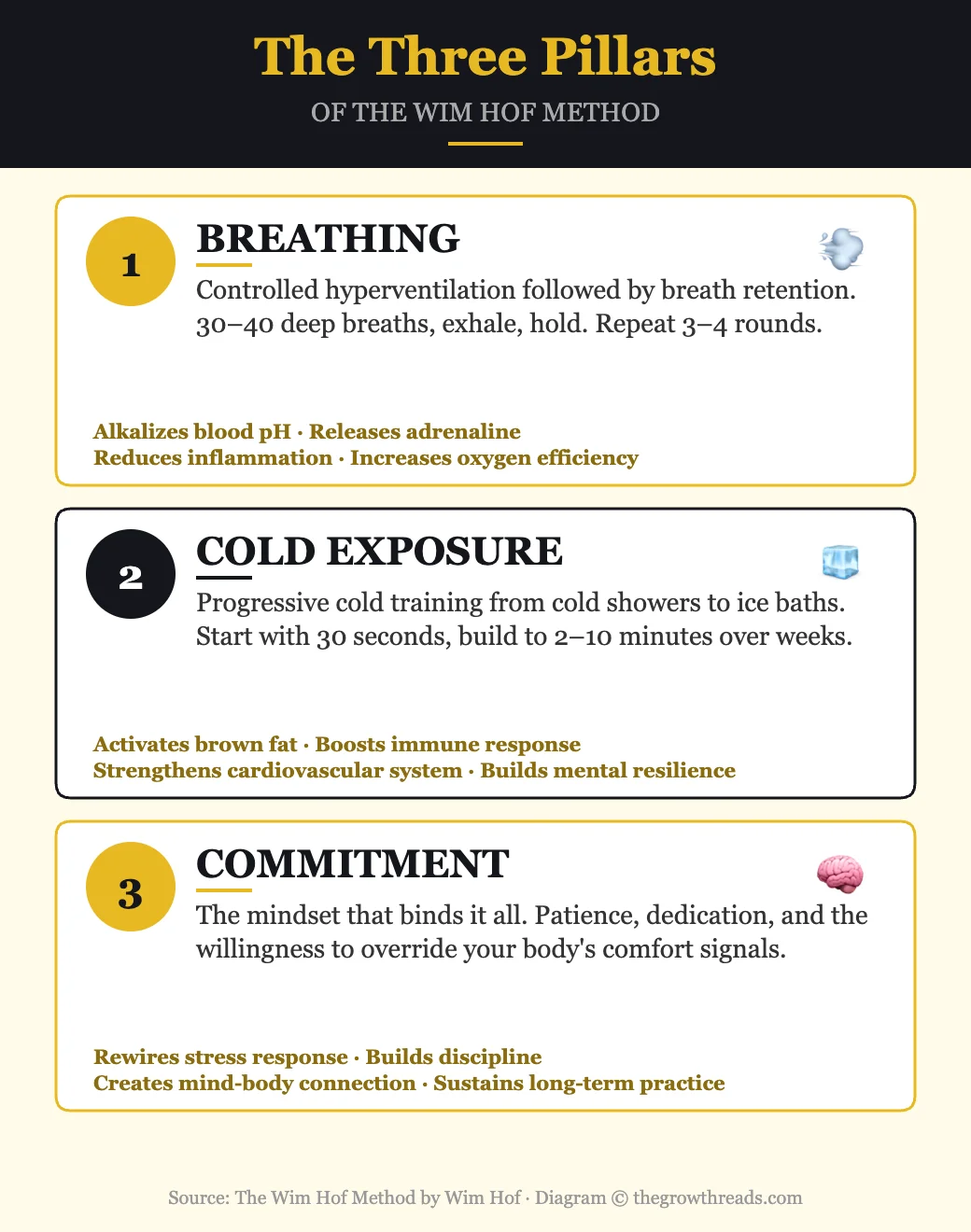
- Three pillars form the method: breathing (controlled hyperventilation + retention), cold exposure (progressive training from cold showers to ice baths), and commitment (the mindset discipline that makes the other two stick).
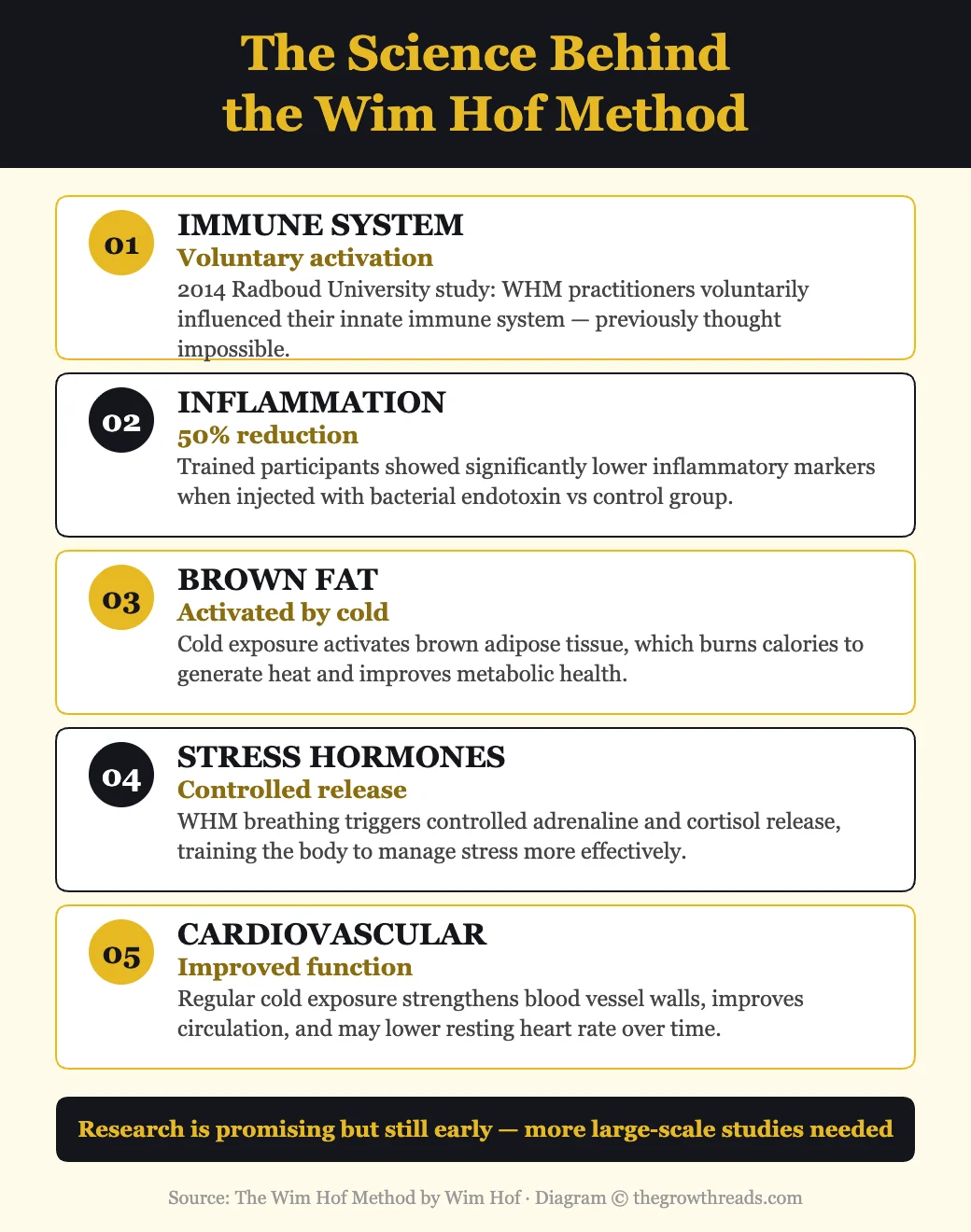
- You can influence your immune system voluntarily: a 2014 study at Radboud University showed that WHM-trained participants could voluntarily suppress their innate immune response to bacterial endotoxin — reducing inflammation markers by roughly 50% compared to the control group.
- Cold is a teacher, not a punishment: cold exposure activates brown adipose tissue (which burns calories for heat), strengthens blood vessel walls, releases endorphins, and trains your nervous system to handle stress without panic.
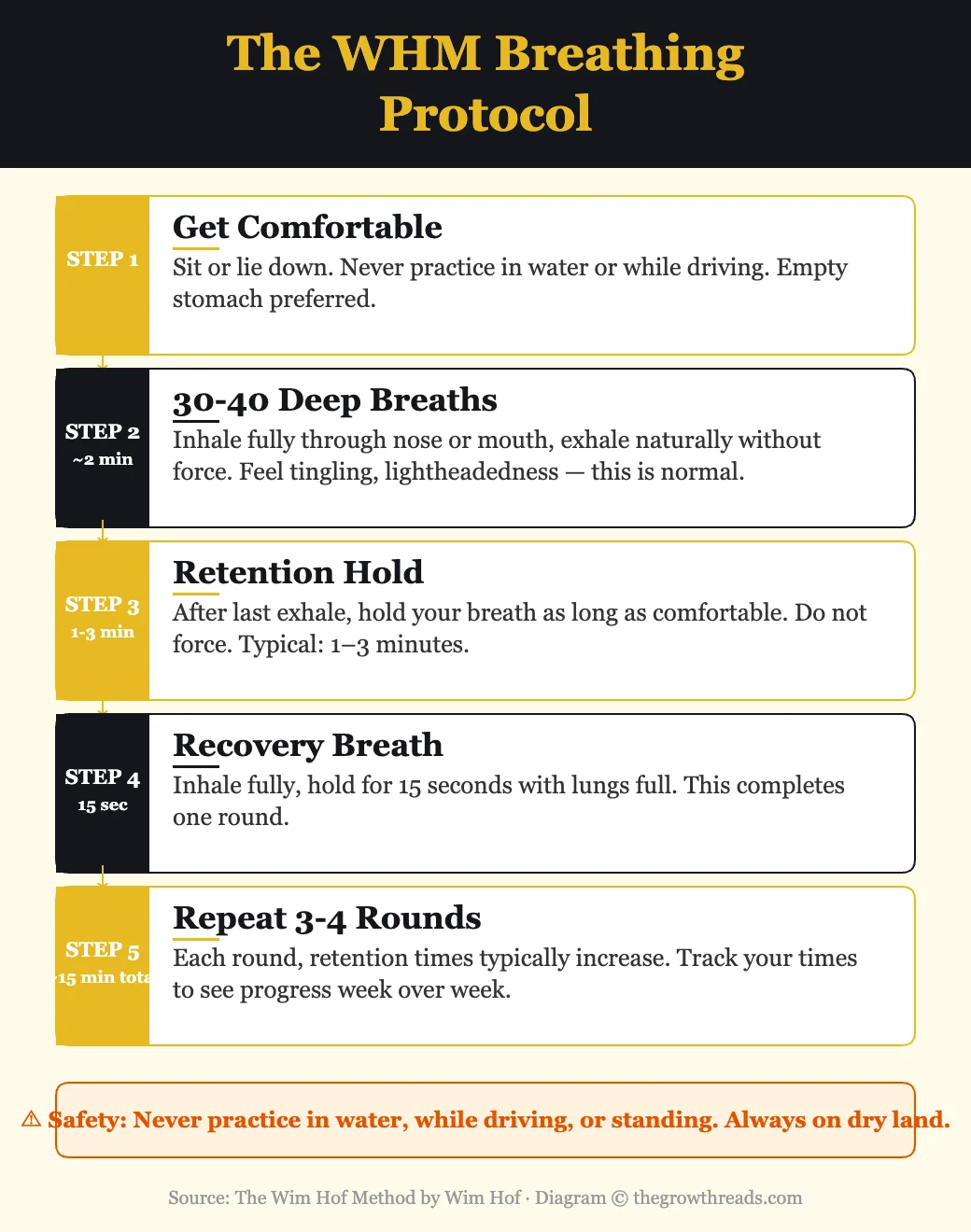
- The breathing technique is precise and powerful: 30–40 deep breaths (full inhale, passive exhale), then exhale and hold for as long as comfortable, then a recovery breath held for 15 seconds. Three to four rounds. Total time: about 15 minutes.
- Start small and progress gradually: begin cold showers at 30 seconds and add 15 seconds per week. Begin breathing with two rounds and add a third when comfortable. The method rewards patience, not heroics.
- Mindset transforms physiology: Hof argues that the commitment pillar is what separates a breathing exercise from a transformative practice. The willingness to lean into discomfort rewires your stress response over time.
- Safety is non-negotiable: never practice the breathing technique in water, while driving, or standing up. The breath holds can cause fainting. Always practice on dry land in a safe position.
- Cold and breath work synergistically: doing the breathing protocol before cold exposure prepares the body by releasing adrenaline and warming the core, making the cold more tolerable and the benefits more pronounced.
- The science is promising but early: the Radboud study is rigorous but small (24 participants). Larger studies are underway. The method appears to have real physiological effects, but more research is needed to fully understand mechanisms and long-term outcomes.
- Consistency beats intensity: a daily cold shower and 15-minute breathing session delivers more benefit than an occasional ice bath marathon. The method works through cumulative adaptation, not single heroic efforts.
What is The Wim Hof Method about?
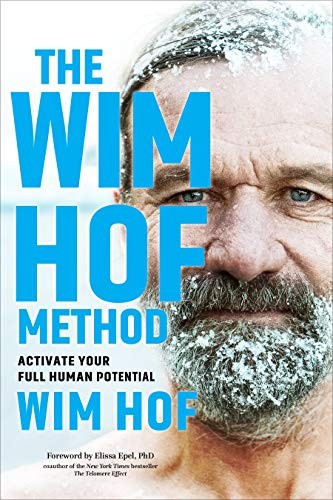
The Wim Hof Method is a health and performance book by Dutch extreme athlete Wim Hof that teaches a three-pillar system — breathwork, cold exposure, and mindset commitment — designed to strengthen the immune system, reduce inflammation, increase energy, and build mental resilience. Backed by scientific research from Radboud University, it provides step-by-step protocols anyone can follow at home.
About the author
Wim Hof, born in 1959 in the Netherlands, holds 26 world records related to cold endurance, including the longest ice bath (nearly two hours), climbing Mount Kilimanjaro in shorts, and running a half-marathon barefoot above the Arctic Circle. After the tragic loss of his wife to suicide in 1995, Hof found solace and purpose in extreme cold, developing the breathing and exposure techniques that now bear his name. He has been the subject of multiple peer-reviewed studies and has trained thousands of practitioners worldwide through workshops, online courses, and this book. Explore all Wim Hof, book summaries →
Key concepts at a glance
| Concept | What it means | Use it when |
|---|---|---|
| WHM Breathing | 30–40 deep breaths followed by breath retention and recovery breath, 3–4 rounds | Morning routine, before cold exposure, or during stress |
| Cold Exposure | Progressive cold training from showers (30 sec) to ice baths (2–10 min) | After breathing practice, daily for adaptation |
| Brown Fat Activation | Cold triggers metabolically active fat tissue that generates heat and burns calories | Improving metabolism and cold tolerance |
| Innate Immune Modulation | Voluntary influence over the innate immune response via breathing and cold | Reducing inflammation and building immune resilience |
| Adrenaline Control | WHM breathing triggers controlled epinephrine release, training stress response | Managing anxiety, improving performance under pressure |
| Hormetic Stress | Small, controlled doses of stress (cold, breath holds) that strengthen the body | Building resilience without overtraining |
| Commitment Pillar | The mindset discipline of consistent daily practice despite discomfort | Sustaining the method long-term |
Part 1: The breathing pillar — controlled hyperventilation and its effects
The WHM breathing technique is deceptively simple but physiologically profound. You take 30 to 40 deep breaths — inhaling fully through the nose or mouth, exhaling passively without force — then exhale and hold your breath for as long as comfortable. After the retention, you take one deep recovery breath and hold it for 15 seconds. This completes one round; the protocol calls for three to four rounds, totaling about 15 minutes.
What happens in the body is remarkable. The rapid deep breathing “blows off” carbon dioxide, raising blood pH (making it more alkaline). This triggers a cascade of effects: tingling in the extremities, lightheadedness, and — critically — a controlled release of adrenaline (epinephrine). The breath retention that follows creates a temporary oxygen deficit that the body responds to by releasing more red blood cells and optimizing oxygen delivery to tissues.
The 2014 Radboud University study demonstrated that this sequence gives practitioners measurable influence over their innate immune system. When injected with bacterial endotoxin (a component of E. coli that normally triggers flu-like symptoms), WHM-trained participants produced more adrenaline, fewer pro-inflammatory cytokines, and reported significantly fewer symptoms compared to the control group. The study’s lead author, Matthijs Kox, called the results “remarkable” — the first scientific evidence that the autonomic nervous system and innate immune response could be voluntarily influenced.
Part 2: Cold exposure — the ice as teacher
The second pillar is progressive cold exposure, starting with cold showers and potentially advancing to ice baths. Hof recommends beginning with just 30 seconds of cold water at the end of a regular shower, adding 15 seconds per week until you reach two minutes. For those who want to go further, ice baths (water at 0–5°C) for two to ten minutes represent the advanced practice.
The physiology of cold exposure is well-documented beyond Hof’s own research. When cold water hits the skin, blood vessels constrict (vasoconstriction), redirecting blood to the core to protect vital organs. When you rewarm, vessels dilate (vasodilation), flushing fresh, oxygen-rich blood through the tissues. This vascular “pumping” is essentially a workout for your blood vessels, strengthening their walls and improving overall cardiovascular function over time.
Cold also activates brown adipose tissue — a metabolically active type of fat whose primary function is to generate heat. Unlike white fat (which stores energy), brown fat burns calories. Regular cold exposure increases both the quantity and activity of brown fat, which may contribute to improved metabolism and body composition. Research from Maastricht University has shown that even mild cold exposure (16°C for six hours) significantly increases brown fat activity in healthy adults.
Perhaps most importantly, cold exposure builds what Hof calls “stress inoculation.” By voluntarily placing yourself in a stressful situation (cold water) and learning to stay calm through breathing and mental focus, you train your nervous system to handle stress without panic. This transfers directly to other stressful situations — a difficult conversation, a high-pressure presentation, an unexpected crisis. The cold becomes a daily laboratory for practicing composure under pressure.
Part 3: Commitment and the mind-body connection
The third pillar — commitment — is the one Hof says most practitioners underestimate. The breathing is not difficult. The cold is uncomfortable but manageable. What separates people who transform their health from people who try it once and quit is the daily discipline of showing up when they don’t feel like it. Hof frames this not as willpower but as a relationship with your own body: you are learning to listen to its signals, override its comfort preferences, and gradually expand what it considers “normal.”
Hof shares his personal story as the embodiment of this pillar. After his wife’s suicide in 1995, he was left as a single father of four children, overwhelmed by grief and searching for meaning. He found it in the cold — immersing himself in frozen canals and snow, discovering that the extreme sensation quieted his mind and gave him a sense of control in an uncontrollable world. The practice became daily, then lifelong. His extraordinary feats (the Kilimanjaro climb, the Arctic half-marathon, the ice bath records) were not goals in themselves but natural extensions of a committed daily practice.
The commitment pillar also encompasses the intention you bring to the breathing and cold. Hof emphasizes that the method is not about suffering or punishment — it is about curiosity and connection. When you step into a cold shower, you are not fighting the water. You are observing your body’s response, breathing through the initial shock, and discovering that you are capable of more than you believed. Each session is a small proof of your own resilience, and those proofs compound over time into genuine confidence and physiological adaptation.
Who is The Wim Hof Method best for — and who should read something else first?
This book is ideal for anyone curious about using breath and cold to improve their energy, immune function, and stress resilience. It is especially valuable for people who feel chronically tired, inflamed, or stuck in a stress cycle and want a simple daily practice that produces noticeable physical results within weeks. Athletes, biohackers, and cold-curious beginners will all find practical protocols they can start immediately.
If you have cardiovascular conditions, epilepsy, or are pregnant, consult a doctor before starting. If you want a deeper scientific understanding of how breathing affects the body before diving into the WHM protocol, read Breath by James Nestor first. If you are more interested in sleep optimization as your entry point to health, start with Why We Sleep by Matthew Walker.
Questions to reflect on
- When was the last time you deliberately placed yourself in a physically uncomfortable situation — and what did it teach you about your own resilience?
- How does your body typically respond to stress? Do you fight, flee, freeze, or breathe?
- If you practiced 15 minutes of breathing and 30 seconds of cold every morning for 30 days, what do you think would change — and what excuses are preventing you from finding out?
- What is the relationship between physical discomfort and mental growth in your own experience?
- How much of your daily energy is consumed by your body’s response to stress — and what would you do with that energy if you reclaimed it?
🔥 Ready to unlock your body’s hidden potential?
The Wim Hof Method gives you a simple daily practice that builds immune strength, energy, and mental resilience — backed by science.
How to apply The Wim Hof Method (7-day plan)
- Day 1 — First breathing session: Find a comfortable seated position. Do 30 deep breaths (full inhale, passive exhale), then exhale and hold for as long as comfortable. Recovery breath: inhale fully, hold 15 seconds. Do 2 rounds. Total time: ~10 minutes.
- Day 2 — First cold shower: At the end of your regular shower, turn the water to cold for 30 seconds. Focus on slow, deep exhales. Notice: the shock passes within 10 seconds.
- Day 3 — Combine breathing + cold: Do your 2 rounds of breathing first, then take your cold shower. Notice whether the breathing makes the cold more manageable.
- Day 4 — Add a third round: Extend to 3 rounds of breathing. Track your breath-hold times — they will likely increase from Day 1. Maintain 30 seconds cold.
- Day 5 — Extend the cold to 45 seconds: Add 15 seconds to your cold shower. Focus on relaxing your shoulders and jaw — tension wastes energy.
- Day 6 — Journal your experience: Write down how you feel physically and mentally after the morning practice compared to days without it. Note energy, mood, and stress levels.
- Day 7 — Commit to 30 days: You now have the basic protocol. Decide to continue for 30 days — adding 15 seconds of cold per week. Mark it on your calendar. Consistency is the method.
Frequently asked questions
Is the Wim Hof Method scientifically proven?
The most significant study was conducted at Radboud University Medical Centre in 2014. Researchers found that WHM-trained participants could voluntarily influence their innate immune response, producing more adrenaline and fewer pro-inflammatory cytokines when exposed to bacterial endotoxin. This was the first scientific evidence that the autonomic nervous system and immune response could be voluntarily influenced. However, the study involved only 24 participants, and while the results were statistically significant, larger studies are needed to confirm long-term effects and broader applications.
Is the Wim Hof Method safe?
The method is generally safe for healthy adults when practiced correctly, but there are critical safety rules. Never practice the breathing technique in water (pools, bathtubs, or open water) — the breath holds can cause fainting, which is fatal underwater. Never practice while driving or standing up. People with cardiovascular conditions, epilepsy, high or low blood pressure, or who are pregnant should consult a doctor before starting. Start cold exposure gradually (30 seconds of cold shower, not ice baths) and progress slowly.
How long does a WHM breathing session take?
A typical session of three to four rounds takes about 15 minutes. Each round consists of 30–40 deep breaths (about 60–90 seconds), a breath retention hold (typically 1–3 minutes as you improve), and a 15-second recovery hold. Most practitioners do the breathing first thing in the morning on an empty stomach. Beginners can start with two rounds (~10 minutes) and add rounds as they become comfortable with the sensations.
How cold should the water be for cold exposure?
For beginners, Hof recommends ending a regular warm shower with 30 seconds of the coldest water your tap provides (typically 10–15°C depending on your location and season). There is no need for ice baths initially. As you adapt over weeks, increase the cold duration by 15 seconds per week, working toward two minutes. Advanced practitioners may use ice baths (0–5°C) for two to ten minutes, but this is not necessary to receive benefits. The key is consistency — a daily 30-second cold shower is more valuable than an occasional dramatic ice bath.
What are the benefits of the Wim Hof Method?
Reported benefits (supported by varying levels of scientific evidence) include reduced inflammation, improved immune function, increased energy, better stress management, improved cardiovascular health, activated brown fat metabolism, enhanced focus and mental clarity, improved mood, and better cold tolerance. The immune modulation and adrenaline control have the strongest scientific support from the 2014 Radboud study. Many other benefits are based on preliminary research, practitioner reports, and physiological mechanisms that are well-established but not yet specifically validated in WHM clinical trials.
Can the Wim Hof Method help with anxiety and depression?
Many practitioners report significant improvements in anxiety and mood, and there are plausible physiological mechanisms: the breathing technique triggers controlled adrenaline release (which can build stress resilience over time), cold exposure triggers endorphins and norepinephrine (both mood-elevating neurotransmitters), and the daily discipline of completing a challenging practice builds confidence and self-efficacy. However, there are no large-scale clinical trials specifically testing WHM for anxiety or depression, and the method should complement — not replace — professional mental health treatment.
How is the Wim Hof Method different from other breathwork practices?
WHM breathing combines elements found in several traditions — the hyperventilation phase resembles Tummo (Tibetan Buddhist inner-heat meditation) and certain pranayama techniques, while the breath retention shares similarities with freediving training. What distinguishes WHM is the specific combination of hyperventilation plus retention plus cold exposure, the scientific validation (the Radboud study), and the structured progression from beginner to advanced. Other breathwork modalities like holotropic breathwork focus on emotional release, while box breathing focuses on calm. WHM is unique in targeting the immune system and cold tolerance alongside the mental and emotional benefits.
Related summaries
- Breath — James Nestor’s deep investigation into the science of breathing and its impact on health, performance, and longevity.
- The Comfort Crisis — Michael Easter’s argument for reintroducing beneficial stressors (cold, hunger, exertion) into modern life.
- Outlive — Peter Attia’s comprehensive guide to the science of longevity, covering exercise, nutrition, sleep, and emotional health.
- Best Health Books — Our complete curated list of the most impactful health and wellness books.
Related Health Summaries
Ikigai Summary & Review: The Japanese Secret to a Long and Happy Life
Super Human Summary & Review: The Biohacker`s Guide to Aging Backwards
The Body Summary & Review: A Guide to the Most Extraordinary Machine in Existence
The China Study Summary & Review: The Case for Plant-Based Eating
Why Zebras Don’t Get Ulcers Summary & Review: The Biology Behind Chronic Stress