

⭐⭐⭐⭐✬ 4.5/5
| Actionability: | ⭐⭐⭐⭐ 4/5 |
| Writing Quality: | ⭐⭐⭐⭐✬ 4.5/5 |
| Research Depth: | ⭐⭐⭐⭐⭐ 5/5 |
| Accessibility: | ⭐⭐⭐⭐ 4/5 |
| Lasting Impact: | ⭐⭐⭐⭐⭐ 5/5 |
The book that taught Warren Buffett to buy outstanding companies — and hold them for decades. A masterclass in qualitative investing that is as relevant today as when it was written in 1958.
Best for: Long-term investors, stock pickers, and anyone who wants to move beyond spreadsheets and learn how to evaluate business quality, management integrity, and growth potential.
Reading time: ~6 hours (320 pages) | Difficulty to apply: Moderate to high — the principles are clear, but the “scuttlebutt” research method requires genuine effort and practice.
Common Stocks and Uncommon Profits in one minute
The best investments come from buying outstanding companies at reasonable prices — and then holding them for years. Philip Fisher, one of the most influential investors of the twentieth century, pioneered the growth stock philosophy in 1958 with a framework that flipped conventional investing wisdom on its head. While Benjamin Graham taught investors to hunt for statistical bargains, Fisher argued that the real money was made by identifying companies with superior management, strong research and development, and the potential for years of above-average growth. His 15-point qualitative checklist — powered by a research method he called “scuttlebutt” (talking to customers, competitors, suppliers, and employees) — became the foundation for quality investing. Warren Buffett has said he is “85% Graham and 15% Fisher,” and that 15% has driven his greatest investments: Coca-Cola, Apple, and See’s Candies were all Fisher-style quality buys held for decades.
Key takeaways
- Buy outstanding companies: the best investments are in companies with superior products, strong management, and the potential for years of above-average revenue growth — not in statistical bargains with limited upside.
- Use the scuttlebutt method: before investing, talk to customers, competitors, suppliers, former employees, and industry experts to build a qualitative picture of the business that financial statements alone cannot reveal.
- Management integrity matters most: Fisher argues that honest, capable management is the single most important factor in long-term investment success — more important than any financial ratio.
- Hold great companies for years: the biggest profits come from buying right and sitting tight. Selling a well-chosen growth stock because of short-term price movements is one of the most costly mistakes an investor can make.
- There are only three reasons to sell: the original analysis was wrong, the company no longer meets your criteria, or a clearly superior opportunity exists. Never sell because of price fluctuations or macroeconomic forecasts.
- R&D spending signals the future: companies that invest consistently in research and development create the products and services that will drive tomorrow’s revenue — underspending is a red flag.
- Profit margins must be protected: a company with great revenue growth but shrinking margins will eventually disappoint. Look for businesses that actively work to maintain and improve margins.
- Concentrate your portfolio: Fisher recommends owning 10–20 stocks at most, with the largest positions in your highest-conviction ideas. Over-diversification dilutes returns and makes it impossible to know your holdings well.
- Ignore market timing: trying to predict short-term market movements is futile and distracting. The right time to buy an outstanding company is when you find one, provided your research is thorough.
- Conservative investors sleep well: Fisher defines “conservative” not as avoiding risk, but as owning companies with such strong competitive positions and capable management that the risk of permanent loss is genuinely low.
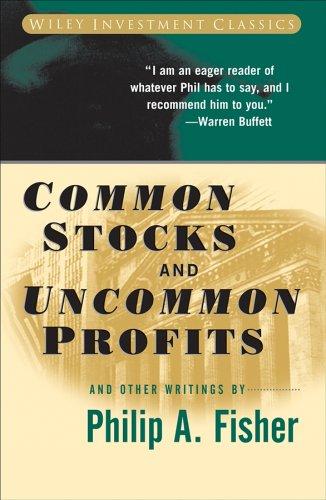
What is Common Stocks and Uncommon Profits about?
Common Stocks and Uncommon Profits is an investing book by Philip Fisher that introduces a qualitative, growth-oriented approach to stock selection. Published in 1958, it outlines Fisher’s 15-point framework for evaluating companies based on management quality, growth potential, and competitive advantages — and his famous “scuttlebutt” research method of gathering intelligence through firsthand conversations.
About the author
Philip A. Fisher founded Fisher & Company, an investment counseling firm, in 1931 and ran it for nearly seven decades until his retirement in 1999 at the age of 91. He was a pioneer of growth stock investing and one of the first investors to systematically analyze qualitative factors like management quality and corporate culture. His client list included some of the wealthiest families in the United States. Warren Buffett has cited Fisher as one of his two primary influences (alongside Benjamin Graham), and Fisher’s son Kenneth went on to become a prominent investor and Forbes columnist in his own right. Explore all Philip A. Fisher book summaries →
Key concepts at a glance
| Concept | What it means | Use it when |
|---|---|---|
| Scuttlebutt Method | Gathering qualitative intelligence by talking to customers, competitors, suppliers, and employees | Researching a potential stock purchase |
| 15-Point Checklist | A qualitative framework evaluating growth, management, margins, R&D, and competitive position | Screening and evaluating individual stocks |
| Growth Stock Investing | Buying companies with above-average potential for long-term revenue and earnings growth | Building a long-term equity portfolio |
| Conservative Investing | Owning high-quality companies with strong moats — not avoiding stocks altogether | Reducing risk without sacrificing returns |
| Concentrated Portfolio | Holding 10–20 stocks with heavy weighting in highest-conviction positions | Maximizing returns on your best ideas |
| Three Reasons to Sell | Sell only if: analysis was wrong, company deteriorated, or a clearly better opportunity exists | Making sell decisions rationally |
| Management Integrity | Honest, shareholder-aligned management as the most critical qualitative factor | Evaluating leadership before investing |
Part 1: What to buy — the 15-point framework
The heart of Common Stocks and Uncommon Profits is Fisher’s 15-point checklist for evaluating a potential investment. Unlike Benjamin Graham’s approach, which relied primarily on financial statements and statistical measures, Fisher’s framework is overwhelmingly qualitative. He believed that the factors most likely to determine a company’s long-term success — management quality, competitive position, research pipeline, corporate culture — could not be found in balance sheets.
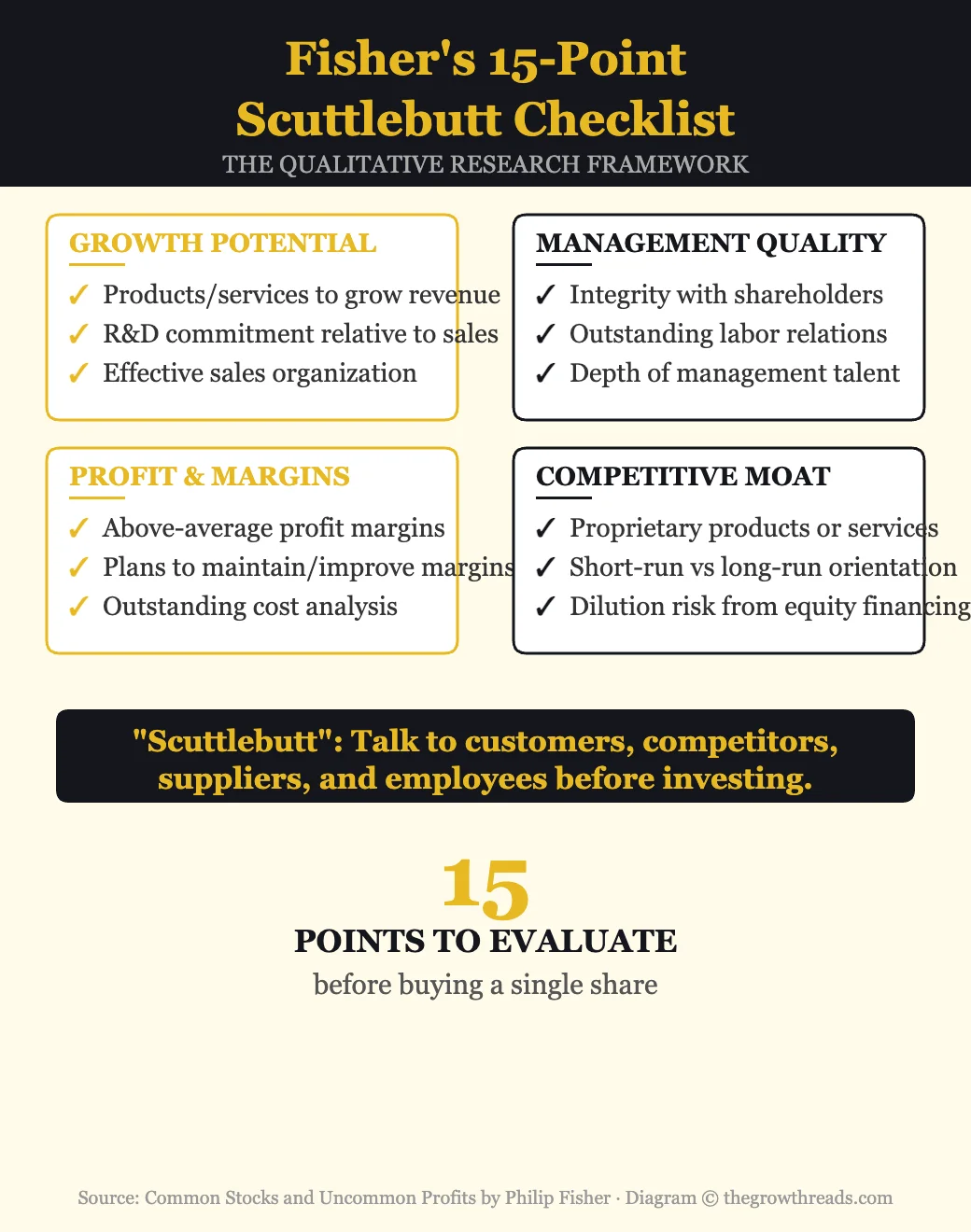
The checklist covers five broad areas. First, growth potential: does the company have products or services with sufficient market potential to make a sizable increase in sales for at least several years? Is management committed to developing new products and markets when current growth opportunities are exhausted? Second, profitability: are profit margins adequate? What is the company doing to maintain or improve them? Does the company have outstanding cost analysis and accounting controls?
Third, management quality: does the management have unquestionable integrity? Does it communicate openly with shareholders when things go badly, not just when things go well? Is there depth of management talent — is the CEO building a team, or is everything dependent on one person? Fourth, competitive position: does the company have proprietary products, technology, or services that give it a genuine edge? Is the company a low-cost producer, or does it compete on differentiation? Fifth, labor and personnel relations: does the company have outstanding relations with its employees? Is turnover low? Does it create genuine opportunities for advancement?
Fisher insisted that most of this information could not be found in annual reports or analyst research. It required what he called the “scuttlebutt” method — systematically talking to people who had direct experience with the company. A competitor would tell you things about a company’s products that no press release would reveal. A supplier would tell you whether the company paid on time and treated vendors fairly. A former employee would reveal the true state of corporate culture. This kind of on-the-ground intelligence, Fisher argued, was the real edge in investing.
Part 2: When to buy, hold, and sell
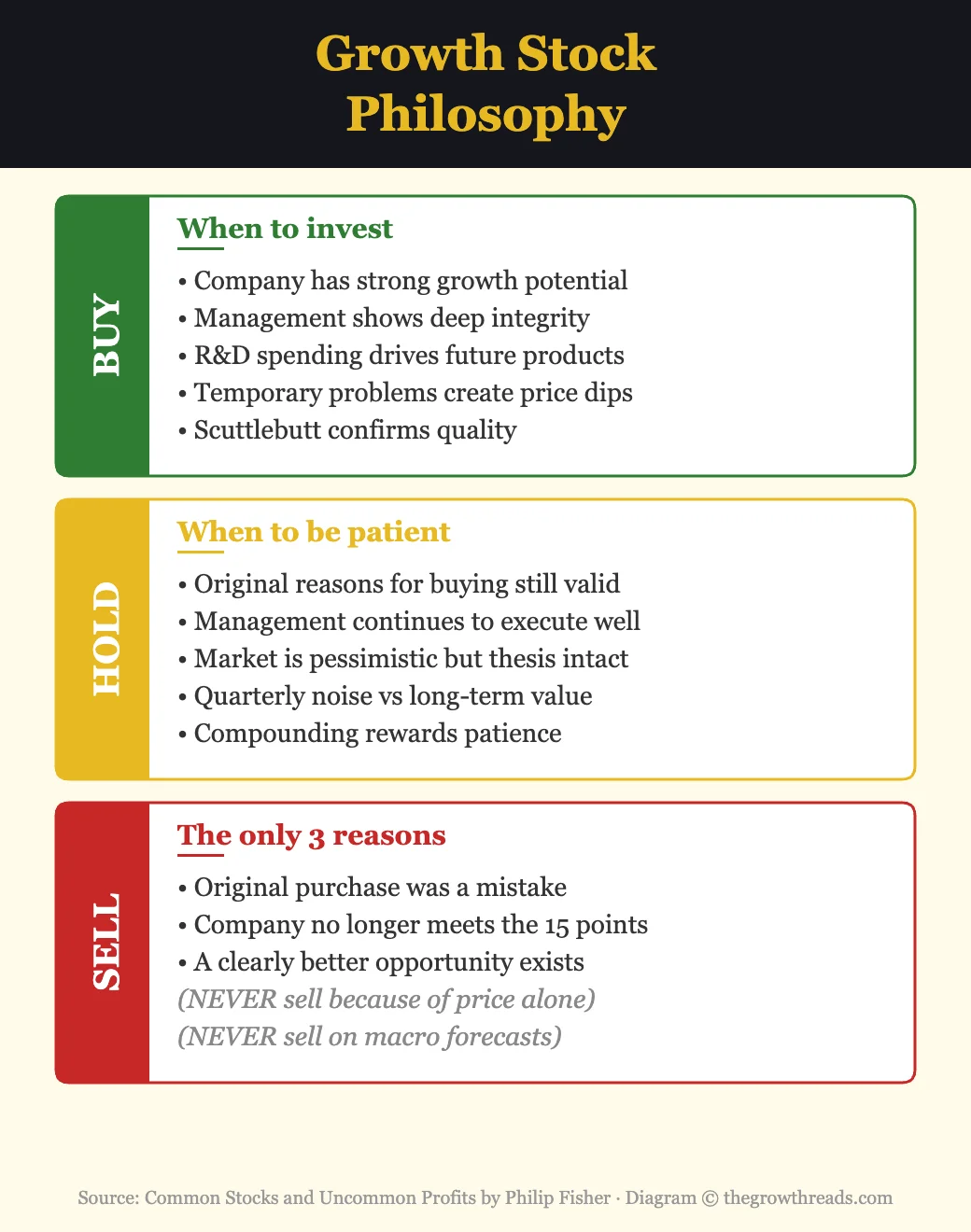
Fisher’s advice on timing is strikingly contrarian. He argues that trying to time the market — buying at bottoms and selling at tops — is a fool’s errand that has cost investors far more money than any bear market. The right time to buy an outstanding company, Fisher says, is when your research tells you the company meets your criteria and the price is reasonable relative to its long-term potential. Waiting for a pullback that may never come means missing years of compounding.
On buying, Fisher identifies two ideal moments. The first is when a company is early in a growth phase that the market has not yet fully recognized — this is where the biggest long-term gains are found. The second is when a truly outstanding company experiences a temporary setback that causes its stock price to drop, but the underlying business strength remains intact. He distinguishes sharply between temporary problems (a product delay, a bad quarter) and permanent deterioration (loss of competitive advantage, management decay).
On holding, Fisher is emphatic: the greatest profits come from buying right and sitting tight. He tells the story of Motorola, which he bought in 1955 and held for decades through multiple market crashes, product cycles, and periods of Wall Street indifference. The stock multiplied many times over. Had he sold during any of the downturns — each of which had plausible justifications — he would have missed the compounding that created real wealth.
On selling, Fisher identifies exactly three legitimate reasons. First, the original analysis was wrong — you bought a company that did not actually meet your criteria, and you now see that clearly. Second, the company has changed and no longer meets your standards — management has deteriorated, competitive position has eroded, or growth has permanently slowed. Third, a clearly superior opportunity exists and you need capital to pursue it. Selling for any other reason — because the market dropped, because the economy looks shaky, because the stock ran up fast — is almost always a mistake.
Part 3: Fisher vs Graham and the evolution of value investing
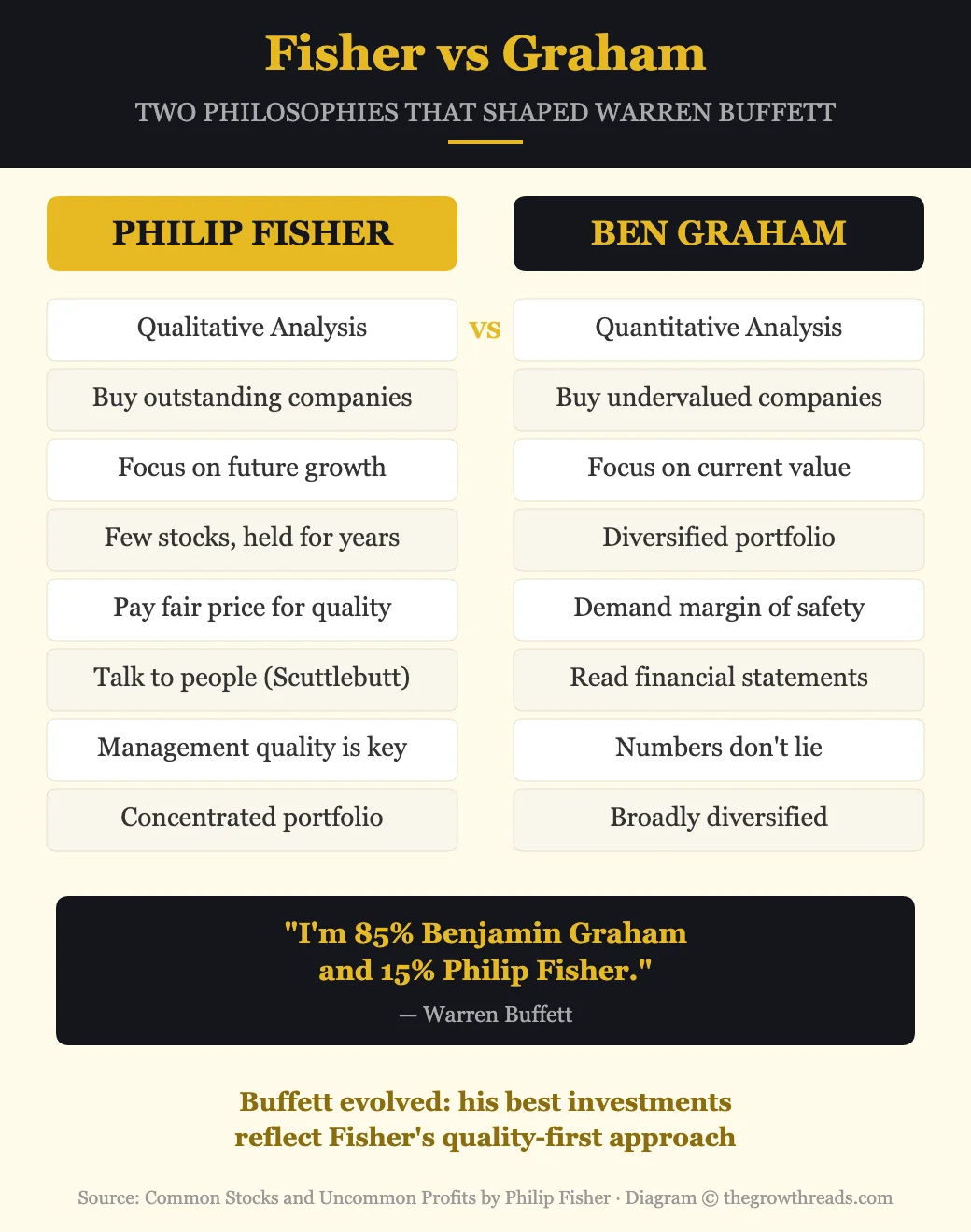
One of the most illuminating aspects of Common Stocks and Uncommon Profits is how sharply it contrasts with the dominant investment philosophy of its era — Benjamin Graham’s value investing. Graham, author of The Intelligent Investor, taught investors to buy statistically cheap stocks: companies trading below their net asset value, with low price-to-earnings ratios, and a “margin of safety” that protected against permanent loss. Graham treated investing as a quantitative exercise — you analyzed the numbers, bought the bargains, and diversified broadly.
Fisher’s approach was almost exactly opposite. Where Graham focused on quantitative metrics, Fisher emphasized qualitative judgment. Where Graham sought bargains, Fisher sought quality. Where Graham diversified into fifty or more positions, Fisher concentrated into ten or twenty. Where Graham looked at the present balance sheet, Fisher looked at the future growth trajectory. Where Graham relied on public financial data, Fisher relied on private conversations and firsthand research.
The most famous synthesis of these two approaches belongs to Warren Buffett, who studied under Graham at Columbia but was profoundly influenced by Fisher after reading Common Stocks and Uncommon Profits. Buffett’s early career reflected Graham’s statistical approach — he bought “cigar butt” stocks that had one last puff of value. But his greatest investments — Coca-Cola, American Express, Apple — were Fisher-style quality investments: outstanding companies with durable competitive advantages, purchased at reasonable (not bargain) prices and held for decades. As Buffett’s partner Charlie Munger has said, Buffett “evolved from pure Graham to Fisher-influenced quality” because the best returns come from great businesses, not cheap stocks.
Part 4: Conservative investing and the long view
Fisher devotes the final sections to redefining what it means to be a “conservative” investor. In conventional wisdom, conservative investing means avoiding stocks, buying bonds, and prioritizing capital preservation. Fisher argues this is exactly backwards. Over decades, inflation erodes the purchasing power of bonds and cash. The truly conservative investor owns outstanding businesses whose earnings power grows faster than inflation — companies so well-managed and competitively entrenched that the risk of permanent capital loss is genuinely small.
Fisher identifies four dimensions of a truly conservative investment. First, the company must have a low cost of production relative to its industry — this ensures survival and profitability even during downturns. Second, it must have outstanding management with the ability and willingness to develop new products and markets. Third, it must have a durable competitive advantage — something proprietary that competitors cannot easily replicate. Fourth, it must have the financial strength to fund its growth without excessive dilution of existing shareholders.
This framework was revolutionary in 1958 and remains relevant today. Fisher essentially described what Warren Buffett later called an “economic moat” — a sustainable competitive advantage that protects a company’s profits over long periods. Fisher was thinking in terms of moats before the term existed in investing vocabulary. His emphasis on quality over cheapness, growth over value, and patience over activity laid the intellectual groundwork for an entire school of investing that now manages trillions of dollars worldwide.
Who is Common Stocks and Uncommon Profits best for — and who should read something else first?
This book is ideal for investors who have moved beyond the basics of indexing and want to learn how to evaluate individual stocks. If you understand why you should invest but want to learn how to identify outstanding companies, Fisher is your essential guide. It pairs perfectly with The Intelligent Investor — read Graham for discipline and risk management, Fisher for quality identification and conviction.
If you are new to investing altogether, start with The Simple Path to Wealth for foundational principles and index fund basics. If you want a more modern, accessible take on the psychology behind investing decisions, read The Psychology of Money first. Fisher’s writing style is dense and academic — it rewards careful reading but can be challenging for complete beginners.
Questions to reflect on
- If you could only evaluate a company by talking to five people and never looking at a financial statement, who would you talk to and what would you ask?
- Which of your current investments would still pass Fisher’s 15-point checklist if you applied it honestly today?
- Have you ever sold a great company too early because of short-term fear — and what did it cost you in missed compounding?
- What is the difference between a company with a temporary problem and one with a permanent deterioration — and how would you tell them apart in real time?
- Does your portfolio reflect concentrated conviction in your best ideas, or diluted bets across too many positions?
🔥 Ready to invest like the mentor who shaped Warren Buffett?
Common Stocks and Uncommon Profits gives you the qualitative framework that separates outstanding investments from ordinary ones.
How to apply Common Stocks and Uncommon Profits (7-day plan)
- Day 1 — Print the 15-point checklist: Write Fisher’s 15 points on a single page and keep it beside your computer. Before you research any stock this week, read through all fifteen.
- Day 2 — Audit your portfolio: Pick your three largest stock holdings. For each one, rate it honestly against Fisher’s 15 points. How many does it actually satisfy?
- Day 3 — Practice scuttlebutt on a company you know: Choose a company whose products you use regularly. Write down five things you know about it from direct experience that you could never learn from its annual report.
- Day 4 — Evaluate management: Read the most recent shareholder letter from one of your holdings. Does the CEO discuss problems honestly, or only celebrate wins? Fisher says this tells you more than any earnings report.
- Day 5 — Apply the three sell rules: Review any stock you have been thinking about selling. Does one of Fisher’s three legitimate reasons apply — or are you reacting to price, emotion, or macroeconomic noise?
- Day 6 — Research one growth company: Pick a company you admire but do not own. Spend 30 minutes applying the scuttlebutt method: read customer reviews, check Glassdoor for employee sentiment, and look for competitor commentary.
- Day 7 — Simplify your portfolio: Count your holdings. If you own more than 20 stocks, identify the weakest positions — those that would fail Fisher’s checklist — and plan to consolidate into your highest-conviction ideas.
Frequently asked questions
What is the scuttlebutt method in investing?
The scuttlebutt method is Philip Fisher’s approach to investment research that involves gathering qualitative intelligence through direct conversations. Rather than relying solely on financial statements and analyst reports, Fisher recommended talking to a company’s customers, competitors, suppliers, former employees, and industry experts. The goal is to build a comprehensive picture of the company’s products, management, culture, and competitive position that cannot be found in public filings. Fisher believed this firsthand intelligence was the single greatest edge an investor could have.
What are Fisher’s 15 points to look for in a stock?
Fisher’s 15 points evaluate a company across five dimensions: growth potential (products, markets, R&D commitment), sales effectiveness (sales organization, profit margins), management quality (integrity, depth of talent, shareholder communication), competitive position (proprietary advantages, cost leadership), and financial discipline (cost controls, accounting quality, equity dilution policy). Each point is qualitative rather than quantitative — Fisher cared more about what management was doing to grow and protect the business than about specific financial ratios.
How did Philip Fisher influence Warren Buffett?
Buffett has said he is “85% Benjamin Graham and 15% Philip Fisher,” but many analysts argue the Fisher influence grew much larger over time. Graham taught Buffett to look for statistical bargains, but Fisher taught him to buy outstanding businesses and hold them indefinitely. Buffett’s greatest investments — Coca-Cola, American Express, Apple, See’s Candies — are Fisher-style quality purchases rather than Graham-style value bargains. Charlie Munger reinforced the Fisher philosophy, pushing Buffett to “pay a fair price for a wonderful company rather than a wonderful price for a fair company.”
When should you sell a growth stock according to Fisher?
Fisher identifies exactly three legitimate reasons to sell a stock. First, the original purchase was a mistake — your analysis was wrong and the company does not actually meet your criteria. Second, the company has changed and no longer satisfies your standards — management has deteriorated, competitive position has weakened, or growth has permanently slowed. Third, a clearly superior opportunity exists and you need the capital. Fisher explicitly warns against selling because of short-term price drops, macroeconomic fears, or because a stock has risen “too fast.” These are emotional reactions, not investment decisions.
What is the difference between Fisher and Graham’s investing approach?
Graham focuses on quantitative analysis — buying stocks trading below intrinsic value with a margin of safety, using financial ratios to identify bargains, and diversifying broadly. Fisher focuses on qualitative analysis — evaluating management quality, competitive advantages, growth potential, and corporate culture through firsthand research, then concentrating in a small number of high-conviction positions held for years. Graham looks at what a company is worth today; Fisher looks at what it will be worth in ten years. Modern quality investors typically blend both: Fisher’s framework to identify great businesses, Graham’s discipline to ensure they do not overpay.
Is Common Stocks and Uncommon Profits still relevant today?
Remarkably, yes. Although Fisher wrote the book in 1958, his core principles — focusing on management quality, competitive advantages, R&D investment, and long-term growth — are more relevant in today’s knowledge economy than ever. Companies like Apple, Google, and NVIDIA succeed precisely because they exhibit the qualities Fisher described. The scuttlebutt method has actually become easier to practice thanks to the internet: customer reviews on Amazon, employee reviews on Glassdoor, and competitor analysis through industry forums give individual investors access to qualitative intelligence that was once available only to institutional investors.
How many stocks should you own according to Philip Fisher?
Fisher recommends owning between 10 and 20 stocks, with the largest positions in your highest-conviction ideas. He was sharply critical of over-diversification, arguing that spreading capital across fifty or more stocks makes it impossible to know any of them well enough. His view was that a well-researched portfolio of ten outstanding companies is far less risky than a diversified portfolio of fifty mediocre ones — because the investor who owns ten stocks knows each business intimately, while the investor who owns fifty is essentially guessing about most of them.
Related summaries
- The Intelligent Investor — Benjamin Graham’s classic value investing framework — the quantitative complement to Fisher’s qualitative approach.
- One Up on Wall Street — Peter Lynch’s accessible guide to the “invest in what you know” philosophy, directly inspired by Fisher’s scuttlebutt method.
- The Psychology of Money — Morgan Housel’s exploration of the emotional side of investing — the behavioral counterpart to Fisher’s rational framework.
- Best Money Books — Our complete curated list of the most impactful personal finance and investing books.
Related Money Summaries
Poor Charlie’s Almanack Summary & Review: Munger’s Masterclass in Worldly Wisdom
Set for Life Summary & Review: Build Wealth to Quit Your Day Job
The Big Short Summary & Review: The Outsiders Who Saw the Crash Coming
The Simple Path to Wealth Summary & Review: One Fund, Zero Complexity, Total Freedom
The Total Money Makeover Summary & Review: 7 Steps to Financial Freedom