

⭐⭐⭐⭐✬ 4.5/5 — A modern interpretation of Stoic philosophy that turns adversity from something to endure into something to leverage.
Best for: Entrepreneurs, athletes, leaders, and anyone facing a significant challenge who needs a mental framework for turning it into an advantage.
Reading time: ~4.5 hours (224 pages) | Difficulty to apply: Moderate — the concepts are intuitive but require practice under real pressure to internalize.
The Obstacle Is the Way in one minute
The thing standing in your way is actually the way forward. Ryan Holiday draws on 2,000 years of Stoic philosophy — particularly Marcus Aurelius’s Meditations — to argue that every obstacle contains within it an opportunity for growth, creativity, and advantage. The book is structured around three Stoic disciplines: Perception (how you see the problem), Action (how you respond to it), and Will (how you endure what you cannot change). Through dozens of historical examples — from Ulysses S. Grant to Amelia Earhart to Steve Jobs — Holiday shows that the people we admire most didn’t succeed despite their obstacles but because of them. The obstacles forced creativity, built resilience, and revealed paths that wouldn’t have existed without the barrier. The book’s core message, borrowed from Marcus Aurelius: “The impediment to action advances action. What stands in the way becomes the way.”
Key takeaways
- The obstacle is the way: every impediment contains within it the seed of an equal or greater advantage — the challenge is learning to see it.
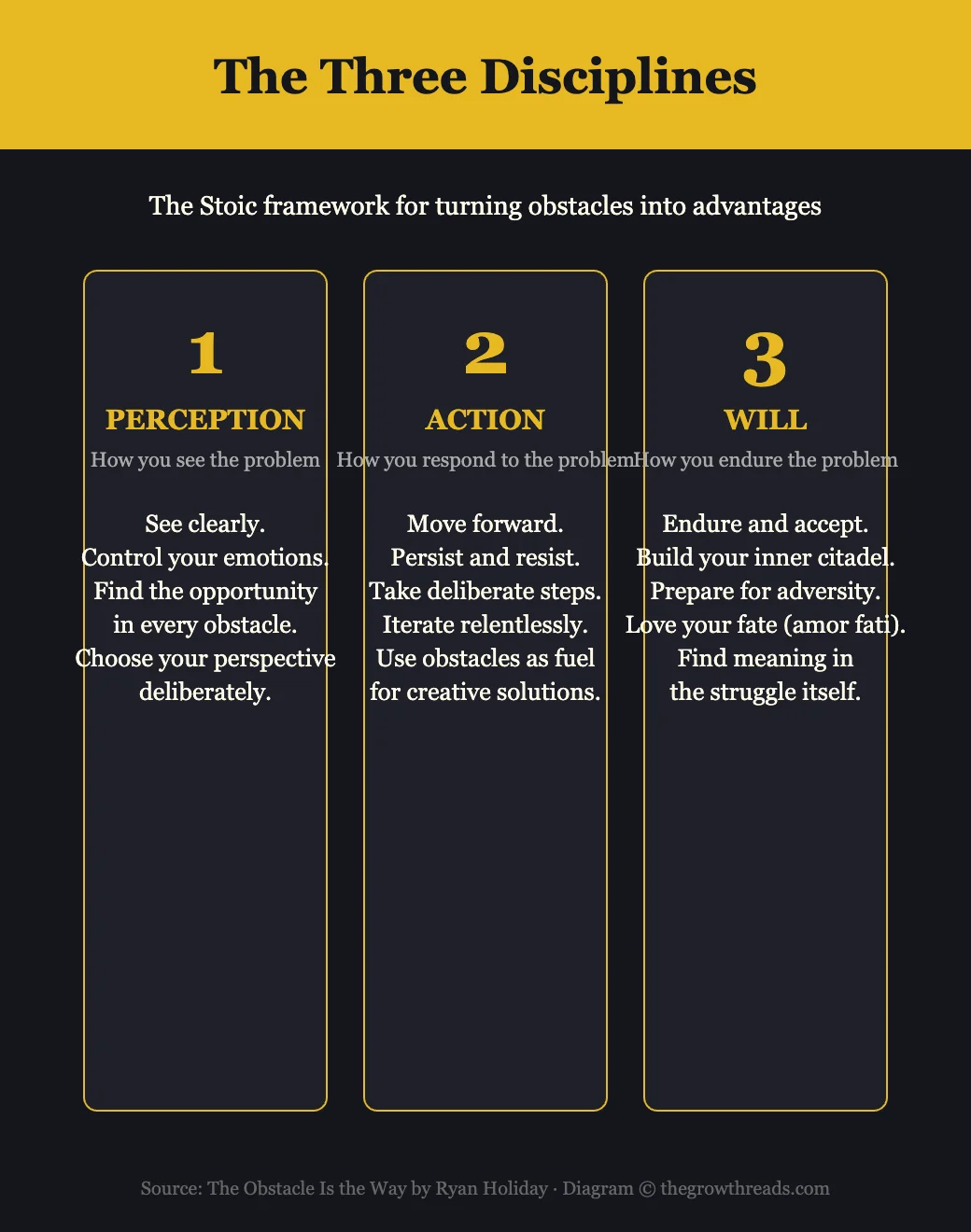
- Three disciplines govern your response: Perception (controlling how you see it), Action (directing how you respond), and Will (cultivating what you endure).
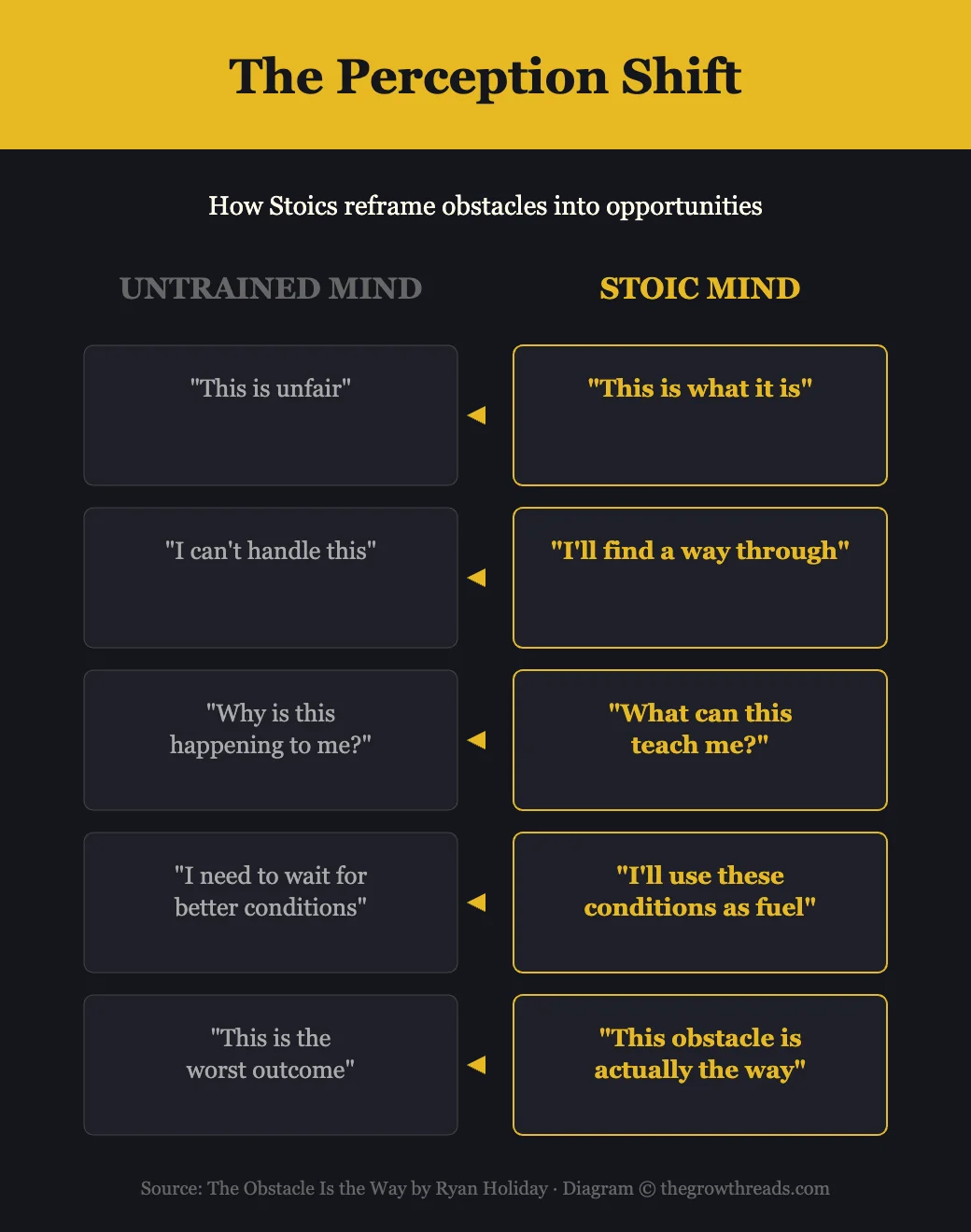
- Perception is everything: the same event can be a catastrophe or an opportunity depending entirely on how you frame it — and framing is a skill you can develop.
- Steady your nerves before anything else: panic, frustration, and emotional reactivity are never helpful — the first Stoic move is always to calm the mind.
- Focus on what you can control: most of your suffering comes from fixating on things outside your influence — redirect that energy to the things within it.
- Action must be persistent, iterative, and creative: when the direct path is blocked, go around, go under, go through — but never stop moving.
- Use obstacles against themselves: sometimes the best response is to yield strategically — let the opponent’s strength become their weakness.
- Build your inner citadel: develop an unshakeable core through preparation, discipline, and the acceptance that adversity is inevitable.
- Amor fati — love your fate: don’t just accept what happens to you, embrace it — treat every event, including hardship, as exactly what you needed.
- Death is the ultimate obstacle: contemplating mortality clarifies everything — it reveals what matters, eliminates triviality, and generates urgency.
What is The Obstacle Is the Way about?
The Obstacle Is the Way applies ancient Stoic philosophy to modern challenges through three disciplines: Perception (seeing obstacles objectively), Action (responding with persistence and creativity), and Will (enduring what cannot be changed). Holiday uses historical examples to demonstrate that adversity, properly leveraged, becomes the raw material for growth, innovation, and personal transformation.
About the author
Ryan Holiday is one of the most widely read authors on Stoic philosophy in the modern era. A former marketing director for American Apparel and a media strategist, Holiday discovered Stoicism in his early twenties and has since written over a dozen books on the subject, including Ego Is the Enemy, Stillness Is the Key, and the bestselling Daily Stoic. His books have sold over 10 million copies worldwide and have been translated into more than 40 languages. Holiday’s work has been adopted by professional sports teams (including NFL and NBA organizations), Special Operations units, and Fortune 500 companies as a framework for mental toughness and resilience. He runs the Daily Stoic website and email, which reaches over a million readers, and owns a bookstore in Bastrop, Texas called The Painted Porch. Explore all Ryan Holiday book summaries →
Key concepts at a glance
| Concept | What it means | Use it when |
|---|---|---|
| The Obstacle Is the Way | Every barrier contains within it an opportunity — the impediment to action advances action | You face a challenge that seems purely negative |
| Perception | The discipline of seeing clearly — removing emotion, bias, and panic from your assessment of reality | Your first reaction to bad news is emotional rather than analytical |
| Action | Persistent, creative, iterative movement forward — even when the direct path is blocked | You know what’s wrong but feel paralyzed about what to do |
| Will | The inner citadel — the strength to endure what you cannot change and find meaning in suffering | The obstacle genuinely cannot be removed and must be borne |
| Amor Fati | Love of fate — not merely accepting what happens but embracing it as necessary and good | You catch yourself wishing things were different |
| The Inner Citadel | An unshakeable psychological foundation built through preparation, discipline, and self-knowledge | External circumstances are chaotic and you need internal stability |
| Turning the Obstacle Upside Down | Using an opponent’s strength against them — yielding strategically rather than fighting head-on | Direct confrontation would be wasteful or futile |
Part 1: The discipline of Perception — seeing clearly
Holiday opens with the story of John D. Rockefeller, who arrived in Cleveland in 1855 as a penniless teenager and within a decade became one of the wealthiest people in history. The key moment came during the Panic of 1857 — a devastating financial crisis that ruined countless investors. While everyone around him panicked, the young Rockefeller watched, studied, and learned. He saw the panic not as a disaster but as a masterclass in market psychology. That ability to remain calm and observant while others lost their heads became the foundation of his entire career.
The Stoic discipline of perception is about controlling how you see events before you respond to them. Holiday distills this into several practices. First, steady your nerves: panic is never productive, and the first step in any crisis is to breathe, slow down, and regain emotional equilibrium. Second, control your emotions: this doesn’t mean suppressing them, but refusing to let them dictate your analysis of the situation. Third, practice objectivity: strip away the narrative (“this is terrible,” “I’m ruined”) and look at the bare facts. Fourth, find the opportunity: in every obstacle, there is something to be gained — new skills, new relationships, new creative solutions that wouldn’t have emerged without the constraint.
Holiday cites the example of Rubin “Hurricane” Carter, the boxer wrongfully imprisoned for murder. Carter couldn’t change the injustice of his conviction, but he could control how he spent his time in prison — he used it to educate himself, earning multiple degrees, and eventually became a symbol of perseverance that influenced criminal justice reform. The obstacle (prison) became the way (education and advocacy).
Part 2: The discipline of Action — moving through resistance
Perception without action is philosophy; action informed by perception is power. Holiday’s second discipline is about directed, persistent movement — not reckless activity, but creative and iterative progress in the face of resistance. He draws on examples ranging from Demosthenes (who overcame a severe speech impediment to become ancient Greece’s greatest orator) to Amelia Earhart (who used gender discrimination as fuel for unprecedented aviation achievements).
The key principles of Stoic action are deliberate and practical. Get moving: inaction in the face of obstacles compounds the problem, while even imperfect action generates information and momentum. Persist and iterate: when one approach fails, try another — the obstacle reveals what doesn’t work, which is itself valuable data. Practice process: focus on the next step, not the distant outcome, because breaking massive challenges into small actions makes them manageable. Do your job: fulfill your role with excellence regardless of whether you receive recognition, because the quality of your work is within your control even when its reception is not.
Holiday tells the story of Ulysses S. Grant at the Battle of the Wilderness, where his army was ambushed and nearly routed. While his generals counseled retreat, Grant said: “I am heartily tired of hearing about what Lee is going to do. Some of you always seem to think he is suddenly going to turn a double somersault, and land in our rear. Go back to your command, and try to think what we are going to do ourselves.” He then ordered an advance — not away from the enemy but toward them, through the obstacle. The battle turned.
Part 3: The discipline of Will — enduring and accepting
The third discipline is the deepest and most difficult. Will is what sustains you when perception and action aren’t enough — when the obstacle genuinely cannot be removed, when the situation is truly beyond your control, and when the only option is to endure. Holiday describes this as building an “inner citadel” — an internal psychological fortress that external events cannot breach.
The Stoics prepared for adversity through a practice called premeditatio malorum — the premeditation of evils. Rather than living in optimistic denial, they regularly visualized worst-case scenarios: loss, failure, death, humiliation. The purpose wasn’t pessimism but preparation. When adversity arrived, they were ready — not surprised, not outraged, not shattered, but prepared and capable of responding with grace.
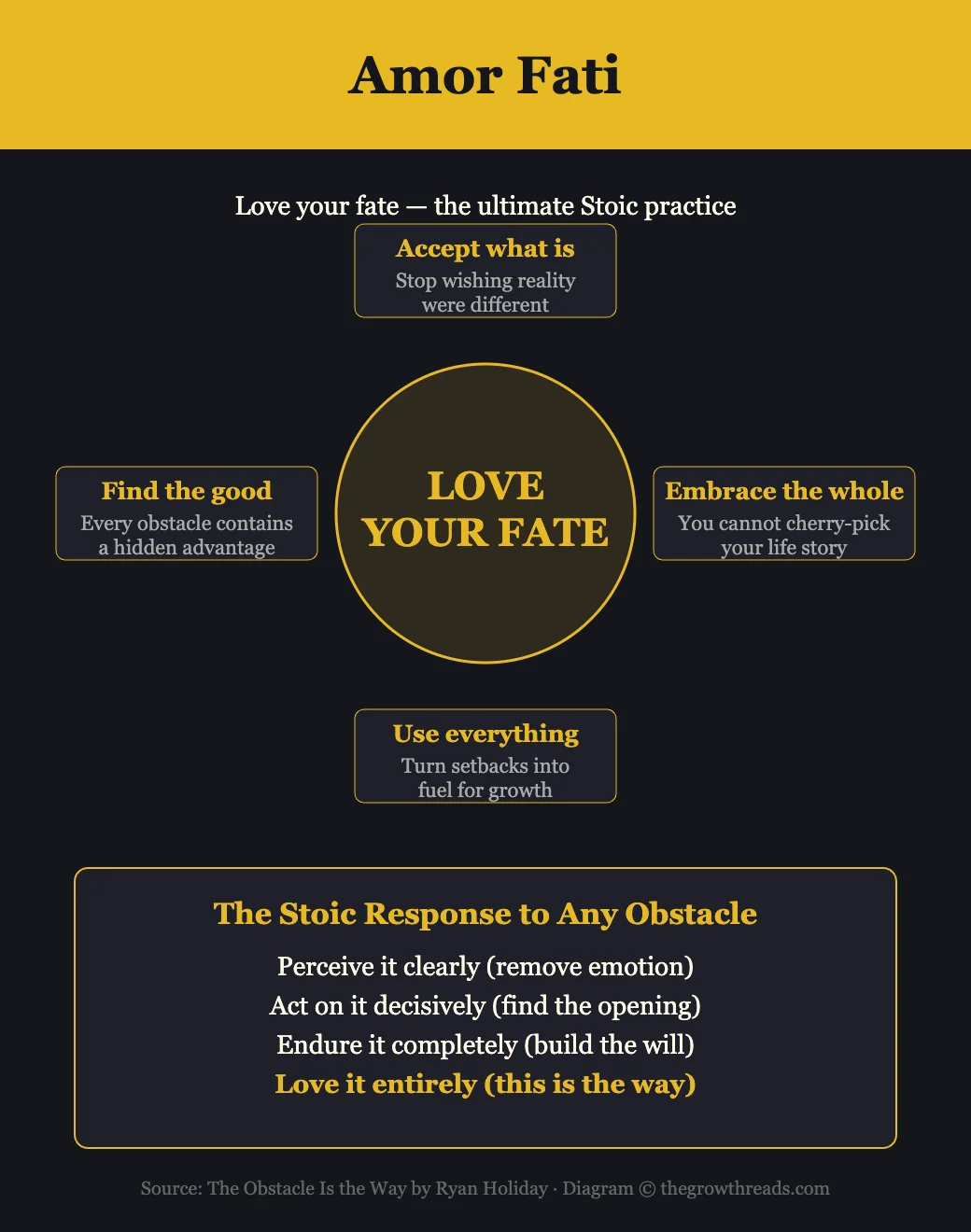
The book’s most powerful section deals with amor fati — the love of fate. Holiday traces this concept from the Stoics through Nietzsche and into modern practice. Amor fati goes beyond acceptance. Acceptance says “I can live with this.” Amor fati says “I wouldn’t have it any other way.” It means treating every event — including the painful ones — as exactly what you needed. This isn’t denial or toxic positivity; it’s the recognition that your character, your resilience, your creativity, and your most meaningful accomplishments all emerged from difficulties you would never have chosen. To wish away the obstacle is to wish away the growth.
Holiday closes with death as the final obstacle. The Stoics practiced memento mori — the contemplation of mortality — not as morbidity but as the ultimate clarifier. Death puts every other obstacle in perspective. The promotion you didn’t get, the deal that fell through, the relationship that ended — against the backdrop of finite life, these shrink to their proper size. And the knowledge that your time is limited generates an urgency that transforms how you spend each day.
Who is The Obstacle Is the Way best for — and who should read something else first?
This book is ideal for entrepreneurs navigating uncertainty, athletes building mental toughness, leaders managing crises, and anyone facing a significant personal or professional setback who needs a framework for moving through it. It’s particularly powerful for people who tend toward pessimism or victimhood and want to develop a more empowering relationship with difficulty.
If you want a deeper dive into Stoic philosophy directly from the source, Marcus Aurelius’s Meditations is the foundational text Holiday draws from most heavily. If you’re interested in Holiday’s companion works, Ego Is the Enemy addresses the internal obstacles of pride and self-deception, while Stillness Is the Key completes the trilogy with the discipline of inner calm. And if you want the psychological science behind why this approach works, Mindset by Carol Dweck provides the research foundation.
Questions to reflect on
- What is the biggest obstacle in your life right now — and if you stopped wishing it away, what opportunity might it contain?
- When you face bad news, is your first reaction emotional (panic, anger, despair) or analytical? What would it take to add a three-second pause before responding?
- Which of the three disciplines — Perception, Action, or Will — is your weakest? What’s one specific practice you could adopt this week to strengthen it?
- Think of the most difficult experience of your life. What did it teach you or build in you that you couldn’t have gained any other way?
- If you truly practiced amor fati — loving everything that happens to you — how would tomorrow look different from today?
🔥 Ready to turn your obstacles into advantages?
Get the Stoic framework that’s been adopted by NFL teams, Special Forces, and Fortune 500 leaders.
How to apply The Obstacle Is the Way (7-day plan)
- Day 1 — Name your obstacle: Write down the single biggest obstacle you’re currently facing. Describe it in purely factual terms — no narrative, no emotion, just what is happening. Notice how the bare facts feel different from the story you’ve been telling yourself.
- Day 2 — Practice the perception shift: Take your obstacle description and rewrite it as an opportunity. What skills could this build? What doors might it open that wouldn’t exist without it? What would a Stoic see in this situation?
- Day 3 — Identify what you control: Draw two columns: “Within my control” and “Outside my control.” Move every aspect of your obstacle into the appropriate column. Commit to spending zero energy on the right column today.
- Day 4 — Take one action: Choose the smallest possible action you can take today that moves you through (not around) your obstacle. Do it. Don’t wait for the perfect move — any move generates momentum and information.
- Day 5 — Practice premeditatio malorum: Spend 10 minutes imagining the worst possible outcome of your situation. How would you respond? What would you do next? Notice how the visualization reduces your fear — you’ve already rehearsed the scenario.
- Day 6 — Try amor fati: For one full day, treat every frustration, setback, and annoyance as if you chose it. When something goes wrong, say to yourself: “Good. This is exactly what I needed.” Track how this changes your emotional state.
- Day 7 — Build your inner citadel: Identify one daily practice that strengthens your psychological foundation — meditation, journaling, cold exposure, exercise, or reading Stoic texts. Commit to it for 30 days. Your inner citadel is built one brick at a time.
Frequently asked questions
What does “the obstacle is the way” mean?
It means that the impediment standing between you and your goal isn’t just something to overcome — it’s the actual path forward. The obstacle contains within it the opportunity for growth, creativity, and advantage that wouldn’t exist without it. The concept comes from Marcus Aurelius’s Meditations: “The impediment to action advances action. What stands in the way becomes the way.” Holiday’s interpretation is that history’s most successful people didn’t succeed despite their obstacles but because the obstacles forced them to develop capabilities and find solutions they never would have discovered otherwise.
What are the three disciplines in the book?
The three disciplines are Perception (how you see the obstacle), Action (how you respond to it), and Will (how you endure what cannot be changed). Perception involves removing emotion and bias to see the situation clearly and find the hidden opportunity. Action involves persistent, creative, iterative movement forward even when the direct path is blocked. Will involves building an unshakeable inner foundation through preparation, acceptance, and the embrace of fate (amor fati). Together, they form a complete framework for handling any challenge life presents.
What is amor fati?
Amor fati is a Latin phrase meaning “love of fate.” It goes beyond mere acceptance of difficult circumstances — it means embracing everything that happens as exactly what you needed. The concept was central to Stoic philosophy and later championed by Friedrich Nietzsche. In Holiday’s framework, amor fati is the highest expression of the discipline of Will: recognizing that your character, resilience, and most meaningful accomplishments all emerged from difficulties you would never have chosen. To wish away the obstacle is to wish away the growth it produced.
Is The Obstacle Is the Way about Stoicism?
Yes — it’s a modern, practical interpretation of Stoic philosophy, drawing primarily on Marcus Aurelius (Meditations), Seneca (Letters from a Stoic), and Epictetus (Discourses). However, Holiday doesn’t require readers to study ancient texts. He translates the Stoic principles into contemporary language and illustrates them through modern and historical examples that anyone can relate to. The book has been credited with sparking a mainstream revival of interest in Stoicism, making it one of the most accessible entry points to the philosophy alongside Holiday’s Daily Stoic and Massimo Pigliucci’s How to Be a Stoic.
Why do NFL teams and military units use this book?
The book’s framework translates directly to high-performance environments where adversity is constant and emotional control determines outcomes. NFL teams including the New England Patriots and Seattle Seahawks have used it as part of their mental conditioning programs. Special Operations units find the Stoic framework valuable for maintaining composure under extreme stress. The appeal is practical: the three disciplines (Perception, Action, Will) provide a simple, repeatable mental process for handling setbacks in real time — exactly what athletes and soldiers need when they can’t pause to think philosophically.
How does The Obstacle Is the Way compare to Ego Is the Enemy?
The two books are companion volumes addressing different threats to success. The Obstacle Is the Way deals with external obstacles — the barriers, setbacks, and challenges the world throws at you — and teaches you to use them as fuel. Ego Is the Enemy deals with internal obstacles — pride, arrogance, self-deception, and the stories your ego tells to protect itself — and teaches you to see past them. Holiday considers Ego the more important book because internal obstacles are harder to recognize and more persistent than external ones. Reading both gives you a complete Stoic toolkit for handling adversity from any direction.
Is the book too simple or repetitive?
This is the most common criticism, and it’s partially valid — the core concept (obstacles contain opportunities) can be stated in a sentence, and the book is essentially variations on that theme illustrated through historical examples. However, Holiday would argue that simplicity is the point. The Stoics believed that wisdom isn’t complex — it’s a handful of principles applied consistently under pressure. The repetition through different examples serves a pedagogical purpose: each story embeds the principle more deeply and shows its application across different domains. If you’re looking for philosophical depth, read Marcus Aurelius directly; if you want practical application, this book delivers exactly that.
Related summaries
- Ego Is the Enemy Summary — Holiday’s companion volume on the internal obstacles of pride and self-deception.
- Man’s Search for Meaning Summary — Viktor Frankl on finding meaning in unavoidable suffering.
- Grit Summary — Angela Duckworth on the science of sustained effort through difficulty.
- Best Psychology Books — Our full ranked list of the most impactful psychology reads.
Related Psychology Summaries
Emotional Agility Summary & Review: Get Unstuck and Thrive
The Chimp Paradox Summary & Review: How to Manage the Brain That Reacts Before You Think
The Righteous Mind Summary & Review: Why Good People Disagree
The Scout Mindset Summary & Review: See Reality Clearly
The Subtle Art of Not Giving a F*ck Summary & Review: Choosing What Truly Matters