

⭐⭐⭐⭐ 4.0/5 — A clear, practical system for capturing and organizing knowledge so your best ideas never get lost.
Best for: Knowledge workers, creators, students, and anyone drowning in digital information who wants a system to turn consumption into creation.
Reading time: ~5 hours (272 pages) | Difficulty to apply: Moderate — the system is simple but building the habit of consistent capture and organization takes weeks of practice.
Building a Second Brain in one minute
You consume more information in a single day than a person in the 15th century encountered in their entire lifetime — and almost none of it sticks. Tiago Forte argues that our biological brains were never designed to store and retrieve the volume of knowledge modern life demands. The solution is a “second brain” — a trusted digital system where you capture, organize, distill, and express your most valuable ideas. His CODE method (Capture, Organize, Distill, Express) gives you a four-step workflow, while his PARA system (Projects, Areas, Resources, Archives) provides a universal organizational structure that works across any note-taking app. The core insight is that knowledge management isn’t about hoarding information — it’s about making your past thinking available to your future self at the exact moment you need it, so every project you tackle benefits from everything you’ve ever learned.
Key takeaways
- Your brain is for having ideas, not holding them: trying to remember everything creates cognitive load that crowds out creative thinking — offload storage to a digital system.
- Capture only what resonates: don’t save everything — save what surprises you, what’s useful, what’s personal, or what’s inspiring. Forte calls these your “knowledge assets.”
- Organize for action, not by topic: the PARA system sorts notes by how actionable they are (Projects → Areas → Resources → Archives), not by academic category.
- Progressive Summarization is the key distillation technique: layer by layer, bold the key passages, highlight within the bold, then write an executive summary — so future-you can grasp the essence in seconds.
- Express early and often: the goal of a second brain isn’t to accumulate knowledge — it’s to create output. Every note should eventually become part of something you make.
- Intermediate Packets are the building blocks of creative work: break every project into reusable chunks (outlines, research notes, brainstorms, drafts) that can be recombined across projects.
- Just-in-time learning beats just-in-case learning: stop front-loading knowledge and start pulling it in at the moment of need — your second brain ensures it’s there when you need it.
- The Cathedral Effect: when you can see your accumulated knowledge organized and searchable, you think bigger — the system expands your creative ambition.
- Start with what you have: don’t wait for the perfect app or the perfect system — import what you’ve already saved, organize it loosely, and refine as you go.
- A second brain compounds over time: every note you capture today becomes more valuable as your library grows, because connections between ideas multiply exponentially.
What is Building a Second Brain about?
Building a Second Brain is a personal knowledge management system for capturing, organizing, distilling, and expressing ideas using digital tools. Forte provides two frameworks — CODE (the workflow) and PARA (the organizational structure) — along with Progressive Summarization for distilling notes and Intermediate Packets for breaking creative work into reusable building blocks, so every project benefits from everything you’ve ever learned.
About the author
Tiago Forte is a productivity consultant and educator who has taught his Building a Second Brain methodology to over 100,000 students across more than 100 countries through his online courses. He began developing the system after a chronic health condition in his twenties left him struggling to manage the information overload of his consulting career. Drawing on influences from David Allen’s Getting Things Done, Niklas Luhmann’s Zettelkasten method, and modern digital tools, Forte created a system designed specifically for the digital age — one that works across any note-taking app rather than being tied to a single platform. He’s spoken at companies including Genentech, Toyota, and the Inter-American Development Bank, and his work has been featured in The New York Times, The Atlantic, and Harvard Business Review. Explore all Tiago Forte book summaries →
Key concepts at a glance
| Concept | What it means | Use it when |
|---|---|---|
| CODE Method | Capture, Organize, Distill, Express — the four-step workflow for your second brain | Building your daily knowledge management habit |
| PARA System | Projects, Areas, Resources, Archives — organize by actionability, not topic | Structuring your notes, files, and digital life |
| Progressive Summarization | Layer-by-layer distillation: bold → highlight → executive summary | Making notes useful for your future self in seconds |
| Intermediate Packets | Reusable building blocks of creative work: outlines, drafts, research, diagrams | Breaking big projects into manageable, recombineable pieces |
| Capture Criteria | Save only what is surprising, useful, personal, or inspiring | Deciding what’s worth saving vs. what’s noise |
| Just-in-Time Learning | Pull knowledge in at the moment of need rather than front-loading it | You’re over-preparing and under-producing |
| The Cathedral Effect | Seeing your accumulated knowledge makes you think bigger and more ambitiously | You need creative inspiration or confidence |
Part 1: The case for a second brain — why your memory isn’t enough
Forte opens with a personal story: a mysterious health condition that caused debilitating pain sent him on a years-long odyssey through the medical system. He started taking detailed notes on every doctor’s visit, every symptom, every research paper — not out of productivity nerdery, but out of necessity. He needed a system to track what his overwhelmed brain couldn’t. That system eventually became the foundation of his methodology.
The broader argument is that modern knowledge work has fundamentally changed what’s required of the human brain. We’re no longer asked to perform repetitive physical tasks — we’re asked to synthesize, connect, and create across an ocean of information. Yet we still try to do this using only our biological memory, which was evolved for a world where the total amount of available information was tiny. The mismatch is severe: the average knowledge worker spends 26% of their workday searching for information they’ve already encountered before.
Forte positions the second brain not as a filing system but as an “idea factory” — a trusted external repository that makes your past thinking available to your current projects. The goal isn’t to remember everything; it’s to offload the storage function so your biological brain can do what it does best: pattern recognition, creative connection, and original thinking.
Part 2: The CODE workflow — from capture to expression
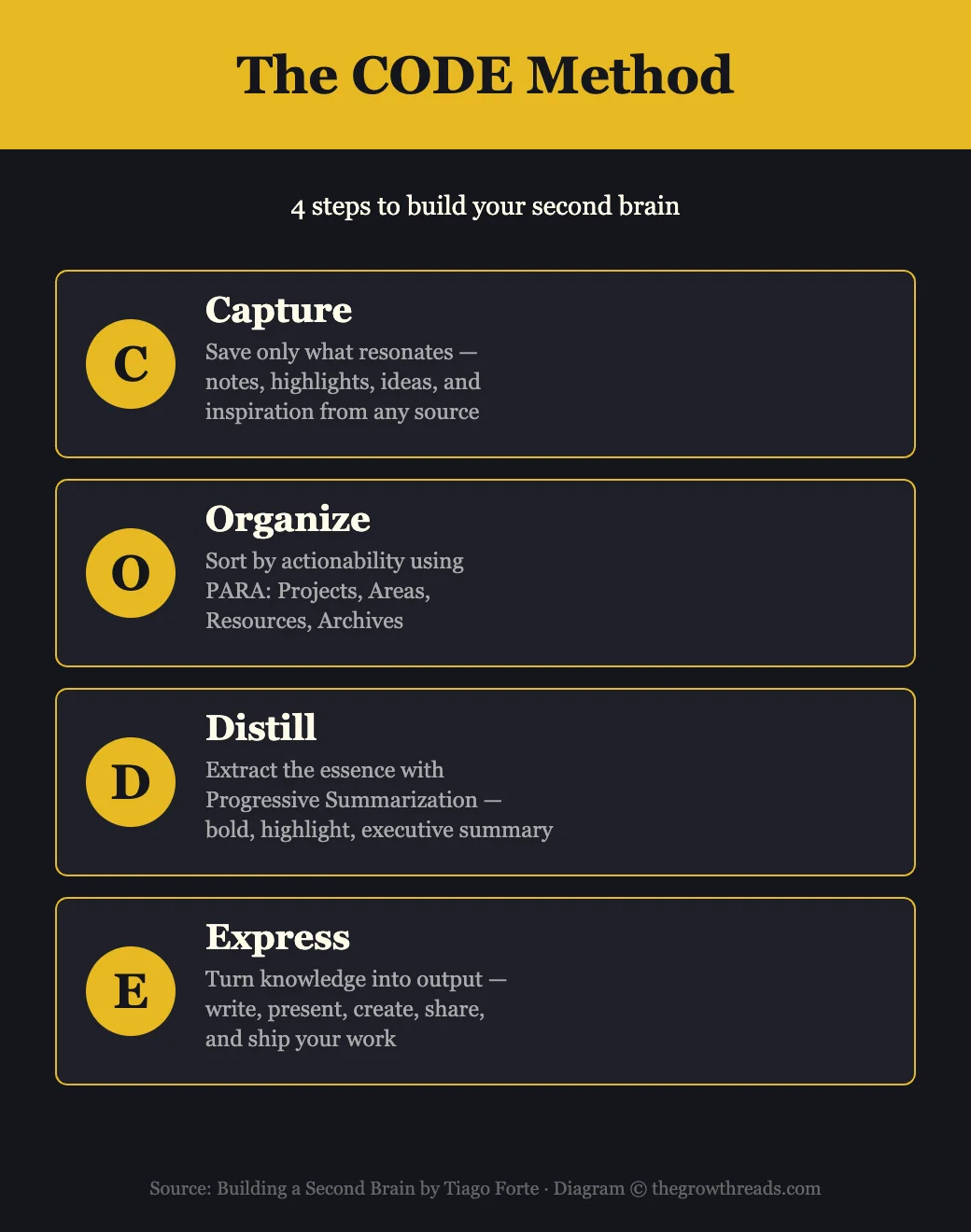
The CODE method is the book’s operational backbone. Capture is about saving the right things — not everything, but the notes, highlights, ideas, images, and inspirations that genuinely resonate with you. Forte provides four capture criteria: save what is surprising (it challenges your existing thinking), useful (it’s immediately applicable to a project), personal (it connects to your experience), or inspiring (it moves you emotionally or creatively). Everything else is noise.
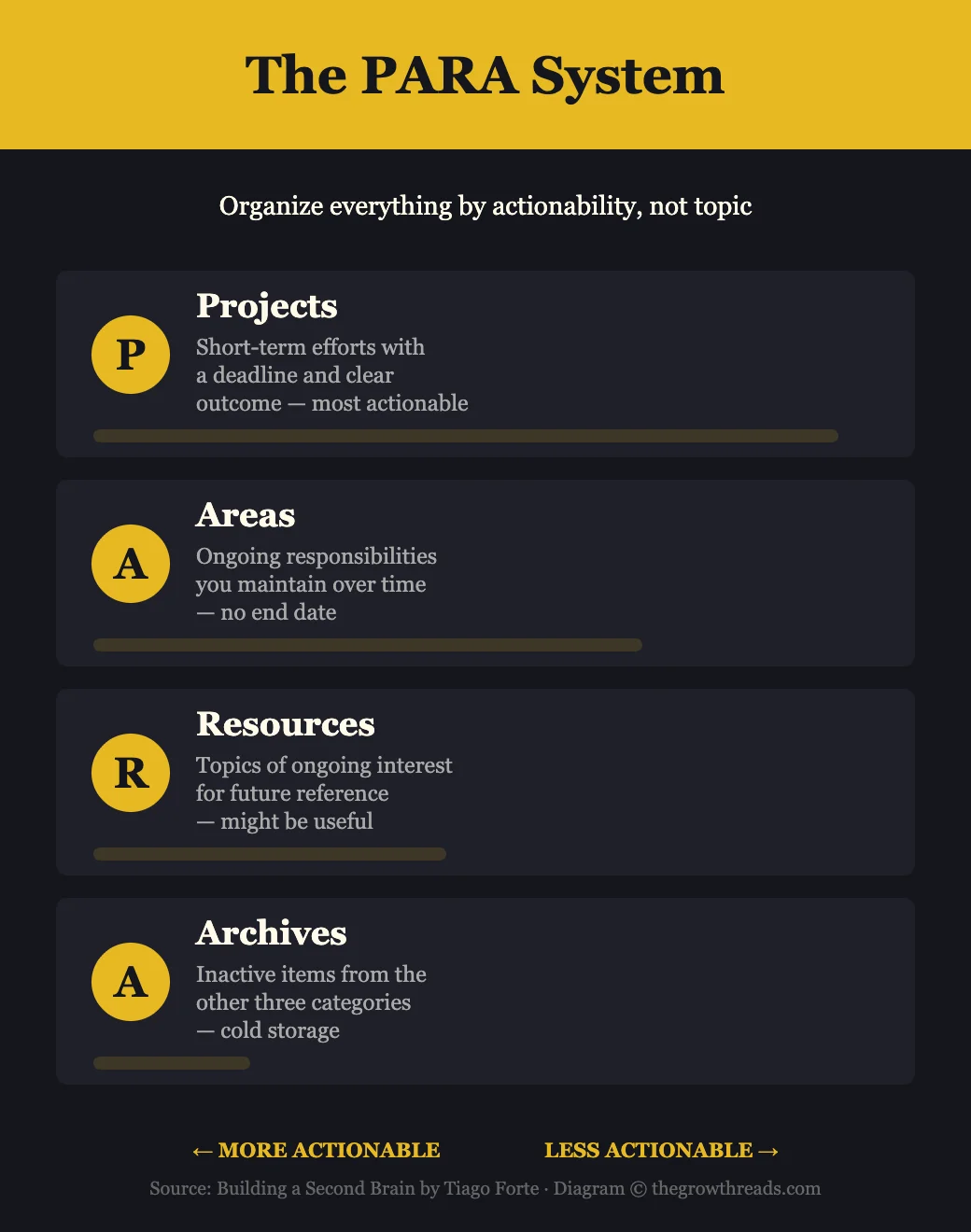
Organize follows, and here Forte introduces PARA. The key insight is that organizing by topic (the way we learned in school — “Marketing,” “Finance,” “Health”) creates beautiful archives that are useless in practice because real projects cut across multiple topics. Instead, organize by actionability. Projects are short-term efforts with a deadline. Areas are ongoing responsibilities with standards to maintain. Resources are topics of interest for future reference. Archives are inactive items from the other three. When a project finishes, its notes move to Archives. This keeps your active workspace lean.
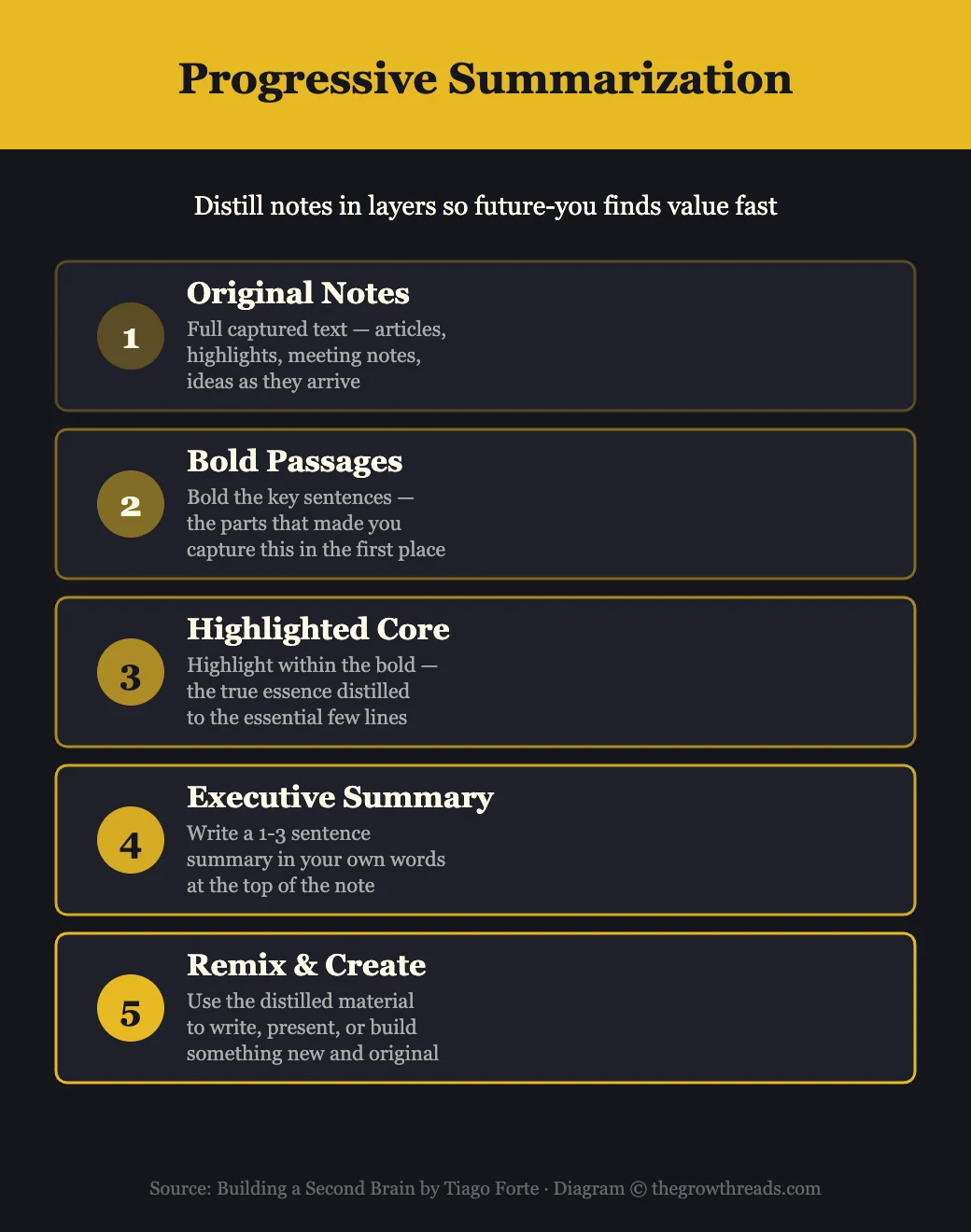
Distill is where Progressive Summarization enters. Forte’s insight is that you should distill notes in layers, over time, on a just-in-time basis — not in one exhaustive session. Layer 1 is the original captured text. Layer 2: bold the key passages. Layer 3: highlight within the bold. Layer 4: write an executive summary at the top in your own words. Layer 5: remix into new creative output. You don’t process every note to Layer 4 — most stay at Layer 1 or 2. You only deepen a note when you encounter it again and need its insights.
Express is the payoff. Forte is emphatic that knowledge management is not an end in itself — the goal is creative output. Every note should eventually contribute to something you make: an article, a presentation, a project deliverable, a conversation, a decision. If your system isn’t producing output, it’s just digital hoarding.
Part 3: Intermediate Packets and the shift to creative output
The concept of Intermediate Packets (IPs) may be the book’s most underappreciated idea. Forte argues that most people approach creative projects as monoliths — a blank page, a looming deadline, and the pressure to produce something complete from scratch. This is both psychologically intimidating and practically wasteful, because you’re reinventing work you’ve already done in previous projects.
Instead, Forte proposes breaking every project into reusable building blocks: a distilled note from a book, a set of research findings, a brainstorm list, a preliminary outline, a rough draft of one section, a curated set of images. These IPs can be created opportunistically (when you have time and energy) and assembled later (when you have a deadline). More importantly, IPs are portable — a research summary created for one project can be recombined into a completely different project months later.
This reframe changes the emotional experience of creative work. Instead of facing a blank page, you face a workshop full of pre-built components waiting to be assembled. Forte compares it to the shift from craft production (every item built from scratch) to modular manufacturing (standardized components assembled into varied products). The quality of your output increases because each IP has already been refined, and the speed increases because you’re assembling rather than creating from zero.
Part 4: Making it stick — habits, workflows, and the Cathedral Effect
The final section addresses the gap between understanding a system and actually using it. Forte is realistic about the adoption curve: most people who learn about personal knowledge management get excited, spend a weekend organizing their notes, and then abandon the system within a month. The antidote is starting small — not with a comprehensive reorganization of your entire digital life, but with a single active project.
He prescribes three maintenance habits. A daily capture habit: at the end of each day, spend five minutes saving anything noteworthy you encountered. A weekly review: clear your inbox of notes, move completed projects to Archives, and review your active Projects list. A monthly reflection: assess whether your PARA structure still reflects your actual priorities and make adjustments. These habits are intentionally lightweight because the system needs to survive your busiest, most stressed weeks — if it requires an hour of maintenance, it won’t last.
The Cathedral Effect is Forte’s term for the psychological shift that occurs when you can see your accumulated knowledge laid out before you, organized and searchable. Just as walking into a cathedral makes you think bigger thoughts (research confirms this — high ceilings increase abstract thinking), seeing months or years of captured, distilled knowledge makes you think more ambitiously about what you can create. Your second brain becomes a creative partner, surfacing unexpected connections between ideas you captured months or years apart. The compound interest of knowledge, Forte argues, is as powerful as the financial kind — but only if you have a system to store and retrieve it.
Who is Building a Second Brain best for — and who should read something else first?
This book is ideal for knowledge workers who read widely but struggle to recall or apply what they’ve learned, content creators who need a system for managing research and ideas across multiple projects, students managing coursework across subjects, and anyone who feels overwhelmed by the volume of digital information in their life. It’s especially useful for people who already have a note-taking habit but lack a system for making their notes useful after the initial capture.
If your primary challenge is managing tasks and commitments (not knowledge), start with Getting Things Done by David Allen — it’s the task management foundation that BASB builds upon. If you want to go deeper on the focus and concentration side, Deep Work by Cal Newport is the essential companion. And if your challenge is more about deciding what to focus on than managing what you know, Essentialism by Greg McKeown should come first.
Questions to reflect on
- How many times in the past month have you spent more than 10 minutes searching for information you know you’ve seen before?
- What is the most valuable idea you’ve encountered this week — and did you capture it anywhere you’ll actually find it again?
- Look at your current note-taking system (or lack of one): if you needed a specific insight for a project next month, could you find it in under 60 seconds?
- Which of your current projects would benefit most from having all your relevant past research organized and searchable?
- Are you consuming information for its own sake, or are you consuming it in service of something you’re creating?
🔥 Ready to build a system that makes your knowledge work for you?
Get the methodology that’s helped 100,000+ people turn information overload into creative output.
How to apply Building a Second Brain (7-day plan)
- Day 1 — Choose your note-taking app: Pick one app (Notion, Obsidian, Apple Notes, Evernote — any will work) and commit to using it as your single capture point. Don’t overthink this; the tool matters less than the habit.
- Day 2 — Set up PARA: Create four top-level folders: Projects (active, with deadlines), Areas (ongoing responsibilities), Resources (topics of interest), Archives (inactive). Move your existing notes roughly into these categories.
- Day 3 — Start capturing: Today, save at least 5 things that resonate using Forte’s criteria: surprising, useful, personal, or inspiring. Use your phone’s share feature, web clipper, or a quick typed note.
- Day 4 — Practice Progressive Summarization: Pick 3 notes from yesterday. Bold the key sentences. Highlight the most essential phrases within the bold. Write a 1-sentence summary at the top of each note.
- Day 5 — Identify your Intermediate Packets: Look at your most important current project. List 5 building blocks it needs (research, outline, examples, data, draft). Check if any already exist in your notes.
- Day 6 — Express something: Take one distilled note and turn it into output: a social media post, an email to a colleague, a section of a report, or a journal entry. The goal is to close the loop from capture to creation.
- Day 7 — Do your first Weekly Review: Spend 15 minutes clearing your capture inbox, moving completed projects to Archives, and reviewing your active Projects list. Schedule this as a recurring weekly event.
Frequently asked questions
What is a “second brain”?
A second brain is a trusted digital system for capturing, organizing, and retrieving your most valuable ideas, notes, and knowledge. Forte uses the metaphor to contrast it with your “first brain” — your biological memory, which is excellent at pattern recognition and creative thinking but terrible at reliable storage and retrieval. Your second brain handles the storage so your first brain can do what it does best: make connections, generate ideas, and produce creative work. It can live in any note-taking app; what matters is the methodology, not the tool.
What does CODE stand for?
CODE is Forte’s four-step workflow for personal knowledge management. C = Capture (save only what resonates — surprising, useful, personal, or inspiring). O = Organize (sort by actionability using PARA, not by topic). D = Distill (extract the essence through Progressive Summarization so future-you can grasp the value in seconds). E = Express (turn your organized knowledge into creative output — articles, presentations, projects, decisions). The sequence matters: capturing without organizing creates chaos, and organizing without expressing creates a digital graveyard.
What is the PARA system?
PARA is a universal organizational structure with four categories sorted by actionability. Projects are short-term efforts with a deadline and clear outcome (most actionable). Areas are ongoing responsibilities you maintain over time with no end date. Resources are topics of ongoing interest you might reference in the future. Archives are inactive items from the other three categories. The key insight is organizing by actionability rather than topic: a note about marketing goes in your “Product Launch” Project, not a “Marketing” folder, because that’s where you’ll need it.
What is Progressive Summarization?
Progressive Summarization is Forte’s technique for distilling notes in layers over time. Layer 1: the original captured text. Layer 2: bold the key passages. Layer 3: highlight within the bold. Layer 4: write a 1-3 sentence executive summary at the top. Layer 5: remix into new creative output. Crucially, you don’t process every note through all layers — most stay at Layer 1 or 2 indefinitely. You only deepen a note when you encounter it again for a specific purpose, making the investment proportional to the note’s actual utility.
What app should I use for my second brain?
Forte is deliberately app-agnostic — the methodology works in Notion, Obsidian, Apple Notes, Evernote, Google Docs, Roam Research, or even a simple folder structure on your computer. He argues that the tool matters far less than the habits and frameworks you apply to it. That said, he recommends choosing an app with quick capture (so the friction of saving ideas is minimal), tagging or linking (so notes can be found multiple ways), and cross-device sync (so you can capture ideas wherever they occur). The most important rule: pick one and commit rather than endlessly evaluating alternatives.
How is Building a Second Brain different from Getting Things Done?
Getting Things Done (GTD) by David Allen is a task and commitment management system — it tracks what you need to do. Building a Second Brain is a knowledge management system — it tracks what you know. Forte considers them complementary: GTD handles your “open loops” (tasks, projects, commitments), while BASB handles your “knowledge assets” (ideas, insights, research, references). Many practitioners use both simultaneously — GTD for action management and BASB for knowledge management — with the PARA structure bridging both by organizing tasks and notes in the same four categories.
How long does it take to set up a second brain?
Forte recommends starting in a single weekend: choose your app, set up the four PARA folders, and move your existing notes roughly into them. Don’t aim for perfection — a rough sort is infinitely better than no system at all. The real investment is in building the daily capture habit over the following 2-4 weeks: saving 3-5 resonant items per day, bolding key passages when you review notes, and doing a 15-minute weekly review. Most people report the system “clicking” after about a month of consistent use, when they first experience the magic of finding exactly the right note at exactly the right time.
Related summaries
- Getting Things Done Summary — David Allen’s task management system that BASB builds upon.
- Deep Work Summary — Cal Newport on the concentration skills that make your captured knowledge productive.
- Essentialism Summary — Greg McKeown’s philosophy of ruthless prioritization that PARA operationalizes.
- Best Productivity Books — Our full ranked list of the most impactful productivity reads.
Related Productivity Summaries
Sprint Summary & Review: Solve Big Problems and Test Ideas in Five Days
The 12 Week Year Summary & Review: Get More Done in Less Time
The 5 Second Rule Summary & Review: Stop Overthinking, Start Moving
The Power of Habit Summary & Review: Why We Do What We Do
The War of Art Summary & Review: How to Defeat Resistance and Do Your Work