

★★★★☆ 4.3/5 — A masterful synthesis of ancient philosophical wisdom and modern psychological science.
Best for: Thinkers who want a deeper, research-backed understanding of what actually makes humans happy.
Reading time: ~6 hours (297 pages)
Difficulty to apply: Medium — the insights are profound but require reflection and gradual integration into daily life.
Intellectual depth: Exceptional — Haidt bridges Buddha, Epictetus, and the latest neuroscience without oversimplifying any of them.
The Happiness Hypothesis in one minute
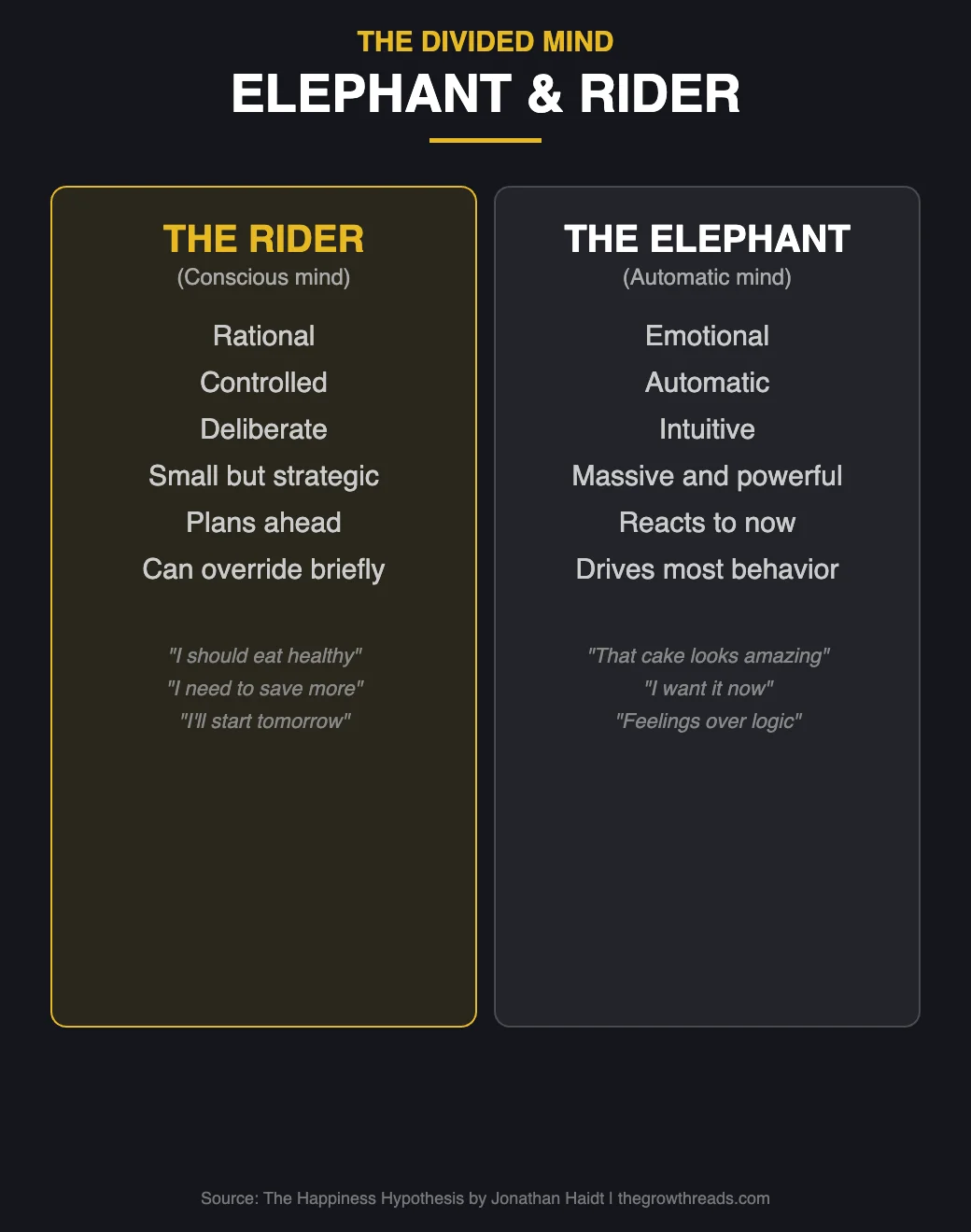
The ancient sages were mostly right about happiness — but not for the reasons they thought. Social psychologist Jonathan Haidt takes ten great ideas from ancient philosophy and religion — from Buddha, Jesus, Confucius, and the Stoics — and tests them against modern psychological research. His central metaphor: the mind is like a rider on an elephant. The rider (conscious reasoning) thinks it is in charge, but the elephant (automatic emotional processes) actually drives most behavior. Understanding this split is the key to understanding why we struggle with happiness, morality, and meaning — and what actually works to improve all three.
Key takeaways
- The rider serves the elephant: Reason evolved not to seek truth but to justify the decisions our emotions already made. Understanding this is the first step to real change.
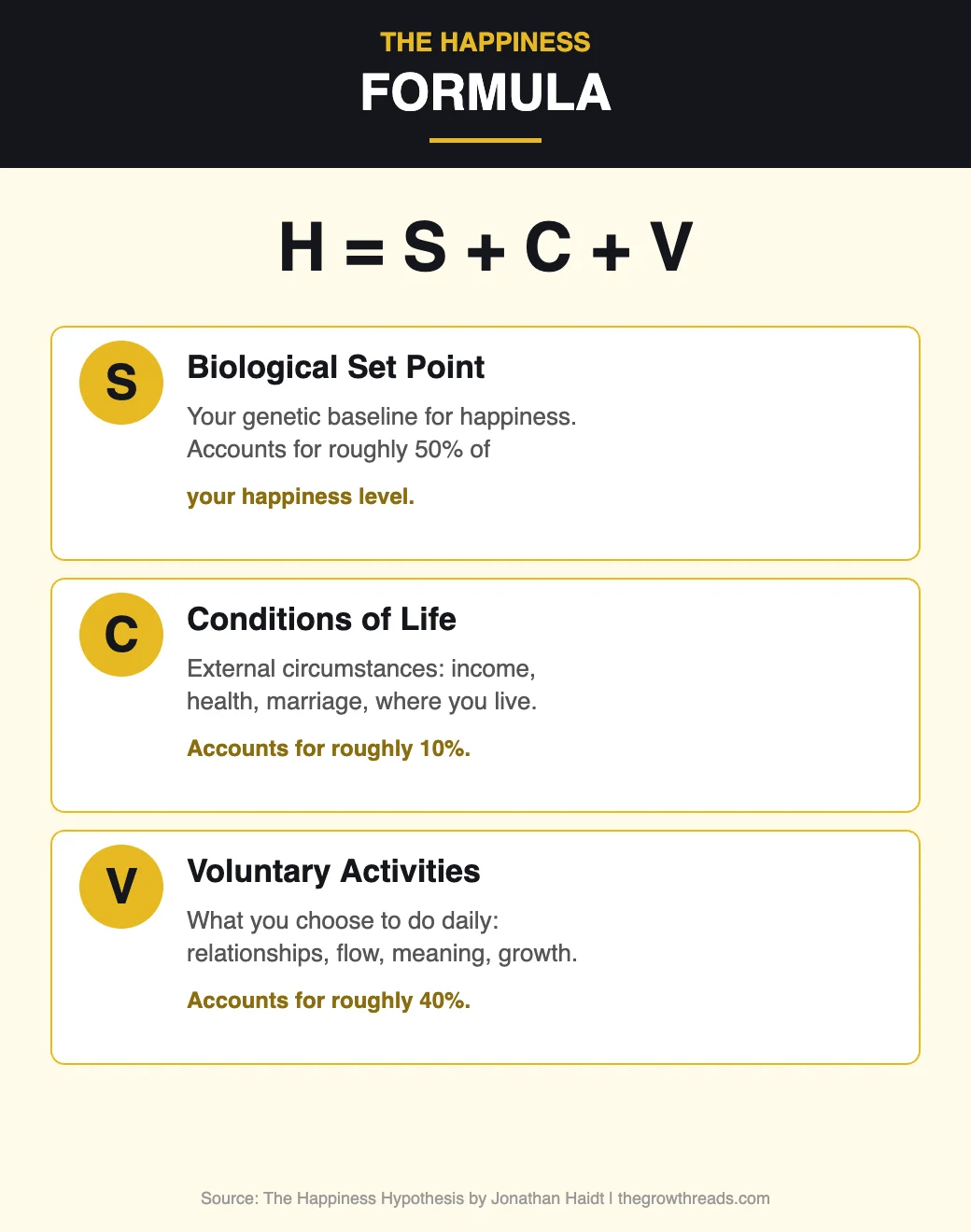
- Happiness = S + C + V: Your happiness level equals your biological set point, plus the conditions of your life, plus your voluntary activities. You control V most directly.
- The adaptation principle is real: We adapt to both good and bad circumstances faster than we expect. This is why lottery winners and paraplegics converge on similar happiness levels.
- Relationships are not optional: Strong social connections are the single strongest predictor of happiness, outweighing income, career success, and health.
- Flow matters more than pleasure: Engagement in challenging, absorbing activities contributes more to lasting well-being than hedonic pleasure.
- Adversity can fuel growth: Post-traumatic growth is a documented phenomenon — struggle, when processed well, can build resilience, meaning, and deeper relationships.
- Virtue is a skill, not knowledge: Aristotle was right — character is built through practice and habit, not through moral instruction or willpower.
- The Golden Rule is wired in: Reciprocity — the instinct to return favors and punish cheaters — is the foundation of all human cooperation.
- We are terrible judges of ourselves: The “mote in your brother’s eye” problem is universal. We see others’ flaws with clarity and our own through a self-serving lens.
- Meaning requires vital engagement: Happiness is not a destination but a byproduct of being deeply engaged with work, relationships, and something larger than yourself.
What is The Happiness Hypothesis about?
The Happiness Hypothesis tests ten great ideas from ancient philosophy and religion against modern psychological science. Jonathan Haidt uses the metaphor of a rider (reason) on an elephant (emotion) to explore why humans struggle with happiness, morality, and meaning — and synthesizes a formula for well-being that bridges Eastern and Western wisdom.
About the author
Jonathan Haidt is a social psychologist and Thomas Cooley Professor of Ethical Leadership at New York University’s Stern School of Business. He spent sixteen years at the University of Virginia, where he developed his research on moral psychology, positive psychology, and the psychology of political division. Haidt is one of the most cited psychologists in the world and a recipient of the Templeton Prize in Positive Psychology. His TED talks have been viewed over twenty million times. He is also the author of The Righteous Mind (on moral and political psychology) and The Coddling of the American Mind (co-authored with Greg Lukianoff). The Happiness Hypothesis, his first book, grew out of his research into the psychology of virtue and the relationship between ancient wisdom and modern science. Explore all Jonathan Haidt book summaries →
Key concepts at a glance
| Concept | What it means | Use it when |
|---|---|---|
| Elephant and rider | The automatic emotional mind (elephant) drives behavior; the conscious mind (rider) rationalizes after the fact | You want to understand why willpower alone rarely works |
| H = S + C + V | Happiness = biological Set point + Conditions + Voluntary activities | You want a framework for where to invest your effort |
| Adaptation principle | We return to a baseline happiness after both positive and negative events | You are chasing a purchase or achievement expecting lasting joy |
| Reciprocity | The deep instinct to return favors and punish cheaters that underlies all cooperation | You want to understand relationship dynamics and trust |
| Post-traumatic growth | Adversity can build resilience, meaning, and stronger relationships when processed well | You are going through difficulty and want perspective |
| Vital engagement | Deep absorption in meaningful work that connects you to something beyond yourself | You want sustainable happiness rather than fleeting pleasure |
| The progress principle | Happiness comes more from making progress toward goals than from achieving them | You feel empty after reaching a major milestone |
Part 1: The divided self — the elephant and the rider
Haidt opens with the book’s central metaphor, borrowed from ancient sources and updated with neuroscience. The mind is divided into parts that sometimes conflict: an automatic system (the elephant) that does most of the work, and a controlled system (the rider) that can sometimes steer but mostly serves as the elephant’s press secretary — crafting justifications for decisions the elephant already made.
This is not a minor insight. It overturns the Enlightenment assumption that reason is the master of emotion. Research by Antonio Damasio, Joseph LeDoux, and others has shown that people with damage to emotional brain regions don’t become more rational — they become paralyzed. Emotion is not the enemy of good decisions; it is the engine that makes decisions possible. The rider’s job is to serve the elephant, not to fight it.
The practical implication: if you want to change your behavior, you need to change the elephant, not just convince the rider. This is why cognitive behavioral therapy (CBT) and meditation work — they gradually retrain the automatic emotional system. Pure willpower (rider yelling at the elephant) is exhausting and rarely sustainable.
Part 2: The happiness formula and what actually works
Haidt introduces his happiness formula: H = S + C + V. Your overall happiness (H) is determined by your biological set point (S, roughly 50% heritable), the conditions of your life (C, roughly 10%), and your voluntary activities (V, roughly 40%). The formula draws from Sonja Lyubomirsky’s research and integrates it with Haidt’s own work on moral emotions.
The set point (S) is sobering: roughly half of your happiness disposition is genetic. Some people have a naturally higher baseline. But this is not destiny — it is a thermostat setting, not a ceiling. The conditions of your life (C) matter less than people think. Income above a moderate threshold, physical appearance, and even climate have surprisingly small effects because of the adaptation principle — we adjust to new circumstances faster than we expect.
The real leverage is in voluntary activities (V). Haidt identifies several that reliably increase well-being: cultivating gratitude, practicing meditation, investing in relationships, pursuing flow states, and committing to work that provides meaning and vital engagement. The key insight: happiness is not something you find or achieve. It is a byproduct of how you live — the “between” of connecting with others, engaging with meaningful work, and growing through challenge.
Part 3: Adversity, virtue, and the search for meaning
The book’s second half tackles deeper questions. Haidt examines the ancient idea that adversity builds character, and finds it partially validated by modern research on post-traumatic growth. Studies by Richard Tedeschi and Lawrence Calhoun show that many people who endure serious hardship — illness, loss, trauma — report not just recovery but genuine growth: deeper relationships, greater appreciation for life, a clearer sense of purpose, and increased personal strength.
The crucial caveat: growth is not automatic. It requires adequate social support, time for processing, and the ability to construct a meaningful narrative from the experience. Suffering alone does not build character — suffering that is understood and integrated does. Haidt connects this to the Stoic idea that our response to events matters more than the events themselves, while adding the psychological nuance that the Stoics lacked.
On virtue, Haidt sides with Aristotle over Kant. Virtue is not about knowing the right thing to do — it is about building habits that make the right thing automatic. Character is formed by practice, just as muscles are built by exercise. You don’t become courageous by understanding courage; you become courageous by repeatedly acting courageously until the elephant is trained. This connects directly to the rider-elephant framework: moral education should target the elephant (through modeling, practice, and stories) rather than just the rider (through rules and reasoning).
The book culminates in a discussion of meaning. Haidt argues that lasting happiness requires what he and Csikszentmihalyi call vital engagement: a deep connection between a person and their work that arises from flow, meaning, and a sense of purpose beyond the self. People who find this connection — whether in a career, a cause, or a practice — report the highest and most stable levels of well-being. Meaning, not pleasure, is the ultimate key.
Who is The Happiness Hypothesis best for — and who should read something else first?
This book is ideal for intellectually curious readers who want a deeper, more nuanced understanding of happiness than most self-help books provide. It is especially valuable for people who have read ancient philosophy (Stoicism, Buddhism, Confucianism) and want to see how those ideas hold up under scientific scrutiny. Graduate students in psychology will find it an accessible synthesis of decades of research.
If you want faster, more actionable advice, Atomic Habits or The Subtle Art of Not Giving a F*ck may be better starting points. If you want the science of happiness without the philosophical framework, Stumbling on Happiness by Daniel Gilbert focuses purely on the psychology. And if the elephant-rider framework resonates, Thinking, Fast and Slow goes much deeper on the cognitive science.
Questions to reflect on
- In what areas of my life is the rider fighting the elephant — and what would it look like to train the elephant instead?
- How much of my pursuit of happiness is aimed at changing my conditions (C) versus my voluntary activities (V)?
- What is the last experience of adversity I went through, and did I grow from it — or just survive it?
- Do I have what Haidt calls “vital engagement” — deep, meaningful connection with my work? If not, what would need to change?
- Which ancient wisdom tradition (Stoicism, Buddhism, Confucianism) resonates most with how I already live — and what could I learn from the others?
🔥 Ready to test ancient wisdom against modern science?
Discover what philosophy and psychology agree on — and where the real leverage for happiness lies.
How to apply The Happiness Hypothesis (7-day plan)
- Day 1 — Map your elephant: Write down three areas where you know the “right” thing to do but consistently don’t do it. These are rider-elephant conflicts.
- Day 2 — Audit your H = S + C + V: Rate your happiness 1–10. Then separately rate S (natural disposition), C (life conditions), and V (daily activities). Where is V weakest?
- Day 3 — Start a gratitude practice: Before bed, write three specific things you are grateful for today. This is one of the most replicated interventions in positive psychology.
- Day 4 — Invest in a relationship: Reach out to one person who matters to you. Have a real conversation — not a text, not a like. Strong connections are the #1 predictor of happiness.
- Day 5 — Seek flow: Spend 30+ minutes on a challenging, absorbing activity that matches your skill level. Notice the difference between flow and passive entertainment.
- Day 6 — Examine your blind spots: Identify one criticism you’ve made of someone else this week. Ask honestly: is this a flaw I also have? The “mote in your brother’s eye” exercise.
- Day 7 — Reflect on meaning: Write a short answer to: “What gives my life meaning beyond my own pleasure and comfort?” If you struggle to answer, that’s the most valuable insight of all.
Frequently asked questions
What is the elephant and rider metaphor?
Haidt compares the mind to a small rider sitting atop a massive elephant. The rider represents conscious, rational thinking — the part of you that makes plans and sets goals. The elephant represents automatic emotional processes — habits, intuitions, desires, and fears. The rider thinks it is in control, but the elephant is far more powerful and does most of the driving. When rider and elephant disagree, the elephant almost always wins, which is why willpower alone rarely leads to lasting change.
What is the happiness formula H = S + C + V?
H = S + C + V states that your happiness (H) is the sum of your biological set point (S, roughly 50% genetic), your conditions of life (C, roughly 10% — income, health, marriage), and your voluntary activities (V, roughly 40% — what you choose to do daily). The key insight is that V — the part you control most directly through choices about relationships, gratitude, flow, and meaning — offers the most leverage for improving well-being.
Is this book religious or spiritual?
No. Haidt is a secular psychologist who takes religious and philosophical wisdom seriously as data without advocating for any particular faith. He examines ideas from Buddhism, Christianity, Stoicism, and Confucianism as testable hypotheses, then checks them against peer-reviewed psychological research. His chapter on “divinity with or without God” argues that awe, elevation, and transcendence are real psychological experiences that don’t require religious belief to access.
How does this compare to Thinking, Fast and Slow?
Both books describe a dual-process mind. Kahneman’s System 1 (fast, automatic) maps roughly to Haidt’s elephant, and System 2 (slow, deliberate) maps to the rider. The difference is focus: Kahneman investigates how the dual system affects judgment and decision-making (biases, heuristics), while Haidt investigates how it affects happiness, morality, and meaning. They are complementary rather than competing books.
Does money actually buy happiness?
Partially. Haidt reviews the evidence and concludes that money does increase happiness — but only up to a point and with diminishing returns. Below a moderate income level, more money significantly reduces stress and increases well-being. Above that threshold, additional income has surprisingly little impact because of the adaptation principle: we quickly adjust to new levels of comfort. How you spend money matters more than how much you have — spending on experiences and others produces more lasting happiness than spending on material goods.
What is post-traumatic growth?
Post-traumatic growth is the documented phenomenon where people who endure significant adversity — illness, loss, trauma, failure — report not just recovery but genuine psychological growth. Researchers Tedeschi and Calhoun identified five domains of growth: greater personal strength, new possibilities, improved relationships, deeper appreciation for life, and spiritual or existential development. Haidt emphasizes that growth is not automatic — it requires social support, time, and the ability to construct meaning from the experience.
What are the ten great ideas in the book?
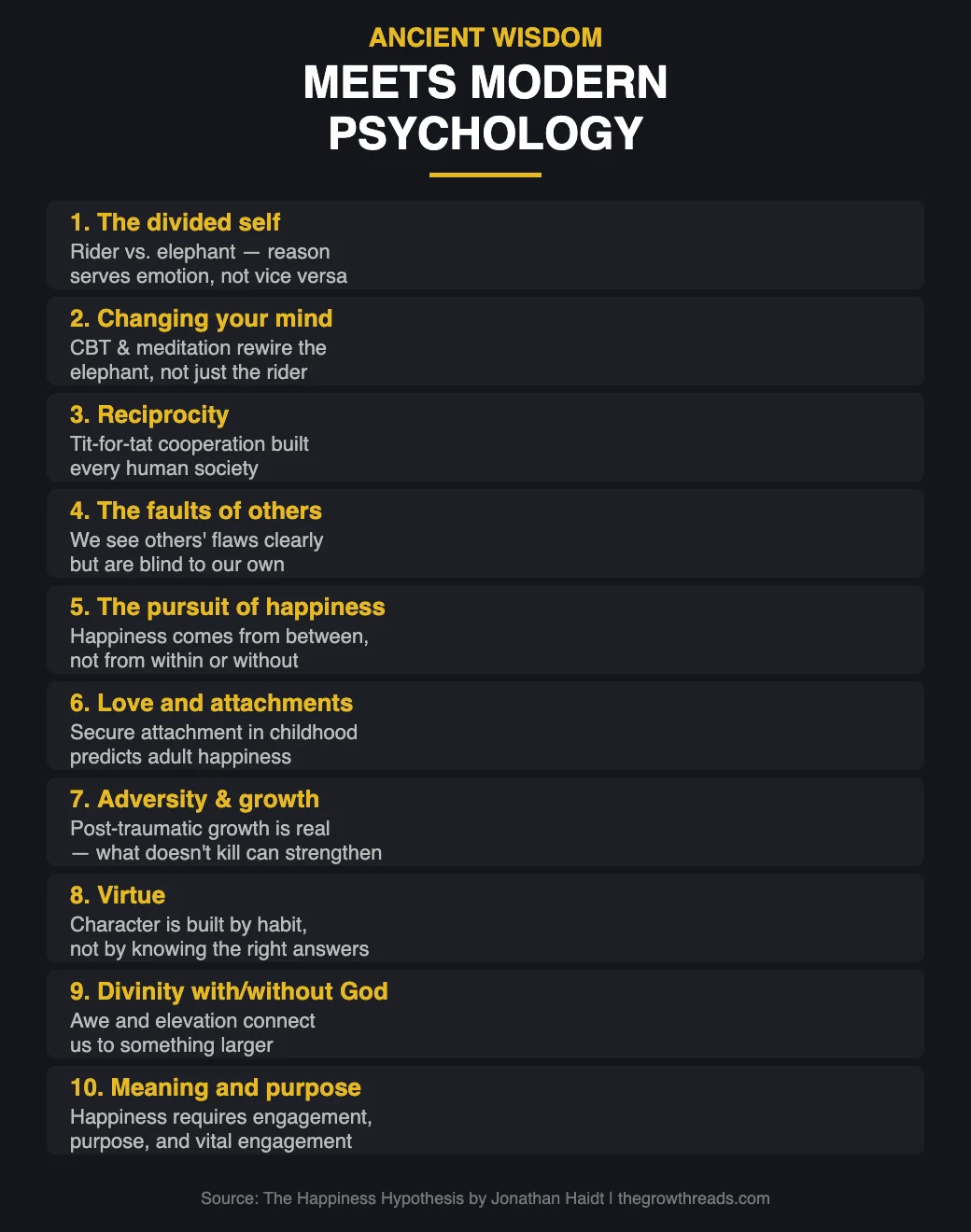
Haidt examines: (1) the divided self, (2) changing your mind through CBT and meditation, (3) reciprocity and cooperation, (4) our blindness to our own faults, (5) the pursuit of happiness itself, (6) love and attachment, (7) adversity and growth, (8) virtue as habit, (9) divinity and transcendence, and (10) meaning and vital engagement. Each chapter takes one ancient idea — from Buddha, Confucius, Jesus, or the Stoics — and tests it against modern research.
Related summaries
- Thinking, Fast and Slow by Daniel Kahneman — the cognitive science companion to the elephant-rider framework.
- Man’s Search for Meaning by Viktor Frankl — the existential companion on meaning and suffering.
- Flow by Mihaly Csikszentmihalyi — the deep dive on engagement and optimal experience.
- Best Psychology Books — our full curated list of essential psychology reads.
How we analyze books: Every book review at The Growth Reads follows a structured evaluation across five criteria: practical applicability, scientific rigor, writing quality, uniqueness of insight, and lasting impact. We read each book cover to cover, cross-reference key claims with primary research, and test the frameworks in real life before publishing. Read our full methodology.
Related Psychology Summaries
Blink Summary & Review: The Power of Thinking Without Thinking
Noise Summary & Review: The Hidden Flaw in Human Judgment
On the Move Summary & Review: A Neurologist’s Extraordinary Life of Curiosity and Courage
The Righteous Mind Summary & Review: Why Good People Disagree
The Scout Mindset Summary & Review: See Reality Clearly