

⭐⭐⭐⭐✦ 4.5/5
One-liner: The most honest, practical guide to what management actually feels like — and how to get good at it fast.
Best for: New managers in their first 1–3 years, individual contributors considering the leap, and anyone who manages people but never got a manual.
Reading time: ~5 hours (260 pages)
Difficulty to apply: Low to medium — the advice is immediately actionable and the writing is refreshingly clear.
The Making of a Manager in one minute
Management is not about authority — it is about outcomes. Julie Zhuo became a manager at Facebook at age 25 with zero preparation and spent years figuring out what the job actually is. Her conclusion: a manager’s job is to get better outcomes from a group of people working together. That means building trust, giving clear feedback, running purposeful meetings, hiring well, and creating an environment where great work happens. This book is the manual she wished she had — direct, personal, and free of corporate platitudes. It covers everything from surviving your first awkward one-on-one to scaling a team from three to thirty, with specific scripts, frameworks, and honest admissions of what new managers get wrong.
Key takeaways
- Your job is outcomes, not activities: a great manager is measured by the results of their team, not by how many meetings they attend or emails they send.
- Trust is the foundation: your reports need to believe you care about them as people and that your feedback is aimed at helping them grow, not judging them.
- Give feedback early, often, and specifically: task-specific feedback delivered weekly is infinitely more useful than vague annual reviews.
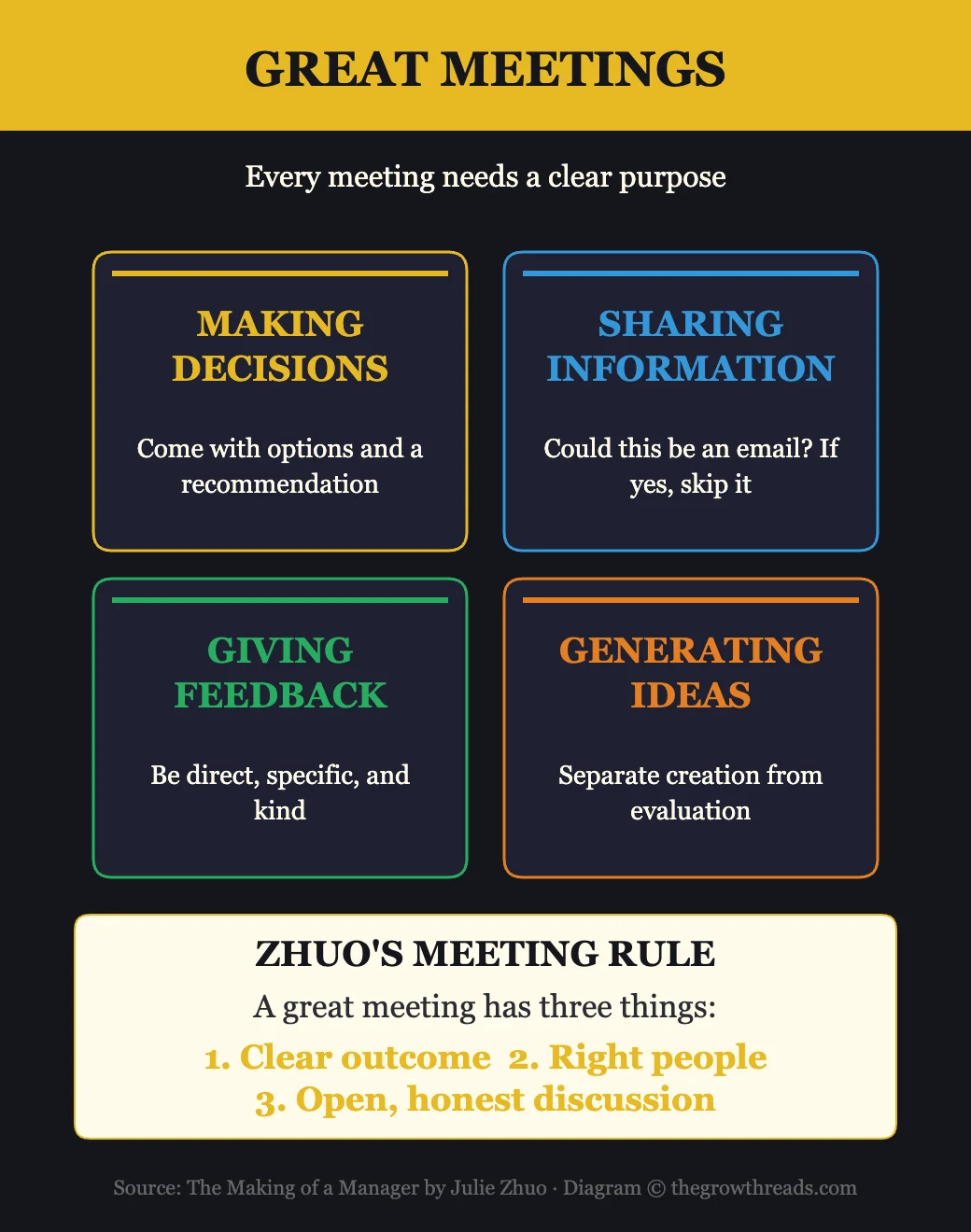
- Great meetings have three ingredients: a clear desired outcome, the right people in the room, and an open honest discussion.
- Hiring is your highest-leverage activity: getting the right person into the right role multiplies your team’s output far more than any process improvement.
- Your first three months set the tone: new managers should focus on building relationships and understanding the team before changing anything.
- Strategy means saying no: the hardest part of managing is not adding more to the roadmap — it is deciding what to cut.
- One-on-ones are for your report, not for you: use them to understand what your people need, what blocks them, and what aspirations they have.
- Growing your team means growing yourself: every new level of scale (3 people, 10 people, 30 people) requires you to develop new skills and drop old habits.
- Done is better than perfect: Zhuo’s Silicon Valley roots show — she consistently favors speed, iteration, and learning over polished but slow execution.
What is The Making of a Manager about?
The Making of a Manager is a practical guide for new and aspiring managers that covers the core responsibilities of management: building trust, giving feedback, running meetings, hiring, strategic thinking, and growing a team through successive stages of scale. Julie Zhuo draws on her experience leading design teams at Facebook from age 25 through VP level to explain what the job really entails, what most new managers get wrong, and how to develop the skills that separate good managers from great ones.
About the author
Julie Zhuo joined Facebook as one of its earliest designers and was promoted to manager at 25 — before she felt ready. Over the next decade she rose to Vice President of Product Design, building and leading a team that grew from a handful of designers to hundreds. She became one of Silicon Valley’s most respected voices on design and management through her popular blog “The Year of the Looking Glass” and her candid essays on Medium. After leaving Facebook (now Meta), she co-founded Sundial, a startup focused on helping managers improve. Her writing is distinctive for its honesty — she openly shares her early failures, her imposter syndrome, and the specific conversations that shaped her growth. Explore all Julie Zhuo book summaries →
Key concepts at a glance
| Concept | What it means | Use it when |
|---|---|---|
| Manager’s purpose | Get better outcomes from a group of people working together | You need to refocus on what actually matters in your role |
| Trust equation | People accept feedback only from those they believe care about them | Your feedback is not landing or people seem defensive |
| Task-specific feedback | Comment on the work and behavior, not the person’s character | You need to address a performance issue without damaging the relationship |
| Meeting purpose types | Every meeting should be for decisions, sharing info, feedback, or ideation | You are planning your calendar and want to cut waste |
| Hiring bar | Only hire someone you would enthusiastically work with again | You are on the fence about a candidate |
| First 90 days | Build relationships and learn context before making changes | You are new to a management role or team |
| Managing at scale | Different team sizes require fundamentally different skills | Your team is growing and old habits are not working |
| Vision as motivation | A compelling picture of the future creates alignment without micromanagement | Your team seems busy but not inspired or directionally aligned |
Part 1 — What is management?
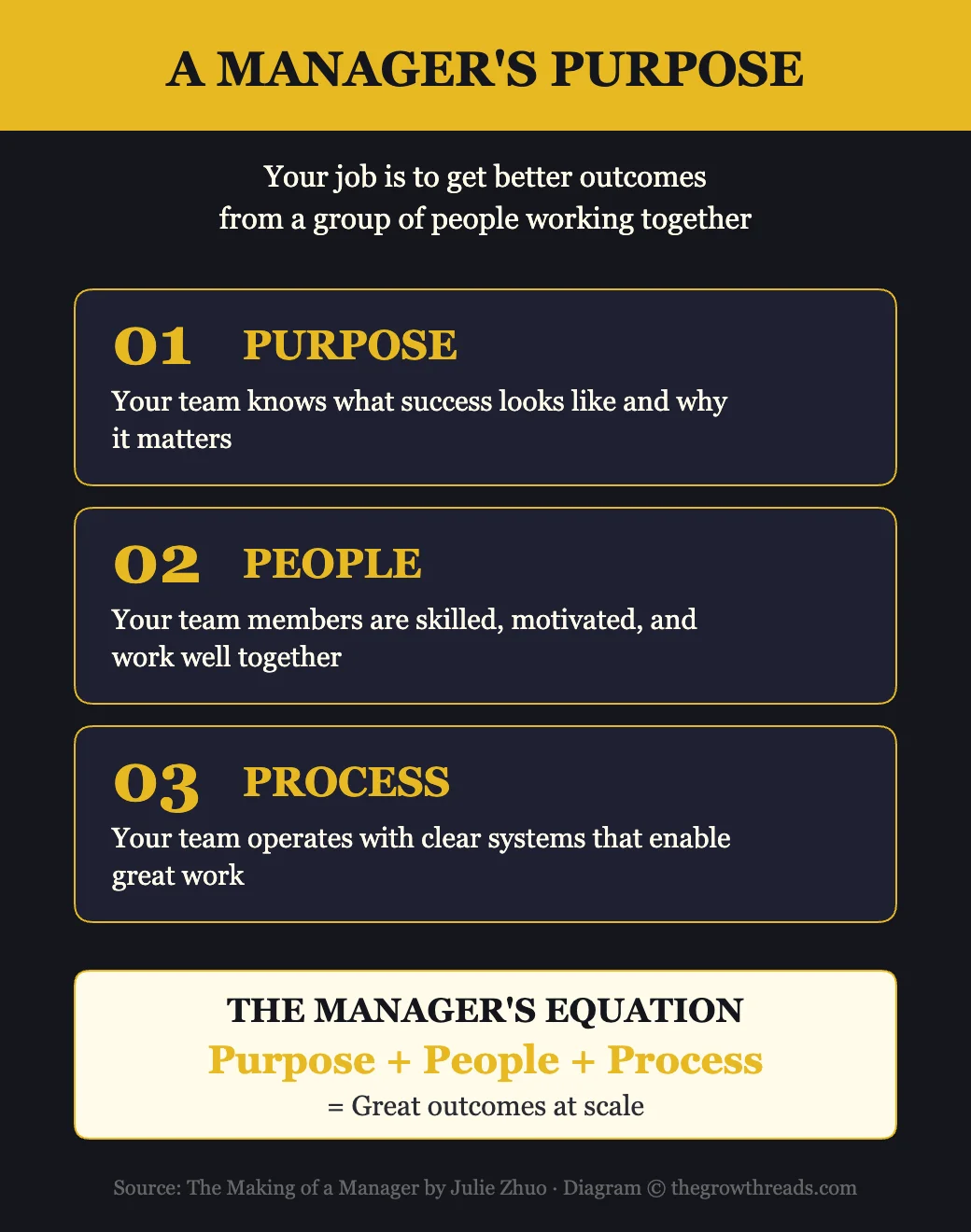
Zhuo opens with the question every new manager asks: “What am I actually supposed to do?” Her answer is deceptively simple: a manager’s job is to get better outcomes from a group of people working together. Not to have all the answers, not to be the best individual contributor, not to make everyone happy — but to produce results through others. She arrives at this definition after years of trying (and failing) at other definitions: management as being liked, management as being the expert, management as keeping everyone busy.
The three pillars of great outcomes are Purpose (the team knows what success looks like and why it matters), People (the team members are skilled, motivated, and work well together), and Process (the team operates with clear systems that enable great work). Zhuo argues that early in your management career, People dominates — building trust, understanding strengths, giving feedback. As you scale, Process becomes equally important because you cannot personally coach thirty people the way you coached three.
One of the most liberating passages in the book is her admission that she spent her first year as a manager pretending she knew what she was doing. She describes her early one-on-ones as “two people staring at each other across a table waiting for it to be over.” This honesty is what makes the book trustworthy — Zhuo earned her frameworks through mistakes, not through theory.
Part 2 — Leading your team day to day
The heart of the book covers the daily work of management: feedback, one-on-ones, and meetings. Zhuo’s treatment of feedback is particularly strong. She argues that feedback fails for one reason more than any other: the recipient does not trust the giver. If your report does not believe you genuinely care about their growth, even perfectly worded feedback will bounce off. Building that trust requires investing in the relationship before you need to deliver hard truths — knowing what motivates someone, understanding their career aspirations, and demonstrating through consistent actions that you are on their side.
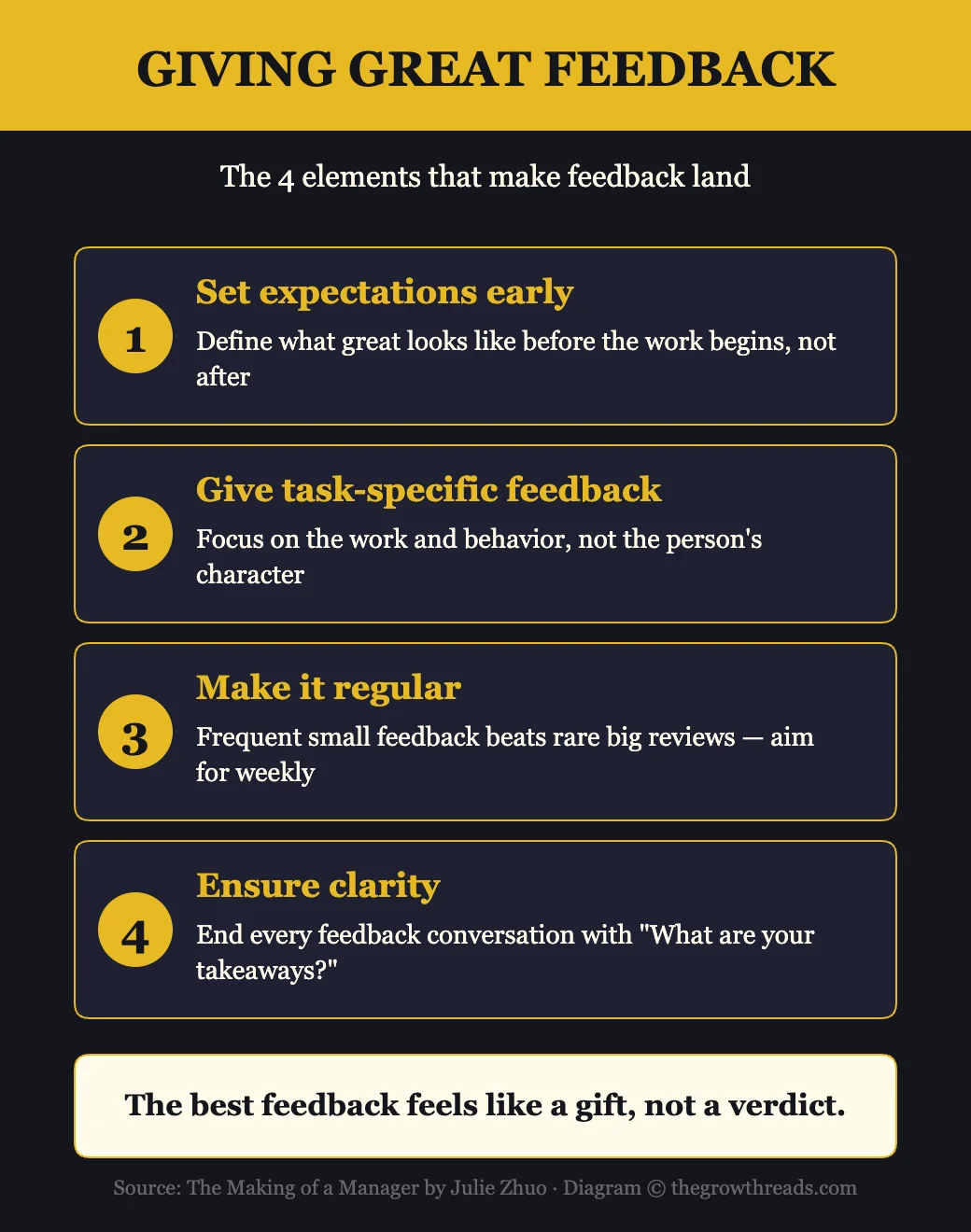
Her feedback framework has four elements: set expectations early (define what “great” looks like before the work starts), give task-specific feedback (comment on the work and behavior, not the person), make it regular (weekly beats annually), and check for understanding (“What are your takeaways from this conversation?”). She also distinguishes between feedback you give in the moment versus feedback about behavioral patterns — the latter requires collecting multiple data points and having a dedicated conversation.
On one-on-ones, Zhuo is emphatic: this meeting belongs to your report, not to you. Status updates can go in an email. The one-on-one is for understanding what your people need, what is blocking them, and where they want to grow. She shares her go-to questions: “What’s top of mind for you right now?” and “What’s your biggest challenge?” and “What can I do to support you?” She recommends at least thirty minutes weekly, and warns against canceling them — it sends the message that the relationship is not a priority.
Part 3 — Hiring and building your team
Zhuo devotes significant space to hiring — and considers it the single highest-leverage activity a manager can perform. Her reasoning is mathematical: a great hire produces exceptional work for years, compounds the performance of everyone around them, and raises the bar for future hires. A bad hire drains energy, creates rework, and often takes six months to recognize and another three to resolve. The asymmetry is enormous.
Her hiring bar is simple and memorable: only extend an offer to someone you would be excited to work with again. Not “good enough,” not “better than the other candidates” — genuinely excited. She describes a technique she learned at Facebook: after an interview, rate the candidate on a scale of 1 to 4, where 1 is “strong no” and 4 is “strong yes.” Any candidate who doesn’t receive at least one “4” from someone on the panel should not be hired, regardless of how many “3”s they collect.
She also addresses the uncomfortable topic of letting people go. Keeping someone in a role where they are failing is not kindness — it is cruelty to them (they know they are struggling), cruelty to their teammates (who pick up the slack), and neglect of your responsibility as a manager. When a role is not the right fit despite coaching, the most compassionate thing you can do is help them find a better one.
Part 4 — Managing at scale and managing yourself
The final section addresses what changes as your team grows — and what changes inside you. Zhuo describes three distinct phases: managing a small team (3–7 people, where you know everyone’s work intimately), managing a team of teams (10–30 people, where you manage through other managers), and managing a large organization (where your influence is primarily through vision, culture, and systems rather than individual relationships).
At each transition, you must let go of what made you successful at the previous level. The manager of three who personally reviewed every design must learn to trust their managers when they reach thirty. The hands-on problem-solver must become the person who sets context and lets others solve. This is emotionally difficult — it feels like you are losing what made you good. Zhuo normalizes this discomfort and argues it is the unavoidable cost of growth.
She closes with a chapter on managing yourself — your energy, your emotions, your growth. Her advice: protect your thinking time, build a support network of peers who manage at similar levels (they understand what you face better than your reports or your boss), and remember that the feelings of inadequacy never fully go away — they simply become familiar. The best managers are not the ones who have it all figured out; they are the ones who keep learning despite the discomfort.
Who is The Making of a Manager best for — and who should read something else first?
This book is ideal for first-time managers in their first three years, individual contributors considering the move to management, and experienced managers who feel like they are “winging it” and want a structured framework. It is especially relevant for managers in fast-growing tech companies where promotions happen faster than preparation.
If you are an experienced executive looking for advanced leadership strategy, High Output Management by Andy Grove covers many of the same topics at a more senior level. If your primary challenge is team dynamics rather than individual management, The Culture Code by Daniel Coyle focuses on how groups build psychological safety. If you want to go deeper on feedback specifically, Radical Candor by Kim Scott is the dedicated deep dive.
Questions to reflect on
- If you had to describe your team’s purpose in one sentence, what would it be — and would every member of your team write the same sentence?
- When was the last time you gave specific, task-level feedback to someone on your team? Was it within the last week?
- Are your one-on-ones structured around your report’s needs or your status updates? What would change if you flipped the ratio?
- Think about your last three hires. For each, were you genuinely excited — or just relieved to fill the seat?
- What skill that made you successful as an individual contributor do you need to let go of to be a better manager?
🔥 Ready to become the manager you wished you had?
Get Julie Zhuo’s playbook for leading with clarity, empathy, and results.
How to apply The Making of a Manager (7-day plan)
- Day 1 — Define your team’s purpose. Write one sentence that captures what success looks like for your team. Share it with your direct reports and ask if they agree.
- Day 2 — Audit your one-on-ones. Review your next scheduled one-on-one. Replace your status update questions with Zhuo’s: “What’s top of mind for you?” and “What’s your biggest challenge?”
- Day 3 — Give one piece of specific feedback. Pick one recent piece of work and give task-specific feedback today: what exactly was done well or could be improved, and why it matters.
- Day 4 — Evaluate your meetings. List all recurring meetings you attend. For each, write the purpose (decision, information, feedback, or ideation). Cancel or restructure any meeting without a clear purpose.
- Day 5 — Reflect on your stories. Think of a team member who frustrates you. Write down the observable facts separate from the story you are telling yourself about them. Notice the gap.
- Day 6 — Set your hiring bar. Write down three qualities that define a great hire for your team. The next time you interview, use only these criteria and rate 1–4.
- Day 7 — Identify your growth edge. Ask yourself: what skill from my IC days am I holding onto that is limiting my team? Write one specific thing you will delegate this week.
Frequently asked questions
What is The Making of a Manager about in simple terms?
The Making of a Manager is a practical guide to management for people who are new to the role or considering it. Julie Zhuo, who became a manager at Facebook at 25, shares the frameworks she developed over a decade of leading design teams. The book covers the fundamentals — building trust, giving feedback, running meetings, hiring, and growing a team — with specific scripts, honest stories of failure, and actionable advice you can use starting today.
What is a manager’s most important job according to Julie Zhuo?
According to Zhuo, a manager’s job is to get better outcomes from a group of people working together. This means your success is measured not by your individual output but by your team’s collective results. She breaks this into three pillars: Purpose (the team knows what success looks like), People (the team members are skilled and motivated), and Process (the team has clear systems for doing great work). Everything a manager does should serve one of these three pillars.
How does Julie Zhuo recommend giving feedback?
Zhuo’s feedback approach has four elements: set expectations early so people know what “great” looks like before they start, give task-specific feedback focused on the work rather than the person’s character, make feedback a regular habit rather than saving it for formal reviews, and always check for understanding by asking “What are your takeaways?” She emphasizes that feedback only lands when the recipient trusts you genuinely care about their growth.
Is The Making of a Manager worth reading for experienced managers?
While the book is primarily written for new managers, experienced managers consistently report finding value in it — particularly the sections on scaling from small teams to large organizations, the feedback framework, and the honest discussion of imposter syndrome. If you have been managing for years but never had formal training, this book fills the gaps with practical frameworks. For very senior leaders, Andy Grove’s High Output Management may be a better fit.
What should a new manager do in their first 90 days?
Zhuo recommends spending your first 90 days primarily listening and building relationships rather than making changes. Schedule one-on-ones with every team member and ask them about their goals, their challenges, and what they wish was different. Understand the team’s existing processes before deciding what to change. Identify the three to five most important outcomes your team needs to deliver and focus your early efforts there. Making big changes too quickly signals that you do not value what came before.
How is this book different from other management books?
Most management books are written by academics, consultants, or retired executives. Zhuo wrote this while still actively managing — which gives it an immediacy and honesty that more theoretical books lack. She openly shares her failures and insecurities in a way that makes the reader feel less alone. The book is also notably practical: where many leadership books stop at mindset, Zhuo provides specific questions to ask, scripts to use, and habits to build. It reads like advice from a brilliant friend rather than a textbook.
What is the difference between management and leadership?
Zhuo does not draw a hard line between the two but implies a practical distinction throughout the book. Management is the operational work: feedback, one-on-ones, hiring, process design, and day-to-day decision-making. Leadership is the directional work: setting vision, building culture, and inspiring people toward a shared future. In her framework, every manager must do both — but the ratio shifts as you scale. A manager of three spends 80% on management and 20% on leadership; a VP spends the inverse.
Related summaries
- High Output Management by Andy Grove — the classic senior-level management manual from Intel’s legendary CEO.
- Radical Candor by Kim Scott — the deep dive on feedback that pairs perfectly with Zhuo’s practical approach.
- The Culture Code by Daniel Coyle — how great teams build the psychological safety Zhuo describes.
- Best Leadership Books — our complete guide to the top leadership reads.