

⭐⭐⭐⭐⭐ 4.7/5 — A masterwork on why smart people make irrational decisions and how to recognize the hidden forces shaping every choice you make.
Best for: Anyone who wants to understand how their own mind works — especially decision-makers, investors, managers, and curious thinkers.
Reading time: ~12 hours (499 pages)
Difficulty to apply: Medium — the concepts are intuitive once you see them, but overriding your own biases takes sustained practice.
Thinking, Fast and Slow in one minute
Your mind is running two systems at once — and the fast one is in charge far more often than you realize. Daniel Kahneman, the Nobel Prize-winning psychologist, spent decades mapping the systematic errors in human judgment. His core insight: we have an intuitive, automatic System 1 that generates impressions and a deliberate, effortful System 2 that should check those impressions but is often too lazy to bother. The result is a predictable pattern of cognitive biases — anchoring, availability, loss aversion, overconfidence — that shape our decisions about money, health, happiness, and relationships. Once you see these patterns, you cannot unsee them. This book is less about thinking faster and more about knowing when to slow down.
Key takeaways
- Two systems drive all thinking: System 1 operates automatically and quickly with little effort; System 2 allocates attention to effortful mental activities. Most of your daily judgments come from System 1.
- Cognitive ease breeds overconfidence: When information feels familiar or easy to process, System 1 generates a feeling of truth — whether the information is actually accurate or not.
- Anchoring is everywhere: The first number you encounter on any topic disproportionately influences your subsequent estimates, even when that number is obviously arbitrary.
- WYSIATI (What You See Is All There Is): System 1 builds the best story it can from available information and rarely considers what might be missing. This leads to confident but incomplete judgments.
- Loss aversion shapes most decisions: People feel losses approximately twice as intensely as equivalent gains, which explains everything from irrational investing to why people refuse fair gambles.
- The remembering self decides: We have an experiencing self that lives through events and a remembering self that writes the story afterward — and the remembering self, guided by peak-end rule and duration neglect, makes our future choices.
- Regression to the mean is misunderstood: Extreme performance naturally moves toward average, but we invent causal stories — praising punishment and blaming reward — instead of recognizing statistical inevitability.
- Experts are often no better than algorithms: In many domains, simple statistical models outperform expert intuition because they apply consistent rules without being swayed by irrelevant details.
- Framing changes choices: Identical information presented differently (90% survival rate vs. 10% mortality rate) leads to dramatically different decisions, even among professionals.
- Knowing your biases does not eliminate them: Awareness helps at the margins, but the most effective strategy is redesigning the environment and decision-making process rather than relying on willpower.
What is Thinking, Fast and Slow about?
Thinking, Fast and Slow explains how the human mind uses two distinct systems — fast intuition and slow reasoning — to navigate the world. Drawing on decades of research with Amos Tversky, Kahneman reveals the systematic biases that distort our judgment about probability, risk, and happiness, and shows how understanding these patterns can lead to better decisions in every area of life.
About the author
Daniel Kahneman was born in Tel Aviv in 1934 and grew up in Nazi-occupied France before emigrating to Israel. He studied psychology at the Hebrew University and earned his PhD from UC Berkeley. His partnership with Amos Tversky produced prospect theory — the work that won Kahneman the 2002 Nobel Prize in Economics (the first psychologist to receive it). He spent most of his career at Princeton University, where he was Professor of Psychology and Public Affairs Emeritus. Kahneman passed away in March 2024 at age 90, leaving behind a body of work that fundamentally reshaped economics, medicine, law, and public policy. Explore all Daniel Kahneman book summaries →
Key concepts at a glance
| Concept | What it means | Use it when |
|---|---|---|
| System 1 / System 2 | Fast automatic vs. slow deliberate thinking | You catch yourself jumping to conclusions |
| Anchoring | First numbers bias all later estimates | Negotiating salary, pricing, or budgets |
| Availability heuristic | Memorable events feel more probable | Assessing risks after vivid news stories |
| Loss aversion | Losses hurt ~2x more than equal gains | Making investment or career change decisions |
| WYSIATI | Judging based only on information at hand | Forming opinions with incomplete data |
| Prospect theory | People evaluate outcomes relative to a reference point, not absolute value | Understanding why people refuse fair gambles |
| Peak-end rule | We remember the peak moment and the ending, ignoring duration | Designing experiences, evaluating past events |
| Regression to the mean | Extreme results naturally move toward average | Evaluating performance changes after feedback |
Part 1: Two systems — the machinery of thought
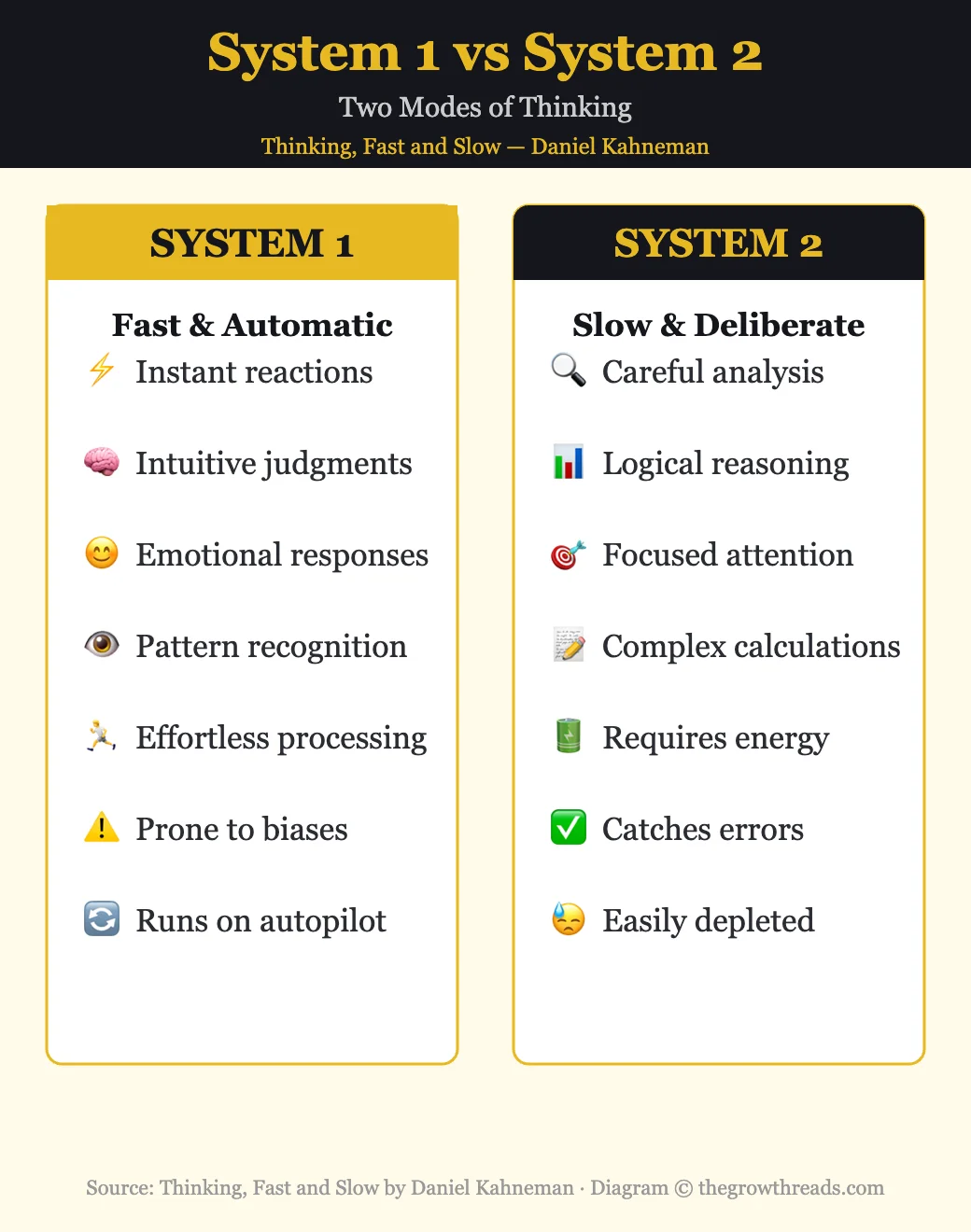
Kahneman opens with a deceptively simple framework that organizes everything that follows. System 1 is the mental machinery that lets you read facial expressions, drive on an empty road, and understand simple sentences without any sense of effort. System 2 is what you engage when you multiply 17 × 24, parallel park in a tight space, or compare two washing machines on price and features. The crucial asymmetry: System 1 runs constantly and automatically, generating impressions that System 2 usually endorses with minimal scrutiny.
The relationship between the two systems explains a phenomenon Kahneman calls cognitive ease. When something is presented in a clear font, repeated frequently, or primed by recent exposure, System 1 produces a feeling of familiarity that System 2 misreads as truth. Researchers demonstrated this by showing that stocks with easy-to-pronounce ticker symbols outperform hard-to-pronounce ones in the days following their IPO — not because the companies are better, but because fluency creates false confidence.
Attention is the critical bottleneck. In the famous “invisible gorilla” experiment by Chabris and Simons, roughly half of observers focused on counting basketball passes fail to notice a person in a gorilla suit walking through the scene. Kahneman uses this to illustrate that System 2 has a limited budget — and when that budget is spent, System 1 fills the gaps unchecked. This is not a defect; it is the design. Most of the time, System 1 does a remarkable job. The problems arise at the boundaries, where intuition meets complexity.
Part 2: Heuristics and biases — the shortcuts that mislead
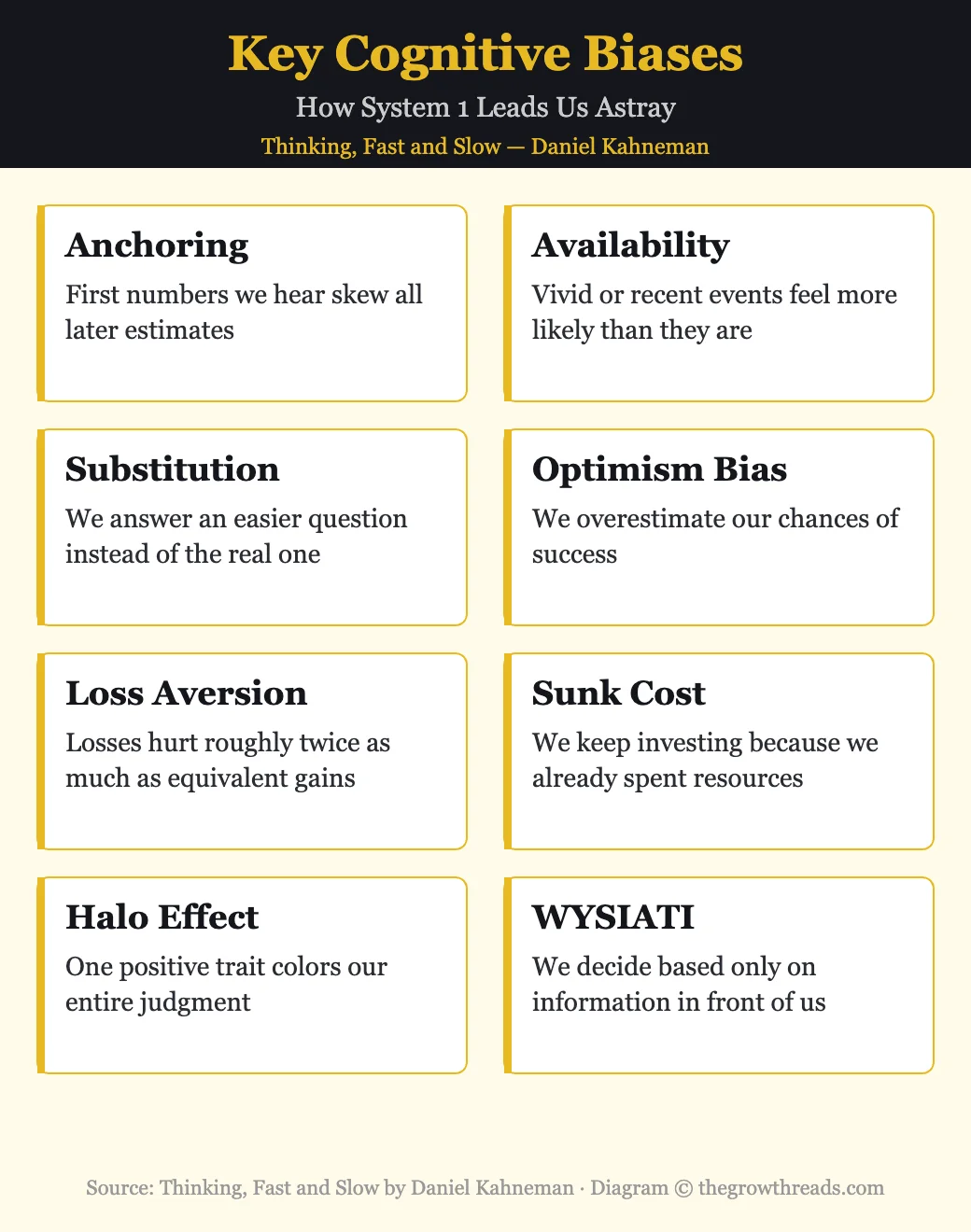
The second section is the intellectual heart of Kahneman and Tversky’s research program. They identified a specific set of mental shortcuts — heuristics — that System 1 uses to answer difficult questions quickly. These shortcuts are efficient but systematically biased.
Anchoring is perhaps the most commercially exploited bias. In one experiment, participants spun a rigged roulette wheel landing on either 10 or 65, then estimated the percentage of African nations in the United Nations. Those who saw 65 guessed significantly higher than those who saw 10 — even though the wheel was obviously random. Real-world anchoring is everywhere: retailers set high “original” prices before discounting, salary negotiations depend heavily on who names the first number, and judges give longer sentences when prosecutors request them.
The availability heuristic makes vivid, recent, or emotionally charged events feel more probable. After a plane crash, people overestimate flying risks and underestimate driving risks — despite driving being statistically far more dangerous. Media coverage amplifies this: rare but dramatic events (shark attacks, terrorism) dominate our risk perception while common but undramatic killers (diabetes, stroke) fade into the background.
Representativeness is the tendency to judge probability by resemblance rather than base rates. Kahneman’s classic “Linda problem” demonstrates this: told that Linda is 31, single, outspoken, and deeply concerned with social justice, most people judge “Linda is a bank teller and active in the feminist movement” as more probable than “Linda is a bank teller” — a logical impossibility. The detailed description fits a stereotype, and System 1 substitutes fit for probability.
The chapter on WYSIATI (What You See Is All There Is) ties these biases together. System 1 excels at constructing coherent stories from limited data. It does not flag what it does not know. This produces overconfidence: the less information you have, the easier it is to construct a tidy narrative, and the more confident you feel. Kahneman writes that confidence is a feeling generated by coherence, not by the quality or quantity of evidence.
Part 3: Overconfidence and the limits of expert judgment
Kahneman devotes several chapters to a finding that unsettles professionals across fields: expert intuition is often no better than simple algorithms. In study after study — predicting wine quality, diagnosing illness, selecting job candidates, forecasting business outcomes — statistical models that weight a few variables consistently outperform human experts. Why? Because experts are inconsistent (the same radiologist reading the same X-ray on different days reaches different conclusions 20% of the time), and because they weight irrelevant details (a candidate’s firm handshake influences the interviewer’s assessment of their analytical ability).
The exception is what Kahneman calls “legitimate expert intuition” — the kind possessed by chess masters, experienced firefighters, and seasoned clinicians in high-feedback domains. For intuition to be trustworthy, two conditions must be met: the environment must be sufficiently regular (i.e., predictable) and the expert must have had adequate opportunity to learn the regularities through prolonged practice. Stock markets, political elections, and long-term business forecasting fail both conditions — which is why pundits and fund managers perform at chance levels once you adjust for survivorship bias.
The planning fallacy receives an extended treatment. People consistently underestimate the time, cost, and risk of projects while overestimating their benefits. Kahneman’s proposed remedy is “reference class forecasting”: instead of estimating your project from the inside out, find the base rate for similar projects completed by others and adjust from there. The Sydney Opera House, planned for 6 years and $7 million, took 16 years and $102 million. Kahneman argues this is not an outlier — it is the norm, and inside views consistently produce optimistic nonsense.
Part 4: Choices — prospect theory and the two selves
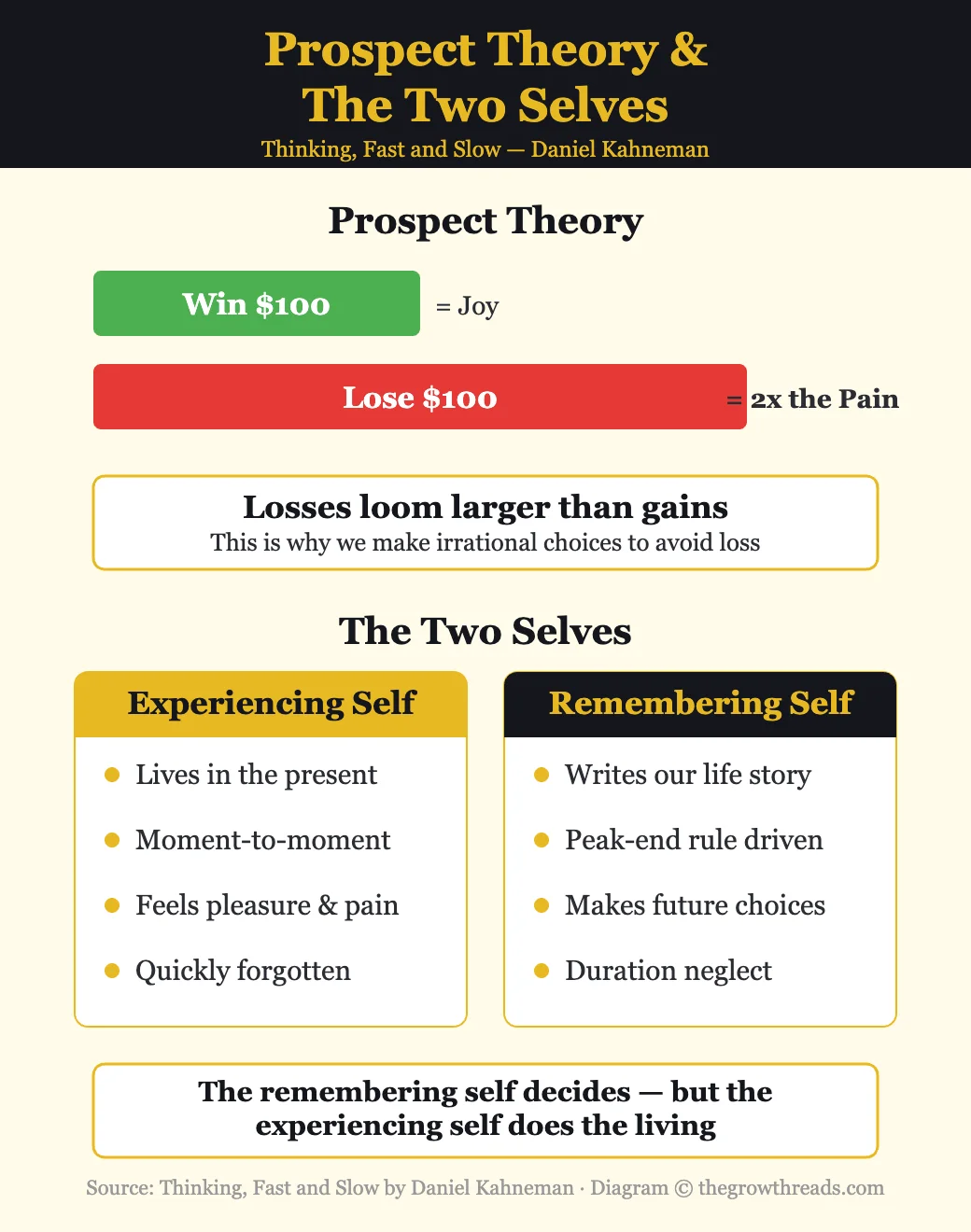
The final section presents the work that earned Kahneman the Nobel Prize. Prospect theory overturns the classical economic assumption that people evaluate outcomes by their absolute value. Instead, people evaluate outcomes relative to a reference point — typically the status quo — and they are roughly twice as sensitive to losses as to equivalent gains. A person who loses $100 feels worse than a person who gains $100 feels good, by a factor of approximately two.
This asymmetry explains a cascade of irrational behaviors. Investors hold losing stocks too long (selling would mean realizing a loss) while selling winners too early (locking in a gain feels safe). People refuse actuarially fair gambles because the potential loss looms larger than the potential gain. Insurance companies profit because customers pay a premium above expected value to eliminate the possibility of loss. The endowment effect — valuing something more simply because you own it — is loss aversion wearing a different hat.
Kahneman then turns to the gap between the experiencing self and the remembering self. In a famous experiment, patients underwent two versions of a colonoscopy. Group A experienced shorter total discomfort but ended abruptly at a peak of pain. Group B had a longer procedure but the final moments were milder. Group B rated the experience as less unpleasant and was more willing to return — even though they endured more total pain. The remembering self, Kahneman shows, follows the peak-end rule: it judges an experience by its most intense moment and its conclusion, ignoring duration almost entirely.
This has radical implications for how we design lives. A two-week vacation provides almost no more remembered happiness than a one-week vacation if the peak and ending are identical. The remembering self writes the story, and the experiencing self is largely forgotten. Kahneman asks a provocative question: which self should we optimize for? Most people, once they understand the distinction, are unsettled to realize that their future choices will be made by a self that distorts their past experiences.
Who is Thinking, Fast and Slow best for — and who should read something else first?
This book is ideal for readers who enjoy intellectually rigorous nonfiction and want the original source material behind the behavioral economics revolution. It rewards patient readers — investors trying to understand their own irrational tendencies, managers making hiring or strategy decisions, professionals in law, medicine, or policy where judgment under uncertainty is the daily work, and anyone who has ever wondered why smart people make dumb choices.
If you prefer shorter, more action-oriented books, start with The Psychology of Money for investing-specific biases or Nudge for practical applications of behavioral science to policy and personal life. If you find academic research writing challenging, Predictably Irrational by Dan Ariely covers similar terrain in a lighter style. Come back to Kahneman once you are ready for the deep dive.
Questions to reflect on
- Think of a recent important decision you made. Can you identify where System 1 generated the initial impression and whether System 2 actually checked it?
- What anchors are influencing your current financial decisions — a purchase price, a salary offer, a market peak — and how would you evaluate the situation if you had never seen that number?
- When you assess risks (health, career, investment), are you basing your estimates on statistical base rates or on vivid stories you can easily recall?
- Consider a past experience you remember as negative. Was it genuinely bad throughout, or does the peak-end rule explain why it feels worse in memory than it actually was?
- If you could design your next week to optimize for your experiencing self instead of your remembering self, what would you change?
🔥 Ready to understand the hidden forces behind every decision you make?
Thinking, Fast and Slow is the foundational text on human judgment — read it and you will never see your own thinking the same way again.
How to apply Thinking, Fast and Slow (7-day plan)
- Day 1 — Label your systems: Throughout the day, pause before three decisions and ask: “Is this System 1 reacting or System 2 analyzing?” Write down each instance in a notes app. The goal is not to change behavior yet — just to notice.
- Day 2 — Spot your anchors: Before any financial decision today (a purchase, an estimate, a negotiation), write down your independent estimate before seeing any external number. Compare afterward to see how much the anchor shifted you.
- Day 3 — Test your availability bias: Pick one risk you worry about (flying, crime, a health scare). Look up the actual base rate. Compare it to how probable it “feels.” Note the gap between feeling and data.
- Day 4 — Run a pre-mortem: Take your most important current project or goal. Imagine it has failed spectacularly one year from now. Write down the three most likely reasons. This overcomes overconfidence by forcing System 2 to generate failure scenarios.
- Day 5 — Apply reference class forecasting: For any deadline or budget you are estimating, find out how long similar projects took for other people (not just your optimistic inside view). Adjust your estimate toward the base rate.
- Day 6 — Design for the peak-end rule: Plan your weekend or an upcoming experience to have a clear positive peak and a pleasant ending, rather than maximizing total duration. Notice how this changes your anticipation and later memory.
- Day 7 — Build a decision checklist: Based on the biases you caught this week, create a personal checklist of 3–5 questions to ask yourself before any important decision: Am I anchored? Am I ignoring base rates? Am I feeling overconfident because the story is coherent?
Frequently asked questions
Is Thinking, Fast and Slow still relevant?
Yes. While some individual studies cited in the book have faced replication challenges (particularly social priming experiments in Chapter 4), the core frameworks — System 1/System 2, prospect theory, anchoring, availability, and loss aversion — have been replicated extensively and remain foundational in behavioral science. Kahneman himself acknowledged the replication concerns publicly. The practical value of the mental models is undiminished, and the book remains the best single introduction to how human judgment actually works.
What is the main idea of Thinking, Fast and Slow?
The central idea is that human thinking is governed by two systems: System 1 (fast, automatic, intuitive) and System 2 (slow, deliberate, analytical). Most of our judgments come from System 1, which is efficient but prone to systematic biases. System 2 can catch errors but is lazy and easily depleted. Understanding this dual-process architecture helps explain why intelligent people make predictable mistakes in judgment, finance, risk assessment, and happiness.
How long does it take to read Thinking, Fast and Slow?
At an average reading speed of about 40 pages per hour, the 499-page book takes approximately 12–13 hours to read cover to cover. However, this is dense material — many readers spread it over 3–4 weeks, reading one section at a time and reflecting between sessions. The audiobook runs about 20 hours. It is not a book you race through; the value comes from pausing to test each concept against your own experience.
What is prospect theory in simple terms?
Prospect theory says people evaluate gains and losses relative to a reference point (usually their current situation), not in absolute terms. Losing $100 feels about twice as bad as gaining $100 feels good. This “loss aversion” explains why people hold losing investments too long, buy unnecessary insurance, and refuse fair bets. It also explains the endowment effect — once you own something, giving it up feels like a loss, so you demand more to sell it than you would pay to buy it.
What are System 1 and System 2 thinking?
System 1 is the fast, automatic mode — it recognizes faces, reads emotions, completes the phrase “bread and ___,” and generates gut reactions without effort. System 2 is the slow, controlled mode — it handles complex math, weighs pros and cons, and follows multi-step instructions. System 1 runs by default and produces most of our daily judgments. System 2 takes over only when the task is novel, difficult, or when System 1 runs into trouble. The problem is that System 2 is lazy and often accepts whatever System 1 suggests.
What is the peak-end rule?
The peak-end rule is the finding that people judge past experiences primarily by two moments: the most intense point (peak) and the final moments (end). Duration is largely ignored. A 30-minute massage with a wonderful peak and gentle ending is remembered more favorably than a 60-minute massage that was uniformly pleasant. This has practical implications for designing customer experiences, vacations, and even medical procedures — make sure the peak is positive and the ending is gentle.
Can you actually overcome cognitive biases?
Kahneman is refreshingly honest: knowing about biases does not eliminate them. You will still feel anchoring effects even after reading this book. The most effective strategies are environmental, not willpower-based: use checklists to force System 2 engagement, employ reference class forecasting instead of inside-view estimates, make decisions based on pre-set criteria rather than gut feel, and introduce structured decision-making processes (like pre-mortems) to counteract overconfidence. The goal is not to become unbiased — it is to build systems that reduce the damage biases cause.
Related summaries
- Predictably Irrational by Dan Ariely — a lighter, experiment-rich tour of behavioral economics
- The Psychology of Money by Morgan Housel — Kahneman’s insights applied specifically to investing and wealth
- Influence by Robert Cialdini — how persuasion professionals exploit the biases Kahneman discovered
- Best Psychology Books — The Growth Reads
Related Psychology Summaries
Outliers Summary & Review: Why Success Is Never a Solo Act
Radical Acceptance Summary and Review
Sapiens Summary & Review: How Shared Fictions Built the Modern World
The Paradox of Choice Summary & Review: Why Less Is More for Happiness
When the Body Says No Summary & Review: How Suppressed Emotion Makes You Sick