

⭐⭐⭐⭐ 4.0 / 5
One-liner: A sweeping investigation into why your ability to focus is declining — and why the fix is bigger than willpower.
Best for: Anyone who feels increasingly distracted, parents worried about screen time, professionals seeking systemic solutions to the attention crisis
Reading time: ~6 hours (352 pages)
Difficulty to apply: Medium-high — individual strategies are actionable, but Hari argues the deepest fixes require societal change
Stolen Focus in one minute
Your shrinking attention span is not your fault. Johann Hari spent three years interviewing the leading experts on attention — neuroscientists, tech insiders, educators, and psychologists — and concluded that we are living through an unprecedented attention crisis driven by at least twelve converging forces. From the surveillance capitalism business model that profits from distraction, to chronic sleep deprivation, speed culture, pollution, and deteriorating diets, Hari argues that individual willpower is hopelessly outmatched. The book identifies three layers of attention under siege: spotlight (focusing on immediate tasks), starlight (maintaining long-term goals), and daylight (knowing what you truly want). While Hari offers personal strategies, his central argument is radical — we need collective, structural change to reclaim the ability to think deeply.
Key takeaways
- Attention has three layers: Spotlight attention (focusing on one task), starlight attention (long-term purpose), and daylight attention (self-knowledge about what you truly want). All three are under attack.
- The average worker switches tasks every 3 minutes: Research by Gloria Mark at UC Irvine found that after an interruption, it takes an average of 23 minutes to return to the same depth of focus.
- Technology is designed to steal your focus: Social media platforms employ thousands of engineers using persuasive design techniques — infinite scroll, variable rewards, notification triggers — to maximize “engagement” (time on app).
- Surveillance capitalism is the root cause: The business model of most tech companies requires capturing and holding your attention to sell to advertisers. Distraction is not a bug; it is the product.
- Sleep loss devastates attention: 40% of Americans are chronically sleep-deprived, and even modest sleep loss (one hour less per night) significantly impairs concentration, memory, and emotional regulation.
- Mind-wandering is not wasted time: When your mind wanders freely, it performs essential functions — consolidating memories, making creative connections, and processing emotions. Constant stimulation suppresses this.
- Flow states require protection: Mihaly Csikszentmihalyi’s research shows that deep focus requires uninterrupted blocks. The current environment makes sustained flow increasingly rare.
- Children are the most affected: Kids who spend more time on screens show reduced ability to read facial expressions, lower empathy scores, and diminished capacity for sustained attention.
- Individual solutions are necessary but insufficient: Personal habits like phone-free mornings help, but the systemic forces — algorithmic feeds, the attention economy, environmental toxins — require policy solutions.
- The attention crisis is a political issue: A society that cannot pay attention cannot solve complex problems like climate change, inequality, or democratic governance. Stolen focus has civilizational consequences.
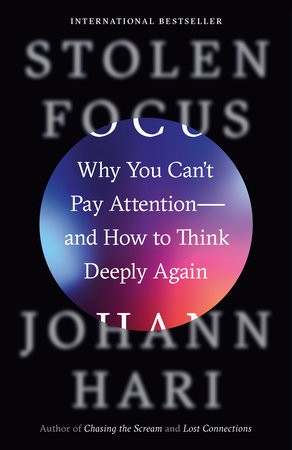
What is Stolen Focus about?
Stolen Focus investigates why human attention is declining at an unprecedented rate. Johann Hari identifies twelve interconnected causes — from technology design and surveillance capitalism to sleep deprivation, stress, and environmental pollution — and argues that reclaiming deep focus requires both personal habit changes and systemic reform of the attention economy.
About the author
Johann Hari is a British-Swiss journalist and author whose previous books include Chasing the Scream (on the war on drugs) and Lost Connections (on depression and its social causes). His TED Talks have been viewed over 80 million times. Hari is known for embedding himself in his subjects — for Stolen Focus, he traveled to interview experts across multiple continents and spent three months in Provincetown, Massachusetts, without a smartphone to test his own capacity for deep attention. A former columnist for The Independent, Hari writes at the intersection of science, politics, and personal narrative. Explore all Johann Hari book summaries →
Key concepts at a glance
| Concept | What it means | Use it when |
|---|---|---|
| Spotlight attention | Narrowing focus on one immediate task | You need to do deep, concentrated work |
| Starlight attention | Long-term goals that guide daily choices | Setting priorities and saying no to distractions |
| Daylight attention | Self-awareness of what you truly want | Making career or life direction decisions |
| Surveillance capitalism | Business model that profits from capturing attention | Understanding why apps are designed to be addictive |
| Cruel optimism | Believing tech will improve life while it degrades it | Evaluating your relationship with devices |
| Flow state fragility | Deep focus requires unbroken time blocks to emerge | Structuring your workday for concentration |
| Pre-commitment | Locking yourself into focus before temptation arrives | Building systems that make distraction harder |
| Mind-wandering value | Unfocused time is when the brain does essential work | Scheduling downtime without guilt |
Part 1: The attention crisis
Hari opens with a personal confession: despite writing books about human behavior, he found himself unable to read a book to completion. He could not sustain focus for more than a few pages before reaching for his phone. This experience — universally recognizable — launched a three-year investigation.
The first force Hari examines is speed and switching. Gloria Mark, a professor at UC Irvine who has studied attention in the workplace for decades, wired up office workers and tracked their behavior in real time. She found that the average worker switches tasks every three minutes and five seconds. After each interruption, it takes approximately 23 minutes to return to the original depth of focus — if they return at all. Mark calls this “attention residue”: a piece of your mind stays stuck on the previous task even after you have moved on.
The second force is the collapse of sustained flow. Hari revisits Mihaly Csikszentmihalyi’s flow research and argues that the conditions for flow — clear goals, immediate feedback, a match between challenge and skill, and crucially, uninterrupted time — are being systematically dismantled by the modern environment. You cannot enter flow if your phone buzzes every ninety seconds.
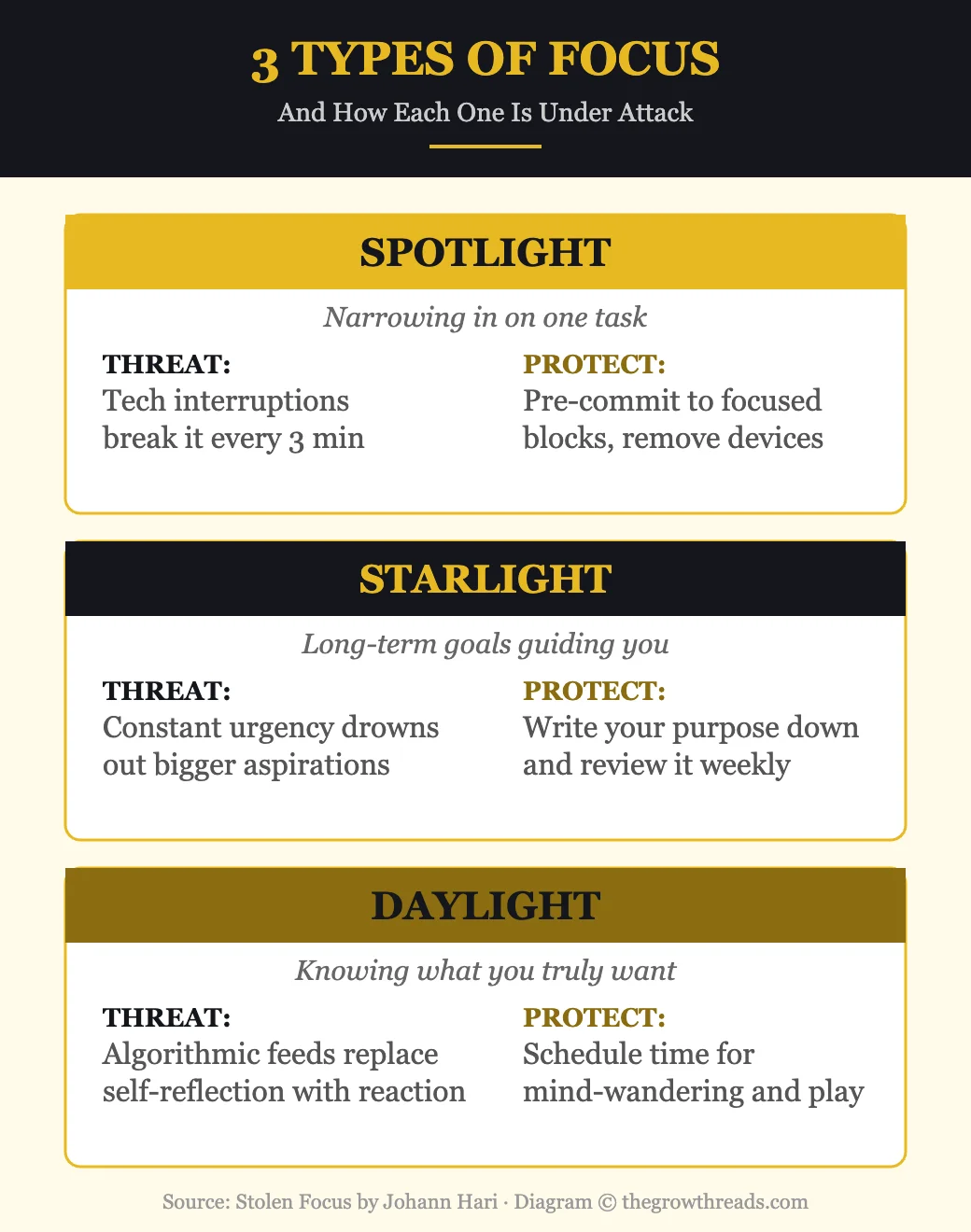
Hari introduces his three-layer model of attention. Spotlight attention is what most people think of — the ability to concentrate on one thing. Starlight attention is the capacity to maintain long-term goals that guide your daily actions (like a sailor navigating by stars). Daylight attention is the deepest layer: knowing what your goals should be in the first place, understanding what you truly value. All three layers, he argues, are degrading simultaneously.
Part 2: The forces stealing your focus
The heart of the book is Hari’s tour through twelve causes of the attention crisis. The most provocative chapters concern technology and its business model. Hari interviews Aza Raskin, the inventor of infinite scroll, who expresses regret about his creation. Raskin explains that infinite scroll was designed to eliminate “stopping cues” — natural break points where a user might decide to close the app. Without them, people scroll far longer than they intend to. Raskin estimates that infinite scroll causes users to spend an additional 200,000+ lifetimes per day on social media globally.
Hari then examines surveillance capitalism — a term coined by Shoshana Zuboff — as the engine driving attention theft. The business model is simple: tech companies make money by selling your attention to advertisers. The more time you spend on the platform, the more ads you see, the more revenue the company generates. This means every engineer at these companies is incentivized to make the product more addictive. Hari compares this to the food industry engineering hyper-palatable foods that override satiety signals: tech companies engineer hyper-engaging feeds that override your intention to stop scrolling.
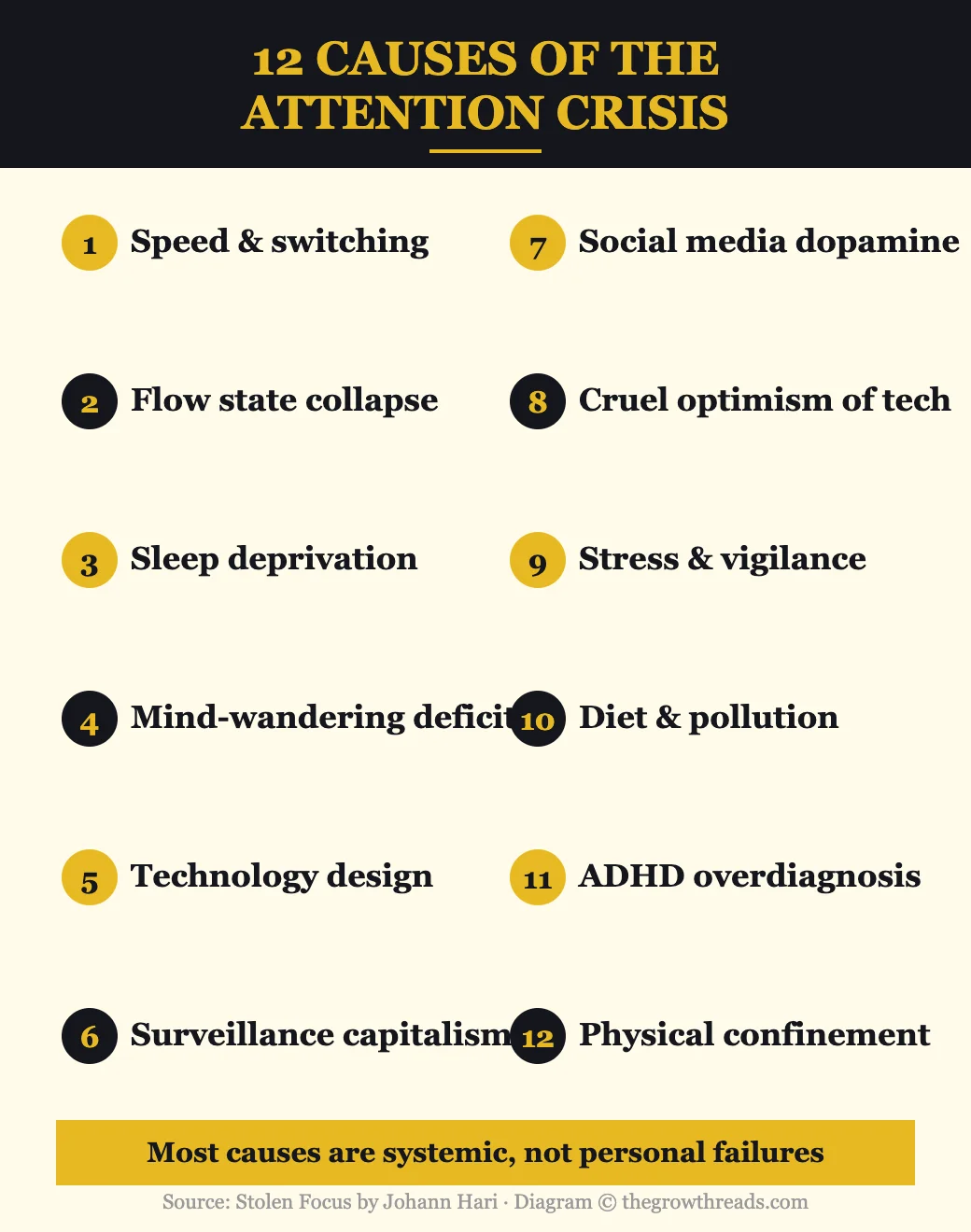
Beyond technology, Hari explores physical causes. Sleep deprivation — affecting 40% of Americans — degrades every dimension of cognition. Processed food and environmental pollutants impair brain function in ways most people never consider. Stress and hypervigilance, driven by economic insecurity and a culture of overwork, keep the brain in fight-or-flight mode, which is the neurological opposite of focused attention.
One of the book’s most important chapters examines children. Hari documents how screen time reduces children’s ability to read facial expressions, lowers empathy scores, and disrupts the development of sustained attention. He visits schools that have eliminated screens and found dramatic improvements in concentration, creativity, and social skills.
Part 3: Mind-wandering and the value of boredom
One of Hari’s most counterintuitive arguments is that mind-wandering is not the enemy of attention but an essential component of it. He interviews neuroscientist Nathan Spreng, who studies the brain’s default mode network — the system that activates when you are not focused on an external task. Far from being idle, this network performs critical functions: consolidating memories, making creative connections between disparate ideas, processing emotions, and simulating future scenarios.
The problem with constant stimulation — checking your phone every few minutes, filling every quiet moment with a podcast or music — is that it suppresses the default mode network. You never give your brain the unfocused downtime it needs to do its background processing. Hari argues this is why people report feeling simultaneously overstimulated and uncreative: they are drowning in input but starving for synthesis.
He draws a powerful parallel: just as muscles need rest days between workouts, attention needs periods of unfocused wandering between periods of concentrated work. The current environment, with its infinite content streams, has eliminated the “rest days” for our minds.
Part 4: Solutions — individual and collective
Hari is candid that his personal experiment — three months without a smartphone in Provincetown — was life-changing. His ability to read returned. His conversations deepened. His creativity surged. But he is equally candid that this solution is a privilege most people cannot afford. A single mother working two jobs cannot simply “disconnect.”
At the individual level, Hari recommends pre-commitment (using tools like app blockers and phone lockboxes before temptation strikes), protecting extended periods for flow, prioritizing sleep, building in time for genuine mind-wandering (walks without headphones, sitting without a screen), and slowing down — doing fewer things with more presence.
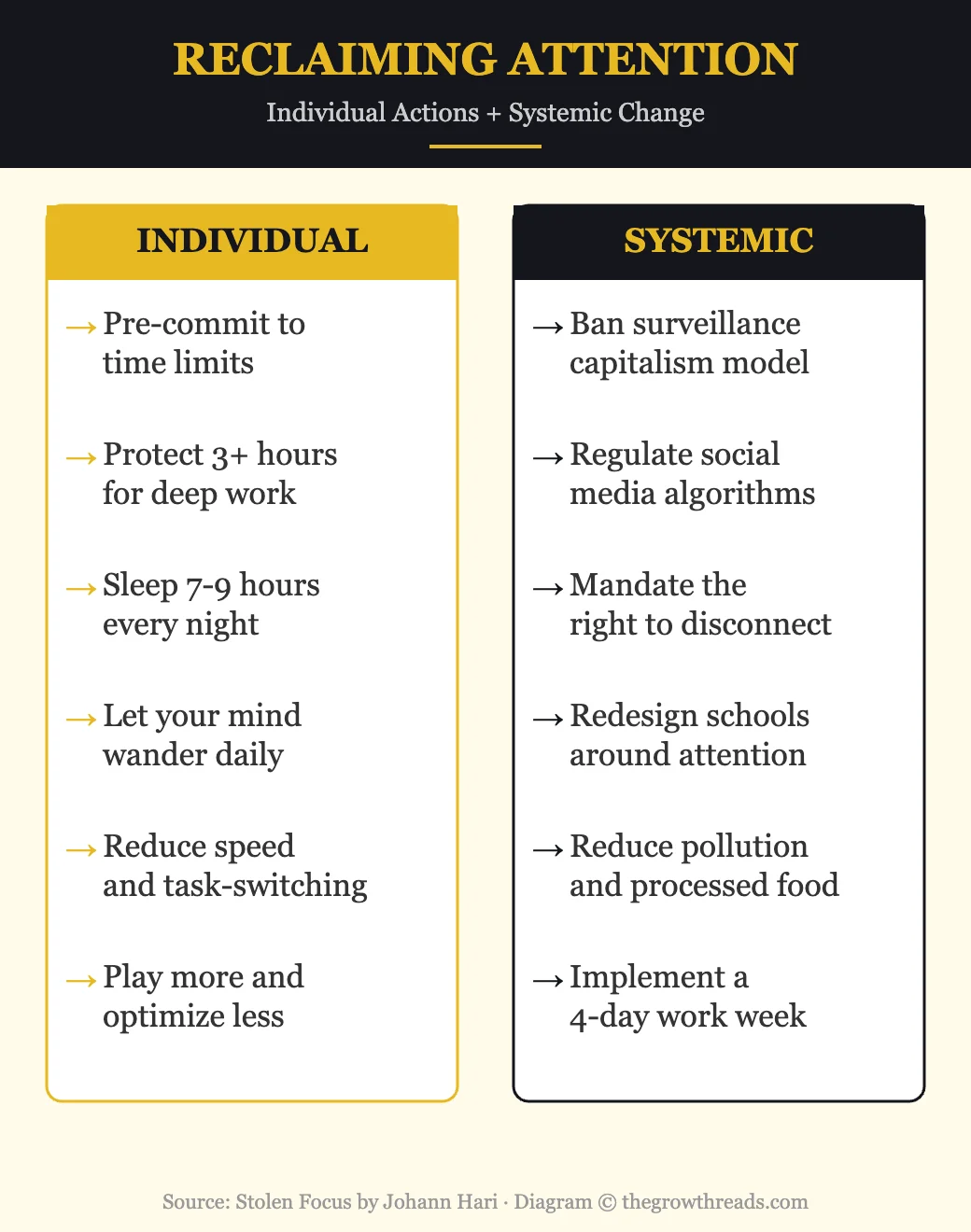
But the book’s most provocative argument is that individual solutions are insufficient. Hari calls for banning the surveillance capitalism business model (shifting social media to subscription or public-utility models), implementing a four-day work week (which trials in Iceland showed improved both productivity and well-being), redesigning schools around attention and play rather than standardized testing, and giving children the legal right to play freely outdoors. These are political proposals, not self-help tips — and Hari argues that is precisely the point. The attention crisis is a political problem masquerading as a personal failure.
Who is Stolen Focus best for — and who should read something else first?
Read this if: You sense your attention is declining and want to understand the systemic forces behind it. You are a parent navigating children’s screen time. You manage a team and want to understand why deep work is so hard to sustain. You care about policy solutions, not just personal productivity hacks.
Read something else first if: You want a tactical system for eliminating phone distractions right now (start with Indistractable). You want to build a structured deep-work practice (try Deep Work). You want the neuroscience of sleep’s role in cognition (read Why We Sleep).
Questions to reflect on
- How many times have you checked your phone today without a specific purpose? What were you avoiding or seeking in those moments?
- When was the last time you let your mind genuinely wander — no podcast, no music, no phone — for more than ten minutes?
- Do you primarily lose spotlight attention (can’t focus on a task), starlight attention (lost sight of long-term goals), or daylight attention (unsure what you really want)?
- If the business model of social media changed tomorrow — from ad-funded to subscription — how would your usage change?
- What would your ideal relationship with technology look like, and what is the single biggest barrier to getting there?
🔥 Ready to understand why your attention is under siege?
Discover the twelve forces stealing your focus and what you can do about them
How to apply Stolen Focus (7-day plan)
- Day 1 — Track your interruptions: Set a timer and note every time you switch tasks or check your phone. Count your total switches by end of day. The number will shock you into action.
- Day 2 — Create a phone-free morning: Keep your phone in another room for the first 60 minutes after waking. Use this time for reading, thinking, or conversation.
- Day 3 — Pre-commit to a focus block: Use an app blocker (Freedom, Cold Turkey, or a physical lockbox) to eliminate social media access during a 3-hour deep work block.
- Day 4 — Schedule mind-wandering: Take a 30-minute walk with no headphones, no phone, no destination. Let your thoughts go wherever they want.
- Day 5 — Fix one sleep habit: Set a hard screens-off time 60 minutes before bed. Replace the screen with a physical book or conversation.
- Day 6 — Audit your feeds: Unfollow or mute every account that does not genuinely inform or inspire you. Reduce your feed to signal, not noise.
- Day 7 — Reflect and commit: Write down: what was different about this week? Pick the two changes that made the biggest difference and commit to them for the next month.
Frequently asked questions
What is the main argument of Stolen Focus?
Stolen Focus argues that the global decline in attention is not caused by personal weakness but by at least twelve systemic forces — including technology designed to be addictive, surveillance capitalism, sleep deprivation, stress, pollution, and deteriorating diets. Hari contends that while individual strategies help, reclaiming deep focus requires collective, structural changes to the attention economy, work culture, and education systems.
What are spotlight, starlight, and daylight attention?
These are Hari’s three layers of attention. Spotlight is the ability to focus on one immediate task (like reading a page). Starlight is the capacity to maintain long-term goals that guide your daily choices (like working toward a career change). Daylight is the deepest layer — the self-awareness to know what you truly want in life. Hari argues all three are degrading simultaneously under modern conditions.
Does Johann Hari blame individuals for their distraction?
No — and this is one of the book’s central points. Hari argues that telling people to simply “put down your phone” is like telling people in a polluted city to “just breathe less.” Individual willpower cannot overcome systems designed by thousands of engineers to capture attention. He advocates for personal strategies as a first step, but insists the real solutions are structural: changing business models, regulating algorithms, and redesigning work and school environments.
What does Stolen Focus say about social media?
Hari describes social media platforms as attention-extraction machines. He interviews former tech insiders including Aza Raskin (inventor of infinite scroll) and ex-Google engineer James Williams, who explain how engagement-maximizing algorithms deliberately exploit psychological vulnerabilities — variable reward schedules, social validation loops, outrage amplification — to keep users scrolling. Hari’s proposed solution is to ban the surveillance capitalism model and replace it with subscription or public-utility models.
How does Stolen Focus compare to Deep Work by Cal Newport?
Both books address the crisis of diminishing focus, but from different angles. Newport takes a tactical, individual approach — here are the systems and routines you need to protect deep work. Hari takes a diagnostic, systemic approach — here are the forces destroying your attention and why individual tactics alone are not enough. Newport focuses on professional output; Hari encompasses health, democracy, children, and society. The books complement each other well.
Is Stolen Focus anti-technology?
Not exactly. Hari distinguishes between technology as a tool and the business model that currently drives it. He does not argue that smartphones or social media are inherently destructive. His argument is that when these platforms are funded by surveillance capitalism — where profit depends on maximizing time-on-screen — they are inevitably designed to be addictive. Change the business model, and you change the incentives. Hari is anti-surveillance-capitalism, not anti-technology.
How long does it take to read Stolen Focus?
The book is approximately 352 pages and takes about 5–6 hours to read at an average pace. Hari writes in an accessible, narrative journalism style that moves quickly through interviews, research findings, and personal anecdotes. The audiobook, narrated by Hari himself, runs approximately 8 hours and 22 minutes. Many readers find the personal stories and expert interviews make it a faster read than its page count suggests.
Related summaries
- Deep Work by Cal Newport — the tactical playbook for building sustained concentration habits
- Indistractable by Nir Eyal — a step-by-step system for becoming impervious to distraction
- Digital Minimalism by Cal Newport — how to intentionally curate your relationship with technology
- Best Productivity Books — our full ranked list of must-read productivity titles
Related Productivity Summaries
Joy at Work Summary & Review: The KonMari Method for Your Professional Life
The 5 Second Rule Summary & Review: Stop Overthinking, Start Moving
The Now Habit Summary & Review: A Strategic Program for Overcoming Procrastination
The Pomodoro Technique Summary & Review: 25 Minutes to Real Focus
The War of Art Summary & Review: How to Defeat Resistance and Do Your Work