

★★★★ 4.3/5 — a punchy, battle-tested leadership manual built on one radical idea: the leader owns everything. Repetitive in structure, but the principles are gold.
Best for: leaders, managers, and anyone who wants to stop blaming and start owning their outcomes · Reading time: ~6 hours (this guide: 16 min) · Difficulty to apply: Moderate — the mindset is simple to state, humbling to live
Extreme Ownership in one minute
The best leaders take ownership of everything in their world — there is no one else to blame. Former Navy SEAL officers Jocko Willink and Leif Babin, who led the most decorated special-operations unit of the Iraq War in the brutal Battle of Ramadi, distill their hardest-won leadership lessons into a set of principles that translate directly to business and life. The foundation is Extreme Ownership: a leader owns every failure, every mistake by the team, and every shortfall in results, because the moment you blame others or circumstances, you give away your power to fix the problem. From this flow a series of battlefield-tested “laws of combat” — teamwork, simplicity, prioritizing and executing, and empowering your people to lead. Each chapter pairs a vivid combat story with the principle it taught and a business case where the same principle applied. The structure is formulaic, but the core message is bracing and genuinely transformative: stop making excuses and own it, all of it.
Key takeaways
- Extreme Ownership: the leader is responsible for everything in their world — no excuses, no blaming others or circumstances.
- There are no bad teams, only bad leaders: leadership is the single greatest factor in a team’s performance.
- You must believe in the mission: if you don’t understand and believe in the “why,” you can’t lead others to it.
- Check the ego: ego clouds judgment and blocks ownership; humility is essential to lead well.
- Cover and move: teamwork — every element must support the others toward the overall goal.
- Keep it simple: plans and orders must be clear enough that everyone understands and can execute them.
- Prioritize and execute: when overwhelmed, relax, look around, determine the highest priority, and execute it — one at a time.
- Decentralized command: empower subordinate leaders to make decisions; no one can manage everything alone.
- Plan thoroughly, then brief simply: a good planning process reduces risk and aligns the team.
- Discipline equals freedom: self-discipline in the small things creates the freedom to succeed in the big ones.
What is Extreme Ownership about?
Extreme Ownership is a leadership book by former Navy SEALs Jocko Willink and Leif Babin. Its central principle is that leaders must take total responsibility for everything in their sphere — failures included — rather than blaming others or circumstances. Drawing on combat experience, it lays out practical leadership laws for teams, decisions, and execution that apply directly to business and life.
About the authors
Jocko Willink and Leif Babin are retired US Navy SEAL officers who served together in SEAL Team Three’s Task Unit Bruiser during some of the fiercest urban combat of the Iraq War, in Ramadi. Willink was the task unit commander and Babin a platoon commander, and their unit became one of the most highly decorated of the war. After leaving the military, they founded Echelon Front, a leadership consultancy that teaches their principles to businesses and organizations, which is where the book’s business case studies come from. Willink has since become widely known for his podcast and his ethos of discipline, captured in the phrase “Discipline Equals Freedom.” Published in 2015, Extreme Ownership became a bestseller and a fixture on corporate leadership reading lists. Its authority comes from the fact that these principles were forged in life-or-death conditions and then proven again in the boardroom.
Key concepts at a glance
| Principle | What it means | Use it when |
|---|---|---|
| Extreme Ownership | Own everything; no excuses | Something on your team fails |
| No bad teams | Leadership drives performance | A team is underperforming |
| Cover and move | Teams support one another | Groups are working in silos |
| Keep it simple | Clear, executable plans | Instructions get confused |
| Prioritize and execute | One highest priority at a time | You’re overwhelmed |
| Decentralized command | Empower others to lead | You’re a bottleneck |
Part 1: Winning the war within — Extreme Ownership
The book’s foundation is the title principle, illustrated with a story in which a mission went badly wrong. In the chaos of Ramadi, a friendly-fire incident occurred, and as commander, Willink’s instinct — like anyone’s — was to find who was at fault. Instead, standing before his superiors and his men, he took total ownership: it was his responsibility, full stop. The counterintuitive result was that this built trust and made the whole unit stronger. Extreme Ownership means that as a leader, everything that happens in your world is your responsibility — not because you literally caused it, but because owning it is the only stance from which you can actually fix it. Blaming subordinates, other departments, bad luck, or circumstances feels satisfying but is a dead end; it changes nothing.
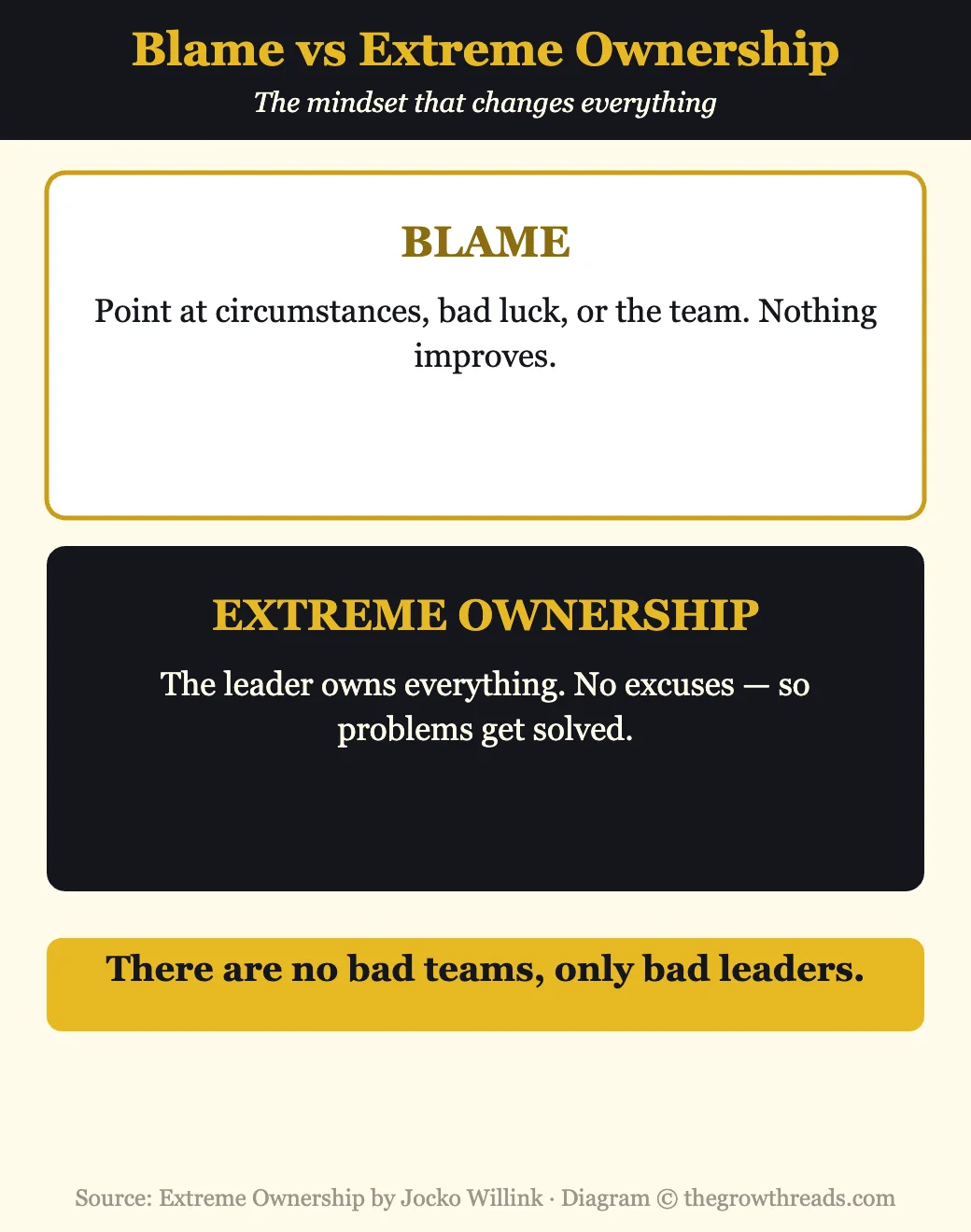
From this flow three supporting ideas. First, “there are no bad teams, only bad leaders” — Willink recounts a SEAL training exercise where swapping the leaders of the best and worst boat crews caused the worst crew to become the best, proving that leadership, not the personnel, was the difference. Second, a leader must genuinely believe in the mission; if you don’t understand the “why” behind an order, you cannot lead your people to execute it with conviction, so you must seek that understanding and, if needed, question up the chain until you have it. Third, you must check the ego. Ego is the biggest obstacle to ownership, because it makes you defensive, blinds you to your mistakes, and stops you from listening; humility is the precondition for leading well.
TGR Note: “Check the ego” is the entire thesis of Ryan Holiday’s Ego Is the Enemy, and Extreme Ownership’s demand to believe in the mission is the leadership application of Simon Sinek’s Start With Why. Read together, they form a coherent leadership stack: know your why, kill your ego, and own the outcome.
Part 2: The Laws of Combat
The middle of the book lays out four “Laws of Combat” that the SEALs used under fire and that map directly onto any team.
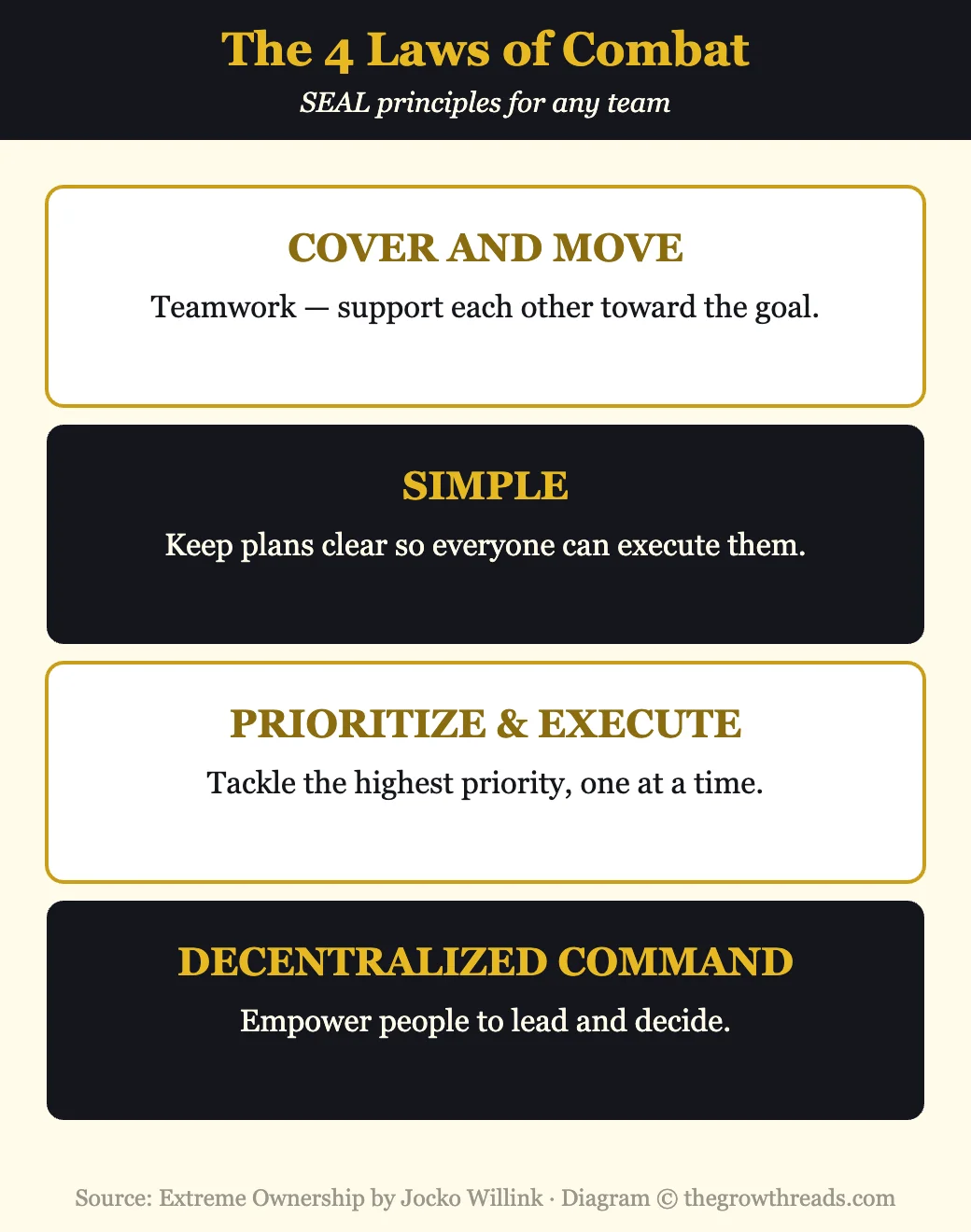
The first is Cover and Move — the essence of teamwork. On the battlefield, one element covers while another moves; in an organization, it means every team and department must support one another rather than competing or working in silos, because they all serve the same overarching mission. The second is Simple: plans, orders, and communication must be stripped down to be as clear as possible, because complexity breeds confusion and failure, especially under stress. If your people don’t understand the plan, they can’t execute it. The third is Prioritize and Execute, the antidote to being overwhelmed when many problems hit at once. The fourth is Decentralized Command: no single leader can control every detail, so you must empower subordinate leaders to make decisions within a clear intent, pushing authority down to the people closest to the action. Together these laws turn a group of individuals into a coordinated, resilient team that can function even when the leader isn’t there to direct every move.
Part 3: Prioritize and execute, and empower your leaders
Two of the laws deserve a closer look because they are the most immediately useful. Prioritize and Execute addresses the moment when everything seems to be going wrong at once and panic sets in. Willink’s advice, drilled in combat, is a short mental drill: relax, look around, make a call.
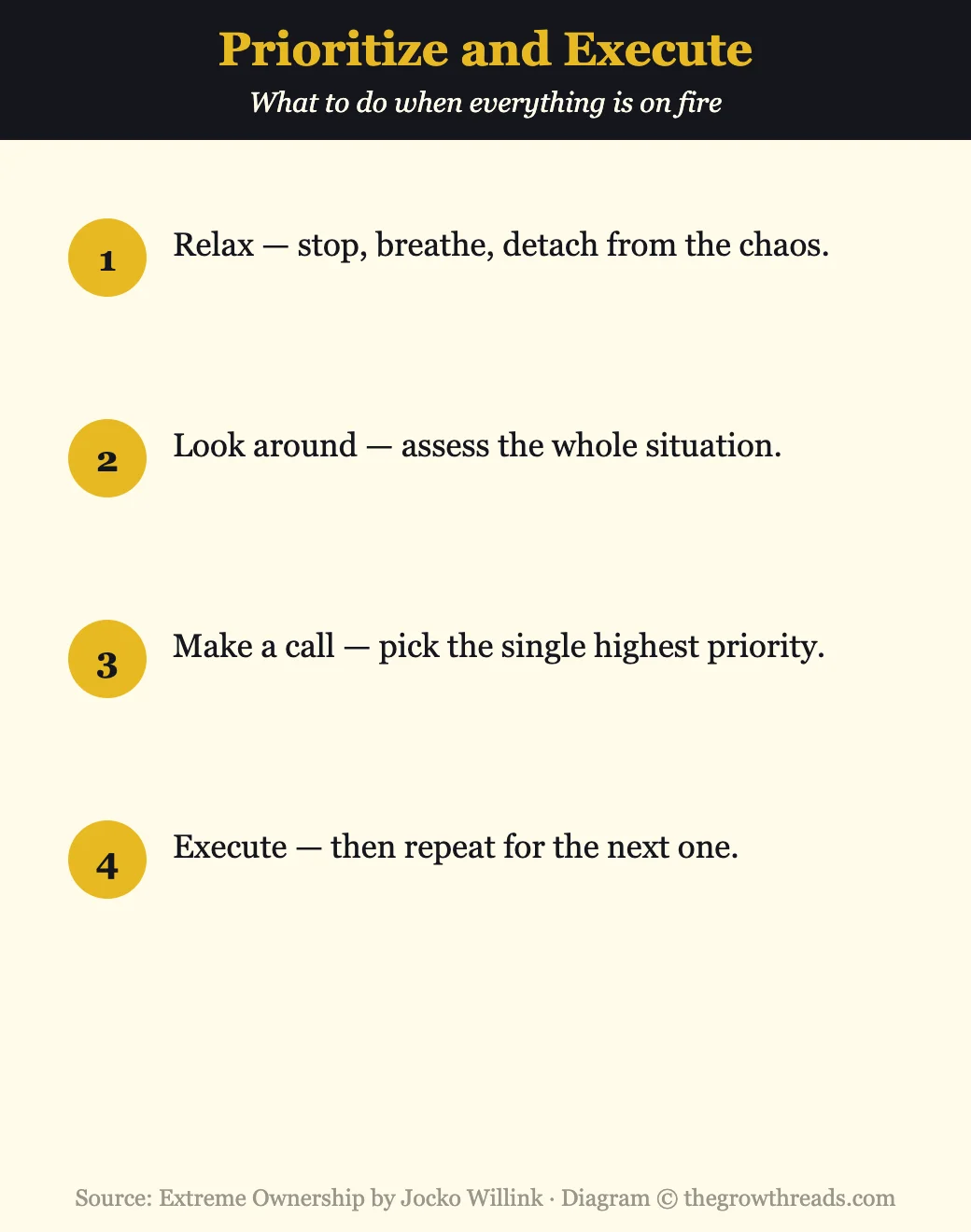
First you consciously detach and calm down — you cannot think clearly while panicking. Then you step back and assess the whole situation rather than fixating on the loudest problem. Then you determine the single highest priority and direct all effort at it, communicate it clearly, execute, and only then move to the next priority. Trying to solve everything simultaneously guarantees you solve nothing; disciplined sequencing is what wins. Decentralized Command, meanwhile, is about scaling leadership. Because a leader’s attention is finite, effective organizations push decision-making authority downward, empowering junior leaders who understand the commander’s intent to act on their own initiative. This requires clear communication of the mission’s purpose and boundaries, and trust in your people — but it produces a team that is faster, more resilient, and not bottlenecked by a single overworked leader trying to control everything.
Part 4: Sustaining victory — planning, leading, and discipline
The final section covers the leadership habits that sustain success over time. A disciplined planning process — clarifying the mission, analyzing resources and risks, developing a course of action, and then briefing it simply so everyone understands their role — dramatically reduces the chance of failure. Leadership, the authors stress, runs in two directions: you must lead down the chain to your team, but also “up the chain” to your own bosses, taking ownership of the relationship by communicating clearly, providing information, and helping your leaders make good decisions rather than resenting them. They also confront the reality that leaders must be decisive amid uncertainty — you will rarely have perfect information, and waiting for certainty is its own failure, so you must make the best decision you can with what you have and adjust.
Underlying all of it is what the authors call the dichotomy of leadership: great leadership is a constant balancing act between opposing qualities — confident but humble, aggressive but disciplined, a leader but also a follower, close to the team but able to make hard calls. And beneath that sits Willink’s signature idea, discipline equals freedom. Far from being opposites, discipline is the path to freedom: the self-discipline to wake early, prepare thoroughly, hold standards, and do the hard things is precisely what creates the freedom to succeed, adapt, and lead. The book’s format — combat story, principle, business application — repeats twelve times and can feel mechanical, and the relentless military framing won’t suit everyone. But the substance is unusually solid, and its central demand, to own everything and blame no one, is one of the most powerful leadership ideas you can adopt.
TGR Note: Extreme Ownership’s “discipline equals freedom” is the leadership-world version of the radical accountability David Goggins preaches in Can’t Hurt Me, and its emphasis on owning your response rather than your circumstances rhymes with the first habit — be proactive — in The 7 Habits of Highly Effective People. Different worlds, same spine: responsibility precedes results.
Who is Extreme Ownership best for — and who should read something else first?
This book is ideal for anyone in a leadership role — managers, founders, team leads, coaches — and for individuals who want to internalize a no-excuses, high-accountability mindset. Its principles are practical and battle-proven, and the combat stories make them memorable. It is not for you if you dislike heavy military framing or find repetitive structure tiresome, since every chapter follows the same template. If you want the deeper “why” behind believing in a mission, pair it with Start With Why; for the humility it demands, read Ego Is the Enemy.
Questions to reflect on
- What outcome are you currently blaming on others or circumstances that you could instead own?
- If a team you lead is underperforming, what would change if you assumed the leadership was the cause?
- Do you actually believe in the mission you’re asking others to execute — and can you explain the “why”?
- When you’re overwhelmed, do you prioritize and execute, or try to fix everything at once?
- Where are you a bottleneck because you haven’t decentralized command and empowered others?
🔥 Ready to own everything?
This guide is the map — Jocko and Leif’s combat stories are what make the principles land.
How to apply Extreme Ownership (7-day plan)
- Day 1 — Own one failure. Take a recent setback you’ve blamed elsewhere and claim full responsibility for it.
- Day 2 — Find the “why.” Pick one task you resent and dig until you understand and believe its purpose.
- Day 3 — Check your ego. Ask for honest feedback on one thing and receive it without defending yourself.
- Day 4 — Simplify a plan. Take one plan or message and strip it down until anyone could execute it.
- Day 5 — Prioritize and execute. When overwhelmed, relax, look around, pick the single top priority, and do it.
- Day 6 — Decentralize. Delegate one real decision to someone, with clear intent, and let them own it.
- Day 7 — Practice discipline. Choose one hard daily standard — an early alarm, a workout, a habit — and hold it.
Frequently asked questions
Is Extreme Ownership worth reading?
Yes, especially for anyone in a leadership role. Its central principle — that leaders should own everything and blame no one — is one of the most powerful and practical mindsets you can adopt, and the combat stories that illustrate each lesson make it memorable and credible. The main criticism is structural: every chapter follows the same template of war story, principle, and business example, which can feel repetitive, and the heavy military framing isn’t for everyone. But the substance is solid, and the book earns its place on most leadership reading lists.
What is extreme ownership?
Extreme Ownership is the principle that a leader is responsible for everything in their sphere — every failure, every mistake by the team, every shortfall in results — with no excuses and no blaming others or circumstances. The point is not self-flagellation but empowerment: the moment you own a problem, you are in a position to fix it, whereas blaming leaves you powerless. It applies beyond leadership too, as a personal mindset of taking full responsibility for your outcomes rather than attributing them to external factors.
What are the Laws of Combat in Extreme Ownership?
They are four battle-tested team principles. Cover and Move means teamwork — every element supports the others toward the shared goal. Simple means keeping plans and communication clear enough to execute under stress. Prioritize and Execute means, when overwhelmed, relaxing, assessing, and tackling the single highest priority before moving to the next. Decentralized Command means empowering subordinate leaders to make decisions within the leader’s intent, because no one can control every detail alone. Together they turn individuals into a coordinated, resilient team.
What is the main message of Extreme Ownership?
That leadership is the decisive factor in any team’s success, and that great leadership begins with taking total ownership. Leaders must own their failures, believe in the mission, check their ego, and apply disciplined principles for teamwork, communication, prioritization, and empowerment. The larger message is that responsibility precedes results: whether you win or lose, owning the outcome — rather than making excuses — is what allows you to learn, improve, and lead effectively.
How long does it take to read Extreme Ownership?
The book is around 320 pages and most readers finish it in about six hours, helped by the fast-paced combat narratives. Its consistent chapter structure also makes it easy to read in sections. Our summary above captures the core principles in roughly 16 minutes, which is enough to grasp the leadership framework before deciding whether to read the full stories that bring each lesson to life.
Is Extreme Ownership only for military or business leaders?
No. While the stories come from combat and the case studies from business, the principles apply to anyone who leads or wants to take more responsibility for their life — team leads, entrepreneurs, coaches, parents, and individuals alike. The core idea of owning your outcomes rather than blaming circumstances is universal, and concepts like prioritize and execute, check the ego, and discipline equals freedom translate readily to everyday challenges well beyond any battlefield or boardroom.
What does “discipline equals freedom” mean?
It is Jocko Willink’s signature idea that discipline, far from restricting you, is the path to freedom. The self-discipline to wake early, prepare thoroughly, hold high standards, and do the hard things consistently is precisely what creates the freedom to succeed, adapt, and lead. Skipping discipline for short-term ease leads to worse outcomes and less freedom later. In the book it underlies everything: disciplined ownership, planning, and execution are what give a leader and a team the capacity to win.
Related summaries
- Start With Why Summary — the mission and purpose behind great leadership.
- Ego Is the Enemy Summary — the humility Extreme Ownership demands.
- Can’t Hurt Me Summary — radical accountability and discipline.
- The 7 Habits Summary — proactivity and principle-centered leadership.
- Browse all our best leadership books.
How we analyze books: We work from the full book — reconstructing its core arguments in our own words, adding commentary that connects it to related research and other books in our library, and pressure-testing the advice against how it plays out in real life. We never reproduce the text; we synthesize it. Read our full methodology.
Disclosure: The Growth Reads is reader-supported. When you buy through links on our site we may earn an affiliate commission at no extra cost to you. We only recommend books we believe are worth your time, and our summaries and opinions are written independently.
Related Leadership Summaries
First, Break All the Rules Summary & Review: What Great Managers Do Differently
Radical Candor Summary & Review: Be a Great Boss Without Losing Your Humanity
The Dichotomy of Leadership Summary & Review: Balance Every Principle or Fail
The First 90 Days Summary & Review: Master Every Leadership Transition
The Lean Startup Summary & Review: Build, Measure, Learn