

★★★★★ 4.7/5 — The definitive, no-nonsense guide to management as a production process, written by the former CEO of Intel and treated as required reading across Silicon Valley.
Best for: New and experienced managers who want a systems-level, practical framework for running teams and meetings — not motivational theory.
Reading time: ~6–7 hrs for the full book (240 pages) · ~13 min for this guide.
Difficulty to apply: Moderate — the concepts are simple, but applying them means deliberately redesigning your calendar, one-on-ones, and meeting habits.
High Output Management in one minute
Management is not an art you’re born with — it’s a production process you can engineer. Andrew Grove, who ran Intel through some of the most competitive years in Silicon Valley history, argues that a manager’s job has the same structure as running a factory: you take inputs (people, information, decisions), run them through a process (meetings, reviews, planning), and produce outputs — your team’s results. High Output Management gives you the tools to increase your leverage, the ratio of output to effort, through better one-on-ones, matching your management style to each person’s task-relevant maturity, structuring meetings around a clear purpose, and using indicators to catch problems while they’re still small. It’s dense, unsentimental, and more than 40 years after Intel first printed it internally, still one of the most referenced books among the founders and executives who built the modern tech industry.
Key takeaways
- Managerial output is your team’s output: it’s the output of the organization under your supervision plus the output of organizations under your influence — not your personal to-do list.
- Leverage is the multiplier: high-leverage activities affect many people or outcomes at once, like training, clear decisions, and well-run meetings.
- Model management like a factory: every process, including management itself, can be broken into inputs, process steps, indicators, and output.
- Match style to task-relevant maturity: supervise closely when someone is new to a task, and step back as their competence grows — not based on your personal preference.
- One-on-ones are a manager’s highest-leverage recurring activity: protect them, and let the subordinate set the agenda.
- Separate process-oriented meetings from mission-oriented meetings: mixing recurring status updates with one-time decisions wastes everyone’s time.
- Good decisions need three stages: free discussion, a clear decision, and full support, even from people who originally disagreed.
- Set indicators as early as possible: catching a problem at the first stage of a process is far cheaper than catching it at the last.
- Hybrid organizations are normal, not broken: most real companies trade a little efficiency for speed by mixing mission-oriented and functional reporting.
- Performance reviews should improve future output: not score past behavior — and should never contain surprises.
What is High Output Management about?
High Output Management is Andrew Grove’s framework for treating management as an engineering discipline — applying production concepts like leverage, indicators, and task-relevant maturity to one-on-ones, meetings, decision-making, and planning so a manager’s team consistently produces more, with fewer dropped balls, regardless of industry or team size.
About the author
Andrew S. Grove (1936–2016) fled Hungary as a teenager after surviving Nazi occupation and later the Soviet crackdown on the 1956 uprising, arriving in the United States with almost no money and no English. He earned a PhD in chemical engineering from UC Berkeley, then joined the fledgling semiconductor company that would become Intel as one of its first employees, eventually serving as its President, CEO, and Chairman. Under Grove’s leadership, Intel grew into the dominant force in microprocessors and one of the most valuable companies in the world; Time magazine named him Person of the Year in 1997. Grove wrote High Output Management in 1983, drawing directly on his own notes and internal Intel training materials, and later wrote Only the Paranoid Survive, a companion book on strategic inflection points. Explore all Andrew S. Grove book summaries →
Key concepts at a glance
| Concept | What it means | Use it when |
|---|---|---|
| Managerial Leverage | Output produced per unit of a manager’s effort or time | Deciding which activities deserve your limited time |
| Task-Relevant Maturity | A person’s skill and experience for a specific task, not overall seniority | Choosing how closely to direct someone |
| Production Process Model | Inputs → process → indicators → output, applied to any workflow | Diagnosing a broken or slow process |
| Process- vs. Mission-Oriented Meetings | Recurring info-sharing meetings vs. one-time decision meetings | Fixing a calendar full of unclear meetings |
| Indicators | Early-warning measurements placed at each stage of a process | Preventing small problems from becoming crises |
| Hybrid Organization | A mix of mission-oriented and functional reporting lines | Structuring a team that needs both speed and expertise |
| Performance Review | A structured look back designed to improve future output | Preparing for review season |
Part 1: Management as a Production Process
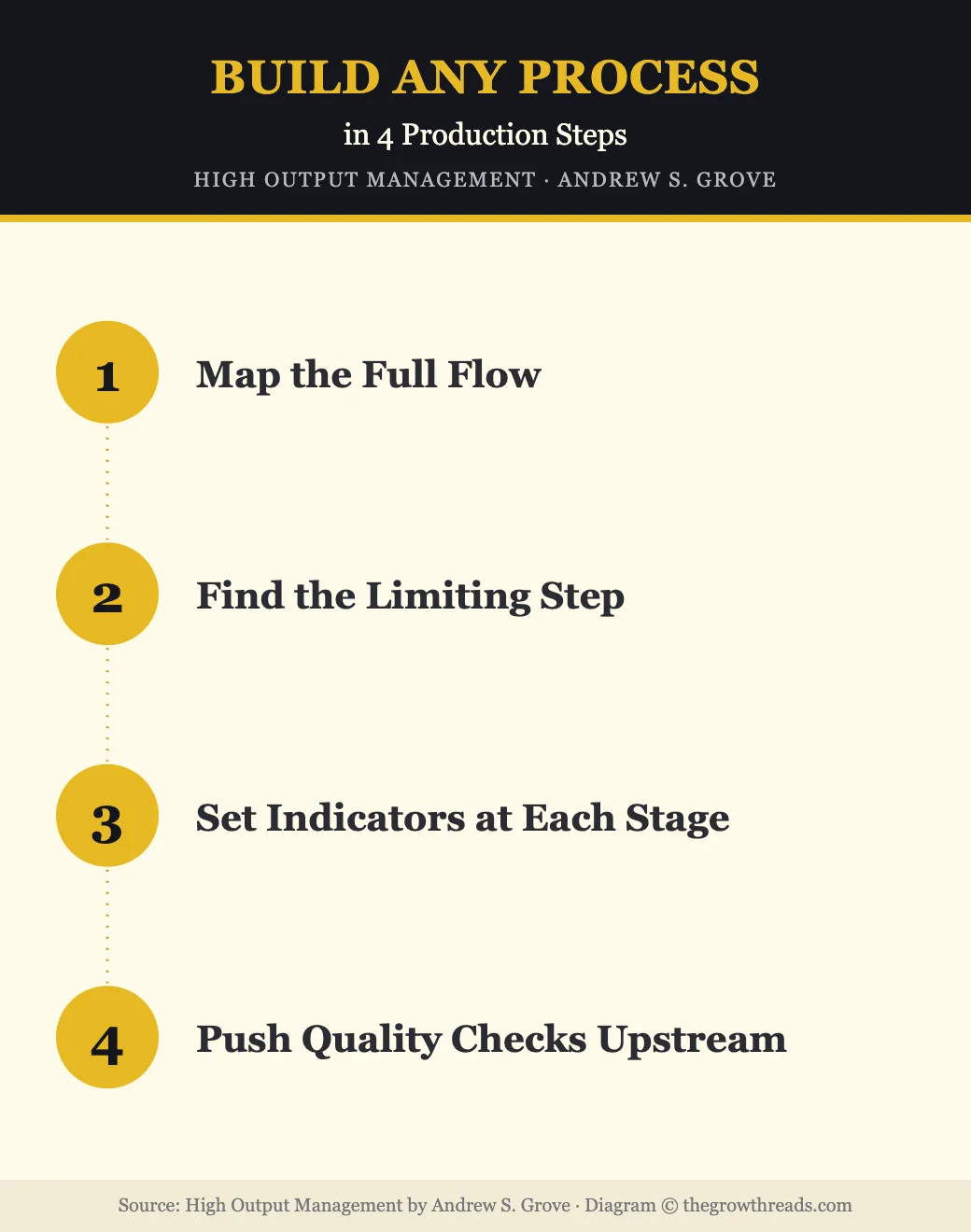
Grove opens by arguing management has no special mystique — it can be understood the same way you’d understand any production process. He illustrates this with what he calls the “breakfast factory”: making a simple breakfast of soft-boiled eggs, buttered toast, and coffee is, structurally, identical to running a manufacturing plant. You have raw materials, a production sequence, and a finished product that needs to be ready and hot at the same moment. The exercise forces you to identify the limiting step, usually the eggs, work backward from the deadline, and build in indicators, like a timer or a visual check, so you catch a burnt piece of toast before it ruins the whole meal, not after.
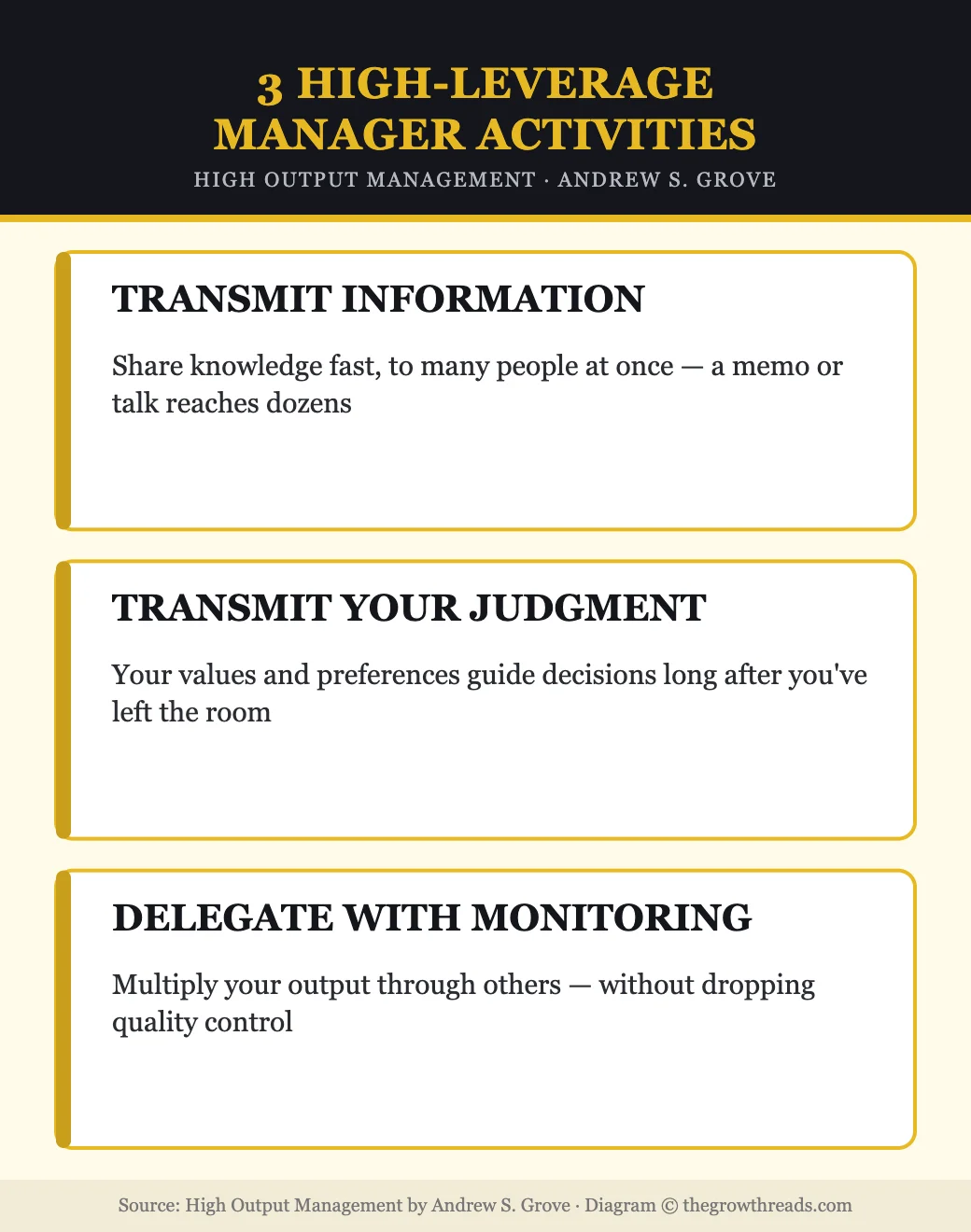
From this, Grove derives what may be the book’s single most quoted idea: a manager’s output is not what they personally produce, but the output of the organization under their supervision plus the output of organizations under their influence. This reframes the entire job. Answering email quickly, attending every meeting you’re invited to, or personally writing the best code on the team are not, by themselves, evidence of good management — they can even be a manager avoiding the harder, higher-leverage work of training, deciding, and communicating.
Grove then defines managerial leverage directly: some activities move the needle for many people at once, like a well-run training session, a clearly communicated decision, or a good one-on-one that unblocks someone for weeks, while others consume time without multiplying anything. The manager’s job, in Grove’s framing, is to relentlessly seek out and prioritize the highest-leverage activities available, and to delegate or eliminate the rest.
Part 2: Task-Relevant Maturity and the Power of the One-on-One
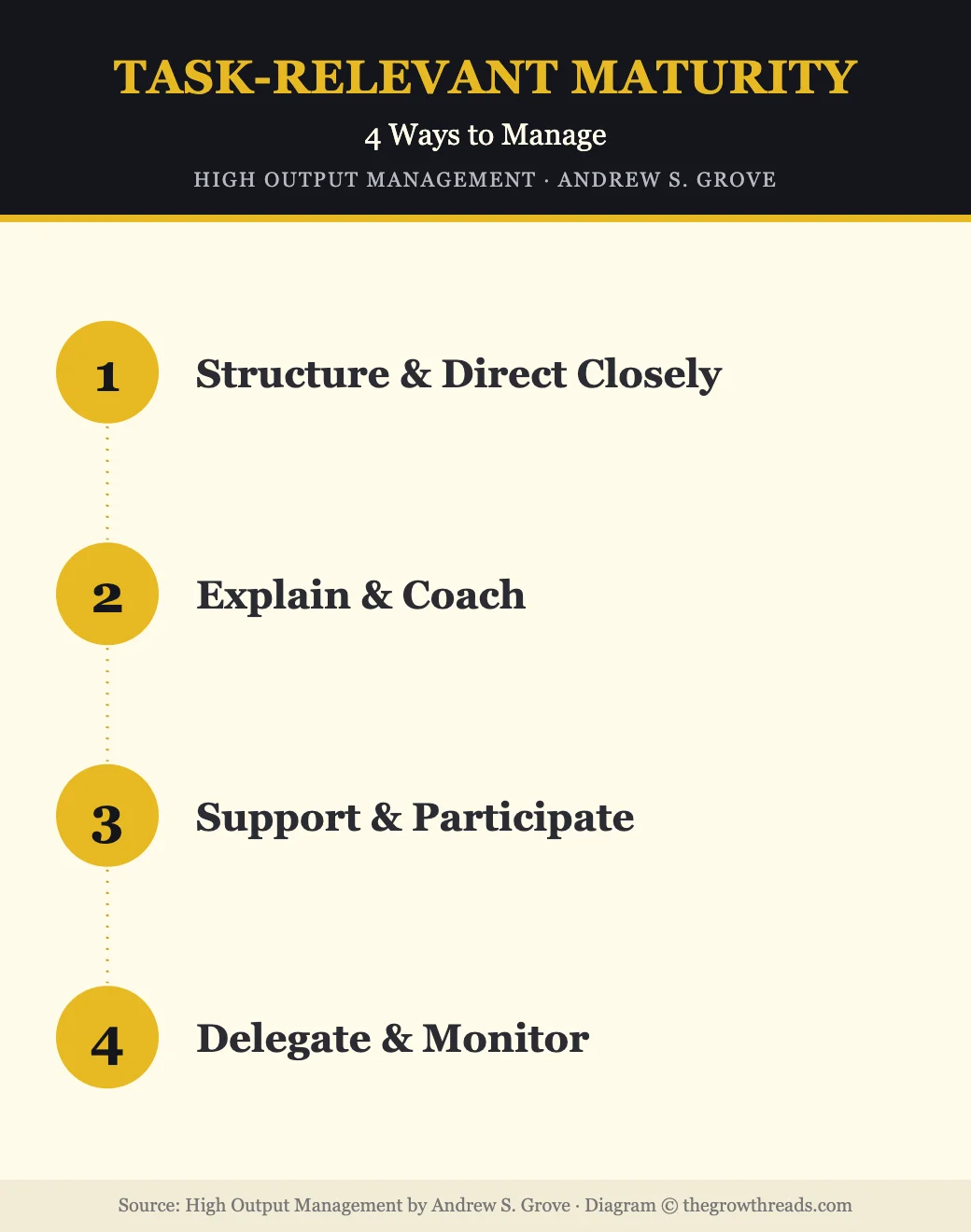
Grove rejects the idea of a single “best” management style. Instead, he introduces task-relevant maturity: how much experience, skill, and track record a specific person has for a specific task, right now. Someone can be highly mature, in Grove’s sense, at one task and a complete novice at another — a star sales rep moved into a new market is, temporarily, low task-relevant maturity again. The manager’s job is to adjust supervision style to match: closely structuring and directing someone new to a task, shifting to explaining and coaching as they gain competence, then to participative support, and finally to largely hands-off monitoring once maturity is high. Applying a hands-off style to someone still learning, or micromanaging someone who has mastered the task, both waste leverage and damage morale.
The practical engine for calibrating this, in Grove’s view, is the one-on-one meeting — not a status update, but dedicated, uninterrupted time for the subordinate to raise whatever matters most to them, get coaching on specific work, and surface problems while they’re still small. Grove is specific about mechanics: the one-on-one belongs to the subordinate, not the manager, who should come with their own notes and agenda; it should happen regularly enough that problems don’t have time to compound, weekly to monthly depending on task-relevant maturity; and even brief, frequent one-on-ones outperform long, rare ones. He treats the one-on-one as a manager’s single highest-leverage recurring activity, precisely because a well-run one can prevent problems that would otherwise take far longer to fix later.
Part 3: Meetings and Decision-Making Done Right
Most organizations, Grove argues, are bad at meetings not because meetings are inherently wasteful but because they conflate two fundamentally different types. Process-oriented meetings are recurring and exist to transfer information and calibrate — staff meetings, one-on-ones, operation reviews — and should follow a predictable rhythm and structure precisely so people don’t have to think about the format, only the content. Mission-oriented meetings exist to solve a specific problem or make a specific decision, are one-time by nature, and fail when they’re run like a status update instead of ending with a clear resolution.
Decision-making itself, Grove argues, breaks down when organizations skip stages. He lays out three: free discussion, where every relevant viewpoint is aired without hierarchy; a clear decision, where someone with the authority to do so actually decides; and full support, where everyone, including those who argued against the decision, commits to executing it as if it were their own. Skipping free discussion produces decisions nobody trusts; skipping the clear-decision stage produces what Grove calls “peer-group syndrome,” endless discussion that never resolves because no one wants to be the one to close it; and skipping full support means good decisions get quietly sabotaged in execution.
Part 4: Planning, Hybrid Organizations, and Performance Reviews
Grove treats planning as another production process rather than a once-a-year ritual: the purpose of planning is not the plan document itself but determining what actions to take today to produce the outcome you want at a future decision point. He recommends working backward from that future point, identifying the gap between where current momentum would take you and where you want to be, and then defining the specific actions that close that gap, rather than simply extrapolating last year’s numbers forward.
On structure, Grove observes that pure functional organizations, grouped by specialty, are efficient but slow to respond to cross-functional problems, while pure mission-oriented teams, grouped around a product or outcome, are fast and responsive but can duplicate effort and lose economies of scale. Most real organizations, including Intel, end up as hybrids, and dual reporting relationships, like a marketing manager who reports to both a product line and a central marketing function, aren’t a failure of org design in his view, but a deliberate and often necessary trade-off.
Finally, Grove reframes performance reviews around their actual purpose: improving a person’s future output, not scoring their past behavior. A useful review, in his framework, should contain no surprises, because task-relevant issues were already surfaced in one-on-ones, should be specific enough to change behavior, and should address the person’s trajectory, not just a single period’s results.
Who is High Output Management best for — and who should read something else first?
High Output Management is best for new managers who want a systems-level framework rather than motivational advice, and for experienced managers who want to audit their calendar and meeting habits against a rigorous standard. Its terse, engineering-minded style rewards readers who like frameworks and equations more than stories.
If you want a more relationship-centered approach to the same one-on-one and feedback skills, pair this with our Radical Candor summary. If you’re earlier in your career and want a broader introduction to what makes teams function well before diving into Grove’s production framework, start with our The Five Dysfunctions of a Team summary. And if you lead an organization rather than a single team, follow this with our Good to Great summary for the level above individual management practice.
Questions to reflect on
- Looking at your calendar from last week, how much of it went to high-leverage activities like training, clear decisions, and one-on-ones, versus low-leverage busywork?
- For each person on your team, what is their task-relevant maturity for their current main project, and does your management style actually match it?
- Which of your recurring meetings are secretly mission-oriented decisions dressed up as status updates, and which decisions have been stuck in “free discussion” too long?
- Where in your team’s workflow would an earlier indicator catch a problem before it becomes a crisis?
- When did you last give a performance review that contained a genuine surprise, and what does that reveal about your one-on-ones?
🔥 Ready to multiply your output as a manager?
Get the full book for Grove’s complete frameworks, worked examples, and the famous “breakfast factory” walkthrough.
How to apply High Output Management (7-day plan)
- Day 1: Audit last week’s calendar and tag each meeting as high-leverage or low-leverage.
- Day 2: Write down each direct report’s task-relevant maturity for their current top project.
- Day 3: Restructure your next one-on-one so your report sets the agenda, not you.
- Day 4: Split your recurring meetings into process-oriented vs. mission-oriented, and fix any that mix the two.
- Day 5: Map one workflow on your team using the inputs → process → indicators → output model and find its limiting step.
- Day 6: Identify one decision stuck in “free discussion” and force it to a clear decision with full support.
- Day 7: Draft one performance review update using only things you’ve already discussed in one-on-ones — no surprises.
Frequently asked questions
What is managerial leverage in High Output Management?
Managerial leverage is the ratio of a manager’s output to their effort, and Grove defines a manager’s true output as the output of the organization under their supervision plus the output of organizations under their influence. High-leverage activities, like training a group, making a clear decision that unblocks many people, or running an effective one-on-one, multiply a manager’s effect far beyond the time spent, while low-leverage activities consume time without multiplying anything for the team.
What is task-relevant maturity?
Task-relevant maturity is how much skill, experience, and track record a specific person has for a specific task at this moment, rather than their overall seniority or general competence. The same person can have high task-relevant maturity in one area and low maturity in another, such as a star performer moved into an unfamiliar role. Grove argues managers should adjust how closely they direct someone based on this task-specific maturity, moving from close direction toward hands-off monitoring as it increases.
How does Andrew Grove recommend running a one-on-one meeting?
Grove treats the one-on-one as belonging to the subordinate, not the manager: the report should come with their own notes and set the agenda, while the manager listens, coaches on specific work, and helps surface problems while they are still small. He recommends a regular cadence, weekly to monthly depending on the person’s task-relevant maturity, and argues that frequent, brief one-on-ones outperform long, infrequent ones because they catch issues before they compound.
What is the difference between process-oriented and mission-oriented meetings?
Process-oriented meetings are recurring and exist to share information and calibrate, such as staff meetings and operation reviews, and work best with a predictable, repeatable structure. Mission-oriented meetings exist to solve a specific problem or make a specific one-time decision, and fail when they are run like a routine status update instead of ending with a clear resolution. Grove argues most organizations waste time by blending the two formats instead of running each on its own terms.
What is the “breakfast factory” example about?
The breakfast factory is Grove’s illustration of the production process model using something everyone understands: making soft-boiled eggs, toast, and coffee at the same time, hot and ready together. It forces you to identify the limiting step (usually the eggs), work backward from your deadline, and place indicators, like a timer, at points where problems could occur. Grove uses it to show that management and manufacturing share the same underlying structure of inputs, process, indicators, and output.
Is High Output Management still relevant for managing remote or hybrid teams today?
Yes, largely because the book’s core ideas, leverage, task-relevant maturity, structured one-on-ones, and clear decision-making, are independent of whether a team sits in the same office. Some specific examples reflect 1980s-1990s corporate life, and remote work adds new coordination challenges Grove doesn’t address directly, but the underlying frameworks for prioritizing high-leverage activities and running effective one-on-ones translate directly to distributed teams.
Is High Output Management a good first management book?
It’s an excellent first or second management book for readers who prefer frameworks and systems thinking over stories and motivational language. First-time managers sometimes find its terse, engineering-style prose denser than more narrative books, so pairing it with a more relationship-focused book like Radical Candor can round out the softer interpersonal skills alongside Grove’s structural frameworks.
Related summaries
- Multipliers Summary & Review: How the Best Leaders Make Everyone Smarter
- Radical Candor Summary & Review: Be a Great Boss Without Losing Your Humanity
- The Five Dysfunctions of a Team Summary & Review
- Good to Great Summary & Review
- See all of our best leadership book summaries
How we analyze books: Every TGR summary is built from a full read of the original text, cross-checked against the author’s public interviews and later writing where relevant, and organized around practical application rather than just chapter recaps. We never critique books here — our job is to help you get more value out of them, faster. Read our full methodology.
Related Leadership Summaries
It’s Your Ship Summary & Review: Build a Crew That Owns the Outcome
Principles Summary & Review: How to Make Better Decisions in Life and Work
Team of Rivals Summary and Review
Team of Teams Summary & Review: Leading in Complexity
The No Asshole Rule Summary and Review