

⭐⭐⭐⭐ 3.8/5 — The most systematic leadership framework available, packed with real-world examples for every level of leader.
Best for: New and mid-career leaders who want a comprehensive, principle-based framework for growing their influence.
Reading time: ~7 hours (336 pages) | Difficulty to apply: Medium (one law at a time makes it manageable)
The 21 Irrefutable Laws of Leadership in one minute
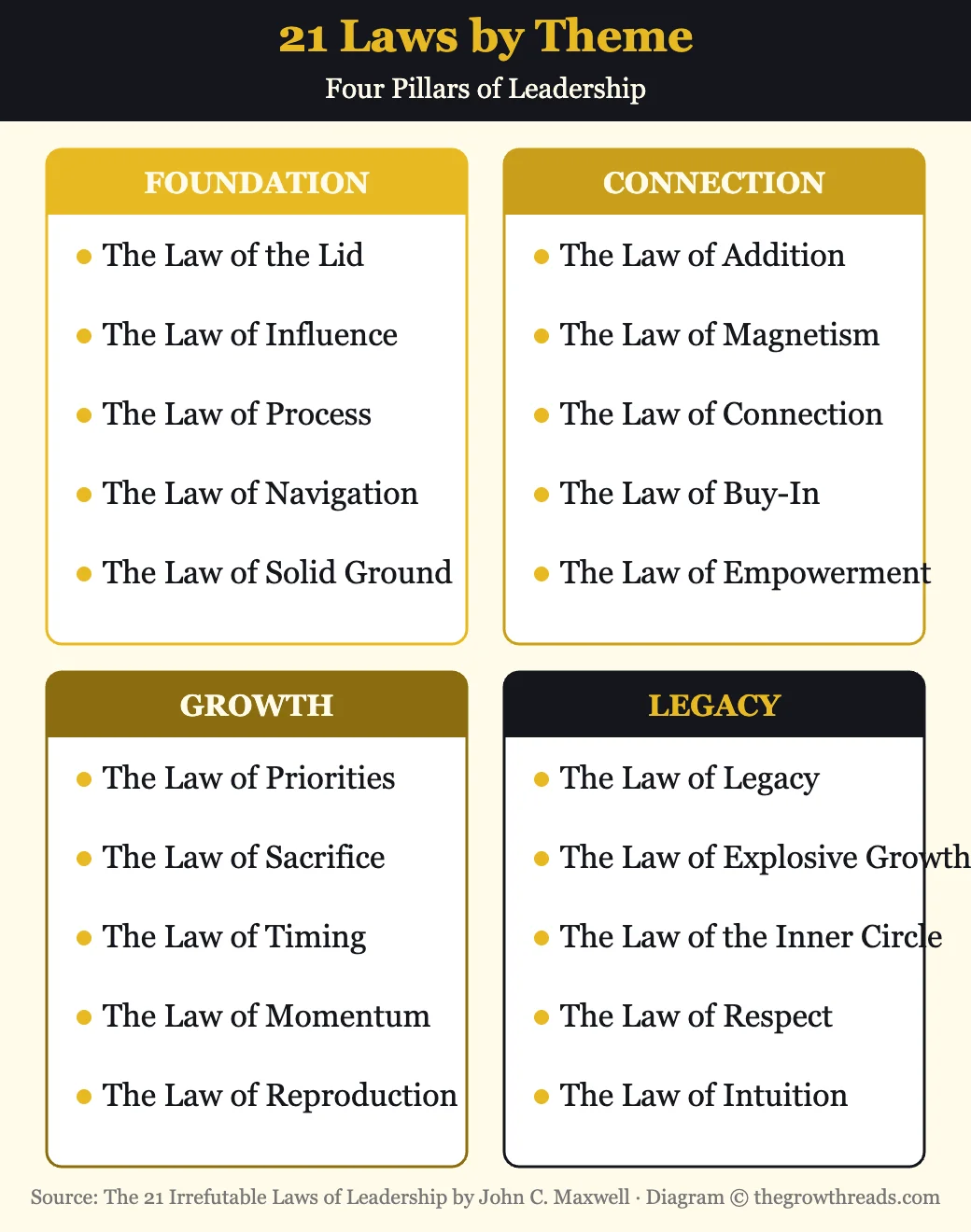
Leadership is not a title — it is influence, and influence follows predictable laws. John Maxwell distills decades of leadership experience into 21 principles that determine whether people will follow you. The Law of the Lid says your leadership ability sets the ceiling on your effectiveness. The Law of Influence says the true measure of leadership is not position but the ability to move people. From the Law of Process (leadership develops daily, not in a day) to the Law of Legacy (a leader’s lasting value is measured by succession), Maxwell gives each law a clear definition, real-world examples, and practical action steps. The book argues that leadership is learnable and that mastering even a few of these laws will dramatically change your results.
Key takeaways
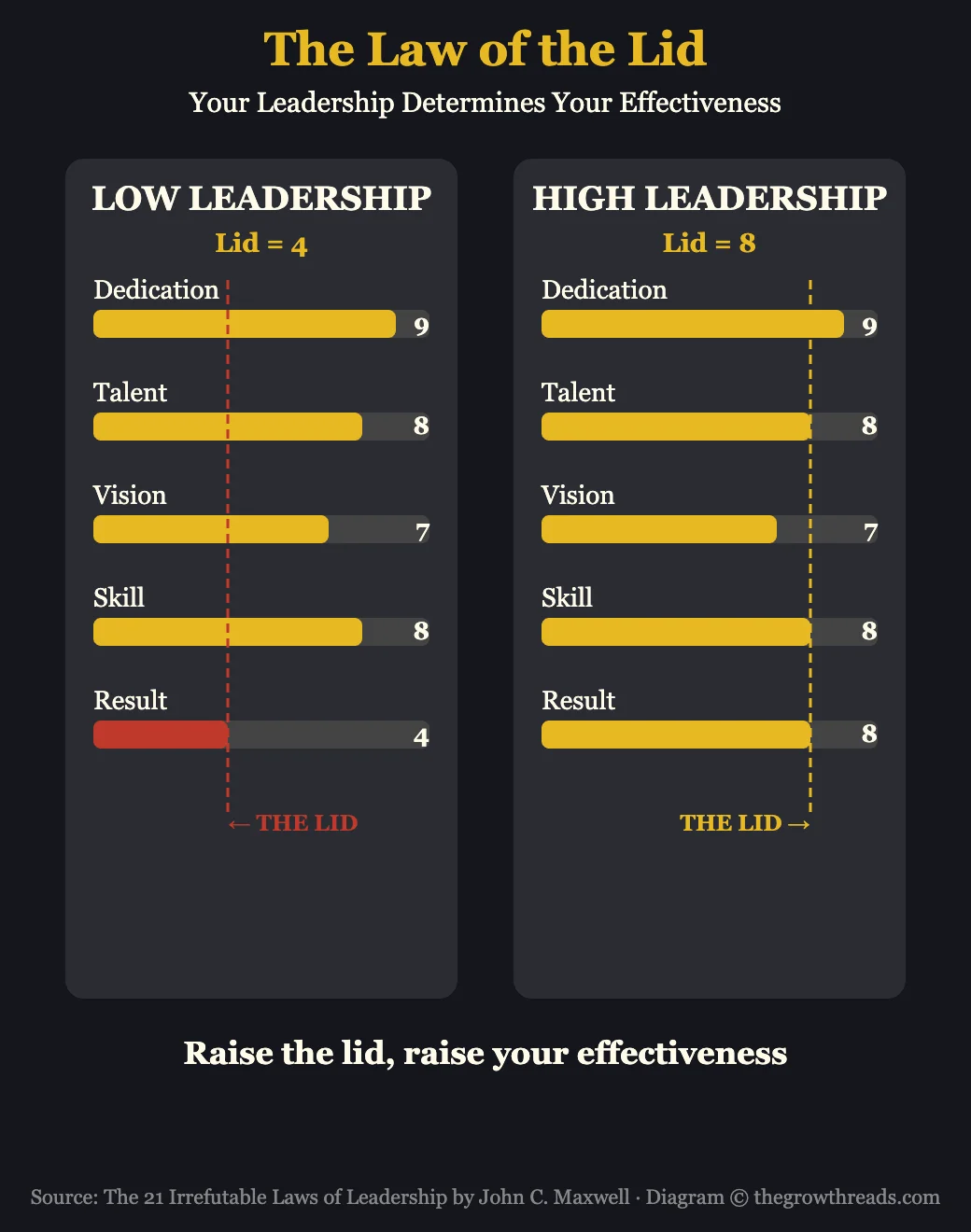
- The Law of the Lid: Your leadership ability is the lid on your organization’s effectiveness. Raise your leadership, raise the lid on what everyone around you can achieve.
- The Law of Influence: Leadership is not about titles, seniority, or org charts. The true test of leadership is whether anyone follows you voluntarily.
- The Law of Process: Leadership develops daily, not in a day. The most effective leaders commit to continuous, incremental growth over years.
- The Law of Navigation: Anyone can steer a ship, but it takes a leader to chart the course. Great leaders see more, see farther, and see before others.
- The Law of Addition: Leaders add value by serving others, not by being served. The quickest way to gain influence is to help people win.
- The Law of Solid Ground: Trust is the foundation of leadership. It is built through consistent character, competence, and connection.
- The Law of the Inner Circle: A leader’s potential is determined by those closest to them. Your inner circle either multiplies or diminishes your ability.
- The Law of Empowerment: Only secure leaders give power to others. Insecure leaders hoard authority because sharing it feels like losing it.
- The Law of Sacrifice: A leader must give up to go up. The higher you climb, the more you must sacrifice personal preferences for the team’s benefit.
- The Law of Legacy: A leader’s lasting value is measured by succession. The ultimate test is not what happens while you lead but what happens after you leave.
What is The 21 Irrefutable Laws of Leadership about?
The 21 Irrefutable Laws of Leadership presents a comprehensive framework of universal leadership principles. Maxwell identifies the fundamental laws that govern how influence works, how leaders develop, and how organizations grow or stagnate based on leadership quality. Each law is illustrated through historical and contemporary examples, self-assessment tools, and application exercises designed to help readers develop their own leadership capacity.
About the author
John C. Maxwell is widely considered the most influential leadership expert in the world. He has written over 100 books, sold more than 35 million copies, and trained leaders in every country on the planet. Before becoming a full-time author and speaker, he spent 25 years as a pastor, leading congregations that grew dramatically under his leadership. He founded the John Maxwell Company, EQUIP (a nonprofit that has trained millions of leaders globally), and the Maxwell Leadership Foundation. His practical, principle-based approach to leadership has influenced presidents, Fortune 500 CEOs, military commanders, and coaches at every level. Explore all John C. Maxwell book summaries →
Key concepts at a glance
| Concept | What it means | Use it when |
|---|---|---|
| The Law of the Lid | Leadership ability determines a person’s level of effectiveness | Your team’s output plateaus despite hard work — raise your leadership first |
| The Law of Influence | True leadership is measured by influence, not authority | You have a title but people are not following you willingly |
| The Law of Process | Leadership develops daily through intentional growth habits | You want a roadmap for becoming a better leader over time |
| The Law of Magnetism | Who you are is who you attract — leaders attract people like themselves | Your team lacks diversity of thought or energy and you want to understand why |
| The Law of Empowerment | Secure leaders give power to others to multiply their effectiveness | You are doing everything yourself and need to learn to delegate with trust |
| The Law of Momentum | Momentum is a leader’s best friend — it makes problems look smaller | Your team feels stuck and you need to create a series of quick wins |
| The Law of Priorities | Activity is not accomplishment — leaders evaluate by results, not busyness | You are overwhelmed and need to focus on what actually moves the needle |
| The 5 Levels of Leadership | Leaders progress through Position, Permission, Production, People Development, Pinnacle | You want to assess where you are and what it takes to reach the next level |
Part 1: The foundation laws — what leadership actually is
Maxwell opens with his most famous principle: the Law of the Lid. He uses the example of the McDonald brothers, who created a brilliant restaurant system but could not grow it beyond a few locations. Their leadership lid was low. When Ray Kroc came along with a much higher leadership lid — specifically in vision, deal-making, and organizational building — the same system exploded into a global empire. The lesson is that no amount of dedication, talent, or hard work overcomes a low leadership lid. If your effectiveness as a leader is a 5 out of 10, your organization’s maximum effectiveness is a 5.
The Law of Influence follows naturally. Maxwell argues that leadership has nothing to do with titles, positions, or seniority. Mother Teresa had no formal authority, yet she moved governments. Some CEOs have enormous authority but minimal influence. True leadership is voluntary influence — people follow because they choose to, not because they have to. Maxwell identifies seven factors that determine influence: character, relationships, knowledge, intuition, experience, past success, and ability.
The Law of Process addresses a truth most aspiring leaders ignore: leadership is built daily, not in a crisis or a single seminar. Maxwell uses the metaphor of investing — leaders who invest small amounts daily in their growth create compound returns over time. He points to leaders like Theodore Roosevelt, who spent decades developing himself physically, intellectually, and politically before his presidency. The leaders who look like overnight successes have usually been building their capacity for years before anyone noticed.
The Law of Navigation is about the leader’s ability to chart the course for the team. Leaders see more than others see (peripheral vision), see farther than others see (strategic vision), and see before others see (timing). Maxwell uses the contrast between the Amundsen and Scott Antarctic expeditions — identical goal, vastly different planning and leadership, one triumph and one tragedy — to show that navigation ability can mean the difference between success and catastrophe.
Part 2: The connection laws — building influence through people
Maxwell argues that the most powerful laws deal with how leaders connect with people. The Law of Addition says leaders add value by serving others. Maxwell tells the story of how he transformed a struggling organization not by pushing harder but by asking one question in every meeting: “How can I help you?” When leaders focus on adding value to others, influence follows naturally.
The Law of Magnetism explains why leaders attract people similar to themselves. If a leader values excellence, they attract excellence-driven people. If they tolerate mediocrity, they attract those comfortable with mediocrity. Maxwell points out that when leaders complain about the quality of their team, they are often looking in a mirror. The solution is not better recruiting — it is becoming a better leader.
The Law of Connection is about touching hearts before asking for hands. Maxwell distinguishes between communicators who reach minds and leaders who reach hearts. People do not care how much you know until they know how much you care. He uses examples of leaders who achieved extraordinary buy-in not through brilliant strategy presentations but through genuine emotional connection with their teams.
The Law of Buy-In addresses a common leadership frustration: great ideas that nobody supports. Maxwell argues that people buy into the leader before they buy into the vision. If they trust you, almost any vision becomes viable. If they do not, the most brilliant strategy dies on arrival. This is why new CEOs often fail when they bring big ideas before establishing relationships.
The Law of Empowerment separates secure leaders from insecure ones. Insecure leaders hoard power because giving it away feels like losing control. Secure leaders give power freely because they understand that empowering others multiplies their own effectiveness. Maxwell points to leaders like Henry Ford, whose early success was limited by his inability to empower others, versus leaders who built empires by developing autonomous teams.
Part 3: The growth laws — developing momentum and priorities
Maxwell transitions from connecting with people to building organizational momentum. The Law of Momentum is the leader’s best friend — momentum makes problems look smaller, makes average performers look good, and makes the future look brighter. Without it, even talented teams struggle. With it, ordinary teams achieve extraordinary results. Maxwell uses sports analogies extensively here: a team on a winning streak plays with a confidence and energy that cannot be manufactured — it can only be created through a series of wins.
The Law of Priorities addresses one of the most common leadership failures: confusing activity with accomplishment. Maxwell introduces the Pareto Principle as a leadership tool — 20 percent of your priorities will give you 80 percent of your return. Great leaders ruthlessly eliminate the 80 percent that produces little so they can focus energy on the 20 percent that matters. He recommends leaders ask three questions about every activity: Is it required? Does it give the highest return? Does it bring the greatest reward?
The Law of Sacrifice says a leader must give up to go up. Maxwell notes that many people want leadership until they understand its cost. The higher you climb in leadership, the more personal preferences you sacrifice — your schedule, your privacy, your comfort, sometimes your relationships. The leaders who resist sacrifice plateau; those who embrace it continue to grow. He uses examples of leaders from Martin Luther King Jr. to corporate executives who gave up personal comfort for organizational impact.
The Law of Timing addresses something most leadership books ignore: not just what to do, but when to do it. The wrong action at the wrong time leads to disaster. The right action at the wrong time creates resistance. The wrong action at the right time is a mistake. Only the right action at the right time results in success. Maxwell argues that reading timing is one of the hardest leadership skills to develop because it requires experience, intuition, and patience — qualities that take years to build.
Part 4: The legacy laws — lasting impact and the 5 Levels
Maxwell’s final section addresses what separates good leaders from great ones: their ability to build something that outlasts them. The Law of Explosive Growth says that to add growth, lead followers; to multiply growth, lead leaders. Most leaders focus on accumulating followers. The best leaders focus on developing other leaders, creating a multiplication effect that scales far beyond what any individual could achieve alone.
The Law of the Inner Circle says a leader’s potential is determined by those closest to them. Maxwell is blunt: if the people in your inner circle are not strong, you will never be a strong leader. He recommends evaluating your inner circle on five criteria: influence with others, capacity to grow, character under pressure, chemistry with you, and track record of results. If someone does not score high on these criteria, they should not be in your inner circle — regardless of how long you have known them.
The Law of Reproduction states that it takes a leader to raise up a leader. Followers can raise up other followers, but only leaders develop leaders. This is why organizations with strong leadership cultures perpetuate themselves — the leaders at every level are intentionally developing the leaders below them. Organizations without this culture are always one retirement or departure away from crisis.
The Law of Legacy brings everything full circle. Maxwell argues that the ultimate measure of a leader is not what happens during their tenure but what happens after they leave. Did they build systems and develop people who can carry the mission forward? Or did they create a personality-driven organization that collapses when they depart? Legacy-minded leaders spend at least half their time developing successors.
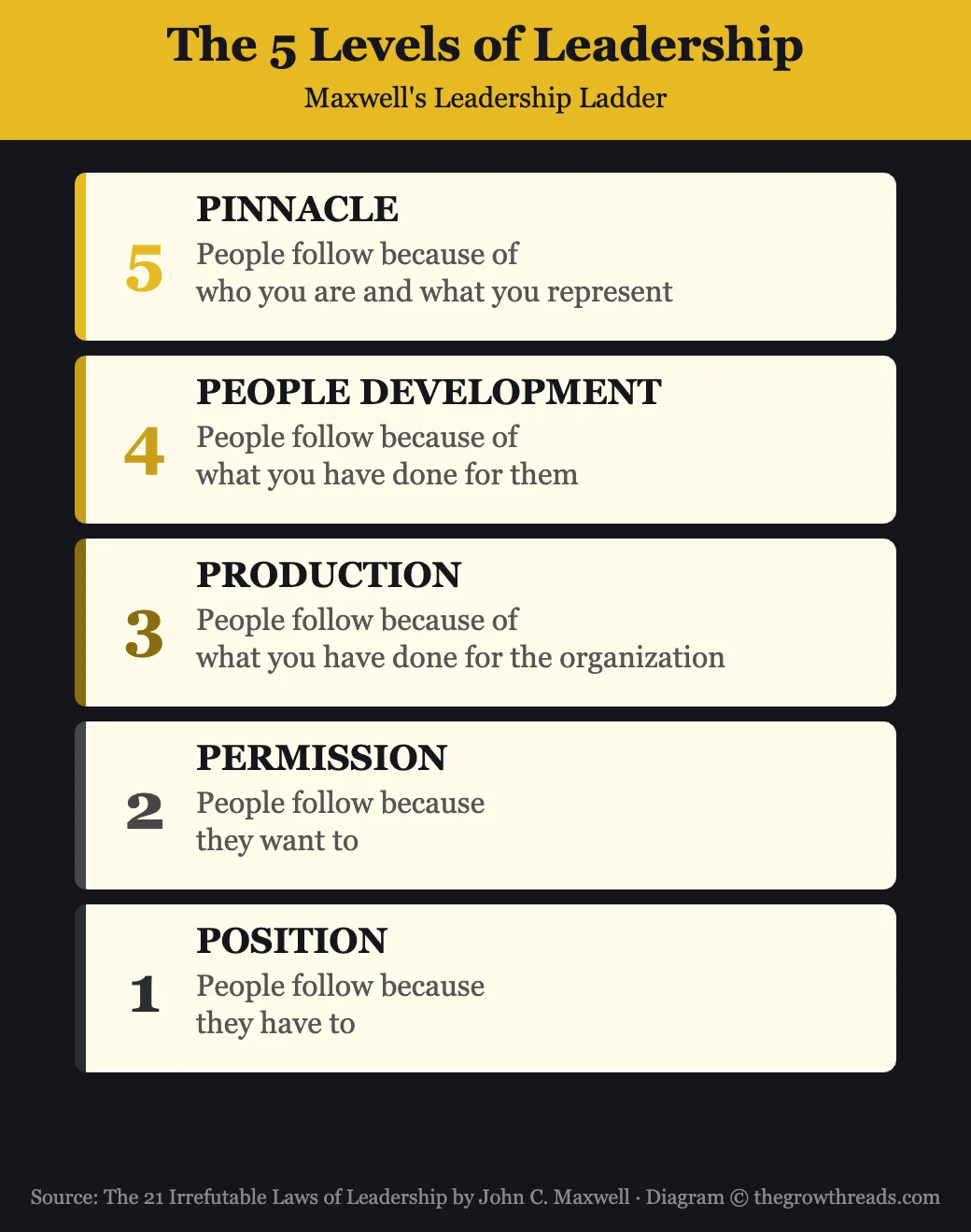
Woven through the book is Maxwell’s 5 Levels of Leadership: Position (people follow because they have to), Permission (people follow because they want to), Production (people follow because of results), People Development (people follow because of what you have done for them), and Pinnacle (people follow because of who you are). Maxwell argues every leader should know which level they are on with each person they lead — and that the goal is to climb higher with everyone.
Who is The 21 Irrefutable Laws of Leadership best for — and who should read something else first?
This book is ideal for anyone who has recently taken on a leadership role, aspiring leaders preparing for their first team, and mid-career managers who want a systematic framework rather than ad hoc leadership development. It is also excellent as a team read — many organizations work through one law per week in leadership meetings.
If you are already a senior leader with decades of experience, some of the principles may feel familiar. In that case, start with Good to Great for research-backed leadership insights or Principles by Ray Dalio for a more analytical approach. If you want leadership lessons delivered through a specific, gripping narrative rather than a framework, try Extreme Ownership or Turn the Ship Around.
Questions to reflect on
- On a scale of 1 to 10, what is your current leadership lid — and how is it limiting the people around you?
- Who follows you not because of your title but because they genuinely want to? What does that number tell you?
- Which of the 21 laws is your greatest strength, and which is your biggest blind spot?
- Are the five people in your inner circle raising your game or holding you back?
- If you left your current role tomorrow, what would continue without you — and what would collapse?
🔥 Ready to raise the lid on your leadership?
Maxwell gives you 21 laws you can apply immediately — start with the one where you are weakest.
How to apply The 21 Irrefutable Laws of Leadership (7-day plan)
- Day 1 — Assess your lid: Rate your leadership ability honestly on a 1-10 scale. Ask two trusted colleagues to rate you too. The gap between your self-assessment and theirs reveals your blind spots.
- Day 2 — Map your influence: List ten people you work with. Mark each as: follows willingly (Permission+), follows because required (Position only), or does not follow at all. Count the ratios.
- Day 3 — Add value: Practice the Law of Addition. Ask three people today: “What is the biggest challenge you are facing, and how can I help?” Then actually help.
- Day 4 — Audit your inner circle: Evaluate the five people closest to you in your professional life on Maxwell’s five criteria: influence, growth capacity, character, chemistry, and results.
- Day 5 — Prioritize ruthlessly: List everything on your plate. Apply the 80/20 rule — identify the 20 percent producing the most results. Start eliminating or delegating the rest.
- Day 6 — Develop a leader: Identify one person on your team with leadership potential. Set up a 30-minute meeting to discuss their growth goals and offer to mentor them on one specific skill.
- Day 7 — Write your legacy statement: Answer: “When I leave this role, what will continue without me?” If the honest answer is “not much,” create a plan to change that.
Frequently asked questions
Do I need to master all 21 laws to be an effective leader?
No. Maxwell himself acknowledges that no single leader excels at all 21 laws. The framework is designed for self-assessment — identify your strongest laws (lean into them) and your weakest (shore them up or surround yourself with people who are strong where you are weak). Most leaders find that improving in just three or four of their weakest laws produces dramatic results. The Inner Circle law is especially useful here: build a team whose strengths complement your gaps.
Which edition should I read — original or 25th anniversary?
The 25th anniversary edition (2022) is the recommended version. Maxwell revised and updated examples, added new case studies from the last two decades, and refined several of the laws based on feedback from millions of readers. The core 21 laws remain unchanged, but the illustrations and applications are more current. If you already own an older edition, the principles still apply — but the newer examples make it easier to share with younger team members.
Is this book only for people in corporate leadership?
Not at all. Maxwell’s definition of leadership — influence, not position — applies everywhere. Parents, coaches, teachers, community organizers, and entrepreneurs will all find applicable principles. The Law of Addition (add value to others) works identically in a classroom, a nonprofit, or a corporate boardroom. Several of Maxwell’s most compelling examples come from education, ministry, and volunteer organizations rather than business.
How does this compare to other leadership books like Good to Great?
Good to Great by Jim Collins is research-driven — it identifies what separates great companies from good ones through rigorous data analysis. Maxwell’s book is principle-driven — it provides a comprehensive framework based on decades of leadership practice and observation. Collins gives you what to look for; Maxwell gives you what to do. Many leadership development programs use both: Collins for the “what” and Maxwell for the “how.” They complement each other perfectly.
What is the 5 Levels of Leadership model?
Maxwell’s 5 Levels framework describes leadership progression: Level 1 (Position) means people follow you because of your title. Level 2 (Permission) means they follow because they like and trust you. Level 3 (Production) means they follow because you deliver results. Level 4 (People Development) means they follow because you have personally helped them grow. Level 5 (Pinnacle) means they follow because of your reputation and who you have become. The goal is to progress from Level 1 to Level 5 with every person you lead.
Can someone with no natural charisma become a great leader?
Maxwell is emphatic on this point: leadership is learned, not inherited. The Law of Process states that leadership develops daily through intentional practice. While charisma can accelerate certain aspects of influence, Maxwell identifies seven factors that drive influence — and most of them (character, knowledge, experience, competence) are entirely within your control. Many of history’s most effective leaders were not naturally charismatic but built enormous influence through consistent character and competence.
How do I use the 21 laws with my team?
Maxwell’s most popular recommendation is a “Law of the Week” approach: spend 21 weeks reading and discussing one law per week as a team. Each person rates themselves on the law, shares examples of it in action, and commits to one application step. This builds a shared leadership vocabulary and creates accountability. Many organizations report that this single practice — one law, one week, one discussion — transforms their leadership culture more than any formal training program.
Related summaries
- Good to Great Summary & Review — Collins’ research-backed companion to Maxwell’s framework on what separates good organizations from great ones.
- Extreme Ownership Summary & Review — Jocko Willink’s Navy SEAL approach to total leadership accountability.
- Multipliers Summary & Review — Liz Wiseman on how the best leaders amplify the intelligence around them.
- Best Leadership Books — Our full ranked guide to books that build real leadership capacity.
Related Leadership Summaries
Servant Leadership Summary and Review
The Culture Map Summary & Review: Decode Any Culture Before It Costs You a Deal
The First 90 Days Summary & Review: Master Every Leadership Transition
The Leadership Challenge Summary and Review
The No Asshole Rule Summary and Review