

★★★☆☆ 3.5/5
One-liner: A compelling case for why leaders must stop playing to win and start playing to keep the game going.
Best for: CEOs, founders, team leads, and anyone frustrated by short-term corporate thinking.
Reading time: ~5 hours (272 pages)
Difficulty to apply: Moderate — the mindset shift is the hard part; the five practices give you a clear starting path.
The Infinite Game in one minute
Most leaders are playing a game they don’t understand. Simon Sinek argues that business isn’t a finite contest with clear winners and losers — it’s an infinite game where the goal isn’t to win but to keep playing. Companies that treat business as finite (quarterly earnings, market share, beating the competition) eventually exhaust themselves. Those that play with an infinite mindset — guided by a Just Cause, trusting teams, and the courage to make dramatic pivots — are the ones that outlast everyone else. Sinek lays out five essential practices that shift leaders from a win-at-all-costs mentality to a keep-playing-and-improving one. The book draws heavily on examples from Apple, Microsoft, Costco, and the U.S. military to illustrate how infinite thinking creates more resilient organizations and more fulfilled people.
Key takeaways
- Business is an infinite game: There are no fixed rules, no agreed-upon endpoint, and no final winner — the only objective is to stay in the game as long as possible.
- A Just Cause is your north star: A vision that’s bigger than any product, revenue target, or CEO tenure gives people a reason to show up and sacrifice.
- Finite-minded leaders create fragile organizations: Obsessing over quarterly results, layoffs for numbers, and beating competitors erodes trust and innovation.
- Trusting teams outperform high-performing ones: Psychological safety matters more than raw talent — people who feel safe take the risks that drive breakthroughs.
- Worthy rivals reveal your weaknesses: Instead of enemies to crush, treat strong competitors as mirrors that show you where to improve.
- Existential flexibility is a superpower: The willingness to blow up your own business model to advance your cause separates the enduring from the extinct.
- Courage means choosing cause over comfort: Infinite-minded leadership requires resisting Wall Street pressure, board demands, and the lure of short-term wins.
- Ethical fading is the silent killer: Small, incremental compromises — each seemingly harmless — gradually corrupt a company’s culture until a scandal becomes inevitable.
- Will and resources are both necessary: Organizations need both the will (cause, culture) and resources (money, talent) to survive, but will must lead.
- The infinite game never ends: There is no finish line — the goal is to build something that outlives any individual leader.
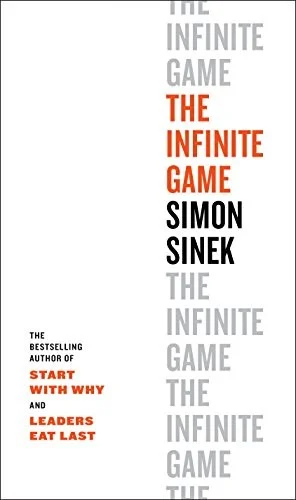
What is The Infinite Game about?
The Infinite Game applies mathematician James Carse’s concept of finite and infinite games to business and leadership. Sinek argues that leaders who adopt an infinite mindset — focused on advancing a Just Cause, building trust, studying rivals, and demonstrating courage — create organizations that thrive for decades, while finite-minded leaders chase short-term wins that ultimately destroy value.
About the author
Simon Sinek is a British-American author and motivational speaker best known for popularizing the concept of “Start With Why.” Born in Wimbledon, England, he grew up across multiple countries before settling in the United States, where he studied cultural anthropology at Brandeis University. His 2009 TED Talk on the Golden Circle became one of the most-watched talks of all time, launching him into global prominence. Sinek has advised organizations from the U.S. military to Microsoft, and his books — including Start With Why, Leaders Eat Last, and The Infinite Game — have collectively sold millions of copies. He teaches strategic communication at Columbia University. Explore all Simon Sinek book summaries →
Key concepts at a glance
| Concept | What it means | Use it when |
|---|---|---|
| Just Cause | A forward-looking vision so compelling people sacrifice to advance it | Defining or refining your organization’s purpose statement |
| Trusting Teams | Environments where vulnerability is safe and people admit mistakes freely | Building culture after a leadership change or team expansion |
| Worthy Rival | A competitor whose strengths reveal areas where you can improve | Reframing competitive anxiety into productive self-improvement |
| Existential Flexibility | The capacity to make a dramatic strategic shift to advance the Cause | Your business model is working today but won’t survive the next decade |
| Courage to Lead | Choosing the Cause over short-term gains, even under immense pressure | Facing board pressure to cut costs at the expense of culture |
| Ethical Fading | The gradual normalization of unethical behavior through small compromises | Auditing company practices before they become scandals |
| Will vs Resources | Will (culture, purpose) and resources (money, talent) must both be strong | Diagnosing why a well-funded team still underperforms |
| Finite vs Infinite Mindset | Playing to win (finite) vs playing to keep the game going (infinite) | Evaluating whether your strategy is sustainable long-term |
Part 1: The game we’re playing
Sinek opens with a story that became the seed of the entire book. He was invited to speak at an education summit alongside a Microsoft executive. Backstage, the Microsoft executive talked almost exclusively about how to beat Apple. Later that day, Apple’s representative talked almost exclusively about how to help teachers and students. One was obsessed with the competition; the other was obsessed with a cause. That contrast, Sinek argues, explains why Apple consistently outmaneuvered Microsoft during the 2000s despite Microsoft having more resources.
The core distinction comes from James Carse’s 1986 book Finite and Infinite Games. In a finite game, the players are known, the rules are fixed, and there is an agreed-upon endpoint — think football or chess. In an infinite game, the players can change, the rules are fluid, there is no finish line, and the objective is simply to keep playing. Business, politics, education, and life itself are infinite games.
The problem, Sinek explains, is that most leaders play business as if it were finite. They talk about “winning,” rank themselves against competitors, and optimize for quarterly results. But in a game with no finish line, the concept of winning is meaningless. The companies that last — the ones that survive technological revolutions, economic downturns, and leadership transitions — are the ones that play with an infinite mindset.
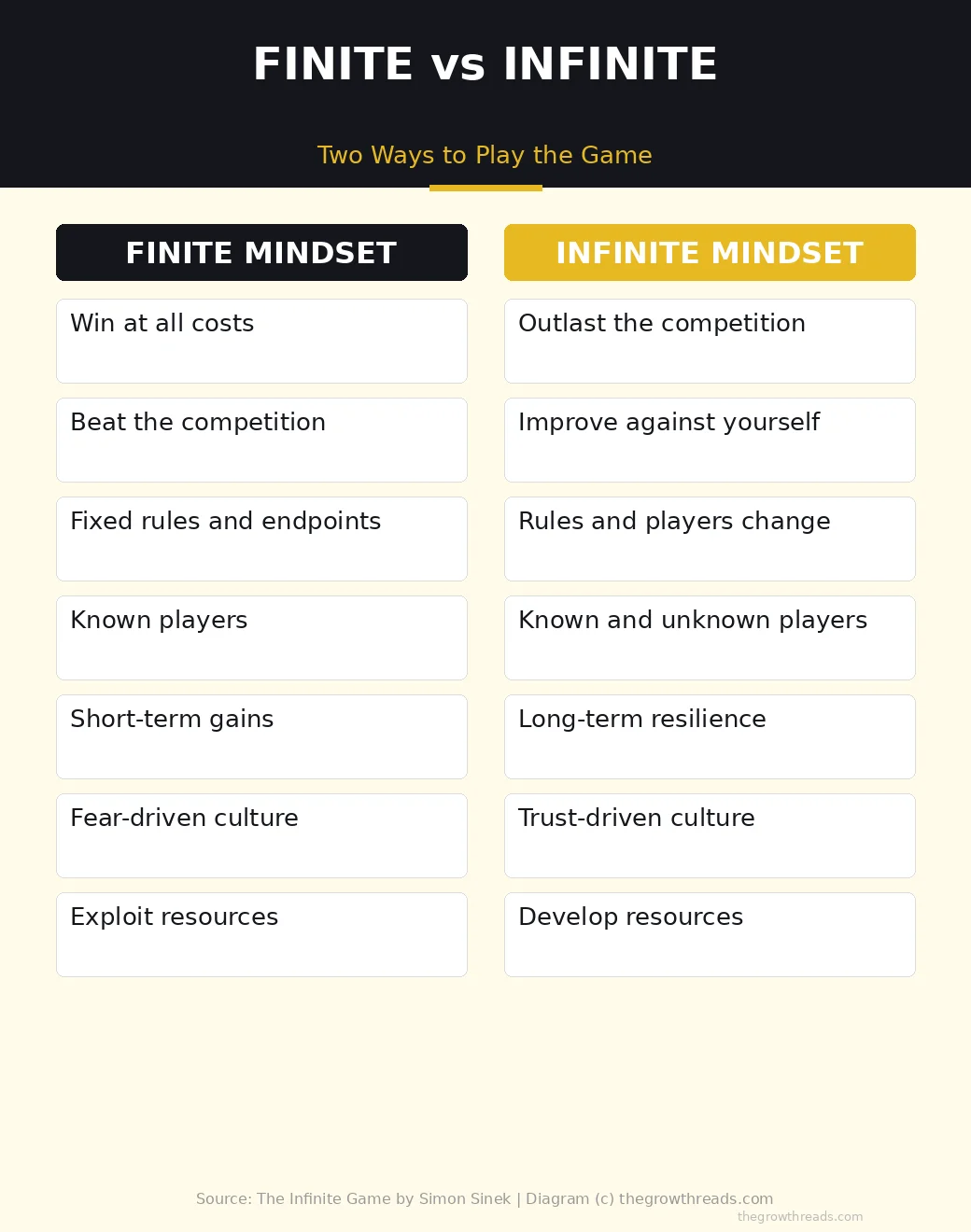
Sinek identifies five concrete consequences of playing with a finite mindset: declining trust, declining cooperation, declining innovation, declining employee engagement, and ultimately, declining organizational resilience. When leaders fixate on beating the competition, they make decisions that look smart on a spreadsheet but hollow out the culture. Layoffs to hit earnings targets. Withholding information from teams to maintain control. Rewarding individual performance over collective contribution. Each decision makes sense in isolation; together, they create organizations that are brittle.
Part 2: Advance a Just Cause
The first of Sinek’s five essential practices is having a Just Cause — a specific vision of a future state so appealing that people are willing to make sacrifices to help advance toward it. This isn’t a mission statement. Most mission statements are too vague, too self-serving, or too achievable to qualify. A Just Cause must meet five criteria: it must be for something (affirmative, not against a competitor), inclusive (open to anyone who wants to contribute), service-oriented (benefits people beyond just shareholders and leaders), resilient (can endure political, technological, and cultural change), and idealistic (big enough that it can never be fully achieved).
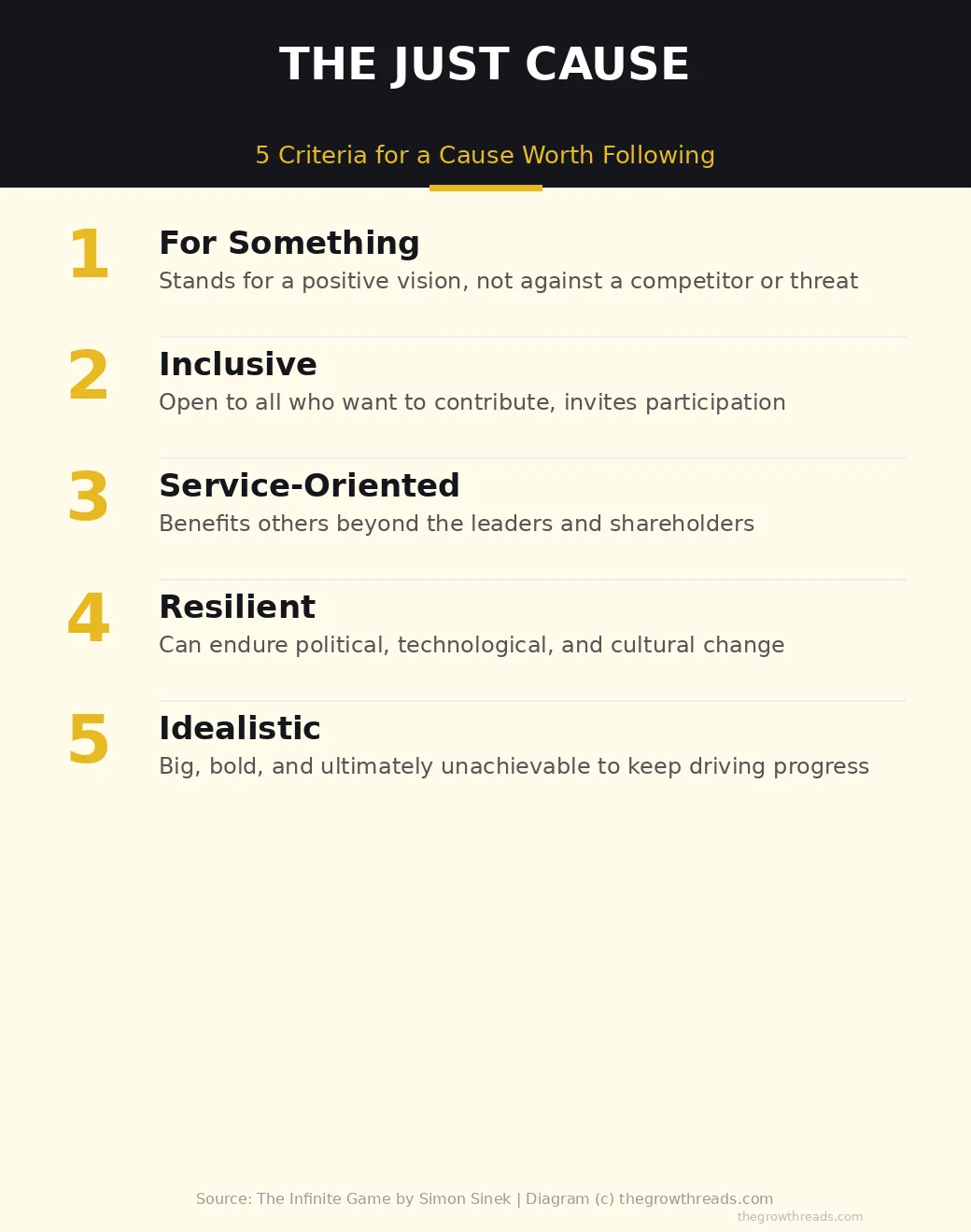
Sinek uses the Declaration of Independence as his primary example of a Just Cause. “All men are created equal” is affirmative, inclusive (in aspiration, at least), service-oriented, resilient across centuries of change, and idealistic enough that no nation has ever fully achieved it. In business, he points to CVS’s 2014 decision to stop selling tobacco products — a move that cost the company $2 billion in annual revenue but aligned with their stated purpose of helping people on their path to better health.
The chapter also introduces the concept of “Cause Blindness” — what happens when a company loses sight of its original purpose. Sinek traces how companies like GE and Lehman Brothers gradually drifted from their founding visions, making decisions that optimized for short-term financial performance while eroding the culture and trust that made them great in the first place. The most dangerous form of cause blindness, he argues, isn’t a sudden abandonment of values — it’s a slow, almost imperceptible drift where each small compromise seems reasonable in isolation.
Part 3: Build trusting teams and study worthy rivals
The second practice — building trusting teams — is where Sinek is at his most persuasive. He distinguishes between a “trusting team” and a “high-performing team.” A high-performing team might deliver results, but its members don’t necessarily feel safe admitting mistakes, asking for help, or challenging the boss. A trusting team may not always have the highest individual performers, but it creates an environment where collective intelligence flourishes.
The most memorable example is from the U.S. Navy SEALs. Sinek recounts conversations with SEAL leaders who explained that they would rather have a medium-performing team member with high trust than a high-performing member with low trust. On a battlefield, you need to know that the person next to you has your back — raw skill without trust is a liability. The SEALs use a simple two-axis model: performance on one axis, trust on the other. The most dangerous person in any organization is the high-performer/low-trust individual — the brilliant jerk who delivers numbers but poisons the culture.
The third practice is studying worthy rivals. Instead of viewing competitors as enemies to be destroyed, Sinek suggests we identify “worthy rivals” — other players in the game whose strengths reveal our own weaknesses. When Apple launched the Zune, Microsoft was trying to build a better iPod. They were playing finite — trying to beat Apple at Apple’s game. Meanwhile, Apple was already thinking about the iPhone, rendering the entire MP3 player category obsolete. A worthy rival isn’t someone you try to beat; it’s someone who makes you better by exposing where you fall short.
Sinek shares a personal example: he once viewed another speaker as a threat until he reframed the relationship. Instead of competing for the same audiences, he began studying what the other speaker did better — structure, humor, audience engagement — and used those observations to improve his own craft. The emotional shift from threat to teacher, he says, was liberating.
Part 4: Existential flexibility and the courage to lead
Existential flexibility is the capacity to make a profound strategic shift — a shift in the very business model or direction of a company — in order to more effectively advance the Just Cause. This isn’t pivoting because a product failed or the market shifted. It’s the proactive decision to blow up something that’s working because there’s a better way to advance the cause.
Sinek’s central case study is Apple. In the early 2000s, Apple was thriving as a computer company. The Mac was beloved, the iMac had reinvigorated the brand, and the iPod was dominating portable music. But Steve Jobs saw that the future wasn’t in computers or music players — it was in mobile computing. So he made the existential flex: pouring resources into the iPhone, a device that would eventually cannibalize iPod sales and redefine Apple’s entire business. Jobs wasn’t reacting to failure; he was advancing Apple’s cause of empowering individuals through technology.
The flip side is what happens when leaders lack existential flexibility. Sinek points to Kodak, which invented the digital camera in 1975 but refused to cannibalize its film business. And to Blockbuster, which had the chance to buy Netflix for $50 million and passed. In both cases, finite-minded leadership — protect what we have, optimize current revenue — prevented the existential flex that could have saved the company.
The final practice, the courage to lead, ties everything together. It takes courage to maintain a Just Cause when shareholders demand short-term returns. It takes courage to build trusting teams when firing someone would boost quarterly numbers. It takes courage to study a worthy rival instead of dismissing them. And it takes courage to make an existential flex when the current business is profitable. Sinek introduces the concept of “ethical fading” — the slow, systematic erosion of ethical standards through small, seemingly harmless decisions. Each compromise makes the next one easier, until the organization is doing things that would have been unthinkable at the start.
He uses Wells Fargo’s fake accounts scandal as a case study in ethical fading. No single employee woke up and decided to commit fraud. Instead, years of intense sales pressure, aggressive targets, and a culture that rewarded numbers over ethics gradually pushed thousands of employees to create accounts customers didn’t authorize. The system, not any individual, was the villain.
Who is The Infinite Game best for — and who should read something else first?
The Infinite Game is best suited for leaders and aspiring leaders who sense that something is wrong with the “win at all costs” mentality but haven’t been able to articulate an alternative. If you’re a CEO, founder, or team lead frustrated by the tyranny of quarterly thinking, this book gives you a vocabulary and a framework for a different approach. It’s also valuable for anyone in a corporate environment who wants to understand why their company’s culture feels transactional rather than purposeful.
If you’re new to Sinek’s work, start with Start With Why — it lays the foundation for the Just Cause concept. If you’re looking for more tactical, research-heavy leadership advice, try Turn the Ship Around! by L. David Marquet, which gives you a concrete model for distributing authority. And if you want the psychological depth that Sinek gestures at but doesn’t fully explore, Dare to Lead by Brené Brown goes deeper into the emotional side of courageous leadership.
Questions to reflect on
- What is the Just Cause of your organization — and does it meet all five criteria (for something, inclusive, service-oriented, resilient, idealistic)?
- Think of a competitor you resent — what specific strength do they have that reveals a weakness in your own approach?
- If you had to make one existential flex in your career or business right now, what would it be?
- On the performance/trust matrix, where do your team members fall — and are you tolerating any high-performers with low trust?
- Where in your work have you noticed ethical fading — small compromises that have gradually become “just how things are done”?
🔥 Ready to lead with a long-term vision?
Discover how to build an organization that outlasts any individual leader.
How to apply The Infinite Game (7-day plan)
- Day 1 — Audit your current cause: Write down your company’s or team’s stated mission. Test it against Sinek’s five criteria. Note which criteria it fails.
- Day 2 — Identify your worthy rival: Name one competitor or peer whose strengths make you uncomfortable. Write down three specific things they do better than you.
- Day 3 — Map your performance/trust grid: List your five closest colleagues or direct reports. Rate each on performance and trust. Notice any patterns.
- Day 4 — Spot ethical fading: Identify one practice at your organization that started as an exception but has become standard — and ask whether it still aligns with your values.
- Day 5 — Draft a Just Cause: Write a one-paragraph vision of a future worth fighting for. Share it with one trusted person and ask if they’d sacrifice to advance it.
- Day 6 — Build one trust ritual: Start a weekly practice where team members can share mistakes or struggles without judgment — a “failure debrief” or “learning round.”
- Day 7 — Stress-test your flexibility: Ask yourself: “If my current product or business model disappeared tomorrow, what cause would still drive me forward?” Write the answer down.
Frequently asked questions
What is the main point of The Infinite Game?
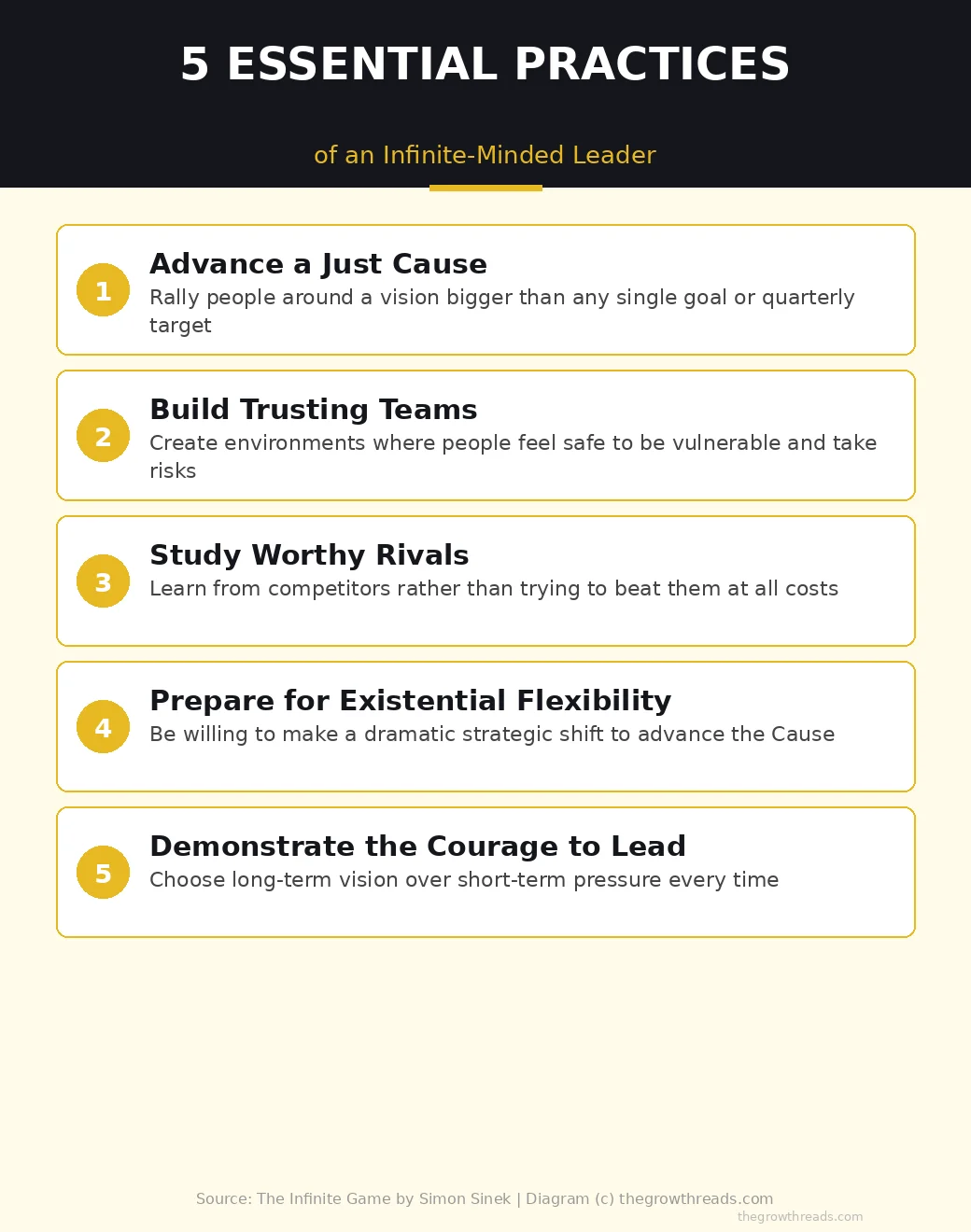
The central argument is that business is not a finite game with winners and losers but an infinite game where the goal is to keep playing. Leaders who adopt an infinite mindset — focused on a Just Cause, trusting teams, and long-term resilience — build organizations that outlast those obsessed with quarterly wins. Sinek lays out five practices that help leaders make this shift: advance a Just Cause, build trusting teams, study worthy rivals, prepare for existential flexibility, and demonstrate the courage to lead.
Is The Infinite Game worth reading if I’ve already read Start With Why?
Yes, because the two books address different levels of the same idea. Start With Why focuses on discovering your personal or organizational purpose. The Infinite Game takes that purpose and shows you how to build an organization around it that can survive decades of change, competition, and leadership transitions. Think of Start With Why as finding the “what” and The Infinite Game as building the “how.” The five practices — especially existential flexibility and worthy rivals — are entirely new material.
What is a “Just Cause” and how do I create one?
A Just Cause is a specific vision of a future state so appealing that people are willing to make sacrifices to help advance it. It must be for something (not against a competitor), inclusive, service-oriented, resilient to change, and idealistic (never fully achievable). To create one, start by asking what future you’re trying to build — not what you’re trying to achieve. Test it against the five criteria and refine until it passes all of them. The Declaration of Independence and CVS’s health mission are Sinek’s go-to examples.
What are the five practices of infinite-minded leadership?
The five practices are: (1) Advance a Just Cause — define a vision bigger than any single goal. (2) Build trusting teams — create environments where people feel safe to be vulnerable. (3) Study worthy rivals — learn from competitors instead of trying to crush them. (4) Prepare for existential flexibility — be willing to make dramatic strategic shifts to advance the cause. (5) Demonstrate the courage to lead — resist short-term pressure in favor of long-term vision. Together, they form a framework for sustainable leadership.
What is ethical fading in The Infinite Game?
Ethical fading is the gradual normalization of unethical behavior through a series of small, seemingly harmless decisions. Each individual compromise appears reasonable, but collectively they erode an organization’s moral foundation. Sinek uses Wells Fargo’s fake accounts scandal as the primary example: no single employee decided to commit fraud, but years of aggressive sales targets and a culture that rewarded numbers over ethics pushed thousands of employees across the line. The lesson is to audit practices regularly before they drift too far.
How long does The Infinite Game take to read?
The Infinite Game runs 272 pages and takes the average reader about five hours to complete. The audiobook, narrated by Sinek himself, runs approximately six hours and 56 minutes. The writing style is accessible and story-driven, making it a relatively quick read despite the business-strategy subject matter. Most readers report finishing it in two to three sittings. If you’re short on time, the five practices chapter summaries capture the core framework.
What are the criticisms of The Infinite Game?
The most common criticism is that the book relies heavily on anecdotal case studies (Apple, Microsoft, Costco) rather than rigorous empirical research, and some of these examples have been used across multiple Sinek books. Some readers also note that the concept of infinite games, borrowed from James Carse, isn’t given sufficient attribution throughout. That said, the practical framework of five practices gives the book more structure than Sinek’s earlier works, and the core argument — that short-term thinking destroys long-term value — is well-supported by broader organizational research.
Related summaries
If The Infinite Game resonated with you, explore these related summaries in the Leadership silo:
- Start With Why Summary — Sinek’s foundational book on finding your purpose.
- Leaders Eat Last Summary — Sinek’s deep dive into why some teams trust each other and others don’t.
- Good to Great Summary — Jim Collins on what separates enduring companies from the rest.
- Dare to Lead Summary — Brené Brown on the emotional mechanics of courageous leadership.
→ See all: Best Leadership Books