

★★★★½ 4.4 / 5
One-liner: A sports journalist turned science writer makes the counterintuitive case that in a world obsessed with specialisation, generalists — people with broad experience and diverse skills — consistently outperform early specialists in complex, unpredictable domains.
Best for: Anyone who feels behind because they have not specialised early, career-changers, parents debating when to specialise their children, and leaders hiring for innovation.
Reading time: ~7 hrs (guide: 26 min)
Difficulty to apply: Low–Moderate (the book reframes how you think about your path rather than prescribing a protocol)
Range in one minute
The world tells you to specialise early, go deep, and commit — but the evidence says the opposite works better for most people in most domains. David Epstein, a bestselling science journalist, challenges the Tiger Woods model of success (start young, specialise relentlessly, achieve greatness through early, narrow focus) with the Roger Federer model (sample many sports as a child, specialise late, and develop the broad pattern-recognition skills that complex domains demand). Drawing on research in sports, education, music, science, and business, Epstein shows that “kind” learning environments with clear rules and immediate feedback (chess, golf) reward early specialisation — but most of life is a “wicked” environment where rules are unclear, feedback is delayed, and the ability to draw analogies across domains produces the breakthroughs that narrow expertise cannot. The book is a permission slip for the curious, the late bloomers, and the multipotentialites who have been told they are falling behind.
Key takeaways
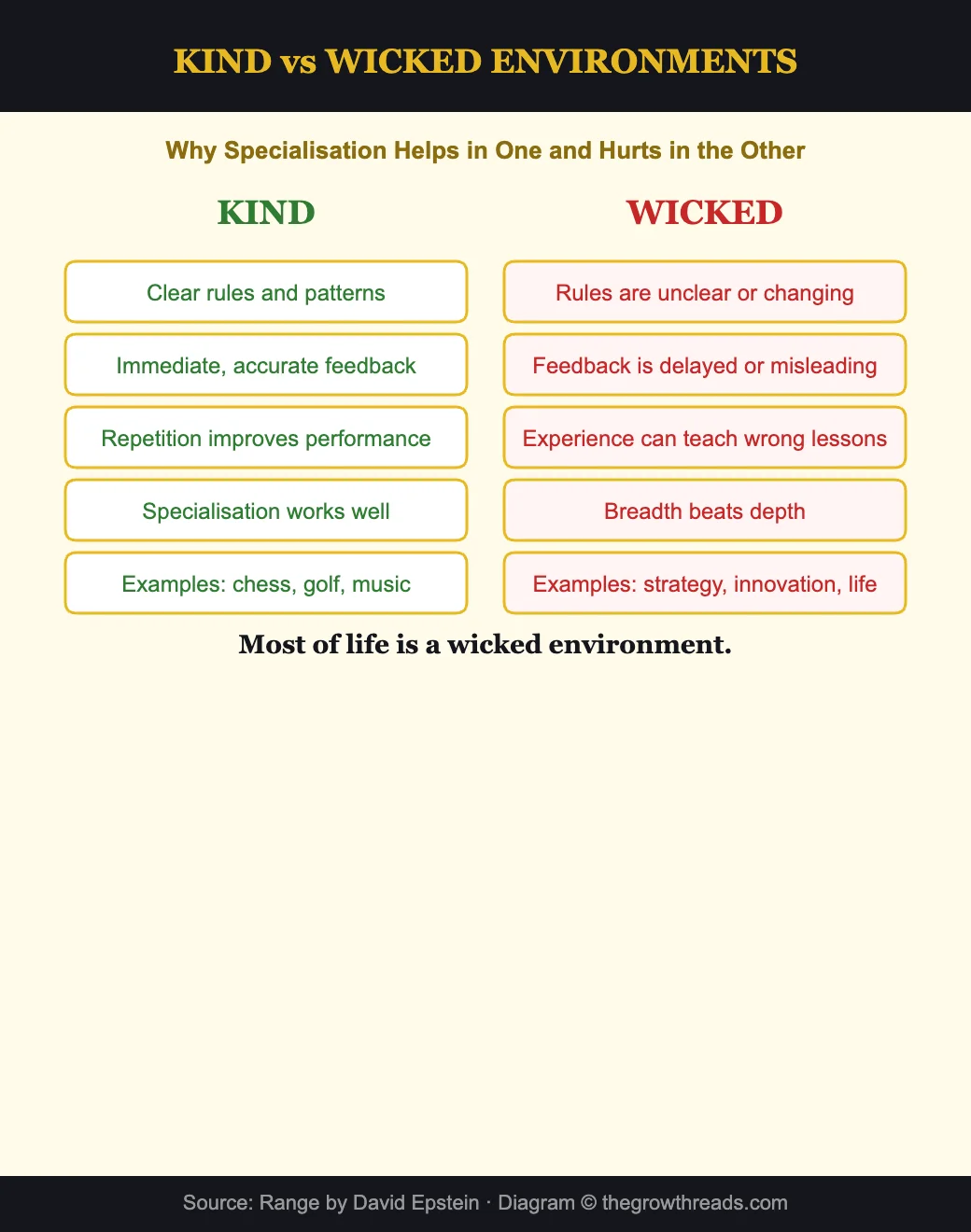
- Early specialisation works in kind environments only: Chess, golf, and classical music have clear rules, immediate feedback, and repeating patterns. Here, starting early and drilling narrows the gap. But most careers, problems, and life decisions are not kind environments.
- Most of life is a wicked environment: Rules are unclear, feedback is delayed or misleading, and the same strategy may produce different outcomes. In wicked environments, breadth of experience outperforms narrow depth.
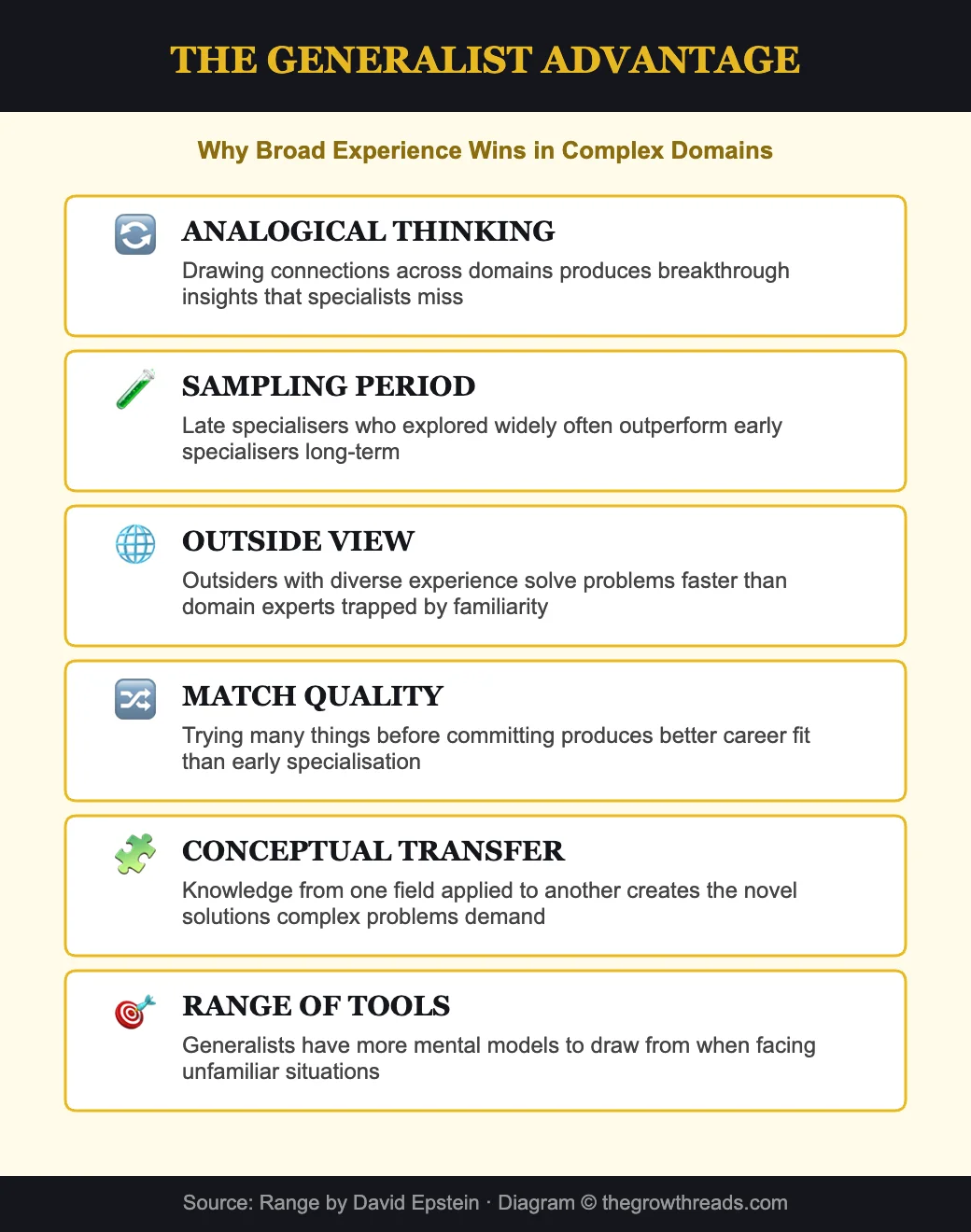
- Late specialisers often outperform early ones: In music, science, and sports (outside narrow skill domains), people who sampled widely before committing frequently surpass those who committed early — because they developed better “match quality” between their abilities and their chosen field.
- Analogical thinking drives innovation: The most significant breakthroughs in science and technology come from people who apply concepts from one domain to a problem in another. This requires broad knowledge that deep specialists lack.
- The “outside view” beats the “inside view”: When domain experts are asked to solve problems in their own field, they often perform worse than outsiders with diverse experience — because familiarity creates cognitive tunnels that block novel solutions.
- Sampling periods are not wasted time: The time a young person spends trying different sports, subjects, instruments, or careers is not lost — it is the exploration that produces better long-term fit and more creative thinking.
- Grit can be a liability without fit: Persisting at the wrong thing — because you committed too early or because you believe changing direction is weakness — wastes years that could be spent finding a better match.
- Match quality matters more than early starts: Finding the right fit between your abilities and your field is a stronger predictor of long-term success and satisfaction than the number of years of experience.
- Deliberate practice is not enough in wicked domains: In complex fields, what matters is not just hours of practice but the diversity of problems you have encountered and the range of mental models you can apply.
- The generalist’s strength is integration: In an era of increasing specialisation, the ability to connect ideas across disciplines — the generalist’s core skill — becomes more valuable, not less.
What is Range about?
Range argues that in most complex domains, generalists — people with broad experience and diverse skills — outperform early specialists. David Epstein uses research from sports, science, music, and business to show that sampling widely, specialising late, and thinking across domains produces better outcomes than the “10,000 hours” model suggests.
About the author
David Epstein is a science journalist and bestselling author whose previous book, The Sports Gene, explored the nature-nurture debate in athletic performance. He has written for ProPublica, Sports Illustrated, and authored investigations that have won multiple journalism awards. Epstein holds master’s degrees in environmental science and journalism from Columbia University — an appropriately generalist background for someone arguing the case for broad experience. Range grew from a TED talk that received millions of views and challenged the dominant narrative that early specialisation is the only path to excellence. Explore all David Epstein book summaries →
Key concepts at a glance
| Concept | What it means | Use it when |
|---|---|---|
| Kind environment | Domain with clear rules, immediate feedback, and repeating patterns (chess, golf) | Evaluating whether specialisation is appropriate |
| Wicked environment | Domain with unclear rules, delayed feedback, and non-repeating patterns (strategy, innovation) | Most of life and career decisions |
| Sampling period | Time spent exploring different activities before committing to one | You feel guilty about not specialising early |
| Match quality | The fit between your abilities/interests and your chosen field | You are deciding whether to persist or pivot |
| Analogical thinking | Applying concepts from one domain to solve problems in another | You need creative solutions to complex problems |
| Outside view | Solving problems from a diverse, cross-domain perspective rather than within-domain expertise | Experts are stuck and fresh thinking is needed |
| Fermi estimation | Using broad knowledge to make reasonable estimates about unfamiliar problems | You face a problem with no established approach |
Part 1 — Tiger vs Roger
Epstein opens with the story everyone knows and the story almost no one tells. Tiger Woods started golf at age 2, appeared on The Bob Hope Show at 3, won junior championships by 8, and became the greatest golfer of his generation. This narrative dominates popular culture: start early, specialise relentlessly, commit wholly, and greatness follows. It is the story behind the 10,000 hours rule, the justification for every parent who enrolls a toddler in year-round training, and the implicit assumption of nearly every career advice book.
Then Epstein introduces Roger Federer. As a child, Federer played soccer, basketball, handball, badminton, and swimming. His mother, a tennis coach, refused to coach him because she did not want to push. He did not focus on tennis until his mid-teens — an age when Tiger Woods had already been training for over a decade. Yet Federer became arguably the greatest tennis player in history, winning 20 Grand Slam titles over a career that lasted into his 40s. His athletic “sampling period” — far from being wasted time — built the coordination, spatial awareness, and movement creativity that made his tennis game unique.
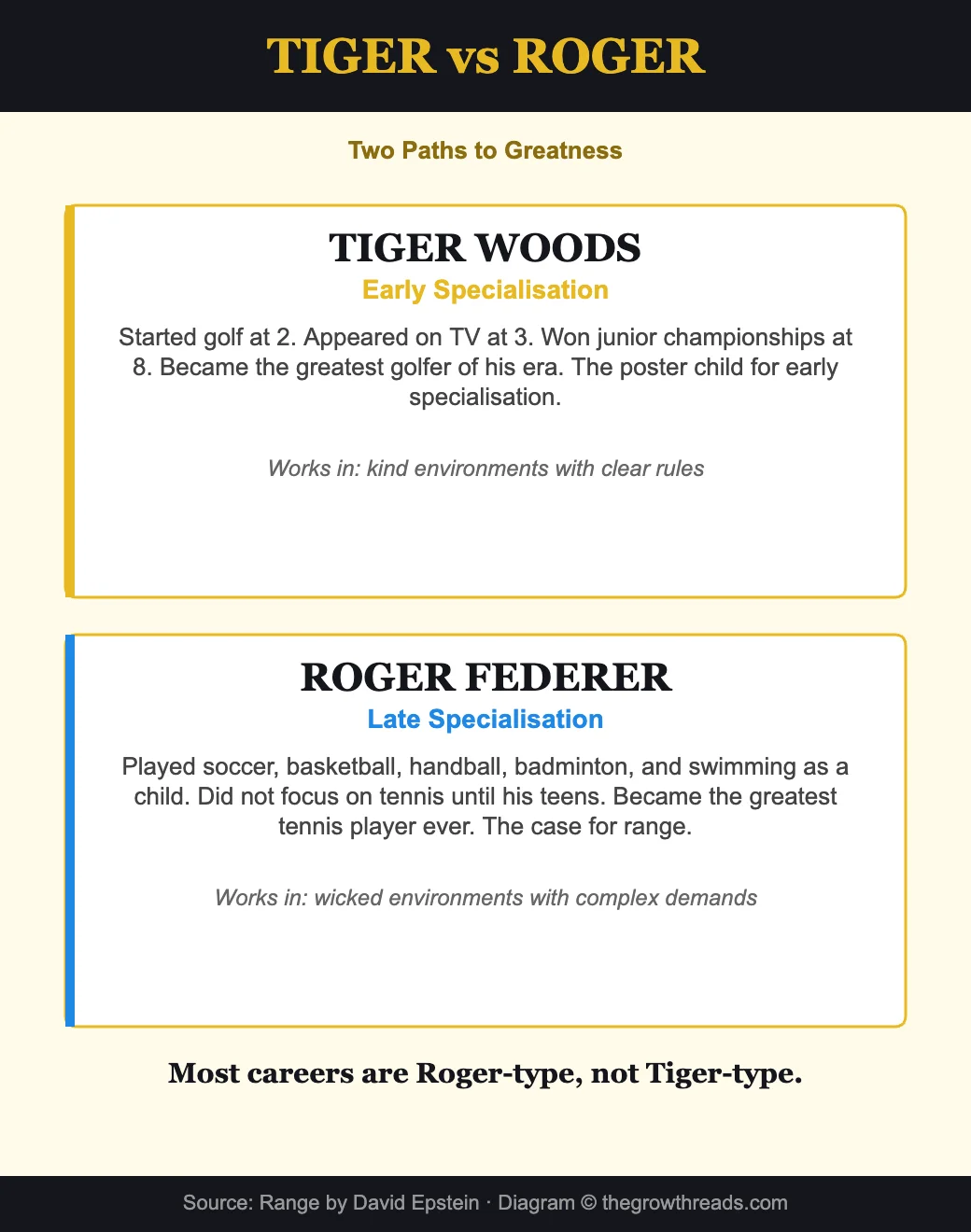
Epstein’s key distinction: Tiger’s path works in “kind” learning environments — domains with clear rules, immediate feedback, and repeating patterns. Golf qualifies: the course does not change mid-shot, the ball goes where physics dictates, and thousands of practice swings produce measurable improvement. But most of life is not a kind environment. It is “wicked” — the rules are unclear, feedback is delayed or misleading, and the same action can produce different results depending on context. In wicked environments, the Roger path — broad sampling, late specialisation, diverse experience — consistently outperforms the Tiger path.
Part 2 — The science of breadth
The middle section builds the case with research from multiple fields. In science, Epstein cites a study of Nobel laureates: they are significantly more likely than average scientists to have hobbies and interests outside their field — music, art, writing, acting. The breadth is not incidental; it is causal. Cross-domain thinking produces the analogies that drive breakthrough insights. The physicist who plays violin thinks about resonance differently than one who does not.
In music, Epstein documents that the most accomplished classical musicians typically tried several instruments before settling on one — and that the sampling period was a better predictor of long-term achievement than early hours of practice on a single instrument. In education, he shows that students taught through “desirable difficulties” (learning strategies that feel slow and confusing in the moment but produce deeper understanding) outperform those taught through fluent, efficient instruction — because the struggle forces broader neural encoding.
The InnoCentive story is the section’s showpiece. InnoCentive is a platform where organisations post difficult scientific problems they cannot solve internally. The company found that the problems most likely to be solved were solved by people working outside their area of expertise — a chemist solving a biology problem, an aerospace engineer solving a medical device problem. The further the solver’s background was from the problem domain, the more likely they were to crack it. Specialists knew too much about why the problem was hard; outsiders applied analogies from their own fields that the specialists could not see.
Part 3 — Late bloomers and match quality
The final section addresses the personal and emotional dimension of range. Epstein introduces “match quality” — the fit between a person’s abilities, interests, and their chosen field — and shows that it is a stronger predictor of long-term success and satisfaction than raw talent, early starts, or hours of practice. People who sample broadly before committing find better matches, which means they work harder because they want to (intrinsic motivation) rather than because they should (external pressure).
This leads to a nuanced critique of grit. Epstein does not argue against perseverance — he argues against perseverance at the wrong thing. Grit applied to a bad fit wastes years that could have been spent finding a better match. Strategic quitting — changing direction when the evidence shows you are in the wrong lane — is not failure but intelligent reallocation. Van Gogh did not start painting until his late 20s after failing at multiple careers. Julia Child did not enter the kitchen professionally until her 40s. Both became masters — but only after extensive sampling revealed where their strengths and passions actually lay.
The book’s most powerful message is emotional as much as intellectual: if you have followed a winding path, tried many things, and still feel like you are behind the people who committed early — you are not behind. You are acquiring the range that will serve you in the complex, wicked environments where real careers and real lives unfold. The zigzag is not a detour; it is the route.
Who is Range best for — and who should read something else first?
This book is essential for anyone who has been told they are behind because they have not specialised, for parents deciding when (and whether) to push specialisation on their children, and for leaders building teams that need to innovate. It is also deeply comforting for career-changers, late bloomers, and multipotentialites who have internalised the message that their broad interests are a weakness.
If you want the case for depth and deliberate practice (the complementary argument), read Deep Work or Peak. If you want the practical system for building one specific skill, So Good They Can’t Ignore You provides the framework. And if the grit question interests you, read Grit alongside Range for the most balanced perspective.
Questions to reflect on
- Is your current career environment kind or wicked — and does your approach to skill-building match the environment?
- How much of your diverse experience have you dismissed as “wasted time” that might actually be your greatest asset?
- Are you persisting in your current path because the match quality is high, or because you believe changing direction would be failure?
- When was the last time you solved a problem by applying an idea from a completely different domain?
- If you gave yourself permission to sample one new field, skill, or interest — purely for exploration — what would you try?
🔥 Ready to discover your greatest asset is your range?
Learn why generalists triumph and why your winding path may be exactly right.
How to apply Range (7-day plan)
- Day 1 — Assess your environment: Is your field kind or wicked? List the rules, the feedback loops, and how predictable the outcomes are. This determines whether depth or breadth should dominate your development strategy.
- Day 2 — Inventory your range: List every skill, hobby, interest, and field you have explored — including ones you abandoned. For each, note one unique insight or ability it gave you. You are mapping your cross-domain toolkit.
- Day 3 — Try analogical thinking: Take a current work problem and deliberately apply a concept from a completely unrelated domain. How would a chef approach this engineering challenge? How would an athlete think about this management issue? Force the analogy.
- Day 4 — Assess your match quality: Rate your current career on three dimensions: How well does it use your strengths? How much does the work itself energise you? How aligned is it with your values? Score each 1–10. If the total is below 18, consider whether sampling more broadly might improve your match.
- Day 5 — Sample something new: Spend one hour exploring a field, skill, or subject you know nothing about. Watch a lecture, read an article, try a tutorial. You are not committing — you are sampling. Notice what sparks your curiosity.
- Day 6 — Talk to an outsider: Describe your hardest current problem to someone outside your field and ask for their perspective. The further their background is from your domain, the more likely they are to offer an insight you cannot see.
- Day 7 — Give yourself permission: Write a brief statement acknowledging that your diverse experiences are assets, not liabilities. If you have been beating yourself up for not specialising early, let Epstein’s research release that guilt. Your range is your superpower.
Frequently asked questions
Is Epstein saying specialisation is bad?
No. He is saying specialisation is optimal in kind environments (clear rules, immediate feedback) but suboptimal in wicked environments (unclear rules, delayed feedback) — and that most of life and most careers are wicked environments. In kind domains like chess, golf, or classical music, early specialisation demonstrably works. The problem is applying the kind-environment model to wicked environments where it does not fit. The takeaway is not “never specialise” but “specialise at the right time, in the right domain, after sufficient sampling.”
Does this contradict the 10,000 hours rule?
Partially. The 10,000 hours framework (from Anders Ericsson’s research, popularised by Malcolm Gladwell) applies primarily to kind environments where deliberate practice produces predictable improvement. Epstein shows that in wicked environments, accumulated hours in a single domain can actually impair performance by creating narrow expertise that misses novel solutions. The most accurate framing: deliberate practice is necessary but not sufficient, and in complex domains, the diversity of your practice matters as much as the quantity.
Should I discourage my child from specialising early?
Epstein recommends a “sampling period” where children try multiple activities before committing — and notes that this period often extends well into adolescence. The research shows that late specialisers in music, sports, and academics frequently outperform early specialisers long-term, partly because they develop better match quality and partly because diverse early experiences build transferable skills. The exception: if your child is clearly in a kind environment (gymnastics, figure skating) where physical development makes early specialisation necessary, the calculus changes. For most activities, however, broad early exploration is the better bet.
How do I know if I should persist or pivot?
Epstein’s match quality concept provides the framework. Ask: Does this work use my strengths? Do I find the work itself inherently interesting (not just the rewards)? Am I improving and seeing a path to mastery? If the answers are yes, persist — you have good match quality and grit will serve you well. If the answers are consistently no despite genuine effort, pivoting is not failure — it is intelligent reallocation of your limited time toward a better match. The key distinction: are you quitting because it is hard (bad reason) or because the fit is wrong (good reason)?
Is this book relevant for people already deep in a specialty?
Yes. Even established specialists benefit from adding range. Epstein shows that the most innovative experts are those who maintain interests and knowledge outside their primary field. You do not need to abandon your speciality — just cultivate cross-domain thinking alongside it. Read outside your field, attend conferences in adjacent disciplines, pursue hobbies that exercise different cognitive muscles. The combination of deep expertise in one area and broad knowledge across others is the most powerful career configuration Epstein identifies.
How does Range relate to Grit?
They are complementary, not contradictory. Duckworth argues that perseverance and passion are the strongest predictors of achievement. Epstein agrees — but adds that passion and perseverance only produce great outcomes when applied to the right match. Grit at the wrong thing is stubbornness; grit at the right thing is mastery. Range provides the exploration strategy for finding the right match; Grit provides the persistence strategy for excelling once you have found it. Read both for the complete picture.
What is the strongest evidence for the generalist advantage?
The InnoCentive study is the most compelling single piece of evidence. On a platform where organisations post difficult unsolved problems, solutions were most likely to come from solvers working outside their area of expertise — and the further the solver’s background was from the problem domain, the higher the success rate. This directly contradicts the assumption that domain experts are always best positioned to solve domain problems. In wicked environments, the outsider’s diverse mental models provide the analogies that domain experts, trapped by familiarity, cannot access.
Related summaries
- So Good They Can’t Ignore You by Cal Newport — The case for depth: building career capital through deliberate practice.
- Grit by Angela Duckworth — Why perseverance matters — and when it matters most (after finding the right match).
- Deep Work by Cal Newport — How to develop rare skills through concentrated focus.
- Mindset by Carol Dweck — The growth mindset that makes both sampling and mastery possible.
- See all Productivity book summaries on our Best Productivity Books pillar page.