

★★★★½ 4.4 / 5
One-liner: A computer scientist argues that “follow your passion” is terrible career advice — and that the craftsman mindset of building rare, valuable skills is the only reliable path to work you love.
Best for: Career-changers, graduates choosing their path, anyone disillusioned with the passion hypothesis, and professionals who want to build leverage through skill rather than luck.
Reading time: ~5 hrs (guide: 22 min)
Difficulty to apply: Moderate (requires sustained deliberate practice and patience)
So Good They Can’t Ignore You in one minute
“Follow your passion” is not just unhelpful — it is actively dangerous. Cal Newport, a computer science professor at Georgetown University who has studied career satisfaction for over a decade, argues that passion is not something you discover and then pursue — it is something that develops after you become excellent at something valuable. His alternative: the craftsman mindset. Instead of asking “What does the world owe me?” (the passion mindset), ask “What can I offer the world?” Build rare and valuable skills through deliberate practice. Accumulate “career capital.” Then invest that capital in the traits that make work great: autonomy, competence, relatedness, and mission. The book presents four rules, illustrated through case studies of people who built extraordinary careers — not by following their passion, but by becoming so good they could not be ignored.
Key takeaways
- “Follow your passion” is bad advice: Most people do not have a pre-existing passion waiting to be discovered. Those who do often have passions (art, sport, philosophy) that do not easily translate into viable careers. Telling people to follow their passion creates anxiety and job-hopping, not fulfillment.
- Passion develops from mastery: Research on career satisfaction consistently shows that people grow to love work they are good at. Mastery creates engagement, which creates passion — not the reverse.
- The craftsman mindset is the foundation: Focus on what you can offer the world, not what the world owes you. This shift from consumer to producer is the first step toward building a career you love.
- Career capital is your currency: Rare and valuable skills are the only reliable currency for acquiring the traits that make work great. Without career capital, demands for better conditions are just wishes.
- Deliberate practice is the only way to build capital: Showing up is not enough. You must deliberately stretch beyond your current ability, seek honest feedback, and focus on the skills that are most valued in your field.
- Control requires capital: Autonomy is the most powerful predictor of career satisfaction, but you can only earn it after building enough career capital that your employer or market values you too much to lose you.
- The control traps are real: Trap 1: seeking control before you have capital (you will fail). Trap 2: gaining capital and having your employer resist your bid for control (they will try to keep you doing what makes them money).
- Mission requires mastery: A compelling career mission — a unifying purpose for your work — cannot be planned from scratch. It emerges from the “adjacent possible” that only becomes visible after you reach the frontier of your field through mastery.
- Little bets test big missions: Instead of betting everything on a grand mission, make small, reversible experiments (little bets) that test whether a potential mission resonates with the market. Let the market guide you.
- Remarkable projects in remarkable venues: For a mission to succeed, you need projects compelling enough that people remark on them, launched in venues where they can be noticed and shared.

What is So Good They Can’t Ignore You about?
This book argues that “follow your passion” is bad career advice and presents an alternative: the craftsman mindset. Build rare, valuable skills through deliberate practice, accumulate career capital, then invest it in autonomy, competence, and mission. Passion follows mastery — not the other way around.
About the author
Cal Newport is a computer science professor at Georgetown University and the author of seven books on work, technology, and human flourishing, including Deep Work, Digital Minimalism, and A World Without Email. He earned his PhD from MIT and has published peer-reviewed research on distributed algorithms while simultaneously building a parallel career as one of the most influential writers on productivity and career strategy. Newport is notable for practising what he preaches: he does not have social media accounts, works in focused blocks, and credits his career output to the deliberate practice and career capital principles he advocates in this book. Explore all Cal Newport book summaries →
Key concepts at a glance
| Concept | What it means | Use it when |
|---|---|---|
| Passion hypothesis | The belief that you must discover your passion first, then pursue it as a career | You feel anxious because you have not found “your thing” |
| Craftsman mindset | Focus on what value you produce rather than what value you receive | You want to shift from entitlement to agency in your career |
| Career capital | Rare and valuable skills that give you leverage in the career marketplace | You want to understand what actually creates career options |
| Deliberate practice | Structured practice that stretches you beyond current ability with feedback | You want to improve faster than just “putting in the hours” |
| Control | Autonomy over what you do and how you do it — the top predictor of job satisfaction | You feel micromanaged or trapped in your current role |
| Adjacent possible | The zone of new ideas that becomes accessible only after reaching the frontier of a field | You want to find a mission but cannot see one yet |
| Little bets | Small, reversible experiments that test whether a potential mission has market viability | You have an idea but are not sure if it will work |
Part 1 — Why passion is a trap
Newport opens by dismantling the most sacred advice in career counselling: “follow your passion.” He presents three arguments against it. First, most people do not have a pre-existing passion that maps to a career. Surveys show that common passions — sports, art, music, reading — rarely translate into viable jobs. Second, the research on career satisfaction does not support the passion hypothesis. A 2002 study of college administrative assistants found that the strongest predictor of job satisfaction was not whether the person had a passion for administrative work (none did) but how long they had been in the role — because tenure creates mastery, social bonds, and autonomy. Third, the “follow your passion” narrative creates anxiety: if you have not identified your passion, you must be doing something wrong.
Newport profiles Steve Jobs — ironically the most famous advocate of “follow your passion” — and shows that Jobs himself did not follow his passion into Apple. His passions were Zen Buddhism and calligraphy. He stumbled into computer business almost by accident, and his passion for Apple developed over years of building something successful. The passion came after the mastery, not before. This is the pattern Newport finds repeatedly: people who love their work did not start by loving it. They started by becoming good at it.
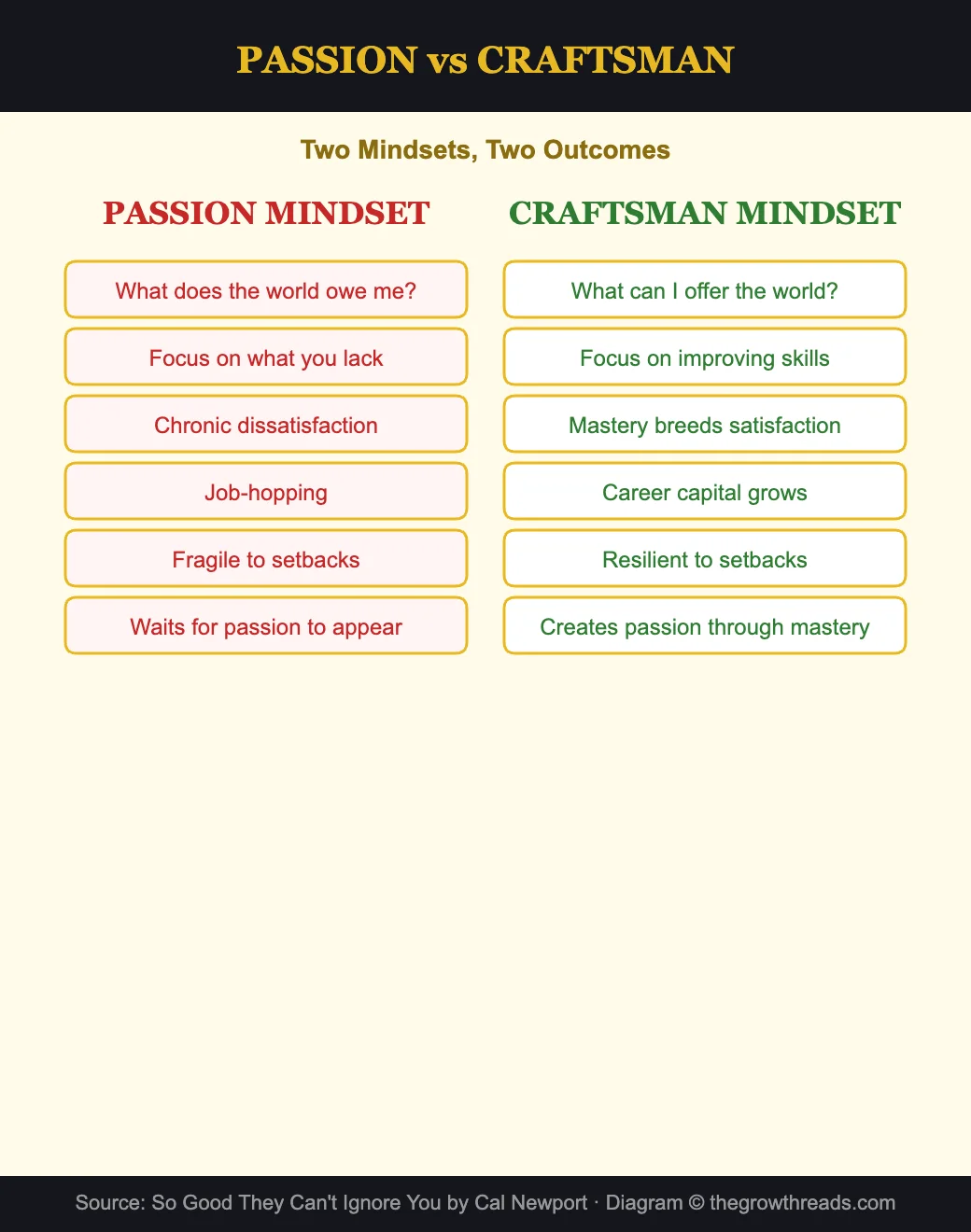
Part 2 — The craftsman mindset and career capital
The second section introduces the craftsman mindset as the alternative to the passion mindset. The craftsman asks: “What can I offer?” rather than “What do I get?” This shift from consumer to producer is more than a motivational reframe — it is a strategic repositioning. When you focus on building rare and valuable skills (career capital), you create something the market wants. When you focus on finding passion, you create nothing — you just search.
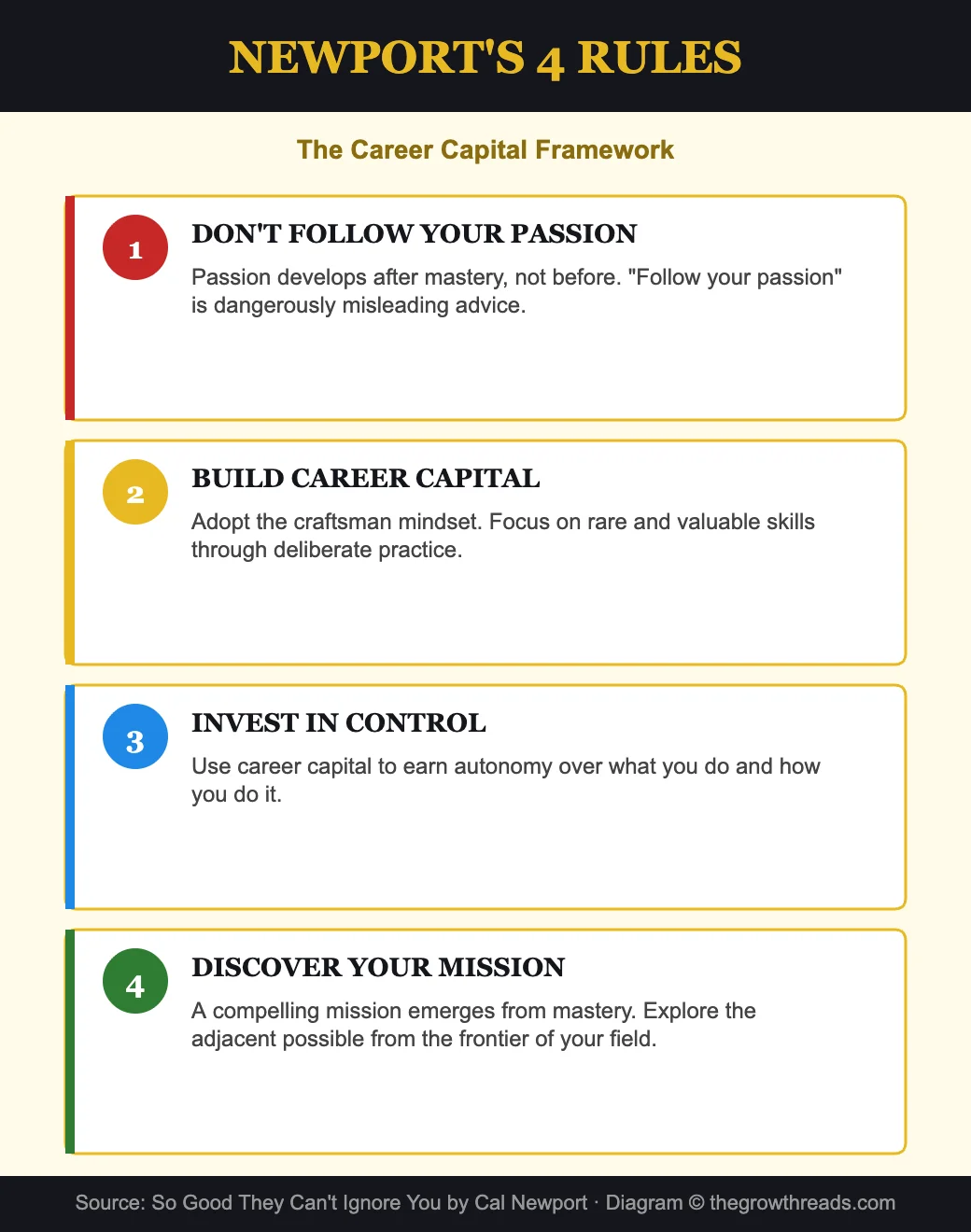
Career capital theory is Newport’s central framework. The traits that make work great — autonomy, competence, relatedness, impact — are rare and valuable. Therefore, you need something rare and valuable to trade for them: skills that are difficult to replicate and that the market prizes. This is career capital. Without it, seeking better conditions is like trying to buy a house with no money — the desire is real but the currency is missing.
Deliberate practice is the mechanism for building career capital. Newport draws on Anders Ericsson’s research (popularised in Peak) to argue that simply “putting in the hours” is not enough. Most professionals reach a competence plateau and then stop improving. Deliberate practice requires identifying specific sub-skills that need improvement, designing exercises that stretch you beyond current ability, seeking honest feedback, and repeating until the once-difficult becomes automatic — then finding the next stretch. This is uncomfortable by definition, which is why most people avoid it and why those who embrace it build disproportionate career capital.
Part 3 — Control, mission, and the adjacent possible
The final section addresses what to do with career capital once you have it. Newport identifies control — autonomy over what you work on, when you work, and how you work — as the most powerful predictor of career satisfaction. Self-Determination Theory research confirms this: autonomy, competence, and relatedness are the three fundamental psychological needs that drive intrinsic motivation. Control addresses the first and most impactful of these.
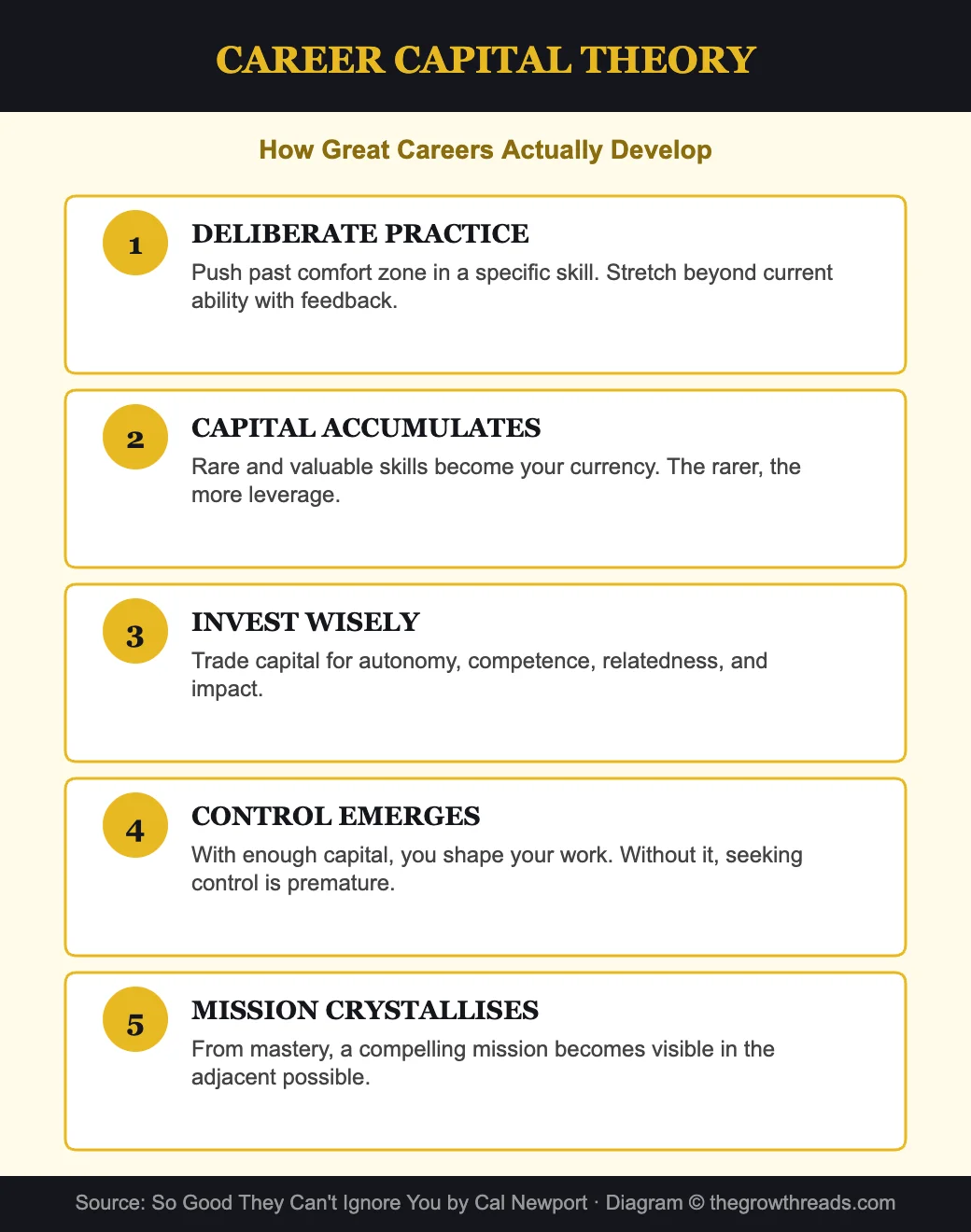
But control has two traps. Trap 1: gaining control without enough career capital. The graduate who quits their job to start a lifestyle business, the aspiring writer who moves to a cabin to write without having published anything — these people seek control before they have earned it, and they almost always fail because the market does not value what they offer. Trap 2: gaining enough career capital that your employer resists your bid for control. When you become valuable enough to demand autonomy, your current employer will typically offer promotions, raises, or increased responsibility to keep you doing what benefits them. The test Newport proposes: will someone pay you for the control you seek? If yes, you have enough capital. If no, you do not.
The mission chapter is the book’s most nuanced contribution. Newport argues that a compelling career mission — a unifying purpose — cannot be planned from a standing start. Missions emerge from the “adjacent possible”: the space of new ideas that becomes accessible only after you push to the frontier of your field through mastery. You cannot see the adjacent possible from the middle of the field; you can only see it from the edge. This means the conventional advice to “start with your why” has it backwards — you must start with mastery and let the why emerge from the territory mastery reveals.
Who is this book best for — and who should read something else first?
This book is essential for anyone who feels stuck because they have not “found their passion,” for graduates choosing career paths, and for mid-career professionals who want to build more leverage and autonomy. Newport writes with academic precision but accessible style, and the case studies — from musicians to venture capitalists to organic farmers — make the abstract principles concrete.
If you have already identified what skill to develop and want the focus system, read Deep Work next. If the deliberate practice angle interests you most, Peak by Anders Ericsson goes deeper on the science. And if you are looking for a habit system to sustain the craftsman mindset daily, Atomic Habits provides the framework.
Questions to reflect on
- How much of your career dissatisfaction comes from genuinely bad conditions versus the belief that you should feel passionate and do not?
- What rare, valuable skill could you develop that would give you leverage in your field — and are you currently practising deliberately or just showing up?
- If passion follows mastery, what would happen if you stopped searching for the right career and started getting excellent at your current one?
- Do you have enough career capital to demand the autonomy you want — or would the market not yet pay for it?
- What mission might emerge if you pushed to the frontier of your field rather than trying to plan one from the middle?
🔥 Ready to stop searching and start building?
Learn why skills beat passion and how career capital creates the work you love.
How to apply So Good They Can’t Ignore You (7-day plan)
- Day 1 — Identify your capital market: Is your field a winner-take-all market (one dominant skill matters, like screenwriting) or an auction market (many different skills can be valuable, like consulting)? Your deliberate practice strategy depends on the answer.
- Day 2 — Audit your current skills: List the skills you currently use at work. Rate each from 1–10 on rarity and value. Identify the one skill with the highest potential career capital return — this is where deliberate practice should focus.
- Day 3 — Design a deliberate practice session: Take your identified skill and design a 30-minute practice session that stretches you beyond your current ability. If you are a writer, write a piece in a genre you find difficult. If you are a programmer, solve a problem at the edge of your skill level.
- Day 4 — Seek honest feedback: Share your Day 3 output with someone qualified to evaluate it. Ask specifically: “What is the weakest part of this, and how could I improve it?” Feedback is the compass of deliberate practice.
- Day 5 — Assess your career capital balance: How much autonomy do you currently have at work? If the answer is “not much,” do you have enough career capital to negotiate for more? Apply the test: would someone pay you for the control you want?
- Day 6 — Make one little bet: If you have an idea for a career direction or side project, take one small, reversible step to test it: write one article, build one prototype, have one conversation with someone in the field. Test the mission, do not commit to it.
- Day 7 — Commit to the craftsman mindset: Write down your daily deliberate practice commitment: what skill, how long, how often. Schedule it like an appointment. The craftsman mindset is not a one-time decision — it is a daily discipline.
Frequently asked questions
Is Newport saying passion does not exist?
No. He is saying passion is real but develops differently than most people assume. Passion does not precede great work — it follows it. People who love their careers did not discover a pre-existing passion and pursue it; they built mastery in something, and the mastery generated passion through competence, autonomy, and connection. The practical implication: stop searching for the “right” career and start getting excellent at the one you have (or at a skill the market values).
What if I hate my current job?
Newport acknowledges that some jobs are genuinely bad — they offer no opportunity for skill development, no autonomy, and no path to career capital. In those cases, leaving is appropriate. But he cautions against leaving because of the passion mindset (“this is not my calling”) rather than because of genuinely poor conditions. Before quitting, ask: can I build career capital here? If yes, build it first and use it to negotiate better conditions or transition with leverage. If no, leave — but leave for a position where you can build capital, not just for one that “feels right.”
How long does it take to build career capital?
Newport does not give a specific timeline because it depends on the field, the skill, and the intensity of your deliberate practice. However, the research he draws on (particularly Ericsson’s work) suggests that reaching expert-level performance in most complex fields requires roughly 10 years or 10,000 hours of deliberate practice — not just time spent on the job, but time spent deliberately stretching beyond your current ability. Most people never engage in deliberate practice at all, which means even moderate deliberate practice can build significant career capital relatively quickly.
How is this different from Deep Work?
So Good They Can’t Ignore You explains WHY you need rare skills (career capital theory) and WHAT to do with them (control and mission). Deep Work explains HOW to develop those skills through concentrated, uninterrupted cognitive effort. They are sequential: read So Good first for the strategy, then Deep Work for the execution method. Newport himself describes Deep Work as the “implementation guide” for the career capital theory in this book.
Does this apply to creative fields?
Yes, and Newport uses several creative professionals as case studies. The career capital framework applies to musicians, writers, designers, and artists — the difference is that creative fields are often “winner-take-all” markets where a single skill (writing ability, musical performance, visual design) dominates, as opposed to “auction” markets where diverse skill combinations create value. In creative fields, deliberate practice on the core craft skill is even more important because the market is brutally competitive and only rare skill levels generate sufficient career capital.
What are “little bets” and how do they work?
Newport borrows the concept from Peter Sims’s book of the same name. Little bets are small, reversible experiments that test whether a potential career direction or mission has real-world viability. Instead of making a grand career pivot based on a theoretical mission, you make a series of small bets — write an article, build a prototype, teach a workshop, launch a side project — and see which ones resonate with the market. The bets that generate positive feedback become the foundation for a larger mission. This approach is lower risk and produces better outcomes than the “leap of faith” strategy most career advice advocates.
Is this book anti-entrepreneurship?
Not at all. Several of Newport’s case studies are entrepreneurs. His argument is not against entrepreneurship but against premature entrepreneurship — starting a business before you have built the career capital (skills, knowledge, network) to make it viable. The entrepreneurs who succeed in his case studies are those who first built deep expertise in a field, then used that expertise as the foundation for a business. The ones who fail are those who quit their jobs to “follow their passion” without first developing rare and valuable skills that the market actually wants.
Related summaries
- Deep Work by Cal Newport — The implementation guide: how to build career capital through concentrated, undistracted effort.
- Peak by Anders Ericsson — The science of deliberate practice that underpins the craftsman mindset.
- Atomic Habits by James Clear — Building the daily systems that sustain deliberate practice.
- Mindset by Carol Dweck — The growth mindset: the psychological foundation for believing skills can be built.
- See all Productivity book summaries on our Best Productivity Books pillar page.