

★★★★☆ 4.0 / 5
One-liner: A retired Navy SEAL admiral distils 37 years of military experience into ten simple lessons — starting with making your bed — that show how small acts of discipline create the momentum to change the world.
Best for: Readers who want a short, motivational read with practical life lessons, graduates entering the workforce, and anyone who needs a reset on the fundamentals of discipline and resilience.
Reading time: ~2 hrs (guide: 15 min)
Difficulty to apply: Very Low (the lessons are simple by design)
Make Your Bed in one minute
If you want to change the world, start by making your bed. Admiral William H. McRaven, who led the special operations raid that killed Osama bin Laden, delivered a commencement address at the University of Texas in 2014 that went viral with over 10 million views. This book expands that speech into ten lessons drawn from his Navy SEAL training — the most gruelling military programme in the world. The lessons are deceptively simple: start each day with a completed task, find a swim buddy, measure people by heart not size, embrace failure, take risks, be your best in the darkest moments, and never quit. Each lesson is illustrated with a story from SEAL training or combat operations, making the principles vivid and memorable. The book is not a comprehensive self-help system — it is a concentrated shot of discipline, perspective, and resilience that you can read in a single sitting and carry with you for years.
Key takeaways
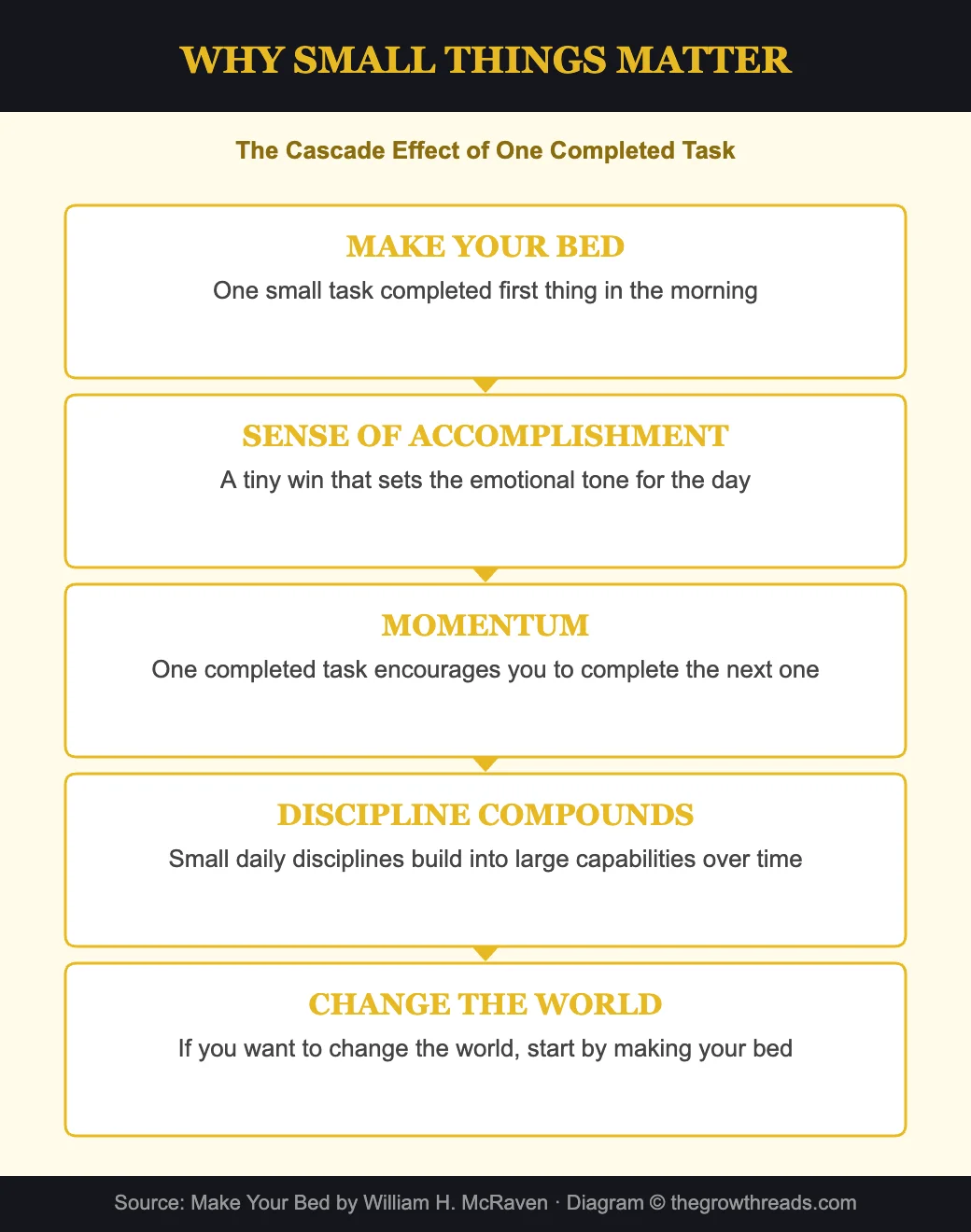
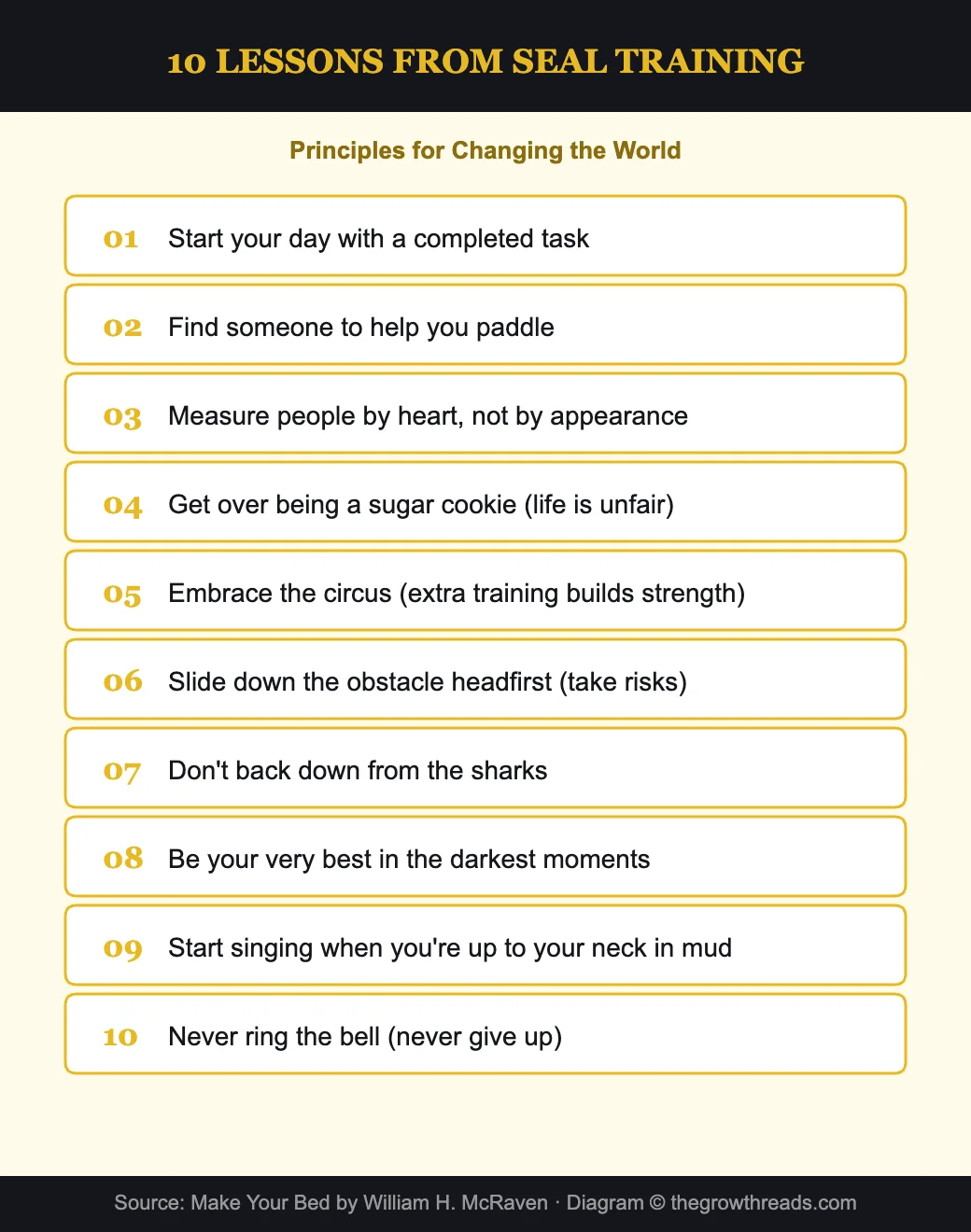
- Start each day with a completed task: Making your bed first thing in the morning gives you a small sense of accomplishment that encourages you to do another task, then another. By the end of the day, one completed task has turned into many.
- You cannot go it alone: In SEAL training, you paddle everywhere in boat crews of seven. No one succeeds alone. Find your “swim buddy” — the person who has your back when the water gets rough.
- Only the size of your heart matters: The strongest SEAL candidates are often not the biggest or most athletic. Heart, determination, and the refusal to quit matter more than physical gifts.
- Life is not fair — move on: In training, “sugar cookies” are students who must roll in the sand and stay wet and cold all day for no reason. Sometimes life punishes you for no reason. Accept it and keep moving.
- Failure can make you stronger: Students who fail an obstacle must do extra training called “the circus.” The extra work is brutal — but those who endure it become the strongest performers.
- Take risks — go headfirst: On the SEAL obstacle course, students who slide down the rope headfirst finish faster. Calculated risk-taking, not caution, produces the best results.
- Stand up to the sharks: At some point, you will face bullies, opposition, or seemingly insurmountable enemies. Do not back down. Most threats are not as dangerous as they appear if you confront them directly.
- Be your very best in the darkest moments: When the situation is at its worst — when the mission is failing, when you are exhausted, when hope seems gone — that is precisely when your performance matters most.
- Start singing when you are in the mud: During the most miserable phase of SEAL training (“Hell Week”), one man started singing. The song gave everyone hope. One person’s courage can lift an entire group.
- Never ring the bell: In SEAL training, the bell is always available. Ring it and the pain stops. But so does the growth. Never ring the bell — no matter how hard it gets.
What is Make Your Bed about?
Make Your Bed presents ten life lessons drawn from Navy SEAL training, each illustrated with stories from military operations. The core message: small acts of discipline create momentum, teamwork beats individual talent, adversity builds strength, and the refusal to quit is the most powerful tool you have.
About the author
Admiral William H. McRaven (Ret.) served 37 years as a Navy SEAL, rising to the rank of Four-Star Admiral and commanding the United States Special Operations Command (USSOCOM), which oversees all special operations forces worldwide. He led the raid that resulted in the death of Osama bin Laden in 2011 — one of the most complex special operations missions in history. After retiring from the military, McRaven served as Chancellor of the University of Texas System. His 2014 commencement address at UT Austin, which formed the basis of this book, has been viewed over 10 million times and became one of the most shared graduation speeches in history. He is also the author of Sea Stories: My Life in Special Operations. Explore all William H. McRaven book summaries →
Key concepts at a glance
| Concept | What it means | Use it when |
|---|---|---|
| Make your bed | Complete one small task first thing to create momentum for the day | You feel overwhelmed and do not know where to start |
| Swim buddy | A partner who shares responsibility, provides support, and holds you accountable | You are trying to accomplish something difficult alone |
| Sugar cookie | Unfair punishment that must be endured without complaint | Life treats you unfairly and you want to quit |
| The circus | Extra work imposed after failure that ultimately builds greater capability | You have failed and feel humiliated |
| Ring the bell | The option to quit that is always available — choosing not to ring it is the ultimate act of resilience | You are at your breaking point |
Part 1 — Small disciplines, big results
McRaven opens with the signature lesson: in SEAL training, every morning begins with an inspection of your bed. The hospital corners must be tight enough to bounce a quarter off. The pillow must be centred. The blanket must be smooth. It seems absurd — these are warriors training for the most dangerous missions on Earth, and they are inspecting bedsheets? But McRaven argues the lesson is profound: if you start each day by completing a task, you have established a pattern of discipline that cascades through every subsequent decision. The made bed is not about tidiness — it is about proving to yourself, before you face any external challenge, that you are in control of at least one thing.
The swim buddy concept extends the discipline theme into relationships. SEAL training is deliberately designed so that no individual can succeed alone. Boat crews of seven must paddle in perfect synchronisation or the boat goes nowhere. Students are assigned swim buddies who must stay within six feet of each other at all times. McRaven’s message: the people you surround yourself with are not accessories to your success — they are prerequisites for it. Every significant accomplishment in his career, including the bin Laden raid, was achieved through a team whose members compensated for each other’s weaknesses.
The “size of your heart” lesson comes from a specific memory: the boat crew that consistently won every race during training was not crewed by the tallest, strongest students. It was a crew of shorter, less physically imposing men who paddled with such ferocious determination that they outperformed crews with clear physical advantages. McRaven uses this to argue against the common mistake of judging capability by appearance, credentials, or résumé. What predicts performance under pressure is not talent but will — the refusal to accept failure as final.
Part 2 — Embracing adversity
The middle lessons deal with failure, unfairness, and resilience — the themes that make the book more than a motivational poster. The “sugar cookie” lesson is McRaven’s term for arbitrary punishment: sometimes in training, an instructor would order a student to get wet in the ocean and then roll in sand until completely coated — for no specific infraction. The student would then spend the rest of the day cold, sandy, and miserable. McRaven’s point: life is frequently unfair. Bad things happen to people who did nothing wrong. The ability to accept injustice without letting it stop you is a survival skill, not a luxury.
The “circus” lesson reframes failure as opportunity. Students who failed an obstacle or a timed run during the day were assigned to “the circus” — two extra hours of calisthenics designed to push them to their limits. The punishment was brutal, but McRaven observed something surprising: the students who endured the most circuses often became the strongest performers. The extra work built capacity that students who never failed never developed. Failure plus effort equals growth — a principle that applies identically to athletic training, career setbacks, and personal development.
The risk lesson involves the SEAL obstacle course, specifically a rope slide high above the ground. Students who went feet-first were slower and more cautious. Students who went headfirst were faster and, counterintuitively, often safer — because the speed and commitment required for headfirst meant they were fully engaged rather than tentatively halfway. McRaven applies this to life decisions: half-hearted risk-taking is more dangerous than full commitment, because partial engagement produces the worst of both worlds — neither the safety of caution nor the rewards of bold action.
Part 3 — The darkest moments
The final lessons address the hardest moments — the times when giving up seems not just tempting but rational. McRaven describes Hell Week: five and a half days of continuous physical training with a maximum of four hours of total sleep. Students are cold, exhausted, injured, and hallucinating. At any point, they can walk to a brass bell hanging in the centre of the compound, ring it three times, and the suffering stops. A warm cup of coffee and a blanket appear. The training is over. About 75% of students ring the bell.
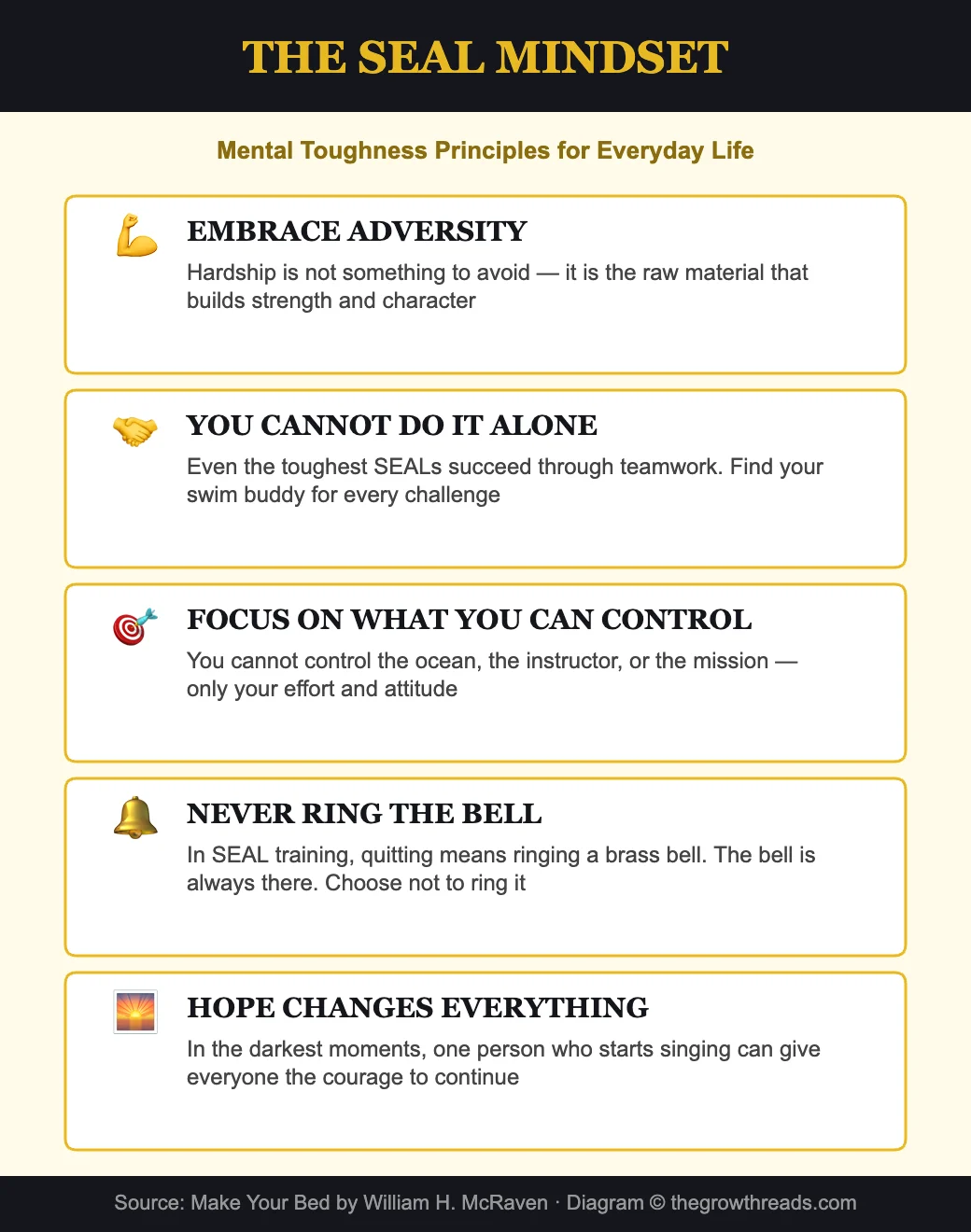
McRaven recounts one night during Hell Week when his class was ordered to sit in the freezing mud flats of San Diego Bay for hours, linked arm in arm. The cold was so severe that instructors warned them of the risk of hypothermia. Several students had already quit. Then one man started singing. The song was off-key and absurd, but it broke the silence and the despair. Others joined in. Within minutes, the entire class was singing, and the cold felt slightly less unbearable — not because anything had changed externally, but because one person’s courage had reminded everyone that they were not alone.
The final lesson — never ring the bell — is the book’s thesis statement. McRaven does not minimise the temptation to quit; he acknowledges that every SEAL has been close to ringing the bell. The point is not that quitting is shameful but that what lies on the other side of the bell is always smaller than what you are capable of becoming if you push through. The bell is a metaphor for every moment in life when giving up seems easier than continuing: the difficult marriage, the failing business, the chronic illness, the setback that seems final. McRaven’s message: the bell is always there. Choose not to ring it.
Who is Make Your Bed best for — and who should read something else first?
This book is ideal for readers who want a quick, powerful motivational read — it can be finished in a single sitting. It is particularly effective as a gift for graduates, young professionals, or anyone going through a difficult transition. McRaven writes with military precision: no wasted words, no filler, no meandering. Each chapter delivers one lesson, one story, and one takeaway.
If you want a more comprehensive system for building discipline and habits, Atomic Habits or Tiny Habits provides the framework. If you want the extreme version of military-forged mental toughness, Can’t Hurt Me by David Goggins takes the intensity much further. And if leadership is your primary interest, McRaven’s stories of operational leadership make a natural bridge to Extreme Ownership by Jocko Willink.
Questions to reflect on
- What is your equivalent of “making your bed” — the one small disciplined act that could set the tone for your entire day?
- Who is your swim buddy — and if you do not have one, who could you ask?
- When was the last time failure led to growth that you could not have achieved through success?
- What “bell” are you tempted to ring right now — and what would you become if you chose not to ring it?
- If one act of courage (singing in the mud) can transform an entire group, what small act of courage could you contribute today?
🔥 Ready to start changing the world one bed at a time?
Ten simple lessons from Navy SEAL training that build discipline, resilience, and purpose.
How to apply Make Your Bed (7-day plan)
- Day 1 — Make your bed: First thing tomorrow morning, make your bed properly — hospital corners, smooth blanket, centred pillow. Do this before anything else. Notice how completing one task affects your momentum.
- Day 2 — Identify your swim buddy: Who is the person you trust most to support you through challenges? Call or message them today. If you do not have one, identify someone you could build that relationship with.
- Day 3 — Accept one sugar cookie: Identify something unfair that happened to you recently. Instead of complaining about it, accept it and move forward. Channel the energy you would have spent on resentment into action.
- Day 4 — Embrace a circus: Take on one extra challenge today — something outside your comfort zone or an area where you have recently failed. The extra work is what builds the muscle you are missing.
- Day 5 — Take a headfirst risk: Identify one decision you have been postponing because of fear. Commit fully: make the call, send the email, start the project. Half-commitment is more dangerous than bold action.
- Day 6 — Be someone’s singer: Find someone in your life who is struggling and offer genuine encouragement — not advice, not solutions, just the message: “I see you, and you are not alone.” Be the person who starts singing in the mud.
- Day 7 — Commit to never ringing the bell: Write down the one area of your life where you are most tempted to quit. Make a commitment — to yourself, to your swim buddy, in writing — that you will not ring that bell for the next 30 days. Then start Day 8 by making your bed.
Frequently asked questions
Is this book too short to be useful?
The brevity is a feature, not a bug. At roughly 130 pages with large type, Make Your Bed can be read in 1–2 hours. McRaven writes with the economy of a military briefing: one lesson per chapter, one illustrating story, no filler. The ideas are simple by design — they are meant to be remembered and applied, not analysed. Many readers return to specific chapters when they need a shot of perspective. If you want comprehensive systems, read Atomic Habits or Deep Work. If you want concentrated motivation, this is the book.
Is this just for military-minded readers?
No. While the stories come from SEAL training and combat operations, every lesson is framed as a universal life principle. “Find a swim buddy” is about partnership. “Never ring the bell” is about persistence. “Start singing in the mud” is about hope. McRaven explicitly wrote the book for civilian audiences — the commencement address that inspired it was delivered to university graduates, not military personnel. Readers who have no interest in the military consistently rate it highly for its directness and practical wisdom.
Does making your bed really change your life?
The bed itself is symbolic — what changes your life is the principle it represents: starting each day by completing a task creates momentum that carries through subsequent decisions. Behavioural research supports this: “keystone habits” (small behaviours that trigger positive cascades) are well-documented in psychology. Making your bed is a particularly effective keystone habit because it is fast, requires no equipment, and provides an immediate visual reminder that you chose discipline over passivity. Whether it literally changes the world is debatable; that it shifts your daily mindset is well-supported.
How does this compare to Can’t Hurt Me by David Goggins?
Both draw on military special operations experience to teach resilience, but the tone is very different. McRaven is measured, dignified, and institutional — a four-star admiral who led with quiet authority. Goggins is raw, intense, and individual — a self-made SEAL who clawed his way up from extreme poverty and abuse. McRaven emphasises teamwork and leadership; Goggins emphasises individual mental toughness. McRaven’s lessons are immediately accessible; Goggins’s approach requires a higher tolerance for discomfort. Read McRaven for the distilled wisdom; read Goggins if you want to be pushed to your absolute edge.
What is the most underrated lesson in the book?
The singing-in-the-mud story is often overlooked because it seems sentimental. But it contains the book’s deepest insight about leadership and hope: in the worst moments, one person’s courage — even something as simple as a song — can transform the experience of an entire group. This is not about being the toughest person in the room; it is about being the person who reminds everyone else that they can keep going. In families, workplaces, and communities, this kind of everyday courage is more valuable (and rarer) than physical toughness.
Is the commencement speech different from the book?
The speech is available on YouTube and covers the same ten lessons in about 20 minutes. The book expands each lesson with additional stories from McRaven’s military career, including combat operations in Iraq, Afghanistan, and the bin Laden raid. If you have watched the speech and loved it, the book adds depth and narrative context. If you have not, the book is the more complete experience. Some readers prefer to read the book first and then watch the speech as a powerful summary.
Are these lessons actually practical or just motivational?
Both. The lessons are simple enough to apply immediately (make your bed, find a partner, accept unfairness, take a risk) and deep enough to sustain reflection over time. The practical application is in the daily discipline: choosing to start with a completed task, choosing to commit fully rather than hedge, choosing not to quit when quitting would be easier. These are not complex productivity systems — they are foundational principles that make every productivity system work better. The simplicity is the strength.
Related summaries
- Can’t Hurt Me by David Goggins — The extreme version of military-forged mental toughness.
- Atomic Habits by James Clear — The systematic approach to building the small disciplines McRaven advocates.
- Extreme Ownership by Jocko Willink — SEAL leadership principles applied to business and life.
- Grit by Angela Duckworth — The research behind why passion and perseverance beat talent.
- See all Productivity book summaries on our Best Productivity Books pillar page.