

★★★★☆ 4.2 / 5
One-liner: The author of Hooked (the book that taught tech companies to build addictive products) now teaches you how to defend yourself against those very techniques — with a four-part model for becoming indistractable.
Best for: Knowledge workers drowning in notifications, anyone who feels their phone controls them, and readers who want a practical system for protecting focused time.
Reading time: ~6 hrs (guide: 24 min)
Difficulty to apply: Moderate (requires sustained attention management, not a one-time fix)
Indistractable in one minute
The opposite of distraction is not focus — it is traction: actions that pull you toward what you want in life. Nir Eyal, who previously wrote Hooked (the playbook Silicon Valley used to build habit-forming products), turns his expertise against the attention economy with a four-part framework: (1) master internal triggers — the boredom, anxiety, and discomfort that drive you to seek distraction in the first place; (2) make time for traction through timeboxing — scheduling every minute of your day so that the plan, not your impulses, determines your actions; (3) hack back external triggers by auditing every notification, app, and interruption and eliminating everything that does not serve you; and (4) prevent distraction with pacts — commitments that make it harder or costlier to get off track. The book’s deepest insight: distraction is not a technology problem but an emotion-management problem, and until you address the internal trigger, no app blocker will save you.
Key takeaways
- Distraction starts from within: The root cause of distraction is not your phone — it is the uncomfortable internal state (boredom, anxiety, loneliness, uncertainty) you are trying to escape. Until you learn to manage internal triggers, external solutions are band-aids.
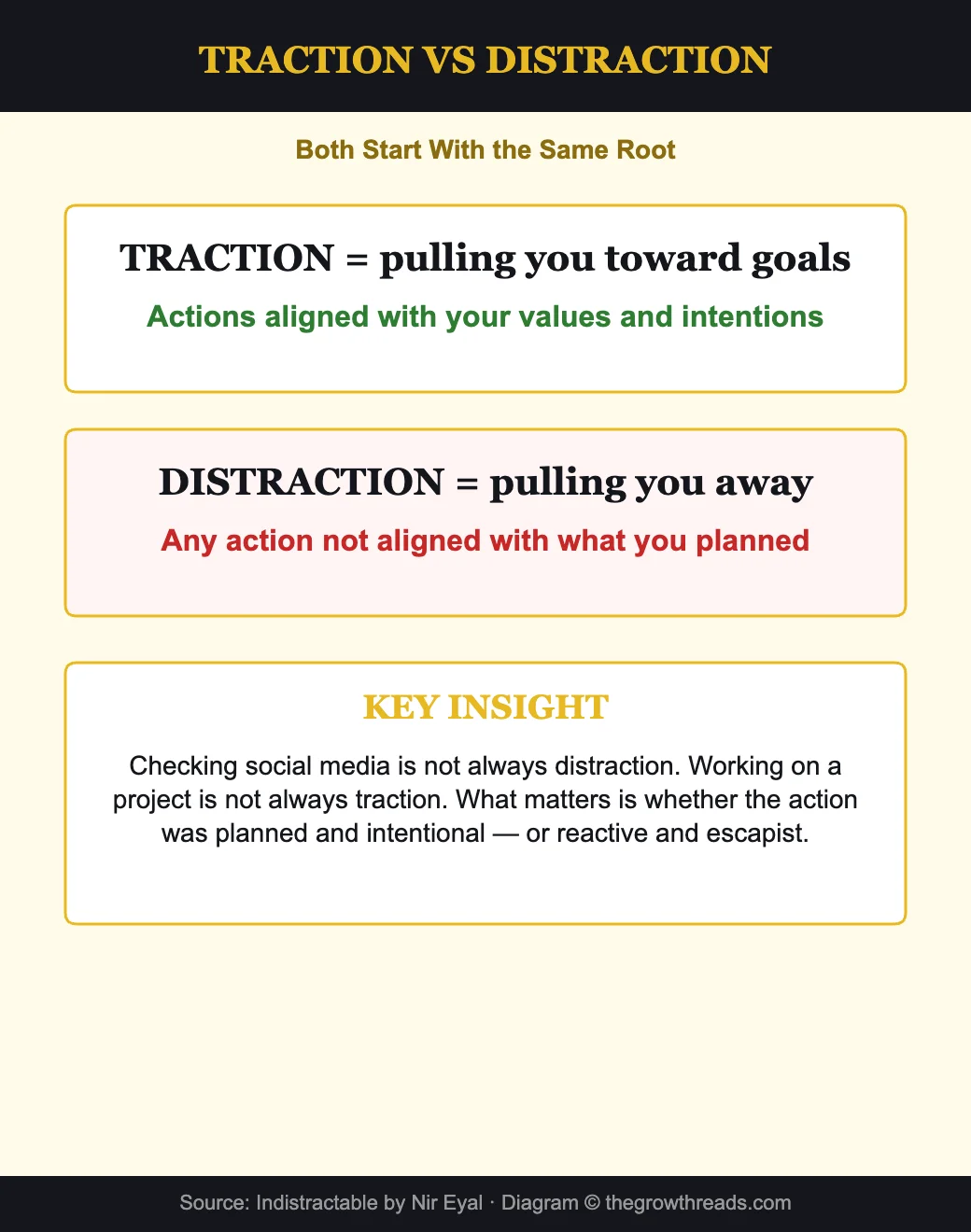
- Traction is any action aligned with your values: Scrolling social media can be traction if you planned it. Working on a project can be distraction if you are using it to avoid something more important. Intent, not activity, determines the category.
- Timeboxing beats to-do lists: To-do lists create guilt (items left undone) and encourage busywork (easy tasks first). Timeboxing — assigning specific tasks to specific time blocks — ensures that your values, not your impulses, determine how you spend your day.
- You cannot call something a distraction unless you know what it distracted you from: Without a planned schedule, everything is reactive. Timeboxing creates the baseline against which distraction becomes visible.
- Most external triggers are noise: The average person receives 63 notifications per day. Eyal recommends auditing every single one and asking: “Is this trigger serving me, or am I serving it?” Remove or mute everything that fails the test.
- Surf the urge: When an internal trigger arises (the itch to check email, the pull toward social media), note it, name the emotion driving it, and wait 10 minutes. Most urges pass. This technique borrows from ACT (Acceptance and Commitment Therapy).
- Identity pacts are the most powerful: Telling yourself “I am indistractable” creates an identity that guides behaviour — similar to saying “I am a non-smoker” rather than “I am trying to quit.” Identity shapes decisions effortlessly.
- Schedule your relationships first: Eyal timeboxes his relationship priorities — date nights, family dinners, friend meetups — before scheduling work. What gets scheduled gets done; what does not gets displaced.
- The workplace is a major distraction source: An always-on, instant-reply culture is one of the biggest attention killers. Eyal provides specific strategies for managing workplace expectations, including schedule syncing with managers and establishing “focus blocks.”
- Being indistractable is a skill, not a trait: You are not born focused or unfocused. Attention management is a learnable competency that improves with practice — like any other skill.
What is Indistractable about?
Indistractable provides a four-part model for controlling attention: mastering internal triggers (the emotions that drive distraction), making time for traction (through timeboxing), hacking back external triggers (auditing notifications and interruptions), and preventing distraction with pacts (commitments that raise the cost of getting off track).
About the author
Nir Eyal is a behavioural designer, lecturer at Stanford’s Graduate School of Business, and the author of Hooked: How to Build Habit-Forming Products — the book that became Silicon Valley’s playbook for creating addictive apps. The irony of writing a book about resisting the very techniques he taught companies to deploy is not lost on Eyal, and he addresses it directly: “Having taught companies how to build engaging products, I felt a moral obligation to help people defend themselves.” Indistractable draws on his understanding of persuasive design, behavioural psychology, and his personal experience as someone who struggled with distraction in his own life and family. Explore all Nir Eyal book summaries →
Key concepts at a glance
| Concept | What it means | Use it when |
|---|---|---|
| Internal triggers | Uncomfortable emotions (boredom, anxiety, loneliness) that drive the urge to seek distraction | You reach for your phone without knowing why |
| Traction | Any action that moves you toward your values and intentions | You want to distinguish productive behaviour from busy behaviour |
| Distraction | Any action that moves you away from what you planned | You find yourself doing unplanned activities |
| Timeboxing | Scheduling every minute of your day with specific tasks assigned to specific blocks | You want to replace to-do lists with an intent-driven system |
| External triggers | Notifications, pings, and environmental cues that interrupt focused work | You are constantly pulled out of deep work |
| Pacts | Pre-commitments that make distraction harder or costlier (effort, price, identity) | You need a commitment device to stay on track |
| Surfing the urge | Noting and sitting with the internal trigger for 10 minutes instead of acting on it | You feel the pull to check your phone or switch tasks |
Part 1 — Internal triggers
Eyal opens with his most important and least intuitive argument: the root cause of distraction is not technology but the internal discomfort you are trying to escape. When you reach for your phone during a meeting, you are not responding to a notification — you are fleeing boredom. When you open social media instead of starting a difficult task, you are not addicted to the app — you are avoiding the anxiety of the task. Technology is the proximate cause; the internal trigger is the ultimate cause. This distinction matters because it determines the solution: if the problem were technology, you could fix it by deleting apps. But you would simply find another distraction — a book, a snack, a daydream. The urge to escape discomfort predates smartphones by millennia.
Eyal borrows the “surfing the urge” technique from Acceptance and Commitment Therapy (ACT). When you notice an internal trigger — the pull to check email, the itch to scroll, the restlessness that precedes procrastination — instead of acting on it, you note it: “I am noticing the urge to check my phone. The emotion driving this urge is boredom.” Then you set a ten-minute timer and continue what you were doing. Most urges, Eyal observes, peak and pass within ten minutes if you do not feed them. The skill is not suppressing the urge (which creates internal tension and eventual collapse) but observing it with curiosity and letting it pass — the same principle that underlies mindfulness meditation.
Part 2 — Traction and timeboxing
The second strategy is making time for traction — and this is where timeboxing replaces the to-do list as the primary productivity tool. Eyal argues that to-do lists are fundamentally flawed: they have no constraint on size (you can always add more), they encourage doing easy tasks first (creating the illusion of productivity), and they generate guilt (unfinished items carry over indefinitely). Timeboxing solves all three problems by assigning specific tasks to specific time blocks in your calendar.
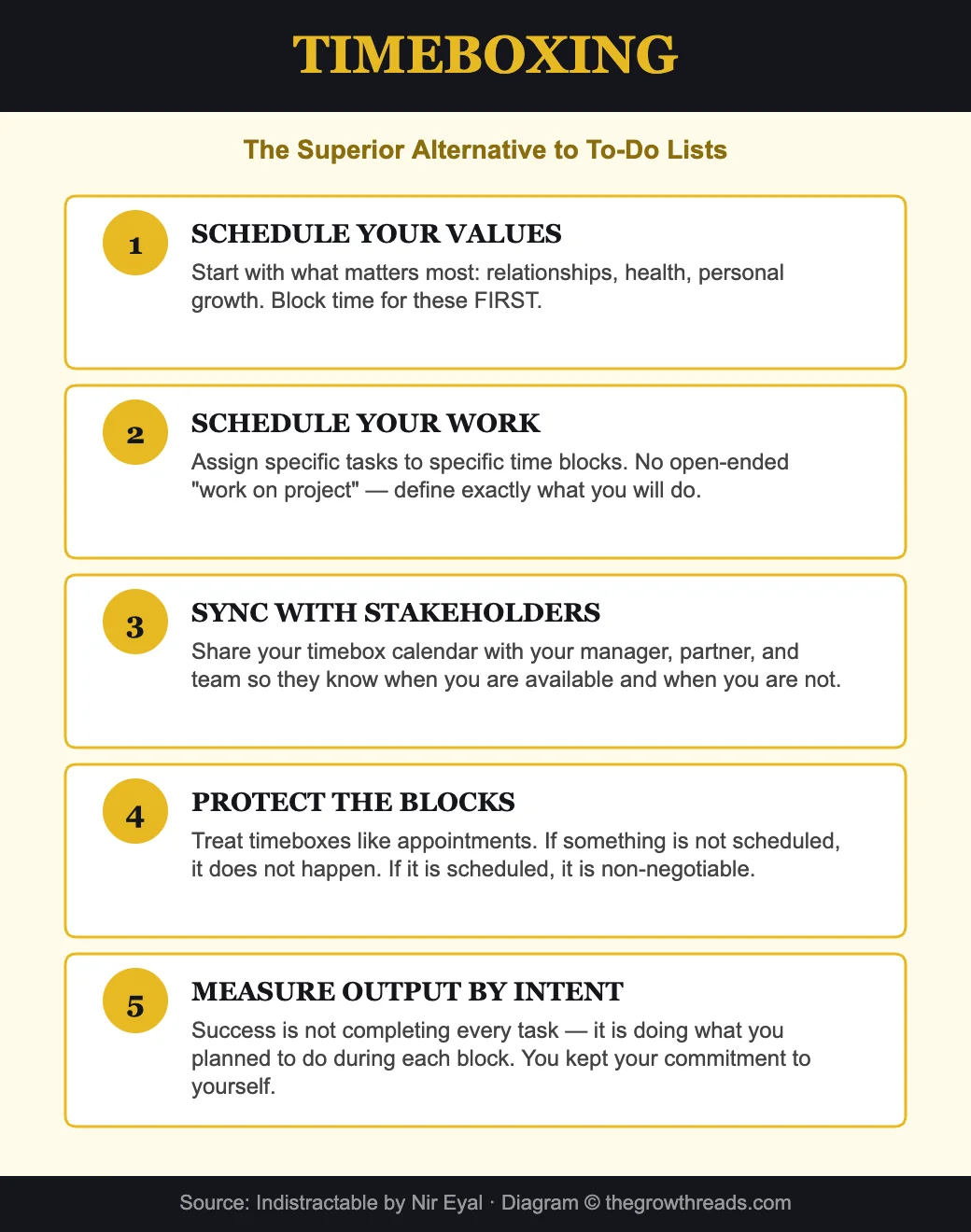
The timeboxing process starts with values, not tasks. Eyal recommends scheduling three domains in order: (1) You — time for sleep, exercise, meditation, reading, and personal growth; (2) Relationships — date nights, family dinners, friend meetups, social time; (3) Work — reactive work (email, meetings) and reflective work (deep thinking, creative output). This ordering is deliberate: most people schedule work first and squeeze personal and relationship time into the gaps. Eyal reverses the priority: what matters most gets scheduled first, and work fills the remaining space. The calendar becomes a physical expression of your values.
A crucial principle: the measure of success is not whether you completed everything in the timebox, but whether you did what you planned to do during the allotted time. “Did I work on the report during the report block?” is the question — not “Did I finish the report?” This removes the anxiety of incompletion and focuses on the only thing you can control: your intention and effort during the block. Over time, you learn how long tasks actually take (most people underestimate dramatically), and your timeboxing becomes more accurate.
Part 3 — External triggers and pacts
The third and fourth strategies address the external environment. Eyal recommends a complete audit of every notification on your phone and computer. For each one, ask: “Is this trigger serving me, or am I serving it?” Most people discover that the majority of their notifications serve the app’s engagement goals, not their own priorities. The solution is aggressive: turn off all non-essential notifications, unsubscribe from email lists, remove social media apps from your phone’s home screen (or delete them entirely), and establish “do not disturb” signals at work — Eyal uses a red card on his monitor to signal “I am in focus mode, do not interrupt.”
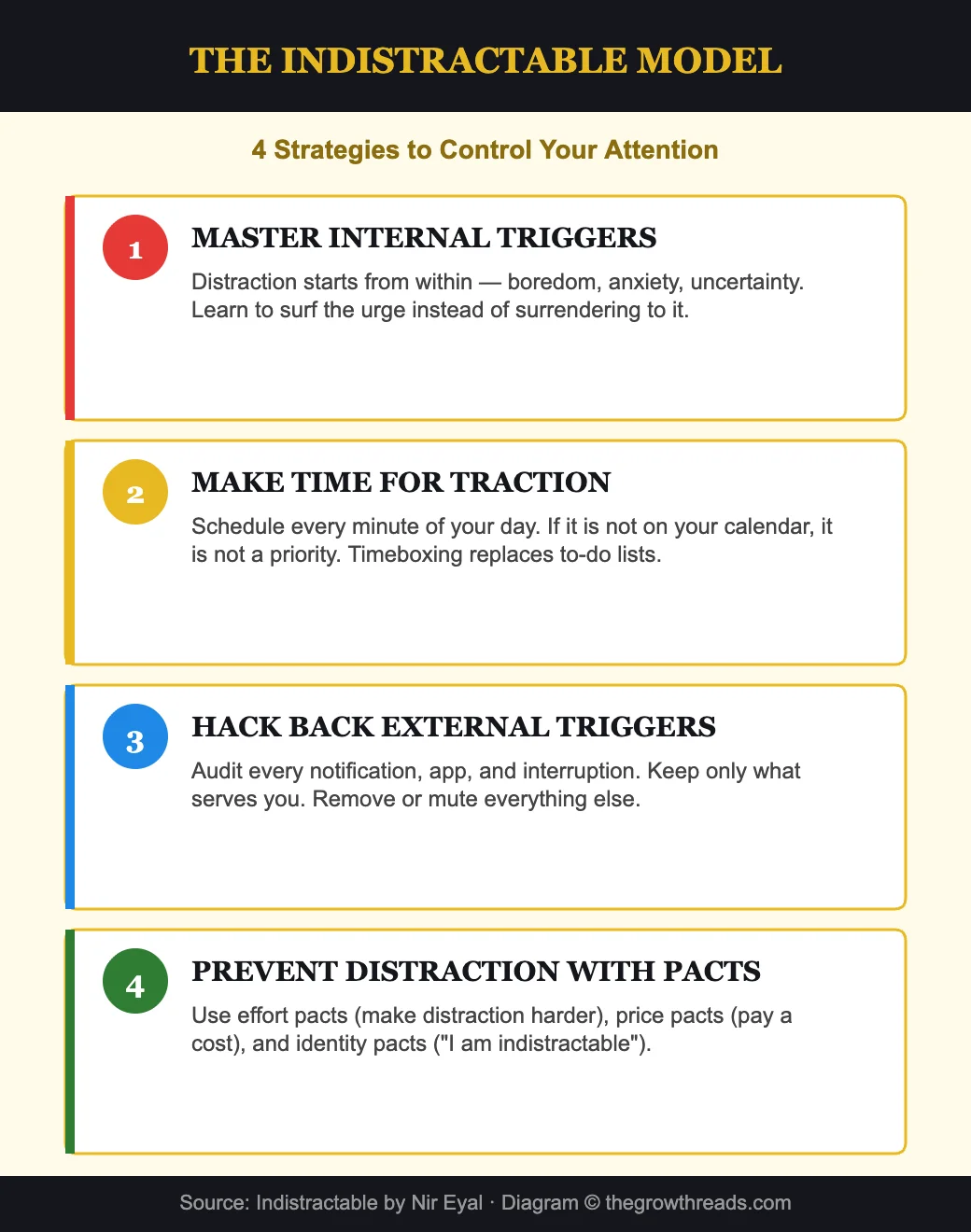
Pacts are pre-commitments that raise the cost of distraction. Effort pacts make the distracted behaviour harder to do: deleting social media apps so you must re-download them, using website blockers during focus hours, or leaving your phone in another room. Price pacts attach a financial consequence to distraction: Eyal describes putting money on the line through apps like Stickk, where failing to follow through means losing a stake to charity. Identity pacts are the most powerful: instead of trying not to be distracted, you declare “I am indistractable” — adopting it as an identity that guides decisions automatically, the same way a vegetarian does not need to deliberate over every meal.
Eyal extends the framework to relationships and children. He and his wife use a shared timeboxed calendar so each person knows when the other is available and when they are focused. For children, he argues that the same principles apply: help kids understand internal triggers (the emotions driving their device use), teach them to make time for traction (scheduled screen time and non-screen activities), and model indistractable behaviour yourself. The family chapter is surprisingly moving — Eyal admits that his own distraction (checking his phone during time with his daughter) was the personal crisis that motivated the book.
Who is Indistractable best for — and who should read something else first?
This is essential for any knowledge worker who spends their day at a computer and feels that notifications, emails, and social media consume more attention than their actual work. It is also valuable for parents who want to help children develop healthy relationships with technology, and for managers who recognise that workplace culture may be the biggest source of employee distraction.
If your primary challenge is deep focus rather than distraction resistance, Deep Work provides the complementary framework. If you want a more philosophical approach to technology, Digital Minimalism goes deeper. And if procrastination is your specific problem (rather than notification-driven distraction), Eat That Frog provides the anti-procrastination toolkit.
Questions to reflect on
- What internal trigger — what uncomfortable emotion — most frequently drives you to seek distraction?
- If you timeboxed your ideal week starting with values first, how different would it look from your actual week?
- How many of your phone notifications are actually serving you versus serving the app’s engagement metrics?
- What identity statement could you adopt — “I am ___” — that would make your desired behaviour feel automatic?
- If being indistractable is a skill you can develop, what would change if you practised it as deliberately as you practise any other skill?
🔥 Ready to take back your attention?
Learn the four strategies that make distraction a choice, not a default.
How to apply Indistractable (7-day plan)
- Day 1 — Track your distractions: For one day, note every time you get distracted: what were you doing, what did you switch to, and what internal trigger (boredom, anxiety, loneliness) drove the switch? This is your distraction map.
- Day 2 — Surf one urge: The next time you feel the pull to check your phone or switch tasks, set a 10-minute timer and continue what you were doing. Note the emotion, observe it, and let it pass. Practise this at least once today.
- Day 3 — Timebox tomorrow: Tonight, schedule every hour of tomorrow in your calendar: sleep, exercise, meals, relationship time, focused work, reactive work, and leisure. Tomorrow, follow the plan.
- Day 4 — Audit your notifications: Go through every notification setting on your phone and computer. For each one, ask: “Is this serving me?” Turn off everything that is not. This typically eliminates 80% of notifications.
- Day 5 — Create one effort pact: Make one distraction physically harder to access: delete a social media app, use a website blocker during focus hours, or move your phone to another room during work.
- Day 6 — Share your timebox: Show your timeboxed schedule to your partner, manager, or closest colleague. Ask: “Does this reflect how you would want me to spend my time?” Alignment prevents others from becoming sources of distraction.
- Day 7 — Adopt the identity: Write “I am indistractable” on a card and place it where you will see it daily. When a distraction arises, ask: “Is this what an indistractable person would do?” Let the identity guide the decision.
Frequently asked questions
Is Eyal being hypocritical given he wrote Hooked?
Eyal addresses this directly. He views the two books as complementary: Hooked describes how products can be designed to be engaging (which is not inherently evil — engagement can serve users well), and Indistractable teaches individuals how to manage their attention in a world full of engaging products. He argues that understanding how habit-forming technology works (from writing Hooked) makes him uniquely qualified to teach defence against it. Whether you find this convincing depends on your view of tech ethics, but the techniques in Indistractable are sound regardless.
How is this different from Deep Work?
Deep Work by Cal Newport focuses on creating periods of intense, uninterrupted concentration for high-value cognitive work. Indistractable has a broader scope: it addresses distraction in all areas of life (work, relationships, personal time, parenting) and focuses more on the psychological drivers of distraction (internal triggers) than on the cognitive science of focus. Newport is more philosophical and prescriptive; Eyal is more tactical and flexible. They pair well: read Deep Work for the argument for focused work, and Indistractable for the system to protect it.
Is timeboxing realistic for unpredictable jobs?
Eyal acknowledges that rigid timeboxing does not work for everyone and recommends a flexible version: timebox the non-negotiables (values, relationships, key work blocks) and leave buffer time for unexpected demands. The goal is not to predict every minute but to ensure that your highest priorities have protected time. Even scheduling just 2–3 “focus blocks” per day dramatically reduces the reactive pattern that characterises most knowledge work.
Do I need to delete social media?
Not necessarily. Eyal is more moderate than Cal Newport (who advocates quitting social media in Digital Minimalism). Eyal’s position: social media is a tool. If you use it intentionally — scheduling specific times, turning off notifications, and engaging with purpose — it is traction. If you use it reactively — mindlessly scrolling to escape boredom — it is distraction. The test is not the platform but the intention. That said, removing social apps from your phone’s home screen and accessing them only through a browser dramatically reduces impulsive use.
What about ADHD or clinical attention issues?
Eyal is careful to note that Indistractable addresses typical distraction patterns, not clinical conditions. ADHD is a neurodevelopmental disorder with specific neurological mechanisms that differ from the internal-trigger-driven distraction the book addresses. If you suspect clinical attention issues, professional evaluation and treatment should come first. That said, some readers with ADHD report that the practical tools — particularly timeboxing and effort pacts — complement their clinical treatment by providing external structure.
Can children really learn to be indistractable?
Eyal argues yes, but the approach must be age-appropriate. Young children benefit from scheduled screen time (timeboxing), parental modelling (children copy behaviour, not lectures), and conversations about internal triggers (“How did that game make you feel?”). Older children and teens can learn to audit their own notifications, set their own timeboxes, and create identity pacts. The most important factor is parental behaviour: if you model indistractable habits, your children are far more likely to develop them.
Is this just about phones and screens?
No. While technology is the most visible distraction in modern life, Eyal’s framework applies to any form of distraction: rumination, gossip, busywork, snacking, shopping, daydreaming, or any behaviour used to escape internal discomfort. The four-part model (internal triggers, traction, external triggers, pacts) works whether the distraction is digital or analogue. The phone is just the most convenient escape device; the underlying pattern is the same regardless of the medium.
Related summaries
- Deep Work by Cal Newport — The case for intense focus and how to create the conditions for it.
- Digital Minimalism by Cal Newport — A more radical approach to reclaiming attention from technology.
- Atomic Habits by James Clear — Building the systems that make focused behaviour automatic.
- Essentialism by Greg McKeown — Deciding what matters most so you know what to protect your attention for.
- See all Productivity book summaries on our Best Productivity Books pillar page.