

★★★★☆ 4.2 / 5
One-liner: The book that named codependency for millions of people — a compassionate, no-nonsense guide to recognising when you have lost yourself in someone else’s problems and learning to put your own oxygen mask on first.
Best for: Anyone who over-gives in relationships, people-pleasers, partners or family members of addicts, and anyone who feels responsible for other people’s happiness.
Reading time: ~6 hrs (guide: 24 min)
Difficulty to apply: High (requires confronting deep relational patterns)
Codependent No More in one minute
If you have ever sacrificed your own wellbeing to fix, rescue, or manage someone else — and felt resentful about it afterward — you may be caught in the codependency trap. Melody Beattie, a counsellor and recovering addict, wrote Codependent No More after recognising that the partners and family members of addicts often develop their own destructive patterns: chronic caretaking, obsessive control, suppressed emotions, eroded boundaries, and a sense of identity that depends entirely on being needed. But codependency extends far beyond addiction — it shows up in friendships, workplaces, parenting, and any relationship where one person consistently abandons their own needs to manage another’s. The book provides a framework for recognising these patterns, practising detachment with love, rebuilding boundaries, and learning to care for yourself without guilt.
Key takeaways
- Codependency is a relational pattern, not a diagnosis: It describes a set of behaviours — caretaking, controlling, denial, poor boundaries — that develop in response to another person’s dysfunction, often addiction or emotional instability.
- Caretaking is not the same as caring: Caring is giving freely without strings. Caretaking is doing things for others that they should do for themselves, then feeling resentful when they do not reciprocate or change.
- Codependents try to control through helping: The need to fix, rescue, or manage others is often a disguised attempt to control outcomes and reduce one’s own anxiety — not genuine altruism.
- Denial keeps the cycle running: Codependents minimise their own pain (“it’s not that bad”), ignore their own needs (“I’m fine”), and refuse to acknowledge that the relationship is harmful.
- Detachment is the core skill: Detaching does not mean disconnecting or stopping love — it means releasing responsibility for other people’s feelings, choices, and consequences while staying emotionally present.
- Boundaries are not walls: Healthy boundaries define where you end and another person begins. They are not punishment — they are self-preservation. Learning to say no without guilt is the foundational boundary skill.
- You must feel your feelings: Codependents often suppress, intellectualise, or redirect emotions. Recovery requires learning to sit with uncomfortable feelings without immediately fixing, eating, drinking, or caretaking them away.
- Self-care is not selfish: Taking care of your own physical, emotional, and spiritual needs is not optional — it is the foundation without which you have nothing to give anyone else.
- Recovery is a process, not an event: Codependent patterns develop over years (often rooted in childhood) and do not disappear overnight. Support groups, therapy, and daily practice are part of the long-term path.
- You are allowed to live your own life: The deepest shift in recovery is the realisation that your life has value independent of what you do for others — that you are worthy of care simply because you exist.
What is Codependent No More about?
Codependent No More identifies the patterns of codependency — chronic caretaking, people-pleasing, poor boundaries, and loss of self — and provides a compassionate framework for recovery through detachment, self-care, boundary-setting, and emotional honesty. Originally written for partners of addicts, its insights apply to any relationship where one person consistently abandons their own needs.
About the author
Melody Beattie is an American author and counsellor whose personal experience with addiction, codependency, and recovery shaped her writing career. She struggled with drug and alcohol addiction in her youth, achieved sobriety, and then recognised that her own codependent patterns were as destructive as the substances she had quit. Codependent No More, published in 1986, has sold over eight million copies and remained on the bestseller lists for years, effectively introducing the concept of codependency to mainstream culture. She followed it with Beyond Codependency, The Language of Letting Go, and over a dozen other recovery-focused books. Her writing style blends clinical insight with raw personal honesty, making complex psychological concepts accessible to readers in crisis. Explore all Melody Beattie book summaries →
Key concepts at a glance
| Concept | What it means | Use it when |
|---|---|---|
| Codependency | A pattern of losing yourself in concern for, or control of, another person | You feel more focused on others’ problems than your own life |
| Caretaking | Doing for others what they can and should do for themselves | You feel resentful after helping someone |
| Detachment | Releasing responsibility for others’ feelings and choices while staying loving | You are consumed by someone else’s crisis |
| Enabling | Removing natural consequences so the other person never has to change | You repeatedly rescue someone from their own decisions |
| Boundaries | Limits that define where you end and another person begins | You say yes when you mean no |
| Denial | Minimising pain, ignoring needs, or pretending the situation is acceptable | You catch yourself saying “it’s not that bad” |
| Learned helplessness | Believing you cannot change your situation after prolonged dysfunction | You feel stuck but cannot identify why |
Part 1 — Recognising codependency
Beattie opens by defining codependency not as a clinical diagnosis but as a cluster of relational behaviours that develop in response to living with dysfunction — originally addiction, but applicable to any situation where one person’s chaos becomes another person’s full-time job. The codependent person does not enter the relationship planning to lose themselves; they enter with good intentions (love, loyalty, compassion) and gradually discover that their entire emotional life has become organised around managing someone else.
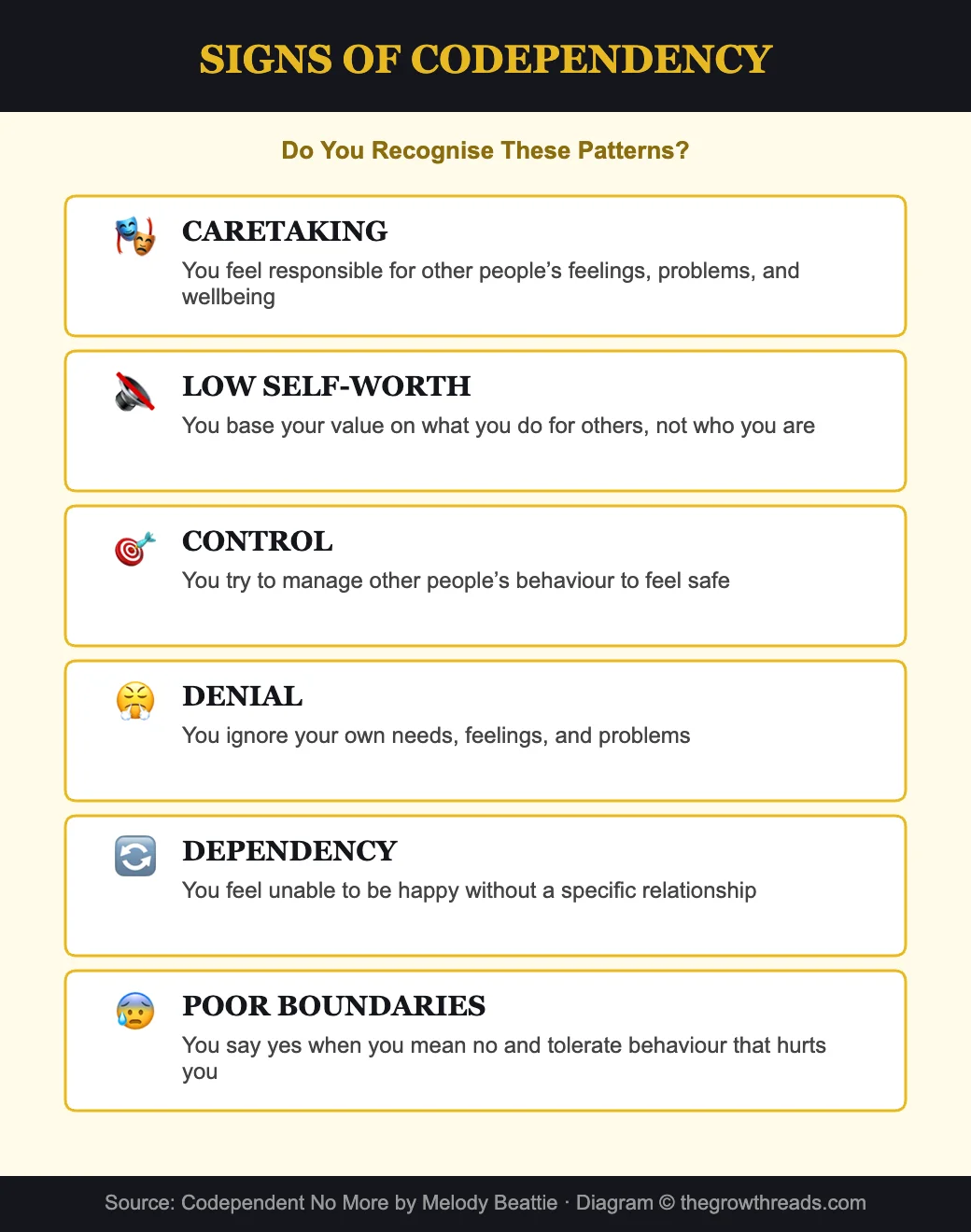
The caretaking distinction is crucial. Beattie differentiates between genuine caring (freely given, with no expectation of return) and caretaking (doing for others what they should do for themselves, then feeling resentful, martyred, or unappreciated). Caretaking looks generous on the surface, but underneath it is driven by anxiety: if I fix this person, I will feel safe. If I solve their problem, they will love me. If I manage their life, I will not have to face my own. The codependent’s generosity is real, but it comes with invisible strings attached — and when the other person does not change, gratitude, or reciprocate, the resentment is crushing.
Control is the other side of the coin. Beattie observes that codependents are often the most controlling people in the room, even though they feel powerless. The control manifests as managing, advising, suggesting, nagging, threatening, guilt-tripping, and rescuing — all aimed at getting the other person to behave differently. The tragic irony: the more you try to control someone, the more out of control the situation becomes, because people resist being managed. This cycle — caretaking, control, resentment, more caretaking — is the engine of codependency.
Part 2 — Learning to detach
The centrepiece of the book is the concept of detachment — Beattie’s most important and most misunderstood contribution. Detachment does not mean ceasing to care, withdrawing emotionally, or abandoning the relationship. It means releasing the belief that you are responsible for another person’s feelings, choices, and outcomes. It means allowing people to experience the natural consequences of their decisions. It means accepting that you cannot force someone to change, no matter how much you love them or how hard you try.
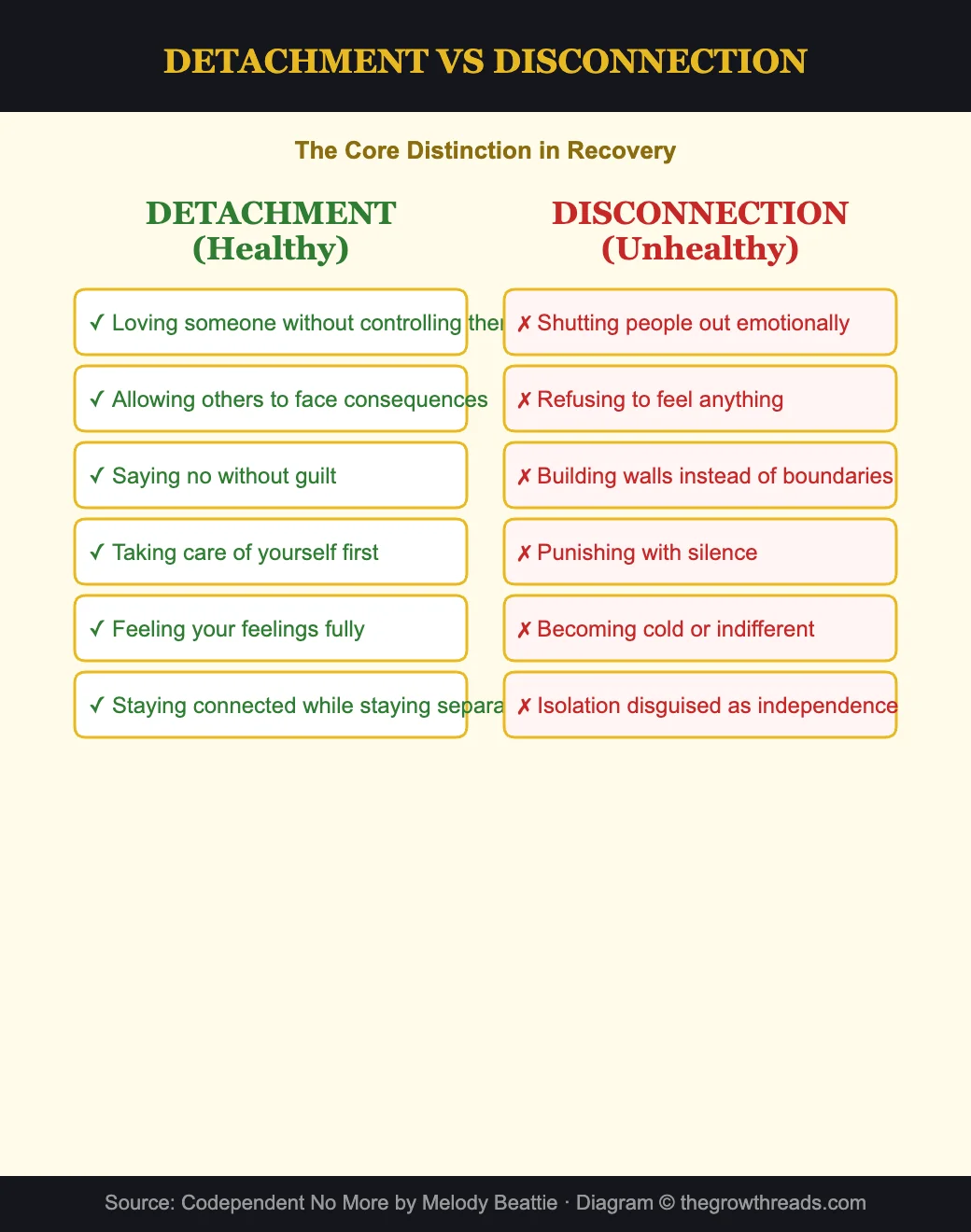
Beattie is careful to distinguish detachment from disconnection. Disconnection is building walls, shutting down emotionally, punishing with silence, or becoming cold and indifferent — these are defensive reactions that protect you from pain but also prevent genuine connection. Detachment, by contrast, allows you to remain loving and present while accepting that the other person’s journey is not yours to manage. You can love someone deeply and simultaneously refuse to participate in their self-destruction. This is excruciatingly difficult in practice, which is why Beattie emphasises that detachment is a daily practice, not a one-time decision.
The enabling concept is closely related. Beattie defines enabling as any action that removes the natural consequences of someone’s behaviour, thereby removing their motivation to change. Bailing out an addict, covering for an irresponsible partner, making excuses for abusive behaviour — all are forms of enabling that feel like love but function as obstacles to growth. Allowing someone you love to experience pain is one of the hardest things a codependent will ever do, and it is often the most loving thing they can do.
Part 3 — Rebuilding yourself
The final section shifts from what to stop doing to what to start doing. Beattie’s self-care framework is not bubble baths and spa days — it is the fundamental reorientation of a life that has been organised around someone else. The work includes identifying your own needs (many codependents genuinely do not know what they need because they have spent years attending to everyone else), learning to feel emotions without immediately acting on them, setting boundaries with the people you love most, and building an identity that is not contingent on being needed.
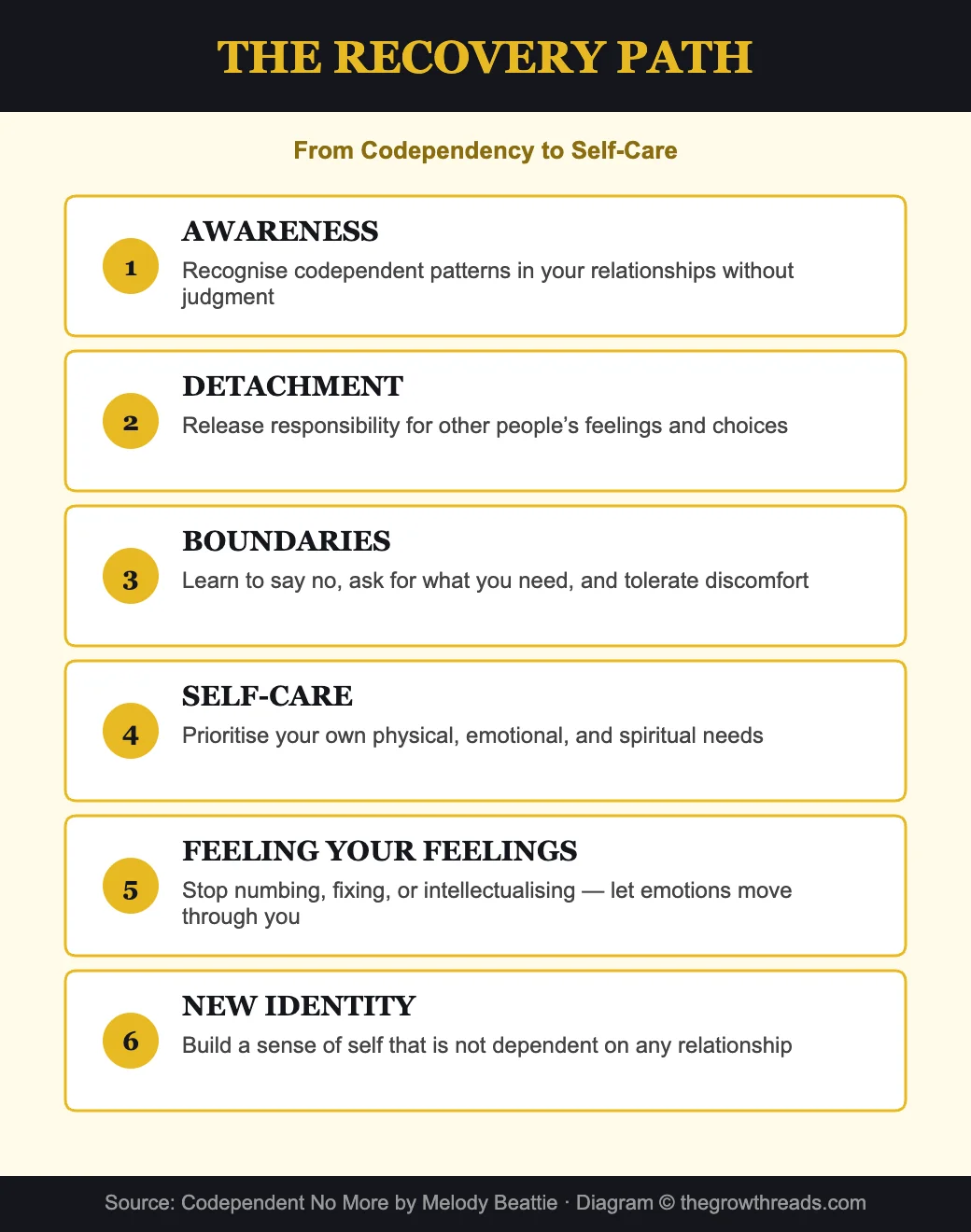
The feelings chapter is particularly powerful. Codependents are often emotionally fluent about other people’s feelings but illiterate about their own. Beattie argues that suppressed emotions do not disappear — they leak out as resentment, passive aggression, physical symptoms, or compulsive behaviour. Recovery requires learning to sit with anger, sadness, fear, and grief without immediately fixing, intellectualising, or numbing them. This is uncomfortable work, and Beattie validates that discomfort: “Feelings are not facts, but they are not irrelevant either. They are information about what is happening inside you.”
She also addresses the spiritual dimension of recovery — not in a religious sense, but in the sense of developing a relationship with something larger than the codependent cycle. For many readers, this means the Twelve Step framework (Al-Anon, CoDA). For others, it means therapy, meditation, journaling, or any practice that reconnects them with their own inner authority. The core shift is from “I am responsible for everyone” to “I am responsible for myself, and that is enough.”
Who is Codependent No More best for — and who should read something else first?
This book is essential for anyone who recognises the caretaking-control-resentment cycle in their own relationships. It is particularly valuable for partners or family members of addicts, chronic people-pleasers, and anyone who consistently puts others’ needs ahead of their own to the point of self-neglect. Beattie writes with the compassion of someone who has lived the experience, making the book feel like a conversation with someone who understands.
If your codependent patterns are rooted in childhood, start with or follow up with Adult Children of Emotionally Immature Parents. If you need practical communication tools for setting boundaries, Nonviolent Communication provides the scripts. And if your focus is specifically on romantic attachment patterns, Attached offers a complementary framework through attachment theory.
Questions to reflect on
- When you help someone, is it truly free — or do you expect something (gratitude, change, love) in return?
- Whose problems are you spending more time thinking about than your own?
- When was the last time you said no to someone you love — and how did it feel?
- If you stopped caretaking for one week, what do you think would happen to your relationships — and what does your answer reveal?
- What would your life look like if you spent as much energy on your own growth as you spend managing others?
🔥 Ready to stop losing yourself in other people?
Learn how to detach with love, set boundaries without guilt, and reclaim your own life.
How to apply Codependent No More (7-day plan)
- Day 1 — Name the pattern: Write down three relationships where you consistently give more than you receive. For each, identify: what do you do for them that they could do for themselves? This is your caretaking inventory.
- Day 2 — Practice one boundary: Choose one small request or expectation you normally accept automatically and say no. “I can’t do that this week.” Do not explain, justify, or apologise beyond one sentence. Notice the discomfort and sit with it.
- Day 3 — Detachment exercise: When someone you care about shares a problem today, listen fully without offering solutions. Respond with: “That sounds really hard. What are you thinking of doing?” Let them own their problem.
- Day 4 — Feel one feeling: Set a timer for 10 minutes. Sit quietly and ask yourself: “What am I feeling right now?” Write down whatever comes up — anger, sadness, fear, loneliness — without judging or fixing it. This is data, not a crisis.
- Day 5 — Do one thing for yourself: Identify one activity you have been neglecting because you have been too busy managing others: a walk, a book, a meal with a friend, a creative project. Do it today. Notice any guilt and let it pass.
- Day 6 — Check your enabling: Ask yourself: “Am I protecting someone from the natural consequences of their behaviour?” If yes, step back. Let the consequence happen. Loving someone does not mean shielding them from reality.
- Day 7 — Write a self-care commitment: Write one paragraph describing how you will care for yourself this month. Include: one boundary you will maintain, one need you will honour, and one caretaking behaviour you will stop. Read it each morning.
Frequently asked questions
Is codependency a mental health diagnosis?
No. Codependency is not recognised in the DSM-5 as a formal psychiatric diagnosis. It is a relational pattern described in addiction recovery literature that has since been applied more broadly. Some therapists and researchers argue it should be classified as a personality trait or relational disorder; others view it as a normal response to abnormal circumstances. Regardless of its diagnostic status, the patterns Beattie describes — chronic caretaking, poor boundaries, suppressed needs, and loss of identity — are clinically recognised and treatable through therapy.
Can you be codependent without being in a relationship with an addict?
Absolutely. While Beattie originally wrote for partners of alcoholics and addicts, codependent patterns appear in any relationship where one person consistently abandons their own needs to manage another’s dysfunction. This includes relationships with emotionally unstable partners, demanding parents, needy friends, difficult colleagues, and even children. The common thread is not addiction but the codependent’s belief that they are responsible for someone else’s wellbeing at the expense of their own.
What is the difference between being kind and being codependent?
Kindness is freely given with no expectation of return. It feels good and leaves you energised. Codependent caretaking is driven by anxiety, guilt, or the need to be needed. It feels obligatory and leaves you resentful. The test: after helping someone, do you feel content (kindness) or depleted and unappreciated (codependency)? Another test: can you say no without guilt? If yes, your giving is genuine. If no, there may be a codependent dynamic at work.
How long does recovery from codependency take?
Beattie is honest that recovery is a long-term process, not a quick fix. Codependent patterns often develop over decades — frequently rooted in childhood — and they do not disappear after reading one book. Most people benefit from a combination of self-help reading, therapy (particularly with a therapist experienced in codependency or attachment issues), and support groups like CoDA (Co-Dependents Anonymous). Meaningful change is typically visible within months; deep relational transformation takes years of consistent practice.
Does detachment mean I stop caring?
No — and this is the most common misunderstanding. Detachment means releasing the belief that you are responsible for another person’s feelings, choices, and consequences. You can love someone deeply while accepting that their journey is not yours to control. You can care about someone without carrying their emotional weight. Detachment is not indifference — it is love without enmeshment. The goal is to be present and supportive without sacrificing your own wellbeing or enabling destructive behaviour.
Is this book outdated?
The core concepts — caretaking, detachment, boundaries, self-care — remain as relevant as when the book was published in 1986. Some of the language and case studies reflect the era (heavy focus on alcoholism, traditional gender roles in some examples), but the psychological insights are timeless. The revised edition (2022) updates some references. If the dated elements bother you, pair the book with a more contemporary resource like Set Boundaries, Find Peace by Nedra Glennon Tawwab, which applies similar principles in modern language.
How does Codependent No More relate to Attached?
Both books address unhealthy relational patterns but from different frameworks. Codependent No More uses the codependency model: caretaking, control, and loss of self. Attached uses attachment theory: anxious, avoidant, and secure attachment styles. There is significant overlap — anxious attachment and codependency share many features (need for approval, fear of abandonment, difficulty with boundaries). Reading both gives you the behavioural toolkit (Beattie) and the psychological model (Levine and Heller) for understanding why you relate the way you do.
Related summaries
- Boundaries by Cloud and Townsend — The practical framework for setting and maintaining healthy limits in relationships.
- Attached by Amir Levine — Attachment theory applied to romantic relationships — anxious, avoidant, and secure styles.
- Nonviolent Communication by Marshall Rosenberg — The communication tools for detaching lovingly instead of reactively.
- The 5 Love Languages by Gary Chapman — Understanding how you and your partner express and receive love differently.
- See all Relationships book summaries on our Best Relationship Books pillar page.