

★★★★½ 4.3 / 5
One-liner: Part adventure story, part biomechanics manifesto — McDougall embeds a radical argument against modern running shoes inside a gripping narrative about Mexico’s Tarahumara tribe and a legendary ultramarathon.
Best for: Runners of all levels, anyone curious about human evolution and movement, and readers who love narrative non-fiction with a rebellious thesis.
Reading time: ~7 hrs (guide: 26 min)
Difficulty to apply: Moderate (gradual transition to natural running form takes weeks)
Born to Run in one minute
Humans did not evolve to sit in cushioned shoes — we evolved to run barefoot across savannas, and our bodies still work best when we let them. Christopher McDougall, a journalist plagued by chronic running injuries, travels to Mexico’s Copper Canyons to find the Tarahumara — an indigenous tribe whose members run 50–100 miles at a time in thin sandals, well into old age, with virtually no injuries. What he discovers challenges everything the $20-billion running shoe industry has told us: that more cushioning and support means fewer injuries. The data says the opposite. Since Nike introduced the modern running shoe in 1972, injury rates have not declined at all. The book weaves evolutionary biology, biomechanics research, ultramarathon culture, and the story of an epic race in the canyons into a single argument: we were born to run, and we forgot how.
Key takeaways
- Modern running shoes may cause injuries: Cushioned heels encourage heel-striking, which sends impact forces through the knee and hip. Barefoot or minimalist runners naturally land on the midfoot, reducing impact by up to 50%.
- Humans are the greatest endurance runners on Earth: We can outrun every animal on the planet over long distances thanks to our ability to cool through sweating, our spring-loaded Achilles tendons, and our nuchal ligament (which stabilises the head during running).
- The Tarahumara run injury-free into old age: Using thin huarache sandals and fuelling on chia seeds, corn, and beans, they routinely cover ultramarathon distances as part of daily life and social celebration.
- Persistence hunting shaped human evolution: Our ancestors ran prey to exhaustion in the midday heat — a strategy that required endurance, not speed, and explains why our bodies are optimised for long, slow running.
- Running should feel joyful, not punishing: The Tarahumara run because they love it. Western running culture’s emphasis on competition, pain tolerance, and expensive gear has turned a natural human behaviour into a dreaded chore.
- Form matters more than footwear: A short stride, midfoot landing, 180-step cadence, and relaxed upper body constitute the natural running form that minimises injury regardless of what is on your feet.
- Chia seeds are a legitimate superfood: The Tarahumara’s staple endurance fuel — chia seeds mixed with water (iskiate) — delivers omega-3s, protein, fibre, and slow-release energy in a calorie-dense package.
- Ultrarunning is more accessible than you think: The book profiles everyday people who discovered that running very long distances at a slow pace is often easier on the body than running short distances fast.
- The running shoe industry prioritises profit over science: Nike’s co-founder acknowledged that there is no evidence cushioned shoes prevent injuries, yet the industry continues to sell increasingly expensive, increasingly cushioned models.
- Community makes endurance possible: The Tarahumara run together, race as festivals, and treat running as a social bond — a stark contrast to the solo, headphone-in, suffer-through-it Western model.
What is Born to Run about?
Born to Run follows journalist Christopher McDougall into Mexico’s Copper Canyons to find the Tarahumara, an indigenous tribe of extraordinary long-distance runners. Along the way, he uncovers evidence that humans evolved specifically for endurance running and that modern running shoes may be causing the very injuries they claim to prevent.
About the author
Christopher McDougall is a journalist and former war correspondent for the Associated Press who covered conflicts in Angola and Rwanda before turning to investigative health writing. His personal struggle with chronic running injuries — doctors told him his body was simply not built for running — launched the investigation that became Born to Run. The book spent four years on the New York Times bestseller list and is widely credited with launching the barefoot and minimalist running movement. McDougall followed it with Natural Born Heroes (2015) and Running with Sherman (2019), continuing to explore the intersection of human movement and evolutionary biology. Explore all Christopher McDougall book summaries →
Key concepts at a glance
| Concept | What it means | Use it when |
|---|---|---|
| Persistence hunting | Running prey to heat exhaustion over long distances — the evolutionary basis of human endurance | You want to understand why your body is built for running |
| Heel-striking | Landing on the heel first during a stride — encouraged by cushioned shoes, linked to higher impact forces | You experience knee or hip pain from running |
| Midfoot strike | Landing on the ball of the foot, the natural pattern when running barefoot | You want to transition to natural running form |
| Huarache sandals | Thin-soled sandals made from tire rubber, worn by the Tarahumara for ultramarathon distances | You are curious about minimalist footwear |
| Iskiate (chia fresca) | Tarahumara endurance drink: chia seeds, water, lime, and sweetener | You want a natural alternative to commercial sports drinks |
| 180 cadence | Optimal running cadence of 180 steps per minute that reduces overstriding | You want to improve running efficiency |
| Caballo Blanco | American ultrarunner who lived among the Tarahumara and organised the canyon race | You are following the book’s narrative thread |
Part 1 — The hidden tribe
McDougall opens with a simple question that no doctor could answer: “How come my foot hurts?” Despite consulting specialists, podiatrists, and orthopaedic surgeons, and despite wearing the most technologically advanced running shoes available, his injuries persisted. This personal frustration leads him to the Copper Canyons of Mexico’s Sierra Madre, where the Tarahumara (who call themselves the Rarámuri, meaning “the running people”) have been running extraordinary distances for centuries — in sandals thinner than a flip-flop.
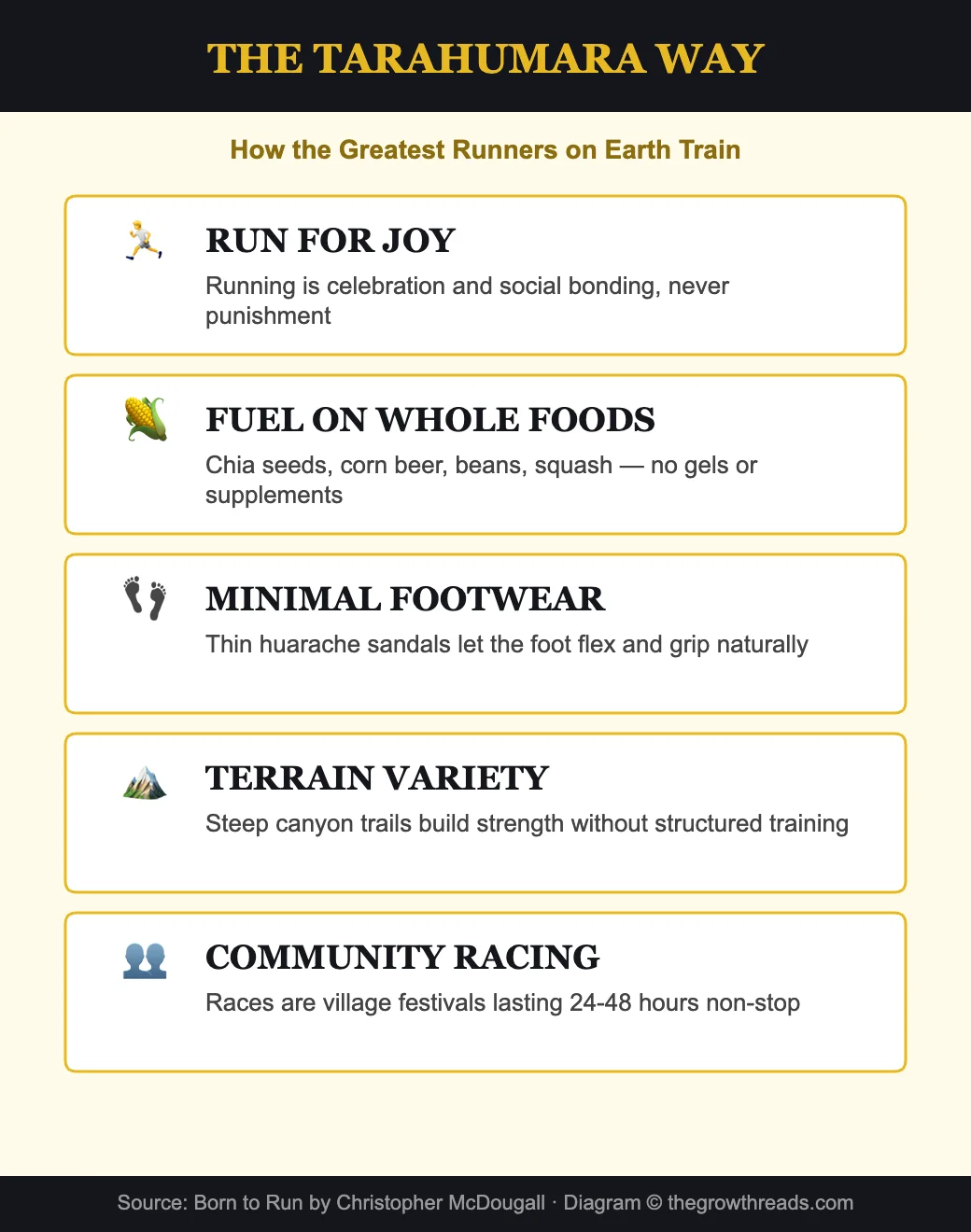
The Tarahumara’s running culture is not sport — it is life. They use running as their primary mode of transportation across steep canyon terrain, as a hunting technique (chasing deer until the animals collapse from exhaustion), and as social glue. Their traditional game, rarajípari, involves kicking a wooden ball across 50–100 miles of canyon trails, often through the night, fuelled by corn beer and communal cheering. Injuries are essentially unknown. Men in their sixties and seventies run distances that would hospitalise most Western ultramarathoners.
McDougall’s guide into this world is Caballo Blanco (“the White Horse”), an American named Micah True who dropped out of mainstream society to live in the canyons with the Tarahumara. Caballo dreams of organising a race that brings the world’s best ultrarunners to compete alongside the Tarahumara on their own terrain — a dream that becomes the book’s narrative engine.
Part 2 — The science of running
The book’s middle section builds the scientific case for natural running, and it is devastatingly well-argued. McDougall interviews Harvard evolutionary biologist Daniel Lieberman, whose research established that humans evolved specifically for endurance running. Lieberman’s evidence includes the nuchal ligament (which stabilises the head during running but is absent in walking), the enlarged gluteus maximus (essential for running balance but barely used in walking), the Achilles tendon (a spring mechanism that stores and returns running energy), and our unique ability to cool through sweating while running — an advantage no other mammal possesses.
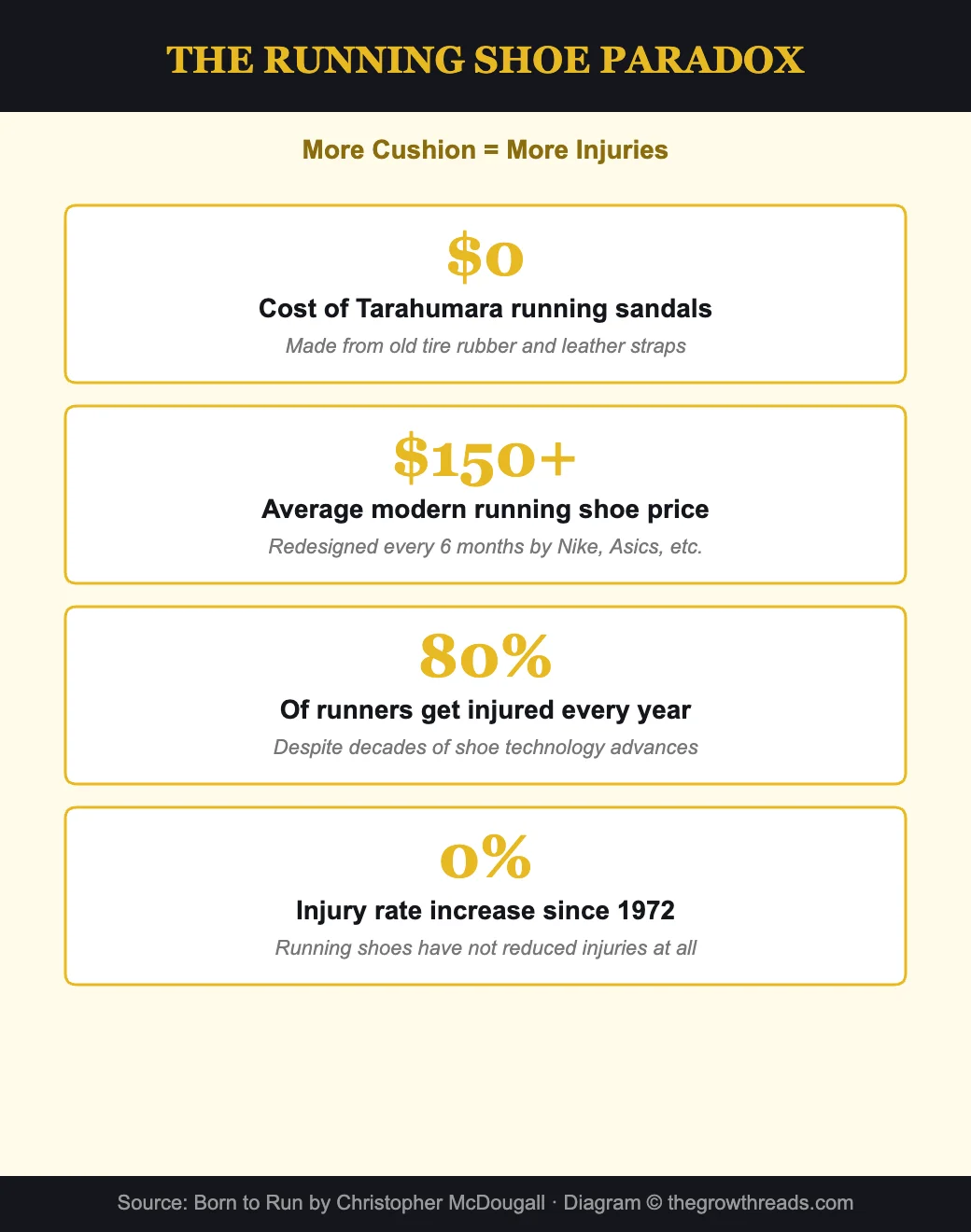
The running shoe argument is the book’s most provocative claim. McDougall documents that the modern cushioned running shoe was invented by Nike co-founder Bill Bowerman in the early 1970s. Before that, runners wore thin-soled shoes and had lower injury rates. Since the introduction of motion-control, stability, and cushioned shoes, the annual injury rate for runners has remained stubbornly at roughly 65–80%. A 2008 study in the British Journal of Sports Medicine found no evidence that running shoes reduce injury risk. Lieberman’s lab research showed that barefoot runners who land on the midfoot generate significantly lower collision forces than shod runners who heel-strike — and that the cushioning in shoes actually encourages the heel-strike pattern by masking the pain signal that would naturally correct it.
Part 3 — The art of running
McDougall transitions from science to practice through a cast of real ultrarunners who embody different aspects of the natural running philosophy. Scott Jurek, one of the greatest ultramarathoners in history, runs on a plant-based diet and trains with a focus on relaxation rather than intensity. Ann Trason dominated women’s ultrarunning for over a decade through patience and strategy rather than raw speed. Barefoot Ted McDonald is the book’s comic relief and most committed minimalist — a man who runs ultramarathons in homemade huarache sandals and eventually founds a minimalist sandal company.
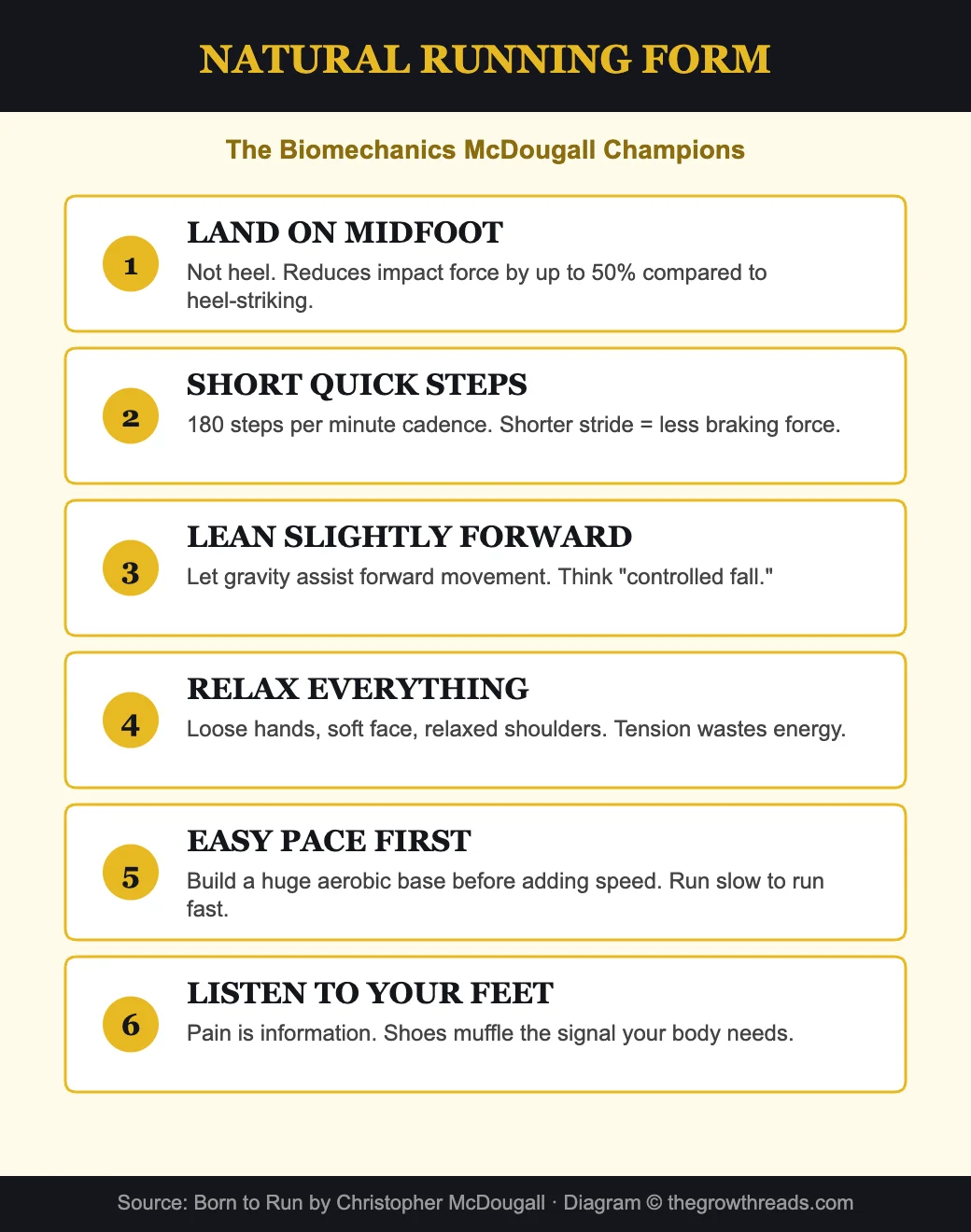
The practical running advice embedded in these profiles is valuable. McDougall distils a set of form principles: land on the midfoot, keep a cadence of roughly 180 steps per minute, shorten your stride so your foot lands beneath your centre of gravity rather than ahead of it, lean slightly forward, and relax your hands, face, and shoulders. The 180-cadence principle (identified by running coach Jack Daniels, who observed that virtually every elite distance runner at the 1984 Olympics ran at 180 steps per minute regardless of speed) is the simplest single change a recreational runner can make to reduce injury risk.
The Tarahumara diet receives detailed attention. Chia seeds — a pre-Columbian staple that was nearly lost during the Spanish conquest — deliver omega-3 fatty acids, complete protein, soluble fibre, and sustained energy. The Tarahumara mix them with water and lime to make iskiate, a drink that doubles as a meal replacement during long runs. Pinole, a roasted corn flour mixed with water, provides easily digestible carbohydrates. The diet is almost entirely plant-based, extremely affordable, and demonstrates that endurance performance does not require expensive supplements or engineered nutrition products.
Part 4 — The race
The book builds to its climax: Caballo Blanco’s dream race in the Copper Canyons, pitting the world’s top ultrarunners against the Tarahumara on their home terrain. The race is 50 miles through brutal canyon heat, and McDougall reconstructs it with the pacing and tension of a thriller. The Tarahumara runners — in their sandals, fuelled on pinole and corn beer — compete alongside Americans wearing the latest technical gear and carrying engineered nutrition.
The race outcome is less important than what it represents: two approaches to running — technological versus natural, individual versus communal, suffering versus joy — meeting on equal ground. The Tarahumara run with smiles on their faces. They run in groups, encouraging each other. They treat the race as a celebration, not a war. And they perform at a level that astonishes the American competitors, most of whom are half their age.
McDougall’s own transformation is the quieter story. The journalist who could not run a mile without pain completes the 50-mile canyon race in huarache sandals, injury-free. His conclusion is not that everyone should throw away their shoes tomorrow, but that we should question the assumption that running is inherently dangerous and that our bodies need corporate products to do what they evolved to do. The real enemy is not shoes — it is the belief that we are too fragile to run.
Who is Born to Run best for — and who should read something else first?
This book is essential reading for any runner, whether beginner or ultra-experienced. Even if you never change your shoes, the running form principles and the joy-centred approach to movement will improve your practice. It is also a superb adventure narrative — you do not need to be a runner to enjoy it. The writing is vivid, funny, and propulsive.
If you want a structured training plan rather than a narrative, look at Peak by Anders Ericsson for the science of deliberate practice. If your interest is more in the longevity benefits of movement broadly, The Blue Zones covers the lifestyle picture. And if you are specifically focused on the health consequences of inactivity, Exercised by Daniel Lieberman provides the academic companion to Born to Run’s narrative.
Questions to reflect on
- When was the last time you ran (or moved vigorously) purely for the joy of it, with no performance goal?
- What would happen if you shortened your running stride by 10% and increased your cadence?
- How much of your spending on fitness gear is driven by marketing rather than evidence?
- If the Tarahumara can run 100 miles in sandals fuelled by chia and corn, what does that say about the complexity we have added to exercise?
- Who in your life would you enjoy running (or walking) with regularly, and why have you not asked them?
🔥 Ready to rediscover the runner inside you?
Learn why humans evolved to run and how the Tarahumara do it injury-free into old age.
How to apply Born to Run (7-day plan)
- Day 1 — Check your cadence: Go for a 20-minute run at your normal pace. Count your steps for 60 seconds. If you are below 170, focus on shortening your stride and quickening your turnover toward 180.
- Day 2 — Practice the midfoot landing: Take off your shoes and run barefoot on grass or a smooth surface for 5 minutes. Notice how your body naturally avoids heel-striking. Memorise that landing pattern.
- Day 3 — Make iskiate: Mix 2 tablespoons of chia seeds, 300ml of water, juice of half a lime, and a teaspoon of honey. Let it sit for 15 minutes. Drink it before or during your next run as a natural fuel.
- Day 4 — Run with a friend: Invite someone to join you for a conversational-pace run. No watches, no distance goals. Run at a pace where you can talk comfortably. Rediscover running as a social activity.
- Day 5 — Relax your upper body: During your run, periodically check: are your hands relaxed? Your jaw unclenched? Your shoulders dropped? Pretend you are holding a crisp between your thumb and forefinger without breaking it.
- Day 6 — Run on varied terrain: Skip the flat pavement and find a trail, park path, or hilly route. Varied terrain forces your feet and ankles to adapt, building the stabilising muscles that flat surfaces neglect.
- Day 7 — Assess and plan: Journal about how the week’s experiments felt. Did the higher cadence reduce joint pain? Did the midfoot landing feel more natural? Pick the two changes that felt best and commit to them for the next month.
Frequently asked questions
Should I switch to barefoot running immediately?
No. McDougall does not advocate throwing away your shoes overnight. The transition to minimalist or barefoot running should be gradual — start with 5–10 minutes of barefoot walking or running on soft surfaces, then slowly increase over weeks and months. Your feet, ankles, and calves need time to strengthen muscles that cushioned shoes have been doing the work for. Rushing the transition is the most common cause of injury among people inspired by this book.
Is the anti-running-shoe argument scientifically supported?
Partially. Daniel Lieberman’s Harvard research on barefoot biomechanics is peer-reviewed and well-regarded. His data showing lower impact forces with midfoot striking is solid. However, the claim that running shoes cause injuries is harder to prove definitively — the evidence shows they have not prevented injuries, which is different from proving causation. A 2016 systematic review found insufficient evidence to recommend for or against minimalist shoes. The strongest takeaway is that running form matters more than footwear.
Who are the Tarahumara?
The Tarahumara, who call themselves the Rarámuri (“the running people”), are an indigenous people living in the Copper Canyons of Mexico’s Sierra Madre Occidental. They are known for their extraordinary long-distance running ability — routinely covering 50–100+ miles in thin sandals — and for their remarkably low rates of modern diseases including heart disease, diabetes, and depression. Their culture centres running as a social activity, a spiritual practice, and a mode of transportation across canyon terrain.
What is the 180 cadence rule?
Running coach Jack Daniels observed at the 1984 Olympics that virtually every elite distance runner, regardless of speed or event, ran at approximately 180 steps per minute. A higher cadence naturally shortens your stride, which means your foot lands closer to your centre of gravity rather than reaching out ahead of you. This reduces braking forces and impact loading on the knees and hips. Most recreational runners have a cadence of 150–165; increasing it to 170–180 is one of the simplest form corrections available.
Can I run an ultramarathon after reading this book?
The book makes a compelling case that ultramarathons are more accessible than most people assume — the pace is slower than a typical 10K, and the limiting factor is mental persistence rather than speed. However, running 50+ miles requires months of progressive training, solid nutrition knowledge, and experience with heat and terrain management. Born to Run is inspiring, not a training manual. If you are seriously interested, start with shorter trail races and build your base over 6–12 months before attempting ultra distances.
Is chia really that effective as a running fuel?
Chia seeds are nutritionally impressive: they deliver omega-3 fatty acids, complete protein (all essential amino acids), soluble fibre that slows glucose absorption, and minerals including calcium and magnesium. A 2011 study in the Journal of Strength and Conditioning Research found chia-based drinks performed equally to Gatorade for endurance performance. They are not magic, but they are a legitimate, whole-food alternative to engineered sports nutrition — and they cost a fraction of the price.
How does Born to Run compare to other running books?
Born to Run is primarily a narrative — it tells a story and embeds science within it. If you want a pure training manual, look elsewhere (Daniels’ Running Formula or Fitzgerald’s 80/20 Running). If you want the evolutionary biology in academic depth, read Daniel Lieberman’s Exercised. Born to Run’s unique strength is making the case for natural running through compelling storytelling, unforgettable characters, and adventure — it changes how you think about running, which often changes how you run more than any training plan could.
Related summaries
- The Blue Zones by Dan Buettner — Natural movement as one of nine longevity habits shared by the world’s longest-lived people.
- How Not to Die by Michael Greger — The clinical evidence for plant-based eating and its impact on endurance and disease prevention.
- Breath by James Nestor — Another “lost art” investigation — this time into how modern humans forgot how to breathe properly.
- Can’t Hurt Me by David Goggins — A very different take on ultrarunning — driven by mental toughness rather than joy.
- See all Health book summaries on our Best Health Books pillar page.