

★★★★☆ 4.1 / 5
One-liner: A compelling (if polarising) case that your thoughts can physically rewire your brain and body — backed by neuroscience, epigenetics, and dozens of real remission stories.
Best for: Open-minded readers curious about the neuroscience of belief, meditation practitioners, and anyone exploring mind-body healing.
Reading time: ~8 hrs (guide: 28 min)
Difficulty to apply: Moderate–High (daily meditation commitment required)
You Are the Placebo in one minute
Your thoughts are not invisible — they are physical events that alter your brain chemistry, gene expression, and immune function. Joe Dispenza argues that the same mechanism that makes sugar pills heal patients can be harnessed deliberately through sustained mental rehearsal and elevated emotion. Drawing on neuroscience, epigenetics, and quantum physics, he presents a meditation model designed to break the body’s addiction to familiar stress chemicals and replace them with new neural hardware. The core promise: if a placebo can trigger measurable biological change when a person believes in a future they cannot see, then you can become your own placebo by learning to think and feel in new ways before external circumstances change.
Key takeaways
- The placebo effect is real biology: When patients improve on sugar pills, genuine changes occur in brain chemistry, hormone levels, and immune markers — it is not “just in their head.”
- Thoughts produce measurable chemistry: Every thought triggers a cascade of neuropeptides that instruct cells to make specific proteins, meaning your mental state directly shapes your physical state.
- Your body can become addicted to stress: Chronic negative emotions create a chemical dependency; the body craves the familiar cocktail of cortisol and adrenaline even when no real threat exists.
- Genes are not destiny: Epigenetic research shows that environmental signals — including thoughts and emotions — can activate or silence genes without changing DNA itself.
- Mental rehearsal changes the brain: Brain scans of people who mentally practised piano scales showed nearly identical neural changes to those who physically played, proving imagination reshapes hardware.
- Elevated emotions are the catalyst: Gratitude, love, and joy signal safety to the body, shifting it from survival mode into growth-and-repair mode where healing accelerates.
- You must think greater than your environment: Lasting change requires maintaining an internal state that is independent of external circumstances — otherwise the old personality recreates the old reality.
- Meditation is the vehicle: Dispenza’s specific meditation model combines relaxation induction, clear intention, and elevated emotion to break the habit of being your old self.
- Crossing the river of change is uncomfortable: The gap between the old self and the new self triggers uncertainty and discomfort; most people retreat — persistence through this phase is what separates transformation from wishful thinking.
- Case studies show consistent patterns: Across dozens of documented remissions, the common thread is a decisive moment where the person fully committed to a new way of being before any physical evidence supported it.
What is You Are the Placebo about?
You Are the Placebo explores how the mind can produce real, measurable changes in the body — the same way a sugar pill can trigger genuine healing when a patient believes it will work. Joe Dispenza combines neuroscience, epigenetics, and meditation techniques to teach readers how to become their own placebo by changing their thoughts and emotions before their circumstances change.
About the author
Joe Dispenza, D.C., is a chiropractor, researcher, and lecturer who first gained attention after healing six compressed vertebrae through mental rehearsal alone following a cycling accident in 1986 — refusing the recommended surgery. That experience launched a decades-long investigation into the relationship between mind and body. He has since conducted brain-mapping workshops worldwide, gathering thousands of brain scans to study the effects of meditation on neuroplasticity and gene expression. His books, including Breaking the Habit of Being Yourself and Becoming Supernatural, have collectively sold millions of copies and been translated into dozens of languages. Explore all Joe Dispenza D.C book summaries →
Key concepts at a glance
| Concept | What it means | Use it when |
|---|---|---|
| Placebo effect | A measurable biological response triggered by belief rather than a pharmacological agent | You want to understand why expectation alone can heal |
| Epigenetics | The study of how environmental signals turn genes on or off without altering DNA | You question whether genes are fixed destiny |
| Mental rehearsal | Vividly imagining an action or outcome to rewire neural circuits | You want to practise change before acting on it |
| Elevated emotions | States like gratitude, love, and joy that shift body chemistry from survival to growth | You need to break a chronic stress loop |
| Analytical mind | The conscious thinking brain that must be bypassed to access the subconscious | You notice overthinking blocks meditation progress |
| Survival mode | A stress-driven state where the body prioritises fight-or-flight over repair | You feel constantly anxious despite no real danger |
| Quantum field | Dispenza’s term for the field of possibilities that responds to focused intention | You are exploring the book’s more speculative claims |
| River of change | The uncomfortable gap between the old self and the new self | You feel tempted to quit a new habit during the hard middle |
Part 1 — The science of the placebo
Dispenza opens with a survey of placebo research that is far more striking than most readers expect. In 1957, a patient named “Mr. Wright” was given an experimental drug for his lymphoma — tumours shrank dramatically within days. When news broke that the drug was ineffective, the tumours returned. His doctor then administered a saline injection, telling Wright it was a more potent version; once again the tumours vanished. The case illustrates Dispenza’s central thesis: belief does not merely influence subjective experience — it orchestrates objectively measurable biological events.
He then walks through a range of clinical evidence. A 2002 Baylor College study found that sham knee surgery produced outcomes equal to real arthroscopic surgery in osteoarthritis patients. Harvard researcher Ted Kaptchuk demonstrated that even when patients knew they were taking placebos, irritable bowel syndrome symptoms still improved. Italian neuroscientist Fabrizio Benedetti showed that placebos can trigger endorphin release strong enough to be blocked by naloxone, an opioid antagonist — proving the chemical response is genuine, not imagined.
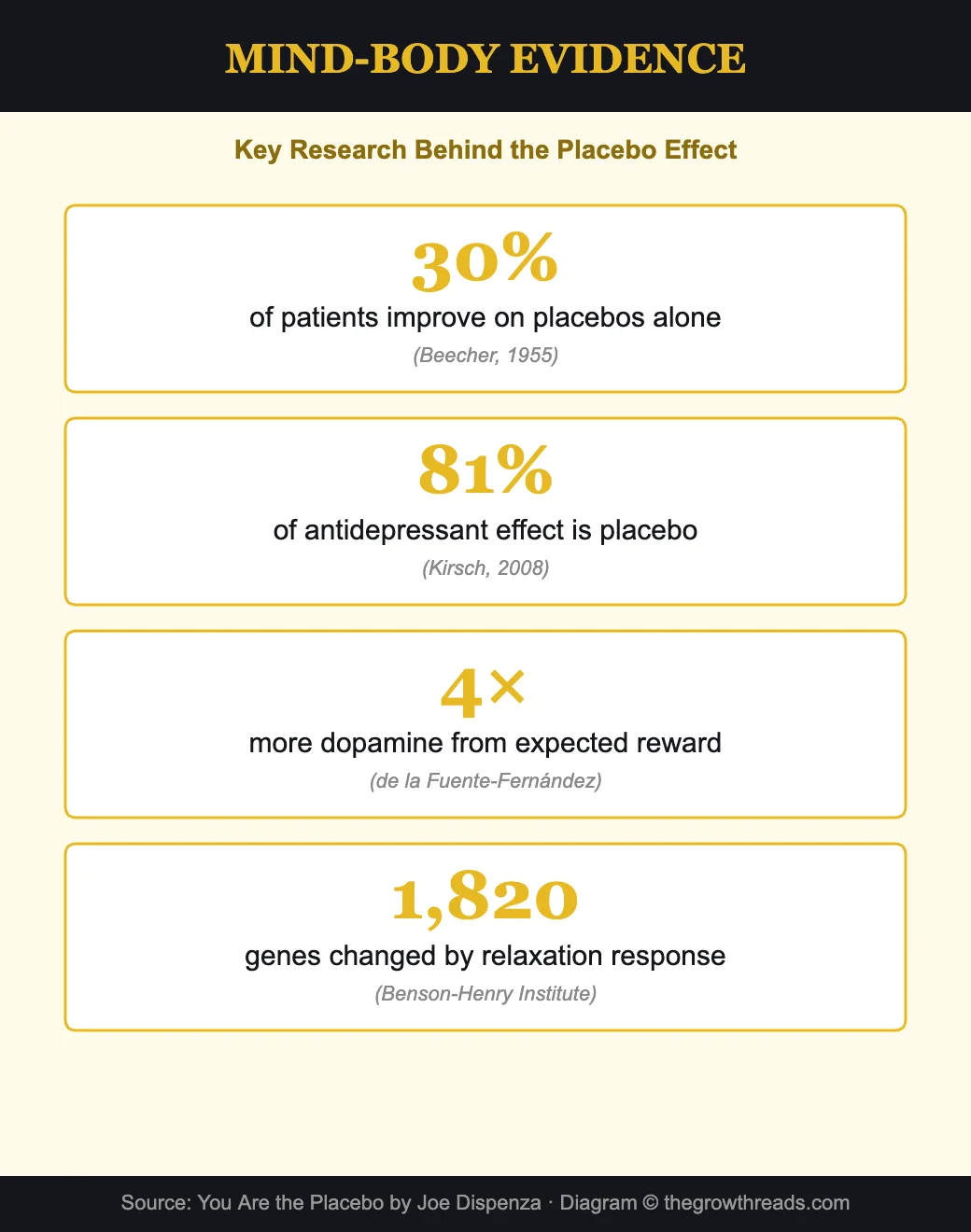
The implication, Dispenza argues, is that the body possesses an internal pharmacy far more precise than any external drug. The challenge is learning how to activate it on demand. That requires understanding how thoughts become chemistry — which he unpacks in the next section.
Part 2 — Thoughts become things
The book’s second section bridges neuroscience and epigenetics. Dispenza explains that every thought triggers a specific electrochemical signal: neurons fire, neuropeptides are released, and receptor sites on cells receive instructions. Think an anxious thought, and within seconds your adrenal glands produce cortisol; think a grateful thought, and your brain releases dopamine, serotonin, and oxytocin. Over time, habitual thought patterns create hardwired neural networks — which is why the same person tends to have the same reactions day after day.
He draws heavily on the work of cell biologist Bruce Lipton, whose research showed that the cell membrane responds to environmental signals, not just genetic instructions. When Lipton placed identical stem cells in different chemical environments, they became bone, muscle, or fat depending on the signal — not the DNA. Dispenza extends this: if your thoughts produce the chemical environment your cells live in, then changing your thoughts literally changes the signals your genes receive.
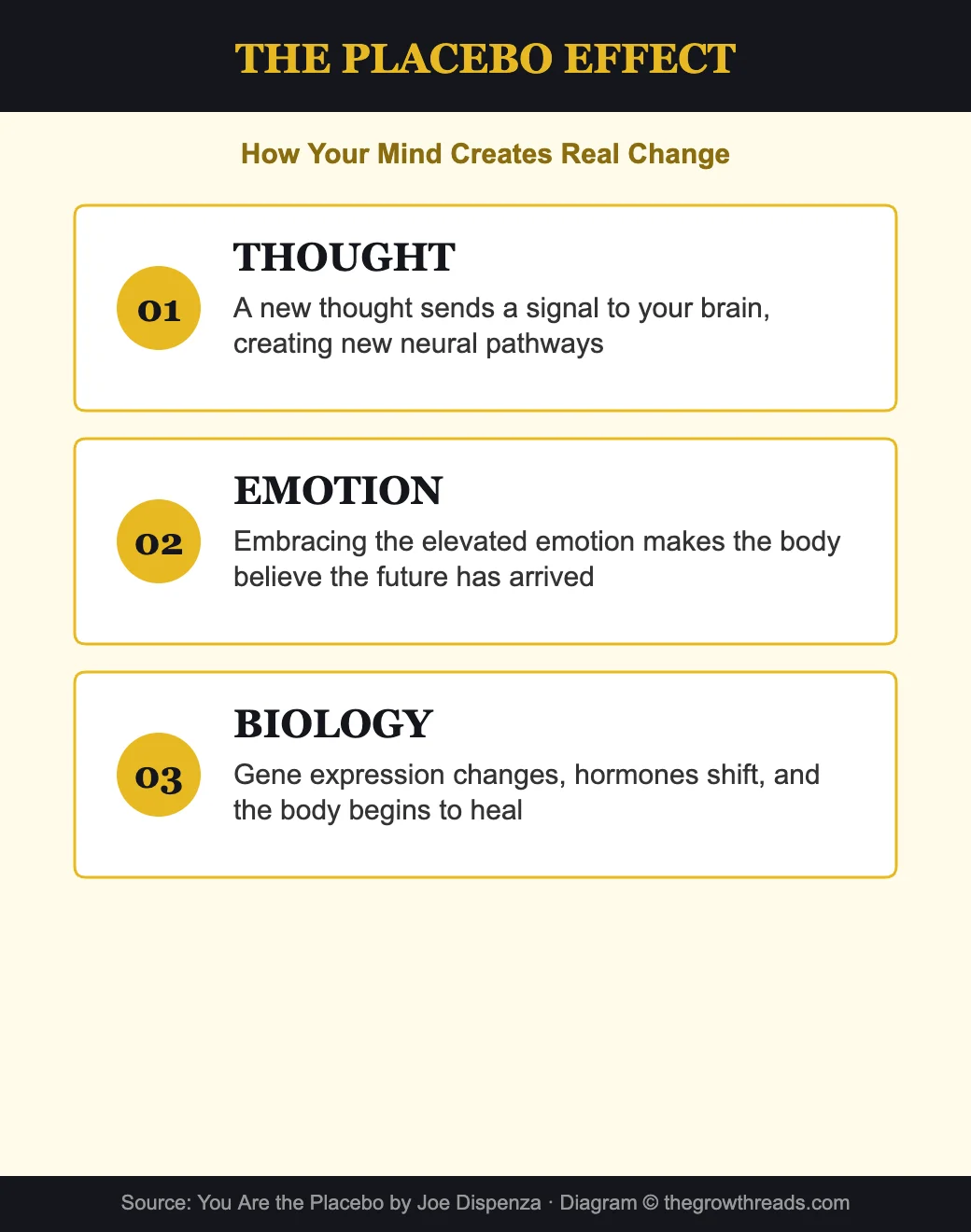
This is where the “addiction to stress” concept becomes important. When someone lives in a chronic state of anger, worry, or self-pity, the body becomes chemically conditioned to those states. The cells literally develop more receptor sites for stress hormones and fewer for feel-good chemicals. The person does not just feel stressed — their biology has been redesigned around stress as the baseline. Breaking this cycle, Dispenza argues, requires not just positive thinking but a sustained change in the emotional state held during meditation.
Part 3 — The meditation model
The practical core of the book is Dispenza’s four-step meditation process. He designed it to bypass the analytical mind — the conscious, critical-thinking brain — and access the subconscious operating system that runs 95% of daily behaviour. The steps are: (1) Induction, where slow breathing and a body scan shift brain waves from high-beta (stress) to alpha (relaxation) and eventually theta (subconscious access); (2) Intention, a clear mental picture of who you want to become — crucially, framed as identity rather than outcome (“I am healthy” rather than “I want to be healthy”); (3) Elevation, generating elevated emotions like gratitude, love, or awe as if the desired reality has already occurred; and (4) Change, where repeated practice installs new neural circuits and begins to shift gene expression.
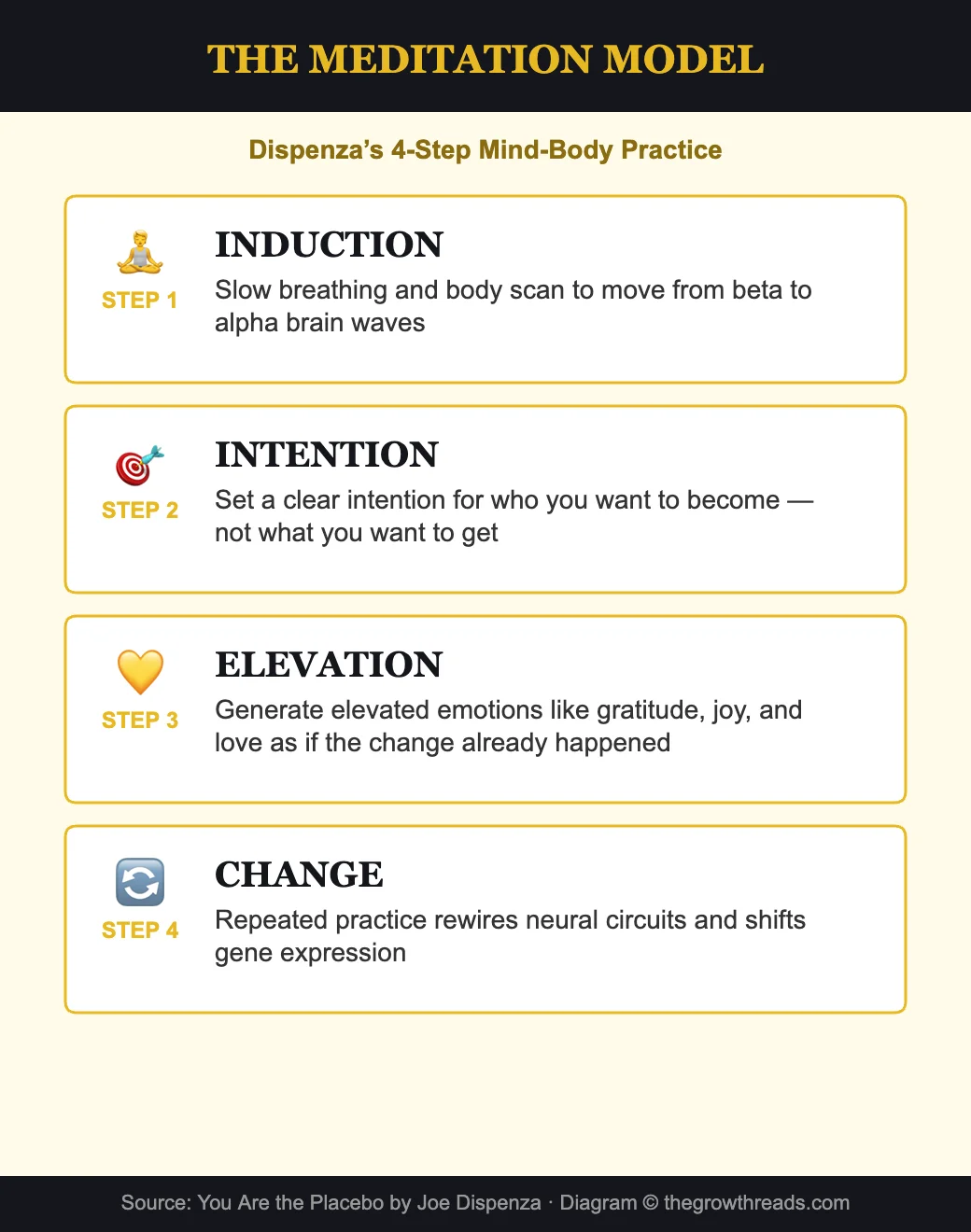
Dispenza stresses that the emotional component is not optional — it is the mechanism. Neuroscience shows that experiences accompanied by strong emotion are encoded more deeply in long-term memory. By generating the emotion of the desired future during meditation, you are essentially giving the body a “memory” of an event that has not happened yet. The body, which cannot distinguish between a real event and a vividly imagined one, begins to physiologically prepare for that future. Over weeks and months, this practice can measurably alter brain coherence patterns, heart-rate variability, cortisol levels, and immunoglobulin A levels — all of which Dispenza has documented at his workshops.
He is candid about the difficulty. The “river of change” — the gap between deciding to change and seeing results — is where most people give up. The body, conditioned to old chemistry, sends urgent signals to return to the familiar state. Dispenza compares it to withdrawal from an addictive substance: the discomfort is real, temporary, and a sign that change is occurring.
Part 4 — Case studies and the quantum model
The final section presents roughly a dozen case studies of people who report dramatic health recoveries after adopting Dispenza’s meditation practice. These include a woman whose Hashimoto’s thyroiditis markers normalised, a man whose Parkinson’s tremors reduced significantly, and several individuals who reversed chronic pain conditions. Dispenza presents before-and-after lab results and brain scans, and while he acknowledges these are not randomised controlled trials, he argues the consistency of the pattern — decisive mental commitment followed by measurable biological change — is too strong to dismiss.
He also ventures into quantum physics, arguing that at the subatomic level, the observer influences reality. This is the book’s most contested territory. Dispenza uses the double-slit experiment and the concept of wave-function collapse to argue that focused intention can influence matter. Many physicists would push back on this interpretation, noting that quantum effects at the subatomic level do not straightforwardly scale to human biology. Readers should evaluate these claims carefully — the neuroscience and epigenetics sections of the book are on firmer evidentiary ground than the quantum arguments.
The practical takeaway, however, remains consistent: whatever the mechanism, the combination of clear intention, elevated emotion, and sustained practice produces real, documented changes in brain structure, body chemistry, and health outcomes in a meaningful number of people. Whether you frame that as quantum physics or as well-understood neuroplasticity, the protocol itself has value.
Who is You Are the Placebo best for — and who should read something else first?
This book is ideal for readers who already have some meditation experience and want a science-informed framework for deepening their practice. It also suits anyone dealing with chronic stress or health challenges who wants to understand the biological mechanisms connecting mind and body. If you are sceptical but curious, the first half of the book (placebo research and neuroscience) offers plenty of well-referenced material to evaluate.
If you are completely new to meditation, you may find Dispenza’s protocol complex. Consider starting with The Power of Now for a simpler foundation. If you are primarily interested in the habit-change angle without the spiritual dimension, Atomic Habits is more actionable. And if the quantum physics arguments put you off, you can still extract tremendous value from Parts 1–3 while setting aside Part 4.
Questions to reflect on
- What emotional state does your body default to, and what chemical cocktail does that produce?
- When was the last time you experienced a health change you could not fully explain through physical causes?
- What would your life look like if you spent 30 minutes a day feeling genuine gratitude for a future that has not arrived yet?
- Which of your daily thoughts are truly new, and which are yesterday’s thoughts on repeat?
- If your genes respond to your emotional environment, what “environment” have you been providing them?
🔥 Ready to become your own placebo?
Learn how your thoughts reshape your brain, your genes, and your health.
How to apply You Are the Placebo (7-day plan)
- Day 1 — Audit your default state: Set three random alarms throughout the day. Each time one goes off, note what you are thinking and feeling. Write down the top three emotions you cycled through. This is your baseline “chemical self.”
- Day 2 — Choose your new state: Pick one elevated emotion (gratitude, joy, or love) and write a single paragraph describing the version of you who lives in that state daily. Read it aloud morning and evening.
- Day 3 — Start the induction: Sit quietly for 15 minutes. Close your eyes, breathe slowly (4 counts in, 6 out), and do a body scan from feet to head. Your only goal is to reach a calm, unfocused state.
- Day 4 — Add intention: After the breathing induction, spend 5 minutes visualising your “new self” paragraph from Day 2. See yourself living that reality in vivid detail — the environment, the actions, the conversations.
- Day 5 — Add elevated emotion: During the visualisation, actively generate the feeling of gratitude as if the change has already happened. Hold that emotion for at least 2 minutes. Notice any resistance — that is the river of change.
- Day 6 — Full 30-minute session: Combine induction (10 min) + intention (10 min) + elevated emotion (10 min). If your mind wanders to old patterns, gently return without judgment. Consistency matters more than perfection.
- Day 7 — Reflect and commit: Journal about any shifts you noticed during the week — sleep quality, mood, energy, physical sensations. Decide whether to continue the 30-minute daily practice for the next 30 days. The neuroscience suggests 4–8 weeks for measurable neural changes.
Frequently asked questions
Is You Are the Placebo scientifically accurate?
The book’s strongest sections — placebo research, neuroplasticity, and epigenetics — draw on peer-reviewed studies from institutions like Harvard, Baylor, and the Benson-Henry Institute. These claims are well-supported. The quantum physics arguments in Part 4 are more speculative and not endorsed by mainstream physicists as applicable to human-scale biology. Readers benefit most by engaging critically: accept the neuroscience, evaluate the quantum claims on their own merits, and focus on the practical meditation protocol regardless of the theoretical framework.
How long does the meditation take each day?
Dispenza recommends a minimum of 30 minutes per day, ideally in the morning before the analytical mind fully engages. Advanced practitioners in his workshops often meditate for 45–60 minutes. For beginners, starting with 15 minutes and gradually extending to 30 is more sustainable. The key is consistency over duration — a daily 20-minute practice will produce more neural change than occasional hour-long sessions.
Can this book replace medical treatment?
No, and Dispenza does not recommend it as a replacement for medical care. The book positions meditation as a complement to conventional treatment, not an alternative. The case studies involve individuals who typically continued some form of medical support alongside their meditation practice. Always consult a qualified healthcare provider for medical conditions. The book is best understood as a tool for optimising the mind-body connection, not as a substitute for evidence-based medicine.
What is the difference between this book and Breaking the Habit of Being Yourself?
Breaking the Habit of Being Yourself (2012) is more of a step-by-step meditation manual — it walks you through the practice in sequential detail. You Are the Placebo (2014) goes deeper into the science: placebo research, epigenetics, and case studies. There is overlap, but Placebo provides the evidence base while Breaking the Habit provides the daily how-to. Reading both gives you the fullest picture, but if you only read one, Placebo offers the stronger intellectual foundation.
How is this different from positive thinking or affirmations?
Dispenza explicitly distinguishes his approach from simple positive thinking. Affirmations without emotional engagement are just words — the conscious mind says one thing while the body’s chemistry says another. His model requires generating the feeling of the desired state at a level the body interprets as real. This is more demanding than repeating affirmations because it requires sustained focus, physiological relaxation, and emotional authenticity. The goal is to change the body’s chemical baseline, not just the content of conscious thoughts.
What results can I expect from practising the meditation?
Based on Dispenza’s workshop data, practitioners commonly report improved sleep, reduced anxiety, greater emotional stability, and increased energy within the first 4–8 weeks. Some report changes in chronic pain, autoimmune markers, or hormonal balance, though individual results vary widely. The most consistent early benefit is a noticeable shift in baseline mood — moving from reactive stress to proactive calm. Brain-scan data from his workshops shows increased coherence in the prefrontal cortex after consistent practice.
Is You Are the Placebo worth reading if I am a sceptic?
Yes, with a caveat. The first half of the book — covering placebo research, neuroplasticity, and epigenetics — is well-referenced and engaging even for sceptical readers. The second half introduces quantum physics interpretations that many scientists would dispute. A productive approach is to read the whole book while mentally separating the claims into three buckets: well-supported (placebo research, neuroplasticity), emerging (epigenetics of emotion), and speculative (quantum consciousness). You can extract significant practical value from the first two categories alone.
Related summaries
- The Power of Now by Eckhart Tolle — A simpler entry point into present-moment awareness and the relationship between thought and suffering.
- Dopamine Nation by Anna Lembke — The neuroscience of pleasure, pain, and why the brain resists unfamiliar emotional states.
- The Body Keeps the Score by Bessel van der Kolk — How trauma is stored in the body and what it takes to release it — a clinical complement to Dispenza’s model.
- Why We Sleep by Matthew Walker — Sleep as the foundation of brain health and emotional regulation.
- See all Health book summaries on our Best Health Books pillar page.