

★★★★☆ 4.3/5 — A brutally honest field guide to leading through impossible situations.
Best for: Founders, startup executives, and anyone managing through crisis or rapid growth.
Reading time: ~7 hrs (304 pages) · This summary: ~18 min
Difficulty to apply: High — the lessons only click when you are in the middle of your own hard thing.
Links below may earn us a commission at no extra cost to you — it helps keep the site running.
The Hard Thing About Hard Things in one minute
Most business books tell you how to do things right — this one tells you what to do when things go horribly wrong. Ben Horowitz draws on his years running Loudcloud and Opsware to share the raw, unfiltered reality of building a company when there is no easy answer. The book covers everything from firing your friends to managing your own psychology as a CEO. It is not a step-by-step playbook because, as Horowitz argues, the hardest things in business have no formula. Instead, it is a survival manual for leaders who are already deep in the struggle and need to know they are not alone.
Key takeaways
- The Struggle is real and universal: Every founder goes through periods of near-despair, and those who endure learn that the struggle itself is the job.
- There is no recipe for hard decisions: No framework will tell you whether to sell the company, lay off your team, or pivot your product. You have to make the call with incomplete information.
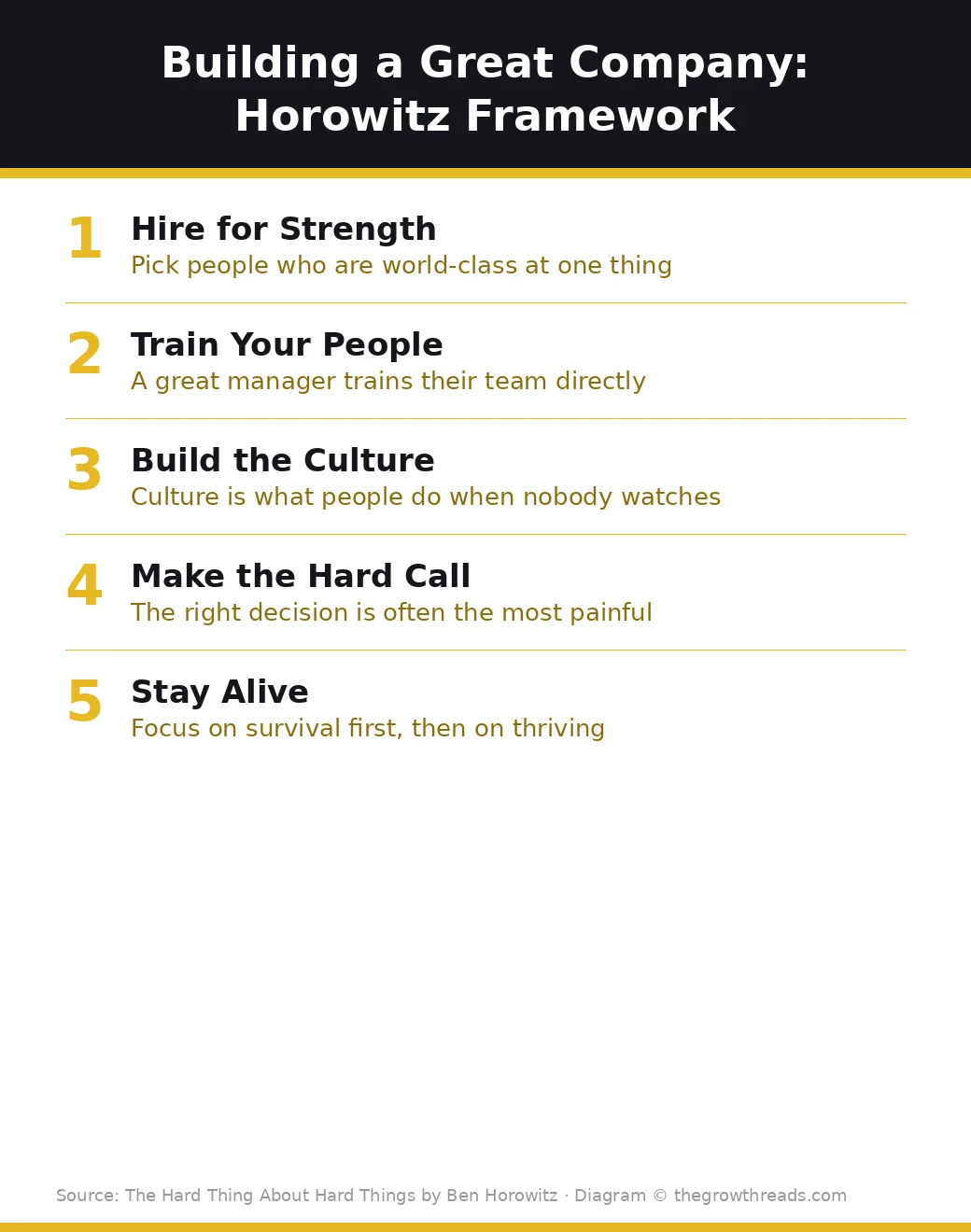
- Take care of the people first: If you get the people right — hiring, training, and managing them well — the products and profits tend to follow.
- Peacetime and wartime demand different CEOs: Peacetime means expanding market share methodically; wartime means the company faces an existential threat and the CEO must be directive and fast.
- Train your people yourself: Managers who do not train their direct reports are neglecting the single highest-leverage activity available to them.
- Hire for strength, not lack of weakness: A candidate who is world-class at one critical thing is more valuable than someone who is merely good at everything.
- Give feedback honestly and quickly: Avoiding hard conversations does not protect people. It robs them of the chance to improve.
- Build a culture on purpose: Culture is not ping-pong tables or free lunches. It is the set of assumptions people use to resolve the problems they have never seen before.
- Manage your own psychology: CEOs must find a way to stay functional through fear, loneliness, and self-doubt. Sharing the burden with a small circle of trusted advisors helps.
- Lead with transparency: When things go wrong, tell the company. Bad news travels fast; trust evaporates if people find out from someone other than you.
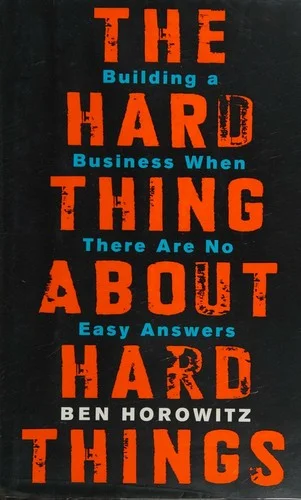
What is The Hard Thing About Hard Things about?
The Hard Thing About Hard Things is a leadership memoir and management guide by venture capitalist and former CEO Ben Horowitz. It captures the lessons he learned while cofounding, nearly bankrupting, and eventually selling Opsware for $1.6 billion, covering everything from layoffs and demotions to hiring executives and building culture under extreme pressure.
About the author
Ben Horowitz grew up in Berkeley, California, studied computer science at Columbia, and earned his MBA from UCLA. After stints at Silicon Graphics and Netscape, he cofounded Loudcloud in 1999 — right before the dot-com crash forced the company through a near-death pivot into Opsware. He sold Opsware to Hewlett-Packard in 2007 for $1.6 billion. In 2009, he and Marc Andreessen cofounded Andreessen Horowitz (a16z), now one of the most influential venture capital firms in tech. Horowitz is known for blending management theory with hip-hop lyrics and raw personal stories. Explore all Ben Horowitz book summaries →
Key concepts at a glance
| Concept | What it means | Use it when |
|---|---|---|
| The Struggle | The emotional agony of being responsible when everything is falling apart | You feel like quitting and need to know that is normal |
| Peacetime / Wartime CEO | Two distinct operating modes that demand different leadership styles | Deciding whether to empower teams or take direct control |
| Hire for Strength | Prioritize one extraordinary skill over a balanced but unremarkable profile | Evaluating senior hires or building your founding team |
| One-on-One Meetings | Regularly scheduled manager-report conversations that surface real problems | Building trust and catching issues before they explode |
| The Right Kind of Ambition | Executives who put the company first, not personal empire-building | Promoting leaders or restructuring the org chart |
| Lead Bullets | Sometimes there is no silver bullet — you just have to improve everything a little | Facing a competitor threat with no easy counter |
| Giving the Nines | Getting system reliability from 99% to 99.9% is harder than getting to 99% | Setting expectations for quality in engineering or operations |
| Ones and Twos | Some executives create ideas (Ones); others optimize existing ones (Twos) | Placing people in the right roles during growth or crisis |
Part 1 — From Loudcloud to Opsware: building inside the hurricane
Horowitz opens with the founding of Loudcloud in 1999, a cloud-computing company launched during the peak of the internet bubble. Within months he had raised over $60 million, hired hundreds of employees, and landed major contracts. Then the bubble burst. Revenue targets became impossible, the IPO market froze, and the company was weeks away from running out of cash. Horowitz managed to push the company through a public offering at the last possible moment, but the stock quickly dropped below $1.
Rather than shutting down, Horowitz engineered a radical pivot: he sold the managed-services business to EDS for $63.5 million and transformed what remained into Opsware, a pure software company. That pivot meant laying off most of the staff he had personally recruited. He describes standing in front of the company and delivering the news, knowing that each person cut was someone he had convinced to join. The emotional toll, he writes, was the worst experience of his professional life — and the moment he understood that leadership is not about having answers but about making decisions when there are no good options.
Part 2 — The Struggle: surviving the emotional war
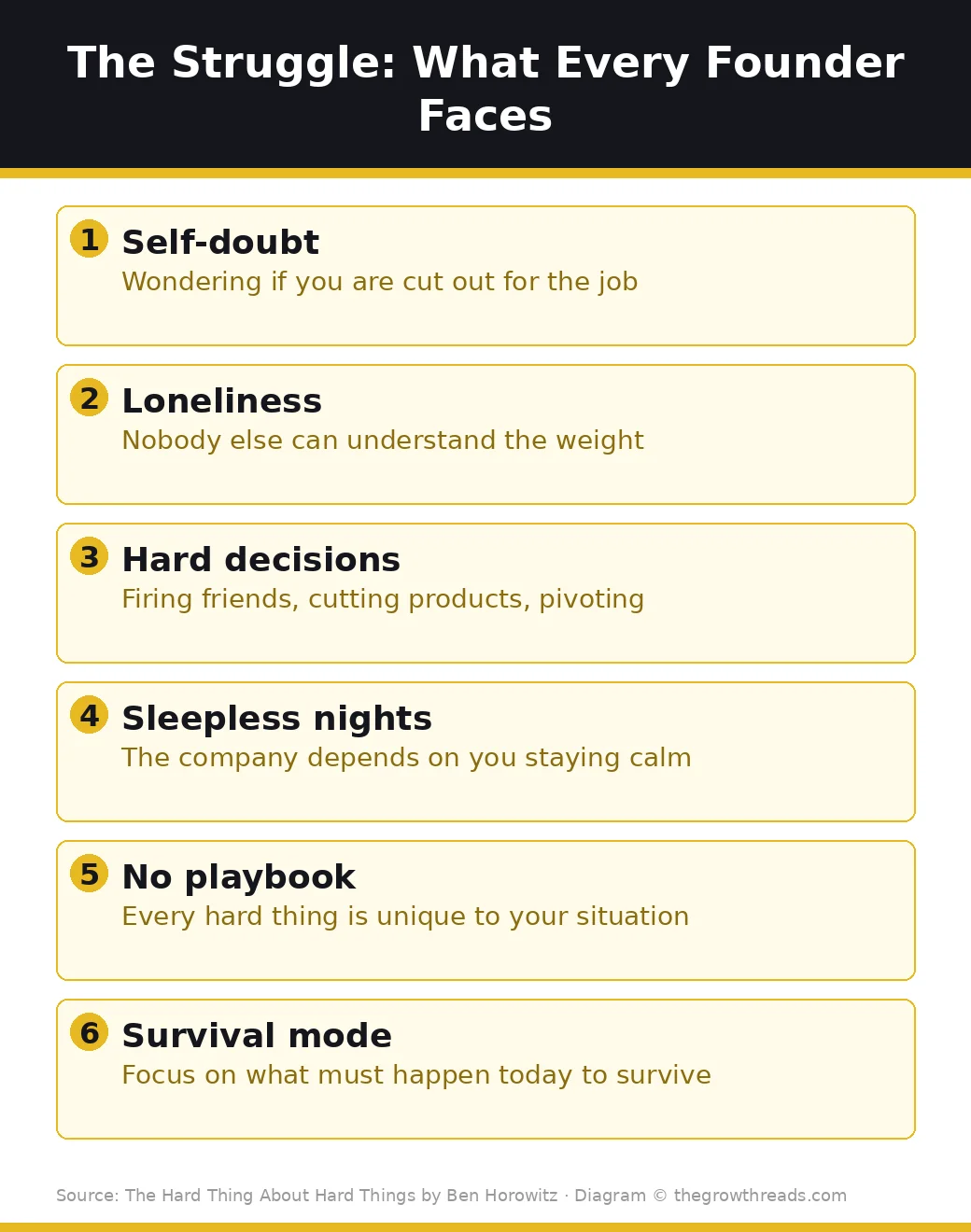
The centerpiece of the book is what Horowitz calls The Struggle — the founder experience of lying awake at night, wondering if you made the wrong bet, and knowing that hundreds of people and their families depend on your next decision. He argues that almost every successful founder he knows went through a version of this, and the ones who survived did so not because they had a secret but because they simply refused to quit.
Horowitz offers practical survival tactics: focus on what you can do today rather than worrying about what might happen next quarter; do not take problems personally even when they feel personal; build a small group of peers you can be completely honest with; and play long enough for luck to find you. He stresses that most outsiders — board members, journalists, employees — will never understand the full weight of the CEO role, so expecting sympathy from them is a recipe for disappointment.
He also covers the psychology of sharing bad news. When Opsware lost its largest customer, Horowitz called an all-hands meeting and told the entire company the same day. He argues that transparency is not just morally right — it is strategically necessary because the smartest employees will figure out the truth anyway, and if they learn it from the rumor mill rather than from the CEO, trust collapses.
Part 3 — People, management, and the art of the hard conversation
Horowitz devotes the longest section of the book to people management. He opens with a principle that runs counter to most hiring advice: hire for strength, not lack of weakness. A candidate who is extraordinary at one critical skill — say, enterprise sales or systems architecture — will outperform a candidate who is merely acceptable across the board. The key is to know which strength matters most for the role you are filling right now.
On training, Horowitz is blunt: managers who do not personally train their direct reports are failing at their most important job. He cites Andy Grove, whose book High Output Management influenced him deeply, and argues that a single training session delivered by a manager can raise the output of an entire team by 1% for years. No other activity has that kind of return.
He then covers the mechanics of hard conversations: how to demote a loyal friend, how to fire an executive you recruited, and how to conduct layoffs without destroying the morale of the survivors. In each case, his advice is the same — be clear, be fast, and be humane. Dragging out a decision to avoid discomfort makes everything worse for everyone.
Part 4 — Peacetime CEO, wartime CEO, and building culture
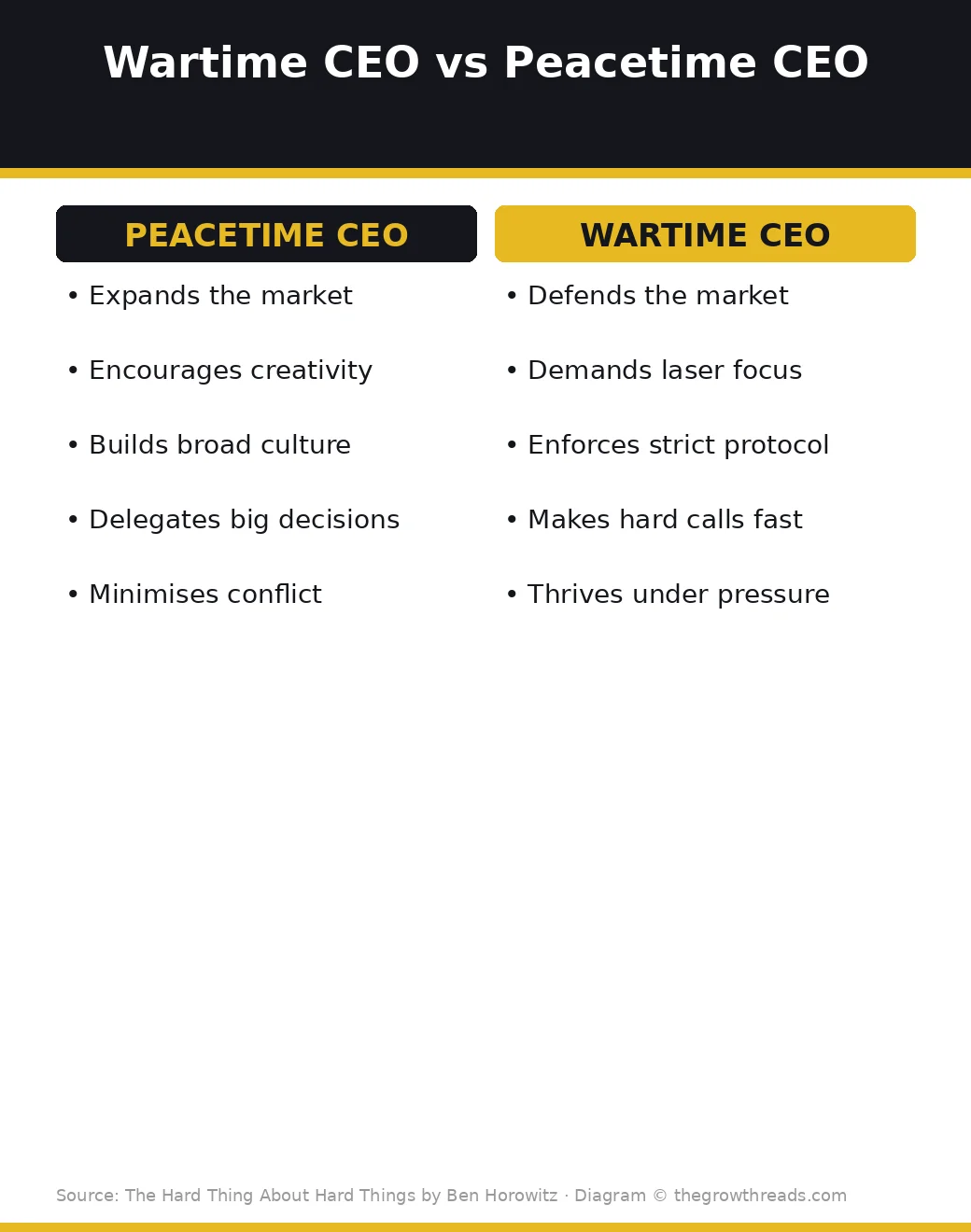
Horowitz introduces a framework that has become one of the most cited in Silicon Valley: the distinction between a peacetime CEO and a wartime CEO. A peacetime CEO operates when the company has a clear advantage in a growing market — they encourage creativity, delegate broadly, and build systems for scale. A wartime CEO takes over when the company faces an existential threat — a competitor eating the core business, a market collapse, or a product failure that threatens survival.
The two styles are almost opposites. Peacetime leaders tolerate deviation from the plan if an employee has a compelling reason. Wartime leaders insist on strict adherence because the margin for error is zero. Horowitz argues that most management advice is peacetime advice, and applying it during wartime is like following a recipe while the kitchen is on fire.
On culture, Horowitz rejects the superficial version — perks, slogans, mission statements — and focuses on what he calls “shocking rules.” A shocking rule is a cultural norm that is so counterintuitive that it forces people to ask “why do we do this?” and in answering, internalize the real value. His example from Loudcloud: all managers had to respond to customer-escalation emails within 30 minutes. The rule was extreme but it encoded a deeper truth — the company existed to serve customers, and no internal meeting was more important than a customer in pain.
Who is The Hard Thing About Hard Things best for — and who should read something else first?
This book is ideal for anyone already running a company, leading a large team, or seriously considering starting a business. It is most useful when you are in the middle of something difficult — a painful reorg, a failing product, a cash crunch — because the lessons land hardest when they mirror your own experience. If you are early in your leadership journey and have not yet faced real adversity, start with Start with Why by Simon Sinek for foundational inspiration, or Dare to Lead by Brene Brown for vulnerability-based leadership, then come back to Horowitz when the stakes feel real.
Questions to reflect on
- When was the last time you made a decision you knew was right even though it was painful — and what did you learn about yourself from the experience?
- Are you currently in peacetime or wartime at your company? Does your leadership style match the situation?
- Which of your direct reports have you personally trained in the last 90 days, and what skill did you teach them?
- If your company had a “shocking rule” that encoded its deepest value, what would it be?
- Who are the two or three people you can be completely honest with about the struggles of your role?
🔥 Ready to face the hard things head-on?
Get the leadership survival manual that every founder wishes they had read sooner.
How to apply The Hard Thing About Hard Things (7-day plan)
- Day 1 — Identify your hard thing: Write down the single most difficult decision you are currently avoiding at work. Describe why it is hard and what you fear will happen if you act.
- Day 2 — Schedule the conversation: If your hard thing involves a person (firing, demoting, giving critical feedback), schedule the meeting for this week. Prepare what you will say in three clear sentences.
- Day 3 — Run a one-on-one audit: List every direct report. When was your last substantive one-on-one with each? Schedule any that are overdue for this week.
- Day 4 — Share bad news early: Identify one piece of bad news you have been sitting on (a missed target, a lost customer, a delayed project). Share it with your team today with a clear plan for next steps.
- Day 5 — Assess peacetime vs. wartime: Evaluate honestly: is your team or company in peacetime or wartime? Write three specific behaviors you would change if you fully committed to the right mode.
- Day 6 — Design a shocking rule: Draft one cultural norm for your team that feels extreme but encodes a real value. Share it with a trusted colleague and refine it based on their reaction.
- Day 7 — Build your support circle: Identify two or three people outside your company (former colleagues, founders, mentors) who can handle hearing the unvarnished truth about your challenges. Reach out to at least one today.
Frequently asked questions
Is The Hard Thing About Hard Things only for tech founders?
Not at all. While Horowitz draws his examples from Silicon Valley, the core lessons — making decisions with incomplete information, managing people through crisis, and staying psychologically resilient — apply to any leader in any industry. Managers in healthcare, manufacturing, nonprofits, and government have all found the book relevant because the emotional challenges of leadership are universal, even if the specific business context differs.
What is the main lesson of The Hard Thing About Hard Things?
The central lesson is that leadership is defined by how you handle the situations where there are no good answers. Most business advice covers predictable scenarios, but the hardest and most important decisions — layoffs, pivots, firing friends — fall outside any playbook. The book argues that your ability to endure these moments with honesty and decisiveness is what separates great leaders from mediocre ones.
What does Ben Horowitz mean by “The Struggle”?
The Struggle is Horowitz’s term for the emotional agony that founders experience when their company is in danger and they have no clear path forward. It includes self-doubt, loneliness, sleepless nights, and the weight of knowing that hundreds of employees depend on your next move. Horowitz considers it a universal founder experience and argues that surviving it requires grit, a small support circle, and the discipline to focus only on what you can control today.
What is the difference between a peacetime CEO and a wartime CEO?
A peacetime CEO leads when the company has a clear market advantage and is growing steadily. They delegate widely, encourage experimentation, and tolerate creative deviation. A wartime CEO leads when the company faces an existential threat — a competitor eating market share, a cash crunch, or a failing product. They are directive, demand strict execution, and make fast decisions even without full information. Horowitz says most management advice is peacetime advice, and applying it during wartime can be fatal.
How long does it take to read The Hard Thing About Hard Things?
At roughly 304 pages, most readers finish the book in six to eight hours. Horowitz writes in a direct, conversational style with plenty of war stories, so it reads faster than a typical business book. Many readers report finishing it in a weekend. The hip-hop quotes that open each chapter add personality but do not slow the pace. You can also get the audiobook, which runs about seven hours and is narrated clearly.
Should I read The Hard Thing About Hard Things before starting a company?
You can, and many aspiring founders do, but the book is most impactful when you have already experienced some of the challenges Horowitz describes. Reading it before starting a company gives you a realistic preview of what to expect. Reading it while running a company gives you actionable guidance for the specific pain you are feeling. Either way, it is one of the most honest accounts of entrepreneurship available, and far more useful than books that promise easy formulas.
What other books pair well with The Hard Thing About Hard Things?
For leadership depth, pair it with Extreme Ownership by Jocko Willink and Good to Great by Jim Collins. For startup-specific strategy, read The Lean Startup by Eric Ries. For personal psychology under pressure, Can't Hurt Me by David Goggins covers the mental-resilience side. Together these four books give a 360-degree view of building something from nothing under real-world conditions.
Related summaries
- Good to Great Summary — Jim Collins on what separates great companies from merely good ones
- Extreme Ownership Summary — Jocko Willink on leading with total accountability
- Dare to Lead Summary — Brene Brown on brave leadership through vulnerability
- Best Leadership Books — Our complete ranked guide