

★★★★☆ 4.4 / 5 — A short, fierce, almost spiritual book that names the invisible force stopping you from doing your best work — and shows you how to defeat it every single day.
Best for: Writers, artists, entrepreneurs, and anyone who knows what they should be doing but cannot seem to start — or finish.
Reading time: ~3 hours (168 pages) | This summary: ~20 min
Difficulty to apply: Low in concept, high in discipline — the prescription is simple (show up daily), but Resistance never stops fighting.
Page and product links in this article may earn us a small commission at no extra cost to you.
The War of Art in one minute
There is an invisible, universal force that stands between the life you live and the life you know you should be living — and Pressfield calls it Resistance. Resistance is the internal saboteur that produces procrastination, self-doubt, distraction, drama, and every other form of creative avoidance. It is impersonal, relentless, and proportional: the more important a project is to your growth, the harder Resistance will fight to stop you. The antidote is not inspiration, talent, or luck — it is turning professional. A professional shows up every day, does the work regardless of mood, separates ego from craft, and treats creative practice with the seriousness of a job. The final section introduces the Muse — Pressfield’s term for the creative force that arrives only after you have done the difficult work of sitting down and beginning.
Key takeaways
- Resistance is the single greatest enemy of creative work: It is not external — it lives inside you, and its sole mission is to prevent you from doing the work you are meant to do.
- Resistance is universal and impersonal: Every person who has ever tried to create, start a business, get healthy, or grow spiritually has faced it. It is not personal weakness — it is a force of nature.
- Resistance is proportional to importance: The more a project matters to your soul’s evolution, the more fiercely Resistance will fight to stop you. If you feel massive Resistance, you are on the right track.
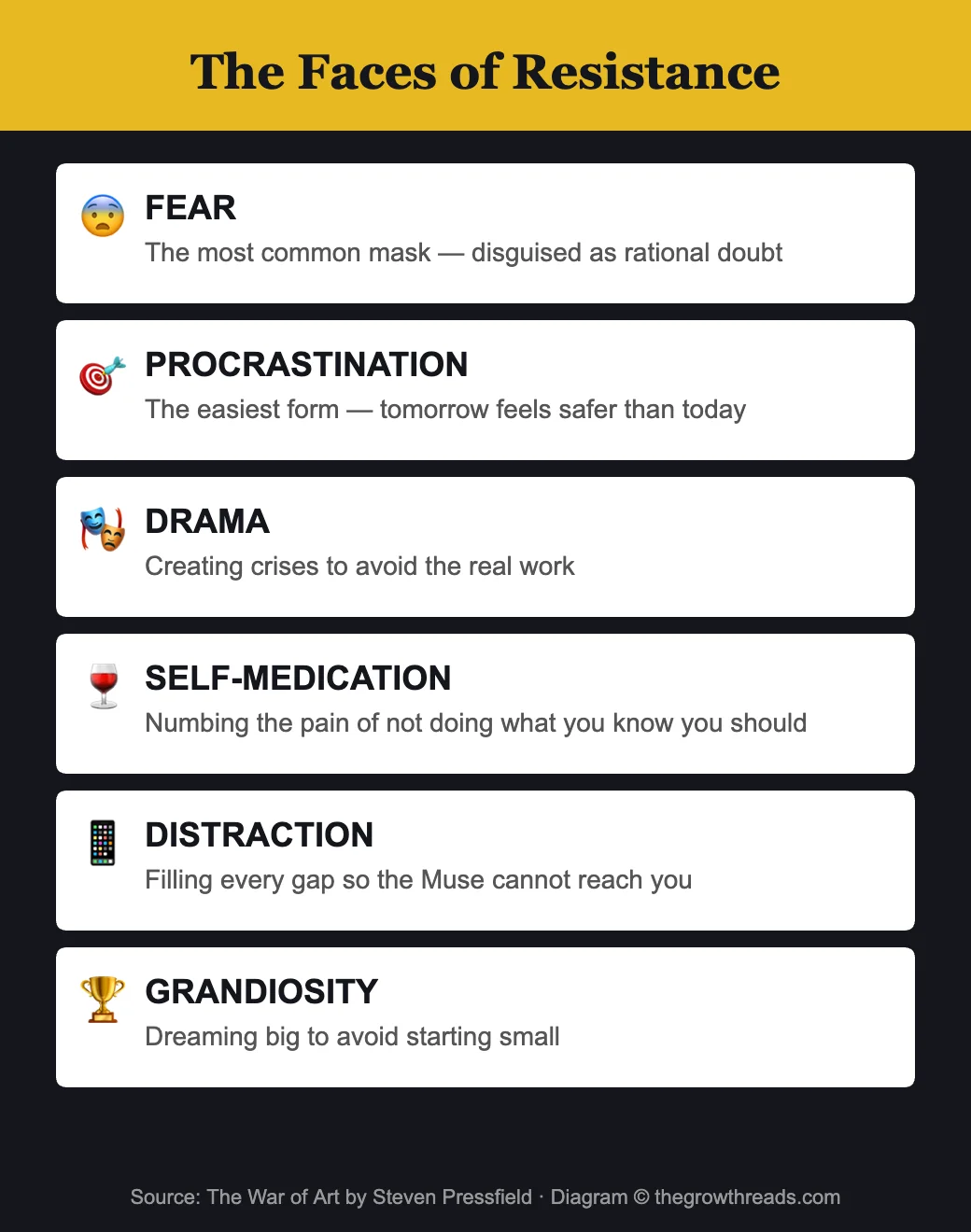
- Resistance wears many masks: Procrastination, fear, self-doubt, perfectionism, drama, addiction, distraction, and rationalisation are all faces of the same enemy.
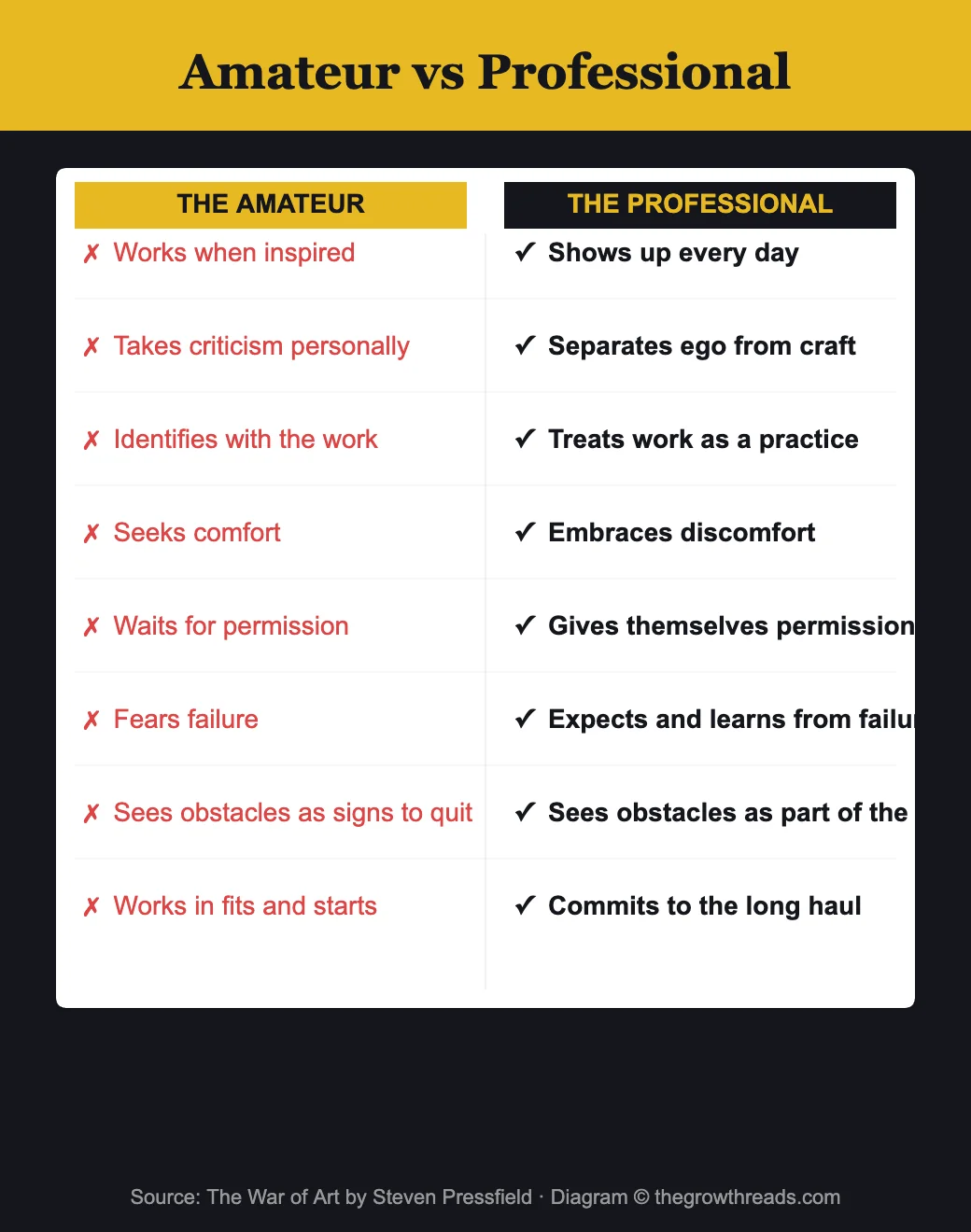
- The cure is turning professional: The amateur works when inspired; the professional shows up every day. The amateur takes criticism personally; the professional separates ego from craft.
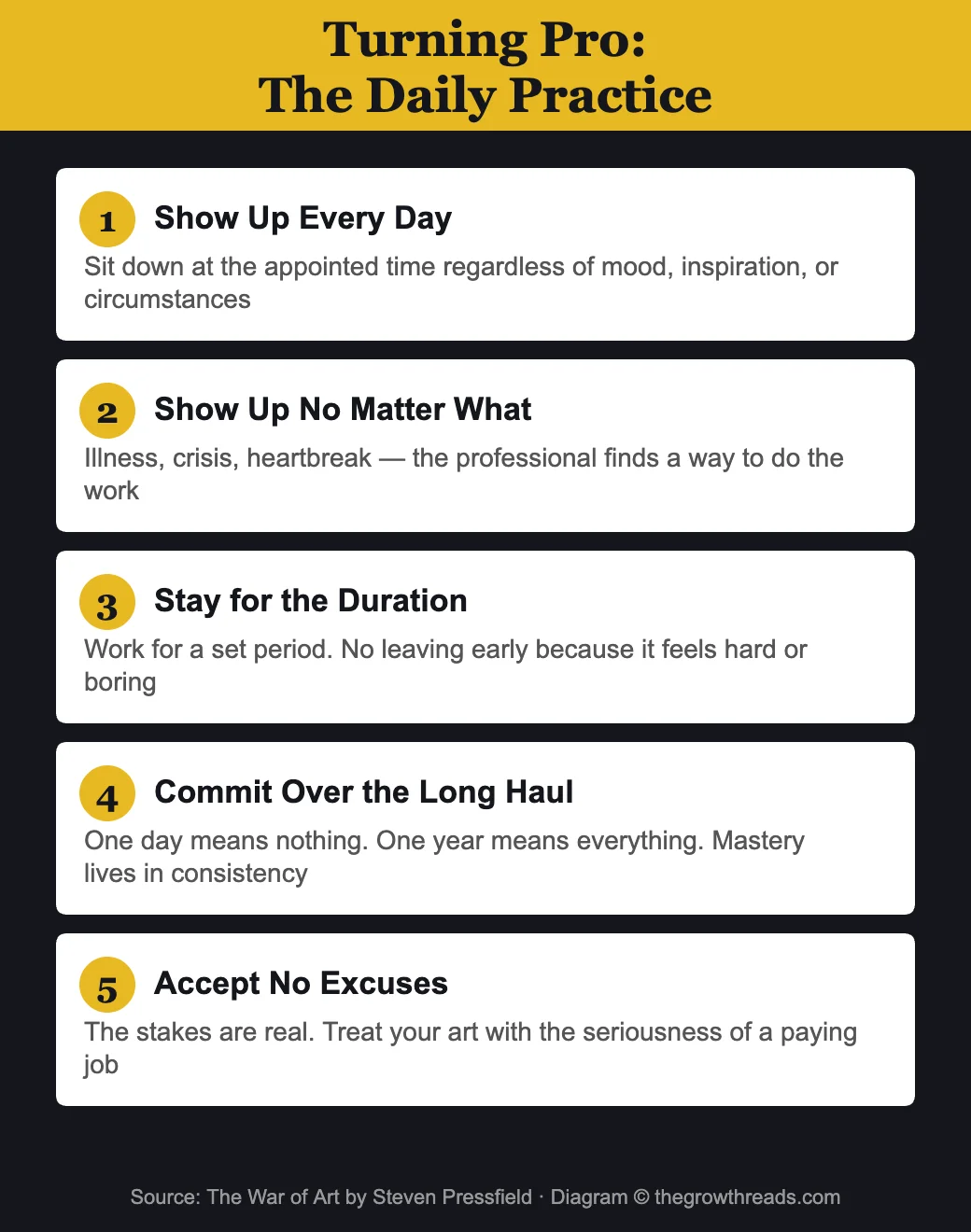
- Professionals show up no matter what: Rain or shine, sick or well, inspired or not — the professional sits down and does the work for a set period, every single day.
- The professional is patient: Mastery takes years. The professional commits to the long haul and does not expect overnight results.
- Fear is a compass: The more afraid you are of a piece of work, the more certain you can be that it matters. Walk toward the fear, not away from it.
- The Muse rewards effort, not talent: Inspiration arrives after you start working, not before. Sitting down is the invitation; the Muse is the guest who shows up once the table is set.
- You are not your work: The professional creates, ships, and moves on. Identifying too closely with any single piece of work makes you fragile and feeds Resistance.
What is The War of Art about?
The War of Art identifies the internal force — Resistance — that prevents people from doing creative work, launching ventures, or pursuing growth. Pressfield diagnoses its many disguises, prescribes the professional mindset as the antidote, and argues that creative inspiration arrives only after you commit to showing up and doing the work.
About the author
Steven Pressfield spent seventeen years struggling to finish his first novel, working as a truck driver, bartender, oilfield roughneck, and advertising copywriter while battling the very Resistance he later wrote about. His breakthrough came with The Legend of Bagger Vance, followed by historical novels like Gates of Fire and Tides of War. The War of Art, published in 2002, distilled decades of hard-won creative discipline into a cult classic that has been adopted by writers, musicians, entrepreneurs, and athletes. Pressfield lives in Los Angeles and continues to write about the creative struggle through books like Turning Pro and The Artist’s Journey. Explore all Steven Pressfield book summaries →
Key concepts at a glance
| Concept | What it means | Use it when |
|---|---|---|
| Resistance | The universal internal force that opposes any act of creation, growth, or higher purpose | You feel blocked, distracted, or unable to start the work you know matters most |
| Turning pro | Adopting a professional mindset: showing up daily, accepting no excuses, separating ego from craft | You want to move from dabbling to committed practice |
| The amateur vs the professional | The amateur works when inspired and takes criticism personally; the professional works regardless and treats craft as practice | You notice yourself waiting for the right mood, conditions, or validation |
| The Muse | The creative force or inspiration that arrives after you sit down and begin working — never before | You are waiting for inspiration instead of starting |
| Fear as compass | The intensity of fear around a project is proportional to how much it matters to your growth | You feel terrified of a creative project and are tempted to abandon it |
| Territory vs hierarchy | Working for intrinsic satisfaction (territory) vs working for external approval (hierarchy) | You catch yourself creating for likes, praise, or status instead of for the work itself |
Part 1: Resistance — defining the enemy
Pressfield opens with a claim that reads like a declaration of war: there is an enemy, it has a name, and every creative person who has ever lived has fought it. He calls it Resistance, and he capitalises it like a proper noun because he considers it that real. Resistance is not laziness, lack of talent, or bad luck. It is an active, intelligent, malevolent force whose sole purpose is to prevent you from doing the work you were born to do.
He catalogues its faces with the precision of a field manual. Procrastination is the most common — the seductive lie that tomorrow will be a better day to start. Fear comes next, often disguised as rational analysis: the project is too risky, the market is saturated, you are not ready. Self-doubt whispers that you are a fraud. Drama manufactures crises that conveniently prevent you from sitting down to work. Perfectionism insists that nothing is good enough to ship. Addiction numbs the pain of unfulfilled potential. Distraction fills every gap with noise so the signal cannot get through.
The most dangerous property of Resistance, Pressfield argues, is that it is proportional. The more a project matters — the closer it is to your soul’s calling — the harder Resistance will fight. This means that the very fear and avoidance you feel around your most important work is evidence of its importance. Resistance is a compass: it points directly at the thing you most need to do.
Part 2: Turning pro — combating Resistance
If Book One is diagnosis, Book Two is prescription — and the prescription is brutally simple: turn professional. Pressfield draws a sharp line between the amateur and the professional, and the distinction is not about money or credentials. It is about mindset. The amateur plays at the craft; the professional commits to it. The amateur works when conditions are right; the professional shows up regardless. The amateur takes failure personally; the professional treats it as data. The amateur lets Resistance win most days; the professional has systems that beat it every day.
The professional’s code, as Pressfield lays it out, has the clarity of military discipline — which makes sense, given his background as a Marine. Show up every day. Show up no matter what. Stay for the duration of the work session. Commit over the long haul, not just for a week or a month. Accept that the stakes are real. Do not over-identify with the work (you are not your manuscript, your painting, your startup). Master the technique of your craft. Do not take failure or success personally. Endure adversity. Act in the face of fear. Accept no excuses.
He illustrates this with stories from his own career — seventeen years of false starts, abandoned manuscripts, and menial jobs before he finished his first novel. The turning point was not a burst of inspiration but a decision: he would sit down every morning and write, and he would not stop until the day’s work was done, regardless of quality. Most of what he wrote was terrible. That did not matter. What mattered was the practice, the daily act of defiance against Resistance. Over time, the terrible writing improved, the habit solidified, and the Muse began to show up more reliably.
Part 3: The higher realm — the Muse and the creative force
The final section takes a spiritual turn that divides readers. Pressfield invokes the Muse — not as a metaphor but as a real force that he believes exists outside the individual and flows through anyone willing to do the work. He draws on the ancient Greek concept of the daemon, the guardian spirit that guides a person toward their calling, and on the idea that creative work is not self-expression but channelling — receiving something from a source larger than yourself and giving it form.
Whether you take this literally or figuratively, the practical implication is the same: inspiration is not something you wait for but something you earn through discipline. The Muse does not visit people who are scrolling their phones or reorganising their desk. She visits people who are already at work, already wrestling with the material, already deep enough into the struggle that their ego has stepped aside and something else can enter. Pressfield compares it to a prayer: you do not pray for the outcome but for the strength to do the labour. The outcome takes care of itself.
He also introduces a distinction between hierarchy and territory. Hierarchical orientation means working for external validation — applause, sales figures, social media metrics. Territorial orientation means working for the intrinsic satisfaction of the craft itself. The professional, Pressfield argues, must be territorial: you do the work because the work itself nourishes you, not because of what it might bring. A runner runs because running is her territory — the road, the rhythm, the effort. If she runs to win races, she is in the hierarchy, and Resistance will eventually use that dependency to destroy her.
Who is The War of Art best for — and who should read something else first?
The War of Art is ideal for anyone who knows exactly what they should be working on but cannot seem to start — or cannot seem to finish. It is a book for the writer staring at a blank page, the entrepreneur delaying the launch, the painter who has not touched a brush in months. Its short, punchy format makes it the kind of book you can read in an afternoon and return to whenever Resistance flares up.
If you want a more systematic approach to building daily creative habits, Atomic Habits by James Clear provides the tactical framework. If your block is less about discipline and more about deep focus in a distracting world, Deep Work by Cal Newport is the better starting point. And if the spiritual dimension of creativity interests you, pair The War of Art with The Power of Now by Eckhart Tolle for a complementary perspective on ego and presence.
Questions to reflect on
- What is the one project you have been avoiding that, if you are honest, matters more to you than anything else you are currently doing?
- Which face of Resistance do you wear most often — procrastination, perfectionism, distraction, drama, or something else?
- If you treated your creative work with the same seriousness as your job, what would your daily practice look like?
- When was the last time you started working and felt the Muse arrive — that moment when the work began to flow? What conditions made it possible?
- Are you working in territory (for the intrinsic satisfaction of the craft) or hierarchy (for external validation)? How would your work change if you shifted?
🔥 Ready to defeat Resistance and do your best work?
Get The War of Art and turn professional — starting today.
How to apply The War of Art (7-day plan)
- Day 1 — Name your Resistance: Write down the one project Resistance is keeping you from. Then list every excuse you have used to avoid it. Seeing them on paper strips their power.
- Day 2 — Set your professional hours: Choose a daily time block (minimum 60 minutes) for your creative work. Put it in your calendar as a non-negotiable appointment.
- Day 3 — Show up: Sit down at your appointed time and work. Do not judge the quality. Do not stop early. The only goal is to complete the session.
- Day 4 — Face the fear: Identify the part of your project that scares you most. Work on that part today. Walk toward the fear, not away from it.
- Day 5 — Separate ego from craft: Share a piece of your work with one trusted person. Practice receiving feedback without defending, explaining, or collapsing. The work is not you.
- Day 6 — Eliminate one distraction: Identify the biggest Resistance-enabler in your environment (your phone, social media, a cluttered workspace) and remove it during your work hours.
- Day 7 — Commit to the long haul: Write a one-sentence commitment to your creative practice. Post it where you will see it every morning. Review your week: did you show up? That is all that matters.
Frequently asked questions
Is The War of Art only for artists and writers?
Not at all. Pressfield defines creative work broadly: starting a business, getting fit, pursuing a spiritual practice, changing careers, or any act that requires you to overcome internal resistance and grow. The book has been adopted by entrepreneurs, athletes, students, and anyone facing a meaningful challenge they keep avoiding. If you have a calling you are not answering, this book is for you.
Is the book too short to be useful?
Its brevity is its strength. At 168 pages of short, punchy chapters — many just a paragraph or two — The War of Art reads more like a manifesto than a textbook. Pressfield deliberately strips away academic nuance to deliver maximum impact. Most readers finish it in a single sitting and then keep it on their desk as a reference to reread whenever Resistance flares up. It is a book you return to, not one you study once.
What is Resistance exactly?
Resistance is Pressfield’s term for the internal force that opposes any creative, entrepreneurial, or self-improvement effort. It manifests as procrastination, fear, self-doubt, perfectionism, distraction, addiction, and drama. It is not a psychological diagnosis but a practical label for the universal experience of knowing what you should do and finding yourself unable to do it. Pressfield personifies it as an adversary to make it easier to recognise and fight.
What does turning pro actually look like?
Turning pro means treating your creative work with the same discipline and seriousness as a paying job. Concretely: you set regular hours, you show up regardless of mood, you do not wait for inspiration, you accept that most days the work will be mediocre, you do not over-identify with results, and you commit to years rather than weeks. It is not a one-time event but a daily decision renewed every morning when the alarm goes off.
Is the spiritual section about the Muse necessary?
This is the section that divides readers. Some find it inspiring — a beautiful articulation of the creative mystery. Others find it too mystical. Pressfield himself acknowledges this divide. The practical takeaway, regardless of your spiritual orientation, is powerful: inspiration follows effort. You do not wait for the Muse; you start working, and she arrives. Whether you attribute that to a divine force or to the neuroscience of flow states, the prescription is identical.
How is The War of Art different from Atomic Habits?
Atomic Habits is a systems book: it teaches you how to build and sustain habits through cue-routine-reward loops, identity shifts, and environmental design. The War of Art is a mindset book: it names the internal enemy, prescribes a warrior’s attitude, and relies on willpower and commitment rather than systems. They complement each other beautifully — Clear builds the track, Pressfield provides the fire in the engine.
What should I read after The War of Art?
For building the daily habits that sustain a professional practice, Atomic Habits by James Clear is the natural companion. For understanding deep focus as the foundation of creative work, try Deep Work by Cal Newport. For the psychology of perseverance, Grit by Angela Duckworth provides the research behind what Pressfield preaches. And for Pressfield’s own follow-up, Turning Pro expands the amateur-to-professional framework.
Related summaries
- Atomic Habits by James Clear — The systems that keep the professional showing up after motivation fades.
- Deep Work by Cal Newport — How to protect the focus that creative work demands.
- Grit by Angela Duckworth — The science of perseverance that validates Pressfield’s philosophy.
- Best Productivity Books — Our full ranked guide to the productivity shelf.
This article contains affiliate links to Amazon and Bookshop.org. If you buy through these links, we may earn a small commission at no extra cost to you. This never influences our reviews — we only recommend books we have read and believe in. See our full disclosure.