

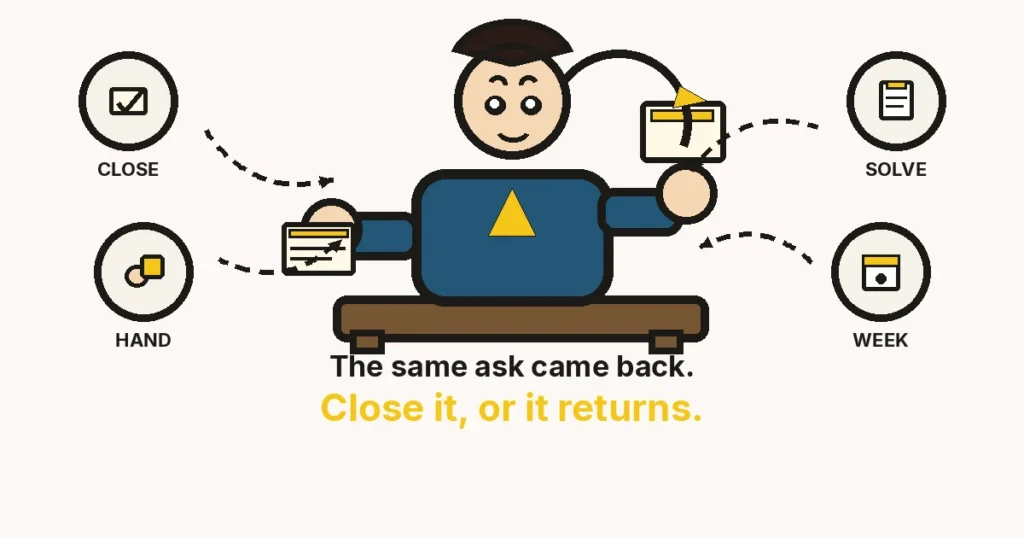
The same ask comes back when you answer it once and leave the kind of ask open. Will Larson’s essay of 29 March 2018 says to close this one, solve that kind for six months, or hand it to the person who owns it. Pick one before you reply.
Key takeaways
- The same ask comes back when an answer covers one message and leaves the kind of ask open.
- Will Larson, in the essay published on 29 March 2018, says the skill that scales the worst is outworking your problems.
- Larson’s three options in that 2018 essay are to close the ask, solve the category for six months, or delegate the ask to someone who can finish the work.
- Larson’s 28 May 2019 note announces An Elegant Puzzle: Systems of Engineering Management, and the note does not print the essay’s sentences or an ISBN.
- The three-line cut and the three sentences are an application for a solo founder or a new manager, and the print book was not opened.
What a returning ask is
The same ask comes back when you have already answered one message, and a cousin of that message arrives because the kind of ask is still yours. You are a solo founder. A client sends a file on Tuesday with the line “can you just check this before it goes out?” You leave three comments. Next Tuesday a different file arrives with the same line. You are a new manager. Someone asks in the channel whether Friday is a date the team can promise. You type yes. Next week a different customer, and the same question, and your name is still the place the question lands.
The ask is one message. The kind is the category that message belongs to. A check before a file goes out is a kind. A date you are willing to promise a customer is a kind. A discount, a vendor exception, a “quick look” at a draft, a dispute about who is on the late shift: each of those is a kind. Answering the message finishes neither the kind nor, often, even the message, because the decision was never said to everyone who has to live with it.
This page starts after the reply has already gone out once. Work that waits on you is the pile that has not moved because the decision is still unmade. Here the reply exists. The kind comes back anyway. Two people on the same task is an owner line for one job. Here the job looks finished, and the next one of the same shape has no owner either. A step you already know, and still skip, is a line missing from a send you repeat. The returning ask is the send that was never given a rule.
What the essay says
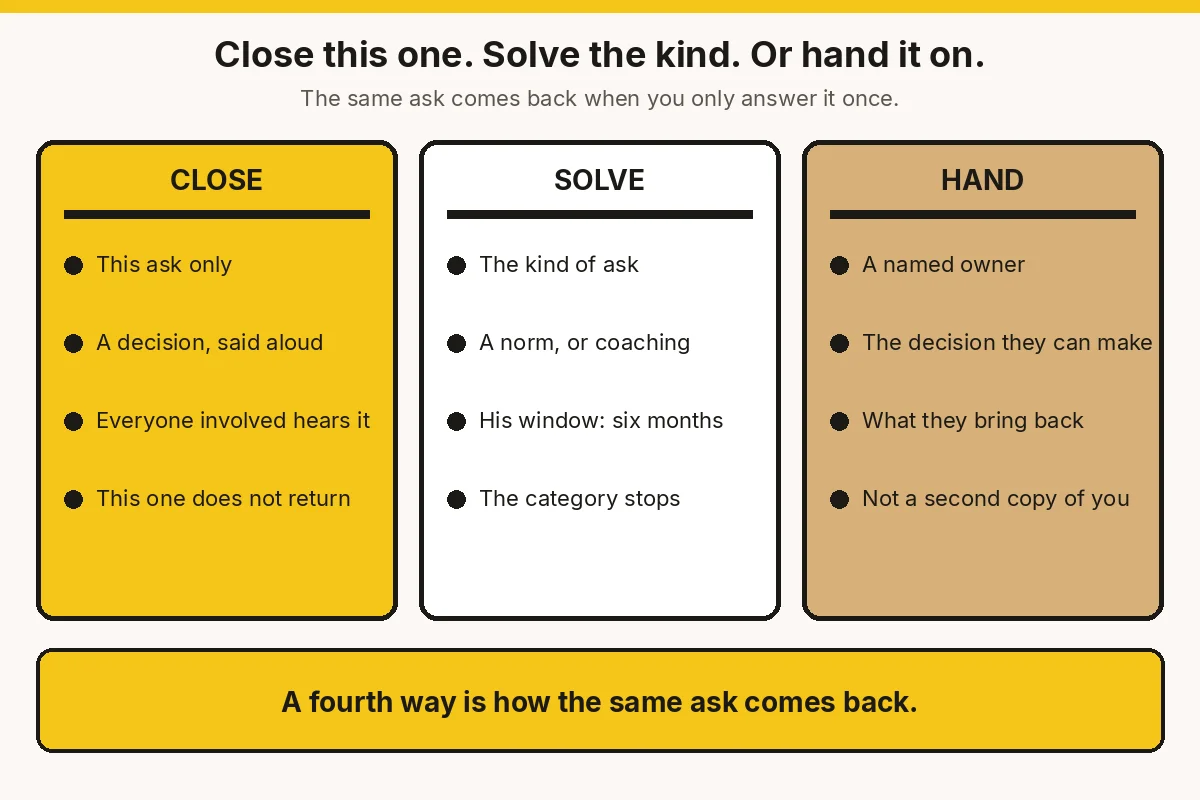
Larson’s essay says that for every problem that reaches you, you close that one, you solve the category, or you delegate it, and you do not handle it any other way. The copy read on 19 November 2026 is the essay “Close out, solve or delegate,” published on his site on 29 March 2018. The essay is short. It was read in full. It states no study, no sample size, and no page number.
The scene is a conversation with an engineering manager. That person described a low-grade, ambient anxiety about impact, felt since moving into a role focused on supporting managers rather than leading a team directly. Larson writes that the feeling matches the move to managing managers. You lose the work that used to make you happy, partnering directly with a team, and you have not yet found a new source of self-worth. He says that loss is not the only reason the move is hard. Skills and habits stop working. The skill that scales the worst, in his words, is outworking your problems.
He is plain about why the skill is hard to drop. Putting your head down on gritty problems was probably part of how you were promoted. He does not call that bad. He calls it too inefficient for the breadth you now have, and the wrong answer to most of the problems in the pile you cannot dent.
The tool is a rule with three doors, and no fourth. Every problem that comes in has to leave through one of them. His examples of a problem are an email asking for a decision, a production problem, a dispute around oncall, and a request to transfer teams. Those are his examples. A studio that has no oncall rota and no team-transfer request does not invent them in order to use the rule. You use the rule on the ask you actually have.
| His name | What he says success is | What he says you are doing |
|---|---|---|
| Close out | This particular task never comes back to you | Make a decision and tell every person involved. Finish this task quickly and permanently. |
| Solve | You do not spend time on this kind of ask again in the next six months | Design a norm or a process, or coach one person, so the category is finished. |
| Delegate | The ask sits with someone who can close it or solve it | Redirect it to the person responsible for that work, or, sometimes, hand a one-off to someone with the skill or someone who can work in the system. |
He uses “solve” for the category door, and again in the line that you are not allowed to handle a problem any other way. That second use means no fourth method. The fourth method is outworking the ask until the afternoon is gone and the kind is still yours. His last instruction is to try the three doors for a week.
The book beside this tool was not opened. On 13 July 2018 he published a proposal, then titled “Systems for Engineering Leadership,” and the seventh management item is “Close out, solve or delegate.” That page is a proposal, not a finished table of contents. On 28 May 2019 he wrote that An Elegant Puzzle: Systems of Engineering Management was released that day, and that the book was a longer format than the blog, where most of his writing had happened. The note does not reprint the essay. This page claims no printed chapter, no publisher, and no ISBN. None of those were on the pages read.
The three-way cut
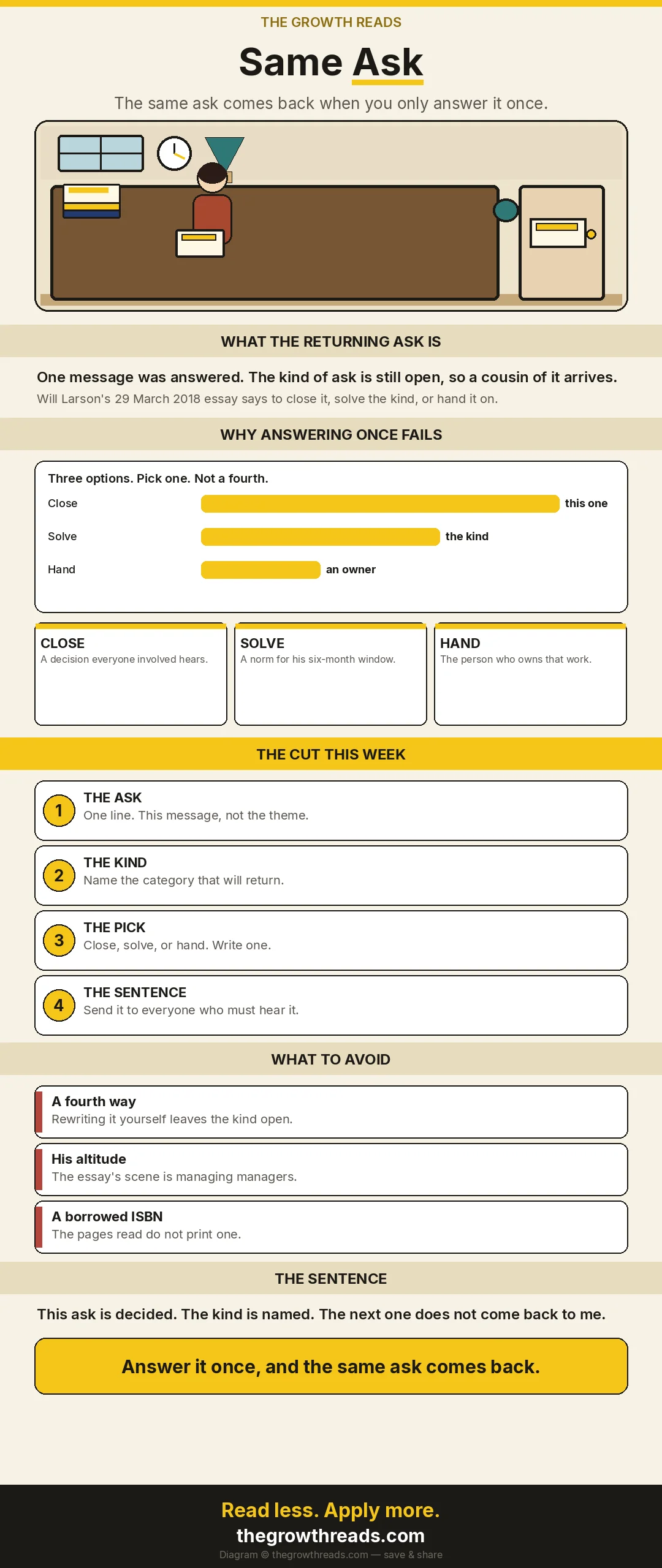
Write three lines on the ask in front of you before you answer it a second time. The lines are this page’s application. They are not a form in the essay. The essay gives the order: one specific task, fully closed, or the category handled for six months, or the ask moved to someone who can finish it. The cut is how a founder or a new manager keeps that order on a Tuesday, on one message.
1. The ask. One line, copied from the message. “Can you check this file before it goes out?” is an ask. “Clients” is not an ask. If you cannot paste a sentence, you are about to solve a mood.
2. The kind. The category this message belongs to, in words a colleague could use next week without you in the room. “A draft that wants a check before it is sent” is a kind. “This file, the blue one, today” is still the ask. If the kind line is only a restatement of the ask, you have not named what will come back.
3. The pick. One word: close, solve, or hand. Then the sentence in the next section, sent to every person who has to live with it. If the pick line stays blank while you type comments into the file, you have chosen the fourth way. The essay does not allow that way for the week you are trying the tool.
The ask line is something that arrived. The kind line could arrive again with different nouns. His six months sit on the solve line only, as his horizon for a category, not as a deadline on one file. A close is finished when this task cannot come back. A solve is finished when the next one of the kind does not need you. A hand is finished when one named person has the ask, the decision they may make, and what they bring back.
His four examples are a check, not a quota. An email that asks for a decision is usually a close. The same decision every week is a solve. Leave oncall and team transfers in the essay if you do not have them. A problem you do not have yet is a rota for a team that is not here.
The sentence you send
Send the sentence for the door you picked, to every person who has to live with it, before you touch the work. Larson says a close includes communicating the decision to all involved folks, and that success is this particular task never coming back. A comment only you and the author can see is not that communication. A yes typed into a channel, with no statement of what was decided, is not that communication either. The brackets are the lines you already wrote.
Close. The decision on this ask is [the decision]. Everyone on this note has it. This one does not come back to me. The next message, if it is a new ask, starts again. This file is finished.
Solve. This kind of ask is [the kind]. For the next six months, the rule is [the norm, or the coaching]. The next one uses that rule and does not come to me. If the rule is wrong, we change the rule on [the date], not in the middle of the next message.
Hand. [Name] owns this kind of work. I am sending [the ask] to them. They can decide [the decision they can make]. They bring back [the thing you still need]. I am not a second copy of the answer.
Three replies follow. Only one of them means the door you picked was the right size.
- The same nouns come back tomorrow. You closed an ask and the kind was the real problem. The next message is not a failure of the close. It is evidence that the pick should have been solve. Write the kind line you skipped, and send the solve sentence. Do not close the cousin as if it were a new species.
- The rule is ignored on the first cousin. You named a norm and nobody heard it, or the norm does not fit the work. That is not a reason to go back to comments in the file. Say the rule again to the people who have to use it, or change the rule on the date you named. A rule that lives in your head is the fourth way with a title.
- The owner sends it back untouched. The hand line did not include a decision they can make, or they are not the person responsible. Larson’s delegate door is a redirect to someone who can close or solve, or who can work in the system. A forward with no authority is a second inbox. Rewrite the hand sentence with the decision and the return, or pick a different door.
Keep the sentence on the ask and the kind. Feedback that turns into a personality comment is a different page. “You always need me to check” is a verdict. “This kind of draft goes out when the three lines on the checklist are present, and I look only when a line is missing” is a solve. Answering before they finish is how the sentence goes out too early. Let them say what the message is asking before you pick the door. Then send one sentence, not a paragraph of comments that never names the door.
When you are the only person
If there is nobody to hand the ask to, the week has two doors, close and solve, and the essay’s third door waits. Larson writes the delegate option for an organization that already has someone responsible for that kind of work, or someone with the skill, or someone who can work in the system. A founder alone at the desk may have none of those. Inventing a deputy so the three doors look complete is not the tool. Name the absence. Pick close or solve.
The client file is the clean case. Close means this file: send it, or change the two lines you named, and say that to the client so this file does not come back. Solve means the kind: drafts go out when they match a checklist you both can see, and you look only when a line is missing. The six months are his window. If the work cannot honestly see six months, write the date you can keep, and say that six months is his horizon and the date is yours.
Outworking the file still finishes Tuesday. He does not call the behavior useless. He calls it the wrong answer to most problems once the quantity no longer fits in one afternoon. On a team of one, the same Tuesday comes back next week. For the week of the trial, do the gritty work only after the sentence, and only when the door was close and the decision was those two edits, then the file is finished.
A contractor, a producer, or the client can be the person who works in the system, if that is actually true this week. The hand sentence has to name them and the decision they can make. “Looping in Alex” with no decision is not a hand. If Alex cannot stop the send, Alex is an audience, and you are still the owner. A week that still depends on your hours is the capacity cut after this one. The returning ask is one reason those hours stay full.
When the ask is a person
A person in distress is not a task you close so that the name never comes back. The essay’s success line for a close is that this particular task never returns. That line fits a file, a date, and a discount. It fits a production incident if what you mean is this incident. It does not fit a person who is scared, ill, or asking for help that will still be true tomorrow. Using the close door to make a human situation “go away” is a misuse this page will not teach. The essay does not discuss that case. The limit is ours.
What the essay does allow is coaching as a form of solve. He says a category is often finished by a norm or a process, and sometimes by coaching one person. A new manager asked the same career question every week can point at a written next step and a date, and say the next conversation uses that note. A one-line “you’re fine” in the channel is the fourth way. The question comes back.
His scene of anxiety is the manager, not the report. He describes losing the work of partnering directly with a team. A new manager who misses the craft is in that scene. A solo founder still doing the craft is beside the scene, not inside it. Do not import the anxiety as a diagnosis. Use the tool on the inbox. The tool does not replace a conversation about the role.
His dispute around oncall is a kind, and it is also about people. Close it only when this week is the whole decision and everyone involved hears it. If the dispute will return next month, the pick is a written rule. A founder with no rota leaves that example in the essay.
Common mistakes
The mistakes add a fourth way, or they borrow a company he did not put in the essay.
- Calling a comment thread a close. He says the decision is communicated to all involved folks, and that success is this task never coming back. Notes in the margin of a file, seen by one person, are not that. The cousin arrives because the decision was never said.
- Solving a kind you do not have. A norm for team transfers, or an oncall rota, belongs in the essay’s examples. Building one for a company of two is a future system. Park it on the future-problem page. Use the kind that already returned.
- Handing the ask to two names. Delegate, in the essay, is a redirect to someone responsible, or a one-off to someone who can finish it. Two names is the owner problem. One name, the decision they can make, and what they bring back.
- Holding a meeting so the kind can be felt. A meeting that should have been a note is how a solve becomes an hour. The solve sentence is the note. If the norm needs a conversation, the conversation ends in the sentence, not in a second meeting.
- Using six months as a law. The window is his, for the solve door. It is not a finding, and it is not a reason to refuse a shorter date you can actually keep. Say which number is his and which date is yours.
- Treating the proposal as the printed chapter. The 13 July 2018 page lists the title in a book he was still planning. The 28 May 2019 note announces the book and does not reprint the essay. No page number and no ISBN were on the pages read.
- Outworking the pile and calling the afternoon leadership. He says that skill is probably why you were promoted, and that personal effort is now the wrong answer to most of the problems at a wider breadth. For the week of the trial, effort after the sentence is allowed. Effort instead of the sentence is the fourth way.
What the source does and does not say
The essay gives the scene, the reason outworking stops scaling, the three doors, four examples, and a week to try them. The three-line cut and the three sentences are this page’s. The essay was read in full on 19 November 2026. The 13 July 2018 proposal and the 28 May 2019 release note were read the same day. The print book was not opened.
| Source | What was read | What this page uses | What this page leaves in the source |
|---|---|---|---|
| Will Larson, “Close out, solve or delegate,” 29 March 2018. His proposal “Systems for Engineering Leadership,” 13 July 2018. His note “An Elegant Puzzle is released today!”, 28 May 2019. | The essay in full. The proposal in full, including the management list that names this title. The release note in full, including the book title and his remark that most of his writing had been on the blog and that the book was a longer format. | Outworking problems scales worst. Close this task by a decision everyone involved hears. Solve the kind so you do not spend time on it for six months, by a norm, a process, or coaching. Delegate to the person responsible, or sometimes to someone who can finish it. No fourth way. Try it for a week. The proposal lists the title. The release names the book. | Any ISBN. Any print page. Any claim that the printed wording matches the essay. His examples of oncall and team transfer, unless you have them. The anxiety scene as a diagnosis for a founder who is still doing the work. The three-line cut and the sentences, which are this page’s application. |
He is writing to a manager who has moved away from leading a team directly and toward supporting other managers. A new manager of one team is earlier than that scene. A solo founder is beside it. The release note’s point about a longer format is a warning against pretending the essay is the whole book. The filter is the same one the tool already implies: use it on the ask in front of you, for a week, and do not add a door he did not give you.
Frequently asked questions
What does it mean that the same ask comes back?
The same ask comes back when one message was answered and the kind of ask is still open, so a cousin of that message arrives next. Will Larson’s essay of 29 March 2018, read in full on 19 November 2026, calls that habit outworking the problem. Close this ask with a decision everyone involved hears, solve the category, or hand it to the person who owns the work. Answering once and stopping is a fourth way. The three-line cut names the ask, the kind, and the door before the second reply.
What does Larson say to do with every incoming problem?
The essay says you pick one of three options and you are not allowed to handle the problem any other way. Close out means a decision, told to all involved folks, so this particular task never comes back. Solve means a norm, a process, or coaching one person, so that kind of ask does not need you again for six months. Delegate means a redirect to the person responsible, or sometimes to someone who can finish the work. He suggests trying the rule for a week. The essay does not report how that week turned out.
What is the difference between closing an ask and solving the kind?
A close finishes one task. A solve finishes the category. Larson says a close succeeds when this particular task never comes back to you. A solve succeeds when you do not spend time on that kind of ask again for six months. The Tuesday file, decided and told to everyone on the thread, is a close. The rule that later files go out when a checklist is complete is a solve. If the same nouns come back the next day, write the kind line and send the solve sentence.
What sentence do you send this week?
Send one sentence, matched to the door, to every person who has to live with the decision. A close states the decision and says this task does not come back. A solve names the kind, the rule, his six-month window, and the date the rule can change. A hand names one owner, the decision that person can make, and what they bring back. The sentences are this page’s application. They are not printed in the essay. A comment only one person sees is not a close.
What if you are the only person in the company?
The delegate door is not available this week unless a real person already owns that kind of work. Larson describes delegation as a redirect to someone responsible, or to someone with the skill. A founder with no such person picks close or solve. Close this file, or write the norm for the kind. Do not invent a deputy so that three doors are visible. Labor inside a close is allowed after the decision is said. Labor instead of the sentence is the fourth way.
What if the same ask is actually urgent?
Urgency picks the speed of the close, not a fourth door. An email asking for a decision is his first example, and a close is meant to finish that task quickly and permanently. Say the decision to everyone involved, including the person waiting. A production problem can close as this incident and become a solve later if the shape repeats. Urgency does not justify a comment thread that never states the decision. A person in distress is not a task you close so the name goes away.
Does the essay apply to a new manager who still has a team?
The scene in the essay is later than a first team. He is talking with a manager who now supports other managers and misses partnering with a team directly. He says outworking gritty problems, the skill that got people promoted, becomes the wrong answer for most problems at that breadth. A new manager of one team can still use the three doors, because the doors are about the ask. Do not import his anxiety unless that loss is yours. A small team still needs the decision said out loud.
Did this page use a print page or an ISBN?
No. The text read on 19 November 2026 is the essay “Close out, solve or delegate,” in full, from the page dated 29 March 2018. The print book was not opened, so no page number is given. His proposal of 13 July 2018 lists that title as a planned chapter and is not a finished table of contents. His note of 28 May 2019 says An Elegant Puzzle was released that day. Neither page printed an ISBN. The three-line cut and the sentences are an application, not a measured rate of return.
Sources
- Will Larson. “Close out, solve or delegate.” 29 March 2018. Read in full on 19 November 2026 from lethain.com/close-out-solve-or-delegate/. The essay states no study and no page number. The three-line cut is not in the essay.
- Will Larson. “Systems for Engineering Leadership.” 13 July 2018. Read on 19 November 2026 from lethain.com/book-concept-systems-eng-leadership/. A proposal for a book, asking whether it was worth writing. The management list includes “Close out, solve or delegate” as the seventh item. The page is not a table of contents of the finished book.
- Will Larson. “An Elegant Puzzle is released today!” 28 May 2019. Read on 19 November 2026 from lethain.com/elegant-puzzle-release/. The note says the book An Elegant Puzzle: Systems of Engineering Management was released that day, that most of his writing had happened on the blog, and that the book was a longer, more structured, more permanent format. The note does not reprint the essay, and it does not state an ISBN or a publisher.
Related reading on The Growth Reads
- You are the bottleneck — the work that is still waiting on a decision you have not made
- Two people on the same task — one name, when a hand would otherwise land on two
- A step that still gets skipped — the line a repeated send keeps leaving off
- The meeting that should have been a note — the solve sentence does not need an hour
- A problem you do not have yet — the rota and the transfer policy you do not have
- The One Minute Manager Meets the Monkey summary — the owner, when the ask has already climbed back up
- The Effective Manager summary — a 1:1 that ends in one decision
- Productivity — the cluster this article sits in
- How we review — what a checked essay is, and what an unread page is not
How this was checked
Who it is for. A solo founder or a new manager who already answered a message, and who can see the same kind of ask on its way back.
What was read. Will Larson, “Close out, solve or delegate,” 29 March 2018, in full, on 19 November 2026. His proposal “Systems for Engineering Leadership,” 13 July 2018, in full, the same day. His release note for An Elegant Puzzle: Systems of Engineering Management, 28 May 2019, in full, the same day.
What was not read. The print edition of the book. No ISBN, because none of the pages read printed one. No page number, because the essay does not provide one and the book was not opened. No claim that the printed chapter matches the essay.
Limit. The three-line cut and the three sentences are our application. His six months are his horizon for a solve, not a study. His scene is a manager who now supports managers. A person in distress is not a task you close so the name never returns. Early teams that can name one ask, one kind, and one door still use the week. Teams that need a fourth way are outside what he allowed for that week.
How we work: every article on The Growth Reads is built from books we have read and from primary accounts we can check, and it is date-stamped when those sources change. Read our methodology.