

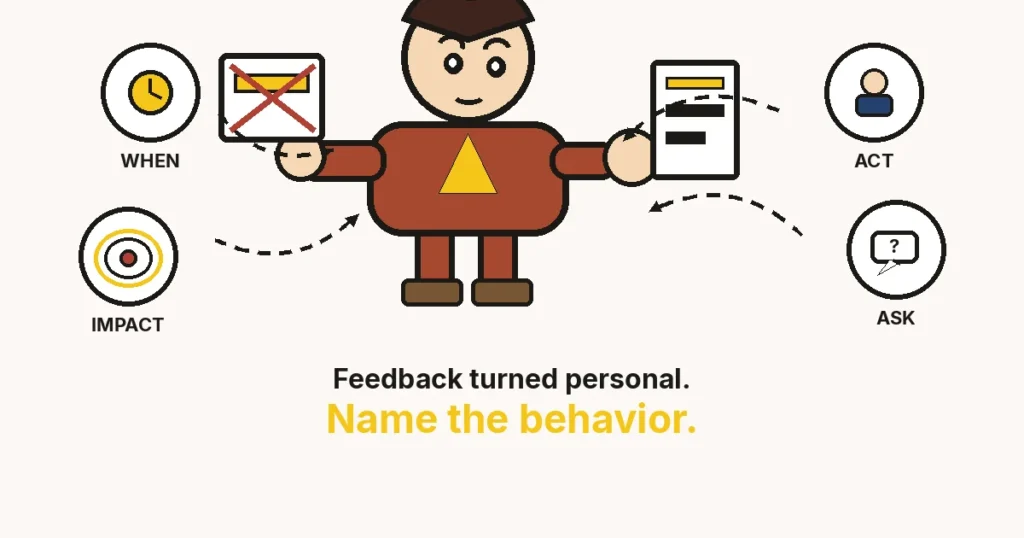
Feedback turns into a personality comment when you judge the person instead of naming what they did and the effect it had. Say the situation, the behavior, and the impact in three short sentences, ask what they intended, and then stop talking so they can answer before you add a label.
Key takeaways
- Feedback turns into a personality comment when the sentence evaluates the person and never names a behavior they can repeat or stop.
- Feedback That Works, second edition (Center for Creative Leadership, 2019, p. 2), says statements such as “a good leader,” “communicates well,” and “needs to be more strategic” only evaluate or interpret.
- William Gentry and Stephen Young, in the 2017 CCL white paper that book lists, replace “you were rude” with the act: the person stood up and began talking about next year’s budget five minutes into the presentation.
- The same white paper says to aim for three short sentences, and to skip “always,” “never,” sarcastic humor, and a threat or a promise mixed into the feedback.
- After those three sentences, the CCL note of 19 August 2025 adds one question about intent, then you listen. That question is not a line from the 2019 pages read for this article.
What the personality comment actually is
The problem is not that you dislike conflict. The problem is that the sentence in your mouth names the kind of person they are, and they cannot repeat or stop a personality. It shows up as “you’re not strategic,” “you’re rude,” “you’re difficult,” or, on a good day, “you’re a natural.” You are a solo founder, so the comment lands on a client, a contractor, or the one person you hired, and the work still is not named. You are a new manager, so the comment lands in a 1:1 or a standup, and the person leaves knowing your mood and not the act.
People call this being direct, or being kind. The useful cut is narrower. A personality comment evaluates. Feedback, in the book we checked, is information you give in response to an action you observed. Feedback That Works: How to Build and Deliver Your Message, second edition (Center for Creative Leadership, 2019), puts the failed version on page 2. You may have told someone “that he is a good leader, or that she communicates well, or that he needs to be more strategic.” The book’s next line is the whole article: “such statements only evaluate or interpret; they don’t describe a specific behavior so that a person can learn and develop by repeating or avoiding that behavior.”
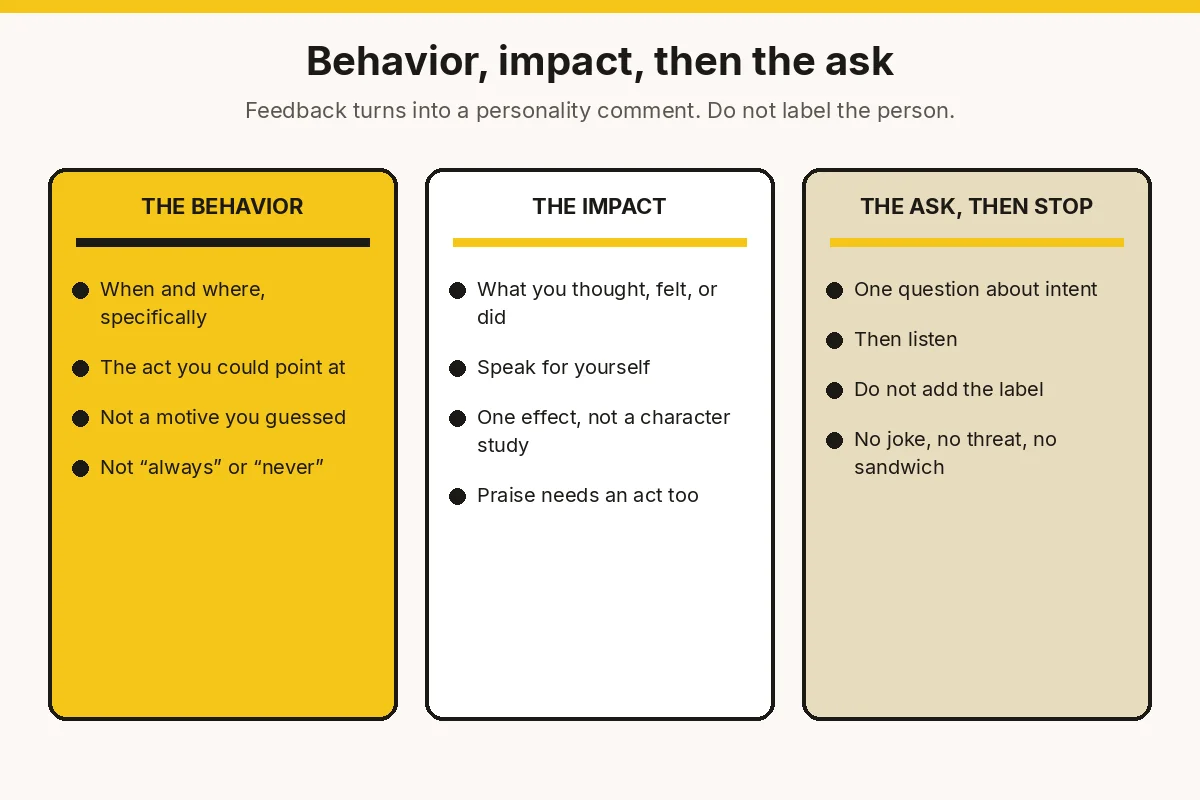
The fix is a script, not a new personality of your own. Name when and where. Name the act you could point at. Name the effect on you. Ask what they were trying to do. Then stop talking. The contents of the 2019 edition place the full SBI method — situation, behavior, impact — at page 13. This run read pages 2 and 3, the contents, the suggested resources, the background, and the back cover. It did not read page 13. The example conversation below is from the white paper that edition lists, not a reconstructed chapter.
Why the label keeps winning
The label wins because it is faster than the act, and because most of the feedback people already hear is a verdict on the result, not a description of what happened while the work was being done. Page 2 of the 2019 book says effective feedback should let the person understand exactly what they did in a particular situation and the impact it had. Page 3 says the aim is a message “without blame, judgment, or emotion,” and it asks the question the label skips: what did the person do that made you call them a good leader, a clear communicator, or not strategic enough?
William A. Gentry and Stephen F. Young answer a different question in the white paper the book lists on page 54: “Busting Myths about Feedback: What Leaders Should Know” (Center for Creative Leadership, April 2017). They polled 235 leaders in June 2016. Asked how often they get feedback from their boss, 14 of the 235, 6 percent, said daily. Almost a third, 32 percent, said weekly. Monthly was 27 percent, quarterly 15 percent, annually 20 percent. The paper’s own sum: 65 percent get some feedback at least monthly, and 38 percent get it weekly or daily.
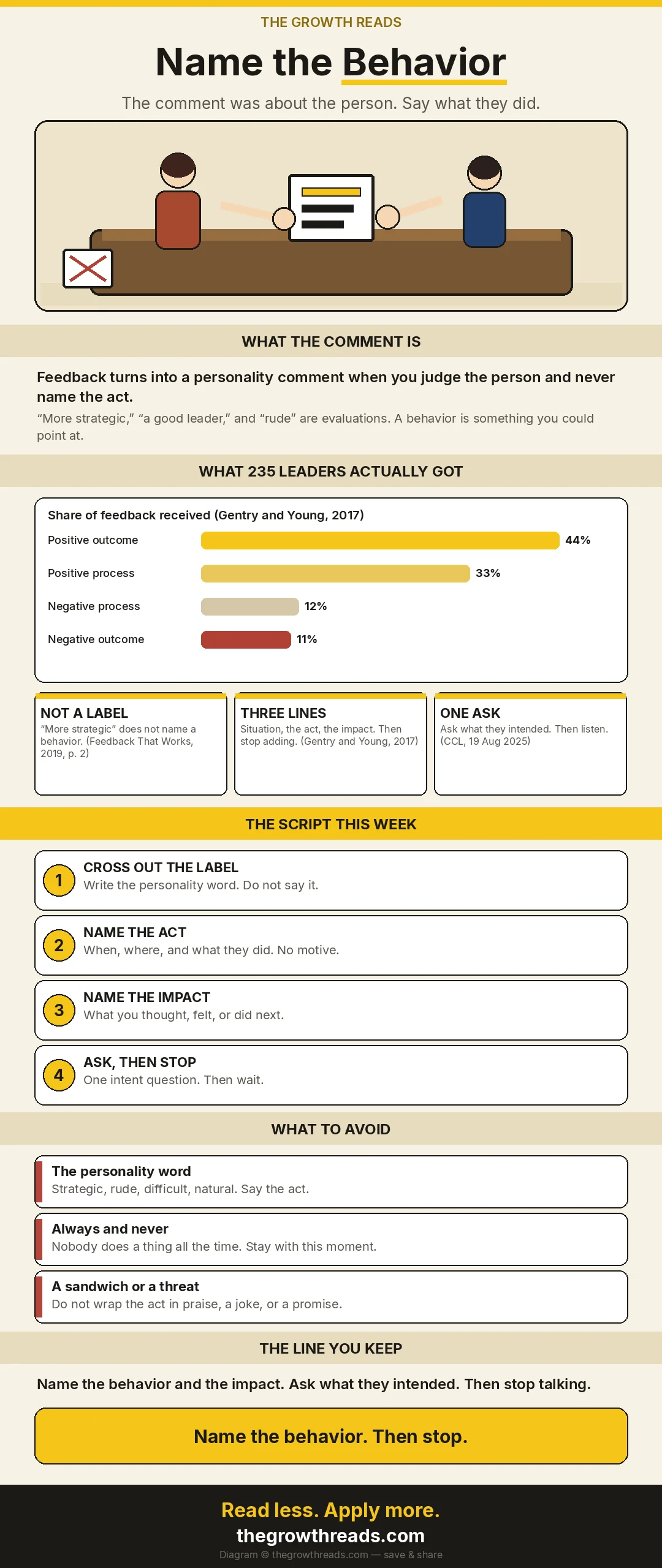
What they receive is mostly a verdict. Over the prior three months, participants split their boss’s feedback into four kinds the paper defines. Positive outcome is a favorable evaluation of a finished task, the example being “Good work!” Positive process is real-time comment on what is going well while the task is still happening. Negative outcome is an unfavorable evaluation of the finished task. Negative process says what is not going well while the work is underway, and it names the act, as in spending the wrong amount of time on it. The mix they reported receiving was 44 percent positive outcome, 33 percent positive process, 12 percent negative process, and 11 percent negative outcome. Positive feedback was 77 percent of the total. Negative was 23 percent.
They wanted a different mix. Preferred positive feedback was 65 percent, against the 77 percent they were getting. Preferred negative was 35 percent, against 23 percent. The paper says they wanted less “good job” and more of both negative outcome and negative process, and about the same amount of positive process they already got. The same 235 reported giving their own direct reports feedback more often than they receive it: 53 percent weekly and 18 percent daily, which the paper adds to 71 percent weekly or daily, against the 38 percent who get that cadence from their own boss. Of what they give, about 65 percent is positive, split evenly between outcome and process (32 and 33 percent), with negative process at 19 percent and negative outcome at 16 percent.
A boss rated among the best was not the one who only praised. Participants rated their boss from 1 to 5. The paper calls a score under 3 ineffective (39 people) and a 5 highly effective (57 people). Ineffective bosses were described as giving daily feedback 5.1 percent of the time and weekly 20.5 percent. Highly effective bosses: 8.8 percent daily and 45.6 percent weekly. Positive process feedback was 22.1 percent from the ineffective group and 34.1 percent from the highly effective group. That is what these leaders said they get. It is not an experiment that proves a script changes performance.
The paper also reports a 2013 SHRM/Globoforce survey of 764 human-resource professionals in which 94 percent said positive feedback has a greater impact on performance than negative feedback. Gentry and Young call the inference — that negative feedback therefore matters less — misleading. We did not read the SHRM survey. The 94 percent stays their citation. Their own panel wanted more of the feedback that names what to change.
Situation, behavior, impact, and the ask
Three short sentences, then one question, then you stop. Situation is when and where. Behavior is the act. Impact is the effect on you. The ask is what they intended. The 2019 book names the method SBI on page 3 and does not, in the pages we read, print a sample conversation. Gentry and Young print one in the best-practices section of the 2017 paper. Situation: “Yesterday at 11 when we were in the team debrief meeting in room 200.” They warn off generalities such as “last week” or “the whole afternoon.” Behavior: “You stood up and began talking about next year’s budget five minutes into my presentation about the action review process,” instead of “You were rude.” Impact: “I felt frustrated because I lost my train of thought, and upset because I felt unheard.”
The same pages keep the positive case in the same shape. Situation: “In the presentation you gave at 2 p.m. Tuesday to the board.” Behavior: “You gave information about our competitors that we did not know about.” Impact: “I was impressed when you addressed that issue without being asked.” Words they offer for a negative effect include troubled, worried, frustrated, and upset. Words for a positive effect include impressed and proud. The impact is yours. It is not a guess about their motive.
| The comment in your head | What you say instead | What you do not add |
|---|---|---|
| “You were rude.” | The paper’s line: they stood up and began talking about next year’s budget five minutes into your presentation. You lost the thread and felt unheard. | The word rude. A joke to lighten it. “You always do this.” |
| “You need to be more strategic” / “you communicate well” / “you’re a good leader.” | The book’s test on page 3: what they did, what they said, and how they said it, in one situation. Then the effect on you. | The evaluation with no act. A personality they cannot repeat on purpose. |
| “You’re difficult,” said about a client or a contractor. | This article’s line, not the paper’s: the day, the message, the piece they added that was not in the priced scope, and what you can no longer finish. Then one question. | The word difficult. A discount to end the mood. A threat about the contract. |
| Silence, and you fill it. | One question about what they intended. Then wait. | A second paragraph that puts the label back, or a promise you did not mean. |
The paper’s illustration, Jim, is a story, not a case with a public record. His old boss never said he was spending too long with current customers. The new boss uses the same three parts. Situation: “Yesterday between the hours of 1 and 4 in the afternoon on the sales floor.” Behavior: “You made one call to an existing client that lasted an hour and a half.” A negative outcome impact: “When you spent that amount of time on the phone, I felt worried.” A negative process impact: “When you spend that amount of time on the phone, I feel worried because the quotas for bringing in new clients are less achievable.” Later, when the behavior changes, the positive process line is that the boss is impressed because Jim is spending the right amount of time on current clients and expanding the base. “I was impressed by your work” is the thinner outcome line. The paper treats the second as the one that tells him what to keep doing.
Then it says to keep the delivery small. “SBI has three parts, so aim for three short, concise, and clear sentences.” Steer clear of “always” and “never,” because nobody does a thing all the time. Skip sarcastic humor. Do not mix the feedback with a threat or a promise, because that sends two messages. Do not sandwich it. The paper’s account of the sandwich is practical, not a separate trial: people ignore the first compliment because they know the bad news is next, and they do not hear the last compliment because they are stuck on the middle. Give it soon enough that they can still picture the moment. And do not make the job “fixing” them. The paper’s line is to help them see what to start, stop, or continue. If “being fixed” would shut you down, it will shut them down too.
The ask is one step past those three sentences, and it is not in the 2019 pages we read. On 19 August 2025 the Center for Creative Leadership published a public note, “Use Situation-Behavior-Impact (SBI) to Understand Intent.” It keeps the three parts, with a shorter example: “This morning at the 11 am team meeting,” then “You interrupted me while I was telling the team about the monthly budget,” instead of “You were rude,” then “I felt frustrated when you interrupted me because it broke my train of thought.” It then adds intent. The feedback has been one-way. A question makes it two-way. The examples on that page are “What were you hoping to accomplish with that?” and “What was going on for you?” Then, the note says, actively listen. That page also claims their research shows SBI reduces anxiety for the giver and defensiveness for the receiver. It does not cite a sample or a paper for that sentence. We do not repeat it as a finding. The question itself is on the page, and we use the question.
The sentence you say
Say when, what they did, the effect on you, and one question. Then stop. These lines are our application. They are not quotations. Replace the brackets. Leave the shape. If a bracket still contains a personality word, you are not ready to speak.
When you were about to say they are not strategic
In [day]’s [meeting], when we got to [the decision]. You [observable act] before [the thing that did not get named]. I felt [one word], because [what did not get decided]. What were you hoping to accomplish with that?
When you were about to say a client is difficult
In [day]’s note, on the line about [the priced piece]. You added [the new piece], which was not in the scope we priced. I cannot finish [the promised work] and also do that. What were you hoping to get from adding it?
When the praise would have been “you’re a natural”
In [the meeting] at [the time], you [the act a stranger could see]. I was [impressed / relieved], because [what the room could then do]. What were you hoping to accomplish with that?
Then stop typing, and stop talking. A second sentence that adds “you’re not a team player,” or “please don’t be difficult,” puts the label back on the table. A joke does the same job more slowly. A threat (“or we’ll have to revisit your role”) is the mix the 2017 paper tells you not to send. If you are a new manager, this is the note you say. A report can tell you what they saw. They do not deliver your label, which is the same line as the decision you do not hand off. If the real problem is that everything in the week was marked urgent and you are about to call them bad at priorities, name the one commitment instead, as in the priority cut. Do not hide that cut inside a personality comment.
How to say it this week
Write it before you are in the room. Six lines. Then say four of them, and do not say the first. The 2017 paper says the first SBIs are hard, and that you may need to draft them alone, or say them to yourself, before you say them to the person. That draft is the checklist.
- Write the personality word you were about to use. Strategic, rude, difficult, natural, not a culture fit. Cross it out. If you cannot think of the word, you may already be describing an act. Check anyway.
- Write when and where, narrowly. A day, a time, a room, a message. “Last week” and “the whole afternoon” are the generalities the white paper says cause confusion.
- Write the act a stranger could have seen or heard. Verbs. If the line needs a motive (“you don’t care,” “you were showing off”), it is still a label. The paper’s test is the budget interruption, not the word rude.
- Write one impact, in the first person. What you thought, felt, or did next. One. A stack of feelings turns back into a character study.
- Write one intent question. Use the 2025 wording if you do not have your own: what were you hoping to accomplish, or what was going on for you. Do not ask “why are you like this.”
- Say lines 2 through 5. Then stop. The paper’s delivery rule is three short sentences for situation, behavior, and impact. The question is the fourth move, and it is the last one. Listening is not a fifth speech.
Say it while they can still picture the moment. The paper’s timing line is “just in time,” so they recall the event and do not repeat it out of ignorance. A quarterly surprise that opens with “you’re not strategic” fails both tests: it is late, and it is a label. If the issue is harassment, a safety risk, or a decision you have already made to end the contract, this script is the wrong tool. Nothing we read presents SBI as a substitute for that process. Use the script for a behavior you want them to start, stop, or continue.
When the comment is praise
Praise turns into a personality comment the same way criticism does. Page 2 of the 2019 book uses the kind versions as the examples that fail: a good leader, communicates well. “Good work!” is the paper’s picture of positive outcome feedback, and it was 44 percent of what the 235 said they received, the largest slice. They wanted less of it. Positive process, the kind that names what is going well while the work is happening, is the slice highly effective bosses were credited with giving more of.
So the praise script is the same shape. “You’re a natural” tells them nothing they can repeat on Thursday. “In Tuesday’s board presentation, you brought competitor facts we did not have, and I was impressed you did it without being asked” tells them the act. That second sentence is the paper’s example, applied here as the test for a compliment you were about to leave vague. Do not spend the compliment as the bread around a criticism. If you have a hard act to name, name that act in its own conversation. The sandwich is how both messages get lost.
When someone else would label them
You still own the sentence. Someone else can collect what they saw. They do not deliver the label, and they do not invent a motive. A new manager hears it from a peer: “Alex isn’t a team player.” That sentence is the personality comment. Ask the peer for the meeting, the act, and the effect on the work. If they cannot produce those, you do not yet have feedback to pass on. The 2017 paper says to speak for yourself. A rumor is not an observation you made.
A solo founder hears it from the first hire, often in week one, because a client was sharp in a thread: “They’re difficult.” The hire does not send “you’re difficult.” They can draft the when, the line in the email, and the piece of scope that moved. You decide whether to send it. Week one is the easiest week to give this away, which is the same risk as handing them the whole job before the week has a shape. If the “difficult” client actually asked for more than the price covers, that is a scope reply, not a character reply. Sort what is in and what is a change, as in the scope note. If they want the same work for less and you are about to call them cheap, that is a price reply, as in the floor. Do not smuggle either decision into a personality comment.
Gentry and Young cite Menon and Thompson (2016), a study of 83 executives, for a cost of not giving feedback to underperforming people: between $6,000 and $8,000 per day, as those executives estimated it. We did not read that book. The figure stays theirs. The usable point from the paper we did read is smaller. People in their panel wanted the harder feedback, and the bosses they rated highly gave feedback more often and described the process, not only the verdict.
Common mistakes
- Saying the evaluation and calling it honesty. “More strategic,” “good leader,” and “communicates well” are the book’s own examples of lines that do not describe a behavior. Directness is the act, not the adjective.
- Swapping in “rude.” Gentry and Young set “you were rude” next to the person who stood up and started on next year’s budget. Only the second one can be repeated or stopped.
- Using “always,” “never,” “last week,” or “the whole afternoon.” The paper says the wide net causes confusion, and that nobody does a thing all the time.
- Adding a joke, a threat, or a promise. The paper says sarcastic humor and a mixed message of threat or promise both get in the way. So does a discount offered so a “difficult” client will calm down.
- Sandwiching. Praise, then the act, then praise again. The paper’s account: they skip the first slice, and they do not hear the last one. Say the act in its own conversation. Say the praise in its own conversation, with an act attached.
- Trying to fix the person. The paper says feedback is not about fixing people. Tell them what to start, stop, or continue. The label is a fix. The act is information.
- Filling the silence. You asked what they intended. If you add the personality word while they are thinking, you took the question back. Stop talking.
- Treating a marriage ratio as a workplace law. The paper suggests a lot of feedback can be positive, “around a 2:1 or 3:1,” and then borrows a 5:1 positive-to-negative ratio from John Gottman’s 1994 work on married couples in conflict. It says that ratio “might be a rule of thumb worth considering.” It is not a trial of manager feedback. We do not use 5:1 as the script. We use the sentence.
What the sources do and do not say
The book names the failure and the method. The white paper prints the conversation and the three-sentence stop. The 2025 note adds the question. None of them is your email. We checked the 2019 promo, which prints pages 2 and 3 of Feedback That Works, the contents, pages 54 through 56, and the back cover. Sloan R. Weitzel is credited there as lead contributor on the first edition, published in 2000. We do not attribute the second-edition sentences to a chapter we did not read. The contents start the SBI method at page 13, common mistakes at page 5, and traps at page 29. Those pages are not quoted here.
| Source | What it is | What we took | What it does not show |
|---|---|---|---|
| Feedback That Works, second edition, Center for Creative Leadership, 2019. Promo PDF: printed pages 2–3, contents, suggested resources pp. 54–55, background p. 56, back cover. Print ISBN 978-1-60491-921-9. | A CCL Press guidebook. The opening defines feedback. The contents point at SBI. Not a survey. | Feedback is information about an action you observed. “Good leader,” “communicates well,” and “needs to be more strategic” only evaluate. Effective feedback lets them see what they did in a situation and the impact. The promise on page 3 is a message without blame, judgment, or emotion. SBI is named. The back cover calls the model actionable, direct, and objective. Background, page 56, calls ongoing feedback part of how leadership is developed. | An example conversation. The words on page 13. This article’s script. A sample size. A rule for harassment, safety, or ending a contract. |
| Gentry and Young, “Busting Myths about Feedback,” CCL white paper, April 2017. Listed in the book’s suggested resources. Read in full. | A survey of 235 leaders, June 2016, plus practice advice. Self-report. Not an SBI experiment. | The mix they get, the mix they prefer, how often they give feedback, and the gap between bosses they rate highly and bosses they do not. The rude-versus-budget example. Jim’s call-length example, marked here as the paper’s story. Three short sentences. No always or never. No sarcasm. No threat or promise. No sandwich. Not about fixing people. Give it while they remember. | Proof that saying the script raises performance. The SHRM 94 percent and the $6,000–$8,000 figure, which the paper cites and we did not re-read. Gottman’s 5:1, which is marriage research. |
| CCL, “Use Situation-Behavior-Impact (SBI) to Understand Intent,” 19 August 2025. Public article. Read in full. | A short note that adds intent to SBI. Not the 2019 book. | One question after the impact: what they were hoping to accomplish, or what was going on for them. Then listen. The shorter interrupt example on that page. | A cited study for the claim that SBI reduces anxiety and defensiveness. We do not use that sentence as a finding. |
Limit: the 235 leaders described their own bosses and their own habits. People who think they give feedback weekly may be counting “good job.” The paper’s four types are a useful split, and the percentages are what this panel typed into a survey, not a count of recorded meetings. The white paper cites Kluger and DeNisi (1996) for the point that positive feedback does not show where the gap is. We did not read that review, and we do not attach an effect size to it. If you need a number to feel finished, you are about to turn this into a personality comment about yourself. Use the checklist instead.
Frequently asked questions
What do you do when feedback turns into a personality comment?
Feedback turns into a personality comment when the sentence names the kind of person they are and not what they did. Cross that word out. Say when and where it happened, the act a stranger could have seen, and the effect on you, in three short sentences. Then ask what they intended, and stop talking. Feedback That Works, second edition (Center for Creative Leadership, 2019, p. 2), calls lines such as “needs to be more strategic” evaluations. They do not describe a behavior anyone can repeat or avoid. Gentry and Young (2017) say to aim for three short sentences and to leave out “always” and “never.”
What is the difference between a personality comment and feedback?
A personality comment judges. Feedback, on page 2 of the 2019 book, is information you give in response to an action you observed, so the person can see what they did and the impact it had. “You communicate well” and “you need to be more strategic” are the book’s examples of the first kind. “You stood up and began talking about next year’s budget five minutes into my presentation” is the second kind, from Gentry and Young. The first gives them nothing to repeat on Thursday. The second does. If you cannot point at the act, you are still holding a label, however kindly you meant it.
How do you give feedback with situation, behavior, and impact?
Say where and when, narrowly. Then say the observable act, with no opinion of their character. Then say the effect on you, in the first person. Gentry and Young’s negative example is the 11 o’clock debrief, the budget interruption five minutes into a presentation, and feeling frustrated and unheard. Their positive example is a Tuesday 2 p.m. board presentation, competitor facts the room did not have, and being impressed they raised it unasked. The 2019 book names this SBI method on page 3. The contents put the full chapter at page 13, which this article does not quote.
What do you say, and when do you stop talking?
You say the situation, the behavior, and the impact, then one question, and you stop. The question on the CCL note of 19 August 2025 is “What were you hoping to accomplish with that?” or “What was going on for you?” Then listen. The three sentences are the 2017 paper’s delivery rule. The question is the 2025 note, not a line we found on pages 2 and 3 of the book. Do not add the personality word, a joke, or a threat while they are answering. The script box in this article is our application of that shape. It is not a quotation, and it is not page 13.
Should you sandwich a hard comment between two compliments?
No. Gentry and Young say not to sandwich feedback. Their account is that people ignore the opening compliment because they know the bad news is next, and they miss the closing compliment because they are stuck on the middle. Say the hard act in one conversation. If you also have praise, give it in its own conversation, with an act attached, not as padding. “You’re a natural, but you’re rude, but the client likes you” is three labels. None of them tells the person what to start, stop, or continue. The paper’s advice is the act, said straight, while they can still picture it.
What if you manage someone and a peer already labeled them?
Ask the peer for the meeting, the act, and the effect. If they only have “not a team player,” you do not have feedback to deliver. Gentry and Young say to speak for yourself, about a behavior you can describe, not a verdict you inherited. You can ask a report what they saw. They do not walk into the 1:1 and deliver your adjective. That sentence stays with you, the same way a price stays with the person who owns it. If the peer’s story is really that the week had five urgent items, name the one commitment. Do not rename the person as someone who cannot prioritize.
What if a client feels difficult and you are about to say so?
Name the message, the piece that was not in the priced scope, and what you can no longer finish. Then ask what they were hoping to get, and stop. “You’re difficult” does not change the scope. If they asked for more than the price covers, sort what is in and what is a change. If they want the same work for less, keep the price and point at a smaller option. Do not discount so the conversation feels kinder. This script is for the act in the thread, said once, without a threat.
What does the research actually show about feedback?
Gentry and Young asked 235 leaders, in June 2016, what feedback they get and prefer. Six percent said they hear from their boss daily. Positive feedback was 77 percent of what they received, and outcome praise was the largest slice at 44 percent. They preferred less of that praise and more feedback that names what to change. Bosses they rated among the best were described as giving feedback more often. This is self-report, not a test of the script. The SBI examples are advice after the survey, not proof the sentences raise revenue. The 5:1 ratio they mention is from marriage research.
Sources
- Center for Creative Leadership (2019). Feedback That Works: How to Build and Deliver Your Message, second edition. CCL Press. First edition 2000. Print ISBN 978-1-60491-921-9. Sloan R. Weitzel is credited in the second-edition front matter as lead contributor on the first edition. Read from the publisher promo PDF: printed pages 2–3 (definition; evaluations that are not feedback; SBI named; a message without blame, judgment, or emotion), the contents (mistakes at p. 5, the SBI method at p. 13, traps at p. 29), suggested resources pp. 54–55 (including Gentry and Young, 2017), background p. 56, and the back cover. The SBI chapter at page 13 was not read for this article. Promo: CCL Press, 2019.
- Gentry, W. A., and Young, S. F. (2017). Busting Myths about Feedback: What Leaders Should Know. White paper, April 2017. Center for Creative Leadership, Greensboro, NC. Survey of 235 leaders, June 2016. Read in full, including the frequency counts, the four-type split (44 percent positive outcome, 33 percent positive process, 12 percent negative process, 11 percent negative outcome), the preference contrast, the SBI examples, the Jim illustration, and the delivery rules (three sentences; no always or never; no sarcastic humor; no threat or promise; no sandwich; not about fixing people). CCL white paper PDF.
- Center for Creative Leadership (19 August 2025). “Use Situation-Behavior-Impact (SBI) to Understand Intent.” Public article. Read in full. Used for the intent question and the instruction to listen after it. The page’s unsourced claim that SBI reduces anxiety and defensiveness is not used as a finding. CCL, 19 August 2025.
Related reading on The Growth Reads
The decision next to this one
- You are the bottleneck — the sentence stays with you, including this one
- Everything is marked urgent — name the one commitment, not a person who “can’t prioritize”
- The first hire, week one — a new person does not deliver your label
- More than the price — more work than the price covers is a scope note, not “they’re difficult”
- The price feels guessy — a request for less is a smaller option, not a personality
Where this sits
How this article was researched
The definition is from pages 2 and 3 of the 2019 CCL Press edition of Feedback That Works, read in the publisher’s promo PDF, plus the contents, the resource list, the background note, and the back cover. The example conversation, the survey of 235 leaders, and the rule of three short sentences are from Gentry and Young’s April 2017 white paper, which that book lists and which we read in full. The intent question is from CCL’s public note of 19 August 2025. The script, the six-line checklist, and the word “stop” after the question are our application for a solo founder or a new manager. We did not invent a page number for a chapter we did not open.
Limit: the survey is what leaders say they give and get. It is not proof that this script changes performance. Gottman’s 5:1 ratio, the SHRM percentage, and the daily cost figure are citations inside the white paper, not studies we re-read. If the issue is harassment, safety, or a decision you have already made, say that through the proper process. This checklist is for a behavior you want someone to start, stop, or continue.
How we work: every article on The Growth Reads is built from sources we can check, and it is date-stamped when those sources change. Read our methodology.