

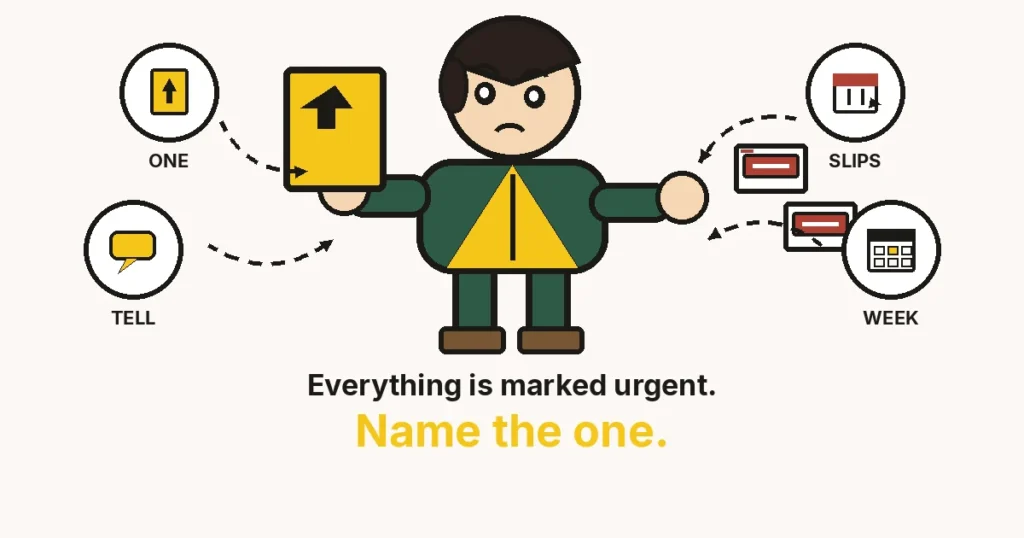
Everything is marked urgent when the week has no single commitment, so every request wears the same label. Ask what one thing you can do this week such that by doing it everything else will be easier or unnecessary. Write that line, name what slips, and send the sentence before you start the pile.
Key takeaways
- Everything is marked urgent when the list has no single commitment, so a louder note and a real deadline look the same.
- Gary Keller and Jay Papasan, in The ONE Thing (Bard Press, 2013), pose one focusing question: the one thing you can do such that by doing it everything else will be easier or unnecessary.
- In the 2013 press kit for that book, Keller calls it a myth that everything matters equally, and he tells the reader to trade the to-do list for a success list.
- The 2013 press kit states the consequence in plain words: focusing on one thing means other things do not get done. Those other things need names.
- Tell people the commitment, the day, and what slips. If a real break erases the block, put the block back the same day.
What “everything is urgent” actually is
The problem is not that people use the word urgent. The problem is that the word no longer picks anything out. You are a solo founder, so the list is clients, cash, and the work only you can finish. You are a new manager, so the list is your boss, your team, and the job you still used to do yourself. Either way the notes arrive already labelled. “Need this today.” “Jumping the queue.” “Quick one.” By Monday afternoon the label is on all of them, which means it is on none of them.
A priority sort that stops at the label will not help. If every row says urgent, you do not have a ranking. You have a pile with one stamp. The cut for this week is narrower than a new system. One commitment. The work that slips, named. The sentence you send before you open the first file.
Why one commitment leaves a gap
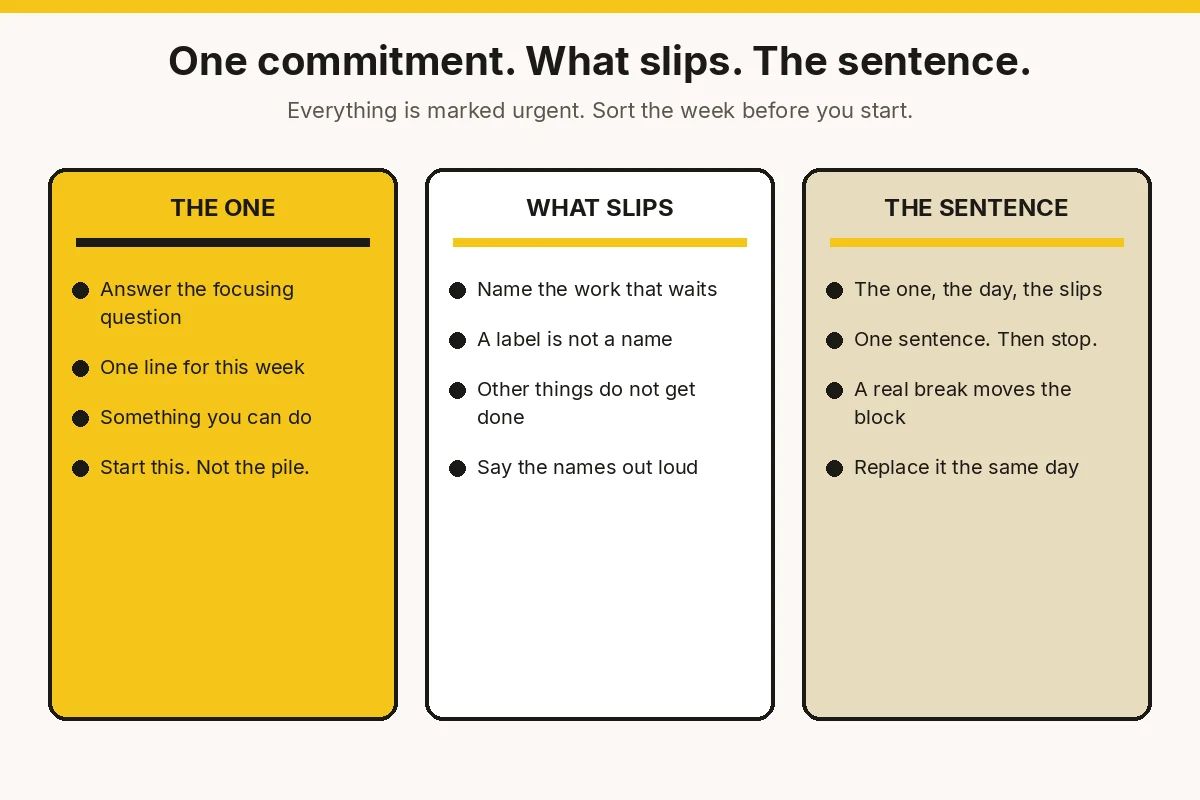
Choosing one thing does not clear the list. It decides which part of the list will not get done. Gary Keller and Jay Papasan’s book The ONE Thing (Bard Press, hardcover, 1 April 2013) is built around a single question. The book’s site and the 2013 Bard Press kit state it the same way: “What’s the ONE Thing I can do such that by doing it everything else will be easier or unnecessary?” The press kit’s own gloss is that this is the one priority which, tackled with intense focus, makes everything else easier or no longer necessary. A daily list, the kit says, will always have a handful of things that matter more than the rest, and of those, one that matters most.
The site’s 28 March 2017 note on that question is useful because it spells out the shape. It leads to one thing, not a few and not a list. It asks for something you can do, not something you wish you could do. And it has an end: once that thing is done, everything else is easier or irrelevant, and you can stop and ask again. The kit calls this the lead domino. It is a ranking step, not a mood.
Keller, in the press-kit interview, names the myth that gets a week into this mess: everything matters equally. He says people are trained to finish the plate and click down any list put in front of them, and that in achievement work that is false. His move is to discard the to-do list for what he calls a success list, built around the result rather than around the order the notes arrived. The kit’s section on the “fear of chaos” thief then says the part most priority talks skip. Focusing on one thing has a guaranteed consequence: other things do not get done. There will always be people and projects that are not the priority and still matter. The fear is not a side effect you can optimise away. It is the cost of the choice.
The one, what slips, and the sentence
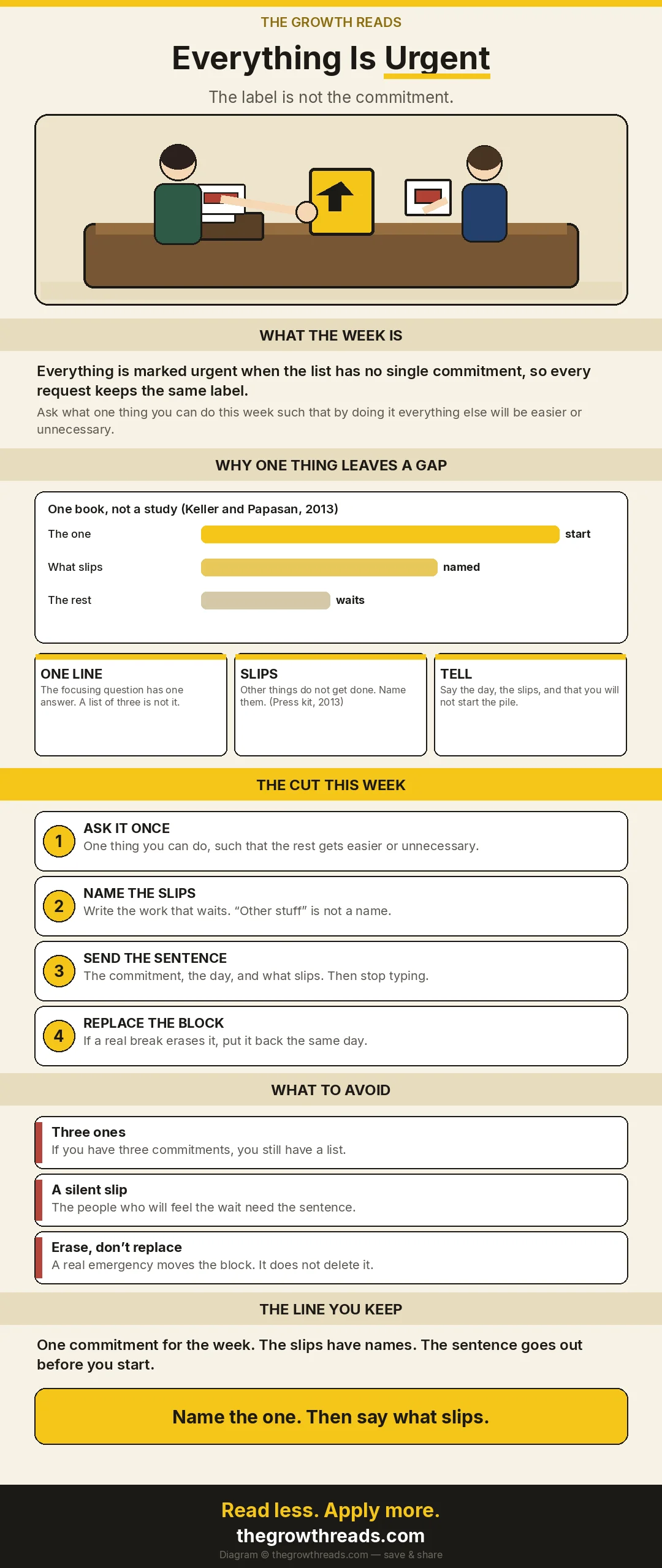
It is the one when it is the answer to the question. It slips when it is a real demand that is not that answer. You say both. Use the week in front of you, not the year. The press kit separates a long-range “big picture” question from the short one: what is my one thing right now? This article is the short one. A life purpose is a different conversation, and it will not pick Monday.
| What arrived | The one | What slips | What you say |
|---|---|---|---|
| The work that answers the focusing question for this week | Yes. One line. You start here. | The other labelled items, named | The commitment, the day, and the names of what waits |
| Another note with the same urgent label, and it is not that answer | No | This note | The day it can wait until. You do not start it to be fair to the label. |
| A real break: payroll, a client who is down, a safety or legal clock | The block moves. The commitment does not disappear. | Nothing new gets added while you move it | You are doing the break now, and the one thing is back on a named block this week |
| A list where you cannot tell these apart | Not yet. You have not asked the question. | Do not guess | Nothing, until the one line exists |
The time-management matrix still sorts urgent from important. That is a different cut. It will not name the one commitment, and it will not tell a client what is waiting. ABCDE will label a whole list. Useful on a Monday inventory. It is not a substitute for one line and a sentence. If the matrix or the letters leave you with five items that all survived, you are back in the pile.
The sentence you send
Send one sentence that a person can answer. Do not send the theory, and do not start the other files while you draft. Keller’s press-kit interview already has a line for a request from someone important: say yes to a later time, and ask, “If I have that done by [a specific time], will that work?” He adds a rule for when the request really is now: if you erase, you must replace, and you reschedule the block immediately. The two sentences below are our application of that pair for this week’s cut. They are not a quotation. Replace the brackets. Leave the shape.
When you name the week
This week’s one thing is [the line], done by [day]. [Named work] slips until [later day]. I will not start the other urgent labels until that one is done.
When a new note wants the label
I can do that by [a specific time]. Will that work? This week’s one thing stays [the line] until [day].
When you have to erase the block
I am doing [the real break] now. I am putting [the line] back on [the new block] this week. It does not drop off.
Then stop typing. A second paragraph that apologises, or that adds “and I’ll try to fit the others in,” puts the pile back on the table. If you are a new manager, this is the note you send. A report can collect the labels in the sender’s words. They do not pick the one, which is the same line as the decision you do not hand off.
How to cut the week
Do the sort before the first hour of work, including when the inbox is already red. Six moves. None of them is a new planning app.
- Write every item that arrived marked urgent, in the sender’s nouns. “Make it pop” is not yet an item. Ask what would be true when it is done.
- Ask the focusing question once, for this week: what is the one thing you can do such that by doing it everything else will be easier or unnecessary. Write one line. If you wrote three, you skipped the question.
- Name what slips. A project, a person, a deliverable, a date it moves to. “Other stuff” is the fear of chaos with the names rubbed off.
- Block the time you actually have. The press kit describes the book’s plan as a daily four-hour appointment with yourself, and Keller’s interview says to start the day by blocking the time the one thing needs, and to let other projects, paperwork, email, calls, and meetings wait. If you do not have four hours, block the hours you have. Do not invent a longer day to match the kit.
- Send the matching sentence to the people who will feel the slip. One sentence. No menu of maybes.
- If a real break erases the block, replace it the same day, on the calendar, not as a hope. The commitment stays the commitment. Only the clock moves.
The kit also lists an “inability to say no” as a thief of the block: when you say yes to someone, you are saying no to the one thing. The sentence is that no, said as a date rather than as a speech. You do not need a new personality to send it. You need the line already written, so the reply is not invented while they are waiting.
When someone else would start the pile
If a new hire or a report is about to treat every labelled note as the work of the day, you still make this call. They can hear “urgent” as care. Starting all of it feels like service, and it spends the week you just ranked. Give them the one line, the names of what slips, and the sentence. They may draft it beside you. They do not send a yes to a second commitment, and they do not quietly start the slip “so it is fair.”
Your own boss gets the same sentence, with Keller’s timing question if you need the shorter form. “If I have that done by Thursday, will that work?” is a complete reply. It is not rude. It is the block, defended in one line. If they say the new item really is now, you erase and you replace. You do not keep both clocks and hope the evening absorbs the difference.
Common mistakes
- Ranking by who shouted. Volume is how the label got on everything. The focusing question does not have a loudness term.
- Three ones. The 2017 note on the question is explicit that it leads to one thing, not a few and not a list. Three commitments is the pile with better stationery.
- Naming the slips only to yourself. The people waiting are the ones the fear of chaos is about. If they do not hear the date, they will send the label again, and they are right to.
- Starting the easy urgent item because the one thing is uncomfortable. The question asks for the thing that makes the rest easier or unnecessary, not the thing you can finish before lunch so the list looks shorter.
- Erasing the block and not replacing it. Keller’s interview rule is if you erase, you must replace. A real break moves the appointment. It does not delete the commitment.
- Using a sort as a substitute for the sentence. The matrix and ABCDE can order a list. Neither one tells a client what slipped. Send the sentence.
- Waiting until the pile is small enough to choose. It will not get small. The kit’s point is that other things do not get done. Choose while it is still large.
What the book does and does not say
The book gives you the question and the cost. It does not give you this week’s sentence. We checked the focusing question on the book’s site and in the April 2013 Bard Press kit, including Keller’s interview in that kit. We did not invent a page number, a sample size, or a percentage from a study. The ONE Thing review is the longer shelf note. This article is only the cut you can make today.
| Source | What it is | What we took | What it does not show |
|---|---|---|---|
| Gary Keller and Jay Papasan, The ONE Thing, Bard Press, hardcover, 1 April 2013. ISBN 978-1-60994-532-9, as printed in the press kit. Checked against the1thing.com (28 March 2017) and the April 2013 Bard Press kit. No page numbers. | A priority book. The kit describes a focusing question, a success list, time blocking, and four thieves of the block. Not a study. | The question, in the kit’s words and on the book’s site. One priority makes the rest easier or no longer necessary. Everything does not matter equally. Other things do not get done. A yes to something else is a no to the one thing. Ask whether a later time will work. If you erase the block, replace it. Block the time, and let email, calls, and meetings wait. | The three sentences in the script box. A rule that a solo founder has four free hours. A promise that the slips stop mattering. Those are this article’s application, or they are outside what we checked. |
Limit: the press kit describes a daily four-hour appointment as the book’s plan. That is a description of the plan, not a measurement of your calendar. If you have ninety minutes, the ranking step is unchanged and the block is ninety minutes. A real break still qualifies: payroll, a downed client, a legal or safety clock. A request that merely feels hot does not. The question will not tell you which of those you are holding. You still have to tell them apart before you erase anything.
Frequently asked questions
What do you do when everything is marked urgent?
Write the items in the words people used, then ask one question for this week: what is the one thing you can do such that by doing it everything else will be easier or unnecessary. That is the focusing question from Gary Keller and Jay Papasan’s 2013 book The ONE Thing. The answer is one line. Name what will slip, send that sentence to the people who will feel it, and do not start the other labels first. A louder note does not change the answer. If you cannot say the one line, you are not ready to work the pile.
How do you pick the one commitment?
Ask for something you can actually do this week, not a hope and not a theme. The 2017 note on the book’s site says the question leads to one thing, not a few and not a list, and that it asks for something you can do. “Grow revenue” is not yet an answer. “Send the three proposals that are waiting on my numbers, by Wednesday” is an answer. If two items both feel essential, ask which one makes the other easier or unnecessary. The one that does is the commitment. The other is a slip with a date, not a second commitment you start in the evening.
What should you say when you tell people what slips?
Say the commitment, the day it will be done, and the name of what waits, including the day it moves to. Then stop. Do not add that you will try to fit the rest in, because that puts the pile back. For a single new request, Keller’s press-kit interview offers a shorter line: ask whether having it done by a specific later time will work. Use that when one person needs a date. Use the fuller sentence when the week itself is what you are announcing. The people who will feel the wait are the ones who need to hear it.
What if a real emergency shows up?
Do the emergency, and put the commitment back on the calendar the same day. Keller’s interview in the 2013 press kit states the rule as: if you erase, you must replace, and you reschedule the block immediately. Payroll, a client who is actually down, and a safety or legal clock qualify. A message that says urgent, from a person who is anxious, does not. When you move the block, send the third sentence: you are doing the break now, and the one thing is back on a named block this week. It does not drop off. You do not add a second commitment to compensate for the interruption.
Do you need a four-hour time block?
The press kit describes the book’s plan as a daily four-hour appointment with yourself for the one thing, and Keller says to block that time first and let other projects, email, calls, and meetings wait. It is not a finding about how many free hours a solo founder has. If you have ninety minutes, block ninety minutes and protect them. The ranking step does not change with the length of the block. What fails is a block you never write down, or a block you erase and do not replace. Short and written beats a four-hour intention that lives only in the press kit.
What if you are a new manager and your team wants to start everything?
You send the sentence. They can list every labelled request in the sender’s nouns, and they can draft the reply beside you. They do not pick a second commitment, and they do not start the work you just named as a slip so the list looks fair. Fair, in a week where everything is marked urgent, is how the label wins. Give them the one line before they are in the inbox alone. The same sentence goes to your boss, with a date they can answer. If they override you, erase the block and replace it the same day. You do not keep both.
Is this the same as the urgent-versus-important matrix?
No. The time-management matrix sorts whether a task is urgent, important, both, or neither. That sort is worth doing when the words still mean different things. It does not name the one commitment for this week, and it does not tell anyone what will slip. ABCDE can order a longer list by consequence. Use either as an inventory if you need one. Then ask the focusing question and keep a single line. If five items survive the matrix, you still have to choose. The sentence is the part neither chart sends for you.
What if everything really does have to happen this week?
Then you still name an order, because a week cannot hold the pile just because the consequences are real. Ask which one thing makes the others easier or unnecessary, do that first, and give the rest dates that may fall past Friday. Keller’s interview treats “everything matters equally” as the myth. The press kit is explicit that other things do not get done. Pretending you will finish all of them is how Thursday becomes another labelled morning. If a date past this week is unacceptable to the other person, that is a resourcing conversation, not a reason to start all of it badly. Say the date. Let them answer.
Sources
- Keller, G., & Papasan, J. (2013). The ONE Thing: The Surprisingly Simple Truth Behind Extraordinary Results. Bard Press, hardcover, 1 April 2013. ISBN 978-1-60994-532-9, as printed in the press kit (9781609945329). The book’s site states the focusing question and, on 28 March 2017, attributes to the book the line that how we phrase our questions determines the answers that become our life: the1thing.com. No page numbers.
- Bard Press kit for The ONE Thing, April 2013, distributed by Cave Henricks Communications. States the focusing question, the “one priority” gloss, the fear-of-chaos consequence, the four-hour time block, the success list, and Keller’s interview lines on saying yes to a later time and on replacing a block you erase. Read for this article. Not a study.
Related reading on The Growth Reads
The book
- The ONE Thing summary — the longer shelf note. This article is only the week’s cut.
The decision next to this one
- The time-management matrix — urgent versus important, which still does not name the one commitment
- The ABCDE method — a labelled list, not the sentence
- You are the bottleneck — the one commitment stays with you, including this reply
Where this sits
How this article was researched
The ranking step is the focusing question, checked on the book’s site (the1thing.com, 28 March 2017) and in the April 2013 Bard Press kit for The ONE Thing, including Keller’s interview in that kit. The kit is the publisher’s account of the book. It is not a page-cited reading, and this article does not invent page numbers to look like one. The one-commitment sentence that names what slips is our application for a solo founder or a new manager. We did not add a study or a success rate.
Limit: a four-hour block is the plan the kit describes, not a measurement of your week. If the hours you have are shorter, keep the question and shorten the block. The existing review stays the place for the rest of the book.
How we work: every article on The Growth Reads is built from sources we can check, and it is date-stamped when those sources change. Read our methodology.