


The price feels guessy when you name a number before anyone has said what success is, then cut that number to win the work. Write what the work costs you, set a floor under that scope, and offer a smaller option. If they want to pay less, they get less delivered.
Key takeaways
- The price feels guessy when the number is named before the client can say what success is, or when that number is then cut to win the work.
- Mike McDerment and Donald Cowper, in Breaking the Time Barrier (FreshBooks, 2013, p. 31), write that if a client cannot define success or how to measure it, pricing is guesswork.
- On page 40 of that book, the rule is not to haggle: if a client wants to pay less, they have to choose to have less delivered.
- The same book still requires a cost check. Page 10 shows discounts below breakeven, and page 26 says the price has to cover costs even though the client is not paying those costs.
- The sentence you send keeps this option’s price and points at a smaller option. A discount in the book, on page 64, is only the one tied to being paid quicker.
What the guess actually is
The problem is not that you lack a personality for sales. The problem is that the number in the draft is not tied to a result, and the easiest way to end the silence is to make the number smaller. It shows up as a blank in the proposal, a rate you copied from a forum, or a figure you said on a call because they asked “what do you charge?” before you had asked what done looks like. You are a solo founder, so the discount comes out of your week and your rent. You are a new manager, so the discount comes out of a promise the company already made, and it still lands on you when the work does not pay for itself.
People call this impostor syndrome, or being bad at sales. The useful cut is narrower. A price is guessy in two cases. You cannot say what success is, so any number is a costume. Or you can say what success is, and you still plan to cut the number for the same work so they will say yes. Both cases end in the same place: a lower price, the same scope, and a week that costs more than it returns.
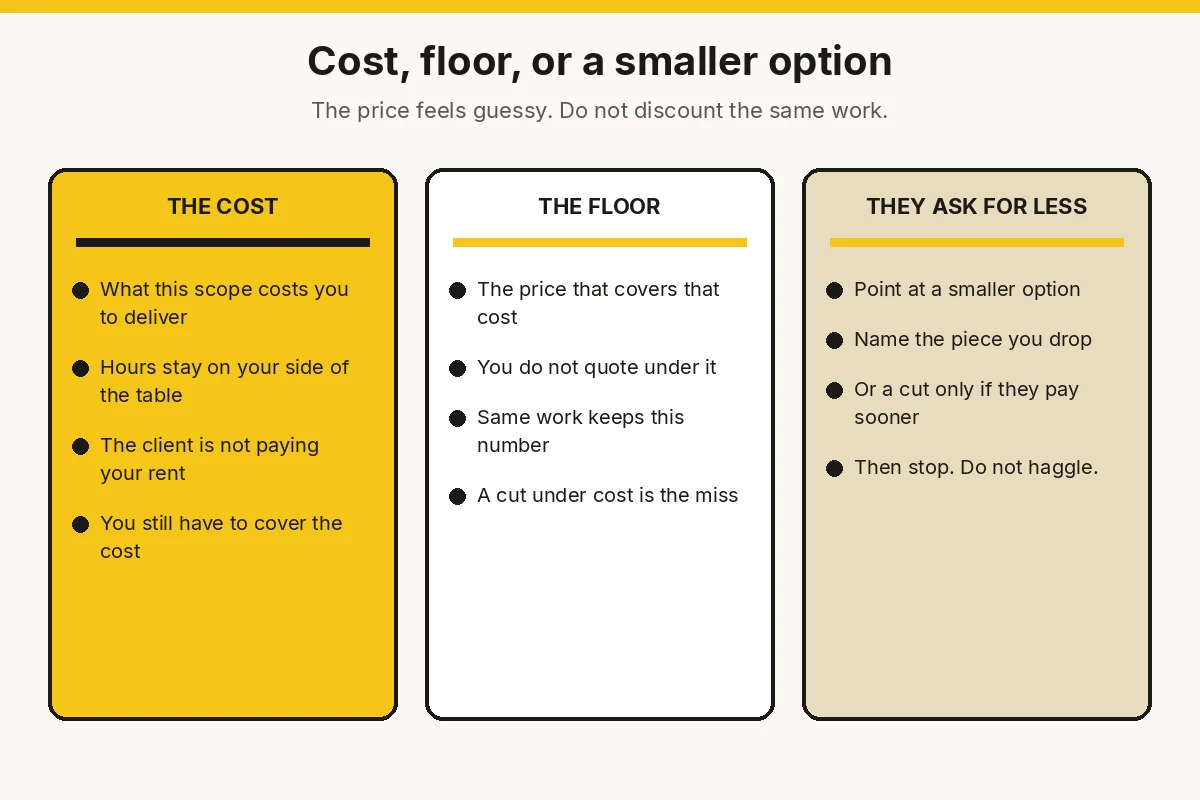
The fix is a checklist, not a new identity. Write the cost of this scope. Write the floor, which is this article’s word for the price you will not go under for that same scope. Offer more than one option, each with its own scope and its own price. When they ask for less, point at the smaller option. Do not shave the option they already liked.
Why the discount keeps winning
You discount because the first number was never a decision. It was a way to stay in the conversation. Mike McDerment and Donald Cowper, in Breaking the Time Barrier (FreshBooks, Toronto, 2013), put the lesson in a business fable. The mentor will not set a price until she understands what the client wants. On page 30 she says, “I tell them I need to understand what they want first before I can set a price.” If they are desperate for a ballpark she might give a range, and she says she really resists that. Prospects who focus on price right away, she finds, often turn out to be the kind of client you do not want.
Page 31 is the line that names the guess. “If they can’t define success or establish ways to measure success, then pricing is guesswork.” Both sides should know that the price makes sense against the value they can expect. She keeps the conversation going until there is some clarity. In the ideal the book describes, the client can express the aim in a dollar figure, such as revenue or a cost saving. When the benefit is harder to count, the book’s move is to ask what success looks like and how they will know. A perception that can be checked is still a result. A mood is not.
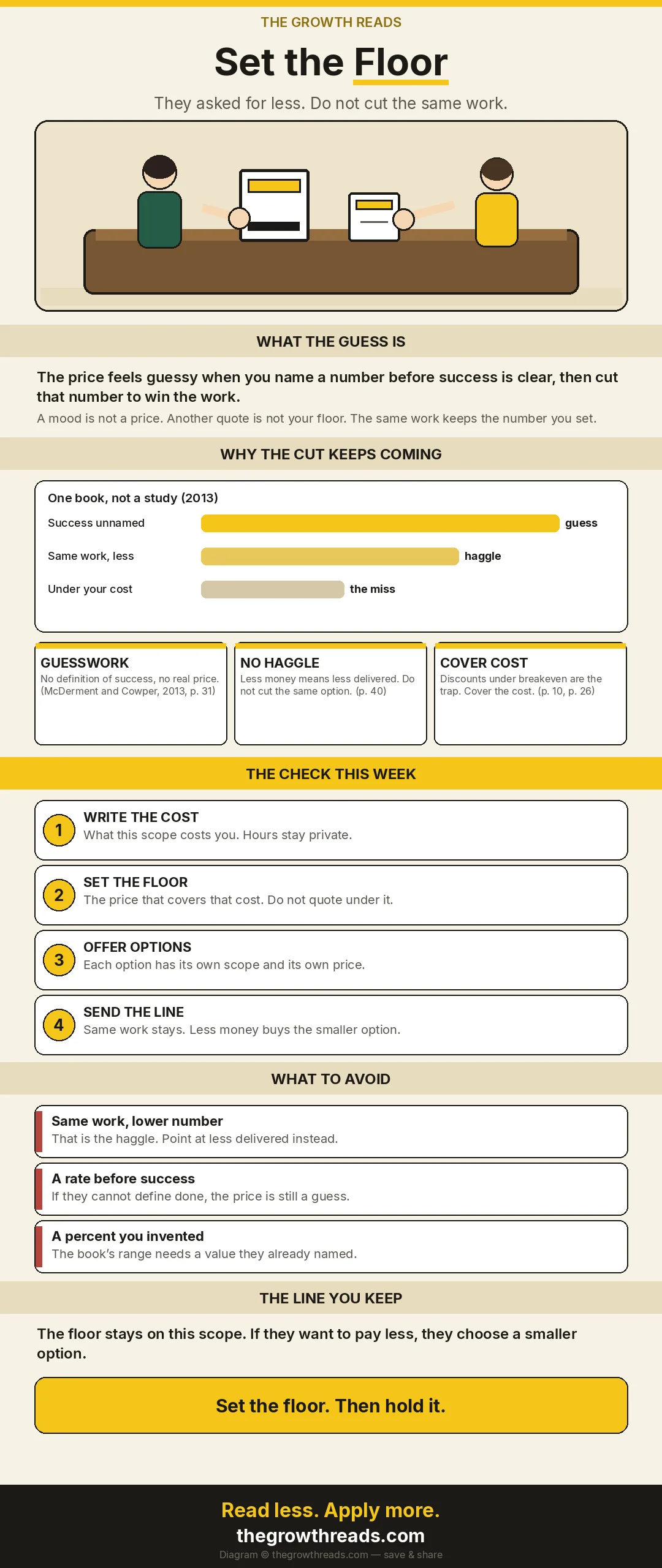
The second failure is the cut after a number exists. On page 10 the freelancer “would often offer discounts, sometimes below his breakeven rate,” because he thought sticking to the rate meant losing the work. On page 13 the people he had discounted refer new prospects who expect similar rates, and he takes the low-paying work because he wants billable hours. The discount does not stay on one invoice. It becomes the rate the next introduction arrives with.
Pages 37 and 38 give the reason a very low number is not a kindness. “Low prices can create the perception of low value.” The picture is a perfectly decent-looking car offered for a thousand dollars, and the thought that something must be wrong under the hood. Matching another quote on the same work teaches them to compare you as a rate. The book’s alternative is to be judged on whether you can deliver the result, which you cannot show if the meeting never got past the number.
Cost, floor, and the smaller option
Three lines, written before you reply. Cost is private. The floor is the price you will not cross for this scope. The smaller option is what you offer when they want to pay less. The book never uses the word floor. We use it so a solo founder or a new manager has one name for the line they keep crossing. The book’s own words are breakeven, covering your costs, and refusing to haggle.
Cost comes first, and it stays on your side of the table. Page 9 shows a cost-plus calculation: business costs and personal costs, the hours he expects to work, a breakeven, then a profit add-on. Those printed rates belong to the character. They are not a fee to copy, and they are not what you say out loud. Page 27 is blunt about why. “Our clients don’t care about our costs. They care about the value we create for them, so that’s what we should be asking them to pay for.” The next sentence keeps the duty: just because they do not care about her costs does not mean she does not. Her job is to create value she can charge for, with fees that more than cover her costs. The same page asks whether a client should be asked which of two lifestyles they want to support, when two people deliver the same service and their hourly rates track how they live. The answer in the book is no. Your rent is your problem. Covering it is also your problem.
Page 26 is the cost check in one line. She still has to make sure she can cover her costs, including in a month where one client takes more time than the fee suggests. The hours are how she notices that. They are not the price. Later in the book the freelancer keeps tracking hours only to manage time and to scope the work, after he has stopped selling the hour.
| They said | What you write first | What you do not do |
|---|---|---|
| What’s your rate, before we talk? | You need to understand what they want before you set a price (p. 30). If they cannot define success, it is still guesswork (p. 31). | Do not invent a precise fee so the silence ends. A range, if you give one at all, is the rare case she resists. |
| Can you do the same thing for less? | This option stays at its price. Less money means a smaller option with a named piece removed (p. 40). | Do not haggle the same scope. Do not match another quote on the same work. |
| We will pay in full this week if you sharpen it. | The book’s only named exception is a discount related to getting paid quicker (p. 64). Name the date. The work stays the same. | Do not leave the amount vague, and do not reuse that exception for a competitor, a nonprofit line, or a fear of losing them. |
| The budget is real, and it is under the floor for this scope. | If the objectives do not warrant the investment, say there is not much reason to go ahead (pp. 32–33). Or drop scope until the price covers the cost. | Do not discount under the cost you already wrote down (p. 10). |
The smaller option is how “less delivered” becomes a thing they can choose. Page 33: she rarely gives a price at the end of the first meeting, and only for small jobs. She goes away and writes a proposal. The proposal outlines the scope and includes some options, each with its own value and price. Page 40 is the rule on the menu. “I won’t haggle on price. If a client wants to pay less, they have to choose to have less delivered.” The choices sit at various depths. A yes-or-no on a single price, she says, is more likely to become a no than a choice between options. You are not adding options so you can negotiate. You are adding them so the trade-off is visible and the original price does not move.
There is one percentage in the book, and it is easy to misuse. On page 45, after a client has already described the value they expect, she says the fee she charges will often range from 10% to 20% of that expected value, and usually the difference has to do with the risks involved. That is one character’s practice in a fable, after the value has been named. It is not a study, and it is not a rate card. If you put 10% on a number you invented, you are back in guesswork. If the math lands under the floor for the scope required, you do not close the gap with a discount. Pages 32 and 33 already have the move: when the objectives do not warrant much investment, she says there is not much reason to pursue the working relationship.
The sentence you send
Send one note. Keep this option’s price. Point at less delivered, or at the single exception for faster payment. Then stop. These lines are our application of pages 40 and 64. They are not quotations. Replace the brackets. Leave the shape.
When they want the same work for less
This option stays at [price]. If you need to spend less, the smaller option drops [named piece] and the price is [lower price]. I don’t reduce the price of the same work. Tell me which option you want.
Only when the cut is for getting paid quicker
I can take [amount] off if the full fee arrives by [date]. The work stays the same. After that date the price is [original price].
Then stop typing. A second paragraph that apologises, mentions a competitor, or offers to “do it for less this once” is the haggle. If you do not want the faster-payment exception, do not send the second sentence. The book does not require it, and it does not name the amount or the number of days. Page 64 only records that he tried to follow the advice not to discount unless it was related to getting paid quicker, and that the other exceptions left him feeling underpaid.
If you are a new manager, this is the note you send. A report can draft the two options beside you. They do not offer a lower number for the same scope on the thread. The price stays with the person who owns it, which is the same line as the decision you do not hand off. If the ask is not a lower price but more work than the price already covers, that is a different reply: sort what is in and what is a change, as in the scope note. Do not hide a discount inside that sort.
How to set the number before you send it
Do the checklist before the reply, including when they are waiting. Six moves. None of them is a new brand exercise.
- Write the scope in one line: what will be true when this option is done, in their nouns. If you cannot, you are not ready to price it. Page 31 calls that guesswork.
- Write the cost of delivering that scope. Include what it takes to do the work, not a lifestyle you hope they will fund. Keep the hours as your scope check. Do not put an hourly rate in the note.
- Write the floor: the lowest price at which this scope still covers that cost, with the margin you need so one slow month does not wipe the job. You will not quote under it. Page 10 is what happens when you do.
- If they have named a value you can check, you may test a price against it. The book’s range on page 45 is often 10% to 20% of the expected value they stated, and the spread is about risk. If that test lands under the floor, say so. Do not invent the value so the percentage looks neat.
- Write two or three options. Each has its own scope and its own price. The smaller ones drop a named piece. They are not the same work with a shaved number.
- If they ask for less, send the matching sentence. Same work stays. Less money buys the smaller option, or, only if you choose it, a dated cut for faster payment. Then wait.
A price you already sent, before you had this checklist, still stands for the scope you already named. You do not reopen today’s fee because tonight’s floor is higher. You use the gap as the reason the next proposal has a cost, a floor, and options. Page 64 is the turn: he got tired of feeling underpaid, decided the work was worth the prices he set, and held his ground. Clients questioned him less. Many agreed to an option, often the higher one. Confidence in the book is not a tone. It is refusing the exception.
When someone else would discount
If a report is about to say “we can sharpen the pencil,” you still own the floor. Helpful is how a new manager loses it. They want the client to like them, the other quote is sitting in the email, and a small cut feels like teamwork. A cut to the same scope is not teamwork. It spends a price you did not give them authority to spend.
Give them the cost line, the floor, and the two options before they are alone on the thread. They may write the client’s words into the smaller option. They may draft the sentence. They do not send a lower number, and they do not promise the faster-payment cut unless you have already named the date and the amount. The first week is the easiest week to give this away, because a new person has not yet seen what a discount does to the next referral. Page 13 is that lesson: the discounted client introduces the next one, and the next one arrives expecting the same rate.
If they already said a lower number on a call, you correct it the same day, in writing, with the sentence. Silence adopts their number. You do not scold them in front of the client. You restate the option and the price, and you ask which scope the client wants.
Common mistakes
- Quoting a rate before success has a sentence. Page 30 is the refusal. You need to understand what they want before you can set a price. A forum rate is not that understanding.
- Discounting under the cost you already calculated. Page 10 is the freelancer going below breakeven to win the work, and then struggling to pay bills. The floor exists so this move has a name before you make it.
- One price, then a haggle. Page 40 will not haggle. Less money has to buy less delivered. A second email that shaves the same option is the haggle with better manners.
- Ten percent of a number you made up. Page 45 follows a value the client had already put in dollar terms. A percentage without that value is another guess, and it does not cancel the floor.
- Letting the last discount set the next rate. Page 13 is the referral who expects the cut you already gave. The sentence is how you stop inheriting it.
- Using “paid quicker” for every uncomfortable ask. Page 64 limits that exception to getting paid quicker. A nonprofit line, a promise of future work, and a competitor’s quote are not that exception.
- Handing the pencil to someone who wants to be liked. They can draft. They cannot spend the floor. If they already did, you correct it in writing the same day.
What the book does and does not say
The book gives you the refusal and the menu. It does not give you the email, the word floor, or a fee schedule. Breaking the Time Barrier is a business fable. Karen is a character. Steve’s calculator, the car, and the clothing-company proposal are illustrations inside that fable. They are not a survey of what clients pay. We did not turn them into one.
| Source | What it is | What we took | What it does not show |
|---|---|---|---|
| Mike McDerment and Donald Cowper, Breaking the Time Barrier, FreshBooks, Toronto, 2013. Publisher PDF, printed pages 9–10, 13, 26–27, 30–33, 37–38, 40, 45, and 64. | A pricing fable for a small service business. Read for this article. Not a study. | Price after you understand what they want. If they cannot define or measure success, pricing is guesswork. Know your costs and cover them, while the client pays for value, not for your costs. Do not haggle: less money means less delivered, on a menu of options. The stated practice, after they have named an expected value, is often 10% to 20% of that value, with the spread tied to risk. Do not discount, except for getting paid quicker. A price that looks too low reads as low value. Discounts teach the next referral to expect the cut. | The two sentences in the script box. The word floor. A rate you should charge. A percentage to use when they never named a value. A rule for a job whose price you already sent. Those are this article’s application, or they are absent. |
Limit: the mentor is further along than a first year alone, and she says hourly rates can make sense at the very start, before references and a record of impact exist. If that is you, the floor still applies. You may not yet have a value story. You still know what the scope costs, and you still do not quote under that cost to win a client who will introduce the next one at the same cut. The book also says the move takes time. It is not a script you perform once and finish.
Frequently asked questions
What do you do when the price feels guessy?
The price feels guessy when you are about to name a number and you cannot say what success is, or you can and you still mean to cut the number so they say yes. Write what this scope costs you. Write the floor, the price you will not go under for that same scope. Ask what done looks like, and offer options that each have their own scope and price. McDerment and Cowper, on page 31 of the 2013 book, say that if the client cannot define success or measure it, pricing is guesswork. A cheaper number on the same work is the discount that book refuses.
How do you set a price floor?
The floor is this article’s name, not a term in the book. Page 9 runs costs, expected hours, a breakeven, and a profit add-on. Those printed rates are the character’s calculator, not a fee to copy. Page 10 discounts below breakeven. Page 26 says she still has to cover her costs. Page 27 says clients pay for value, not for your costs, and that you still care about the costs. Your floor is the price at which this scope covers the cost you wrote down. You do not quote under it, and you do not read the hourly figure aloud. The note contains the option, not your rent.
What do you say when they ask for a discount?
You say this option stays at its price, and that spending less means a smaller option with a named piece removed. Then you stop. That sentence is our application, not a line in the book. Page 40 says she will not haggle on price, and if a client wants to pay less they have to choose to have less delivered. Do not add an apology or a promise to do the same thing for less this once. The same work keeps the same price. The smaller price still has to clear the floor for the smaller scope, not for the scope you just removed.
Should you charge 10 to 20 percent of the value?
Only as a test, and only after they have named the value. On page 45 the mentor’s fee often sits between 10 and 20 percent of that expected value, and she says the spread usually has to do with risk. That is one character’s practice in a fable, not a study or a rate card. Do not put 10 percent on a number you invented. If the test lands under your floor, pages 32 and 33 say the objectives may not warrant the investment. Reduce the scope or decline. Do not discount the same work to close the gap.
What if they want your rate before the conversation?
You do not have a price yet. On page 30 she needs to understand what they want before she can set a price. If they are desperate she might give a range, and she resists even that. Prospects who focus on price immediately often turn out, in the fable, to be the client you do not want. Page 31 adds the test: if they cannot define success or how they will measure it, pricing is guesswork. Tell them you need that picture. Do not invent a precise fee to end the silence, and do not treat a copied rate as the conversation you skipped.
What if someone on your team offers a discount?
You correct it the same day, in writing. They can draft the options and sit in the meeting. They do not tell the client the same work is available for less. Give them the cost, the floor, and the sentence before they are alone on the thread. The price stays with the person who owns it. If a lower number was already spoken, restate the option and the price and ask which scope the client wants. Silence adopts the number they offered. A helpful cut to the same scope is how the floor stops meaning anything.
When is a discount actually allowed?
The book names one case. On page 64 he tries not to discount unless the cut is related to getting paid quicker, and he feels underpaid when he makes another exception. The book does not give the amount or the number of days. If you use that exception, write the date and the reduced figure, and keep the work the same. After the date, the original price returns. A competitor’s quote, a nonprofit line, or a promise of later work is not that exception. Do not borrow the faster-payment sentence for those asks.
What if you already sent a guessy price?
Honour it for the scope you already named. Do not reopen today’s fee because tonight’s floor is higher. Use the gap as the reason the next price has a cost, a floor, and more than one option. If they now want more work than that price covers, sort whether the ask is in the price or a change, and do not hide a discount in that reply. If they want the same work for less, page 40 still applies: less money means less delivered, and only if the smaller price covers the smaller cost. The number you already sent still covers the work you already described.
Sources
- McDerment, M., and Cowper, D. (2013). Breaking the Time Barrier: How to Unlock Your True Earning Potential. FreshBooks, Toronto. Copyright 2013 FreshBooks. Read from the publisher PDF: pages 9–10 (cost-plus, then discounts below breakeven), 13 (referrals who expect the discount), 26–27 (cover your costs; the client pays for value, not your costs), 30–33 (understand what they want before a price; guesswork when success is undefined; options, each with its own value and price), 37–38 (a low price can read as low value), 40 (no haggling; less money means less delivered), 45 (often 10% to 20% of an expected value the client has named; the spread is risk), and 64 (do not discount unless it is to be paid quicker). The script and the word “floor” are not in the book.
Related reading on The Growth Reads
The decision next to this one
- More than the price — they asked for more work, not a lower number. Sort in or a change.
- You are the bottleneck — the price stays with you, including this reply
- The first hire, week one — a new person does not spend the price
Where this sits
How this article was researched
The rules are from the 2013 FreshBooks edition of Breaking the Time Barrier, read as the publisher PDF for this article: price after success is defined, cover your costs, do not haggle a price, trade less money for less delivered, and treat a faster payment as the only discount the story allows. The checklist, the word floor, and the two sentences are our application for a solo founder or a new manager. We did not add a fee, a survey, or a study. The dollar figures inside the fable stay in the fable.
Limit: the book is a teaching story about a designer who already has a record of impact. If you are earlier than that, you still write the cost and you still refuse to quote under it. You do not pretend the book contains your email or a percentage for a value the client never stated.
How we work: every article on The Growth Reads is built from books we have read and from primary accounts we can check, and it is date-stamped when those sources change. Read our methodology.