

★★★★☆ 4/5 — Use it when a client asks for more than the price. The small invoice is the one that snaps the relationship. Do not use it as a script generator.
Best for: a solo founder or a new manager who has to answer an extra that the price did not name.
Reading time: the charge-more proclamation is a short sitting. The 2010 hardcover is 144 pages.
Difficulty to apply: moderate. The sort is simple. Sending one sentence and waiting is the work.
The Win Without Pitching Manifesto in one minute
If the result is the same, do the work and do not send a new invoice. If the result is new, name a price and wait. Blair Enns’s 2010 book is twelve proclamations for a firm that sells ideas. The one that matches this ask is We Will Charge More. The smallest invoices annoy clients most, and a change order builds resentment until the relationship snaps. A higher price is how you stop invoicing every small tactical surprise. A different result is later work, and he says you may price that on its own.
Key takeaways
- The small bill is the dangerous one: firms are not fired over large invoices for strategic work. They are fired over small invoices for tactical work.
- The change order snaps it: that invoice is what builds resentment until the relationship breaks.
- Charge more, earlier: a higher price buys time to think and removes the need to invoice changes and other surprises.
- Round numbers, through the first deliverable: price that stretch in figures that end in zero, so the price is not an hour count.
- Reapplication can be priced: the work that follows the first deliverable is the part he says you are free to charge for, including by the hour.
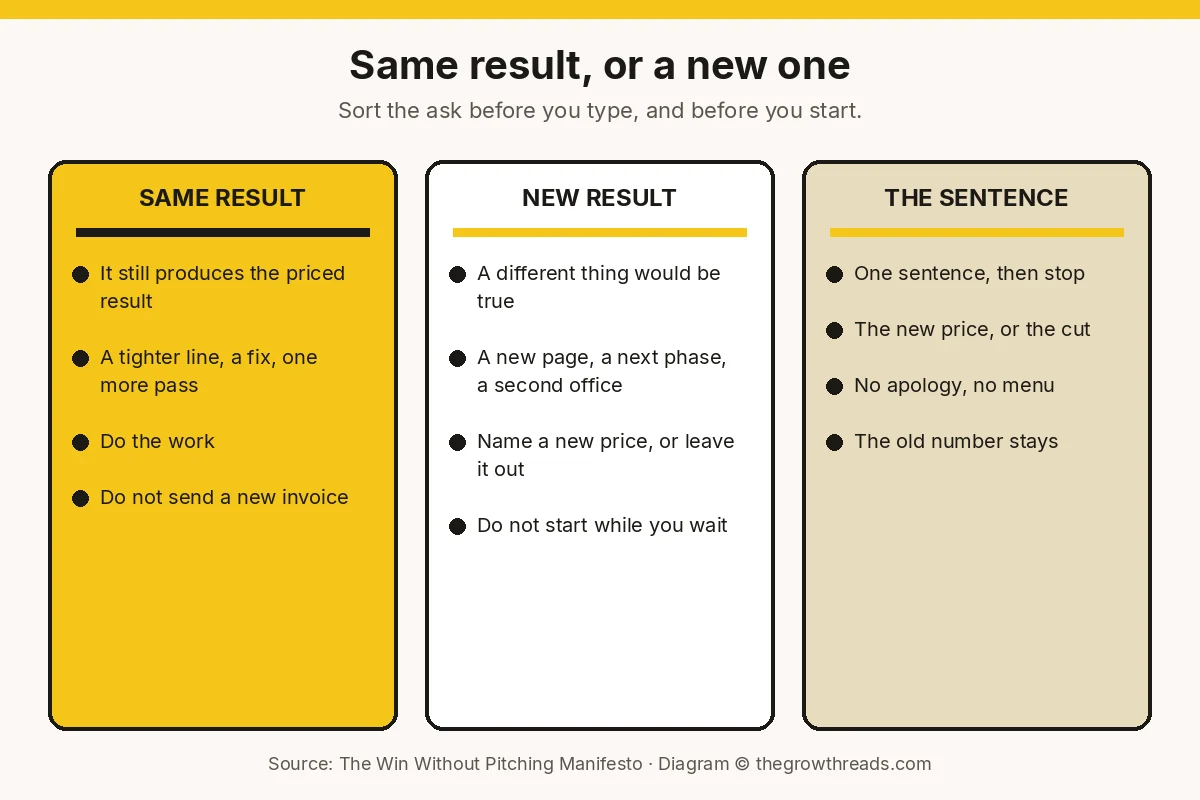
- Same result stays in: a tighter line, a fix, another pass on the thing you sold. Do it. Do not bill it again.
- A new result waits: a new page, a next phase, a second office. One sentence. The new price, or the cut. Then stop.
- Do not solve it before you are paid: there is a line between proving you can do the work and doing the work. The extra does not cross that line while you draft.
What is The Win Without Pitching Manifesto about?
The Win Without Pitching Manifesto is Blair Enns’s 2010 book of twelve proclamations for people who sell ideas. For a client who asks for more than the price, We Will Charge More says to keep a small tactical change inside the price and to price a new result on its own.
About the author
Blair Enns founded Win Without Pitching and writes for firms that sell expertise rather than hours. His site describes him as the author of this manifesto, of Pricing Creativity, and of The Four Conversations. The 2010 hardcover, from RockBench Publishing Corp. in Nashville, is the book in the buttons below. It is written to owners of independent creative businesses, and he says anyone who sells ideas or advice will find the proclamations relevant. This review uses the first edition, ISBN 9781605440040, 144 pages, dated 6 July 2010 in the Open Library record. We quote only lines that a published chapter summary and a reader’s notes both reproduce, and we do not add page numbers. Explore all Blair Enns book summaries →
Key concepts at a glance
| Concept | What it means | Use it when |
|---|---|---|
| Smallest invoices | The small tactical bill annoys more than the large strategic one, and it is the one that gets the firm fired. | You are about to invoice a tweak. |
| Change order | That bill builds resentment until the relationship snaps. | The client was fine until the extras started arriving as invoices. |
| Charge more | A higher price creates time to think and removes invoices for changes and surprises. | You are pricing the next engagement, not reopening this one. |
| First deliverable | Price the work up through the first creative deliverable in round numbers that end in zero. | The price still sounds like an hour count. |
| Reapplication | Work after that first deliverable is the part he says you may charge for, including by the hour. | The ask is a different result. |
| The line before you are paid | Proving you can solve it is not the same as solving it. Do not cross that line before you are engaged and paid. | The “quick extra” is unpaid strategy. |
| Talk about money | People who cannot discuss money are not in a position to do the work. | You are starting the extra while you look for a polite moment. |
The small invoice is the one that snaps
In the proclamation he titles We Will Charge More, Enns is talking to a firm that still wins work and then nickels the relationship. His claim is specific. To the client, the smallest invoices are the most annoying. Charging more creates time to think on the client’s behalf and removes the need to invoice changes and other surprises. Firms like his are not fired over the large invoices for strategic work. They are fired over the small invoices for tactical work. The line he uses for the mechanism is short enough to keep: “It is the change order that creates the resentment that builds until the relationship snaps.”
That is the morning problem, seen from the invoice. A client asks for one more round, another page, the other office. A solo founder loses the week. A new manager spends someone else’s week on a number they still own. The book’s warning is what happens if you then send a small bill. The relationship does not break on the original fee. It breaks on the change order.
Price the first deliverable so surprises are not invoices
The remedy in that same proclamation is not a clever clause. It is a higher price, set before the work, for everything up through the first creative deliverable. He wants that figure in big round numbers that end in zeros, so it is obvious the price has little to do with the hours. The point of the zeros is the signal. An hour grid invites an hour argument every time the work wiggles. A round price for a named result can include the wiggle.
On an engagement you have already closed, you do not reopen today’s number because a tweak arrived. Charging more is how you price the next one. Today, a surprise that is still the same result is the thing a higher price was supposed to swallow. You do the work. You do not send the small invoice. A thin original price is a lesson for the next proposal, not a reason to bill the comma.
He pairs this with an earlier line, in the proclamation about not solving problems before you are paid. There is a line between proving you can solve the client’s problem and actually solving it. You do not cross it before you are paid. A policy he states plainly is that the firm does not begin to solve a client’s problem before it is engaged. A “while you are in there” that is really a new diagnosis is on the unpaid side of that line. You do not wander across it to be helpful.
A new result is not a surprise
After the first creative deliverable, the reapplication work that follows is work he says you are free to charge for, including by the hour. A small tactical change inside the priced result is the surprise you stop invoicing. A new result is reapplication. It is not a surprise you must comp, and it is not a tiny bill for what is actually another project.
The sort is ours. It is the application in the morning article, not a sentence from Enns. Write the result the price bought, in one line a stranger could check. Put the ask beside it.
- Same result. “Tighten the headline on the page we priced.” “Fix the error in what we delivered.” “One more pass on that section.” You do it. You say it stays inside the price. You do not attach an invoice.
- New result. “Also the careers page.” “Add the other office.” “A second phase.” You do not start. You name a new price, or you leave it out and finish the original result.
“While you are in there” is not yet either. Ask what would be true when the extra is done, and sort that sentence. If you never wrote the result down, reconstruct it from the note where you named the price. Do not invent a wider result after the ask arrives, and do not invent a narrower one so you can bill a tweak.
Say the money, then wait
Enns treats silence about money as a disqualification. People who cannot discuss money cannot be the ones who do the work, and people who cannot talk about it do not make it. Taking even half the projects that show up, he warns, builds a tactical firm of too many small clients. Say yes to every adjacent request and you have built that firm inside one account.
So the reply is one sentence, and then you stop typing. These lines are our application of the in-or-change cut. They are not a quotation. Replace the brackets. Leave the shape.
Same result: That stays inside the price. The result is still [the one line], by [the date]. I will do this as part of it.
New result: That is a different result from the one this price covers. I can add it for [amount], or we leave it out and finish [the original result]. Tell me which you want. I will not start the extra until you do.
A second paragraph that apologises, discounts the original number, or offers to throw it in this time undoes the sentence. If you are a new manager, you send this note. A report can collect the client’s words. They do not spend the price. If the client does not reply, the original result is still the job.
Who is The Win Without Pitching Manifesto best for — and who should read something else first?
Read this if you sell a result to a client and an extra just arrived. The charge-more proclamation is the part that matches that problem. The rest of the book is a stance for winning the work without giving the thinking away first. You do not need the whole stance to answer this afternoon’s note.
Read Essentialism first if the problem is a whole client who is a bad fit, not one ask on a good engagement. Read Built to Sell if the price is guessy because the service is still a custom pile and you need a product, not a sentence. Read The E-Myth Revisited if you are the technician who says yes because the file is open. Read The $100 Startup if you do not yet have an offer with a price on it. This book will not write your rate. It will tell you which invoice breaks the relationship, and which work you are free to price next.
Questions to reflect on
- What is the one-line result the current price already bought, written so a stranger could check it?
- Which ask from the last month was the same result, and did you invoice it anyway?
- Which ask was a different result, and did you start it before anyone chose?
- Does the price you are about to name end in a way that still invites an hour argument?
- Who on your side is about to tell the client the extra is included?
🔥 Ready to sort the ask that is more than the price?
The 2010 hardcover is the edition to buy. The charge-more proclamation is the one to use on the note in front of you.
How to apply The Win Without Pitching Manifesto (7-day plan)
- Day 1 — Open the note where you named the price. Write the result that note described, in one line. If the note was only a number, say so and write the result you are actually finishing.
- Day 2 — List the extras sitting in the thread. Mark each one same result or new result. Do not answer them yet.
- Day 3 — Do one same-result item. Reply with the inside-the-price sentence. Send no invoice.
- Day 4 — Pick one new-result item. Send the change sentence with a real amount or a clean cut. Do not open the file.
- Day 5 — Tell the person who talks to the client which asks they may not accept. The price stays with you.
- Day 6 — If they have not chosen, finish the original result. Leave the extra out of the file.
- Day 7 — Write the next price as a round number for one result, with the small fixes inside it. Do not reopen the job you just closed.
Frequently asked questions
What do you do when a client asks for more than the price?
Write the result that price already bought, in one line, before you answer. If the ask still produces that result, do the work and do not send a new bill. Enns treats that small tactical invoice as the one that snaps the relationship. If the ask is a different result, it is later work you price on its own. Send one sentence with the new price or the cut, and do not start until the client chooses. Those sentences are this review’s application. They are not a line from the book. A warm tone does not make a new result free.
Why does Enns say the small invoice is worse than the large one?
In We Will Charge More he says the smallest invoices are the most annoying to clients. Firms like his are not fired over the large invoices for strategic work. They are fired over the small invoices for tactical work. The change order is what builds resentment until the relationship snaps. Charging more is his remedy, because it creates time to think and removes the need to invoice changes and other surprises. That is a claim about the client relationship, not a study and not a percentage. Use it as a reason to keep a same-result tweak inside the price you already named.
What is already included, and what is a new result?
It is included when the ask still produces the result you priced. Another pass on that page, a tighter headline, or a fix to an error in what you delivered are the same result. A new page, a new channel, a second office, or a next phase is a different result, so you price it separately or leave it out. “While you are in there” is not yet either. Ask what would be true when the extra is done, and sort that sentence. If you never wrote the result down, reconstruct it from the note where you named the price.
What sentence do you send for a new result?
Say that the ask is a different result from the one this price covers, that you can add it for a named amount, or that you can leave it out and finish the original result. Ask which they want, and say you will not start the extra until they choose. Then stop. Do not apologise, do not cut the original price in the same note, and do not open the file while you wait. The sentence is this review’s application, not a line from Enns. If they do not reply, the original result is still the job.
What if you already underpriced the job?
You still sort this ask. A same-result tweak stays inside the number you named. A different result gets a new price or a cut. You do not reopen today’s fee because the original guess now feels thin, and you do not pay for that thin guess by absorbing a second project. Enns’s advice to charge more, in round numbers that end in zero, applies to the engagement you have not closed and to the next one. Use this ask as the reason the next price names one result and leaves room for the little fixes. It is not a reason to go silent on this one.
Which edition is this review based on?
This review is based on the 2010 first edition from RockBench Publishing Corp., ISBN 9781605440040, 144 pages, with 6 July 2010 as the date on the Open Library record. The Amazon button uses that hardcover. We do not cite page numbers. The sentences in quotation marks are the ones Patricia Reiners quotes in her 2015 chapter summary of the book, under We Will Charge More, and the same sentences appear in a Goodreads reader’s notes. Where a later edition adds a chapter, this review does not describe it. The two reply sentences are our application for a solo founder or a new manager.
What if someone else is about to say yes?
You send the sentence. They can write the client’s ask in the client’s nouns, and they can draft the reply beside you. They do not tell the client the extra is included, and they do not invoice a tweak. The price, and any change to the promise, stays with the person who owns it. A new hire in week one is the most likely person to say yes in order to be helpful. Give them the one-line result before they are on the thread alone. Enns’s point is that a firm which cannot talk about money is not in a position to do the work.
Related summaries
- Essentialism summary — when the whole client is the no, not one ask
- Built to Sell summary — when the offer is still a custom pile
- The E-Myth Revisited summary — when the technician says yes because the file is open
- The $100 Startup summary — when you still need an offer with a price
- Best productivity books