

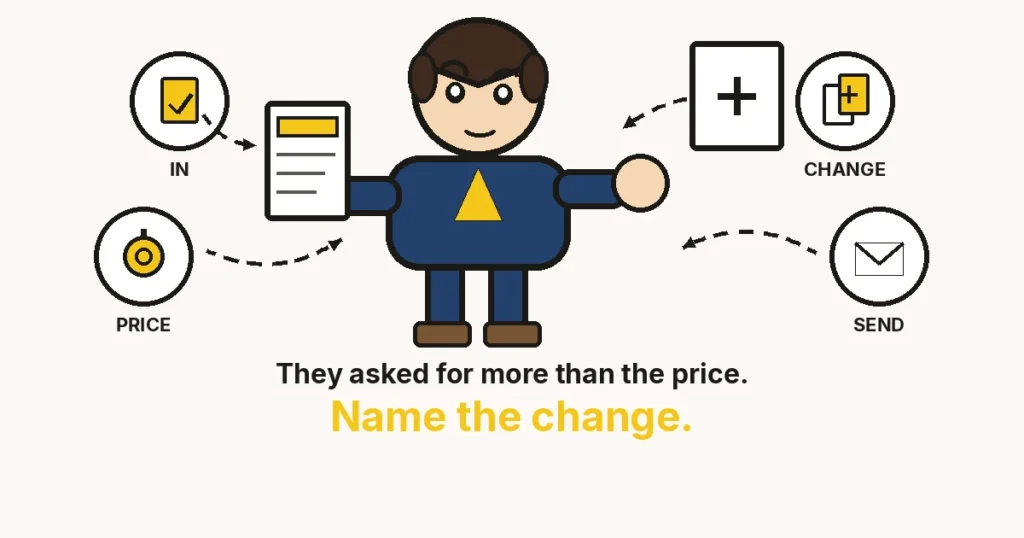
A client asks for more than the price covers when the new request is not the result you sold. Write that result in one line. If the ask still produces it, the work is in and you do it. If the ask is a different result, send one sentence with the new price or the cut, then wait.
Key takeaways
- A client asks for more than the price when the new request is not the result that price already bought.
- Blair Enns, in the 2010 Win Without Pitching Manifesto, writes that firms are fired over the small invoices for tactical work, not the large invoices for strategic work.
- In that same section, the change order is what builds the resentment until the relationship snaps.
- A small move that still produces the priced result stays in. You do the work, and you do not send a new invoice for it.
- A different result is a change. Name the new price or the cut, and do not start until the client chooses.
What the ask actually is
The problem is not that the client is rude. The problem is that a new request arrived and the price you already named does not say whether it is included. It shows up as a short note. “Can we also do the landing page.” “One more round, while you are in there.” “Add the other office.” You are a solo founder, so the yes comes out of your week. You are a new manager, so the yes comes out of someone else’s week and still lands on the number you own. Either way, the work starts before anyone has said what changed.
People call this scope creep. The useful cut is narrower. Write the result the price bought, in one line a stranger could check. Then put the new ask next to that line. Same result, or a different result. That is the whole decision. A mood, a relationship, and how busy the file already is are not the test.
Why the small invoice snaps the work
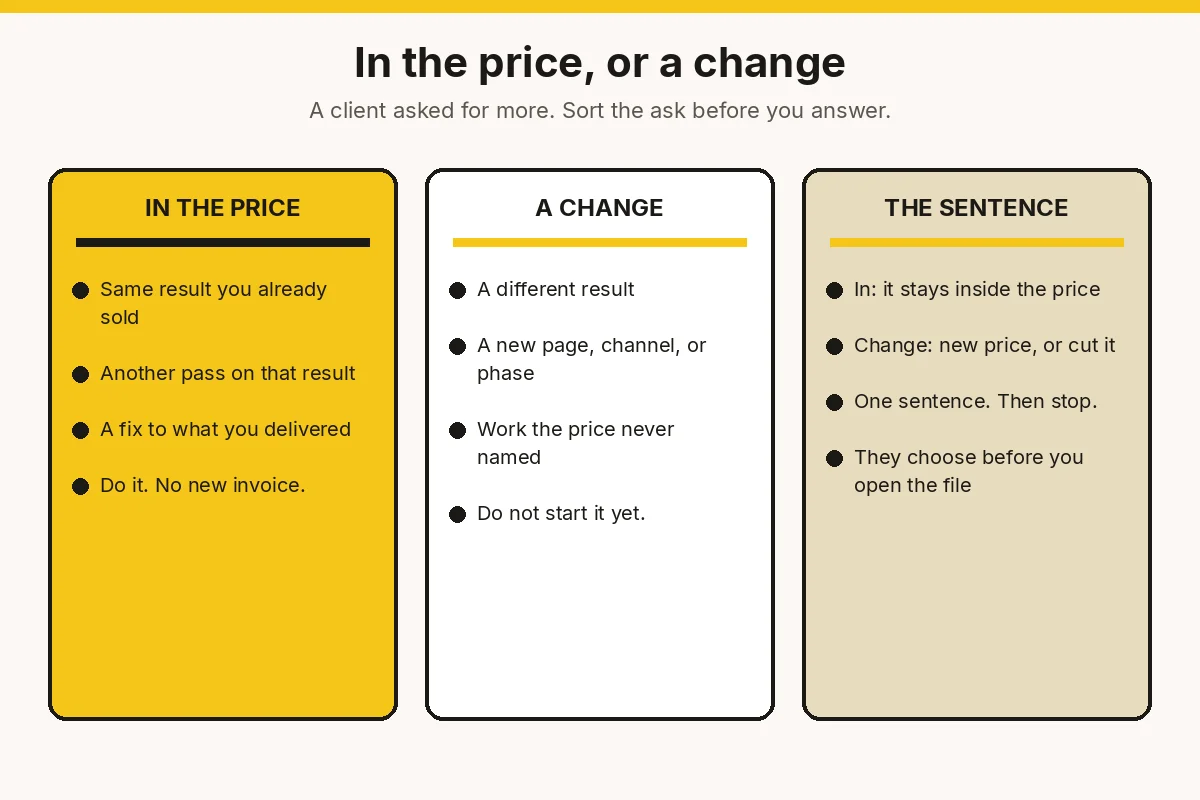
A new invoice for a small tactical change is how a decent client relationship turns sour, even when the extra work was real. Blair Enns, in the first edition of The Win Without Pitching Manifesto (Rockbench, 2010), calls the change order most of what is wrong with the business model and the client relationship. The line is specific. Firms like his “are not fired over the large invoices for strategic work; they are fired over the small invoices for tactical work.” The change order “creates the resentment that builds until the relationship snaps.”
His remedy for a firm that can still price the engagement is to charge more and take control, so the client is spared “a new invoice every time a small tactical change is requested.” The paired promise, earlier in that proclamation, is that you are paid well and in exchange you make the little problems go away. A comma, a second pass on the thing you already sold, a fix to your own delivery: those are the little problems. They are not a new sale.
What is in, and what is a change
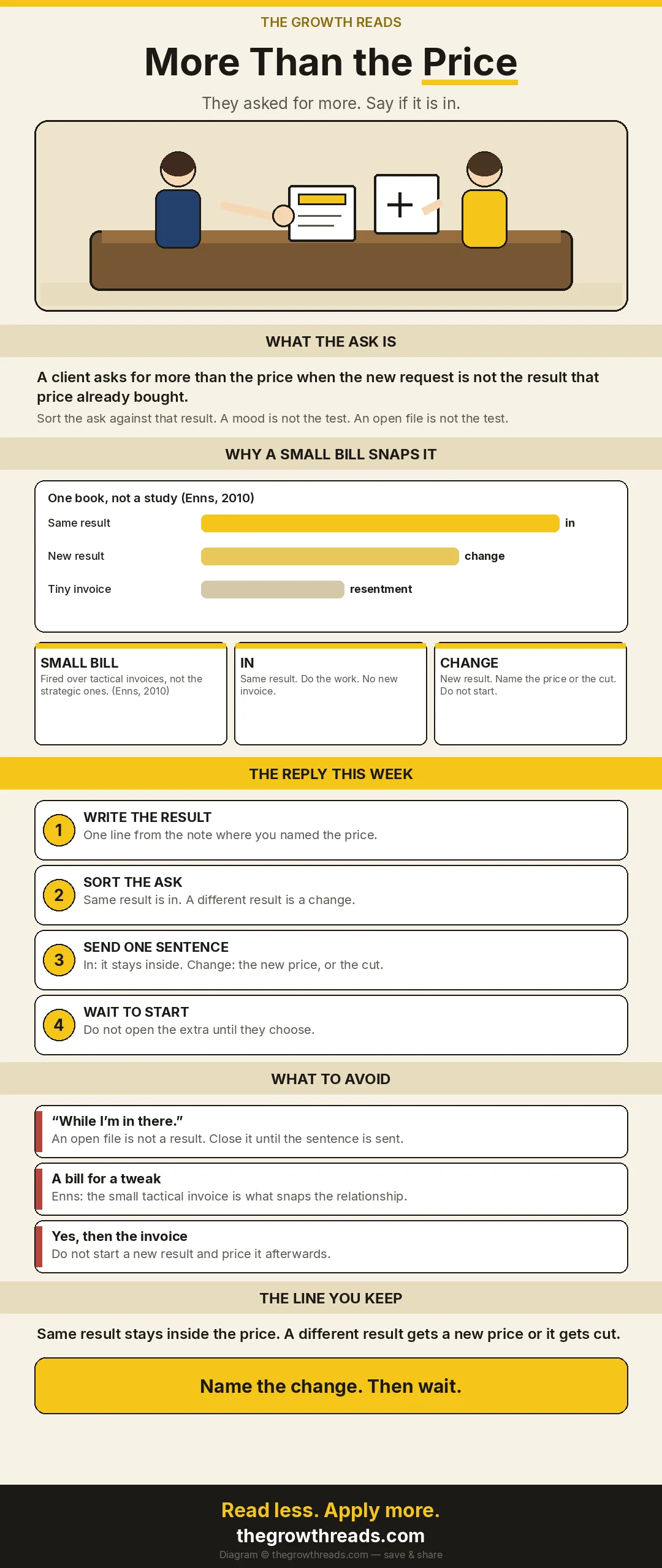
It is in when the ask still produces the result you priced. It is a change when the ask is a different result. Use the line you wrote. “A homepage that states the offer, the proof, and the next step, live by Friday” is a result. “Also the careers page” is a different result. “Tighten the headline on the homepage” is the same result. “A second round of wording on that headline” is still the same result. “A brand film” is not.
| The client said | In the price | A change |
|---|---|---|
| Another pass on the page, the deck, or the deliverable you already named | Yes. The result did not move. Do it. No new invoice. | No |
| Fix an error in what you delivered | Yes. Enns’s “little problems” stay inside a price that was high enough to include care. | No |
| A new page, a new channel, a new office, a new phase | No | Yes. Different result. New price, or leave it out. |
| “While you are in there,” with no result attached | Not yet. Ask which result it serves. Do not start on the phrase. | If they name a new result, yes |
The agreement Enns describes is the scope of work, the timeframe, the budget, and the basic terms, reached in conversation before the paper. If you never wrote the result down, you do not get to invent it in the client’s favour or in yours after the ask arrives. Write the line you would have signed, from the note you actually sent, and sort against that. If the note you sent was only a number, say so in the reply and name the result now. Do not pretend it was always obvious.
The sentence you send
Send one sentence for the path you chose. Do not send a menu, and do not start the extra while you draft. These lines are our application of that in-or-change cut. They are not a quotation from the book. Replace the brackets. Leave the shape.
When it is in
That stays inside the price. The result is still [the one line], by [the date]. I will do this as part of it.
When it is a change
That is a different result from the one this price covers. I can add it for [amount], or we leave it out and finish [the original result]. Tell me which you want. I will not start the extra until you do.
Then stop typing. A second paragraph that apologises, discounts the original number, or offers to “throw it in this time” undoes the sentence. If you are a new manager, this is the note you send. A report can draft it. They do not send a yes. The price, and any change to the promise, stays with you, which is the same line as the decision you do not hand off.
How to decide before you reply
Do the sort before the reply, including when they are waiting on the thread. Five moves. None of them is a new proposal deck.
- Open the note where you named the price. Copy the result, or write the result that note actually described, in one line.
- Write the new ask under it, in the client’s nouns. “Make it pop” is not yet an ask. Ask what would be true when it is done.
- Mark it in or a change, using the table. Same result is in. A different result is a change. If you cannot tell, you are not ready to reply.
- Send the matching sentence. One sentence. No new invoice for an in. No start date for a change.
- If they choose the change, the new price is a new line, not a discount on the old one. If they choose the cut, finish the original result and do not keep the extra in the file “just in case.”
If the original price was a guess and this ask shows it, that is a lesson for the next engagement. Enns’s point about charging more is about the price you set when you still can. It is not permission to reopen today’s number because you feel underpaid. Today you either absorb a same-result ask or you price the new result. You do not do both, and you do not do neither by going quiet.
When someone else would say yes
If a new hire or a report is about to tell the client the extra is included, you still make this call. Week one is the easy place to lose it. They want to be helpful, the client sounds reasonable, and “yes” feels like service. Helpful on a new result is how the price you named stops meaning anything. The first-week scope already keeps the price and the signed promise on you. This ask is that promise, trying to grow.
Give them the one line and the table. They may draft the sentence. You send it, until they have sorted this shape with you and the result they named matched the one you would have written. A title does not carry the cut. The sentence does.
Common mistakes
- Starting because the file is open. “While you are in there” is not a result. Close the file until the sentence has gone.
- A fresh invoice for a tweak. That is the small tactical bill Enns says gets firms fired. If the result is the same, do the work inside the price.
- Absorbing a new result to avoid an awkward note. Awkward is cheaper than a second project you never priced. Send the change sentence.
- Discounting the original price because they asked for more. The original number stays. The new result gets its own number, or it gets cut. A lower number on the old work is a different conversation, and it is not this reply.
- Letting someone else say yes. They can collect the ask in the client’s words. They do not spend the price.
- Writing a new scope document before the one-line sort. If you cannot mark in or change on one line, a three-page rewrite will not know either. Sort first. Expand only if they choose the change.
What the book does and does not say
The manifesto gives you the boundary, not a mail-merge. Enns is writing to creative firms that still have a chance to price the engagement high enough that small tactical changes never become invoices. He is not handing a solo founder a percentage, a script, or a rule that every extra word is billable. We did not add one.
| Source | What it is | What we took | What it does not show |
|---|---|---|---|
| Blair Enns, The Win Without Pitching Manifesto, first edition, Rockbench, Nashville, 2010. Proclamation XI, “We Will Charge More,” and the section “The Death of the Change Order.” | A pricing and positioning book for creative firms. Read for this article. Not a study. | Small invoices for tactical work, not large invoices for strategic work, are what get the firm fired. The change order builds resentment. Charging more, and keeping control, removes a new invoice for every small tactical change. Paid well, you make the little problems go away. The agreement covers scope, timeframe, budget, and terms. | The two sentences in the script box. A rule for a job you have already underpriced. A number for what “more” should cost. Those are this article’s application. |
Limit: if the “small” change is another week of work, it is not the little problem Enns is telling you to absorb. The test is still the result. A new result is a change even when the client is kind, and a same-result fix is in even when you wish you had charged more on day one. A firm that can raise the next price should do that next time. This reply is about the ask in front of you.
Frequently asked questions
What do you do when a client asks for more than the price?
Write the result that price already bought, in one line, before you answer. If the new ask still produces that same result, it is in: you do the work and you do not send a new invoice for it. If the ask is a different result, it is a change. Send one sentence that names the new price or the cut, and do not start until the client chooses. Blair Enns, in the 2010 manifesto, treats an invoice for a small tactical change as the resentment that snaps the relationship. A friendly tone does not make a new result free, and a sharp tone does not make a typo billable.
How do you tell what is already in the price?
It is in when the ask still produces the result you priced. Another pass on that page, a tighter headline, or a fix to an error in what you delivered are the same result. A new page, a new channel, a second office, or a next phase is a different result, so it is a change. “While you are in there” is not yet either. Ask what would be true when the extra is done, and sort that sentence. If you never wrote the result down, reconstruct it from the note where you named the price. Do not invent a wider result after the ask arrives.
What sentence do you send for a change?
Say that the ask is a different result from the one this price covers, that you can add it for a named amount, or that you can leave it out and finish the original result. Ask which they want, and say you will not start the extra until they choose. Then stop. Do not apologise, do not cut the original price in the same note, and do not open the file while you wait. The sentence is this article’s application of the in-or-change cut. It is not a line from Enns. If they do not reply, the original result is still the job.
Should you invoice a small extra?
Not when the result is unchanged. Enns writes that firms are fired over the small invoices for tactical work, not the large invoices for strategic work, and that the change order builds resentment until the relationship snaps. A second pass and a correction are the little problems a sound price already included. You do them, and you do not send a new bill. A different result is not that case. You price it on its own line or you leave it out. Calling a new result “small” so you can avoid the note is how the week disappears.
What if you already underpriced the job?
You still sort this ask. A same-result tweak stays inside the number you named. A different result gets a new price or a cut. You do not reopen today’s fee because the original guess now feels thin, and you do not pay for that thin guess by absorbing a second project. Enns’s advice to charge more applies to the engagement you have not closed yet, and to the next one. Use this ask as the reason the next price names the result in one line and leaves room for the little problems. It is not a reason to go silent on this one.
What if you are a new manager and your report wants to say yes?
You send the sentence. They can write the client’s ask in the client’s nouns, and they can draft the reply beside you. They do not tell the client the extra is included. The price, and any change to the promise you already made, stays with the person who owns it. A new hire in week one is the most likely person to say yes in order to be helpful. Give them the one-line result and the table before they are on the thread alone. Helpful on a new result is how the price stops meaning anything.
What if the client says the extra was obviously included?
Go back to the note where the price was named. If that note described this result, it is in, and you do it without a fight and without a new invoice. If the note described a different result, say so in the change sentence and let them choose the new price or the cut. Memory of a call is a weak place to invent scope in either direction. If the note was only a number, say that plainly, name the result you are finishing, and sort the new ask against that line. Do not match their certainty with a speech.
When should you just do the extra?
When it is the same result, including a fix to your own delivery. That is the work the price was for, and a new invoice for it is the small bill that breeds resentment. Do it, on the date you already gave, and say that it stays inside the price. You should not “just do” a different result because the client is important, because the file is open, or because a new hire already hinted yes. Those are reasons the sentence feels hard. They are not reasons the result changed category. Finish the original line, or price the new one.
Sources
- Enns, B. (2010). The Win Without Pitching Manifesto (first edition). Rockbench Publishing, Nashville. ISBN 978-1-60544-004-0. Proclamation XI, “We Will Charge More,” including “The Death of the Change Order.” Read for this article. No page numbers. The script is not a quotation.
Related reading on The Growth Reads
The decision next to this one
- You are the bottleneck — the price and the promise stay with you, including this reply
- The first hire, week one — three outcomes, and why a new person does not spend the price
Where this sits
How this article was researched
The boundary is from the 2010 first edition of The Win Without Pitching Manifesto, read for this article: small tactical invoices, the change order as resentment, and the trade of a higher price for not billing every small change. The one-line sort and the two sentences are our application for a solo founder or a new manager. We did not add a rate, a percentage, or a study.
Limit: the book is written for a creative firm that can still set the price. If you have already named a thin number, you honour it for the same result, and you price only a new result. You do not pretend the book contains the email.
How we work: every article on The Growth Reads is built from books we have read and from primary accounts we can check, and it is date-stamped when those sources change. Read our methodology.