


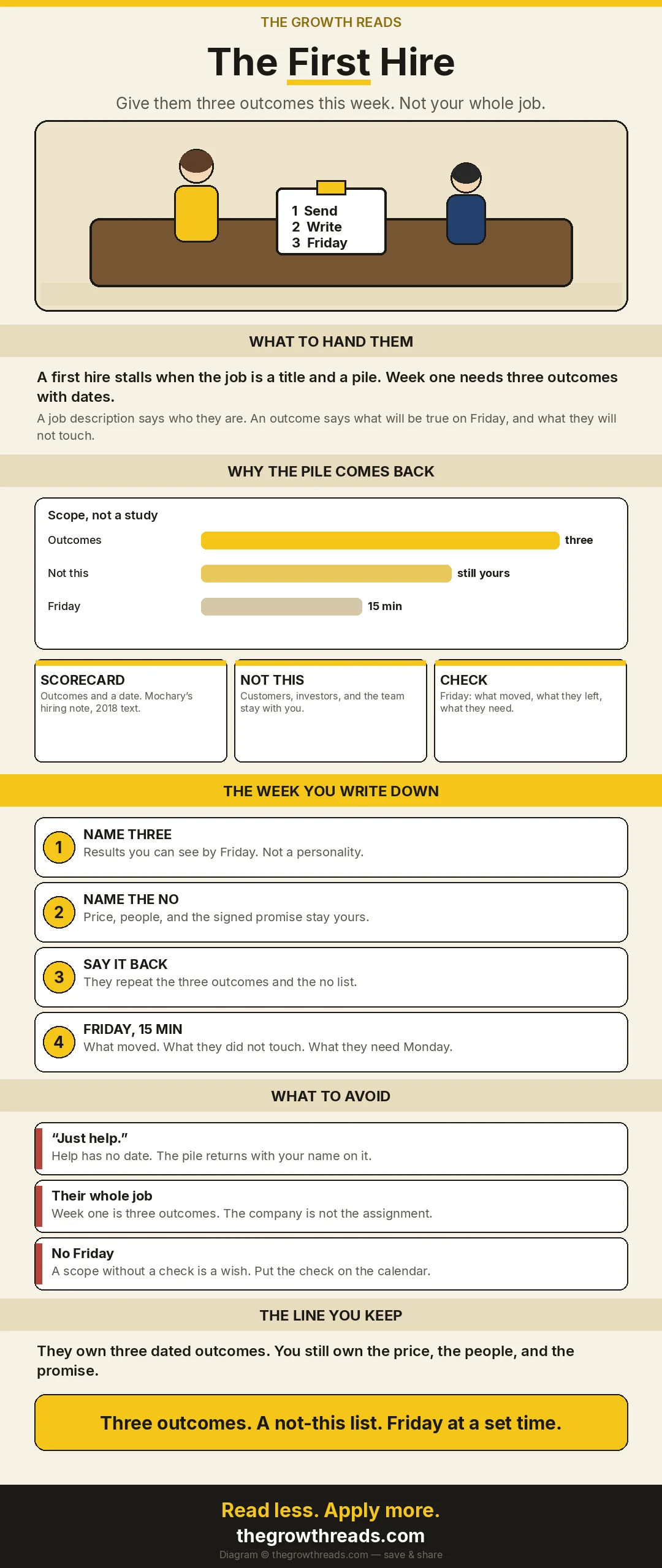
Give a first hire three outcomes with dates, and a list of decisions you are not handing over. A job title does not tell them what “done” is on Friday. Read the three outcomes aloud, have them say the list back, and put a fifteen-minute check on the calendar.
Key takeaways
- Week one fails when the assignment is “help.” Help has no date, so the pile stays on you.
- Write three outcomes you can see by Friday. Each one has a date. They can repeat them.
- Write what you will not assign: the price, who stays or leaves, and the promise you already signed.
- The Friday check is fifteen minutes. What moved. What they left alone. What they need before Monday.
- A scorecard is outcomes plus a date, not a personality sketch. That is the hiring note in Matt Mochary’s 2018 text.
On this page
What week one is missing
You hired someone because work was waiting. Then Monday arrives and the only brief is the job title, a login, and “jump in where you can.” They are capable. They are also guessing. Every guess comes back to you as a question, or worse, as work you have to redo. You are still the bottleneck. The hire did not fail. The scope did.
A solo founder and a new manager hit the same wall. The founder has no second person who already knows the shape of the work. The new manager has a person and a fear of handing them the wrong thing. Both end up keeping the queue. The fix is not a culture speech and not a twenty-page handbook. It is three outcomes, a not-this list, and one check.
Why the job title sends the work back
“Operations,” “assistant,” and “generalist” describe a seat. They do not describe a result. The person can be busy all week and still leave you with the same decisions on Friday. Busy is not the test. The test is whether a specific thing is true that was not true on Monday, and whether you can see it without redoing it.
Matt Mochary’s recruiting note, in the 2018 text of The Great CEO Within, calls the hiring document a scorecard: outcomes and competencies, measurable, with an accomplish-by date. A title is not that document. If you cannot say what will be finished, and by when, you do not yet have a job to give. You have a hope that they will notice what you notice.
The three outcomes
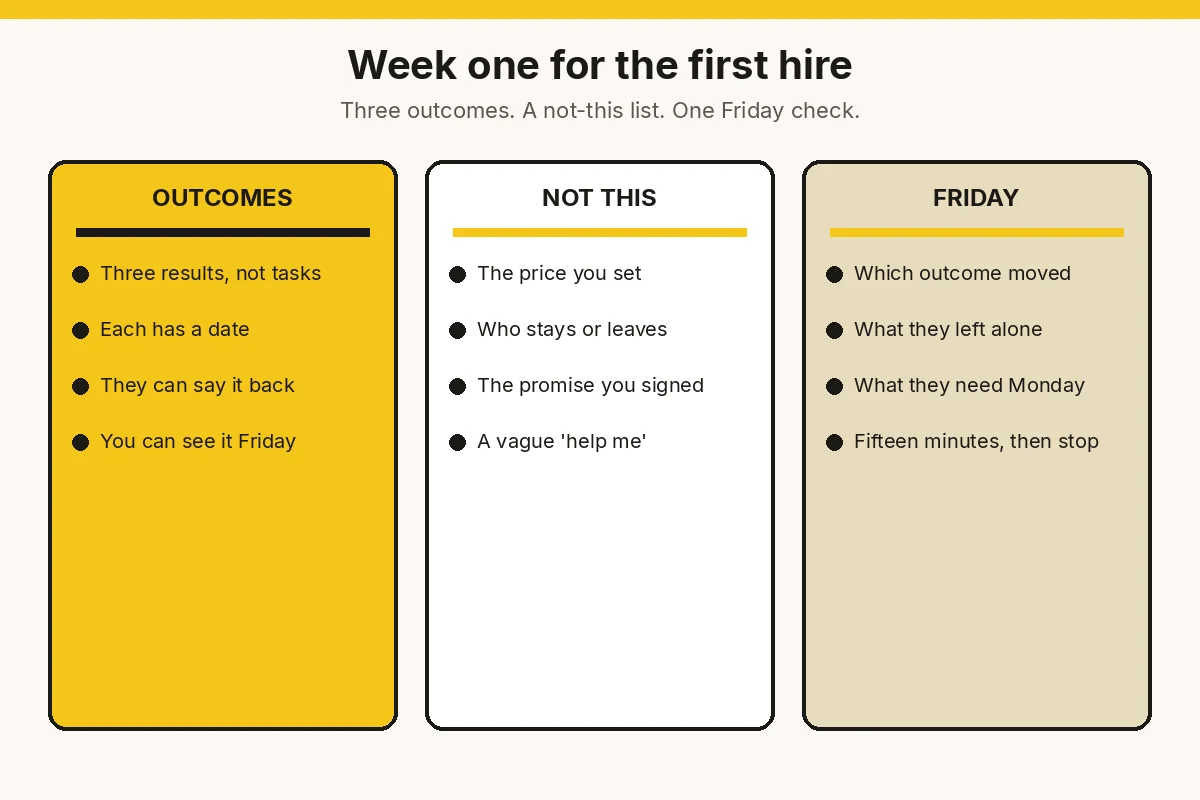
Pick three. Not eight. Eight is the job. Three is the week. Each line needs a verb, a thing someone else could inspect, and a day.
For a first operator sitting next to a solo founder, a clean week looks like this. Change the nouns to your work. Do not add a fourth until Friday.
- By Wednesday: the waiting list is written down. Each item has a name and the date you asked. This is Mochary’s Waiting For list, applied to the pile that was in your head.
- By Thursday: one repeatable task has steps, written the second time it happens, and they have done it once while you watched.
- By Friday: you have both sat for fifteen minutes and named what moved, what they did not touch, and what they need from you before Monday.
Read the three lines to them on day one. Ask them to say the lines back in their own words. If they cannot, the lines are still in your head. Rewrite them until a person who was not in the room could check the result.
What you will not assign
The other half of the scope is the refusal. In the same book’s appendix, a founder’s note on learning to delegate keeps three things off the list: knowing the customers, knowing the investors, and knowing the team. You may use different words. The point is a short no.
For a solo founder or a new manager in week one, write these three as yours:
- The price, and any discount. They can collect the facts. They do not send the number.
- Who joins, and who leaves. They can sit in. They do not decide.
- The promise you already made to a client or to your boss. They can draft. You send it, until they have done that shape before.
Say the no list in the same sitting as the three outcomes. A person who only hears the outcomes will try to be helpful on the price. Helpful on the price is how a first week creates a mess you have to unwind.
The Friday check, in their words and yours
Put it on the calendar when you write the outcomes, not when the week feels busy. Fifteen minutes. Three questions. Then stop.
You: Which of the three outcomes is done, and which is not?
Them: One sentence each. No tour of the week.
You: What did you leave alone on purpose?
Them: They should name the price, the people decision, or the promise. If they cannot, the no list was not clear.
You: What do you need from me before Monday, and by what time?
You, last: I will answer that by [time]. I will not add a fourth outcome today.
This script is our application of a scorecard plus a date. It is not a quotation. If the check turns into a status recital, you lost the week. Bring it back to the three lines.
How to write it before they start
- List the work that is waiting on you. One sitting. Do not design a career path.
- Circle three results a new person could finish by Friday without owning the price, the people, or the promise.
- Write the not-this list under those three lines. Read both lists aloud.
- Have them repeat both lists. Correct the words until you would accept their version as the assignment.
- Book Friday for fifteen minutes. Do not move it to “sometime next week.”
If you cannot circle three results, you are not ready to hand them work. Keep the queue, and use the sitting to decide the items yourself. A hire with nothing true to finish by Friday will invent work, and you will review the invention.
Common mistakes
- “Just help.” There is nothing to check on Friday, so you stay the owner of every item.
- Their whole job in week one. The company is not the assignment. Three outcomes are.
- No not-this list. They will touch the price or the client promise because it looks urgent.
- A handbook instead of a page. Mochary’s rule is the second time you say it, write that thing down. A wiki of everything is how week one disappears.
- Skipping Friday. The scope without the check is a wish. The check is part of the handoff.
The evidence behind this scope
The scorecard line is from Appendix B of the 2018 text: the hiring manager writes outcomes and competencies that are measurable and have an accomplish-by date. The not-this list is from the appendix note that a founder learning to delegate still keeps customers, investors, and the team. We did not add a productivity percentage. Secondary write-ups of a Google manager checklist are easy to find and easy to over-quote. They are not the source of this article.
The same week’s piece on being the bottleneck is the cut for work that is already waiting on you. This article is the next row: what you put in a new person’s hands so that cut has a recipient. Our review of The Making of a Manager is the longer read if the hire is a manager and the first months are about context before you change the team. Do not hand a brand-new helper that job.
Frequently asked questions
What should I give a first hire in week one?
Give them three outcomes you can see by Friday, each with a date, and a short list of decisions you are not handing over. A job title does not tell them what done looks like. Read the three lines aloud and have them say the list back. Book fifteen minutes on Friday for what moved, what they left alone, and what they need before Monday. If you cannot name three results, you are not ready to assign the week.
Why not hand them the whole job?
The whole job is how the queue comes back with your name on it. Week one is a test of scope, not a test of whether they can replace you. Three dated outcomes show whether the words were clear. A vague “own operations” lets them guess, and you spend the week correcting guesses. Add a fourth outcome only after Friday, when you have seen the first three.
What should I refuse to assign?
Keep the price, the decision about who joins or leaves, and the promise you have already signed. They can gather facts and draft. They do not send the number, the offer, or the client commitment until they have done that shape with you watching. Mochary’s appendix keeps customers, investors, and the team with the founder for the same reason. Help on those three is how a first week creates a mess.
What do I say in the Friday check?
Ask which outcome is done, what they left alone on purpose, and what they need from you before Monday, including the time they need it. Answer that ask. Do not add a fourth outcome in the same meeting. If they cannot name what they left alone, the not-this list was unclear and you rewrite it before Monday. Fifteen minutes is the meeting. A status tour means the scope was fuzzy.
What if I am a new manager and they already have a job?
You still write three outcomes for this week and a not-this list. Their old job description is not your assignment. Sit with them on day one, read the three lines, and have them repeat the lines. The Friday check is the same fifteen minutes. You are not redesigning their career. You are making one week inspectable so you are not the person every decision waits on.
What if they cannot repeat the outcomes?
The assignment is still in your head. Rewrite the line until a person outside the room could check it. “Help with clients” fails that test. “The waiting list has a name and a date on each item by Wednesday” passes it. Do not send them off to be resourceful. Resourceful, in week one, means they invent work you then have to undo.
Should the first hire be a chief of staff?
Not from this week’s scope. Mochary describes a chief of staff as someone who sits beside the CEO and slowly takes tasks until the CEO is only doing the work they are uniquely good at. That is a later hire, after you can already name outcomes. Week one for a first helper is three results and a no list. A title that means “be me” puts you back in the queue.
Where does this sit next to handing off one piece?
The bottleneck cut is for work that is already waiting on your say-so: what you still decide, one piece you hand off, and a time you will check. This article is who receives that piece when the person is new. They get three dated outcomes, not your price and not your promise. Use both in the same week if you have just hired. Do not use either as a speech about trust.
Sources
- Mochary, M. (2018). The Great CEO Within (formerly Founder to CEO). Appendix B, recruiting scorecard: outcomes and competencies that are measurable and have an accomplish-by date. Appendix A, the note on what a founder does not delegate. Text read from meirz.net. The 2019 paperback is a later edition. This article does not cite page numbers.
- The Growth Reads (2026). You are the bottleneck. The handoff cut this scope is meant to receive.
Related reading on The Growth Reads
- You are the bottleneck — what you still decide, and the one piece that can leave
- The Making of a Manager summary — if the person is becoming a manager, not a first helper
- The First 90 Days summary — a transition plan, which is a different job from week one
How this article was researched
The scorecard and the not-this list are from the 2018 text of The Great CEO Within, read for this article. The three example outcomes and the Friday script are our application for a solo founder or a new manager. We did not add a ramp-up percentage.
Limit: a funded startup’s recruiting appendix is not a two-person shop. If you have no work a new person can finish by Friday, do not invent an outcome to keep them busy. Decide the waiting items yourself.
How we work: every article on The Growth Reads is built from books we have read and from primary accounts we can check, and it is date-stamped when those sources change. Read our methodology.