

★★★★½ 4.5/5 — OK is a decision. Make it before the next reply.
Best for: Anyone who waits to feel worthy before they speak plainly, and then answers from an old rule or an old feeling
Reading time: ~6 hrs for the Quill edition · ~12 min for this guide
Difficulty to apply: Medium — the labels are simple; catching your own voice in the sentence is not
I’m OK – You’re OK in one minute
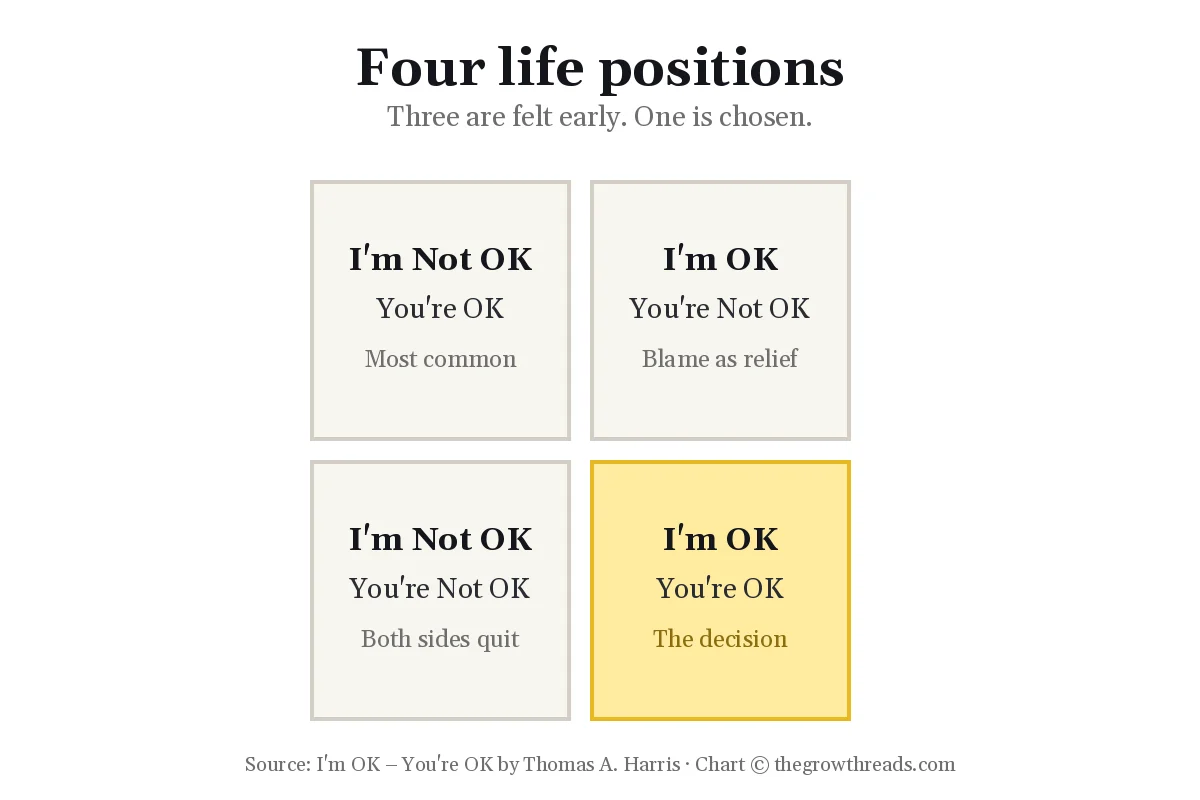
You do not have to feel OK before you treat yourself and the other person as OK. In 1967 psychiatrist Thomas A. Harris put Eric Berne’s transactional analysis into kitchen language. Three recordings sit in every exchange: Parent, Adult, and Child. Most people quietly live in I’m Not OK, You’re OK, the position of a small child looking up at bigger people. The other painful positions are I’m Not OK, You’re Not OK, and I’m OK, You’re Not OK. The fourth one is different. I’m OK – You’re OK is not a mood you wait for. It is a decision the Adult makes, and then a way of answering. The steal: name the voice you are about to use, then send one sentence from the Adult.
Key takeaways
- Three voices: Parent is the copied rule. Child is the old feeling. Adult is today’s fact and the next step.
- The Parent is a tape: “Look both ways” belongs. A sneer from the house you grew up in can be labeled and retired.
- The Child still votes: A small feeling can replay at full volume. Name its age before you obey it.
- The common start: I’m Not OK, You’re OK. Children see adults as capable. That conclusion often stays after you pay the rent.
- Only one position is chosen: The first three are feelings. I’m OK – You’re OK is a decision you can make before the feeling catches up.
- Complementary keeps flowing: The reply matches the voice that spoke. That can be Adult to Adult, or a scolding that gets an apology for years.
- A cross hooks the Child: Words like stupid, should, and ridiculous often arrive before anyone looks. The facts leave the room.
- Contamination: A Parent prejudice or a Child story, spoken in the Adult’s confident tone.
- Keep all three: You want the useful warning, the real joy, and an update when the warning has gone stale.
What is I’m OK – You’re OK about?
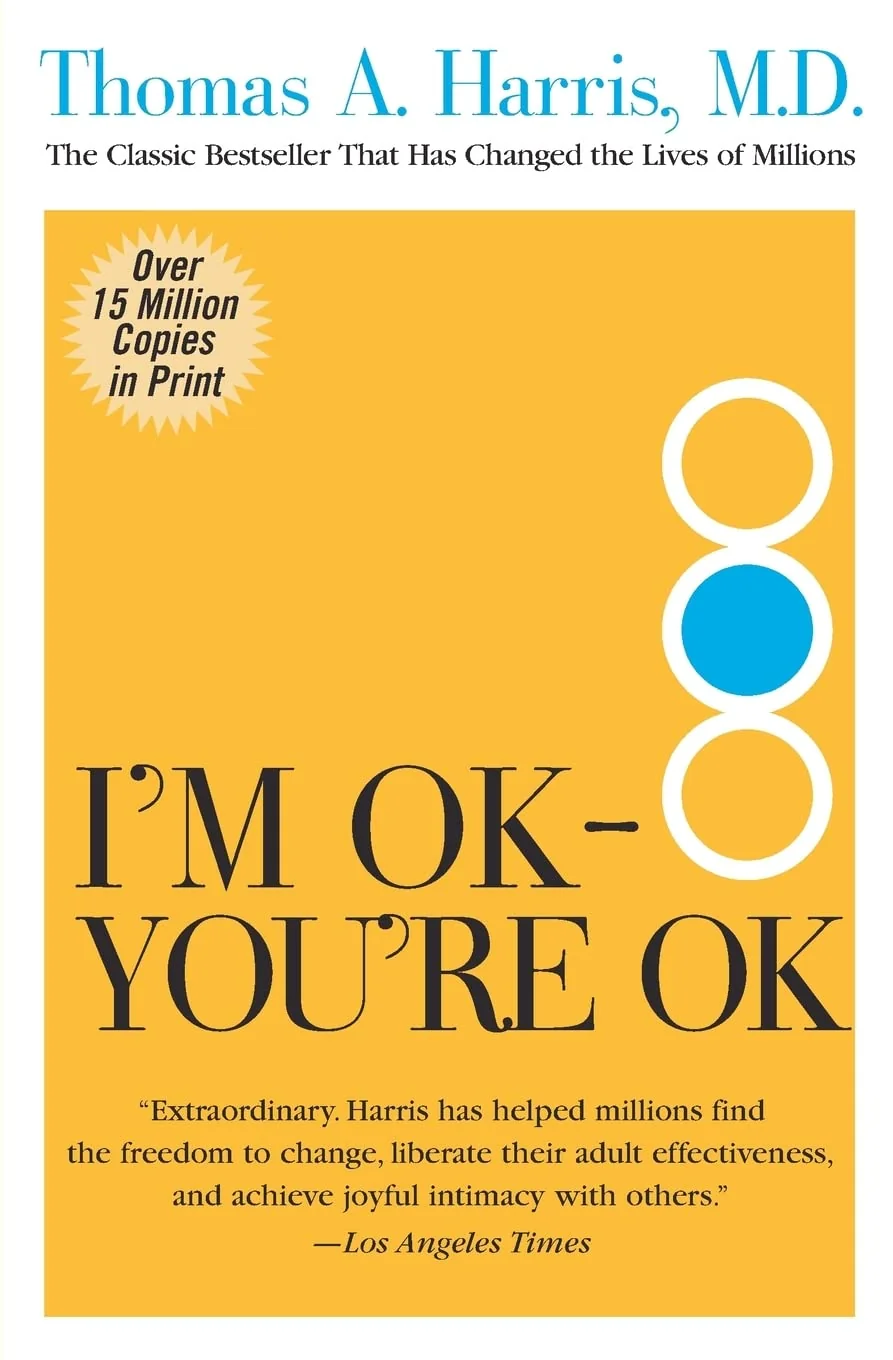
I’m OK – You’re OK is Thomas A. Harris’s plain-language guide to transactional analysis. People switch among Parent, Adult, and Child recordings, and most of us quietly live in I’m Not OK, You’re OK. The useful move is a decision: I’m OK and you’re OK, then speak from the Adult in the next real conversation.
About the author
Thomas Anthony Harris (18 April 1910 – 4 May 1995) was an American psychiatrist who wanted a language people could use on a weeknight. He took a science degree at the University of Arkansas in 1938 and his M.D. at Temple in 1940, then entered the Navy. He was aboard the tender Pelias when Pearl Harbor was attacked, and the blast cost him part of his hearing. Training at St. Elizabeths Hospital followed. He served as chief psychiatric officer on the hospital ship Haven, later led the Navy’s psychiatry branch, and left as a commander in 1954. He then ran Washington state’s Department of Institutions. In 1967 he published this book. It hit the New York Times bestseller list in 1972 and stayed nearly two years. Later publisher counts put sales above 15 million copies. Explore all Thomas A. Harris book summaries →
Key concepts at a glance
| Concept | What it means | Use it when |
|---|---|---|
| Parent | Copied rules and warnings | A “should” arrives before you look |
| Child | An early feeling, ready to replay | You feel suddenly small in a scene that does not match |
| Adult | Today’s check on both recordings | You need the fact and the next step |
| Life position | A standing verdict on worth | Every fight ends at the same score |
| I’m OK – You’re OK | A decision, not a mood you earn | You are about to shrink or to indict |
| Complementary | The reply matches the voice addressed | You want the talk to stay in Adult |
| Crossed | The reply comes from another voice | A plain question just became a fight |
| Stroke | One unit of recognition | You are about to lecture instead of notice |
Part 1: Three recordings are still in the room
Harris wanted a unit small enough to catch in one remark. Berne had named it. Harris walks you there through memory. Wilder Penfield stimulated tiny spots in awake patients’ brains, and some relived a scene instead of reporting it. Harris takes that as a clue that early experience stays hot, then uses Berne’s picture of what those memories do in talk.
The Parent is the outside recording: what adults did and said, stored as the way the world is. “Look both ways” is on that tape. So is “you can never trust a cop,” or a tone that said you were too much. The lifesaving rule and the inherited grudge were filed the same way. The Child is the inside recording made alongside it. A deadline or a silence can press play years later, at the age you were when the tape was cut.
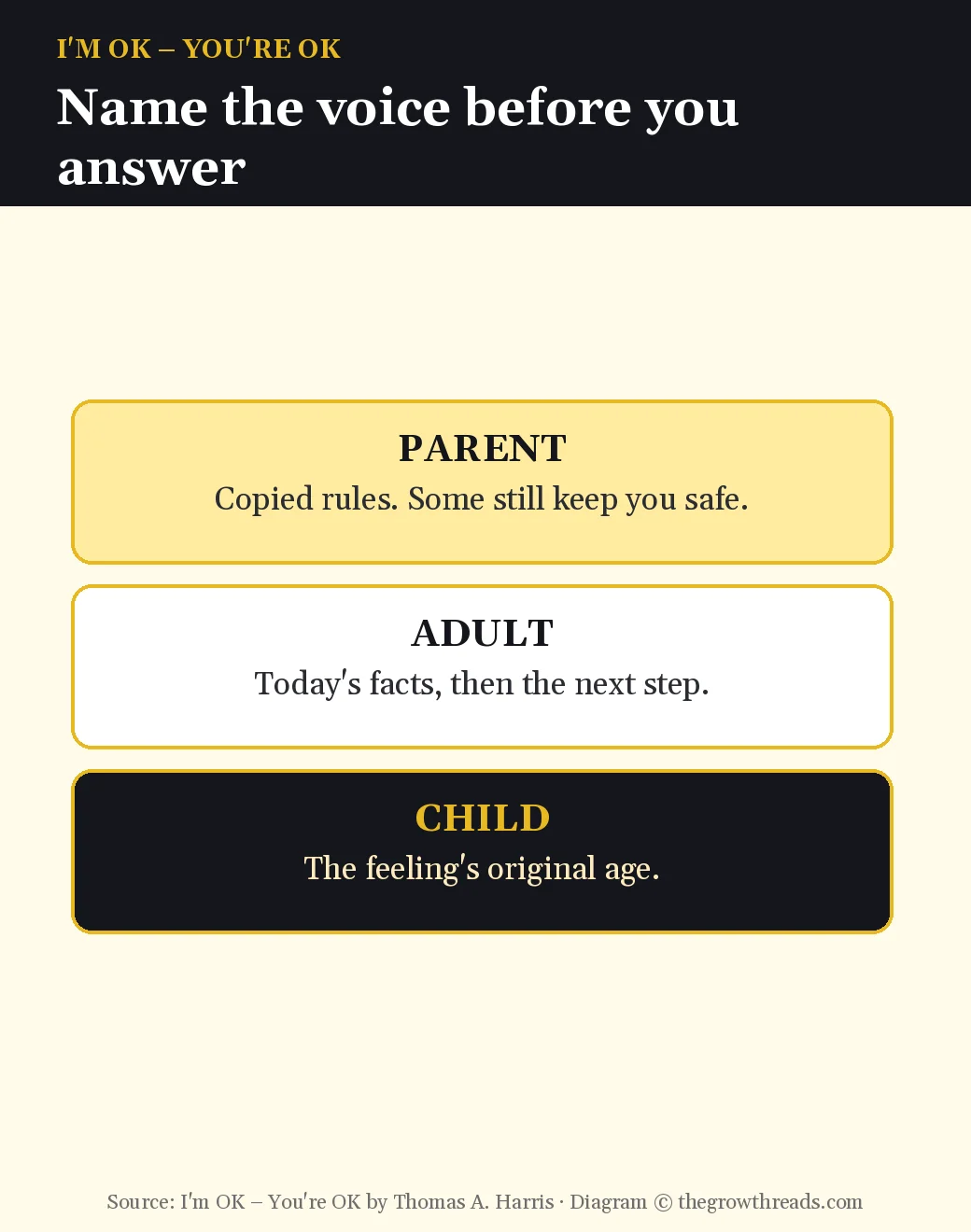
The Adult begins around the time a child walks and tests the room. It checks whether a Parent rule still fits this street, and whether a Child alarm still fits this face. Under stress it goes offline. Harris calls the result contamination: the Adult’s mouth, with Parent or Child writing the script.
Keep the traffic warning. Label the line that calls you ridiculous for wanting something. For one day, after any tense sentence, mark P, A, or C. You are naming the voice that tried to send the text.
TGR Note: Games People Play names the repeating pattern. Stay here for the position under it. Feeling Good is the worksheet when the Child shows up as a thought you can test on paper.
Part 2: Four positions, and only one is chosen
Before this talk, what have you decided about your worth and theirs? Harris names four answers. Only one is a choice.
I’m Not OK, You’re OK is the common one. A child looks up at people who can reach the shelf and concludes: they are OK, I am not. That fits a four-year-old. It is a poor system for an adult who waits to feel permitted before a raise, a boundary, or a hug. I’m Not OK, You’re Not OK gives up on both sides, often after care that was absent or frightening. I’m OK, You’re Not OK flips the wound outward: I survived, so they are the problem. It looks like confidence. Often it is a Child in a Parent costume.
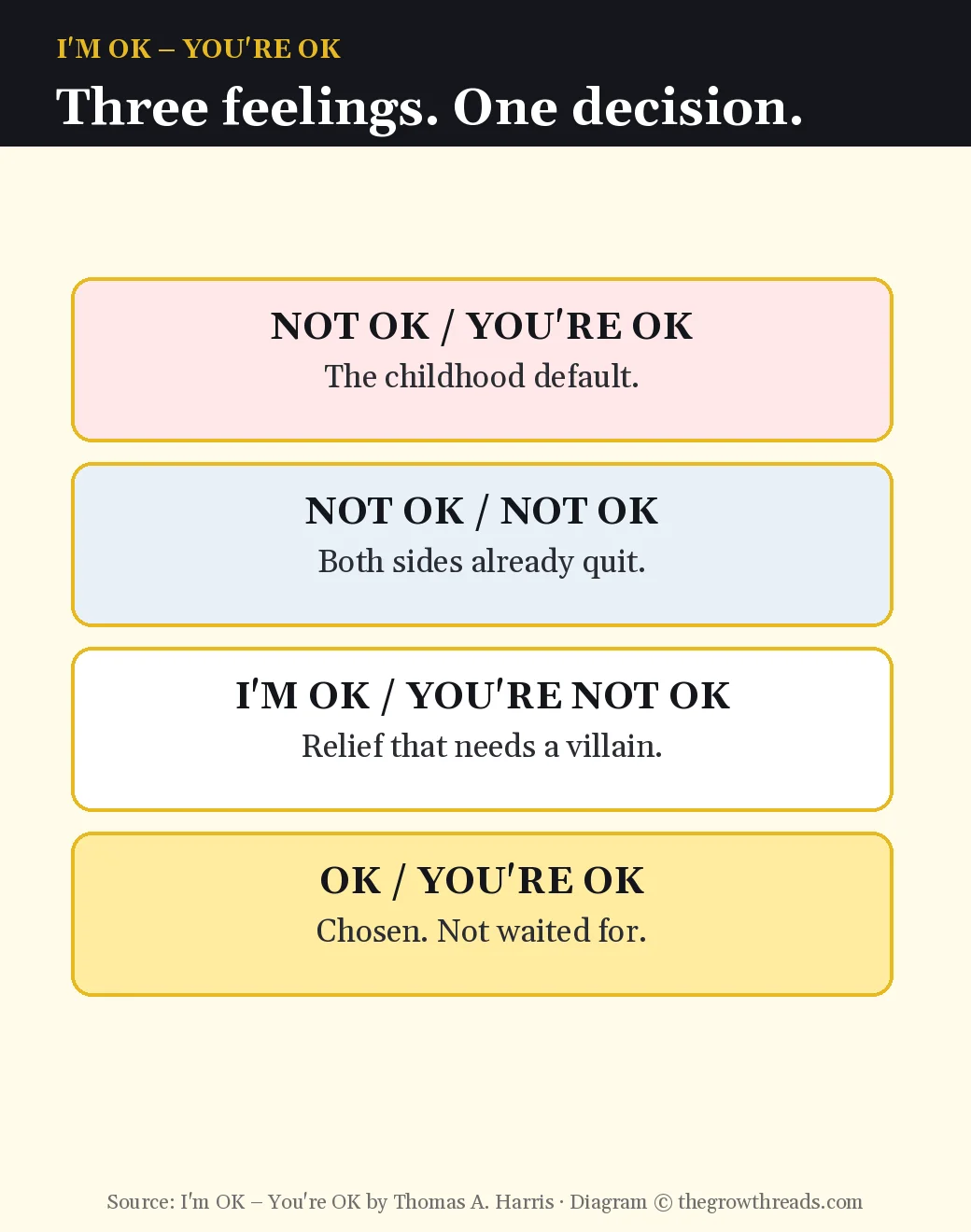
I’m OK – You’re OK does not arrive by getting older. The early positions are feelings. The fourth is a decision: both of us stay people, and we look at the facts. You may still feel Not-OK while you say it. Waiting for a clean feeling is how the childhood position lasts for decades. “I’m probably being difficult, but…” confesses Not-OK in advance. The Adult line is: “Here is what I saw. Here is what I need. I want your read.”
TGR Note: Man’s Search for Meaning asks what the hour demands. Harris asks which voice will answer it. Use Frankl to choose the work. Use this book to keep the other person a person while you do it.
Part 3: Complementary keeps going, crossed hooks the Child
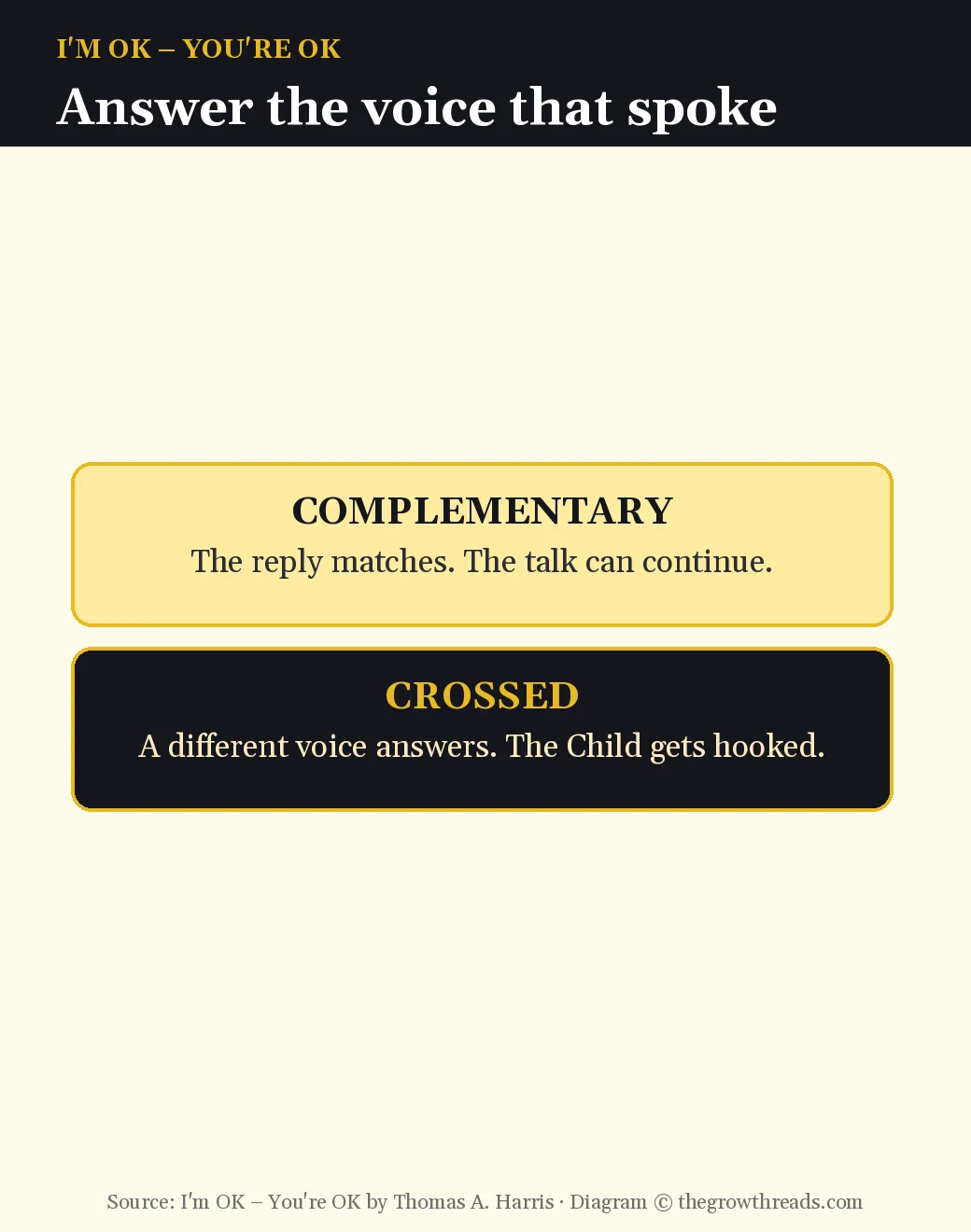
In a complementary transaction the reply comes from the voice that was addressed. Adult asks the time, Adult answers, the talk continues. Parent scolds, Child apologizes, and that pair can last for years. Matching wires are not the same thing as a good match.
A crossed reply answers a different voice. A fact gets a judgment or a sulk, the exchange stops, and the other person’s Child gets hooked. Then both of you are in an old scene instead of the plan. Parent tells include stupid, ridiculous, and should, when they arrive before anyone looks. Adult language names what happened, what it cost, and what you are asking.
Parent leaking into the Adult is prejudice worn as an observation. Child leaking in is a private story told as fact. Keep the curb warning, the joy, and an update when a warning has gone stale — separated, not fused. “What time will you be home?” answered with “Why are you always policing me?” is a cross. The Adult line is dull on purpose: “Around seven. I will text if the train slips.”
TGR Note: Emotional Intelligence notices the feeling without handing it the microphone. Harris names which microphone you picked up. Civilization and Its Discontents is for when the OK decision has to last all week with other people, not just one polite reply.
Part 4: Use it at home without making a courtroom
The later chapters stay where the tape is loudest: marriage, children, adolescents, and moral lines imported from the house you grew up in. The method does not change. At home, a sigh can be a whole transaction.
Parent-to-Child can look like care. One person manages and evaluates. The other apologizes and stays small. Both get a familiar stroke. Harris invites you to break that match on purpose. “You never help” is Parent. “I want Tuesday for the grocery run, and I want you to own the list” is Adult. It feels less righteous. Righteousness is often the Parent collecting a stroke.
With children, the useful Parent keeps a body safe, in a rule the Adult still signs: streets, sleep, kindness with a shape. Sarcasm and global labels teach the child to record I’m Not OK, You’re OK for another generation. “Bikes stop at the corner” belongs on the tape. “You always ruin things” does not. You are writing the recording they will later have to sort.
Lectures push an adolescent into Child. Looking at the actual grade or curfew invites Adult, and you can still hold the limit as a decision rather than a verdict. A stroke is one unit of recognition. If criticism is the only stroke at home, name one specific thing they did this week, with no trailing “but.”
TGR Note: Name a repeating payoff in Games People Play. Put a failure prediction in the columns of Feeling Good. Harris sits under both: which position did you take before the game or the thought started?
Who is I’m OK – You’re OK best for — and who should read something else first?
Read this if you shrink before you ask, or if you win by making someone else the problem. It is a field manual for the next conversation. The labels are easy to use, which is why they lasted.
Read Games People Play first if you want Berne’s games and payoffs. Read Feeling Good first if you want thought records more than ego states. Read Man’s Search for Meaning if the transaction is clear and the point is not. For trauma treatment, start with a clinician. The Body Keeps the Score belongs beside that care, not instead of it.
Come back when you are ready to pick a voice on purpose. It earns a place on the best psychology books shelf as a classic you can practice tonight.
Questions to reflect on
- Which sentence do you send when you feel smaller than the other person, and how old does that sentence sound?
- Where do you feel briefly tall only when someone else has been made wrong?
- What Parent rule still runs your week that the Adult has never actually signed?
- Which question in your house always gets a crossed reply, and what would a dull Adult answer be?
- What specific stroke could you give tomorrow with no “but” attached?
🔥 Ready to decide you are OK before you feel it?
Get I’m OK – You’re OK and practice one Adult reply before the week talks you out of it.
How to apply I’m OK – You’re OK (7-day plan)
- Day 1 — Mark the voice. Carry a card. After three real exchanges, mark P, A, or C for the sentence you actually said. No essays. Three letters.
- Day 2 — Catch the default position. Write the sentence you use when you shrink. Under it, write the sentence you use when you indict. Circle the one you used today.
- Day 3 — One crossed moment. Remember a question that became a fight. Write what they asked, what you answered, and the voice each line came from.
- Day 4 — Send one Adult line. Pick a live loose end. Say what happened, what you need, and by when. Leave out should, always, and never.
- Day 5 — Give a clean stroke. Name one specific thing a person did. No compliment with a bill attached. Stop after the recognition.
- Day 6 — Update one Parent tape. Choose one inherited rule. Write “keep,” “limit,” or “retire,” and the fact that earned that mark.
- Day 7 — Decide out loud. Before one hard conversation, say the position privately: I’m OK, and you’re OK. Then use the Day 4 sentence. Note whether the feeling followed.
Frequently asked questions
What is I’m OK – You’re OK about?
I’m OK – You’re OK is Thomas A. Harris’s 1967 guide to transactional analysis for readers outside a training group. He treats Parent, Adult, and Child as the sources of ordinary remarks, then names four positions about your worth and theirs. Three are early feelings. The fourth, I’m OK and you’re OK, is an Adult decision. Later chapters take that decision into marriage, parenting, and moral arguments. Use it to label the next sentence you send: which voice, which position, and one reply aimed at the person who actually spoke.
What are the four life positions?
Harris lists four conclusions people carry into a room. I’m Not OK, You’re OK is the common childhood position: they are capable, I am not. I’m Not OK, You’re Not OK gives up on both sides. I’m OK, You’re Not OK gets relief by making other people the problem. I’m OK – You’re OK keeps both people human and looks at the facts. The first three, he says, are unconscious feelings, reasonable guesses for a child. The fourth is not a mood. You decide it while the old feeling is still present, then answer from the Adult.
What does Parent, Adult, and Child mean here?
These are Berne’s ego states, taught by Harris as three sources of a remark. The Parent copies rules and warnings from the adults you watched. Some lines keep you alive. Some are only one house’s prejudice. The Child stores how a scene felt at the age you were. The Adult checks both against what is happening now. Harris does not ask you to delete Parent or Child. He asks you to notice which one is about to speak, and to let the Adult sign a real request, a limit, or an apology.
How is this different from Games People Play?
Eric Berne’s Games People Play catalogs repetitive social games and the payoffs that keep them going. Harris writes for a reader who may never study that catalog. He uses the same Parent, Adult, and Child language and aims it at the position under the game: the early decision about who is OK. Read Berne for the moves, the switch, and the payoff. Read Harris for a decision you can make before the next reply. They fit together. On this site Berne’s summary sits with relationship books, and this one sits with psychology, because the unit Harris trains is the position you took before the game started.
Is the 1960s science in the book still useful?
Some of the brain story Harris leaned on has not held in the form he hoped. Penfield’s dramatic reliving, which made the tape feel neurological, has not been easy to repeat. A metaphor is not a scan. The practice does not need that lab scene. You can still sort a remark into a copied rule, a replayed feeling, or today’s facts, and you can still spot a crossed reply. Treat the neuroscience as period scenery. Test the labels in one conversation this week. Where a later study disagrees with a 1967 mechanism, keep the behavior you can actually see.
Who should read I’m OK – You’re OK, and how long does it take?
Read it if your conflicts repeat and you want a small vocabulary for the next one. It fits partners, parents, managers, and anyone who either shrinks or prosecutes when tension rises. It is the wrong first book if you want a modern clinical protocol, a full thought-record workbook, or Berne’s game list. The Quill paperback is a little over 300 pages. Plan about six hours, less if you already know the ego states, more if you stop to rewrite your own sentences. This guide is the twelve-minute version. Sit with the book when you want his scenes of marriage, children, and crossed replies, not only the four boxes.
Can this replace therapy?
No. Harris was a psychiatrist, and he wrote a book for the hours between hard conversations. A reading plan is not care. If you are in danger, if a mood has shut the week down, or if you cannot get an Adult sentence out at all, talk with a clinician. The seven-day practice here only labels voices and sends one cleaner line. It will not treat a trauma or settle a crisis. Many people bring the same labels into therapy because they are easy to say in a session. That is a sound use. Using the book as a reason to skip help you already know you need is not.
Related summaries
Feeling Good puts a hot thought in columns. Emotional Intelligence notices the feeling without handing it the send button. Man’s Search for Meaning asks what the hour is for. The Gift of Fear is for a real danger signal, not an old tape. Berne’s model sits in relationships: Games People Play. The shelf is the best psychology books guide.
How we analyze books: our summaries are built from a full read of the source text, cross-referenced against the author’s published essays and letters where relevant, and structured around practical application rather than critique. Read our full methodology.