

★★★★½ 4.5/5 — Take the seat, own the win, and do not opt out before the choice is real.
Best for: capable people who keep declining stretch work, and the managers and partners who can stop that pattern with them.
Reading time: ~4 hrs (guide: 228 min)
Difficulty to apply: Medium. The moves are small. The social friction, at work and at home, is the real rep.
Lean In in one minute
The seat you do not take is the career you do not get. Lean In is Sheryl Sandberg’s field guide, written with Nell Scovell, for people who are already good at the work and still talk themselves out of the next level. Sit where the decision is made. Own the result without the discounting preface. Treat the career as a jungle gym. Ask for help with one specific question. Do not resign from stretch work years before a real constraint arrives.
The home half is just as operational. If the default chores never move, the workplace advice collapses at dinner. Sandberg’s stance is personal ambition and structural change together.
Key takeaways
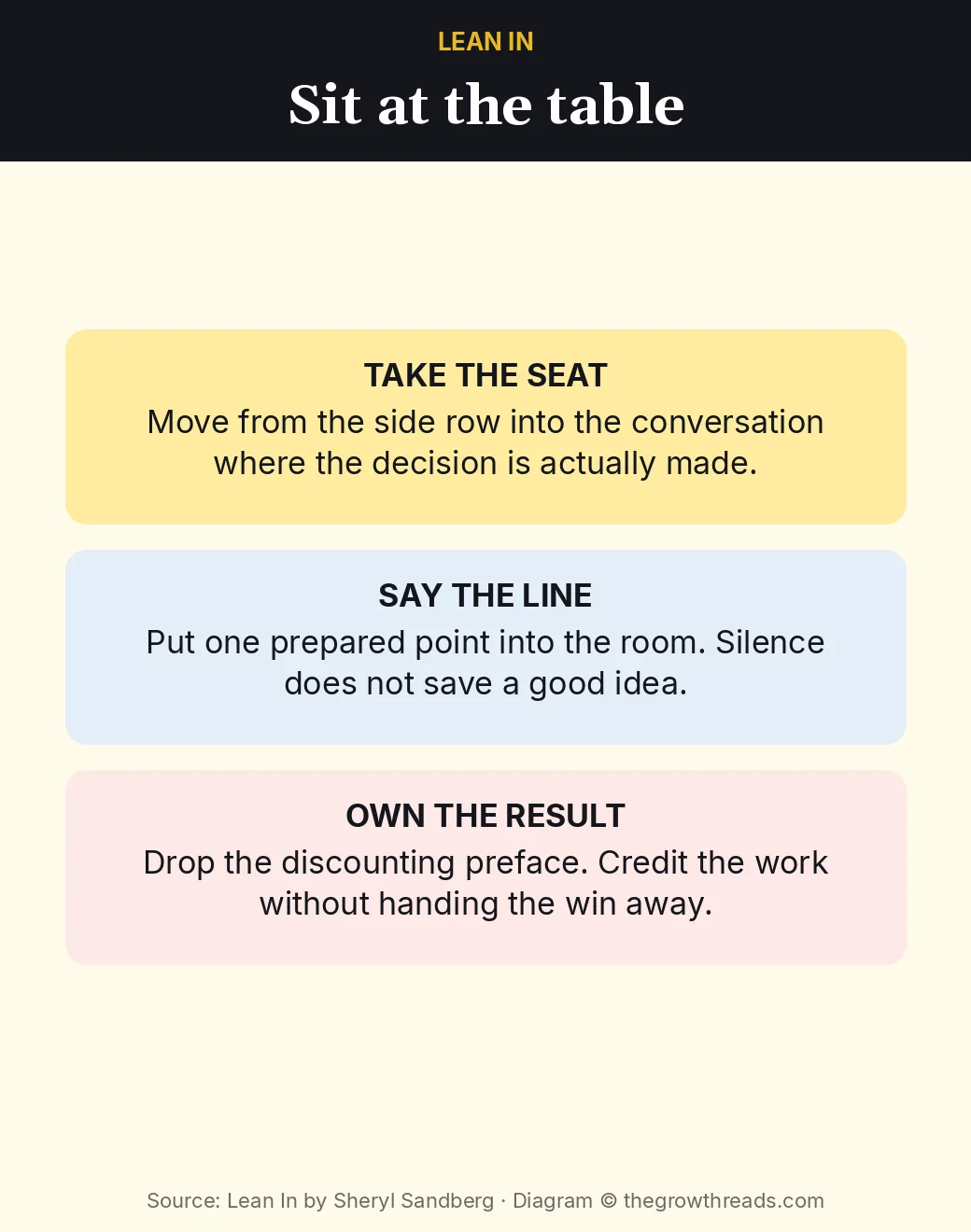
- Take the seat: presence in the decision is part of the job, not a reward for being sure.
- Say one line: bring a prepared point into the meeting and let it stand without an apology.
- Own the win: drop the preface that hands credit to luck, timing, or “the team” when you mean you.
- Expect the likeability tax: negotiate anyway, and judge yourself on the result plus the relationship you actually keep.
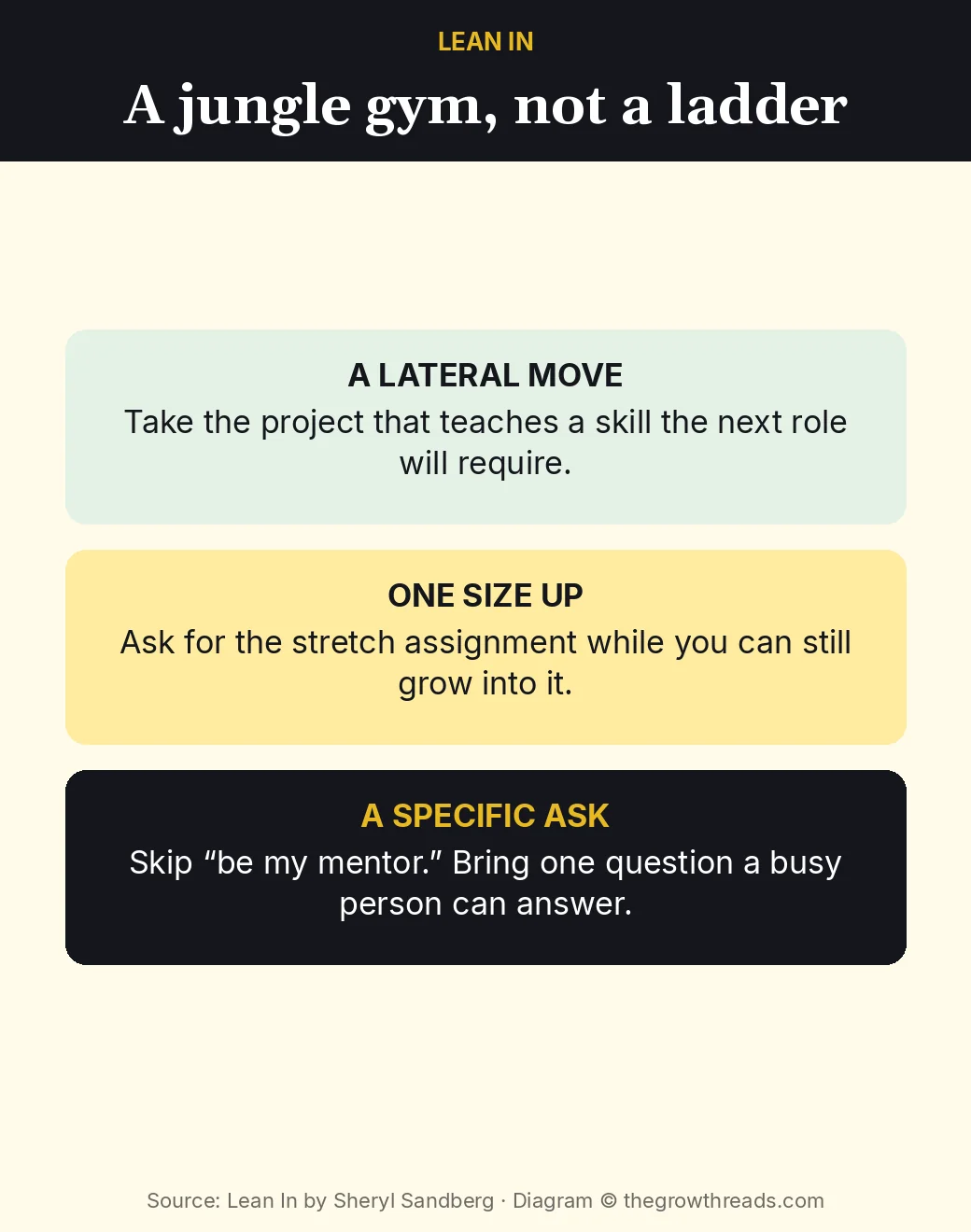
- Climb a jungle gym: a lateral project that builds a portable skill beats waiting on a blocked ladder.
- Ask a smaller mentor question: one specific request a busy person can answer this week.
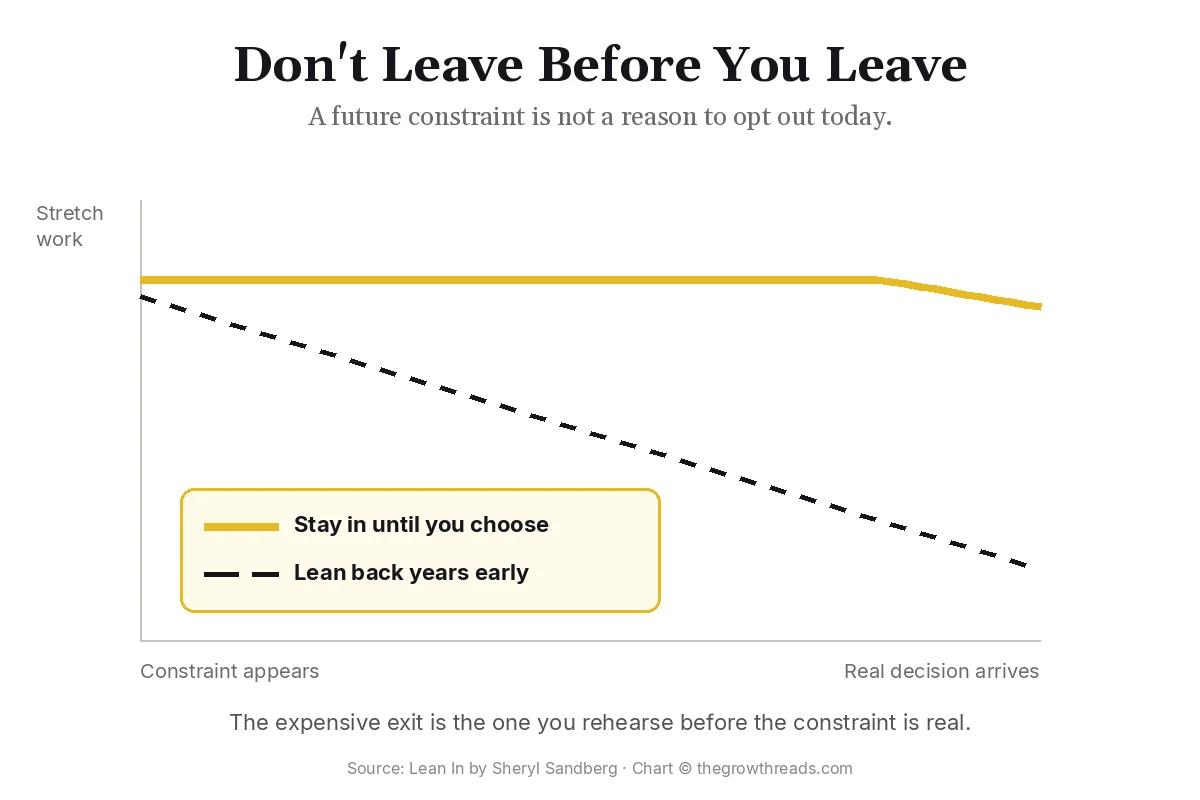
- Do not leave early: mark the date the constraint becomes real, and keep the stretch work until then.
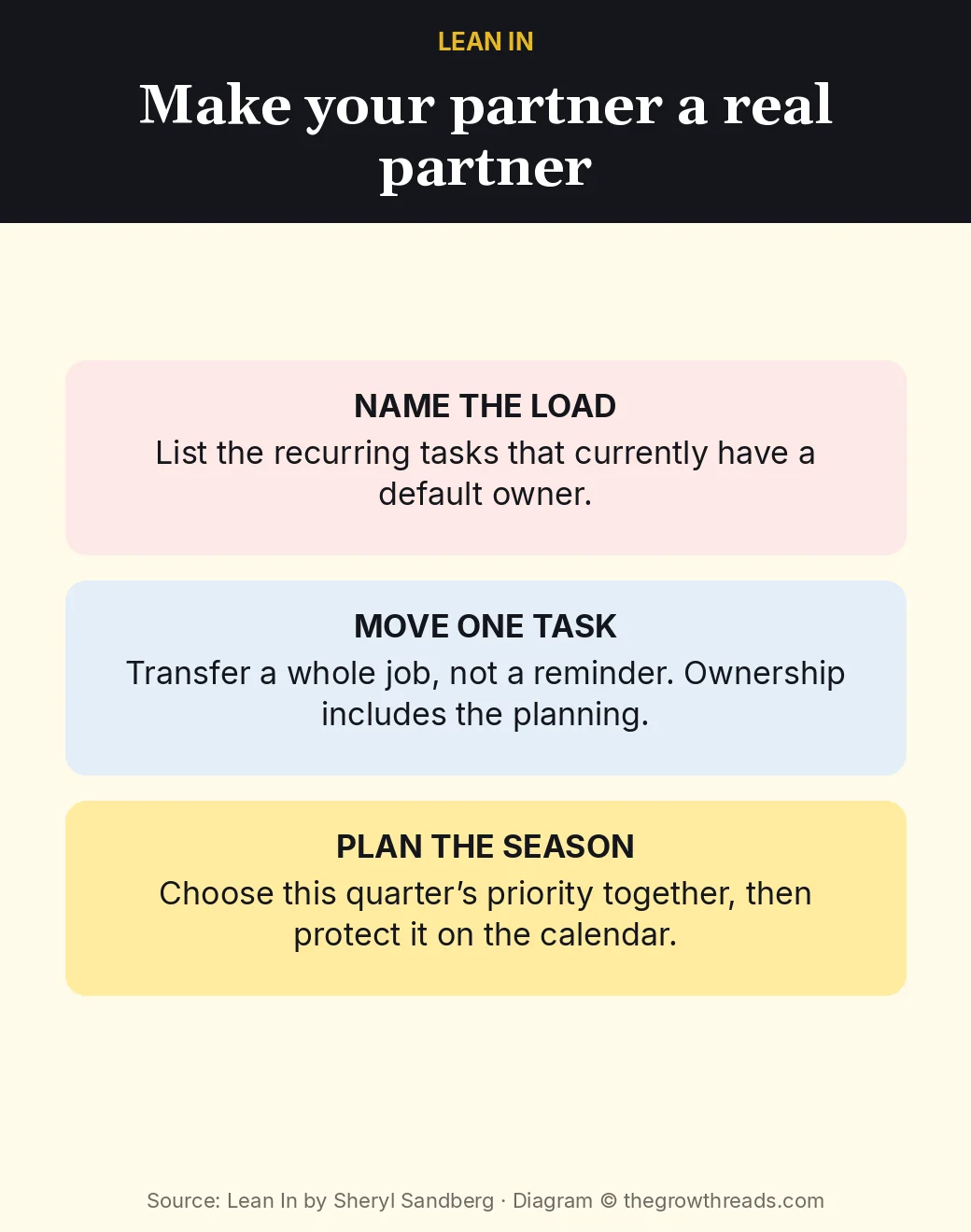
- Move a whole task at home: transfer ownership, not a nag, so the work advice survives the evening.
- Talk about it at work: leave, flexibility, and ambition get easier for the next person when someone says them plainly.

What is Lean In about?
Lean In is Sandberg’s 2013 argument that talented people, especially women, opt out of stretch work too early, and that the fix is both personal and structural: take the seat, negotiate, share the load at home, and keep pushing workplaces to make ambition possible.
About the author
Sheryl Sandberg (born 1969) studied economics at Harvard, worked at the World Bank, and served as chief of staff to Treasury Secretary Larry Summers. She helped build Google’s advertising business, then became chief operating officer of Facebook in 2008, writing from rooms where promotions were actually decided. Lean In, written with Nell Scovell and published by Knopf in 2013, grew out of her TED talk on women and leadership. She later wrote Option B with Adam Grant. LeanIn.org runs circles where readers practice the same conversations. She is explicit that her own path was unusually supported. The pages worth copying are the moments she stopped waiting to feel ready. Explore all Sheryl Sandberg book summaries →
Key concepts at a glance
| Concept | What it means | Use it when |
|---|---|---|
| Leadership ambition gap | Capable people talk themselves out of the next role before anyone else does. | You keep calling a stretch role “not the right time.” |
| Sit at the table | Be in the conversation where the decision is made, and say the point. | You default to the side of the room or the end of the thread. |
| Success and likeability | Assertiveness is often scored as warmth for some people and as a tax for others. | You are softening an ask you already know is fair. |
| Jungle gym | Careers move sideways and diagonally. Skills you can carry beat a single rung. | The obvious promotion is blocked and you are waiting anyway. |
| Specific mentor ask | Busy people can answer one real question. They cannot adopt a stranger. | You are about to send “can I pick your brain?” |
| Don’t leave before you leave | Stay in the hard work until the constraint is real. Then choose. | You are declining growth because of a decision that is still years away. |
| Real partner | A whole recurring task changes hands, including the planning, not a reminder. | One person is the default for the life that makes the job possible. |
| Done is better than perfect | Ship the honest version. Perfection is a sophisticated way to stay small. | You are polishing a comment, a doc, or a plan past the moment it was useful. |
The ambition gap, and the seat that stays empty
Sandberg opens on two gaps. The pipeline narrows as jobs get senior. Inside the pool that remains, capable people still talk themselves out. Offered a stretch, they nominate someone safer. Asked how a win happened, they credit luck, timing, or a generous boss, while peers with the same result narrate it as work they did. That habit is trained. By the time a hard assignment appears, the reflex is to wait until you feel certain. Certainty does not arrive on a growing job. The people who advance take the assignment while it still feels one size too big, then learn in public.
“Sit at the table” makes the same idea physical. Sandberg watched qualified women choose the chairs along the wall while the table stayed half empty. Nobody had sent them there. The side row then confirmed that they were not central. Walk to the table. On a remote team, get onto the decision thread, not only the recap. Prepare one point and spend it. Then own the result in a sentence that says what you decided and what changed. Thank the team in the next sentence if you need to. Do not hand the win away.
TGR Note: Pair this chapter with Multipliers if the issue is a leader who accidentally shrinks the room, and with Dare to Lead if the team needs a shared way to talk about the fear under the silence. Sandberg gives you the individual move. Those two books give you the room the move has to survive.
Likeability, the jungle gym, and a mentor you can actually ask
The likeability chapter prepares a negotiation. Students rated the same résumé under two names. Competence landed similarly. Warmth did not. The assertive woman paid a social penalty the assertive man did not. Expect the tax, make the ask, and let results give the relationship something solid to stand on. Skipping the conversation lets someone else set the scope, the title, and the pay.
When the next rung is blocked, swap the ladder for a jungle gym. A lateral move that teaches a skill you can carry, a project in front of customers, a temporary look at the numbers: these are advances even when the title stays put. Waiting for the perfect rung is how people stall with a clean story about patience.
The mentor chapter is a relief if your vague notes go unanswered. “Will you be my mentor?” asks a stranger for a long relationship. A specific question — how you handled a pricing fight, whether to take the lateral move — can be answered in a reply. A series of useful exchanges sometimes becomes the relationship.
TGR Note: Radical Candor is the companion when the likeability tax shows up as mushy feedback. Kim Scott’s pair — care personally, challenge directly — gives a manager a way to reward the person who negotiated without punishing the warmth. Use Sandberg to make the ask. Use Scott to make sure the culture does not make them pay twice.
Speak plainly, and do not leave before you leave
Sandberg wants the truer sentence earlier than is comfortable. Teams miss the real objection when everyone performs agreement. Careers miss the real constraint when nobody has said the schedule breaks in June. That includes the ambition you have been keeping as a private wish. A manager cannot design a role around a goal you have never named. Feedback you would rather wrap in three compliments belongs in the same habit: say the point, with respect, while it can still change the work.
The signature pattern is leaving before you leave. A pregnancy, a parent’s health, a partner’s move, a plan to be home more later: the constraint is real, and it is not here yet. In the gap, people make the job smaller. They pass on the launch and the transfer. The work gets less interesting, and months later the exit feels obvious. Staying in is not denial. Name the constraint, put a date on the actual decision, and keep the stretch assignment until that date. Then choose, with a partner and a manager who were not surprised. If you tell them only after you have gone quiet, they have spent a year reading disengagement. An early, specific sentence beats a late retreat.
TGR Note: If the fear under that sentence is “I will be punished for wanting both,” read the partner chapter next to Leaders Eat Last. Simon Sinek’s point is that people take risks for a group that protects them. A manager who wants ambition and caregiving in the same person has to make the team feel that both are allowed. Sandberg supplies the script. Sinek supplies the safety.
A real partner, and the end of doing it all
The workplace will not rescue an unequal default at home. If one adult owns every recurring task — meals, forms, the dentist, the list of what runs out — every stretch role is financed by invisible overtime. Help that still leaves the planning with one person is not a partnership. Transfer one whole job this week, including the noticing, and check in on Friday. Sandberg’s point is direct: an equal load at home is how two ambitions fit in one house. Parents who take leave and own the evening change what their colleagues believe is normal.
“Done is better than perfect” answers the myth of doing it all. No week fully serves the job, the people you love, your body, and the inbox. Pick the season’s priority and let a few things stay honestly unfinished. The error is requiring heroics every Tuesday and calling the heroics a personality. The closing move is public. When a senior person says what they need — leave, flexibility, the harder team — the next person borrows the sentence. Individual effort without that conversation just makes one person tired.
Who is Lean In best for — and who should read something else first?
Read Lean In if you are competent, well regarded, and still editing yourself out of the harder assignment. Read it if you manage people like that and have been calling their caution “not ready.” Read it with the person you live with if the two of you have never named who owns the recurring load. The book is short, concrete, and aimed at the next meeting rather than a new personality.
Start somewhere else if the bottleneck is different. If the team cannot argue, read The Five Dysfunctions of a Team. If you are a new manager, start with The Making of a Manager. If feedback is mushy, read Radical Candor. If you want a no-excuses crew standard, use Extreme Ownership. Come back to Lean In when the missing piece is your own opt-out, not the team’s operating system.
Questions to reflect on
- Where did you choose the side of the room, or the recap thread, in the last two weeks?
- Which win did you narrate as luck that was actually a decision you made?
- What stretch role are you declining because of a constraint that is not here yet? What is the real date?
- Which recurring task at home still has a default owner, and what would transferring the whole job look like this week?
- What is one specific question you could ask a person you respect, instead of requesting a mentor?
🔥 Ready to take the seat before you talk yourself out of it?
Use the week plan with the Knopf edition, then keep the chapter that matches the opt-out you are actually running.
How to apply Lean In (7-day plan)
- Day 1 — Name the quiet meeting. Write down the one forum where you usually stay peripheral. Draft a single sentence you will say next time. Do not draft five.
- Day 2 — Take the seat. In that forum, sit in the decision, not the gallery. Put the sentence into the room. Do not apologize for it before or after.
- Day 3 — Own one result. Tell a colleague what you decided on a recent win, in two sentences, without the discounting preface. Thank the people who helped in a third sentence if you need it.
- Day 4 — Ask for one size up. Request a stretch assignment with a scope and a date. If the ladder is blocked, ask for the lateral project that teaches the missing skill.
- Day 5 — Send the specific ask. Email one person a single question they can answer in a reply. Delete any sentence that asks them to “be a mentor.”
- Day 6 — Date the real choice. Write the constraint you have been rehearsing and the month it actually requires a decision. Until then, keep the stretch work on your list.
- Day 7 — Move one whole task. With the person you live with, transfer one recurring job including the planning. Put a ten-minute Friday check-in on the calendar. Tell your manager one true sentence about what you want this year.
Frequently asked questions
What is a useful Lean In summary?
A Lean In summary is a practical reading of Sheryl Sandberg’s 2013 book, written with Nell Scovell: take the seat where decisions happen, own your results, treat the career as a jungle gym, and do not opt out of stretch work years before a real constraint arrives. It asks you to raise a hand, negotiate, and redesign the default load at home so the workplace advice survives a Tuesday night. It is not a promise that bias vanishes if you try harder. Use the behaviors this week, and keep pushing leave, childcare, and fair promotion so those behaviors are possible for more than one person.
What does Sandberg mean by “sit at the table”?
“Sit at the table” is both literal and behavioral. Sandberg describes talented people who hover at the edge of the room, then wonders why they were not heard. Take a chair in the conversation, say the prepared point, and stop treating presence as arrogance. You stop waiting to be invited, you put one observation into the meeting, and you let it stand without an apology wrapped around it. The seat stands for every place a decision is made: the staffing meeting, the customer review, the planning doc. If you are not in that conversation, someone else is shaping the work you will have to live with.
What does “don’t leave before you leave” mean?
“Don’t leave before you leave” names a quiet pattern. A future constraint — a child, a move, a partner’s job — shows up on the horizon, and the person starts declining stretch roles years before a decision is required. The interesting work dries up. By the time the constraint is real, the job is already easy to exit. Sandberg’s counsel is to stay in the challenging work until you are actually choosing, with a partner and a manager who have heard the plan. Opting out early feels responsible. It is often a rehearsal that closes the door. Mark the real date, and keep raising your hand until then.
Is Lean In only for women?
The book is written first to women, because Sandberg had watched ambitious women talk themselves out of seats she knew they could hold. The behaviors travel. Anyone who discounts a win, skips a negotiation, or steps back from hard work years too early can use the same moves. Managers get a second job: notice who is not at the table, ask them for the view, and stop treating likeability as a test only some people have to pay. Couples get a third. If one partner is the default for every recurring task, no workplace slogan will fix the week. The homework is specific either way.
How long does it take to read Lean In, and where should I start?
The Knopf hardcover is 228 pages, about four hours at a steady pace, or a week of short sittings. Start with the ambition-gap and sit-at-the-table chapters if you are already skipping stretch work. Read the likeability chapter before your next negotiation so you expect the social tax and still make the ask. Save “don’t leave before you leave” for a calm evening, and read the partner chapter with the person who shares your house. You do not need the whole book before you act. One meeting, one owned win, and one moved household task will teach you more than a second pass of highlights.
How is Lean In different from Dare to Lead?
Dare to Lead trains a team to do hard things in the open: trust and clear conversations as a group practice. Lean In trains the individual decision to stay in the arena — the seat, the negotiation, the stretch role, the partner conversation at home. Read Dare to Lead when the whole team’s courage is the bottleneck. Read Lean In when you, or someone you manage, is already capable and is opting out before the choice is real. Brown gives you a way to talk about fear without shame. Sandberg gives you a calendar move for this month.
Did critics say Lean In asked women to fix a broken system alone?
Some readers heard the individual advice — negotiate, find a partner, lean in — as a substitute for childcare, paid leave, and promotion systems that still punish caregiving. Sandberg’s own position is a both/and: personal ambition and structural change. The practical chapters do not ask you to pretend the institution is neutral. They give you moves you can run while you also argue for the policy. Use the book as a field guide for the next meeting and the next month at home. Do not use it as proof that anyone who stalls simply failed to want it enough. The useful test is whether the week got more honest.
Related summaries
- Dare to Lead — courage as a team practice, when the fear needs shared language.
- Radical Candor — how to challenge directly without making likeability the goal.
- Leaders Eat Last — the safety a group needs before people will take a stretch risk.
- Multipliers — leaders who make the room smarter instead of becoming the only voice at the table.
- Best leadership books — the silo shelf, if you want a different bottleneck than the early opt-out.