

★★★★☆ 4.6/5 — A practical cascade for leaders who need strategy to be a set of choices, not a binder of initiatives.
Best for: founders, brand owners, and operators who must choose a field and a way to win on it.
Reading time: ~5 hrs, guide: 18 min
Difficulty to apply: Medium. The five boxes are easy to draft and hard to honor, because each one rules something attractive out.
Playing to Win in one minute
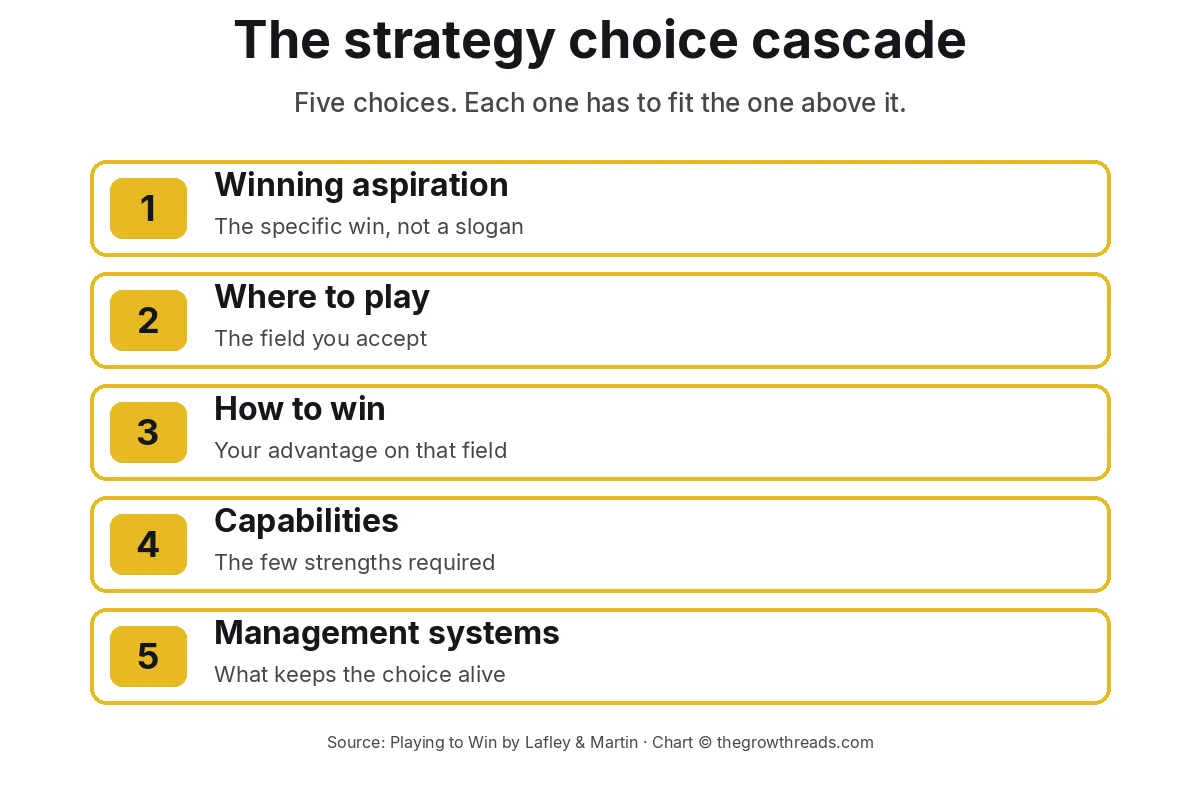
Strategy is not the plan, the vision, or the pile of projects. It is a cascade of choices that tell you where you will play and how you will win there.
A.G. Lafley and Roger L. Martin wrote Playing to Win from inside Procter & Gamble’s strategy work, not from the sidelines. The heart of the book is five questions that have to fit together: the winning aspiration, the field, the advantage, the capabilities, and the systems that keep those choices honest. Most teams play to play. They stay in the category, improve a little of everything, and call the activity a strategy. This book is the antidote: fewer choices, tighter logic, and a way to test the weakest condition before you bet the year.
Key takeaways
- Strategy is five choices: aspiration, where to play, how to win, capabilities, and management systems. A list of projects is not a strategy.
- Winning aspiration: name the win with a real customer. If every rival could print the sentence, it is still a slogan.
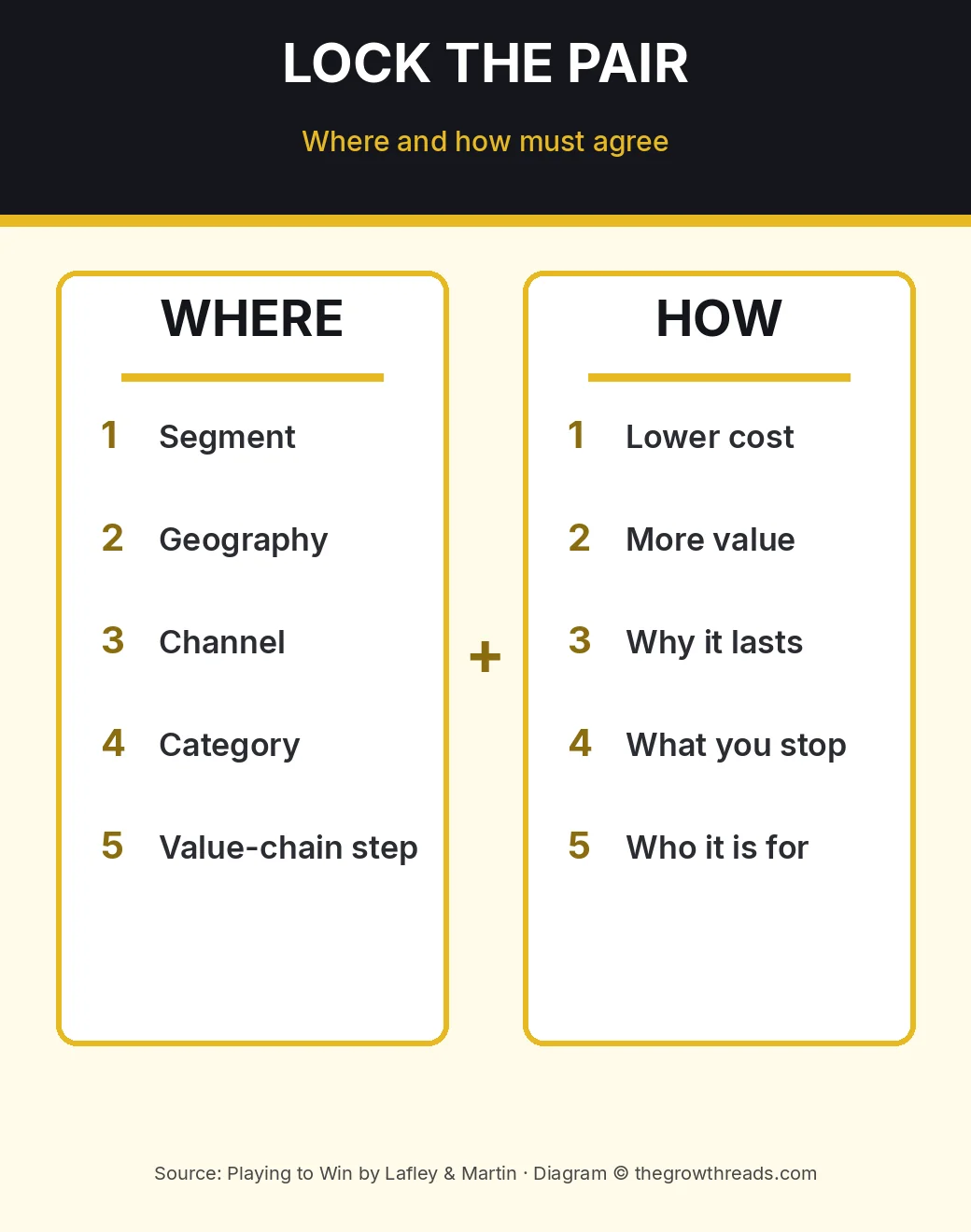
- Where to play: segment, geography, channel, category, and the step in the chain you will own. The no is part of the choice.
- How to win: a theory of advantage on that field, usually lower cost or distinctly more value, plus why you can hold it.
- Capabilities: the few activities that must be excellent together. A competency poster that includes everything explains nothing.
- Management systems: the reviews, measures, and talent calls that reinforce the cascade. The calendar is where strategy goes to live or die.
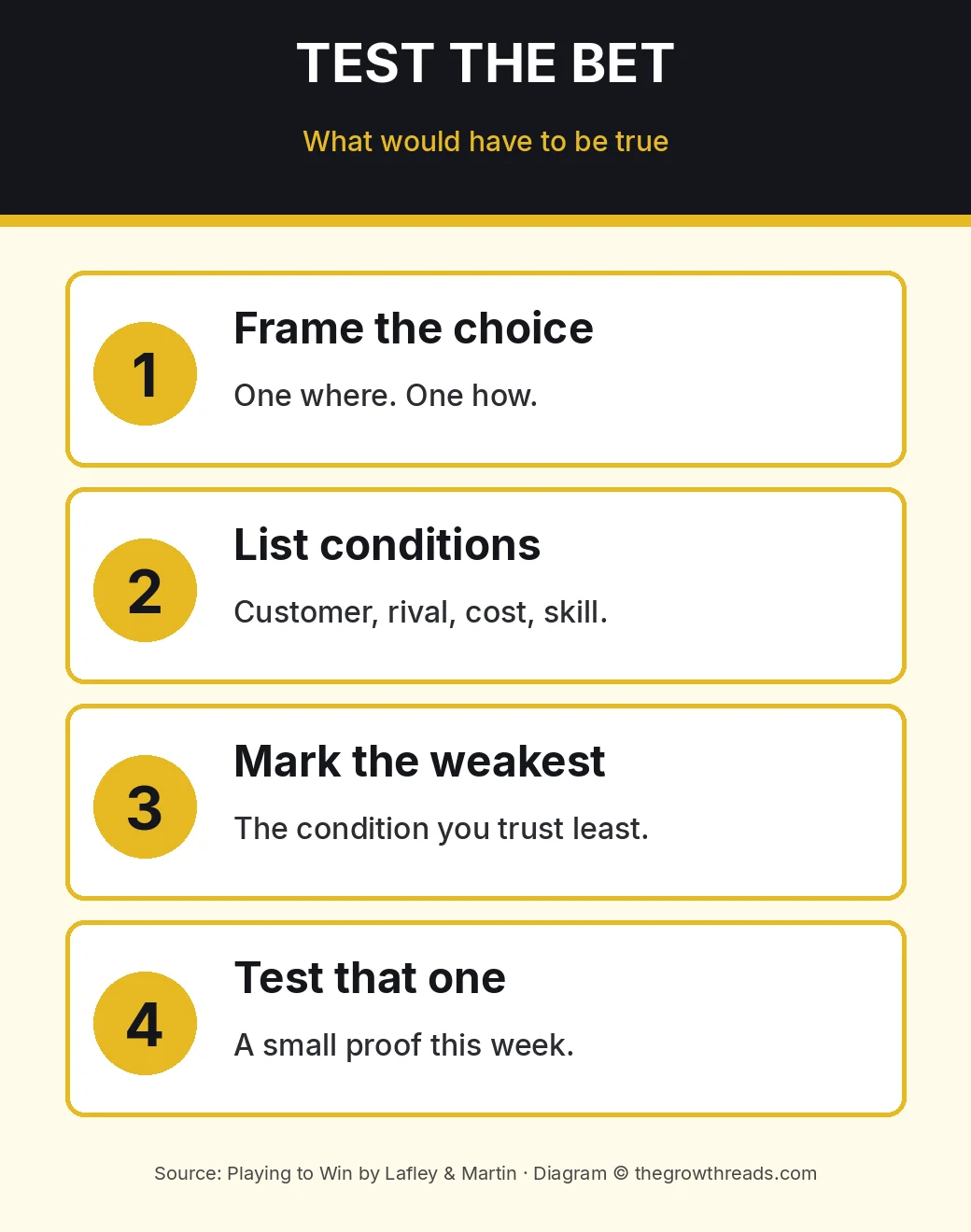
- What would have to be true: agree on the conditions for a choice, then test the condition you trust least. Skip the forecast fight.
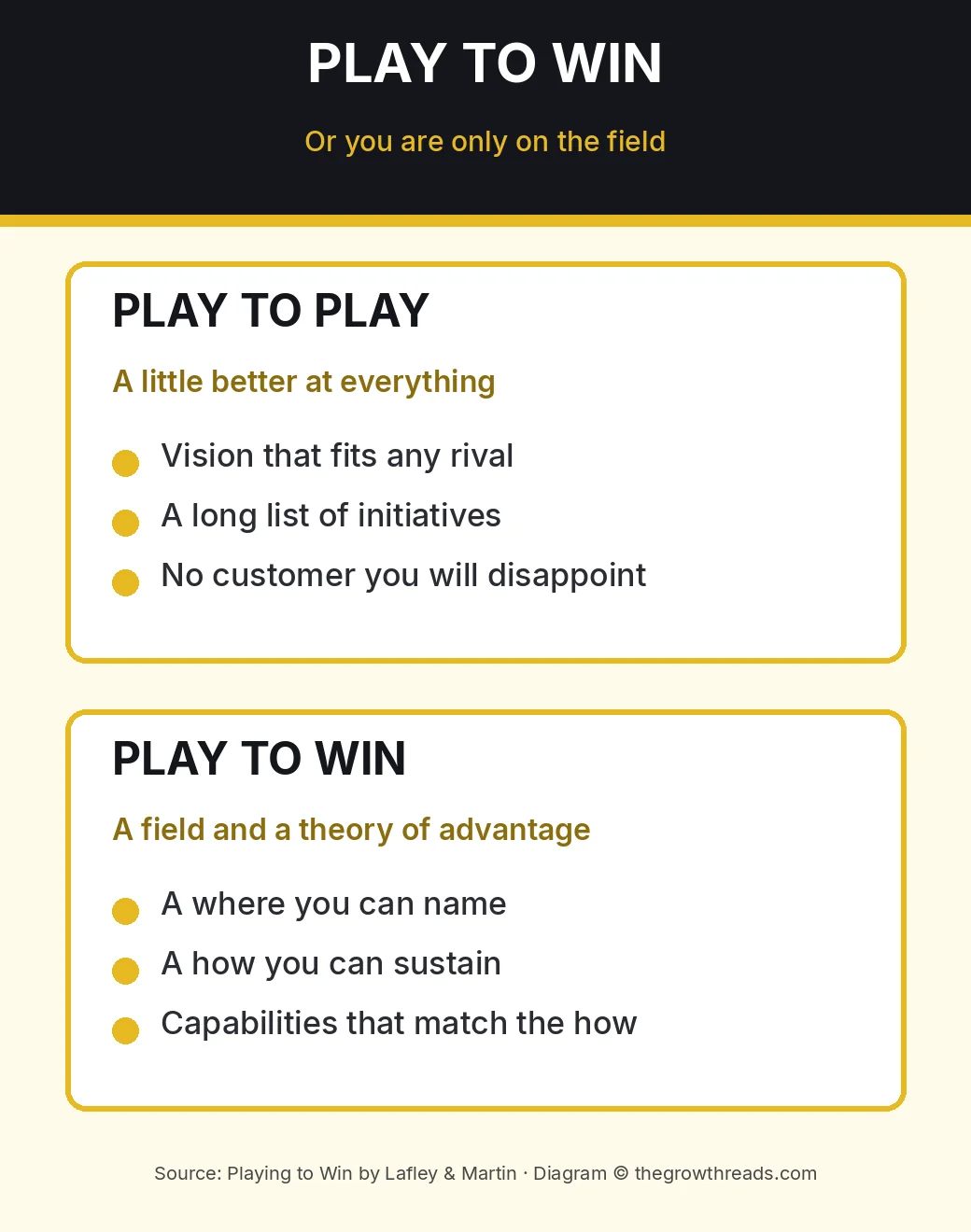
- Playing to play is the default: a little better at everything, on every field, with no customer you are willing to disappoint.
What is Playing to Win about?
Playing to Win argues that strategy is five integrated choices: a winning aspiration, where to play, how to win, the capabilities required, and the management systems that keep those choices honest. Lafley and Martin show that cascade through Procter & Gamble, then how to test the weakest condition.
About the author
A.G. Lafley spent his career at Procter & Gamble and led the company as chief executive from 2000 to 2009, then again from 2013 to 2015. Playing to Win is not a highlight reel of campaigns. It is the choice structure he used with Roger L. Martin, the adviser in those strategy conversations. Martin was dean of the Rotman School of Management at the University of Toronto from 1998 to 2013, and he is known for integrative thinking: staying with two opposing models until a sharper choice appears. One of them had to make the calls. The other had to make the calls discussable. The book is that pairing, for anyone tired of vision lines that never rule an option out. Explore all A.G. Lafley book summaries →
Key concepts at a glance
| Concept | What it means | Use it when |
|---|---|---|
| Winning aspiration | The win you mean, for a named customer. | The current line could fit any company in the category. |
| Where to play | The field: who, where, which channel, which offer. | You are still saying yes to every segment that asks. |
| How to win | Why you win on that field, and how it lasts. | The team can list tactics and cannot name an advantage. |
| Capabilities | The few strengths the how-to-win actually needs. | You are funding skills that do not reinforce the choice. |
| Management systems | Reviews and measures that protect the cascade. | The monthly meeting still rewards a full initiative list. |
| What would have to be true | The conditions that would make the bet a good one. | People are arguing forecasts instead of testing a condition. |
| Play to play | Participating without a distinctive how-to-win. | Activity is up and the customer you would disappoint is unnamed. |
Strategy is a choice, not a plan
The opening argument is blunt in the best way. Companies produce visions, plans, and best-practice copies, then wonder why the work feels busy and the position does not move. Lafley and Martin separate those artifacts from strategy. A vision can inspire and still rule nothing out. A plan can sequence work that should not exist. A best practice copied from a winner usually arrives without the where and the how that made it a win for them.
Strategy, in this book, is an integrated set of choices. The winning aspiration sits at the top, and it has to be a real statement of winning, not a pledge to participate. Under it, the team chooses where to play and how to win. Under that, it names the capabilities required and the management systems that support the set. Skip a box, or let two boxes contradict, and the rest is activity.
The P&G setting matters because the temptation there was scale. A company that can enter almost any aisle still has to decide which aisles deserve a theory of advantage. Lafley’s years as chief executive are the proof-of-use, not a trophy case. Sales roughly doubled across his first tenure because the company got more selective about where a brand was allowed to compete, not because every brand got a longer plan.
TGR Note: Rumelt’s kernel in Good Strategy Bad Strategy is the logic test: diagnosis, guiding policy, coherent action. The cascade is the choice set those actions have to serve. Use the kernel when the slide will not name the crux. Use Lafley and Martin when the crux is named and the team still will not pick a field.
Where to play and how to win
These two questions are the heart of the book. Where to play is not a market-size slide. It is a boundary: which customers, which geographies, which channels, which product categories, and which stage of production or distribution you will actually show up for. How to win is the advantage on that field. The appendix is clear that the broad paths are a lower-cost position the buyer still accepts, or differentiation the buyer values enough to prefer and pay for.
The famous consumer story is Oil of Olay. The old where was a tired mass cream. The new where was a woman who wanted skin care that felt more considered than the bargain jar and more reachable than rarefied prestige. The how was a product and brand position between those poles, backed by formulation, design, and retail execution that could hold a higher price without pretending to be a department-store house. The lesson is not the jar. It is the pair. A new slogan on the old field would have been playing to play.
Where not to play does as much work. A brand that keeps a channel, a country, or a price tier out of habit spends capability on a field where the how cannot win. Lafley and Martin treat that subtraction as strategy. Ambition lives in the aspiration. Discipline lives in the boundary. Write the where in language a salesperson can use to refuse a deal.
TGR Note: A technology where-to-play choice often looks like a beachhead. Crossing the Chasm is the tighter version of that move for a new product: one segment you can win, then the next. The cascade asks the same honesty of a mature brand. Narrow the field until the how is believable.
Capabilities and the systems that protect them
Capabilities are not a tour of everything the company is proud of. They are the few activities that must be great at the same time for the how-to-win to be true. Product superiority without the retail ability to hold the price is a different strategy from the one you wrote. A cost position without the processes that actually remove cost is a hope. Lafley and Martin want the list short enough that a leader can see whether the activities reinforce each other.
This is where the cascade corrects a common planning habit. Teams brainstorm strengths, vote, and produce a slide no one can fail. The book pulls the other direction. Start from the how, then ask which strengths are non-negotiable. Anything else can be adequate. Adequate is allowed. Pretending every function is strategic is how the budget stays flat and the position stays fuzzy.
Management systems decide whether the top boxes survive the quarter. Reviews, metrics, and talent calls either ask the cascade’s questions or they ask for more initiatives. If the operating rhythm still celebrates a full list of projects, the where-to-play line gets overwritten by whoever shouts. Manage what matters means manage the choices. Change one meeting’s first question so a box shows up in the room.
Think it through, then shorten the odds
The back of the book is the working method. Instead of a room full of people defending forecasts, Martin asks what would have to be true for this choice to be a good one. The team lists conditions across the customer, the competitors, the costs, and the capabilities. Then it stops arguing about whose story is more confident and marks the condition it is least sure of. That condition is the one to test. Agreement moves up front, to the logic, where people can still change their minds without losing face.
You can run the cascade in either direction. Down from the aspiration, when you are setting a new game. Up from a capability you already hold, when a strength suggests a where and a how you have not claimed. The book is explicit that the flow is iterative. A beautiful how that your capabilities cannot support is a signal to change the how or the where, not a signal to write a braver poster. Reverse engineering is a feature.
Shortening your odds is the adult version of certainty. You will not remove competitive risk. You can refuse choices whose boxes contradict, and you can buy a little information on the weakest condition before the spending starts. The conclusion calls winning an endless pursuit because rivals move and fields age. The cascade is a habit of refresh, not a plaque.
TGR Note: Once the choice is made, the week still has to carry it. The 4 Disciplines of Execution is the management-system companion: a few wildly important targets and a cadence that does not let the whirlwind rewrite the where. Essentialism is the personal version of the same subtraction. The cascade tells a company what to cut. Essentialism tells a person.
Who is Playing to Win best for — and who should read something else first?
Read this if you run a product, a brand, a business unit, or a company and your strategy process produces binders. You will get a shared language for the argument you are already having in the hallway: where we play, and why we deserve to win there. Founders who are tempted to serve every segment that replies to a cold email will get a clean way to disappoint someone on purpose.
Read something else first if you still cannot name the problem. Start with Good Strategy Bad Strategy, then come back and build the cascade on a real diagnosis. If you want to invent an uncontested space rather than win inside a structure that already has rivals, Blue Ocean Strategy asks a different question. If the work in front of you is personal focus rather than competitive choice, The One Thing or Essentialism will move you faster this week. If the choice is already made and the team keeps dropping it, go to the execution cadence in The 4 Disciplines of Execution. Playing to Win is the choice. Those books are the neighbors, not the substitutes.
Questions to reflect on
- Which sentence on our strategy page could a competitor sign without changing a word?
- Who, specifically, are we willing to disappoint if the where-to-play line is real?
- Is our how-to-win a lower-cost theory or a more-value theory, and what would break it?
- Which capability are we funding that the how does not need?
- What would have to be true for the choice we prefer, and which condition have we never tested?
🔥 Ready to choose where you can win?
Get Lafley and Martin’s cascade and put one where-and-how pair on paper this week.
How to apply Playing to Win (7-day plan)
- Day 1: Write the aspiration in one sentence that names the customer and the win. If a rival could use it unchanged, rewrite it until they could not.
- Day 2: List where you play now: segment, place, channel, category. Circle one you would stop serving if the cascade were real. Say why in a line.
- Day 3: Write the how-to-win for what remains. Choose lower cost or more value as the primary theory, and add the reason you can hold it.
- Day 4: Name three capabilities that must be excellent for that how. Cross the other skills off this week’s funding conversation, even if they are popular.
- Day 5: Find one meeting or metric that still rewards the opposite choice. Change the question it asks so the cascade shows up in the room.
- Day 6: Run what-would-have-to-be-true on the scariest box. List the conditions. Mark the one you are least sure of. Do not average them.
- Day 7: Design a small test of that weakest condition you can finish in the next few days. Put the result next to the cascade, then keep or change a box.
Frequently asked questions
What is a playing to win summary actually for?
A playing to win summary is a field guide to the choice cascade, not a replacement for the cases. Lafley and Martin argue that strategy is five choices that have to agree: a winning aspiration, where you will play, how you will win, the capabilities that make the how real, and the systems that keep the choice from turning into a poster. Draft those five lines for one product or team this week. Then read the book for the Procter and Gamble stories, especially a tired brand that gets a new where and a new how instead of a louder campaign.
What does “where to play” actually decide?
Where to play is the boundary of the game you will be judged on. It names the segment, geography, channel, category, and the step in the value chain you will actually serve, plus the places you will leave alone. A line any rival could use is not a choice yet. The book pairs this box with how to win: a field without an advantage is just a busy market, and an advantage with no field is a slogan. Write both. If the customers inside the line are still everyone, you are playing to play.
How is Playing to Win different from Good Strategy Bad Strategy?
Both books hate strategy-as-a-list. Rumelt wants a kernel: a diagnosis, a guiding policy, and coherent action. Lafley and Martin want a cascade: aspiration, where to play, how to win, capabilities, and management systems. The kernel tests whether the story holds. The cascade is the set of choices a company and a brand can each answer so the levels fit. Read Rumelt when the slide will not name the problem. Read this book when the problem is named and the team still will not choose a field.
Do I need a large company to use the cascade?
No. Procter and Gamble is the classroom, not the entrance fee. A founder answers the same five questions for one offer. Where to play might be a single city, job title, or channel. How to win might be a narrower promise those buyers will pay for. The capabilities list should get shorter as the team gets smaller. What does not shrink is the tradeoff. If you cannot point to a customer you are not serving, the tool has not been used yet, at any company size.
What are the two ways to win in Playing to Win?
There are two broad theories of advantage. You can win with a lower cost the buyer still accepts, or with differentiation the buyer values enough to prefer and pay for. Being a little cheaper and a little nicer than everyone, with no reason you can sustain either gap, is not a theory. The how-to-win line should say why you can hold the advantage on that field, and which capabilities make it true. Pick one primary theory. A second idea can support it. It cannot replace it.
How long does it take to read Playing to Win, and who is it for?
The Harvard Business Review Press edition is about 260 pages, so a careful read is roughly five hours. The cascade plus the chapter on thinking a choice through can be outlined in a sitting. It is for people who already have a product, a brand, or a team and need the choices to reinforce each other. If you want a personal habits system, start elsewhere. If you want a critique of bad strategy before you build one, read Rumelt, then come back ready to cut options.
Is Playing to Win still useful years after it was published?
Yes. The cascade is a set of questions, not a 2013 org chart. Channels have changed. The demand that where-to-play and how-to-win agree has not. The examples are mostly consumer goods, so you translate the Olay lesson into your own field rather than copying a cream jar. What still travels is the refusal to treat a vision, a plan, or a pile of initiatives as a strategy, and the habit of testing the weakest condition before you bet the quarter.
Related summaries
- Good Strategy Bad Strategy — diagnosis, guiding policy, and coherent action when the cascade still lacks a crux.
- Crossing the Chasm — a where-to-play beachhead for a product that cannot win the whole market yet.
- The 4 Disciplines of Execution — a management system that keeps one choice alive after the offsite.
- Essentialism — the personal discipline of cutting what the cascade would not fund.
- Best productivity books — the silo shelf this summary sits on.
How we analyze books: we read for the decisions a reader can use this week, paraphrase the argument, and check the edition before we link a retailer. Read our full methodology.